Spain Diving: Catalonia, the Balearics and the Canaries, and the Rules That Change at Each Regional Border
 by Yannick Schroth
Nov 11, 2026
13 min read
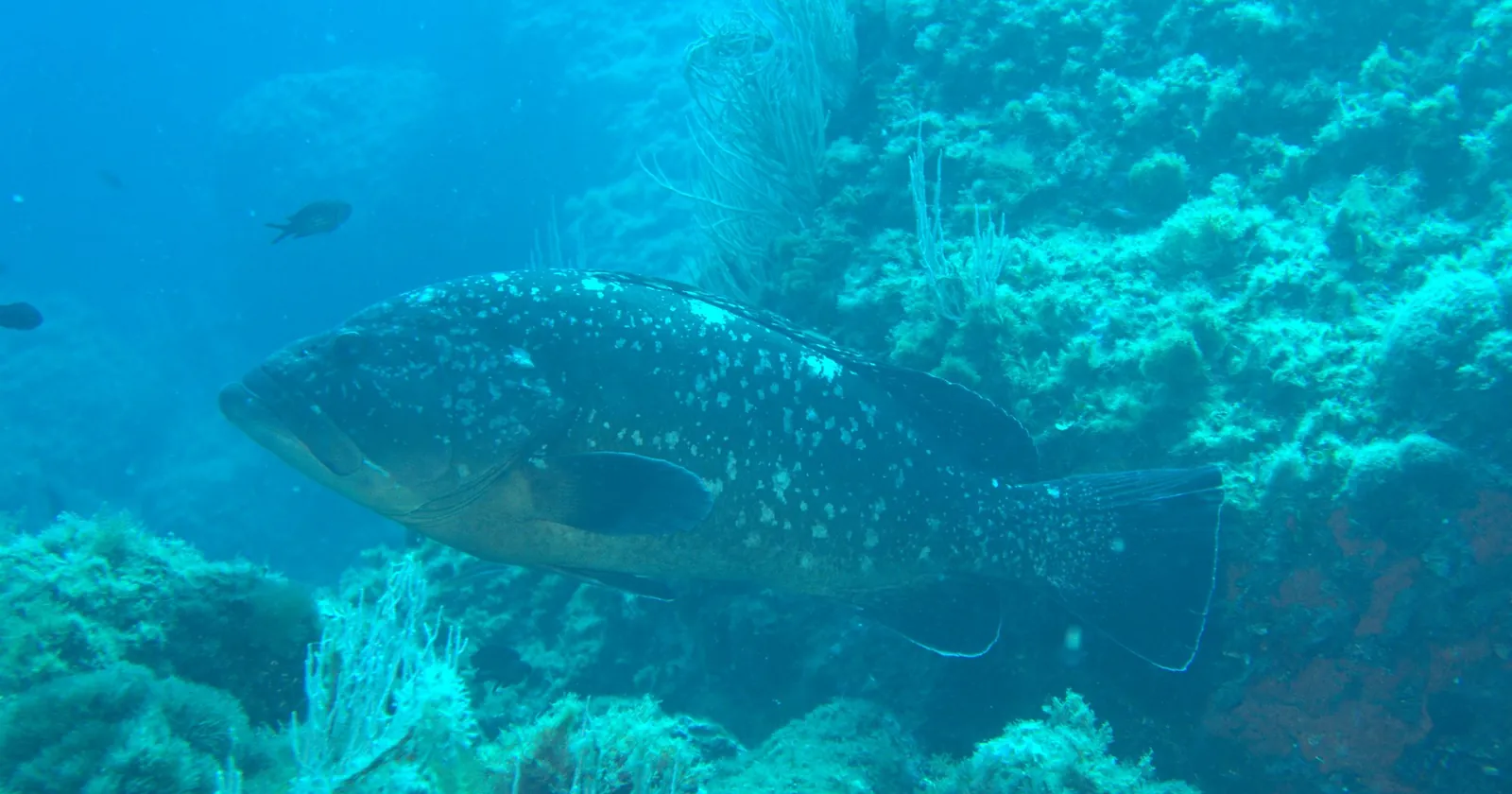
A dusky grouper at Tascó Petit in the Medes Islands reserve, Costa Brava. Jouni Kuisma, DiveCodex, Wikimedia Commons, CC BY-SA 4.0, cropped.

Key takeaways
- Royal Decree 550/2020 caps recreational scuba at 40 meters on air or nitrox with no planned decompression, and requires accident and civil-liability insurance for every recreational diver
- Since 31 December 2025 each try-dive participant must be accompanied by an instructor supervising no other student, and try dives are banned at night and in bad weather
- The agriculture ministry runs a network of marine reserves of fishing interest where scuba needs prior authorisation; at Cabo de Palos-Islas Hormigas the quota is 25 dives a day in the outer waters in July and August
- In the Balearics a September 2026 decree deleted the rule that dive centres guarantee a hyperbaric chamber within two hours; the Canary decree of 2006 still contains it
- Spearfishing on scuba is banned: national rules for outer waters allow only breath-hold spearfishing, and Catalan law fines it as a serious offence of €151 to €30,000
Spain diving: three regions, one national decree
Spain is a country of regional dive rules. The state sets the safety baseline for every dive in Spanish waters, and the autonomous communities regulate dive centres, fishing and their own reserves on top. So a dive off the Costa Brava, off Mallorca and off Tenerife follows the same depth and insurance rules, but a different authority licenses the dive centre and may cap the site. Each region links to our detailed guides, and the second half covers what applies everywhere: the national decree, the state marine reserves, spearfishing, water temperature, chambers and staying longer.
The choice between them matters: the Mediterranean coast and the Balearics are cold in winter and warm in late summer, while the Canaries sit in the Atlantic off Africa and stay within a few degrees of 20 °C all year.
Catalonia: the Medes, Cap de Creus and Barcelona
The Medes Islands off L'Estartit are the reason most divers come to the Costa Brava, and they are capped. Royal Decree 1005/2017 replaced the old limit of 446 daily scuba licences with an annual maximum of 74,876 scuba dives, split between the dive zones. Our Costa Brava diving guide covers the sites and the Generalitat authorisation a centre needs to take you into the strictly protected zone, and the Costa Brava operator list has the centres.
Further north, Roses dives the Cap de Creus natural park, which rewrote its diving rules in 2025; our Roses diving guide explains what the park allows and how the tramuntana wind decides which side of the cape you dive. South of the Medes, Barcelona diving is a city base with shore and boat dives along the Maresme and the Garraf, a hyperbaric unit nearby and the Medes as a day trip.
The Balearic Islands: Mallorca, Menorca and Ibiza
The Balearic government runs its own network of marine reserves, and diving inside them runs on authorisations, usually held by your dive centre. Our Mallorca diving guide covers the reserve paperwork, the dive limits around El Toro and the separate permit for the Cabrera national park. The Menorca diving guide covers the north-coast reserve, its daily caps and its ban on cave dives, plus the caves and wrecks outside it, and the Ibiza diving guide covers the island's four reserves, the Formentera channel and the Don Pedro wreck. For living on the islands, see Palma for sailors.
One Balearic law reaches every dive boat: Decree 25/2018 bans anchoring on Posidonia seagrass as a general rule and allows mooring over a meadow only on authorised low-impact buoys. The decree defines the repeated anchoring of dive companies as "professional anchorage", lists pulling up bundles of Posidonia while diving among the acts that damage the habitat, and notes that the Balearics hold half of all the Posidonia meadow inventoried in Spain.
The Canary Islands: Tenerife, Gran Canaria and Lanzarote
The Canaries are the year-round option. Tenerife diving centres mostly work the south and west coasts, under resident pilot whales, with two wrecks and the cetacean distance rules that come with them. Gran Canaria diving centres on El Cabrón at Arinaga, which our guide shows is a Natura 2000 site rather than a marine reserve. Lanzarote diving means walk-in shore diving at Puerto del Carmen, the Museo Atlántico and the La Graciosa reserve in the north.
To pick an island, our comparisons set them side by side: Gran Canaria vs Tenerife, Lanzarote vs Tenerife, Tenerife vs Fuerteventura and Fuerteventura vs Lanzarote. For a longer stay, see Tenerife for nomads who dive, Lanzarote for surf and wind and Fuerteventura, which we cover for surf and wind rather than diving.
Spain's national dive rules: what Royal Decree 550/2020 asks of you
Royal Decree 550/2020 sets the safety conditions for diving in all maritime waters where Spain has sovereignty or jurisdiction, so it applies on the Costa Brava, in the Balearics and in the Canaries alike. It was last amended by Royal Decree 1188/2025, in force since 31 December 2025. These are the rules a visiting diver meets.
Depth and gas. Recreational scuba is limited to 40 meters, on air or nitrox only, with direct access to the surface and the buddy pair as the minimum unit. Planned decompression stops are not allowed, nor are dives into caves, grottoes or wrecks where the light is lost and the penetration runs past 30 meters. If an emergency forces a decompression stop, it follows your computer or tables and may not exceed ten minutes in total. Diving beyond the depth and gas limits is open only to adults over 18 with the extra equipment the decree lists.
Insurance and health. Every recreational diver must hold accident and civil-liability insurance that can cover any incident during the dive; our guide to dive insurance for nomads explains what to check. For every recreational dive, try dives included, the centre must ask you to sign the health questionnaire in the decree's annex. If your answers show a condition that could affect your safety, you may only dive with a medical exam passed within the year. The two-yearly medical in the same article is for competitive and scientific divers, not recreational ones.
Try dives and children. Since 31 December 2025, each try-dive participant must be accompanied individually by an instructor who supervises no other student at the same time. Try dives are banned in dangerous settings, in bad weather and at night. Children may dive from 8, with depth tied to age: 6 meters at 8 to 9, 12 meters at 10 to 11, 21 meters at 12 to 15 and 40 meters from 16. Minors breathe air only.
On the surface. A surface marker buoy is compulsory when you dive without a boat or in an unmarked area, and every vessel other than the support boat must keep at least 50 meters from the dive zone. No support boat is needed within 200 meters of a beach or 50 meters of the rest of the coast, and any boat taking part flies the international "Alfa" flag. The 2025 amendment also states that Spain recognises qualifications that meet international safety standards and are certified by recognised international and European bodies.
What each region adds: Catalonia, the Balearics and the Canaries
Catalonia. Catalan fishing and maritime law, Llei 2/2010, treats dive centres as maritime-activity centres: opening one requires prior notification to the Generalitat, and centres go on a Catalan register. The same law lists spearfishing with scuba or any other breathing system among its serious offences, which carry fines of €151 to €30,000.
The Balearics. The Balearic diving decree, Decree 14/2014, was rewritten by Decree 30/2026, published on 1 September 2026, to follow the national decree. It still lists what a recreational diver must have, including a certification, the health declaration or medical certificate under the national rules, a dive log, and accident insurance that covers treatment in a hyperbaric medicine centre as well as liability to third parties. Without a log, a centre lets you do only what it judges you capable of. The 2026 decree also deleted the article that made centres guarantee an operational hyperbaric centre within two hours of the dive site. The application form for a centre's authorisation, valid until 31 December each year, still asks for information on the nearest hyperbaric centre.
The Canaries. Recreational dive centres need an authorisation from the island's Cabildo under Decree 35/2006. The decree requires an emergency plan that guarantees a decompression chamber within two hours of the dive site, and support boats with radio contact to the Canary 1-1-2 emergency centre. Written in 2006, it also tells centres to check that customers hold an official medical certificate of fitness. We could not confirm whether centres still ask for one now that the national decree uses a questionnaire, so ask your centre before you travel.
Spain's marine reserves of fishing interest: permits and daily quotas
Alongside the regional reserves, the agriculture ministry (MAPA) manages a network of marine reserves of fishing interest, created to let fish stocks recover. Its list names twelve: Cabo de Gata-Níjar, Cabo de Palos-Islas Hormigas, Cabo Tiñoso, Isla de Alborán, Isla de La Palma, Isla de Tabarca, Isla Dragonera, Isla Graciosa, Islas Columbretes, La Restinga, Levante de Mallorca-Cala Rajada and Masía Blanca. Several are managed jointly with a regional government, with the state in charge of outer waters and the region of inner ones. Scuba in them needs prior authorisation, and some set daily quotas.
Cabo de Palos-Islas Hormigas, off Murcia, shows how tight that can be. The ministry's table allows 25 dives a day in the reserve's outer waters in July and August and 13 in June and September, with at most three boats a day carrying 12 divers each. The inner waters allow 75 dives a day in July and August and 37 in the shoulder months, from up to nine boats. Public holidays and the Easter weekend take the high-season quota. The reserve covers 1,931 hectares, and the ministry notes seabed past 50 meters around the Hormigas islets, deeper than Spanish law lets a recreational diver go.
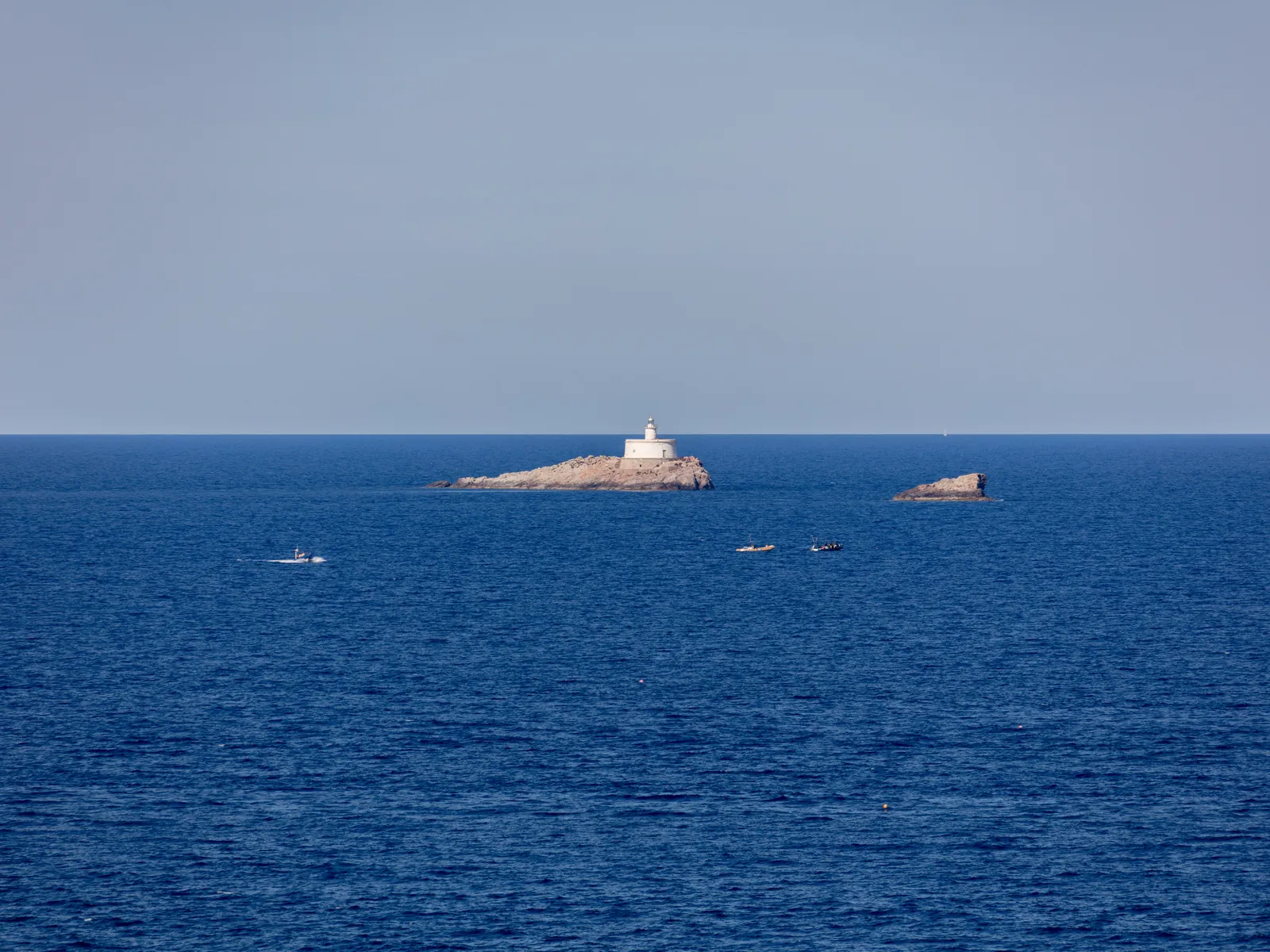
The Hormigas islets off Cabo de Palos, Murcia, a state marine reserve. Diego Delso, Wikimedia Commons, CC BY-SA 4.0, cropped.

Regions we do not cover yet: Murcia, Valencia, Andalusia, El Hierro and the north
We have no guide yet for these coasts, so here is what the ministry's reserve pages say. In Murcia, besides Cabo de Palos, the Cabo Tiñoso reserve near Cartagena, declared in 2016 and 2017, allows scuba by prior authorisation in some zones and bans it in others. Off Valencia, the Columbretes lie about 30 nautical miles off Castellón; dives must start from the reserve's buoys, stay outside the integral reserves and fit seasonal and daily quotas. Off Alicante, Tabarca allows scuba by prior authorisation, with boats on designated buoys and quotas per zone, such as 10 dives and three boats at La Nao.
In Andalusia, the Cabo de Gata-Níjar reserve in Almería allows scuba in its outer waters, outside the integral reserve, with an authorisation from the government sub-delegation in Almería. In the Canaries, the La Restinga reserve off El Hierro allows scuba outside its integral reserve only from a support boat at the marked points, with an authorisation from the ministry for outer waters and from the Canary fisheries office for inner ones. We do not cover Galicia or the Cantabrian coast, where the water is much colder.
Spearfishing, Posidonia and taking sea life
Spearfishing on scuba is not allowed in the rules we checked. The national rules for recreational fishing in outer waters, Royal Decree 347/2011, define spearfishing as breath-hold only, with no breathing equipment or propulsion. It needs a licence from a coastal region, is banned from sunset to sunrise, and is banned whenever a boat carries spearfishing gear and breathing equipment at the same time. In Catalonia the regional law makes scuba spearfishing a serious offence, as above. The simplest rule on a scuba dive anywhere in Spain is to take nothing. In the Balearics, keep your fins off the Posidonia and expect your boat to tie up to a buoy rather than drop anchor.
Sea temperature in Spain by region
The Mediterranean coast runs from cold winters to warm late summers, while the Canaries change little. These are NOAA's satellite averages for 1991 to 2020, for one ocean cell per region:
| Region (NOAA grid cell) | February | May | August | November |
|---|---|---|---|---|
| Costa Brava, off L'Estartit (42.1°N 3.4°E) | 12.8 °C | 15.9 °C | 22.5 °C | 16.3 °C |
| Mallorca, south coast (39.4°N 2.6°E) | 14.2 °C | 18.2 °C | 26.2 °C | 19.2 °C |
| Murcia, Cabo de Palos (37.6°N 0.6°W) | 14.4 °C | 18.3 °C | 25.9 °C | 18.9 °C |
| Lanzarote, south-east (28.9°N 13.6°W) | 18.3 °C | 19.5 °C | 22.3 °C | 21.4 °C |
| Tenerife, south-west (28.1°N 16.9°W) | 19.3 °C | 20.3 °C | 23.2 °C | 22.4 °C |
| El Hierro, La Restinga (27.6°N 17.9°W) | 19.5 °C | 20.7 °C | 23.4 °C | 22.7 °C |
On the Mediterranean side February is the coldest month and August the warmest. In the Canaries the coldest water comes in February and March and the warmest in September, at 22.9 °C off Lanzarote and 24.1 °C off El Hierro, so the eastern islands run about a degree cooler than the western ones. A cell off the Cabo de Gata coast averages 24.6 °C in August, and one off Galicia's Rías Baixas only 17.1 °C. These are long-term surface values; our island comparisons use recent years, which ran warmer, and the water at 30 meters is colder than the surface.
Hyperbaric chambers and emergency numbers in Spain
Spain's emergency number is 112, the single European emergency number. Use it for any diving accident, and ask your centre where its emergency plan would send you.
In Catalonia, the public Consorci Sanitari Integral says it took over the hyperbaric medicine service at the Hospital de Sant Joan Despí itself from October 2024, with renewed equipment. SSIBE, which runs the Hospital de Palamós on the Costa Brava, lists hyperbaric medicine among its hospital services and counts hyperbaric chamber sessions there. Neither states whether its chamber is staffed around the clock. For the islands, our Menorca guide covers what we could and could not confirm about Balearic chambers, and our Tenerife guide the chamber that treats divers on that island. We couldn’t confirm which chambers serve Gran Canaria, Lanzarote or Murcia. Make sure your dive insurance pays for chamber treatment and an inter-island or mainland transfer.
Staying longer: Spain's telework visa
EU citizens need no visa. For others, Spain's international telework permit lets non-EU nationals who work remotely for companies outside Spain stay with a visa of up to a year, then a residence permit of up to three years. The Spanish consulate in Washington states the income bar as 200 percent of the minimum wage and lets freelancers take no more than 20 percent of their work from Spanish companies. The work relationship must have lasted at least three months. Our Spain digital nomad visa guide works through the 2026 figure and the paperwork.
How to choose between Spain's dive regions
Choose the Canaries if you want to dive in winter or base yourself for months, with water at about 18 to 19.5 °C in the coldest month and Tenerife, Gran Canaria and Lanzarote to choose from. Choose the Costa Brava if you want the Medes and Cap de Creus within reach of Barcelona, and book summer dives ahead because the Medes are capped. Choose the Balearics for warm late-summer water, seagrass and caves, and expect reserve dives to run through your centre's paperwork. Spain suits less well a diver who wants deep wrecks past 40 meters on a recreational card, warm water in the Mediterranean in winter, or a chamber confirmed as staffed around the clock.
FAQ: Spain diving
What is the maximum dive depth in Spain?
40 meters for recreational scuba, on air or nitrox only, with no planned decompression stops, under Royal Decree 550/2020. Diving beyond those depth and gas limits is open only to adults over 18 with the extra equipment the decree lists. Children have lower limits by age, from 6 meters at 8 to 9.
Do I need insurance to dive in Spain?
Yes. Royal Decree 550/2020 requires every recreational diver to hold accident and civil-liability insurance that can cover any incident during the dive. In the Balearics the regional decree adds that the accident cover must include treatment in a hyperbaric medicine centre.
Do I need a medical certificate to dive in Spain?
Not as a rule. A centre must ask you to sign a health questionnaire before any recreational dive, and you need a medical exam passed within the year only if your answers show a condition that could affect your safety. The Canary decree of 2006 still mentions an official medical certificate, so ask a Canary centre before you go.
Can you spearfish while scuba diving in Spain?
No. National rules for outer waters allow recreational spearfishing only on breath-hold, with a regional licence, never at night, and never when the boat carries spearfishing gear and breathing equipment together. Catalan law makes spearfishing with scuba a serious offence with fines of 151 to 30,000 euros.
Where is the water warmest for diving in Spain?
In late summer, the Balearics and Murcia: NOAA's 1991 to 2020 averages are about 26.2 °C off south Mallorca and 25.9 °C off Cabo de Palos in August. In winter the Canaries are warmest, at about 18.3 °C off Lanzarote and 19.5 °C off El Hierro in February, against 12.8 °C off the Costa Brava.
Note: Conditions, safety guidance and regulations change. Verify current information with official sources, including the dive operator, the park authority and the relevant government department, before you travel or dive.
Founder of NOMADREEF and a former digital nomad. This guide is sourced from the references below; conditions, prices and rules change, so verify current details, and follow qualified local guidance and safety briefings. About the author · LinkedIn ↗
Sources
- National dive rules (primary). Real Decreto 550/2020, consolidated text (BOE), articles 1, 3, 5, 7, 8, 9, 12 to 15, 18 and transitional provision 1, as amended by Real Decreto 1188/2025. Read 11 November 2026.
- Catalonia (primary). Llei 2/2010 de pesca i acció marítimes (BOE text), articles 114 to 116, 135 and 151; Real Decreto 1005/2017 on the Medes management plan (PDF). Read 11 November 2026.
- Balearic Islands (primary). BOIB: Decreto 14/2014 on recreational diving; Decreto 30/2026, final provision 2; Decreto 25/2018 on Posidonia oceanica, articles 2 and 7 and preamble. Read 11 November 2026.
- Canary Islands (primary, archived). Decreto 35/2006 on dive centres, BOC 86 of 5 May 2006, articles 4 to 6 (archived copy; the government site did not respond). Read 11 November 2026.
- Marine reserves (primary). Ministerio de Agricultura, Pesca y Alimentación, marine reserves of Spain and the characteristics pages for Cabo de Palos-Islas Hormigas, Cabo Tiñoso, Columbretes, Tabarca, Cabo de Gata-Níjar and La Restinga. Read 11 November 2026.
- Spearfishing (primary). Real Decreto 347/2011 on recreational fishing in outer waters, articles 3, 13, 14 and 16. Read 11 November 2026.
- Sea temperature. NOAA PSL, OISST v2.1 monthly long-term means 1991–2020, eight 0.25° grid cells, computed for this page (primary dataset, our calculation). Read 11 November 2026.
- Chambers and emergencies (primary). Consorci Sanitari Integral, hyperbaric medicine service (Catalan, 31 July 2024); SSIBE, 2022 environmental declaration (PDF) listing its services and activity indicators; Real Decreto 903/1997 on the 112 number (PDF). Read 11 November 2026.
- Staying and working (primary). Consulate General of Spain in Washington, telework visa. Read 11 November 2026.
- Left out. Salvamento Marítimo's own emergency number and radio channel, since its site refused our connection; whether any Spanish chamber is staffed around the clock; the chambers serving the Balearics, Gran Canaria, Lanzarote and Murcia at a source we could reach; whether Canary centres still ask for the 2006 medical certificate; daily quotas at Columbretes and La Restinga; the dive-centre rules of Valencia, Murcia, Andalusia and the northern regions; regional wind and storm normals; dive prices, which are on the island and city guides.