Menorca Diving: Two Marine Reserves with Daily Caps, the Pont d'en Gil Cave and Spain's Insurance Rule
 by Yannick Schroth
Nov 10, 2026
13 min read
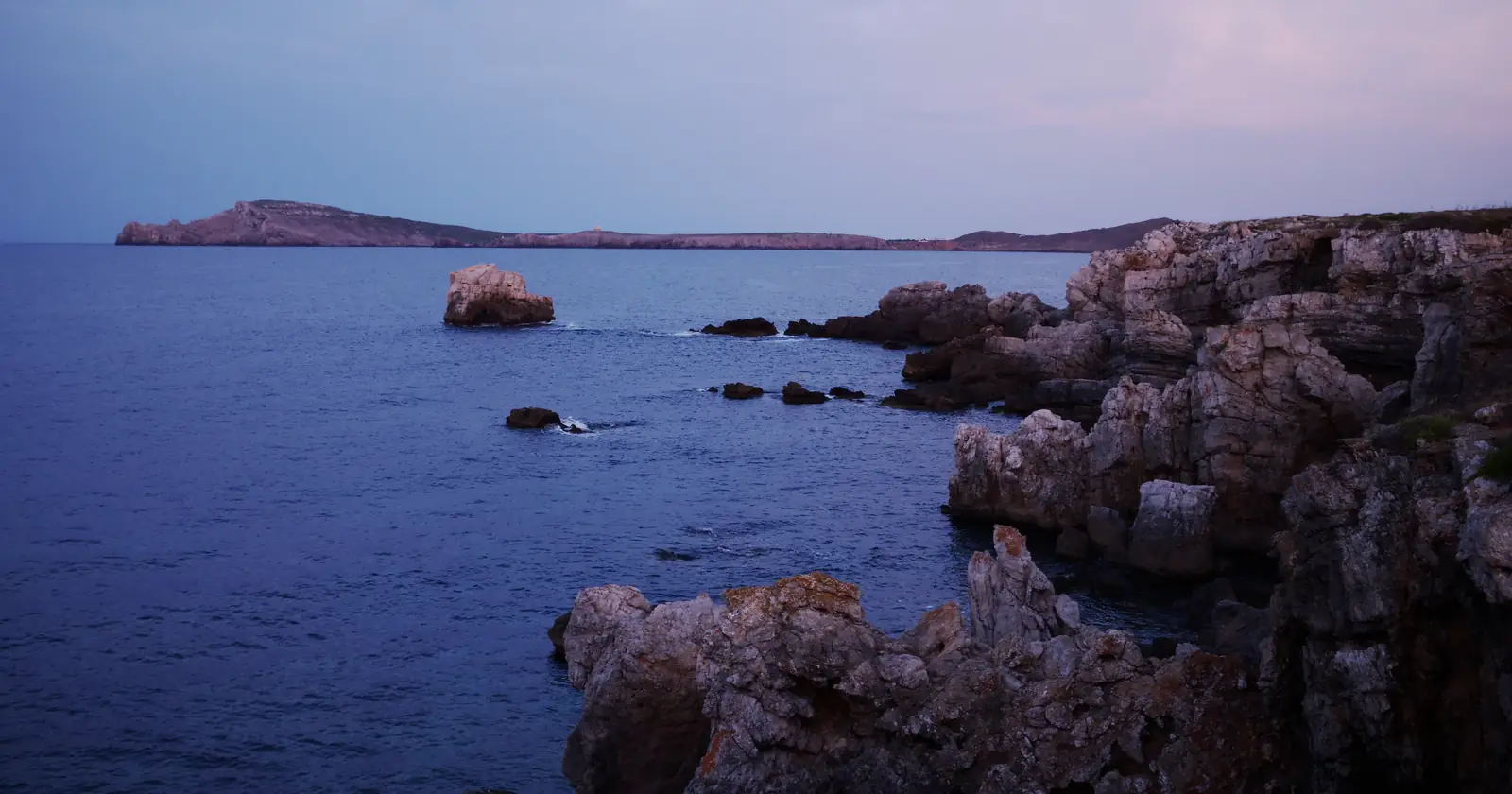
The coast at Cap de Cavalleria, in the Nord de Menorca marine reserve. Nicolas Vigier, Wikimedia Commons, CC0, cropped.

Key takeaways
- In the Nord de Menorca reserve, scuba needs a permit, individual ones last a day or 15 days, five sectors around Cap de Cavalleria take 50 dives a day each, and cave dives are banned
- Divers new to Balearic reserves who have not dived in three years or have fewer than ten dives must pass a skills test at 12 meters
- Spanish law makes accident and civil-liability insurance compulsory for every recreational diver and limits recreational diving to 40 meters on air or nitrox
- One Fornells centre opens from 1 April to 1 November, one in Maó all year; the sea averages about 13.8 °C in February and 25.8 °C in August
- Menorca had its own hospital chamber from 2010; we could not confirm it is still running, and Mallorca's Medisub centre works with the 112 and 061 emergency services
Menorca diving: the north coast reserve and everything else
Menorca's diving has two characters. The north coast between Cap Gros, Cap de Cavalleria and the Illa dels Porros is the Nord de Menorca marine reserve, 5,085 hectares managed by the Balearic government's fisheries directorate since 1999, with drop-offs past 30 meters close to the shore and about 1,000 hectares under special protection. The rest of the island, the caves of the west coast near Ciutadella, the wrecks off the south and the south-east around the Illa de l'Aire, is dived on more ordinary terms. Where you base yourself decides which you get most of: Fornells for the reserve, Ciutadella or Cala'n Bosch for the caves, Maó for the east.
The Nord de Menorca reserve: permits, daily caps and no caves
Balearic decree 41/2015 requires a specific permit for scuba diving in any of the islands' marine reserves. Dive centres and clubs hold collective permits for a day or a calendar year and cover their customers; Diving Menorca in Fornells lists the reserve fees as included in its prices. A private diver needs a personal permit valid for one day or fifteen, and to get one must show a valid certification, accident and liability insurance and a commitment to the government's responsible-diving criteria. Freediving and snorkelling need no permit, and divers must report their dives.
The busiest part is capped. Around the Cap de Cavalleria peninsula the reserve is divided into five sectors, each allowed at most 50 dives a day, except the Sanitja sector, which takes two a day with prior approval because of archaeological sites at risk of looting; wardens spread the visits. The rest of the reserve has no daily cap. Since June 2026, group dives around Cap de Cavalleria and the Tirant islet use six fixed buoys, at the Illa des Porros, the Llosa del Patró Pere and the Tirant islet, reserved for authorized centres and in place from April to October. The order behind them counts 16,121 dives by authorized centres in Menorca's reserves in 2024.
The reserve's rules are strict on behaviour: no diving inside underwater caves, no fishing gear on divers or their boats except a safety knife, and no handling or feeding animals. A diver diving a Balearic reserve for the first time who has not dived in three years or has fewer than ten dives must pass a basic skills test at a maximum of 12 meters, and failing mask clearing or neutral buoyancy means no reserve dives. Group dives must have a guide qualified to at least the ISO dive leader level.
Diving Menorca gives the depths of its reserve sites: the Llosa del Patró Pere to 28 meters, the Illa des Porros to 30 on the north side and through a large tunnel to 25 on the south, the lighthouse wall under Cap de Cavalleria to 25, the Tirant islet to 18 for easy dives, and Punta d'en Baptiste to 33, where it says you see lobsters and red coral at a reachable depth. Its cave dives, the Cueva de los Ingleses and the Coves d'es Llamp, are on its list of sites outside the reserve.
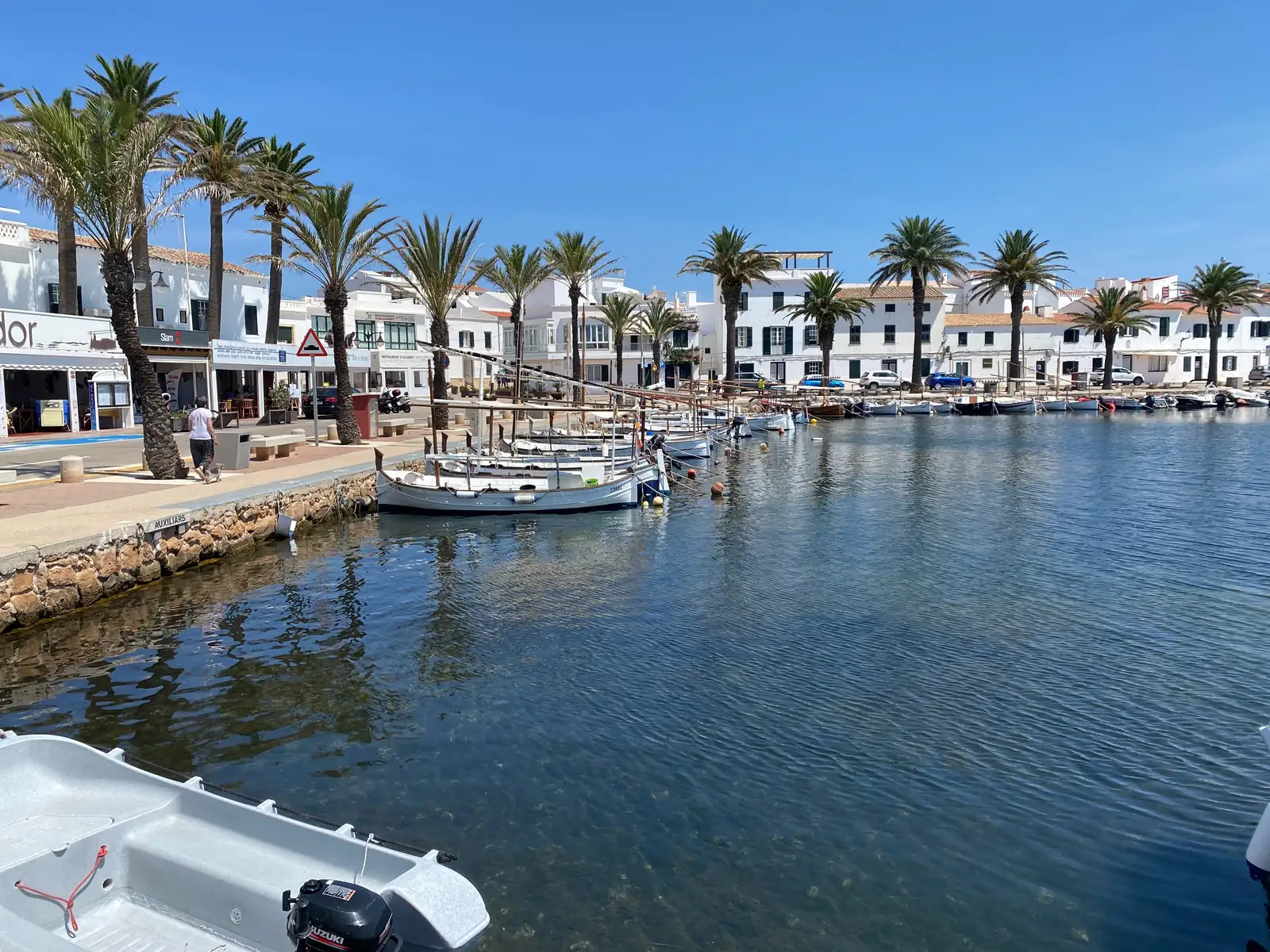
The harbour at Fornells, the nearest town to the reserve's dive sites. Josep Renalias, Wikimedia Commons, CC BY-SA 4.0, resized.

The Illa de l'Aire reserve: no cave diving, two buoys
Off the island's south-east tip, the Illa de l'Aire is a 45-hectare islet about 1,500 meters off the coast whose limestone caves made it popular with divers; the 2019 decree that made it a marine reserve estimated about 2,000 dives a year before protection. It bans recreational diving in its caves, bans scuba altogether in an inner area, and since June 2026 limits boats to 10 knots, bans jet skis and puts group dives on two buoys, at the Cagaires islet and Cap de Llebeig. The seabed around the island is also protected as an archaeological zone with fifteen underwater sites, wrecks and anchors. Merak Diving describes the south side as the shelter when the tramontana blows.
Pont d'en Gil and the Malakoff: Menorca's best-known dives
Outside the reserves, the dive most visitors ask for is the Pont d'en Gil cave north of Ciutadella. Bluewater Menorca describes a cave running more than 200 meters inland with two large chambers of breathable air and a halocline where fresh water meets the sea; the main entrance descends to about 12 meters and most of the route after the first 40 meters stays shallower than six. Dive Inn Menorca takes Open Water divers in small groups, always with two guides, and charges a €15 supplement with a torch included. Figures of 30 to 38 meters for this cave circulate on booking sites; the two shops that dive it do not support them.
The Malakoff is a cargo ship of more than 100 meters that hit a shoal in fog off the south-west coast on 2 January 1929, according to Bluewater, and was later blown apart in salvage work. Three shops agree it lies at 38 to 40 meters off Es Talaier; Dive Inn recommends it for Advanced divers and charges €15 extra, and Merak calls it an expert dive an hour's boat ride from Maó. Off Son Bou, the Ocean Diver, a 23-meter vessel sunk as an artificial reef, lies at 25 to 28 meters. Merak also sells dives to a wartime Junkers Ju 88 bomber and the Santa Clara fishing wreck at 46 meters off S'Algar, deeper than Spanish rules allow recreational divers to go.
Spain's diving rules: insurance, 40 meters and the surface marker
Spain's recreational diving decree, Royal Decree 550/2020, applies on Menorca. It makes accident and civil-liability insurance compulsory for every recreational diver, so bring proof or buy it at the centre; Diving Menorca sells cover from €8 a day to €40 a year, and Merak is a DAN partner and arranges it on the spot. Centres ask for a signed health questionnaire, and a medical exam only if the answers show a relevant condition. Recreational diving stops at 40 meters on air or nitrox, with no planned decompression stops. A surface marker is compulsory when diving without a boat or in an unmarked zone, other boats must keep 50 meters from a dive zone, and dive boats fly the Alfa flag.
Anchoring on Posidonia seagrass is banned across the Balearics under decree 25/2018, which names dive businesses among the boats that must use low-impact moorings, and counts pulling up Posidonia while diving among acts that can cause significant damage. Spearfishing is banned in the Nord de Menorca and Illa de l'Aire reserves, and boats there may not carry spearguns.
When to dive Menorca: April to October, or all year in Maó
Diving Menorca in Fornells opens from 1 April to 1 November; Merak Diving in Maó says it opens all year. NOAA's satellite averages for 1991 to 2020 put the sea at about 13.7 to 13.9 °C in February, 17.7 to 17.9 in May, 25.7 to 25.9 in August and about 22 in October, slightly warmer off Ciutadella than off Fornells. Those are surface figures, and the water at 25 or 30 meters in summer is colder.
Wind is the other limit. Spain's weather agency AEMET gives Menorca airport a normal of nine to ten days of strong wind a month in December and January, eight in April and four in July; in December that is twice the normal at Palma. The north coast takes the tramontana head on, which is why shops keep sheltered south and west sites in reserve.
Menorca's chamber: open question
Menorca's public health service contracted a hyperbaric chamber at the Hospital Mateu Orfila in Maó in 2010, accepted it as a donation in 2017 and tendered a one-year service for it in 2018. We found nothing since that confirms it still runs or who staffs it. In Mallorca, Medisub runs the hyperbaric centre at Clínica Juaneda in Palma and says it works with the 061 and 112 emergency services on diving accidents. A 2026 change to the Balearic diving decree, as republished by Spain's public administration institute, removed the rule that centres guarantee a chamber within two hours. Ask your centre where it would send you, call 112 in an emergency, and check that your dive insurance covers a transfer to Mallorca.
What a dive costs on Menorca
Prices for a single dive on the centres' own pages, read on 10 November 2026:
| Dive centre | With equipment | Tank and weights only |
|---|---|---|
| Diving Menorca, Fornells | €65 | €48 |
| Merak Diving, Maó | €65 | €52 |
| Dive Inn Menorca, Ciutadella | €55 | €45, plus €15 for the Malakoff or Pont d'en Gil |
For a long stay, Diving Menorca and Merak both drop to €53 with equipment or €39 without from ten dives, and Bluewater Menorca charges €42 a dive in a pack of ten, equipment extra.
Getting to Menorca and around it
Menorca's airport is busy in summer and quiet in winter: Aena counted 765,701 passengers in August 2026, most of them international, and 84,119 in February, of whom only 2,171 flew international routes. From 1 November to 31 March the Madrid route is a public service obligation with at least three daily round trips. Ferries run from Barcelona, Valencia, Palma, Alcúdia and Ibiza to Maó and from Alcúdia to Ciutadella, according to Trasmed's route list. On the island, the L01 bus links Maó and Ciutadella in an hour for €5.75 and an express in 45 minutes, but the Fornells line's winter timetable has no Sunday service, and Diving Menorca tells visitors that renting a car is essential.
Menorca as a remote-work base
Spain's telework permit, created in 2022, lets non-EU nationals working for companies outside Spain stay with a visa of up to a year and then a residence permit of up to three years, renewable for two; freelancers may earn up to 20% from Spanish clients. The employer must have existed for a year and the work relationship for three months, and applicants need private health insurance from an insurer authorized in Spain, not travel insurance. The income bar is 200% of Spain's minimum wage, which for 2026 is €17,094 a year; by our arithmetic that is €34,188 a year, but the immigration office's own figure was not readable, so confirm it before you apply. Everyone else has the Schengen 90 days in 180.
Spain had fibre to 95.9% of homes in mid-2025, by the telecommunications ministry's count; we found no figure for Menorca alone. WanderHub in Ciutadella offers members 24-hour access, a day pass for €30 and a fixed desk for €240 a month.
Who Menorca suits
Menorca suits a diver who likes rules that protect what they dive: capped, guided reserve dives on the north coast, caves and air chambers on the west, and a deep wreck in the south. It suits a remote worker with a car and a quiet winter, or a summer stay with a broader choice of shops. It suits less well anyone who wants cave diving inside the reserves, which is banned, deep wrecks past 40 meters on a recreational card, or a confirmed chamber on the island.
Nine dive centres on our Menorca list
Our Menorca operator list holds 9 dive centres, all published by SSI in its register of affiliated centres, read on 9 November 2026: four around Ciutadella, Cala Blanca and Son Xoriguer in the west, two in Fornells, one in Es Mercadal, one in Maó and one filed only under the Balearic Islands. Diving Menorca, Merak and Bluewater, quoted above, are on it; Dive Inn is not, because it is in no register we can cite entry by entry. A register entry says a training body lists a centre; it does not say the reserve has issued it a permit, which is what lets its boat dive the north coast.
FAQ: Menorca diving
Do you need a permit to dive in the Menorca marine reserve?
Yes, for scuba. Dive centres hold collective permits that cover their customers; a private diver needs a personal permit for one day or 15 days. Freediving and snorkelling need no permit. Five sectors around Cap de Cavalleria are capped at 50 dives a day each, and diving inside caves in the reserve is banned.
How deep is the Pont d'en Gil cave dive?
About 12 meters at the main entrance, and mostly shallower than six meters after the first 40, according to Bluewater Menorca. The cave runs more than 200 meters inland with two air chambers. Dive Inn Menorca takes Open Water divers there with two guides.
Is dive insurance mandatory in Spain?
Yes. Royal Decree 550/2020 requires every recreational diver to hold accident and civil-liability insurance. Menorca centres sell short-term cover; Diving Menorca charges from €8 a day.
When is the best time to dive Menorca?
From about May to October, when the sea is above 17 °C and centres are open. Diving Menorca in Fornells runs from 1 April to 1 November, and Merak Diving in Maó opens all year. Winter brings more strong-wind days, about nine to ten a month in December and January at the airport.
Is there a hyperbaric chamber on Menorca?
Hospital Mateu Orfila in Maó had one under a public contract from 2010, but we found nothing since 2018 confirming it still runs. In Mallorca, Medisub at Clínica Juaneda in Palma treats diving accidents with the 061 and 112 emergency services. Ask your centre for its plan.
Note: Conditions, safety guidance and regulations change. Verify current information with official sources, including the dive operator, the park authority and the relevant government department, before you travel or dive.
Founder of NOMADREEF and a former digital nomad. This guide is sourced from the references below; conditions, prices and rules change, so verify current details, and follow qualified local guidance and safety briefings. About the author · LinkedIn ↗
Sources
- Nord de Menorca reserve (primary). Govern de les Illes Balears, reserve pages on legal basis, description and rules; Decreto 41/2015 (PDF), article 9; resolution of 27 November 2017, BOIB 147 (PDF); Orden 21/2022 (PDF); Orden 11/2026 (PDF). Read 10 November 2026.
- Illa de l'Aire and Posidonia (primary). Decreto 26/2019 (PDF); Orden 11/2026, as above; Decreto 25/2018 on Posidonia, articles 2, 7 and 8. Read 10 November 2026.
- Dive sites (each centre primary for itself). Bluewater Menorca on Pont d'en Gil, the Malakoff and the Ocean Diver; Dive Inn Menorca, dives; Merak Diving, dives; Diving Menorca, dives. The Malakoff's depth triangulated across three centres. Read 10 November 2026.
- Spanish diving rules (primary). Real Decreto 550/2020, consolidated (PDF), articles 8, 14, 15 and 18. Balearic Decreto 14/2014 and its 2026 amendment as republished by INAP, which we could not check against the official bulletin. Read 10 November 2026.
- Season and wind. Diving Menorca, contact and Merak Diving (operators); NOAA PSL, OISST v2.1 monthly long-term means 1991–2020, two grid cells, read for this page; AEMET monthly Balearic climate bulletins for January 2026, April 2026, July 2025 and December 2025 (primary). Read 10 November 2026.
- Chambers (primary). BOIB 117 of 23 September 2017 (PDF) on the Mateu Orfila chamber; BOE tender notice of 22 March 2018 (PDF); Juaneda, Medisub. Read 10 November 2026.
- Prices (each centre primary for itself). Diving Menorca, Merak Diving, Dive Inn Menorca, Bluewater Menorca. Read 10 November 2026.
- Getting there (primary). Aena, Menorca airport statistics for February 2026 and August 2026; Orden TRM/10/2026 (PDF); Trasmed routes; TMSA lines L01 and L14; Autos Fornells timetable. Read 10 November 2026.
- Staying and working. Ley 14/2013, consolidated (PDF), articles 74 bis to quinquies (primary); Spanish consulate in Santiago de Chile, telework visa requirements (PDF) (primary); Real Decreto 126/2026 on the minimum wage (primary); broadband coverage report 2025 (PDF) (primary); WanderHub (operator). Read 10 November 2026.
- The nine listings. Nine entries on the Menorca operator list, from the SSI register, read 9 November 2026.
- Left out. The reserve permit fees, which appear only in search snippets of pages we could not open; the current status of the Mateu Orfila chamber; how many buoy slots a day the 2026 order will allow; the immigration office's own 2026 income figure; and a Maó coworking space confirmed open all year.