Roses Diving: Cap de Creus Park Rules, the Tramuntana and Which Sites to Book
 by Yannick Schroth
Nov 4, 2026
15 min read
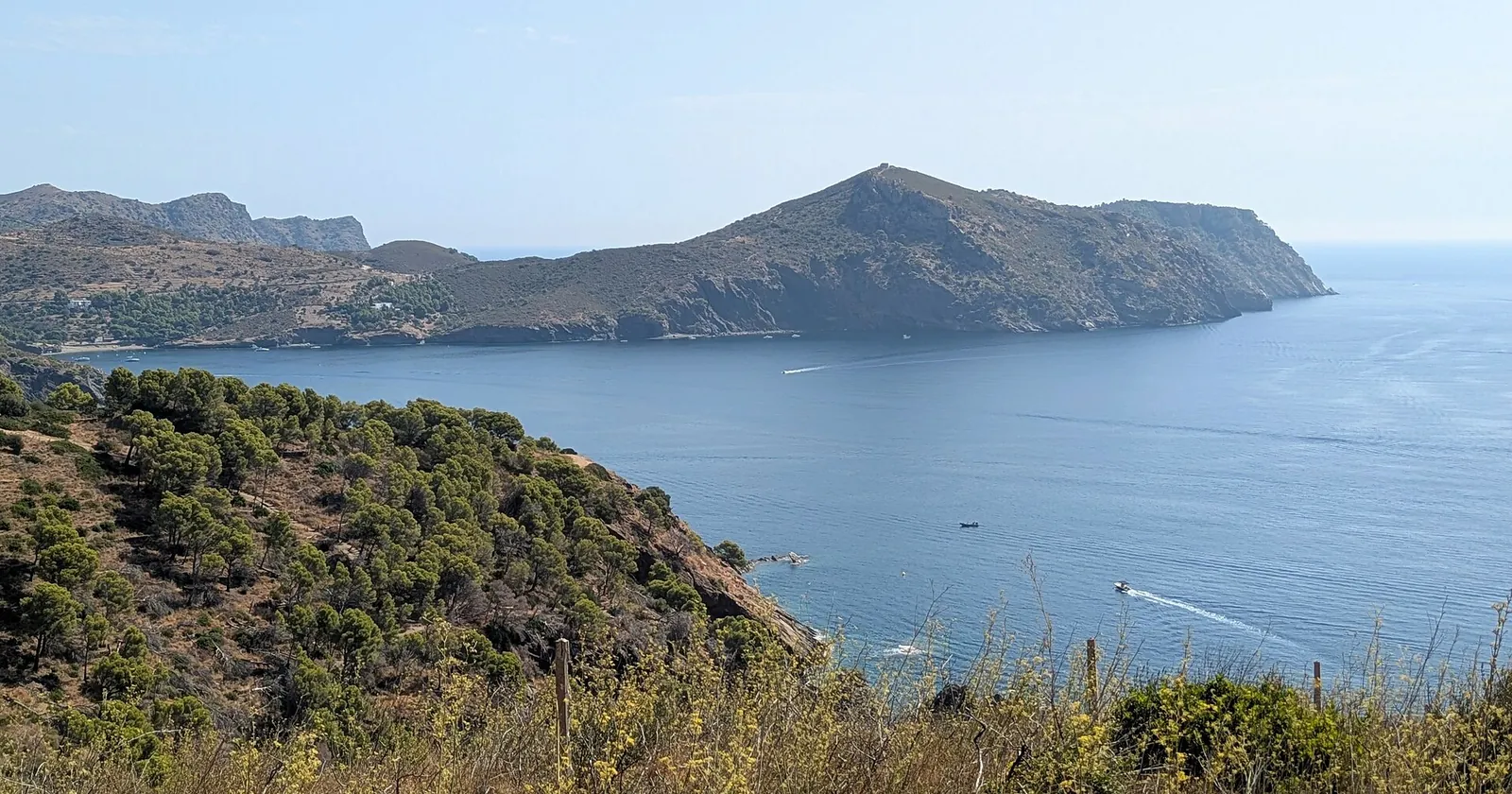
Cap Norfeu from the coast path, with boats in the bay. Photo: Alan Mattingly, Wikimedia Commons, CC0 1.0, cropped.

Key takeaways
- Order TER/130/2025 has governed Cap de Creus diving since 14 August 2025: 15 daily centers, 8 occasional ones, two boats each at most
- Intro courses, first-level courses and scuba try dives are not allowed in the no-fishing sectors, so ask a course provider where the training dives happen
- Most park buoys come out for winter. The park lists 7 that stay, and a moored dive has to use a buoy, with a three-hour limit
- An observer's records put tramuntana days in the Alt Empordà at about 80 to 85 a year since 2015, felt hardest from mid-October to April
- Kite and windsurf stations sit at Sant Pere Pescador, about 20 km south by road, and five of the 12 businesses on our list are in L'Escala, not Roses
Roses diving means Cap de Creus, and the park rewrote its rules in 2025
The town beach is not the attraction. The diving starts past Punta Falconera, the southern limit of a marine park of about 3,000 hectares that runs north to Cala Tamariua at Port de la Selva. Catalonia created it in 1998 as its first park covering both land and sea.
For 27 years the sea side had no management plan. That ended with Order TER/130/2025 of 23 July, published in the official gazette (DOGC 9466) on 30 July and in force on 14 August 2025. It runs four years.
Our Costa Brava guide covers the Illes Medes, where the published limit is dives per day. Cap de Creus limits who may operate, how many boats they run, and what happens at which spot. So on Roses diving trips, the zone under the boat is the first question.
Three zones matter. The Parc Natural is the general regime. The partial reserves, Cap Gros-Cap de Creus and Cap Norfeu, add limits. Inside those sit the no-fishing sectors, mostly at the tip of the cape with a small piece at Norfeu, and they add one more.
What the Cap de Creus plan bans on a Roses dive
Diving is allowed across the park except in one place. The park's own guidance names the strict marine reserve north of S'Encalladora as closed to diving, snorkeling, swimming and navigation alike. The rest comes down to conditions:
| Rule, from the plan's norms | Where | Article |
|---|---|---|
| No handling, touching, removing or altering flora, fauna, archaeological remains or set fishing gear | Whole park | 12.3 |
| No freediving fins on scuba, defined as 80 cm or longer from back of heel to fin tip | Whole park | 12.4 |
| A dive from a mooring point must use a pictogram dive buoy, three hours at most | Whole park | 12.5 |
| No motorized dive devices such as scooters, except adapted diving, authorized science and park management | Partial reserves | 13.1 |
| Night dives, sunset to sunrise, only with a specific authorization for small-group wildlife watching, filming or research | Partial reserves | 13.2 |
| No intro courses, first-level courses or scuba try dives | No-fishing sectors | 13.4 |
Article 13.4 is the one that changes a booking. Its wording is “no es permet fer cursos d'iniciació, primer nivell o bateigs amb escafandre autònom”. A first certification can still happen near Roses, just not inside those sectors. If a center promises Open Water dives at the cape, ask which buoy.
Article 13.2 rules out the casual night dive in a reserve, because sightseeing is not on its list of purposes.
Roses dive centers need a park authorization, and the ceiling is 23
Article 44 sets the numbers. Group A goes to the 15 best-scoring applicants, which may run dive activities daily. Group B goes to the 8 best in that group, limited to two activities a week and 20 outings a year. Each may use two boats, and the second may not exceed 9 meters.
Applications open from 1 to 30 November, every two years, for a two-year award. Until a decision takes effect, a transitional clause lets centers already working in the park carry on. So ask a center which group it holds, or whether it relies on that clause.
You will notice the rules from the boat. Article 15.5 requires the guide to give an ecobriefing before every dive, covering the reserve, the seabed, buoyancy, fin strikes and distance from sensitive reef. Authorized boats must also carry a GeoBlau tracker once the fisheries directorate has fitted it, and centers file monthly reports naming site, time and divers.
A center that skips the briefing is telling you something.
Diving Cap de Creus without a center: 6 dives a day per boat
Private diving remains legal. Article 14 asks two things. You notify the park manager before diving, with the planned dives, their location and the boat. And any private boat is capped across the whole park at 6 dives a day, 30 a week and 120 a year.
The catch is the paperwork. Article 43 routes the notice through a dedicated procedure on the Generalitat's e-government portal, and the park's guidance says it will add the direct link once that procedure is running. Until you can see the link, phone the park office at Vilajuïga on +34 972 19 31 91 and ask what it wants from you. It answers daily from 9:00.
Mooring is shared: dive activity has preference on dive buoys, and two boats may share one if one is 9 meters or shorter. Article 8.4 bars navigation in partial reserves from sunset to sunrise, with exceptions such as a direct transit or an authorized night dive.
The Roses dive sites worth the boat ride sit on park buoys
The plan lists 38 dive buoys, and the park and local centers built site sheets around them. They draw the seabed with depth marks and name the characteristic animals, which makes them the best planning tool for Roses diving. The southern group comes first: Punta de la Creu lies about 7 km from the harbor in a straight line, Ses Orgues about 12 km. Illa Galera and Els 3 Frares are on the north shore, past the cape.
| Site (zone) | Depth marks on the park sheet | Named on the sheet |
|---|---|---|
| Bau de la Ferrera (park) | 2 to 28 m | Seahorse, octopus, dentex, moray |
| Punta de la Creu (partial reserve) | 1 to 42 m | Dusky grouper, barracuda, amberjack, seahorse, sunfish |
| Cova Fumada (partial reserve) | 3 to 50 m | Red gorgonian Paramuricea clavata, grouper, conger, sunfish |
| Ses Orgues (partial reserve) | 6 to 40 m | Slipper lobster, electric ray, moray |
| S'Encalladora south (partial reserve) | 5 to 32 m | Stingray, grouper, brown meagre, barracuda |
| Illa Galera (park) | 6 to 40 m | Posidonia, triton, spiny lobster, conger |
| Els 3 Frares (partial reserve) | 10 to 30 m | Barracuda, grouper, red gorgonian, sunfish |
Those are seabed marks, not a dive plan. The park's guide map says coralligenous reef, the community of calcareous algae, red coral and gorgonians, starts at a depth of 20 meters, and that collecting red coral is banned throughout. The sheets carry a pictogram asking for 1.5 meters' distance from it.
Winter shrinks the map. Article 38.3 has seasonal buoys out by 31 October, and the park lists seven that stay: Punta del Traire, Cova Fumada, El Clot del Boc, Es Forcats Jugadora, Cala Guillosa, Illa Galera S and La Figuerola.
Wreck divers get little to go on. Buoy 26 is labeled El Portaló (el Woodside), and a user-edited dive-site list describes a cargo ship, the Saint Prosper, in the middle of the bay as a deep dive for experienced divers. Get the depth and the net warnings from the center before you commit.
The tramuntana decides which side of Cap de Creus you get
This is the wind that shapes the whole trip. The tramuntana blows from the north to northwest off the Pyrenees, and the park's own map credits a strong north wind with flattening the coastal scrub. Sergi Corral, a weather observer whose counts 3Cat reported in 2022, put it at about 110 to 115 days a year in the Alt Empordà until 2014, and about 80 to 85 days a year from 2015.
He places the strong season from mid-October to April. His count for summer 2022 was six days, and 33 from January to October.
The peninsula stands between Roses and a north wind, while the north shore around Illa Galera takes it from the open sea. One French dive-travel guide describes Montjoi and Jòncols as sheltered from the tramontane. So a tramuntana day from Roses can mean a southern site, or no boat, rather than the dive you booked.
Plan spare days. A long weekend is a gamble here.
Roses water temperature: 13°C in February and a hard drop near 30 meters
The best long record nearby comes from L'Estartit, about 24 km south of Roses, where Josep Pascual has logged sea temperature with the support of Barcelona's Institute of Marine Sciences. Its surface monthly means for 2025 were 13.9°C in January, 12.8 in February, 13.1 in March, 15.0 in April, 17.8 in May, 22.5 in June, 25.5 in July, 23.6 in August, 22.2 in September, 20.0 in October, 17.0 in November and 14.5 in December.
2025 averaged 18.2°C against 16.3°C in 1975, the comparison year on the same chart. Surface water on 1 November 2026 was 19.2°C.
The number that catches people out is below the surface. The same observer's profile off Cap de Creus on 23 September 2026 shows about 22°C down to roughly 20 meters, then a sharp fall to around 17.5°C by 32 meters, and about 15°C below 80 meters. A warm-looking autumn dive to Punta de la Creu's deeper rock can cross that line. Our travel wetsuit guide covers the layering.
A Roses diving accident goes to Palamós, about 70 km away
The nearest chamber in Catalonia is at the Hospital de Palamós. A September 2026 3Cat report calls it one of two in Catalonia, the other being at Hospital Moisès Broggi in Sant Joan Despí. It opened in 1994 for divers visiting the Medes, was renewed in 2010 and holds seven people. It treated 17 divers this summer up to August.
By road it is about 70 km from Roses, roughly 75 minutes by a routing engine's estimate. Call 112, the free EU emergency number, for any emergency. The hospital switchboard is +34 972 60 01 60.
Ask your center how a boat gets a casualty ashore from the far side of the cape. Check that your dive insurance pays for chamber treatment and transport before you rely on it.
The Montjoi barrier closes the road to Roses coves in high summer
The coves east of Roses hang off the Montjoi road, and in summer it has a checkpoint. From 1 July to 31 August 2026, between 9:30 and 16:00, cars may not pass a barrier at Mas de la Torre del Sastre. Two-wheeled motor vehicles still go through. So do cars taxed in Roses, property owners and renters, taxis, and customers of park activities showing proof of booking.
Keep your Roses diving booking on your phone. There is no dedicated public transport. If the Alfa fire plan reaches level 4 for the massif, only vehicles with a booking document get through.
The cape road from Cadaqués runs a similar scheme, with a €7 adult return shuttle and daily restrictions in July and August 2026. A 2025 park study estimated about 960,000 visits a year, 191,258 of them to the Roses coves. Just 0.7% of people surveyed came by public transport.
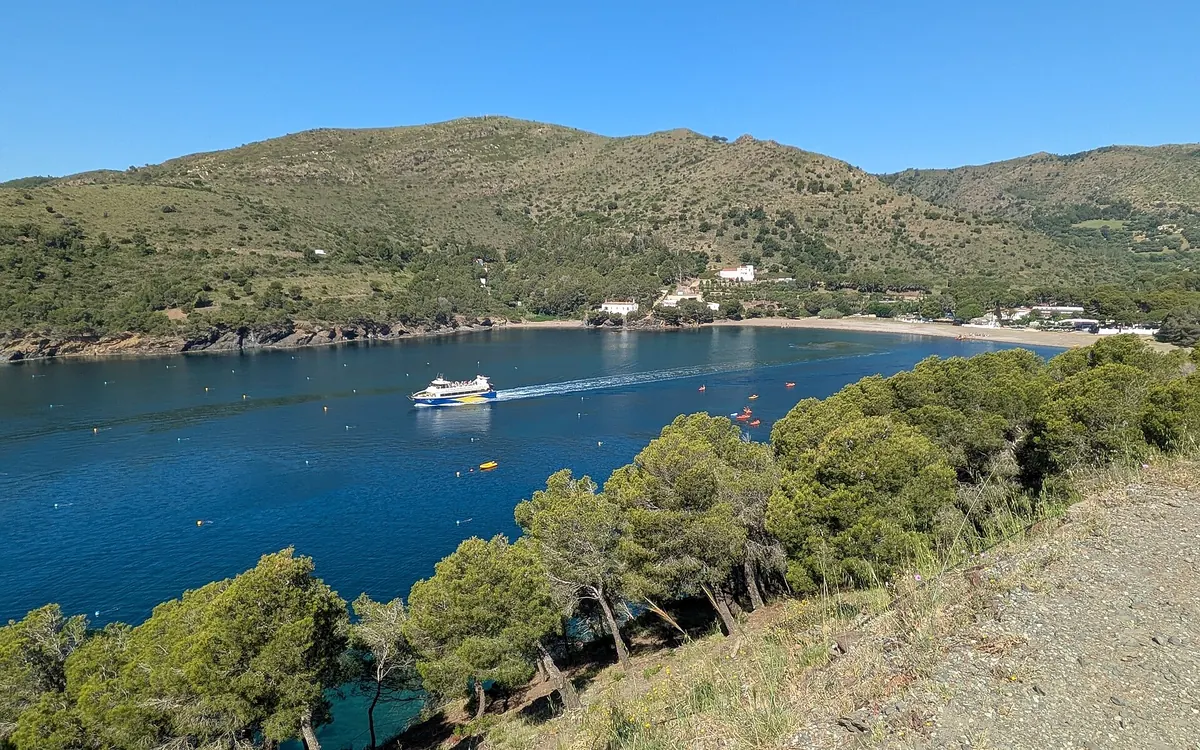

Kite and windsurf on the Gulf of Roses means Sant Pere Pescador
The wind sports on our list are not in Roses. They sit around the long beach at Sant Pere Pescador, about 20 km south by road, near the mouth of the Fluvià. The German magazine SURF calls it the fallback when tramontana overpowers the small sails further north, with at least 1 to 2 Beaufort less. Spring and summer afternoons bring a thermal from the south, which ION CLUB, an operator, puts at 20 to 25 knots.
ION's published 2026 season runs 28 March to 18 October, it splits kite and windsurf zones at peak season, and the campsite hosting it closes in the off-season. A Barcelona windsurfer's guide picks April to June. For other flat venues, see our flat-water kitesurfing list.
Flying to Roses: Girona is a summer airport, Barcelona works all year
Girona-Costa Brava is the close option, about 68 km by road, and its seasonality is stark. Aena counted 297,787 passengers in June 2026 and just over 40,000 in February, about a seventh of the June figure. It advertised 48 destinations in 15 countries for summer 2026, even after Ryanair, the main airline, cut its Girona schedule 11%.
Winter is thinner. Ryanair's 2024-25 winter schedule was 56 flights a week to nine destinations, and easyJet's new 2027 routes are announced as Liverpool from March to October and Gatwick from June. Check the current timetable before you plan a winter stay. Barcelona-El Prat, with about 3.9 million passengers even in February 2026, is about 169 km and a bit over two hours by car.
Rent a car for Roses diving. The Montjoi road has no dedicated public transport, and Figueres, the nearest inland town, is about 22 km away.
Roses as a remote-work base: fine in spring and autumn, thin in winter
Roses works better as a shoulder-season base. The warmest water and the road barriers arrive together in July and August, so May, June and late September are the useful gaps.
Winter gets quiet quickly. Grouper sightings logged at Punta de la Creu in SSI's app run 94 in August, 62 in July, then one each in November and December and none in January. That is a rough proxy for Roses diving activity, and it matches the airport figures above.
Check three things flat by flat before signing: fixed-line speed, whether the building is heated, and whether the owner wants you out by June. Treat a coworking desk as something to find on the ground. Non-EU readers should start with the Spain digital nomad visa rules, and anyone comparing Spanish dive bases can start with our Mallorca diving guide.
Roses diving disappoints anyone after warm water or wrecks
Thirteen degrees in February and a cold layer below 30 meters in September are ordinary here. A tight schedule is a risk too, since the tramuntana can take days from you. Wreck hunters should look elsewhere, because the protected rock is the draw.
First-timers can learn here, but the no-fishing sectors are off limits to their course. Divers who dislike rules will also struggle: no touching, no scooters in the reserves, no casual night dives there. Go for gorgonians and grouper near a town.
Roses dive centers and kite stations on our operator list
The Gulf of Roses operator list holds 12 businesses, read from the registers on 1 September 2026: 10 from SSI, 1 from IKO and 2 from VDWS, with one in two registers. Only 3 are filed under Roses: Cala Montjoi, JBS Divers, whose entry points to Cala Jòncols, and Poseidon. Five are filed under L'Escala, on the Montgrí side to the south, 3 under Sant Pere Pescador and 1 under Empuriabrava.
A listing does not show park authorization, so ask separately. Published prices read on 28 October 2026: Open Water at €500 plus a €40 license at Montjoi, €480 at Scuba Alegre. Which registers can be read explains each source.
FAQ: Roses diving and Cap de Creus
Do you need a permit for Roses diving in Cap de Creus?
With a center, the permit is the center's: Article 44 of the park plan limits authorizations to 15 daily and 8 occasional operators. Private divers must notify the park manager before diving under Article 14, and each private boat is capped at 6 dives a day, 30 a week and 120 a year.
Can you do a try dive or Open Water course in Cap de Creus?
Yes, but not everywhere. Article 13.4 of the plan bars intro courses, first-level courses and scuba try dives in the no-fishing sectors, which lie mostly at the tip of the cape with a small piece at Cap Norfeu. Ask the center which site its training dives use.
Where is the nearest decompression chamber to Roses?
In Catalonia, Hospital de Palamós, about 70 km by road from Roses. A September 2026 3Cat report calls it one of two chambers in Catalonia, the other at Hospital Moisès Broggi in Sant Joan Despí. It opened in 1994 for Medes divers and holds seven people. Call 112 in any emergency.
What is the water temperature for Roses diving?
The nearest long series, at L'Estartit about 24 km south, gave surface means of 12.8°C in February and 25.5°C in July 2025. A profile off Cap de Creus on 23 September 2026 showed about 22°C to roughly 20 meters, then around 17.5°C by 32 meters.
When is the best time for Roses diving with the tramuntana?
Late spring to early autumn. An observer's records reported by 3Cat place the strong tramuntana season from mid-October to April, at about 80 to 85 days a year since 2015. June and September pair warmer water with fewer of those days, though any day can still move your site.
Note: Conditions, safety guidance and regulations change. Verify current information with official sources, including the dive operator, the park authority and the relevant government department, before you travel or dive.
Founder of NOMADREEF and a former digital nomad. This guide is sourced from the references below; conditions, prices and rules change, so verify current details, and follow qualified local guidance and safety briefings. About the author · LinkedIn ↗
Sources
- The park plan (primary). Ordre TER/130/2025, de 23 de juliol, approving the Pla rector d'ús i gestió del Parc Natural de Cap de Creus, DOGC 9466, 30 July 2025: Articles 4 (four-year term), first final provision (in force after 15 days), transitional provision, sixth provision (GeoBlau); Annex 1 norms, Articles 8.4, 10, 11, 12, 13, 14, 15, 38.3, 43, 44, and the action programme's list of 38 dive buoys. Quotations and translations are from the Catalan text. dogc.gencat.cat. Read 4 November 2026.
- The park's guidance (primary). Parc Natural de Cap de Creus, "Activitats a mar", FAQ on the marine regulation: closure of the strict marine reserve at S'Encalladora, in-force date, the seven winter dive buoys, online procedures pending, office hours and phone. parcsnaturals.gencat.cat. Read 4 November 2026. This page says 39 summer dive buoys where the order lists 38 and the park's itinerary page says 38; 38 is used.
- Dive sites (primary). Parc Natural de Cap de Creus, "Itineraris marins", park size and limits, and the site sheets drawn with local centers: itinerary page, Bau de la Ferrera, Punta de la Creu, Cova Fumada, Ses Orgues, S'Encalladora, Illa Galera, Els 3 Frares. Read 4 November 2026. Straight-line distances from Roses are our calculation from the sheets' coordinates.
- Park map (primary). Parc Natural de Cap de Creus, Map guide, June 2025 (PDF): coralligenous reef from 20 m, red coral collection prohibited, strong north wind. Read 4 November 2026.
- Road access (primary). Parc Natural de Cap de Creus, access to the Roses coves, summer 2026, version 26 May 2026, and access to Cap de Creus point, version 28 August 2026. Read 4 November 2026. Dates and fares apply to 2026.
- Visitors (primary). Parc Natural de Cap de Creus press note, 21 March 2026, on its 2025 visitor study. parcsnaturals.gencat.cat. Read 4 November 2026.
- No-fishing sectors (secondary). Impacte, 30 May 2025, on where the restricted area was extended. naciodigital.cat. Read 4 November 2026. The article gives both 325 and 352 hectares, so no area is quoted. The boundaries themselves are the maps in Annex 1.
- Sea temperature (primary for its own measurements). Estació meteorològica de l'Estartit, Josep Pascual, with the support of the Institut de Ciències del Mar: surface series, 2025 against 1975, Cap de Creus profile, 23 September 2026 (values read off the chart, so approximate), station home page for 1 November 2026. Read 4 November 2026. L'Estartit is a nearby station, not a Roses reading.
- Tramuntana counts (one observer's records, reported). 3Cat, "La tramuntana desapareix de l'Empordà", 2 November 2022, quoting Sergi Corral. 3cat.cat. Read 4 November 2026. The wind direction follows the Empordà wind rose. Shelter at Montjoi and Jòncols is the description of one French dive guide.
- The chamber. 3Cat, "La cambra hiperbàrica de Palamós", 1 September 2026, updated 13 October 2026. 3cat.cat. Switchboard from SSIBE, the hospital's operator. Road figures are estimates from the OSRM routing engine, on OpenStreetMap data. 112 from the European Commission. Read 4 November 2026. Whether the chamber takes emergencies around the clock is unverified, needs human check.
- Flights. Aena: June 2026 traffic, February 2026 traffic, 41,011 passengers, 48 destinations for summer 2026. Travel Tomorrow, 11 March 2026, on Ryanair's cut. Catalan News, 18 September 2024, on the 2024-25 winter schedule. ARA, 24 September 2026, on easyJet. Read 4 November 2026. No winter 2026-27 schedule was on these pages.
- Wind sports. ION CLUB Golf de Roses (operator's own statements), SURF magazine spot page, Barcelona Lowdown. Read 4 November 2026.
- User-generated site notes. SSI MyDiveGuide, Punta de la Creu, monthly logbook sightings; Zentacle's Roses list for the Saint Prosper, whose depth and history are left out as unconfirmed. Read 4 November 2026.
- The 12 businesses. Recorded on the Gulf of Roses operator list, read 1 September 2026 from the SSI register and the IKO and VDWS registers; prices from Montjoi Diving Center (read again 4 November 2026), Scuba Alegre and 360Grad-Xdream (read 28 October 2026). Those are operators' own prices.
- Left out. Rents, internet speeds, coworking and bus or train times were not confirmed on a primary page, and the list of centers authorized under Article 44 was not found. Gust records and wind percentages were not confirmed against the Catalan weather service.