Marseille Diving in the Calanques: Riou, the Planier Wrecks and the Two Zones Where Diving Is Banned
 by Yannick Schroth
Nov 10, 2026
14 min read
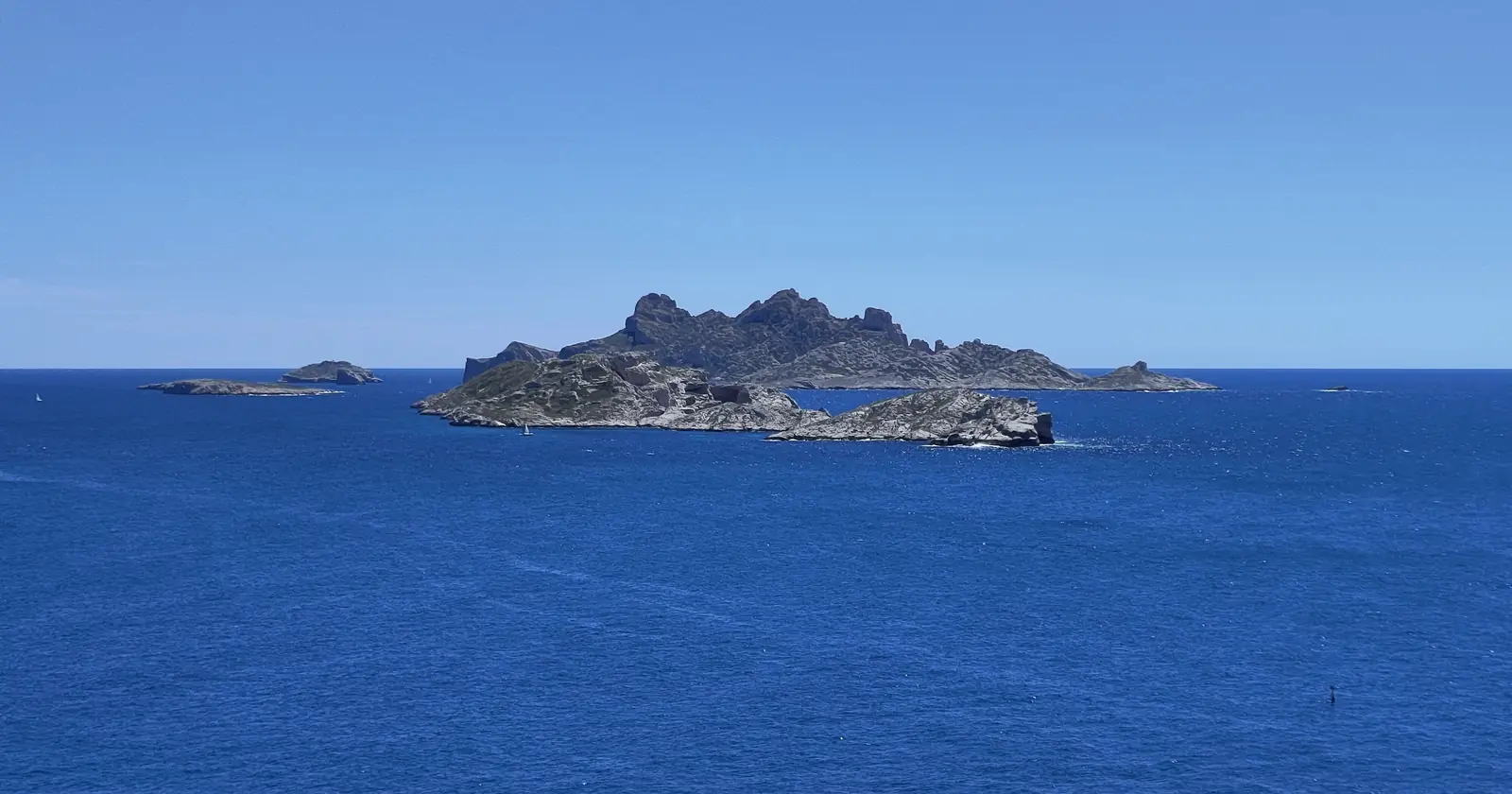
The Riou archipelago, south of Marseille's Pointe Rouge port. LySioS-wkp, Wikimedia Commons, CC BY-SA 4.0, cropped.

Key takeaways
- Scuba and freediving are authorized in the Calanques National Park's marine core, commercial diving included, but only by muscle power: underwater scooters are banned
- A maritime prefecture order bans diving and anchoring within 370 meters of Pointe de la Voile, around the Cosquer cave, and another bans diving in the Triangle Cousteau except in two small arcs
- The park's no-take zones ban fishing, not diving, and the park itself promotes about a hundred dives in them
- PADI and SSI cards are not in France's list of recognized qualifications, so the centre's dive director decides how deep and how independently you dive
- Three centres charge €42 to €65 for a guided dive without equipment; from Marseille Saint-Charles, trains reach Cassis in about 17 minutes and La Ciotat in about 23
Marseille diving happens inside the Calanques National Park
Almost all the diving between Marseille and La Ciotat lies in the marine core of the Calanques National Park, created by decree in 2012: the islands of Riou, Jarre, Plane and Maïre off Marseille's southern tip, the cliffs of the Calanques themselves and the coast toward Cassis. The rules for diving there come from the maritime prefect in Toulon. Order 124/2022 lists scuba and freediving among the activities allowed in the core, explicitly including commercial diving, on one condition: "uniquement musculaire", by muscle power only. Underwater scooters are not allowed.
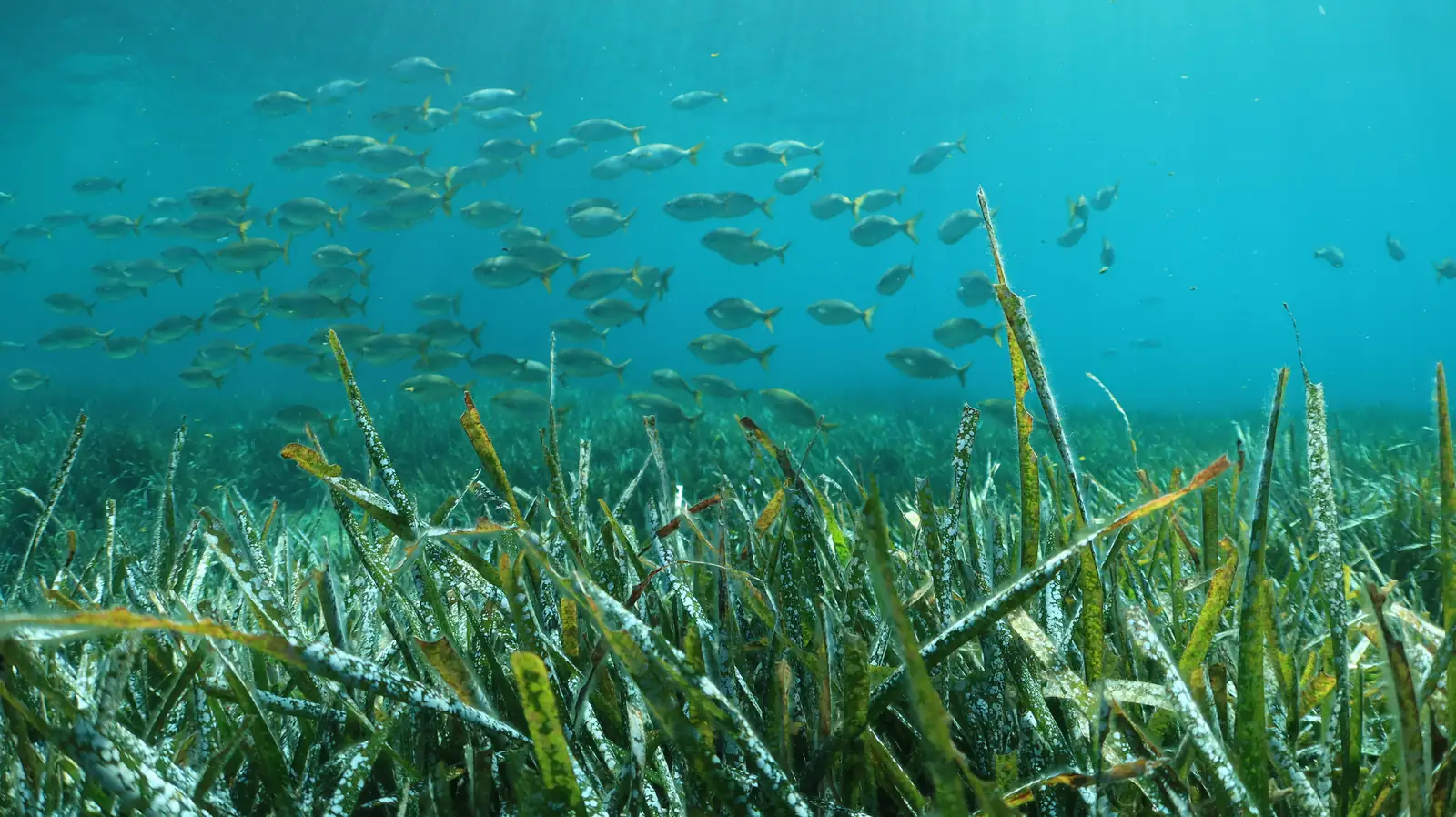
Salema over a Posidonia meadow in the Calanque de Sormiou. Karim Saari, Wikimedia Commons, CC BY 4.0, resized.

The park's own page adds what a diver may not do in the core: take living things or archaeological objects, disturb or feed animals, swim with cetaceans, throw rubbish, use devices whose noise disturbs wildlife, or come close to fishing gear marked with a flag. The park gives that distance as 150 meters on its web page and as 100 meters in its 2025 diving leaflet, so keep well clear. The no-take zones, the parts of the core where all fishing is banned, are open to divers; the same leaflet promotes "une centaine de plongées", about a hundred dives, to see protected species in them. The park also runs a diving charter for clubs and individuals, which it describes as a voluntary commitment rather than a rule: moorings instead of anchors, fewer passes through caves, whose red coral suffers from exhaled air, and beginners taken to less sensitive sites.
The Cosquer cave is closed: no diving within 370 meters of Pointe de la Voile
The Cosquer cave, whose entrance the Ministry of Culture puts at 35 meters below the surface at the end of a 150-meter tunnel, is closed to the public. Maritime prefecture order 021/2022 bans both anchoring and diving, on scuba and on a breath hold, within a 370-meter arc around Cap Morgiou's Pointe de la Voile, to protect the Cosquer, Figuier and Triperie caves and their archaeological remains. Only people authorized by the Ministry of Culture's underwater archaeology service, park staff, state divers and rescuers are exempt. Narval Plongée still sells a dive on the Morgiou drop-off; ask the centre where its boat moors.
Riou and the Triangle Cousteau: diving there is legal only in two arcs
East of Riou lies the zone known as the Triangle Cousteau. Maritime prefecture order 025/2022, citing the area's archaeological heritage and marine life, draws a triangle between the eastern tip of Plane, a point at sea and Pointe Caramassaigne on Riou, bans anchoring in it, and bans diving inside it except within two arcs: 110 meters around the tip of Plane and 135 meters around Pointe Caramassaigne. So the classic Caramassaigne dive is legal, inside its arc. We couldn't tell from the order's text whether the walls of the Grand Congloué islet fall inside the triangle, so ask the boat.
The rest of Riou is the heart of Marseille diving. CIP Marseille lists about fifty sites, from Moyade and Les Impériaux on Riou to the Jarre passage, the Grotte à Perez on Plane and the gorgonian corridor at Congloué; Narval Plongée in Cassis gives most of them a range of 5 to 60 meters, with shallow tops for newer divers and walls dropping past recreational depth. The City of Marseille has fitted 18 sites around Riou with ecological mooring buoys, and La Ciotat has equipped the Mugel; order 229/2025 gives divers priority on the buoys.
The Liban and the Planier wrecks need calm weather
The best-known wreck is the Liban, a 91-meter ship that sank after a collision off Maïre in 1903. Plongée Tek Marseille and Plongée Passion Carry give its depth as 30 to 36 meters; Tek asks for a French Niveau 3 to dive it, while French rules allow a Niveau 2 diver to go to 40 meters with a guide. Further out, around the Planier lighthouse, lie the Chaouen, lost to a navigation error in 1970, the Dalton, the Saint Dominique and a Messerschmitt aircraft at 43 meters. Tek lists the Chaouen at 34 meters for Niveau 3 divers; Passion Carry says it runs from 9 to 36 meters and that its shallow part suits a Niveau 1, so ask which part of the wreck you will see.
Weather decides all of this. Passion Carry says the Planier wrecks need perfect conditions and are 25 to 30 minutes by boat from Carry-le-Rouet. Plongée Tek runs wreck dives only in fine weather or a very light east wind, cave dives only in fine weather, and walls in almost anything, even the mistral, except strong east winds.
The mistral and Marseille's water temperature
The mistral, the region's strong north to north-westerly wind, shapes the diving week. We counted the days with a gust of at least 32 knots from the north to north-west in Météo-France's daily records for Marignane airport, west of the city: 68 a year on average from 2015 to 2024, between 53 and 87. They come in every month, about seven to eight in January and four to five a month through the summer and autumn. Expect a few lost dive days a month, and plan a long stay with slack in it.
Aquadomia, a Marseille dive centre, describes the water as about 14 °C in winter and up to 28 °C in summer at the surface, and warns that the mistral can drop it to 16 °C even in high summer by pulling up cold water from below. The CNRS's long-term SOMLIT-Frioul measurements in the Bay of Marseille show a strong summer thermocline, with water at 30 to 40 meters staying far colder than at the surface. Bring a thick suit for deep summer dives, not only for winter. The centres keep going through the cold months: Cassis Calanques Plongée, Aqua-Evasion, Aquadomia, Plongée Passion Carry and Plongée Tek all say they dive all year.
French dive rules: what a PADI or SSI card gets you in Marseille
In France the Code du sport governs recreational diving. It caps diving on air at 60 meters and divides divers into those who may dive guided by a professional and those who may dive on their own, each up to a depth. The qualifications it recognizes automatically are those of the French federations and CMAS; PADI and SSI are not among them. A foreign diver shows the card and logbook to the centre's dive director, who decides what to allow and may evaluate the diver on a first dive. Since 31 October 2025 the code says outright that diving without a guide is authorized "sur décision du directeur de plongée".
In practice centres translate the cards. Plongée Tek Marseille treats an Open Water diver like a French Niveau 1, guided to 20 meters, and an Advanced diver like a Niveau 2, guided to 40. Plongée Passion Carry guides divers from foreign organizations by default and lets them dive on their own only with the dive director's authorization. Four centres ask for a medical certificate less than a year old, so bring one.
Diving safely off Marseille: flags, boats and who to call
Boats are the main hazard on summer weekends. Maritime prefecture order 109/2024 requires dive boats to fly the international diving flag and a diver on their own to mark their position with a red flag with a white diagonal, and limits any vessel within 100 meters of such a flag to 5 knots.
For an emergency at sea, the Ministry of the Sea says to call the rescue centre on VHF channel 16, or on 196 from the shore, free and around the clock; the park's leaflet adds 112 and warns that not every mobile network reaches into the Calanques. Assistance Publique Hôpitaux de Marseille runs a hyperbaric centre at the Hôpital Sainte-Marguerite with three multiplace chambers, one equipped for intensive care, and lists diving accidents and gas embolism among its emergencies. Its pages do not state its hours, so go through the emergency services rather than calling the chamber. Make sure your dive insurance covers treatment in France.
Prices for a guided dive around Marseille: €42 to €65
Prices for a single exploration dive, read on the centres' own pages on 10 November 2026, without equipment:
| Dive centre | Guided | Autonomous | Full equipment |
|---|---|---|---|
| Plongée Passion Carry, Carry-le-Rouet | €42 | €37 | €20 |
| Anaya Plongée, La Ciotat | €53 | €41 | €15 |
| Cassis Calanques Plongée, Cassis | €65 | €47 | €20 |
Passion Carry adds €10 for the islands off Marseille, Frioul and Planier excepted. In Marseille itself, Aqua-Evasion charges €40 for a morning exploration dive for certified divers and Plongée Tek €55 for an autonomous dive.
Getting to Marseille's dive ports without a car
Marseille Provence airport runs the A1 bus to Saint-Charles station every ten minutes from 07:00 to 20:00, in 30 to 50 minutes. From Paris, the fastest direct TGV on a November weekday takes 3 hours 4 minutes. Most Marseille centres sit at the Pointe Rouge port, which RTM bus 19 from Castellane serves. Cassis and La Ciotat are on the regional railway: on the weekday we checked, 25 trains ran to Cassis in 16 to 18 minutes and 27 to La Ciotat in 22 to 25, all from Marseille Blancarde rather than Saint-Charles, which may be temporary. Cassis station is outside town, with a shuttle bus every 15 to 30 minutes, and buses 78 and 79 run from Castellane to Cassis and La Ciotat in about 45 minutes. Day boats leave early; Plongée Tek meets at 07:30 for an 08:30 departure.
Marseille as a remote-work base
France has no digital nomad visa. EU citizens need nothing; others stay up to 90 days in any 180 under the Schengen rule, now checked by the EU's Entry/Exit System, fully running since 10 April 2026. For longer, the nearest route is the one-year visitor residence card, which requires resources of at least the net annual minimum wage, health insurance and a written commitment not to carry out any professional activity in France. Whether remote work for foreign clients counts as that is not settled by the text, so take advice before relying on it.
Work itself is easy to set up. Coworking spaces in the centre include The Babel Community at République, from €30 a day or €199 a month, and Hiptown at the Vieux-Port, from €190 a month. Fibre is not everywhere: in ARCEP's data for June 2026, 89.9% of premises in Marseille could connect, but only 53.5% in the 1st arrondissement, against 95.7% in the 8th around Pointe Rouge, 96.9% in Cassis and 99.2% in La Ciotat. Check the address before you sign a lease in the old centre.
Who Marseille suits
Marseille suits a diver who wants cold-water Mediterranean walls, caves and wrecks from a big city with trains to everywhere, all year, and who is ready to dive by French rules. It suits a remote worker within Schengen's 90 days or on an EU passport. It suits less well anyone who wants warm water, fixed dive days in mistral season, or to dive alone on a PADI card without convincing a dive director first.
Thirteen dive centres on our Marseille list
Our Marseille operator list holds 13 businesses in Marseille, Cassis, La Ciotat, Carry-le-Rouet, Saint-Cyr-sur-Mer and Gignac-la-Nerthe, all from registers we can link per entry, read on 9 November 2026: nine published by SSI and seven by International Training, the company behind SDI and TDI, three of them by both. Most clubs here teach under France's own federation, whose list we cannot cite entry by entry, so Narval Plongée, quoted above, is not on it. A register entry says a training body lists a centre; it says nothing about how it runs its boat or which sites it dives.
FAQ: Marseille diving
Can you dive the Cosquer cave near Marseille?
No. A maritime prefecture order bans diving and anchoring within 370 meters of Pointe de la Voile at Cap Morgiou, to protect the Cosquer, Figuier and Triperie caves. Only people authorized by the Ministry of Culture, park staff and rescuers are exempt. The cave's entrance is 35 meters deep at the end of a 150-meter tunnel.
Is diving allowed in the Calanques National Park?
Yes. The park's marine core allows scuba and freediving, commercial diving included, by muscle power only, so no underwater scooters. Diving is banned in two zones: around the Cosquer cave and in the Triangle Cousteau east of Riou, except within two small arcs around Plane and Pointe Caramassaigne.
Can I dive in France with a PADI card?
Yes, but the dive director decides how. France's diving rules recognize French and CMAS qualifications automatically, not PADI or SSI. Centres around Marseille usually guide an Open Water diver to 20 meters and an Advanced diver to 40, and allow diving without a guide only on the dive director's decision.
What is the water temperature for diving in Marseille?
About 14 °C in winter and up to 28 °C at the surface in summer, according to a Marseille dive centre, which adds that the mistral can bring it down to 16 °C even in summer. Below a summer thermocline the water at 30 to 40 meters stays much colder than at the surface.
How much does a dive cost in Marseille and Cassis?
A guided exploration dive costs €42 at Plongée Passion Carry, €53 at Anaya Plongée in La Ciotat and €65 at Cassis Calanques Plongée, without equipment, which adds €15 to €20. Autonomous dives cost €37 to €47 at the same centres.
Note: Conditions, safety guidance and regulations change. Verify current information with official sources, including the dive operator, the park authority and the relevant government department, before you travel or dive.
Founder of NOMADREEF and a former digital nomad. This guide is sourced from the references below; conditions, prices and rules change, so verify current details, and follow qualified local guidance and safety briefings. About the author · LinkedIn ↗
Sources
- Diving in the park's core (primary). Préfecture maritime de la Méditerranée, order 124/2022 (PDF), articles 1 and 4 and annex I. Parc national des Calanques, diving page, 2025 diving leaflet (PDF) and diving charter (PDF). Decree 2012-507 (PDF), article 11, on the no-take zones. Read 10 November 2026.
- The two banned zones (primary). Préfecture maritime, order 021/2022 on Cap Morgiou (PDF) and order 025/2022 on the Triangle Cousteau (PDF). Ministry of Culture, Cosquer cave. Read 10 November 2026.
- Moorings, anchoring and boats (primary). Préfecture maritime, order 229/2025 (PDF) on moorings and anchoring zones off Marseille, and order 109/2024 (PDF), article 6, on diving flags and 5 knots. Read 10 November 2026.
- Dive sites and wrecks (each centre primary for itself). CIP Marseille, dive sites; Narval Plongée, dive sites; Plongée Tek Marseille, wrecks and exploration; Plongée Passion Carry, wrecks. Depths of the Liban triangulated across two centres. Read 10 November 2026.
- Wind (own count from primary data). Météo-France, daily climatological data for the Bouches-du-Rhône, open data: days with a maximum gust of at least 16.5 m/s (32 knots) from 280° to 20° at Marignane, 2015 to 2024, counted for this page. The threshold follows a common reading of a mistral day that we could not confirm on a Météo-France page, so the text describes the count rather than naming it. Read 10 November 2026.
- Water temperature. Aquadomia (operator) for the seasonal range and the mistral. Service d'Observation en Milieu Littoral, INSU-CNRS, RI ILICO, Frioul: SOMLIT-Frioul time series, for the summer thermocline, described here without figures. Read 10 November 2026.
- Year-round operation (each centre primary for itself). Cassis Calanques Plongée, Aqua-Evasion, Plongée Passion Carry, Aquadomia and Plongée Tek, as above. Read 10 November 2026.
- French diving rules (primary). Code du sport, articles A322-71 to A322-101, among them A322-73 as in force since 31 October 2025 and A322-77; annex III-14 a. How centres read foreign cards: Plongée Passion Carry and Plongée Tek (operators). Medical certificates asked for by Narval, Passion Carry, Anaya and Tek (operators). Read 10 November 2026.
- Emergencies and the chamber (primary). Ministère de la Mer, how to alert rescue at sea. AP-HM, hyperbaric, underwater and maritime medicine and hyperbaric centre. Read 10 November 2026.
- Prices (each centre primary for itself). Plongée Passion Carry, 2026 prices; Anaya Plongée; Cassis Calanques Plongée, prices; Aqua-Evasion and Plongée Tek, as above. Read 10 November 2026.
- Getting there. Aéroport Marseille Provence, bus to Saint-Charles (primary). Train and bus times calculated for Thursday 12 November 2026 from the published timetable data of SNCF, the regional Zou! trains and the Aix-Marseille metropolis and RTM networks on data.gouv.fr. Cassis station shuttle: Ville de Cassis press kit, July 2025 (PDF). Read 10 November 2026.
- Staying and working. CESEDA article L426-20 (primary); service-public.gouv.fr on long-stay visas (primary); European Commission, border crossing and the 90/180 rule (primary); The Babel Community and Hiptown Vieux-Port (operators); ARCEP, fibre deployment by commune, second quarter 2026, shares calculated for this page. Read 10 November 2026.
- The thirteen listings. Thirteen entries on the Marseille operator list, from the SSI register and the International Training facility register, read 9 November 2026.
- Left out. Whether the Grand Congloué walls lie inside the Triangle Cousteau, which the order's annex map would settle; the hours of the Sainte-Marguerite chamber; depths of the Frioul sites; the criteria for France's talent passport, because France-Visas refused automated requests; and monthly temperature figures from SOMLIT, whose licence restricts reuse.