Gran Canaria vs Tenerife: Which Island for Wind and Diving?
 by Yannick SchrothOct 26, 202615 min read
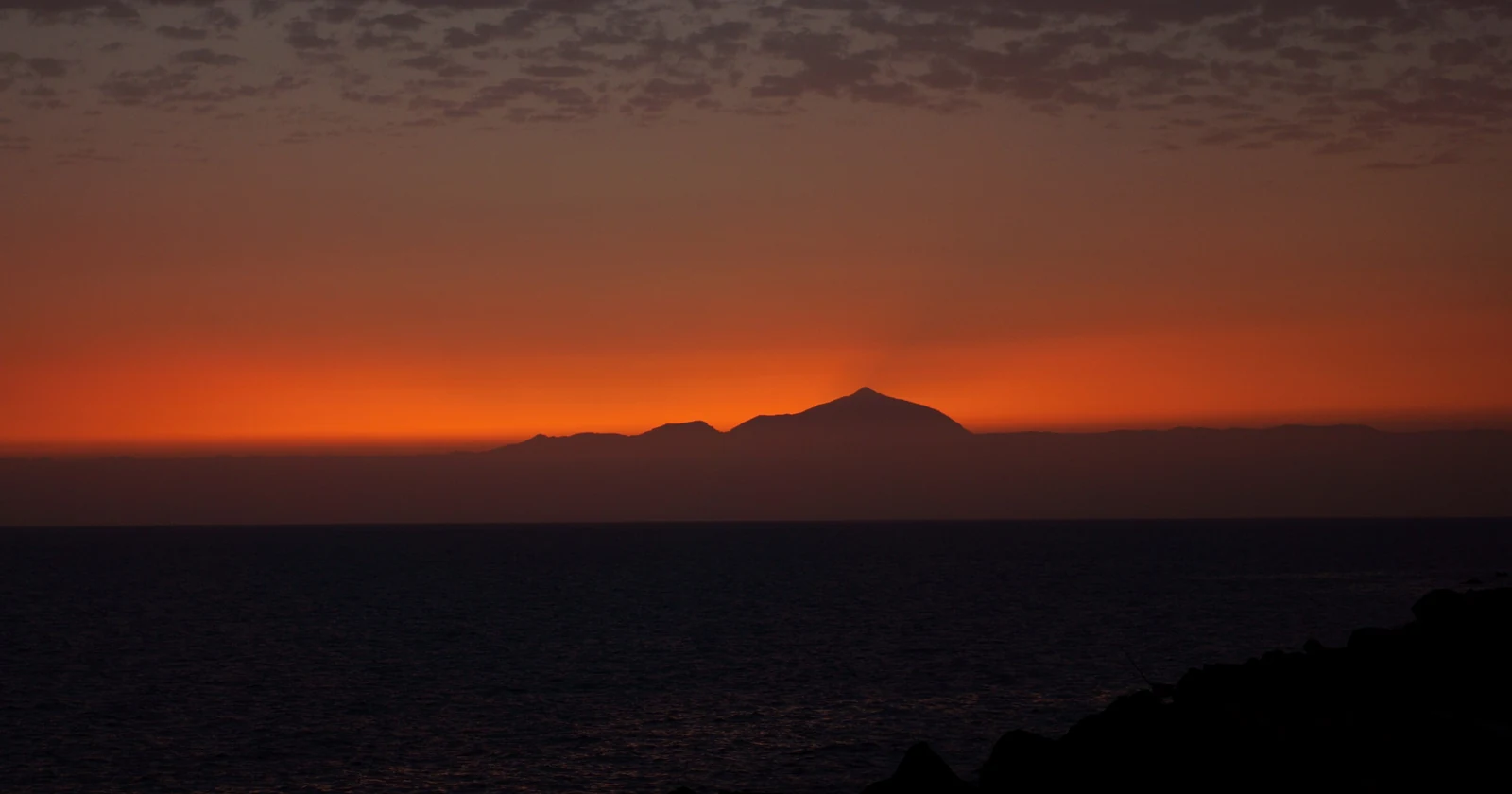
Tenerife and Mount Teide at sunset, seen from Puerto de Mogán on Gran Canaria, July 2012: both sides of this comparison in one frame. Photo: Jarek Prokop, Wikimedia Commons, CC BY 3.0, cropped.
| Gran Canaria | Tenerife | |
|---|---|---|
| Wind spot | Pozo Izquierdo, south-east coast | El Médano, south-east corner |
| Model hours at 16 kn or more, July / December | 57% / 3% | 52% / 38% |
| 2026 PWA wave World Cup | Pozo Izquierdo, 4 to 12 July | El Médano, 31 July to 9 August |
| Sea surface, March / September | 19.7 / 23.7 °C (south-east) | 20.1 / 24.1 °C (south) |
| Protected dive coast | El Cabrón at Arinaga, a Natura 2000 site of 956.20 ha | Teno-Rasca, a Natura 2000 site of 69,489.68 ha on the west coast |
| Airport passengers, 2025 | 15.8 million at Gran Canaria | 14.0 million at Tenerife South, 7.2 million at Tenerife North |
| Airport to the wind spot | 12 km to Pozo, no airport bus names it | 3.6 km to El Médano, by bus with a change at San Isidro |
| Watersports businesses on our lists | 11 | 28 |
Wind is modeled from ECMWF's 9 km model for 2023 to 2025; water is NOAA's daily satellite sea surface temperature for 2021 to 2025, both averaged for this page. Event dates, rules, timetables and visa terms are as read on the issuing body's pages on 26 October 2026.
Gran Canaria vs Tenerife wind: a July peak at Pozo, a steadier trade at El Médano
Both islands sell the same trade wind, and both have a corner where it gets squeezed. On Gran Canaria that corner is the south-east coast around Pozo Izquierdo. On Tenerife it is El Médano, next to Tenerife South airport. The model says the two corners keep very different calendars.
| Month | Pozo cell: mean | Pozo: hours at 16 kn+ / 20 kn+ | El Médano cell: mean | El Médano: hours at 16 kn+ / 20 kn+ |
|---|---|---|---|---|
| January | 9.1 kn | 12% / 1% | 14.6 kn | 44% / 27% |
| February | 9.5 kn | 12% / 3% | 13.1 kn | 35% / 19% |
| March | 9.8 kn | 17% / 2% | 12.8 kn | 35% / 25% |
| April | 10.8 kn | 19% / 2% | 12.9 kn | 33% / 22% |
| May | 12.3 kn | 28% / 7% | 13.9 kn | 40% / 26% |
| June | 11.9 kn | 25% / 3% | 12.7 kn | 32% / 18% |
| July | 16.1 kn | 57% / 16% | 15.8 kn | 52% / 27% |
| August | 14.7 kn | 45% / 8% | 16.2 kn | 55% / 34% |
| September | 12.2 kn | 22% / 1% | 14.7 kn | 46% / 27% |
| October | 8.4 kn | 8% / 0% | 12.2 kn | 33% / 18% |
| November | 8.3 kn | 7% / 1% | 12.9 kn | 34% / 16% |
| December | 7.7 kn | 3% / 0% | 13.6 kn | 38% / 24% |
Calculated for this page from ECMWF's IFS model at about 9 km, hourly wind at 10 m, January 2023 to December 2025, read through Open-Meteo's historical API. The Pozo cell is centered at 27.87° N, 15.41° W, on the coast between Arinaga and Pozo Izquierdo; the El Médano cell is at 27.94° N, 16.54° W, open sea about 11 km south of the beach. Each month holds 2,040 to 2,232 model hours.
Read the Pozo column as a season. From October to April the cell rarely reaches 16 knots; in July it does so in 57% of hours. The El Médano column barely moves: its quietest month, October, still has a third of hours at 16 knots or more.
For Gran Canaria vs Tenerife on wind, that is the whole argument. Across the three years the Tenerife cell averages 13.8 knots and the Gran Canaria cell 10.9. The direction differs too: the model wind off El Médano blows from the north-east, around 45 to 60 degrees, and at the Pozo cell from between north and north-north-east.
Treat the absolute numbers with care. A 9 km model smooths out the way the island terrain accelerates the trade wind along a few kilometres of shore, and the Pozo cell sits on the coast while the El Médano cell lies over open sea, so the two are not measured in the same kind of place. Read the table for the shape of the year. The strength at a given launch on a given afternoon is something no 9 km cell can show.
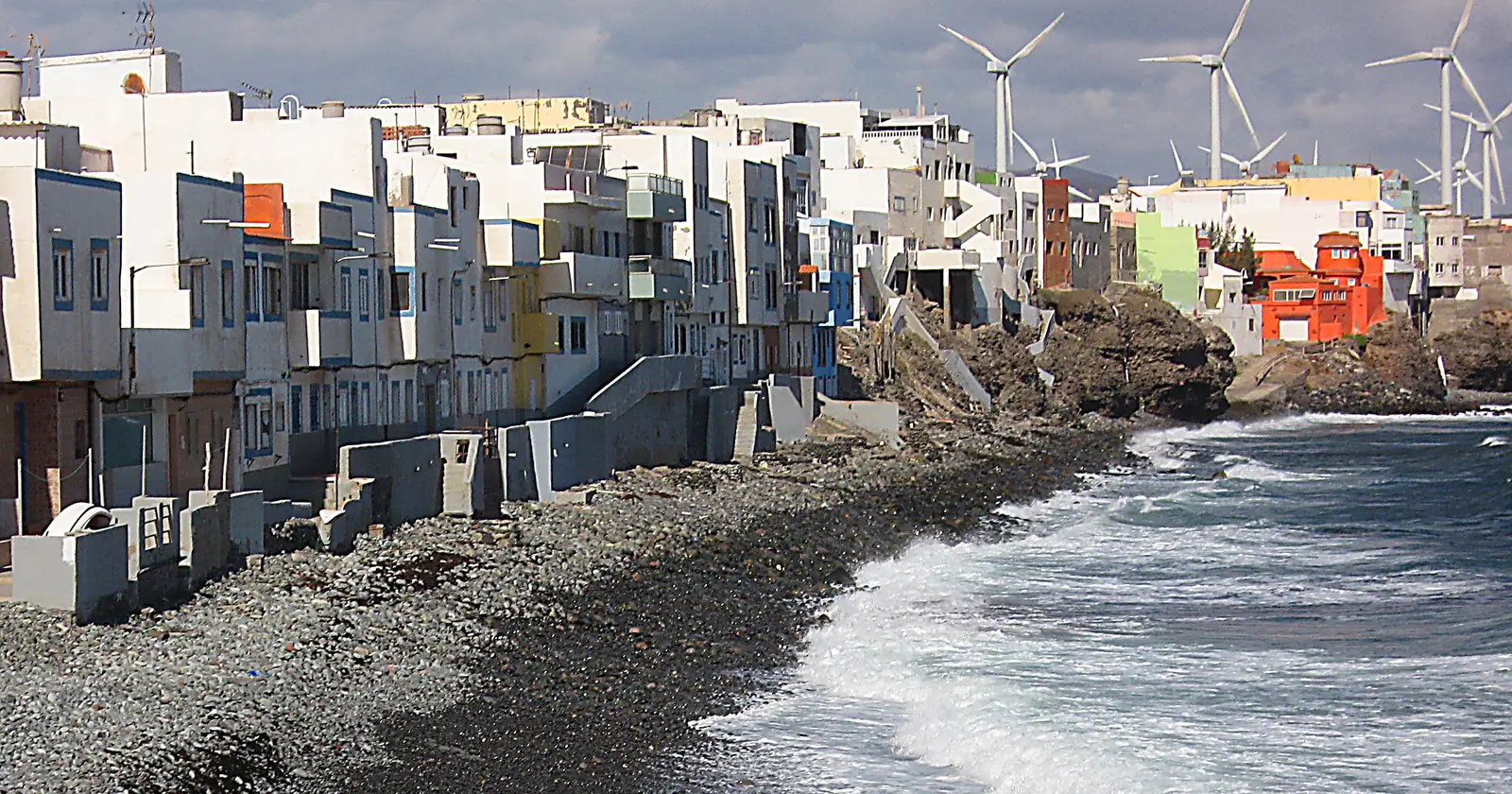
Two summer World Cups: Pozo Izquierdo on Gran Canaria, El Médano on Tenerife
The windsurf tour treats the two islands as equals in high summer. The PWA calendar for 2026 lists the Gran Canaria Gloria Windsurf World Cup at Pozo Izquierdo from 4 to 12 July, and the Tenerife World Cup at El Médano from 31 July to 9 August. Both are five-star events, and both list the same two disciplines: men's wave and women's wave.
That says something the wind table cannot. Each spot produces wave-sailing conditions good enough for a world tour stop, and each in a window of about ten days at the peak of the trade-wind season. If you book July, either island works. If you book November, the model points one way.
The PWA marks every event detail as provisional until entry information is issued, so check the dates again before you plan a trip around watching one.
For kitesurfing the lists point the same way. All four IKO kite schools on our Tenerife list are filed at El Médano; Gran Canaria's list has one, filed at Playa del Inglés, and no school of any kind filed at Pozo Izquierdo itself. Our Pozo Izquierdo windsurf guide covers the Gran Canaria spot on its own.
Gran Canaria and Tenerife water temperature: Tenerife is warmer in every month, by under a degree
On water, Gran Canaria vs Tenerife is close. NOAA's daily satellite sea surface temperature, averaged by month for two cells off each island:
| Month | Gran Canaria south-east | Gran Canaria north | Tenerife south | Tenerife west |
|---|---|---|---|---|
| January | 20.4 °C | 20.4 °C | 20.6 °C | 20.8 °C |
| February | 19.9 °C | 19.9 °C | 20.2 °C | 20.3 °C |
| March | 19.7 °C | 19.7 °C | 20.1 °C | 20.2 °C |
| April | 20.2 °C | 20.2 °C | 20.4 °C | 20.5 °C |
| May | 20.8 °C | 20.8 °C | 21.1 °C | 21.2 °C |
| June | 21.7 °C | 21.8 °C | 22.0 °C | 22.1 °C |
| July | 22.4 °C | 22.4 °C | 22.6 °C | 22.8 °C |
| August | 23.1 °C | 23.2 °C | 23.5 °C | 23.6 °C |
| September | 23.7 °C | 23.8 °C | 24.1 °C | 24.3 °C |
| October | 23.5 °C | 23.6 °C | 24.1 °C | 24.2 °C |
| November | 22.7 °C | 22.8 °C | 23.2 °C | 23.3 °C |
| December | 21.3 °C | 21.3 °C | 21.8 °C | 21.9 °C |
Monthly means of NOAA's Optimum Interpolation sea surface temperature, version 2.1, daily, 1 January 2021 to 31 December 2025, for the quarter-degree cells centered at 27.875° N 15.375° W (off Arinaga and Pozo), 28.125° N 15.375° W (Las Palmas), 27.875° N 16.625° W (south of El Médano and Las Galletas) and 28.125° N 16.875° W (off the Teno-Rasca coast).
The pattern is the same on both islands. March is the coldest month, at about 20 °C, and September or October the warmest, at 23.5 to 24.3 °C. Tenerife's two cells run 0.2 to 0.7 °C warmer than Gran Canaria's in every month, with the widest gap in autumn. Nobody changes wetsuit for that. The two Gran Canaria cells, one off the dive coast and one off the capital, are within a tenth of a degree all year.
A cell about 25 km across cannot show a cold upwelling morning in one bay or the temperature at 20 m. It does show that water is not a reason to pick one island over the other.
Diving Gran Canaria's El Cabrón or Tenerife's Teno-Rasca coast: two Natura 2000 sites, no marine reserve
El Cabrón and the Teno-Rasca coast are both Special Areas of Conservation in the EU's Natura 2000 network, declared in September 2011. Neither is a marine reserve. Spain's fisheries ministry lists twelve reservas marinas, and the three in the Canaries are Isla Graciosa, La Restinga and Isla de La Palma.
Gran Canaria's is small and specific. ZEC Playa del Cabrón covers 956.20 hectares off Agüimes, and the Cabildo's dive guide lists El Cabrón there as a shore dive with an average depth of 19 m, a maximum of 22 m, medium difficulty and frequent current. The same page says the area is rich enough to have been nominated as the future Reserva Marina de Arinaga. Nominated is not declared; the list above has no Gran Canaria entry.
Tenerife's is large. ZEC Franja Marina de Teno-Rasca covers 69,489.68 hectares along five west-coast municipalities, from Buenavista del Norte to Arona. In a 2023 communication the environment ministry calls the short-finned pilot whales there a resident population, sighted all year, and names Japan, Madeira, California and Hawaii as the only other places with known resident populations. It also says the zone carries the largest supply of recreational whale watching in the Canaries, and it asked for a moratorium on new watching permits.
That matters to a diver weighing Gran Canaria vs Tenerife. Spain's cetacean decree, Real Decreto 1727/2007, draws a protection space of 500 m around any whale or dolphin and forbids bathing or diving in its inner exclusion zone of at least 60 m. If a pod surfaces near the boat, the dive waits.
The animal both islands share lies on the sand. In a citizen-science survey of 678 angelshark sightings between April 2014 and March 2015, four places stood out for sighting frequency: Las Teresitas on Tenerife, Sardina del Norte and El Cabrón on Gran Canaria, and Puerto del Carmen on Lanzarote. Tenerife recorded 36 of the 69 newborns, at a nursery area then under study. Males were commonest from November to January; larger females and newborns from April to July.
Our Gran Canaria diving guide and Tenerife diving guide go site by site.
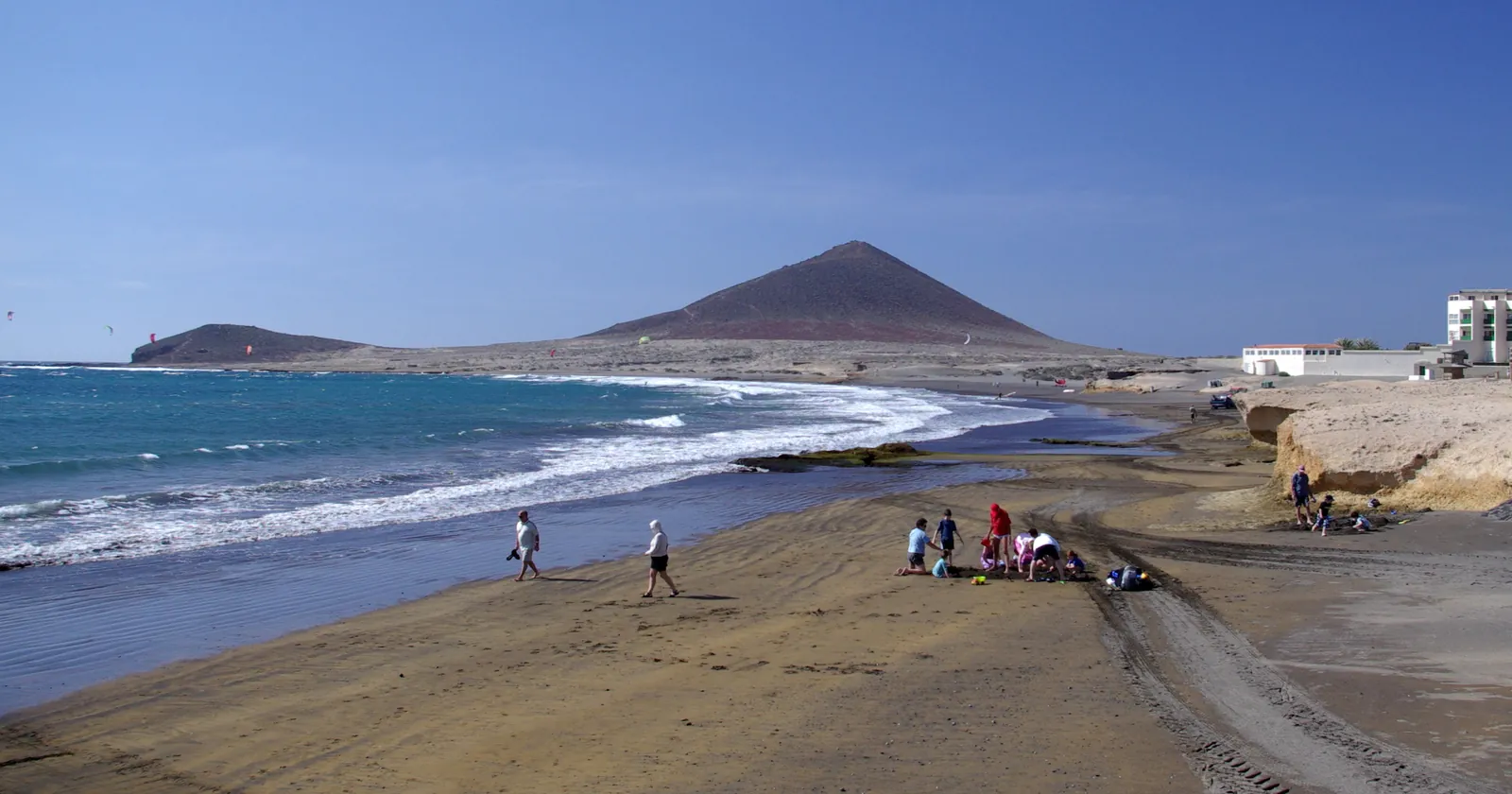
One Canary decree for every dive centre on Gran Canaria and Tenerife
Whichever island you pick, the dive centre works under the same regional law. Decreto 35/2006 regulates recreational dive centres across the Canary Islands, and it asks more than a dive-agency membership does.
A centre needs an administrative authorization. Its emergency and evacuation plan must guarantee a hyperbaric chamber located so that a diver can be moved there in two hours at most from the dive site, along with a first-aid kit, normobaric oxygen and medical staff of its own or under contract. The plan has to state where the chamber is and attach the title that entitles the centre to use it.
The authorization must hang in the centre "en lugar preferente y perfectamente visible", in a preferred and perfectly visible place. Ask to see it on either island, and ask where the plan sends you after an accident. Neither SSI nor any other training body's listing replaces it.
Surf on Gran Canaria and Tenerife: north coasts in winter, Las Palmas on the doorstep
For surfers, Gran Canaria vs Tenerife is a question of which coast. Swell on both islands comes from the north-west in winter and from the trade wind in summer. The wave model shows four coasts:
| Month | Off Gran Canaria's north coast | Off Tenerife's north coast | Off Tenerife's south-west | Off Gran Canaria's south |
|---|---|---|---|---|
| January | 1.79 m, 33% at 2 m+ | 2.12 m, 58% at 2 m+ | 1.24 m, 71% at 1 m+ | 1.05 m, 52% at 1 m+ |
| March | 2.13 m, 47% | 2.45 m, 70% | 1.45 m, 88% | 1.05 m, 55% |
| May | 1.54 m, 16% | 1.59 m, 17% | 1.00 m, 44% | 0.92 m, 39% |
| July | 1.54 m, 13% | 1.49 m, 12% | 1.07 m, 57% | 1.02 m, 48% |
| September | 1.50 m, 18% | 1.54 m, 19% | 0.99 m, 44% | 0.83 m, 23% |
| November | 1.61 m, 22% | 1.83 m, 33% | 1.09 m, 55% | 0.86 m, 22% |
Monthly mean significant wave height, with the share of model hours at 2 m or more for the north coasts and at 1 m or more for the south coasts. Calculated for this page from Météo-France's MFWAM model for Copernicus Marine, 1/12° (about 9 km), January 2023 to December 2025, for cells centered at 28.25° N 15.50° W (north-west of La Isleta), 28.67° N 16.33° W (north of Anaga), 28.00° N 16.83° W (south-west of Playa de las Américas) and 27.67° N 15.58° W (south of Maspalomas). Shares of hours are shares of the model's three-hourly steps.
The north of Tenerife takes more winter swell than the north of Gran Canaria: in January the model has 2 m or more there in 58% of hours, against 33%. In summer the two north coasts are level, and the period tells you why. Swell periods average 9 to 10 seconds in January and under 6 in July, which is short, wind-made sea rather than groundswell. On the south coasts Tenerife's south-west keeps more size than Gran Canaria's south in every month shown.
What the model leaves out is where you can live. Las Palmas, the city of Gran Canaria, has its surf inside the town: its official tourism site describes La Cícer, at one end of Las Canteras beach, as a place of daily training and a hotbed of surf schools, and El Confital's right as a barrel surfers rate among Europe's best. On Tenerife, Spain's national tourism agency names Playa de las Américas in Arona as the stage for international events, the Spring Surfest Las Américas Pro among them.
Getting around Gran Canaria and Tenerife without a car, and between them
Gran Canaria vs Tenerife looks even from the air. AENA counted 15.8 million passengers at Gran Canaria airport in 2025, and 14.0 million at Tenerife South plus 7.2 million at Tenerife North. The difference is what happens after landing.
Gran Canaria has one airport between the capital and the south. Pozo Izquierdo is 12 km from it in a straight line and Las Palmas about 24 km. AENA lists eight Global bus lines at the airport. Line 60 leaves the airport for Las Palmas twice an hour from 6:15 to 20:15, with a last departure at 23:15. None of the eight names Pozo Izquierdo as a stop; line 11 runs to Agüimes, the municipality of Arinaga.
Tenerife has its southern airport 3.6 km from El Médano, yet no direct bus between them in TITSA's timetable data. The route is a change at San Isidro.
On Wednesday 28 October 2026, lines 10, 114, 415 and 711 run 56 trips from the airport to San Isidro station, 2 to 8 minutes each, and lines 408 to 411 run 44 trips from San Isidro to El Médano, 5 to 11 minutes each. Line 470 links El Médano with Las Galletas, where one of the listed dive centres is filed, 17 times a day in about 30 minutes.
Lines 40 and 711 run 40 trips a day from the airport to Los Cristianos, 18 to 30 minutes.
Between the islands, Fred. Olsen sails from Agaete on Gran Canaria's north-west coast to Santa Cruz de Tenerife in 80 minutes. Its Ferry Bus links Santa Catalina Park in Las Palmas with the Agaete port in 25 minutes, leaving 60 minutes before the ship and booked as an extra with the ticket. A month on one island with a weekend on the other is a short trip.
Remote work from Gran Canaria or Tenerife: gigabit coverage, 90 days and the teleworker visa
Fibre is not the deciding factor in Gran Canaria vs Tenerife. Spain's telecoms ministry publishes coverage by municipality, measured in June 2025:
| Municipality | Base for | Households with FTTH | Households with 1 Gbps |
|---|---|---|---|
| Las Palmas de Gran Canaria | The capital, La Cícer | 98.0% | 97.5% |
| Santa Lucía de Tirajana | Pozo Izquierdo | 98.4% | 98.1% |
| Agüimes | Arinaga, El Cabrón | 98.0% | 97.2% |
| San Bartolomé de Tirajana | Playa del Inglés, Maspalomas | 94.1% | 93.4% |
| Santa Cruz de Tenerife | The capital | 97.1% | 96.5% |
| Granadilla de Abona | El Médano | 96.0% | 92.9% |
| Arona | Los Cristianos, Las Galletas | 97.1% | 95.5% |
| Adeje | Costa Adeje | 96.9% | 94.0% |
Coverage means a network reaches the household, not that a rental has a fast line. Ask the host for a speed test before you pay.
Paperwork is identical on both islands, because both are Spain. For non-EU visitors the European Commission's rule is a stay "of up to 90 days in any 180-day period", counted across all 29 Schengen countries, so a ferry to the other island resets nothing.
For a stay longer than that, Gran Canaria vs Tenerife makes no difference either. Spain's teleworker visa asks for income of 200% of the minimum wage (SMI) a month, plus 75% of the SMI for the first family member and 25% for each further one. Real Decreto 126/2026 sets the 2026 SMI at €1,221 a month, with an annual floor of €17,094. The full conditions are in our Spain teleworker visa guide.
The Gran Canaria and Tenerife operator lists: 11 businesses against 28
Our two lists are built from training-body registers and the Green Fins scheme, so they count who those bodies list, not who is good.
| Gran Canaria | Tenerife | |
|---|---|---|
| Businesses listed | 11 | 28 |
| Listed for scuba diving | 9 | 24 |
| Kite schools (IKO) | 1, Playa del Inglés | 4, all at El Médano |
| Windsurf stations (VDWS) | 1, San Agustín | 1, El Médano |
| In the SSI, IKO or VDWS register | 11 | 26 |
| Green Fins members | 0 | 2 |
| Rated by SSI for freediving | 2 | 8 |
| Publish a website | 10 | 22 |
The Gran Canaria list was compiled on 20 September 2026 and the Tenerife list on 21 September 2026. Three of Gran Canaria's nine dive centres are filed at Arinaga, beside El Cabrón. Both Tenerife Green Fins members are digital members, which means a self-evaluation and no assessment in person. None of these listings is the Decreto 35/2006 authorization, so the paper on the dive-shop wall is still the one to read.
Gran Canaria vs Tenerife in five lines
- Wind all year: Tenerife. Off El Médano the model has 16 knots or more in 32 to 55% of hours in every month.
- Wind in July: either. Both host a PWA wave World Cup in 2026, Pozo from 4 July, El Médano from 31 July.
- Water: Tenerife is 0.2 to 0.7 °C warmer, about 20 °C in March and 24 °C in September on both.
- Diving: both coasts are Natura 2000 sites, not marine reserves; Tenerife's list has 24 dive businesses to Gran Canaria's 9.
- City life and surf in town: Gran Canaria, where Las Palmas has its surf schools at La Cícer.
Pick Gran Canaria for Las Palmas and a July at Pozo, Tenerife for El Médano and the dive coast
Pick Gran Canaria if you want a real city with surf on its beach, fibre in nearly every household, and a bus to the airport twice an hour. Pick it for a July of wave sailing at Pozo. Do not pick it for a winter of wind: the model gives Pozo 16 knots in fewer than one hour in five from October to April.
Pick Tenerife if the wind is the reason for the month and the month is not July, or if you want more dive centres and a resident whale population on the same coast. El Médano sits next to the southern airport. Do not pick it expecting a direct airport bus to the beach.
If Gran Canaria vs Tenerife is not quite your question, read Tenerife vs Fuerteventura or Fuerteventura vs Lanzarote, and for life on the bigger island, our Tenerife guide for nomads who dive. Before a month on either, check that your dive insurance pays for a transfer to a chamber.
FAQ: Gran Canaria vs Tenerife
Is Gran Canaria or Tenerife better for windsurfing and kitesurfing?
For wind outside summer, Tenerife. In model data for 2023 to 2025 the sea off El Médano has 16 knots or more in 32 to 55% of hours in every month, while the cell near Pozo Izquierdo stays below one hour in five from October to April. In July both work, and both host a PWA wave World Cup in 2026.
Is the sea warmer in Tenerife or Gran Canaria?
Tenerife, by 0.2 to 0.7 °C in every month in NOAA satellite data for 2021 to 2025. On both islands March is the coldest month at about 20 °C and September or October the warmest at 23.5 to 24.3 °C, so the same wetsuit works for both.
Is El Cabrón in Gran Canaria a marine reserve?
No. It lies in ZEC Playa del Cabrón, a Natura 2000 site of 956.20 hectares off Agüimes, a ZEC since September 2011. The Cabildo's dive guide says the area was nominated as the future Reserva Marina de Arinaga, but the Canary marine reserves on Spain's list are Isla Graciosa, La Restinga and Isla de La Palma.
How do you get from Tenerife South airport to El Médano by bus?
With a change at San Isidro, because TITSA's timetable data show no direct bus. On Wednesday 28 October 2026, 56 buses run from the airport to San Isidro station in 2 to 8 minutes, and 44 run from San Isidro to El Médano in 5 to 11 minutes. The airport is 3.6 km from El Médano in a straight line.
How long is the ferry from Gran Canaria to Tenerife?
80 minutes on Fred. Olsen, from Agaete on Gran Canaria's north-west coast to Santa Cruz de Tenerife. Its Ferry Bus links Santa Catalina Park in Las Palmas with the Agaete port in 25 minutes, leaving 60 minutes before the ship, and is booked as an extra with the ticket.
How long can you stay in Gran Canaria or Tenerife without a long-stay visa?
Both islands are Spain, so the rules are the same. Non-EU visitors may stay up to 90 days in any 180-day period, counted across all 29 Schengen countries. For longer, Spain's teleworker visa asks for income of 200% of the minimum wage (SMI) a month, which Real Decreto 126/2026 sets at €1,221 a month for 2026.
Sources
- Wind. ECMWF IFS at about 9 km, hourly wind speed, gusts and direction at 10 m, 1 January 2023 to 31 December 2025, read through Open-Meteo's historical weather API on 26 October 2026 for the cells at 27.87° N 15.41° W and 27.94° N 16.54° W, 26,304 hourly values each. Monthly means, speed-weighted mean directions and the shares of hours at 16 and 20 knots or more are calculated for this page. Open-Meteo, ECMWF
- Sea state. Météo-France MFWAM global wave model, Copernicus Marine product GLOBAL_ANALYSISFORECAST_WAV_001_027 (1/12°, about 0.083°, three-hourly values, no interpolation), significant wave height and swell period, 1 January 2023 to 31 December 2025, read from Copernicus Marine on 2 November 2026 for the cells centered at 28.25° N 15.50° W, 28.67° N 16.33° W, 28.00° N 16.83° W and 27.67° N 15.58° W. Monthly means and shares of hours are calculated for this page. Shares of hours are shares of the model's three-hourly steps. Generated using E.U. Copernicus Marine Service Information; https://doi.org/10.48670/moi-00017. Copernicus Marine
- Sea surface temperature. NOAA OISST v2.1 AVHRR daily, quarter-degree cells at 27.875° N 15.375° W, 28.125° N 15.375° W, 27.875° N 16.625° W and 28.125° N 16.875° W, 1 January 2021 to 31 December 2025 (1,826 days, none missing), read on 26 October 2026 from NOAA PSL's copy of the dataset and averaged by month for this page. NOAA PSL, NCEI product page
- World Cups. PWA World Tour event pages: 2026 Gran Canaria Gloria Windsurf World Cup, Pozo Izquierdo, 4 to 12 July 2026, men's and women's wave; 2026 Tenerife World Cup, El Médano, 31 July to 9 August 2026, men's and women's wave; both five-star; event details provisional until entry information is issued. Read 26 October 2026. Gran Canaria, Tenerife, 2026 calendar
- The two conservation areas. Ministerio para la Transición Ecológica y el Reto Demográfico: ZEC ES7010053 Playa del Cabrón, 956.20 ha off Agüimes, a ZEC since September 2011; ZEC ES7020017 Franja marina de Teno-Rasca, 69,489.68 ha off Buenavista del Norte, Santiago del Teide, Guía de Isora, Adeje and Arona, a ZEC since September 2011. Read 26 October 2026. ES7010053, ES7020017
- Marine reserves. Ministerio de Agricultura, Pesca y Alimentación, Reservas marinas de España: twelve reserves, the Canary ones Isla Graciosa, La Restinga and Isla de La Palma. Read 26 October 2026. mapa.gob.es
- El Cabrón. Cabildo de Gran Canaria tourism board, dive guide page: shore entry ("Tierra"), average 19 m, maximum 22 m, medium difficulty, frequent current, "nominada para constituir la futura Reserva Marina de Arinaga". Read 26 October 2026. grancanaria.com
- Pilot whales in Teno-Rasca. Dirección General de Biodiversidad, Bosques y Desertificación, communication of 26 September 2023: a resident population of short-finned pilot whales, sighted all year with high site fidelity; "sólo se conocen otras poblaciones residentes en Japón, Madeira, California y Hawaii"; the zone "con mayor oferta de actividad recreativa de observación de cetáceos de todas las islas Canarias"; the moratorium on new authorizations. Read 26 October 2026. miteco.gob.es (PDF)
- The 60-metre rule. Real Decreto 1727/2007, article 2 (a protection space of 500 m radius and an exclusion zone of "no inferior a 60 metros") and article 4.2.f ("Bañarse o bucear en la Zona de Exclusión"). Read 26 October 2026. BOE-A-2008-516
- Angelsharks. Meyers, Tuya, Barker, Jiménez Alvarado, Castro-Hernández, Haroun and Rödder, "Population structure, distribution and habitat use of the Critically Endangered Angelshark, Squatina squatina, in the Canary Islands", Aquatic Conservation (2017): 678 sightings from April 2014 to March 2015; high sighting frequency at Las Teresitas, Sardina del Norte, El Cabrón and Puerto del Carmen; 36 of 69 neonates on Tenerife; males commonest November to January, larger females and neonates April to July. Read 26 October 2026. Full text (PDF)
- The dive-centre decree. Decreto 35/2006, de 25 de abril, BOC 86 of 5 May 2006: article 5 (the emergency plan guaranteeing "una cámara de descompresión (cámara hiperbárica) ubicada a una distancia que permita el traslado en un tiempo máximo de dos horas desde el lugar de la inmersión", its location and the title to use it; the authorization displayed "en lugar preferente y perfectamente visible"). Read 26 October 2026 in the text published by the Parlamento de Canarias, because the Canary government's servers did not answer that day. parcan.es (PDF)
- Airports. AENA press release of 13 January 2026: Gran Canaria 15,826,553 passengers in 2025, Tenerife Sur 13,969,678, Tenerife Norte-Ciudad de La Laguna 7,174,977. Read 26 October 2026. aena.es (PDF)
- Airport buses. AENA's bus pages for Gran Canaria airport (lines 1, 5, 11, 36, 60, 66, 90 and 91; line 60 "two buses an hour" between 6:00 and 20:00, last to Las Palmas at 23:15) and Tenerife South (lines 10, 40, 343, 415 and night line 711). Read 26 October 2026. Gran Canaria, Tenerife South
- Tenerife buses. TITSA timetable data in GTFS, files dated 13 October 2026, service from 13 October 2026 to 11 April 2027, counted for Wednesday 28 October and Saturday 31 October 2026. Read 26 October 2026 from the Mobility Database copy of TITSA's feed, because titsa.com did not answer that day. feed (ZIP), Mobility Database record
- Ferry. Fred. Olsen Express, Gran Canaria to Tenerife route (Agaete to Santa Cruz de Tenerife, 80 minutes) and Ferry Bus page (Las Palmas, Santa Catalina Park, to Agaete in 25 minutes, leaving 60 minutes before departure, booked as an extra). Read 26 October 2026. route, Ferry Bus
- Surf in town. LPA Visit, official tourism site of Las Palmas de Gran Canaria, "Surf City": La Cícer "a site of daily training and a hotbed for surfing schools"; El Confital's right "considered by surfers to be one of the best in Europe". Turespaña, "Tenerife establishes itself as a European surf paradise": Las Américas beach in Arona as "the stage for several international sports events", the Spring Surfest Las Américas Pro. Both read 26 October 2026. lpavisit.com, tourspain.es
- Broadband coverage. Secretaría de Estado de Telecomunicaciones e Infraestructuras Digitales, coverage data 2021 to 2025 by municipality (sheet Municipio_%hogar, FTTH and 1 Gbps download under maximum demand, June 2025), with the 2025 coverage report. Read 26 October 2026. digital.gob.es, report (PDF)
- Schengen short stays. European Commission, Migration and Home Affairs, visa policy: "up to 90 days in any 180-day period", 29 Schengen countries. Read 26 October 2026. home-affairs.ec.europa.eu
- Spain's teleworker visa. Ministerio de Asuntos Exteriores: "200% of the minimum wage (SMI) per month", 75% for the first family member and 25% for each additional one. Real Decreto 126/2026, de 18 de febrero: "40,70 euros/día o 1 221 euros/mes" (article 1) and an annual floor of 17,094 euros (article 3), for 1 January to 31 December 2026. Both read 26 October 2026. exteriores.gob.es, BOE-A-2026-3815
- Distances are great-circle distances between the airports, Pozo Izquierdo, El Médano and Las Palmas (Santa Catalina), calculated for this page.
- SSI, IKO and VDWS registers and the Green Fins member register, for the businesses on both lists. divessi.com, ikointl.com, vdws.de
- Counted from the operator lists: Gran Canaria compiled 20 September 2026 and Tenerife compiled 21 September 2026.