Tenerife Diving: The Resident Pilot Whales, Two Wrecks and a 500-Metre Rule
 by Yannick Schroth
Sep 20, 2026
14 min read
by Yannick Schroth
Sep 20, 2026
14 min read
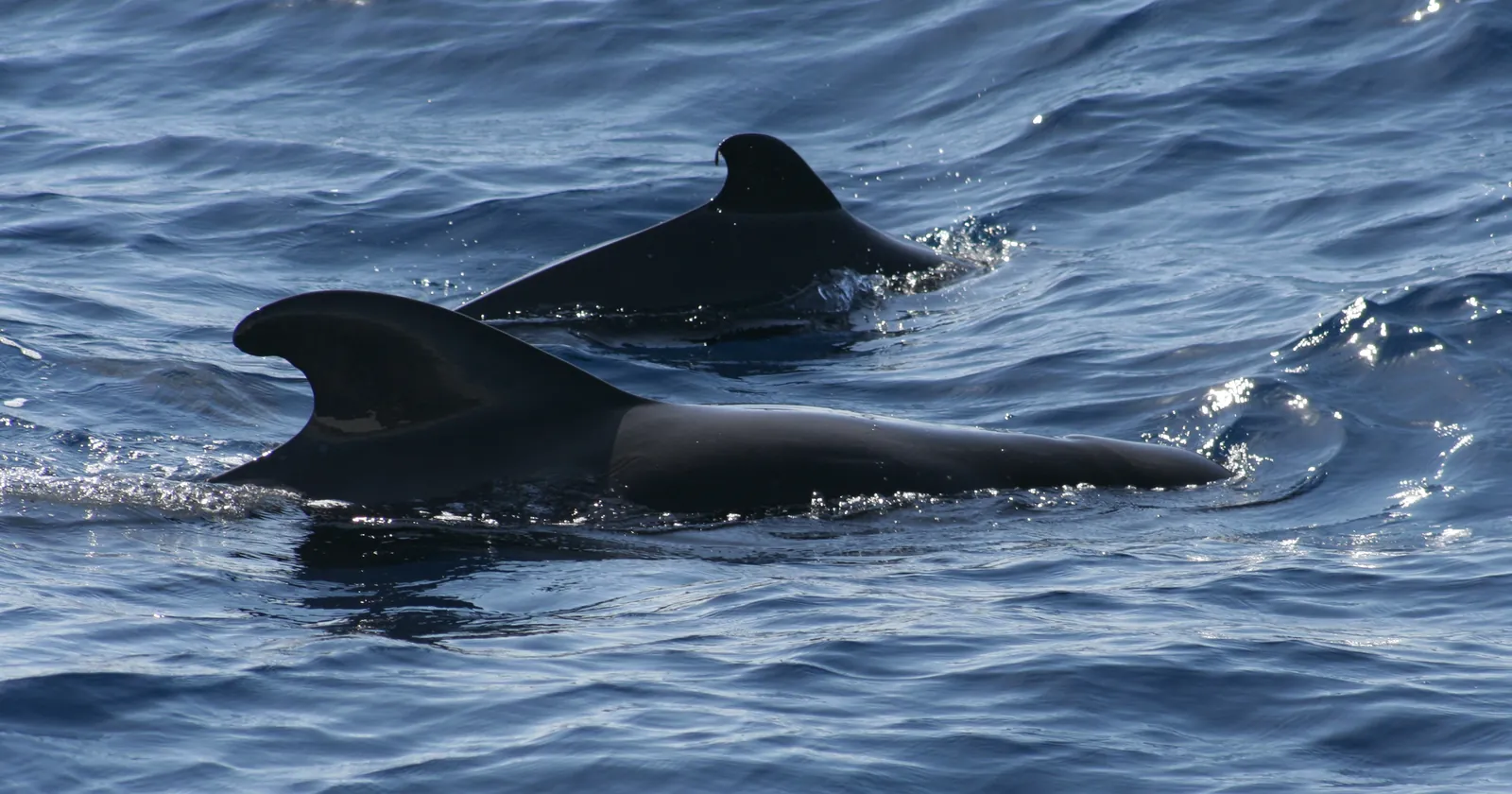
Photo: ahisgett, Wikimedia Commons, CC BY 2.0.

Key takeaways
- The Franja Marina de Teno-Rasca covers 69,489.68 hectares along five west-coast municipalities, declared by Orden ARM/2417/2011 for one sandbank habitat and two species, neither of them the pilot whale
- The environment ministry calls the pilot whales here resident and states that the only other known resident populations of the species are in Japan, Madeira, California and Hawaii
- Spanish law bars bathing and diving inside a 60-metre exclusion zone around a cetacean; the Canarian decree of 2000 puts swimming or diving within 500 metres on its infraction list
- Blubber cortisol in the Teno-Rasca pilot whales fell during the Covid lockdown and was back near pre-pandemic levels by 2022, which is part of the case for the moratorium on new watching permits
- Two wrecks carry the island: El Condesito off Las Galletas, dated 1971 by the tourism board, and El Peñón at Tabaiba, a 35-metre vessel sunk in 2006 and entered on foot
Where Tenerife diving happens: 15 of 22 dive businesses file a southern address
Book a dive here and you will almost certainly end up south of the island’s central ridge. Of the 22 businesses on our Tenerife list registered for scuba diving, 15 file an address on the southern half of the island, running from Santiago del Teide on the west coast round to Abades in the south-east. Four sit in one pocket of the east coast, at Radazul, Tabaiba and El Rosario. Two are in the north.
Weather explains that distribution better than water does. Dive sites in this archipelago cluster on the eastern and southern coasts of each island because of exposure and hydrodynamics, in the words of the research team that surveyed the Canary angelshark population across 84 official diving centres. North-facing coasts take the trade-wind swell, and the north of Tenerife is high, cliffed and short of sheltered entries.
One exception shows how local all this is. All four kitesurfing schools in our list file the same town, El Médano, and the single windsurf and wing listing sits there too. That corner of the south-east is reliably windy, which is exactly what sells a kite lesson and exactly what a dive boat plans around. The Tenerife operator list spreads its 22 dive businesses over 17 different town names and its kite schools over one.
What the west coast has instead of wind is a conservation zone, and it is not a small one.
Teno-Rasca: the 69,489-hectare zone most Tenerife diving sits inside
The Franja Marina de Teno-Rasca runs down the western sea of the island and covers 69,489.68 hectares, a figure the environment ministry publishes to the hundredth of a hectare. Its landward edge touches five municipalities: Buenavista del Norte, Santiago del Teide, Guía de Isora, Adeje and Arona. Orden ARM/2417/2011 of 30 August declared it a Special Area of Conservation, published in the BOE of 14 September 2011 together with the rest of the Macaronesian marine sites.
The annexed map is blunt about the reason. One habitat type: sandbanks permanently covered by shallow seawater, code 1110. Two species: the loggerhead turtle Caretta caretta, code 1224, and the bottlenose dolphin Tursiops truncatus, code 1349. The animal this coast is actually sold on, the short-finned pilot whale, appears nowhere in that list.
Three of the conservation measures attached to the order reach a diver directly. Anchoring over meadows of marine phanerogams is prohibited, with anchoring defined as fixing an anchor system on the seabed. Navigation stays free, subject to good maritime practice. And the ministry reserved the power to regulate underwater activity in the submerged and semi-submerged marine caves habitat, given its singularity and its conservation status.
Those measures were given six years and continue until something replaces them. Nothing has. The rules a visiting diver actually meets in this water arrived later, from a different department, and they are about animals rather than about the seabed.
The pilot whales off Tenerife are residents, and the ministry names four other places
Calderón tropical, the short-finned pilot whale, is why boats leave the south-western marinas in every month of the year. The environment ministry’s own note on this zone calls the population resident, because sightings occur all year and some of the social groups show high fidelity to the area. It then states that the only other known resident populations of the species are in Japan, Madeira, California and Hawaii. Both the pilot whale and the bottlenose dolphin are catalogued as vulnerable in the Spanish Catalogue of Threatened Species.
How many animals there are is less settled than where they live. The IUCN task force factsheet for the Canary and Madeira Islands Important Marine Mammal Area carries two numbers side by side: an estimate of 636 to 1,247 animals off south-west Tenerife from work published in 2014, and 362 individuals counted as resident, with a confidence interval of 252 to 746, from studies covering 2015 to 2020. Different methods, different questions, and the factsheet prints both rather than choosing.
Resident does not mean sealed off. A photo-identification study of the archipelago published in 2019 found evidence of an island-associated subpopulation and a transient one at the same time, sharing range and social contact instead of sitting in separate boxes. Madeira, one of the four places the ministry names, holds the same species in the same arrangement, and the Madeira guide covers an island that protects its water a different way.
The label that travels furthest is not a legal one at all. In January 2021 the Tenerife-La Gomera marine area, roughly 2,000 square kilometres and nine tenths of it sea, was accredited by the World Cetacean Alliance as Europe’s first Whale Heritage Site, an accreditation for responsible watching rather than a protection order. It counts 23 cetacean species in the area, two of them resident. The Canarian decree of 2000 put the archipelago’s total at about 26.
What the ministry wrote in 2023 about the boats above Tenerife’s whales
On 26 September 2023 the Directorate General for Biodiversity, Forests and Desertification set out what it thought was happening over those whales. Teno-Rasca, it wrote, now carries the largest supply of recreational cetacean watching of any area in the Canary Islands. Alongside that it recorded a growing presence of recreational boats and jet skis, with the collision risk and the engine noise that follow.
The evidence it cites is unusual, because the pandemic ran the experiment for it. Work in 2015 had already found that heavy pressure around the pilot whales could push their stress above normal levels, with possible sublethal effects. When nautical activity stopped during the Covid lockdown, blubber cortisol in the same population dropped sharply. Repeated through 2021 and 2022, the measurements had climbed back to almost pre-pandemic levels.
Calves point the same way. Groups watched where recreational pressure is low, at Anaga and around El Hierro, carried a higher proportion of calves than groups in the south-west of Tenerife, and calf numbers rose after the lockdown. A 2021 study found that at speeds of around 1.5 knots the whales cut the time they spend resting and nursing. Slow is not the same as harmless.
What follows from all that is a closed door. The directorate had told the Canary government in 2019, and again in 2020, that new authorisations for recreational cetacean watching in this zone should be held back, and the 2023 note restates it: a moratorium until a carrying-capacity study under the LIFE IP INTEMARES project reports, which was expected during 2024.
That communication is still what the ministry’s page for the activity points at, so the boats out there are working on permits that already existed. New entrants wait. Our whale watching roundup covers coasts where the pressure is arranged differently.
Diving near a cetacean in Tenerife: 60 metres in state law, 500 in the Canarian decree
Two instruments govern how close a person may get, and they do not give the same number. The state one, Real Decreto 1727/2007, draws a mobile protection space around any cetacean: an imaginary cylinder of 500 metres radius, reaching 500 metres into the air and 60 metres under water. Inside it, article 4.2 prohibits physical contact between vessels or people and the animal, feeding it or throwing anything to it, and bathing or diving in the exclusion zone, the inner ring of not less than 60 metres.
The Canarian instrument is older and harder. Decreto 178/2000 lists the conduct it treats as capable of killing, harming, disturbing or alarming a cetacean, and therefore as an administrative infraction. Swimming or diving within 2.7 cables, which the text converts for you as 500 metres, is on that list. So are approaching within 60 metres, exceeding four knots inside 500 metres, staying more than 30 minutes within 100 metres, and being the third boat inside 500 metres or the second inside 100.
Neither text lets a private person off. The decree exempts occasional non-profit observers from needing an authorisation, then says in the next line that the infraction regime applies to them anyway. For a diver the practical reading is short: if a pod is at the surface near the boat, you stay on the boat.
The paperwork above all this has shifted over the years. A tourism business now starts the activity with a responsible declaration rather than a licence, under the change made by Ley 14/2009, with a guarantee of 6,010.12 euros lodged and a sectoral tourism guide aboard. The environmental authorisation is a separate document and still comes from the ministry. A flag goes with it: the Barco Azul, canary yellow, 80 by 50 centimetres, with the period of its authorisation printed on it in blue.
El Condesito off Las Galletas: the Tenerife wreck dive with more than one date
El Condesito is the dive most visitors book twice. The Canary Islands tourism board describes a 30-metre ship that ran aground off the southern tip of the island and now lies broken into several pieces on the floor of a submarine canyon with prismatic walls, at El Palmar, 3.7 nautical miles from the port of Los Cristianos. It gives the depth band as 12 to 30 metres and the difficulty as low, with the warning that current can push it up a grade.
Her cargo is the reason to go. She was carrying cement for the building of Los Cristianos, the sacks set where they sat, and the holds now hold white blocks that read as quarried stone until you get close. Octopus, cuttlefish and parrotfish are the animals the board names. The grounding is also why the Rasca lighthouse stands where it does.
The year is where the story comes apart. Officially she went aground in 1971. Circulating accounts also give 1972 and 27 September 1973, and the depths quoted for her elsewhere, roughly 18 metres down to 21, sit inside rather than alongside the official 12 to 30. Only the 1971 has a named source behind it, which is why it is the figure used here.
None of that changes the profile much. What it changes is the briefing you should expect: ask the centre what it actually measures on the shallowest and deepest parts, because a canyon site quoted as a band is not a site quoted as a depth. Coasts built around this kind of dive are collected in our wreck diving list.
El Peñón at Tabaiba: Tenerife’s shore-entry wreck, sunk in 2006
Tabaiba is the closest this island comes to a walk-in wreck. El Peñón is a 35-metre vessel placed on the bottom as an artificial reef in 2006, and the tourism board lists the access as on foot. Its figures for the site are a maximum of 32 metres and a minimum of 20, difficulty moderate, with the hull lying 30 degrees over to starboard.
What is on the wreck beats what surrounds it. Polyps, octopus and large morays live inside the dismantled ship, while the water above carries shoals of fulas, trumpetfish, barracuda, jacks and amberjack. The board is unusually frank about the rest of the dive: the way out and back holds no great attractions, which is why it suggests nitrox, to spend the time at the wreck rather than on the swim. What nitrox actually buys you is a separate question, and a shallower one than most people assume.
One oddity in the official text is worth knowing before you read a map. It places the wreck on the north-east coast of Tenerife. Tabaiba sits on the east coast a few kilometres south of Santa Cruz, which is where the centres filed under Radazul and Tabaiba work, and the difference matters if you are trying to guess your exposure to swell.
Armeñime and the green turtles Tenerife’s official dive page still promises
El Puertito, which the tourism board files under Armeñime, is a bay in Costa Adeje with an average depth of 6 metres and a maximum of 15. The board rates it low difficulty, calls it suitable for families, and describes green turtles of up to 20 kilos that are very accustomed to human presence. That last phrase carries more weight than it looks like carrying.
A wild turtle that approaches people has usually been fed by them. The green turtle sits in Spain’s special protection regime and in the Canarian catalogue of protected species, in Annexes II and IV of the Habitats Directive and in Appendix I of CITES.
Article 54 of Ley 42/2007 prohibits killing, damaging, disturbing or intentionally alarming wild animals, and article 57.1.b adds, for listed species, any act done with the purpose of pursuing or disturbing them. Feeding one to hold it in a bay is not a grey area in that wording.
A gap between two documents is also worth noticing. The turtle named in the declaration of Teno-Rasca is the loggerhead, Caretta caretta. What the dive pages promise at El Puertito is the green turtle, which that annex does not list, although the general protection regime covers it everywhere in Spanish water. Protection and celebrity run on different maps.
Sightings in the bay have become less reliable than the official wording implies, and no survey we can cite settles how many animals use it in a given season. Look, and keep your hands to yourself. If you want the animal rather than the bay, our turtle destinations guide compares places where the population is counted.
Montaña Amarilla and the angelshark: sand beside reef on the south coast
Montaña Amarilla is a yellow tuff cone at Costa del Silencio that does not stop at the shoreline. Below the surface it continues as rock: a large pinnacle, arches and caves, with sand around the edges holding garden eels and dragonets. The tourism board puts the marina at Las Galletas a mile and a half away, rates the difficulty low, and then contradicts itself on depth, giving 21 to 30 metres in its data field and an average of 15 with a maximum of 25 in the text below it.
Sand beside reef is also the habitat of the animal that makes this coast unusual. The angelshark, Squatina squatina, is Critically Endangered on the IUCN Red List, and since Orden TEC/596/2019 of 8 April, published in the BOE of 5 June 2019, the Canarian population has sat in the Spanish Catalogue of Threatened Species in its highest category, en peligro de extinción. Two related species were listed the same day.
The survey that established where they are ran on divers. Between April 2014 and March 2015 it gathered 678 sightings through a citizen-science tool, from 39 contributors at 22 dive centres, only two of them on Tenerife. Animals measured 20 to 200 centimetres, sightings ran from under a metre of water to 45 metres, and newborns turned up only between the surface and 25 metres, on sand next to reef.
Tenerife’s share of that is the part that should change a booking. Thirty-six of the newborns recorded across the whole archipelago were seen here, more than on any other island, at what the authors describe as a nursery area then under study. Las Teresitas, on the north-east coast, was one of four cells with a high frequency of sightings.
Seasonality follows sex. Males were commonest from November to January, the mating season, while larger females and newborns turned up mostly from April to July. Winter is angelshark season here, and a February trip is not the consolation prize it sounds like.
Where a Tenerife diving accident is treated, and what a third of the cases are
The chamber that would treat you is not near most of the diving. It stands at the Complejo Hospitalario Universitario de Canarias, above La Laguna in the north-east, and is run by IMETISA, a public company of the Cabildo de Tenerife. A doctoral thesis at the Universidad de La Laguna, which examined the diving accidents treated there between 2009 and 2015, describes that hospital as the region’s referral centre and the one holding a multiplace chamber and a hyperbaric medicine unit.
The unit published its own count in November 2024, marking 40 years since the first chamber was installed and 15 years of the current equipment. More than 1,000 patients have been treated in it, and more than 23,000 treatment sessions given. Of the case mix, 30 per cent is diving-related and another 30 per cent is ulcers and wounds, with sudden deafness at 5 per cent and central retinal artery occlusion at 2.
Read that against the first section of this page. Fifteen of the island’s dive businesses work the southern coast; the chamber is on the other side of the island. That is not an argument against diving in Tenerife, it is an argument for cover that pays for a transfer, which our dive insurance comparison works through policy by policy.
The Tenerife operator list holds 26 businesses, 22 of them for diving
Twenty-six watersports businesses on Tenerife appear in the registers behind this site, read on 20 September 2026: 22 published by SSI, 4 by IKO and 1 by VDWS, with one business appearing in more than one of them. Twenty-two of the 26 are listed for scuba diving. Twenty of the 26 publish a website in the register, and 19 of the 22 dive businesses do.
How they are filed tells you something the totals do not. Those 22 dive businesses sit under 17 different town names, from “LOS CRISTIANOS” in capitals to “Puerta de la Cruz”, which is a misspelling of Puerto de la Cruz and the kind of thing that makes a register search by town unreliable. Two of the 22 are in the north, at Puerto de la Cruz and Los Silos. The four kite schools are all in El Médano.
A register entry settles one thing and no more. The body lists this business, on the date given, and nothing follows about the teaching, the boats, the briefings or whether the doors are open this season. No public register of businesses licensed for these activities in Spain was reachable to check the listings against, which is a statement about what can be read rather than about who holds a licence. Which registers can be read logs what each source returned and when it was asked.
If you are weighing the island as a base rather than as a trip, the living side of it, including costs and the wifi, sits in our Tenerife guide for nomads who dive, and the shore-entry wall on the next island east is covered in the Lanzarote guide.
FAQ: scuba diving in Tenerife
Do you need a permit to dive in Tenerife?
Not for the dive itself. A recreational diver books with a centre and goes, and no island or municipal permit stands between the two. What Tenerife adds sits around the dive rather than in it: most of the west coast lies inside the Franja Marina de Teno-Rasca, a Natura 2000 site where anchoring over seagrass meadows is prohibited, and the cetacean rules that cover swimming and diving near whales apply to private people as well as to businesses. A company running cetacean watching needs a ministry authorisation and, on the tourism side, a responsible declaration with a guarantee of 6,010.12 euros.
How close can you get to pilot whales when diving in Tenerife?
Closer than the law allows, if you are careless, because the animals come to the boat. Real Decreto 1727/2007 draws a cylinder of 500 metres radius around any cetacean, reaching 500 metres up and 60 metres down, and prohibits bathing or diving inside its exclusion zone, the inner ring of at least 60 metres. The Canary Islands go further: Decreto 178/2000 lists swimming or diving within 500 metres of a cetacean among the conducts it treats as disturbing the animal, which makes it an administrative infraction. The stricter number is the one that governs in Canarian water.
What is the Franja Marina de Teno-Rasca and does it restrict diving?
It is the Special Area of Conservation covering the western sea of Tenerife, 69,489.68 hectares alongside Buenavista del Norte, Santiago del Teide, Guía de Isora, Adeje and Arona, declared by Orden ARM/2417/2011 of 30 August. It was declared for one habitat, sandbanks permanently covered by shallow seawater, and two species, the loggerhead turtle and the bottlenose dolphin. The measures attached to it prohibit anchoring over seagrass meadows, keep navigation free subject to good maritime practice, and reserve the power to regulate underwater activity in the submerged marine caves habitat. Diving itself is not closed anywhere inside it.
Which wrecks can you dive in Tenerife?
Two carry the island. El Condesito lies off the southern tip near Las Galletas, a 30-metre cement carrier broken into several pieces in a submarine canyon, which the Canary Islands tourism board dates to 1971 and places in a depth band of 12 to 30 metres, 3.7 nautical miles from the port of Los Cristianos. El Peñón at Tabaiba is a 35-metre vessel sunk on purpose as an artificial reef in 2006, tilted 30 degrees to starboard, with a maximum depth of 32 metres and an entry on foot from the shore. The cement sacks in the Condesito set hard and now look like quarried stone.
Can you still see green turtles at El Puertito in Tenerife?
The official dive page still promises them. The Canary Islands tourism board lists the bay at Armeñime, in Costa Adeje, at an average depth of 6 metres and a maximum of 15, and describes green turtles of up to 20 kilos that are very accustomed to human presence. Sightings have become less reliable than that wording suggests, and no survey we can cite settles how many animals use the bay now. Whatever turns up, the green turtle is in Spain’s special protection regime and in Appendix I of CITES, and feeding or handling one is prohibited.
When can you see angelsharks diving in Tenerife?
Winter, mostly. The archipelago-wide citizen-science survey of Squatina squatina, which collected 678 sightings between April 2014 and March 2015, found males significantly more frequent from November to January, the mating season, while larger females and newborns came mostly between April and July. Sightings ran from under a metre of water to 45 metres, and newborns appeared only between the surface and 25 metres, on sandy bottoms next to reef. Tenerife accounted for 36 of the newborn sightings, more than any other island.
Where is the recompression chamber for a diving accident in Tenerife?
At the Complejo Hospitalario Universitario de Canarias, on the north-eastern side of the island above La Laguna, where the chamber is run by IMETISA, a public company of the Cabildo de Tenerife. In November 2024 the unit reported more than 1,000 patients treated and more than 23,000 treatment sessions given, marking 40 years since the first chamber was installed and 15 years of the current one. Thirty per cent of its cases are diving-related. Most of the island’s dive businesses work the opposite coast, which is a point about transfer cover rather than about the diving.
Is diving in Tenerife better in the north or the south?
The market has already answered. Of the 22 businesses on our Tenerife list registered for scuba diving, 15 file an address on the southern half of the island and only two in the north, at Puerto de la Cruz and Los Silos. Dive sites in the Canary Islands cluster on the eastern and southern coasts of each island because of exposure and hydrodynamics, in the words of the researchers behind the angelshark survey. The north takes the trade-wind swell and is short of sheltered entries.
How many dive centres are there on Tenerife?
Twenty-six watersports businesses on Tenerife appear in the registers behind this site, read on 20 September 2026: 22 published by SSI, 4 by IKO and 1 by VDWS, with one business appearing in more than one. Twenty-two of the 26 are listed for scuba diving, and 20 of the 26 publish a website in the register. A register entry means the body lists that business on the date given, and nothing about the teaching, the boats or whether it is trading this season.
Founder of NOMADREEF and a former digital nomad. This guide is sourced from the references below; conditions, prices and rules change, so verify current details, and follow qualified local guidance and safety briefings. About the author · LinkedIn ↗
Sources
- The conservation zone and its size. Surface of 69,489.68 hectares in the western sector of Tenerife, bordering Buenavista del Norte, Santiago del Teide, Guía de Isora, Adeje and Arona, a Special Area of Conservation since September 2011. Ministerio para la Transición Ecológica y el Reto Demográfico, ZEC ES7020017 Franja marina de Teno-Rasca. Read 20 September 2026.
- The declaring order and the measures. Orden ARM/2417/2011 of 30 August declaring the marine sites of community importance of the Macaronesian region as Special Areas of Conservation and approving their conservation measures, published in the BOE of 14 September 2011; the prohibition on anchoring over meadows of marine phanerogams, defined as the fixing of an anchor system on the seabed; free navigation subject to good maritime practice; the reserved power to regulate underwater activity in the submerged and semi-submerged marine caves habitat; the six-year validity of the measures, extended until replaced. BOE-A-2011-14661, consolidated text. Read 20 September 2026.
- What the site was declared for. Annex I cartography for ES7020017 naming the habitat “1110 Bancos de arena cubiertos permanentemente por agua marina poco profunda” and the species “1224 Caretta caretta” and “1349 Tursiops truncatus”. Ministerio de Agricultura, Pesca y Alimentación, ZEC ES7020017 map sheet (PDF). Read 20 September 2026.
- The residency, the stress work and the moratorium. Communication of 26 September 2023 of the Dirección General de Biodiversidad, Bosques y Desertificación on the situation of cetaceans in the ZEC Franja Marina Teno-Rasca: the resident population of Globicephala macrorhynchus, sighted all year with high site fidelity, and the statement that the only other known resident populations are in Japan, Madeira, California and Hawaii; pilot whale and bottlenose dolphin catalogued as vulnerable under Real Decreto 139/2011; the zone holding the largest supply of recreational cetacean watching in the Canary Islands; the 2015 stress findings; blubber cortisol falling during the Covid confinement and returning to almost pre-pandemic levels in 2021 and 2022; the higher proportion of calves at Anaga and El Hierro than in south-west Tenerife; the 2021 finding that at speeds around 1.5 knots the animals reduce resting and nursing; articles 54 and 57.1.b of Ley 42/2007 and the prior authorisation under article 3.4 of Ley 41/2010; the moratorium pending the LIFE IP INTEMARES carrying-capacity study expected to finish in 2024. MITECO, Comunicación moratoria nuevas autorizaciones AROC (PDF), linked from the ministry’s page on actividad recreativa de observación de cetáceos. Both read 20 September 2026.
- The 60-metre exclusion zone. Real Decreto 1727/2007 of 21 December establishing measures for the protection of cetaceans: article 2 defining the mobile protection space as a cylinder of 500 metres radius, 500 metres high in the air and 60 metres deep under water, with an exclusion zone of not less than 60 metres; article 4.2 prohibiting physical contact of vessels or people with the animal, feeding it or throwing food, drink, rubbish or any object, and bathing or diving in the exclusion zone; article 3.1 applying it to internal waters, the territorial sea, the contiguous zone and the exclusive economic zone. BOE-A-2008-516, consolidated text. Read 20 September 2026.
- The 500-metre rule and the Barco Azul. Decreto 178/2000 of 6 September regulating cetacean watching activities, consolidated text in the Canary Islands Libro Azul: article 13.1 making it an infraction to kill, damage, disturb or intentionally alarm cetaceans, and 13.2 specifying the conduct, including “nadar o bucear en un radio inferior a los 2,7 cables (500 metros)”, the 60-metre approach, four knots inside 500 metres, 30 minutes inside 100 metres, two vessels at 100 metres and three at 500; articles 2.2 and 3.2 exempting occasional non-profit observers from authorisation while keeping them inside article 13; article 15 and annex IV on the Barco Azul flag, canary yellow, 80 by 50 centimetres; the preamble putting about 26 cetacean species in Canarian waters. Gobierno de Canarias, Decreto 178/2000 (PDF), also published in BOC 133 of 6 October 2000. Read 20 September 2026.
- The responsible declaration and the guarantee. Procedure sheet for the Declaración Responsable de inicio de actividad de observación de cetáceos con fines turísticos: no fee, effective from the moment it is filed, a lodged guarantee of 6,010.12 euros and a sectoral tourism guide aboard, with Ley 14/2009 as the change that replaced the prior licence. Sede electrónica del Gobierno de Canarias, trámite 3120. Read 20 September 2026.
- The population figures. Canary and Madeira Islands Important Marine Mammal Area factsheet: short-finned pilot whales in south-western Tenerife estimated between 636 (95% CI 602–671) and 1,247 animals, and 362 individuals considered resident (CI 252–746) in studies covering 2015 to 2020, with the area given as 50,006 square kilometres. IUCN Marine Mammal Protected Areas Task Force, Canary and Madeira Islands IMMA. Read 20 September 2026. The two estimates come from different methods and the factsheet publishes both.
- Resident and transient at the same time. Servidio, Pérez-Gil, Pérez-Gil, Cañadas, Hammond and Martín, “Site fidelity and movement patterns of short-finned pilot whales within the Canary Islands: evidence for resident and transient populations”, Aquatic Conservation: Marine and Freshwater Ecosystems 29 (2019). Read 20 September 2026.
- The Whale Heritage Site. Tenerife-La Gomera accredited in January 2021 as the first Whale Heritage Site in Europe, about 2,000 square kilometres with 90 per cent marine area, two resident species and 23 cetacean species in total. World Cetacean Alliance, Tenerife-La Gomera. Read 20 September 2026. This is an accreditation scheme for responsible watching, not a legal protection instrument.
- The dive sites. Canary Islands tourism board dive-site pages, read 20 September 2026: Condesito (a 30-metre ship aground in 1971, fragmented in a submarine canyon with prismatic walls at El Palmar, 3.7 nautical miles from Los Cristianos, 12 to 30 metres, low difficulty, current raising it to medium, cement cargo for the building of Los Cristianos, and the Rasca lighthouse built afterwards); Tabaiba (El Peñón, 35 metres long, sunk as an artificial reef in 2006, 30 degrees to starboard, minimum 20 and maximum 32 metres, moderate difficulty, entry on foot, nitrox suggested because the route out holds no great attractions, and the coast described as north-east); Armeñime (average 6 metres, maximum 15, low difficulty, green turtles up to 20 kilos described as very accustomed to human presence); Montaña Amarilla (a mile and a half from the Las Galletas marina, low difficulty, pinnacle with arches and caves, garden eels and dragonets on the surrounding sand). The Montaña Amarilla page states 21 to 30 metres in its depth field and an average of 15 with a maximum of 25 in its text; both are printed here because the page does not reconcile them.
- The angelshark listing. Orden TEC/596/2019 of 8 April amending the annex of Real Decreto 139/2011, published in the BOE of 5 June 2019, which adds Squatina squatina (Canarias), Squatina oculata (Canarias) and Squatina aculeata (Canarias) to the Spanish Catalogue of Threatened Species in the category en peligro de extinción. BOE-A-2019-8317. Read 20 September 2026.
- The angelshark survey. Meyers, Tuya, Barker, Jiménez Alvarado, Castro-Hernández, Haroun and Rödder, “Population structure, distribution and habitat use of the Critically Endangered Angelshark, Squatina squatina, in the Canary Islands”, Aquatic Conservation: Marine and Freshwater Ecosystems (2017): 678 sightings between April 2014 and March 2015 from 39 citizen scientists at 22 diving centres, two of them on Tenerife; total lengths of 20 to 200 centimetres; depths from under one metre to 45 metres with neonates only between 0 and 25 metres; sandy bottoms adjacent to reefs; males significantly more frequent from November to January and larger females and neonates from April to July; 36 neonates in Tenerife at a nursery area under study; Las Teresitas one of four cells with a high frequency of sightings; and the statement that most dive sites lie on the eastern and southern regions of each island because of exposure and hydrodynamics, across 84 official diving centres in the archipelago. Full text (PDF). Read 20 September 2026. The paper gives the archipelago-wide neonate total as 69 in one place and 79 in another; only the Tenerife count of 36 is used here.
- The green turtle’s status. Chelonia mydas under the Spanish special protection regime and “protección especial” in the Canarian catalogue of protected species, in annexes II and IV of the Habitats Directive, appendix I of CITES, annex II of the Bern Convention and appendices I and II of the Bonn Convention. Banco de Datos de Biodiversidad de Canarias, BIOTA. Read 20 September 2026.
- The chamber. Hyperbaric unit of the Complejo Hospitalario Universitario de Canarias, managed by IMETISA: more than 1,000 patients and more than 23,000 treatments, 40 years since the first chamber and 15 years of the current one, with 30 per cent of cases diving-related, 30 per cent ulcers and wounds, 5 per cent sudden deafness and 2 per cent central retinal artery occlusion. Gobierno de Canarias, 22 November 2024. The description of the hospital as the referral centre with a multiplace chamber and a hyperbaric medicine unit, and the 2009 to 2015 study period, come from Alonso Lasheras, “Accidentes de buceo: epidemiología en un hospital de referencia y uso de la cámara hiperbárica”, Universidad de La Laguna, 2016. Both read 20 September 2026.
- The 26 businesses. Twenty-six watersports businesses on the Tenerife operator list, read 20 September 2026: 22 in the SSI register of training centres, 4 in the IKO school register and 1 in the VDWS station register, one of them in more than one register. Twenty-two are listed for scuba diving, 20 of the 26 publish a website there, and the 22 dive businesses are filed under 17 different town names, one of them spelled “Puerta de la Cruz”. No public register of businesses licensed for these activities in Spain was reachable to check the listings against; what each source returned is logged on which registers can be read.