Lanzarote Diving: Museo Atlántico, Playa Chica and the Chinijo Reserve
 by Yannick Schroth
Sep 20, 2026
11 min read
by Yannick Schroth
Sep 20, 2026
11 min read
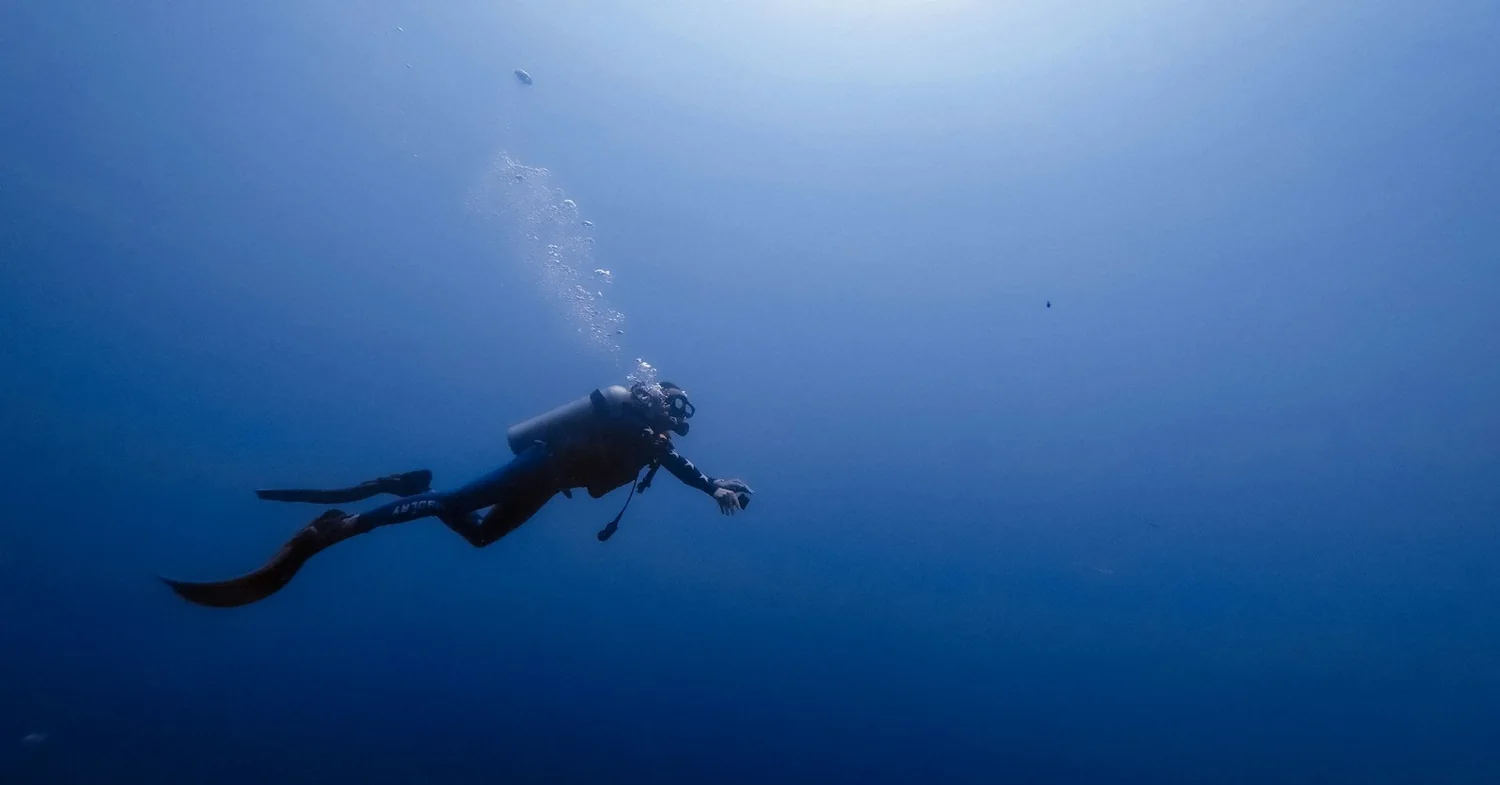
Photo: Unsplash (free licence).
Key takeaways
- The Museo Atlántico lies at 12 to 14 metres on a 50 by 50 metre patch off Playa Blanca: over 300 casts, installed 2016, officially opened January 2017
- The Cabildo closed it as a cultural installation in 2020, so there is no ticket and no safety boat; a reopening was announced on 10 January 2024 with no date attached
- Veril de Playa Chica at Puerto del Carmen is a shore entry onto a cliff of 15 to 40 metres, collapsing past 45, rated low difficulty for its access rather than its depth
- The La Graciosa and northern islets reserve runs to 70,700 hectares; diving needs express authorisation, free, open all year, resolved in 20 days, with silence counting as refusal
- Spain’s 1997 safety order requires accident and civil liability insurance for every recreational diver and caps recreational depth at 40 metres
What the Museo Atlántico actually is, off Playa Blanca
Most people meet this place as a photograph: grey figures standing in blue water, faces half taken by algae. The site is real and it is close in. Jason deCaires Taylor’s Museo Atlántico sits in a sheltered bay at Las Coloradas, off Playa Blanca, on a square of seabed measuring 50 metres by 50 metres that was bare sand before the work went down.
The numbers are modest, and that is the point. Depth runs 12 to 14 metres, which puts the whole exhibition inside entry-level limits. The artist’s own record lists over 300 life-size casts in ten groups, among them Crossing the Rubicon, The Raft of Lampedusa, The Human Gyre and Los Jolateros, built from pH-neutral cement, stainless steel, basalt and aggregates. Installation ran through 2016; the official opening followed in January 2017.
So is it worth the hype for a diver rather than for a photographer? That depends on what the dive is for. As a dive it is shallow, sheltered and completely static. As an artificial reef it has done what it was built to do, gathering fish over ground that held almost nothing. What it is not is a replacement for the volcanic sites up the coast, and treating it as the one dive of a Lanzarote trip is a mistake.
The Museo Atlántico closed as a museum in 2020 and stayed open as a dive site
This is the part the brochures skip. The Cabildo de Lanzarote closed the cultural installation in 2020, and the museum was separated from CACT, the island network of art, culture and tourism centres that had commissioned it. The entry ticket went. So did the safety boat. The sculptures stayed exactly where they were.
What followed was a dispute rather than a plan. In November 2022 the island’s association of diving schools and centres said pieces were being lifted out and that it feared the dismantling of the site, while the Cabildo described the removals as maintenance. That account comes from the trade press rather than from a public file, so it belongs on this page as reported rather than as settled.
On 10 January 2024 the Cabildo announced a reopening and set up a technical and legal working group with SPEL, the island’s external promotion company, and with the artist, to define an operating model and a timetable. The announcement named no date. Diving clubs on the island had been asking for the reopening for years, and the announcement said so in as many words.
The practical effect for a visitor is simple. You reach the Museo Atlántico on a dive centre’s boat out of Playa Blanca, at the centre’s price and on the centre’s schedule, not through a museum counter. There is no published visitor limit and no ticket to buy ahead. Ask the centre when it last dived the site, because the condition of individual pieces has been moving for years.
Puerto del Carmen and Playa Chica: a 40-metre wall reached from the beach
If Lanzarote has one signature dive, it is not the museum. Veril de Playa Chica, in Puerto del Carmen, is a sloping sand platform that ends at a cliff, and the Canary Islands tourism board puts that cliff at 15 to 40 metres, broken by shelves, caves and small hollows, with the collapse continuing past 45 metres.
The entry is a beach. You walk in, swim a short way, and the terrain arrives. That single fact reshapes a dive trip: no crossing, no boat schedule, no weather window to lose, and the same site serves a first descent on the sand platform and a deep dive on the wall in one morning.
The inventory is worth knowing before booking. A small wreck lies at about 30 metres and holds a resident grouper the island calls Félix. The Cueva de las Gambas, the shrimp cave, sits at roughly 45 metres, which is past the Spanish recreational ceiling and therefore not an open-water dive. The official listing rates the site low difficulty, and that rating describes the access rather than the depth.
Round the corner from the beach there is a second Puerto del Carmen dive, and this one needs a boat. The tourism board describes six boats on the bottom that can be linked in a single dive, running from about 12 metres down to roughly 40 metres at a propeller, rated medium to quite experienced. Angel shark, stingray, cardinal fish and sponges are the regular sightings, with anemones in the nearest caves.
Lanzarote’s volcanic seabed: lava tunnels, arches and black sand
The reason the diving looks like this is on land, and it is recent. The eruptions that made Timanfaya ran from 1730 to 1736, and the national park service calls the park an eminently geological one, with more than 25 craters concentrated in the Fire Mountains. It is the rare Spanish national park declared for its rock rather than for its wildlife.
Two features of that geology carry straight into the water. Fluid lava builds volcanic tunnels, hollow tubes left when the surface of a flow sets while the inside keeps running; where the roof of one falls in, Lanzarote calls the opening a jameo. The flows also reached the coast, so this is a lava shoreline, and the arches, swim-throughs and roofed hollows divers here talk about are the submerged version of the same structure.
One of those tubes does not stop at the shoreline. The Corona tube in the north of the island continues below sea level as the Túnel de la Atlántida, described in the research literature and the dive press as the longest known submarine lava tube. It is a scientific cave-diving site rather than a recreational one, and no operator sells it. That claim rests on triangulation across published research and dive journalism, not on a government page.
The everyday consequence is a dark seabed. Black sand and dark basalt swallow light instead of bouncing it, so colour drops away faster than the depth gauge suggests and a torch earns its place on a 20-metre dive. Against that background the sponges, orange coral and anemones on the walls read far brighter than they would over pale Caribbean sand. The tourism board puts horizontal visibility at up to 30 metres.
La Graciosa and the Chinijo reserve: the authorisation a diver needs
North of Lanzarote the rules change. The waters around La Graciosa and the northern islets have been a reserva marina de interés pesquero since 1995, created by a state order of 19 May 1995 and by Canarian Decree 62/1995 of 24 March, and covering 70,700 hectares. Roughly 40 per cent lies in outer waters run by the Spanish state, and the remaining 60 per cent in inner waters run by the Canary Islands.
A circle of one nautical mile radius centred on Roque del Este is the integral reserve. Inside it, every kind of sea fishing and every extraction of marine fauna and flora is prohibited outright. Outside it, scuba diving is allowed, but the 1995 order allows it only with express authorisation, and it bars divers from carrying any instrument usable for fishing or extraction, either on the person or in the boat.
The authorisation is a real procedure. For inner waters the Canary Islands government runs it through its electronic register: applications are open all year, there is no fee, the resolution period is 20 days, and administrative silence counts as a refusal rather than as an approval. Individual divers, clubs, sport and recreational associations and dive centres can all apply.
What the file has to contain is the useful part. A current insurance policy covering the risks and liabilities of the activity, proof of diving certification, and the vessel’s documentation. Organisations add their statutes, proof of representation, a declared maximum number of participants and a responsible declaration covering everyone taking part. Book through a centre and the centre carries this; plan a private boat trip and the 20-day clock is yours.
The reserve sits inside the Chinijo Archipelago Natural Park, protected since 1986 and reclassified by the Canary Islands natural spaces law of 1994, covering La Graciosa, Alegranza, Montaña Clara, Roque del Este and Roque del Oeste. Both the Canary Islands tourism board and Turismo Lanzarote describe it as the largest marine reserve in Europe. The fisheries ministry page for the same reserve makes no such claim, so the superlative is a tourism claim rather than a ministerial one.
The diving is why people make the crossing from Órzola to Caleta de Sebo. The tourism board names Las Gerardias for coral formations thousands of years old, Las Cañas for galleries, tunnels and arches carpeted in anemones, Roncadores for its shoals of grunt and steenbras, and Las Anclas for anchors left by 15th and 16th century ships. It counts more than 700 species in the reserve.
Water temperature off Lanzarote, and the winter season it pays for
Lanzarote sits at roughly 29 degrees north, which sounds subtropical and does not behave that way. The reserve’s published limits put the water off the north of the island at 29 degrees 12 minutes north, and the fisheries ministry describes those waters as fed by upwelling of cold, nutrient-rich current off the African coast. That upwelling is why the life is dense and why the water is not warm.
On the numbers, the Canary Islands tourism board gives an average water temperature between 18 and 24 degrees and says diving is possible in any season, while the visitor information for the Museo Atlántico gives 18 degrees in winter and about 25 in summer. The two agree at the cold end and differ at the warm end. Treat 18 to 19 degrees in February and March as a triangulated range, not a measurement.
That range is the whole commercial argument for Lanzarote in winter. An 18-degree February dive with visibility that can reach 30 metres, inside the EU, with no long-haul flight and no monsoon, is a narrow offer with very little competition. It is also a 5 mm wetsuit and, for most people, a hood. Anyone quoting a shorty in February is quoting the summer.
The surf calendar runs the other way round, and the living side of the island is a separate question from the diving; the surf-and-wind guide to Lanzarote covers the swell season, the trade winds and what a month here costs.
What Spanish and Canarian rules ask of a recreational diver in Lanzarote
Spain regulates this dive at national level, and the instrument is older than most divers expect. The Order of 14 October 1997, approving the safety rules for underwater activities, applies to every operation that subjects a person to a hyperbaric environment, professional, sporting or recreational, in waters under Spanish sovereignty, with military work the only exception.
Three of its articles matter on a holiday dive. Article 24.1 requires every practitioner to hold accident and civil liability insurance, which makes cover a legal requirement in Spain rather than an operator preference. Article 24.4 bars solo diving except in exceptional justified cases, and then only with a safety line to the surface. Article 24.8 sets the recreational ceiling at 40 metres on autonomous equipment, or exceptionally 55 metres on air or nitrox.
Hold that 40-metre line against the map. The Playa Chica wall runs past 45 metres and the shrimp cave sits at around 45, so the deepest features of the island’s easiest site are outside the recreational limit as Spanish law draws it. A centre offering them is offering something other than a recreational dive, and that is worth naming out loud at the briefing rather than discovering on the boat.
The Canary Islands add their own decree, and it points away from this page rather than at it. Decree 88/2008 of 29 April sets the conditions for professional diving in the archipelago and authorises the centres that train professional divers, and it expressly excludes sport and recreational underwater activities from its scope. So the 1997 national order, plus the reserve authorisation in the north, is the rulebook a visiting diver is actually under.
The 22 watersports businesses in the Lanzarote registers, and what a listing settles
Twenty-two watersports businesses on Lanzarote appear in the registers: 21 in the SSI register of training centres and 1 in the IKO school register, read on 20 September 2026 island-wide, from the centre of Lanzarote out to 32 kilometres. Twenty-one of the 22 publish a website in the register.
Where they sit tracks the diving rather than the tourism. Puerto del Carmen and Playa Blanca hold six each, which is 12 of the 22 in the two towns that own the shore-entry wall and the Museo Atlántico. Costa Teguise has five. Teguise, Puerto Calero, Yaiza and Tías carry one apiece. The last one is filed in Caleta de Sebo, on La Graciosa, inside the marine reserve.
The Lanzarote operator list covers the whole island rather than a single resort, and every entry links back to the page it was read from, so an affiliation can be checked at its source instead of taken on trust from here.
What a register entry settles is narrow. It says a training organisation lists the business, on the date given. It says nothing about the teaching, the kit, the boats, the briefings, or whether the centre is trading this season. Two bodies with very different scopes produced this list, which is why the split of 21 and 1 says more about who keeps a public register than about who teaches on the island.
The cross-check that would settle more is the one that could not be made. No public register of businesses licensed for these activities in Spain has been found. That is a statement about what is readable, not a claim that Spain requires no licence, and the difference matters. Which registers can be read, and when each was asked, is logged on which registers can be read.
FAQ: scuba diving in Lanzarote
Can you still dive the Museo Atlántico in Lanzarote?
Yes, through a dive centre rather than through a museum. The Cabildo de Lanzarote closed the cultural installation in 2020, which removed the entry ticket and the safety boat, and the sculptures stayed where they were on the seabed. Operators in Playa Blanca and along the south coast still run guided boat dives on the site. A reopening under a defined operating model was announced on 10 January 2024, with a working group formed and no date published.
How deep is the Museo Atlántico and what does a diver need to visit it?
The exhibition sits at 12 to 14 metres on a 50 by 50 metre square of what used to be bare sand, in a sheltered bay off Playa Blanca. That depth keeps it inside entry-level limits, so a certified open-water diver treats it as a normal guided dive, and centres also run it as a first dive under instructor supervision. There is no decompression obligation and no current to fight. The real constraint is the boat, not the diving.
Do you need a permit to dive the La Graciosa marine reserve?
Yes. Outside the integral reserve zone, scuba diving in the reserve around La Graciosa and the northern islets of Lanzarote is allowed only with express authorisation. For inner waters the Canary Islands government runs the procedure through its electronic register: no fee, open all year, a resolution period of 20 days, and administrative silence counted as a refusal. The file needs current insurance covering the activity, proof of certification and the vessel’s documentation. Dive centres hold their own authorisation, so a booked dive is normally covered; a private boat is not.
How cold is the water in Lanzarote for diving in winter?
Colder than the latitude suggests, because the Canary Current and cold upwelling off the African coast run along this island. The Canary Islands tourism board gives an average between 18 and 24 degrees across the year and says diving is possible in any season, while the visitor information for the Museo Atlántico gives 18 degrees in winter. Triangulating the two, plan on 18 to 19 degrees in February and March. That is a 5 mm wetsuit and, for many people, a hood.
Is Playa Chica in Puerto del Carmen a shore dive?
It is, and that is most of its appeal. Veril de Playa Chica is reached on foot from the beach in Puerto del Carmen, with a sand platform running out to a cliff the Canary Islands tourism board puts at 15 to 40 metres, broken by shelves, caves and small hollows. Beginners and snorkellers use the platform and the top of the wall, while the deeper features, including a small wreck at about 30 metres, need the qualification to match. The collapse below the wall continues past 45 metres.
Is Lanzarote a good place to learn to dive?
The conditions argue for it. Entries at Playa Chica and along Puerto del Carmen are from the beach, the sites are sheltered rather than drift dives, the water is diveable in every month, and one site covers both a first descent and a deep dive. The limits are temperature and light: a winter course means 18 degrees and a thicker suit, and the black volcanic bottom eats colour faster than pale sand does.
Does Spain require insurance for recreational diving in Lanzarote?
It does. The Order of 14 October 1997 on safety rules for underwater activities applies to recreational diving in waters under Spanish sovereignty, and article 24.1 requires every practitioner to hold accident and civil liability insurance. The same order bars solo diving except in exceptional justified cases, and then only with a safety line to the surface, and it sets the recreational limit at 40 metres on autonomous equipment, or 55 metres exceptionally on air or nitrox. Canary Islands Decree 88/2008 covers professional diving and expressly excludes sport and recreational activity, so the national order is what governs a holiday dive.
How many dive and watersports centres are there on Lanzarote?
Twenty-two watersports businesses on Lanzarote appear in the registers behind this site: 21 in the SSI register of training centres and 1 in the IKO school register, read on 20 September 2026 island-wide out to 32 kilometres from the centre of the island. Twenty-one of the 22 publish a website in the register. Puerto del Carmen and Playa Blanca hold six each, Costa Teguise five, with one apiece in Teguise, Puerto Calero, Yaiza, Tías and Caleta de Sebo on La Graciosa. A register entry means the body lists the business on the date given, and nothing about the teaching, the kit or the boats.
Are there lava tubes and caves to dive in Lanzarote?
Caves, arches and swim-throughs, yes, and they come from the same process that built the island above water. The eruptions of 1730 to 1736 that formed Timanfaya left volcanic tunnels where flowing lava set on the surface and kept running inside, and the flows reached the coast, so the submerged shoreline carries the same structure. The Cueva de las Gambas at Playa Chica sits at around 45 metres, past the Spanish recreational limit. The Corona tube in the north of Lanzarote continues below sea level as the Túnel de la Atlántida, but that is a scientific cave-diving site and no operator sells it.
Founder of NOMADREEF and a former digital nomad. This guide is sourced from the references below; conditions, prices and rules change, so verify current details, and follow qualified local guidance and safety briefings. About the author · LinkedIn ↗
Sources
- The museum, from the artist who built it. Depth of 14 metres at Las Coloradas, a seabed area of 50m x 50m, over 300 life-size casts, materials of stainless steel, pH-neutral cement, basalt and aggregates, installation in 2016 and official opening in January 2017, the named groups Crossing the Rubicon, The Raft of Lampedusa, The Human Gyre and The Jolateros, and the commission by the Centre of Art, Culture and Tourism (CACT) of the Government of Lanzarote: Jason deCaires Taylor, Museo Atlántico. Read 20 September 2026.
- The 12 to 14 metre depth, and the winter water temperature. Visitor information for the site gives a depth of approximately 12 to 14 metres and a water temperature from 18°C in the winter months to about 25°C in summer, states that snorkelling is possible, and notes that visits take place under the supervision of a certified instructor or guide: Museo Atlántico visitor information and its FAQ page. Operator-published, read 20 September 2026.
- The closure and the announced reopening. The Cabildo de Lanzarote announced on 10 January 2024 that it would reopen the Museo Atlántico, a “demanda reiterada de los clubes de buceo de la isla”, and would form a technical and legal working group with the Cabildo, SPEL and the artist to “definir un modelo y establecer un cronograma para la apertura del Museo”; depth of 12 to 14 metres and ten sculpture groups: Cabildo de Lanzarote / Turismo Lanzarote corporate. The closure date of 2020 is reported by the Canarian public broadcaster: RTVC. Both read 20 September 2026.
- The 2022 dispute over removed pieces. The association of diving schools and centres of Lanzarote said works were being extracted and feared the dismantling of the site, while the Cabildo described the extractions as maintenance; the article also records the closure since 2020 and the end of the entry fee and the safety boat: Tourinews, 28 November 2022. Trade press rather than a public file, and carried on this page as reported rather than as established. Read 20 September 2026.
- Playa Chica, the Veril and the Puerto del Carmen wrecks. A sand platform ending in a cliff of 15 to 40 metres with shelves, caves and small hollows, collapsing past 45 metres, a shore entry rated low difficulty, a small wreck at 30 metres with the grouper known as Félix, and the shrimp cave at about 45 metres; and, separately, six boats on the bottom from about 12 to 40 metres at the propeller, boat access, rated medium to quite experienced, with angel shark, stingray and cardinal fish. Published by the Canary Islands tourism board: Veril de Playa Chica and wrecks in Puerto del Carmen. Read 20 September 2026.
- The water temperature range, the visibility and the “largest in Europe” claim. An average water temperature between 18 and 24°C making diving possible in any season, horizontal visibility of up to 30 metres, a volcanic seabed with reefs and grottos, the Museo Atlántico as the only underwater sculpture museum in Europe, and the statement that the reserve around La Graciosa and the northern islets “is the largest protected marine area in all of Europe”: Canary Islands tourism board, scuba diving, with the same superlative published as “el área marina protegida más extensa de Europa” by Turismo Lanzarote. The temperature range is triangulated against the museum’s own visitor figures above. Both read 20 September 2026.
- The marine reserve, and the diving authorisation. Created in 1995 by the state Order of 19 May 1995 and by Canarian Decree 62/1995 of 24 March; 70,700 hectares, about 40 per cent in outer waters managed by the state and 60 per cent in inner waters managed by the Canary Islands; the integral reserve as a circle of one nautical mile radius centred on Roque del Este; autonomous diving permitted with prior authorisation: Gobierno de Canarias, reserva marina de La Graciosa. The founding order, with the prohibition on all fishing and extraction inside the integral zone, the requirement of “autorización expresa del Director provincial” for diving, and the ban on carrying any instrument usable for fishing or extraction: BOE, Orden de 19 de mayo de 1995. Both read 20 September 2026.
- How the authorisation is applied for. Procedure for underwater diving activities in the inner waters of the reserve: open all year, no fee, a 20-day resolution period, negative administrative silence, and a file requiring a current insurance policy covering the risks and liabilities of the activity, proof of diving certification and the vessel’s documentation, with statutes, representation, a maximum participant count and a declaración responsable for organisations; legal basis the Orden de 17 de marzo de 1999 and Decreto 62/1995: Sede electrónica del Gobierno de Canarias, trámite 1930. Read 20 September 2026.
- The reserve characteristics and the upwelling. 70,700 hectares, established 1995 (BOE no. 131 of 2 June 1995; BOC no. 51 of 26 April 1995), co-managed by the Secretaría General de Pesca and the Canarian government, rocky and abrupt bottoms with abundant caves, cracks and tunnels, and waters fed by upwelling of cold, nutrient-rich current off the African coast. This page carries no claim that the reserve is the largest in Europe or the EU: Ministerio de Agricultura, Pesca y Alimentación. Read 20 September 2026.
- The Chinijo dive sites and the natural park. Las Gerardias, Las Cañas, Roncadores and Las Anclas, more than 700 species, the ferry from Órzola to Caleta de Sebo, and the park covering La Graciosa, Alegranza, Montaña Clara, Roque del Este and Roque del Oeste: Canary Islands tourism board, diving and snorkelling in the Chinijo archipelago and Natural Park of the Chinijo Archipelago. The 1986 protection and the 1994 reclassification as a natural park under the Canarian natural spaces law are triangulated across public descriptions of Decreto 89/1986 and Ley 12/1994 rather than taken from a single official page. Read 20 September 2026.
- The Spanish safety rules for recreational diving. Order of 14 October 1997 approving the safety rules for underwater activities: scope covering professional, sporting and recreational diving in waters under Spanish sovereignty with military activity excepted; article 24.1 on compulsory accident and civil liability insurance; article 24.4 on solo diving and the safety line; article 24.8 on the 40-metre recreational limit and the exceptional 55 metres on air or nitrox: BOE, Orden de 14 de octubre de 1997. Read 20 September 2026.
- The Canarian decree, and what it excludes. Decreto 88/2008 of 29 April, setting the conditions for professional diving in the Canary Islands and authorising professional training centres, which states that “quedan excluidas del ámbito de aplicación de este Decreto las actividades subacuáticas deportivo-recreativas”: Boletín Oficial de Canarias no. 95, 13 May 2008. Read 20 September 2026.
- Timanfaya and the volcanic tunnels. The eruptions of 1730 to 1736, more than 25 craters in the Fire Mountains, the park described as “un parque eminentemente geológico”, and volcanic tunnels formed by flows of fluid lava, with collapsed roofs producing jameos: Organismo Autónomo Parques Nacionales, Timanfaya. Read 20 September 2026. That the historical flows reached the sea, and that the Corona tube continues below sea level as the Túnel de la Atlántida and is the longest known submarine lava tube, is triangulated across published research on the Corona lava tube and dive journalism rather than taken from a single government page.
- The 22 businesses. Twenty-one from the SSI register of training centres and one from the IKO school register, read 20 September 2026 island-wide, from the centre of Lanzarote out to 32 kilometres; 21 of the 22 publish a website in the register; filed as Puerto del Carmen 6, Playa Blanca 6, Costa Teguise 5, and one each in Teguise, Puerto Calero, Yaiza, Tías and Caleta de Sebo on La Graciosa. From divessi.com and the IKO school register. Each entry links back to the page it was read from on the Lanzarote operator list. No public register of businesses licensed for these activities in Spain has been found; what was asked, and when, is logged on which registers can be read.