Egypt Diving: Sinai, Hurghada and the Deep South, with the Red Sea Rules That Apply Everywhere
 by Yannick Schroth
Nov 10, 2026
13 min read
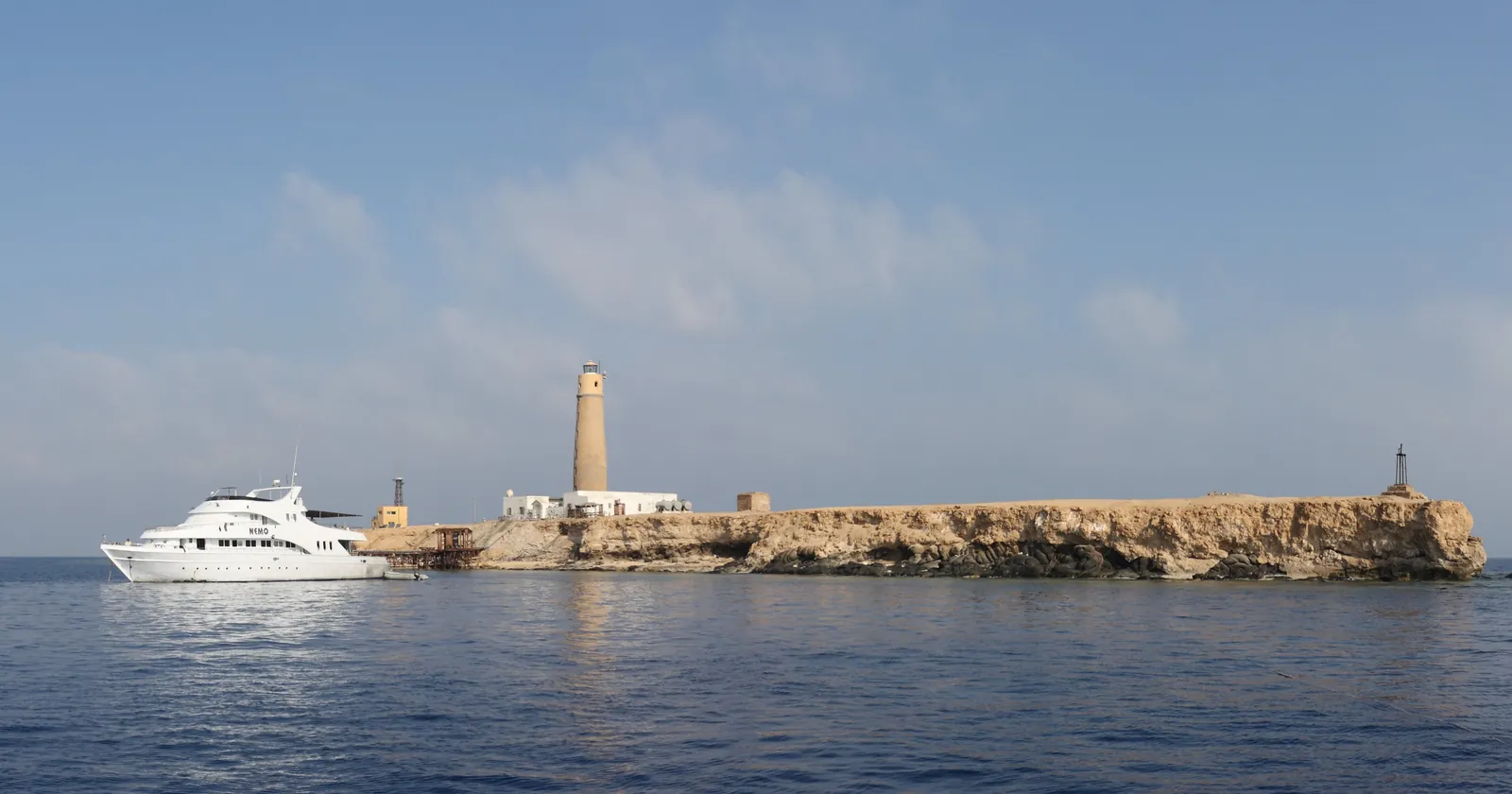
Big Brother Island in the Red Sea. Alexander Vasenin, Wikimedia Commons, CC BY-SA 3.0, cropped.

Key takeaways
- The Chamber of Diving and Water Sports sets 40 meters as the limit on air, 12 meters for intro dives, and one guide per 12 divers on safari and daily boats
- Night, nitrox and wreck dives need the specialty card or enough logged dives, and the Thistlegorm is closed to divers with fewer than 20 dives
- The environment agency's fee table charges a foreign visitor $5 in most Sinai and Red Sea protectorates and $10 at Dahab's Blue Hole, doubled for nights at sea; a 2025 decree raises several of these, partly postponed
- Authorities closed beaches and suspended water activities after fatal shark attacks near Hurghada in June 2023 and Marsa Alam in December 2024
- The diving chamber lists ten emergency and hyperbaric facilities from Dahab to Hamata; only DECO International states 24/7 cover. Call 123 for an ambulance and 122 for police
Egypt diving: one coast, three ways in
Almost all Egypt diving happens on the Red Sea, and it splits into three regions you reach through different airports and that suit different divers. South Sinai, at the mouth of the Gulf of Aqaba, has Sharm el-Sheikh, the Ras Mohammed national park and Dahab's shore diving. The northern Red Sea coast runs from El Gouna through Hurghada and Makadi Bay to Safaga, with the Straits of Gubal wrecks offshore. The deep south starts around El Quseir and runs through Marsa Alam to Hamata, the departure ports for the offshore reefs. Each region below links to our detailed guide, and the second half covers what is the same everywhere: the dive rules, protectorate fees, shark closures, water temperature, chambers and visas.
South Sinai: Sharm, Ras Mohammed and Dahab's Blue Hole
The Chamber of Diving and Water Sports, Egypt's diving chamber, says Sharm el-Sheikh's dive sites lie inside three national parks, Ras Mohammed, Tiran and Nabq, and that liveaboards leave from Sharm for the Straits of Gubal, the Thistlegorm wreck and the reefs around Tiran. Ras Mohammed was declared in 1983 and now covers 778.2 km², according to the environment agency's 2026 list of protectorates. Our Sharm el-Sheikh diving guide covers the park and the town's operators, and Sharm vs Hurghada compares the two boat towns.
Dahab, north of Sharm, is different: the chamber calls its diving "synonymous with shore diving", with sites reached by jeep or camel and entries across the reef flat. It also notes many technical-diving centres in town. The Blue Hole sits inside the Abu Galum protectorate and has its own entry fee, covered below. Our Dahab guide covers living there, and Dahab vs Koh Tao and Marsa Alam vs Dahab set it against other dive towns.
Hurghada, El Gouna and Makadi Bay: the northern Red Sea coast
The chamber names Hurghada, with Sharm, as where Red Sea diving tourism started. It says the city has more than 100 dive operators and mooring buoys at all its dive sites, and describes liveaboards from Hurghada to the Straits of Gubal, the Abu Nuhas wreck reef and the Thistlegorm. Our Hurghada diving guide explains what a chamber membership number does and does not prove about a centre.
El Gouna, north of Hurghada, has a chamber in its hospital; see El Gouna for nomads and El Gouna vs Hurghada. South of the city, our Makadi Bay guide covers the bay's house reefs.
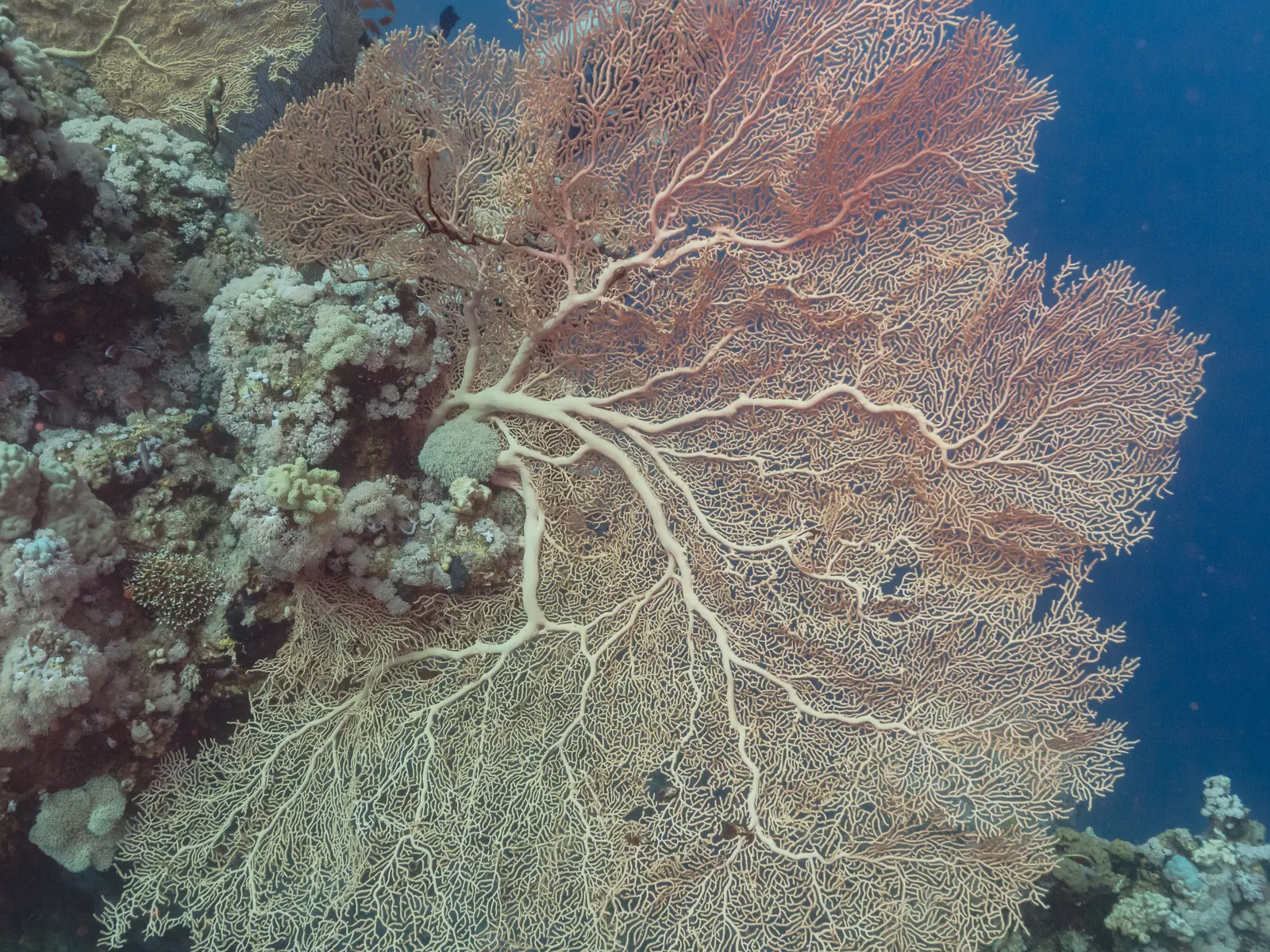
A sea fan in Ras Mohammed National Park. Diego Delso, Wikimedia Commons, CC BY-SA 4.0, cropped.

Safaga and El Quseir: shore reefs and the road to the Brothers
Safaga lies south of Hurghada; our Safaga diving guide covers its reefs and the Salem Express wreck. Further south, the chamber describes El Quseir as a town where "all dives here are performed from shore", along an almost continuous fringing reef, and also as the main departure point for liveaboards to the Brothers islands. Our El Quseir diving guide has the detail, including which chambers are nearest.
Marsa Alam and the deep south: liveaboards to Daedalus and St John's
The chamber describes Marsa Alam as a stretch of coast some 100 km long rather than a town, and calls it Egypt's springboard for liveaboards to three remote islands, Daedalus, Rocky and Zabargad, and to two outer reef systems, Fury Shoal and St John's Reef. Hamata, further south, has become a favourite port for the same trips, and most of its coast belongs to the Wadi el Gemal national park, where the chamber says only eco-lodges may be built. The environment agency's fee table lists the "distant islands" among the protectorates that charge a foreign visitor $5, doubled for visits that run past sunset, which it applies to sea safaris. Our Marsa Alam guide covers Elphinstone and the dugong bays, and Hurghada vs Marsa Alam compares the two bases. We found no official viewing rule for dugongs at Abu Dabbab that we could cite.
The UK government's travel advice says there have been recent incidents, some fatal, on Red Sea dive boats, that safety standards vary considerably, and points to guidance on liveaboards that the UK's Marine Accident Investigation Branch published in February 2025. Its advice is to book through reputable vendors and ask for a full safety briefing on board.
Regions we do not cover yet: Nuweiba, Taba and Hamata
The chamber also lists Nuweiba and Taba on the Gulf of Aqaba, and Hamata and Berenice in the far south, as dive destinations. We have no guide for them yet. Hamata's chamber is listed below.
Egypt's national dive rules: depth, ratios and certification
Every licensed dive operation in Egypt works under the same rulebook. Ministry of Tourism Decree 444 of 2011 says diving centres and safari boats may only operate under a ministry licence, and the Chamber of Diving and Water Sports, which the ministry founded in 2007, audits them. Its rules are written for centres, but several bind you as a customer.
The chamber applies the World Recreational Scuba Training Council standards and sets the maximum depth on compressed air at 40 meters, "if the training qualifications and the experience of the divers allow it". Nitrox is limited to an oxygen partial pressure of 1.4, also 40 meters on a single tank. Technical diving has its own ceilings: 45 meters for decompression-procedures dives, 55 for extended range, 60 for normoxic trimix and 100 for hypoxic trimix. The UK government adds that diving below your insurer's depth limit voids the cover.
On a guided dive, you need at least an entry-level certification under ISO 24801-1, and the centre must check your card and your logbook. Night, nitrox and wreck dives are only for divers with the specialty or "adequate logged experience". If the centre doubts your competence, it should run an assessment dive or send a professional with you. We found no national ban on night diving.
Group size has a hard number. A chamber board decree sets one guide or instructor for every 12 divers on safari and daily boats, and the same applies to kitesurfing from boats. Intro dives for people without a card are one instructor to one participant, with skills done at no more than 2 meters and a maximum depth of 12 meters after that; a shore-only Discover Scuba program may run two participants per instructor. Snorkel groups are capped at 12 per guide. Medical oxygen must be ready on every boat and at every service location.
The Thistlegorm has its own rules. The chamber's 2025 instructions bar divers with fewer than 20 dives or buoyancy problems, forbid touching the wreck and ban mooring to its broken bollards, and say the guidelines apply to all wreck diving in the Red Sea. Among the violations centres must stop are fishing, feeding fish or sharks, breaking coral and entering closed areas of nature reserves. The chamber also publishes a blacklist of facilities.
Protectorate fees: what the environment agency charges
Egypt's marine parks are protectorates under Law 102 of 1983, run by the Egyptian Environmental Affairs Agency. In December 2025 the government added a new one, the Great Fringing Reef, by Prime Minister's Decree 4419 of 2025, and the State Information Service says the governors of the Red Sea and South Sinai are responsible for managing it.
The agency's fee page, which carries a notice that it is being updated, gives these charges for a foreign visitor in the South Sinai and Red Sea protectorates, from Ras Mohammed and Nabq to the Northern Islands, Wadi el Gemal and the distant islands:
| Item | Fee table | Decree 360 of 2025 |
|---|---|---|
| Foreign visitor, most Sinai and Red Sea protectorates | $5 | Ras Mohammed $15 (postponed); Nabq, Northern Islands, Wadi el Gemal $10 |
| Blue Hole area, Abu Galum | $10 | $20 |
| Erg and Fanous, off Hurghada | $10, max 300 visitors per area a day | $15 (postponed) |
| Visits past sunset (camping, sea and land safaris) | fees doubled | separate camping rates |
| Boats over 17 meters | $10 to $60 by length | no change listed |
Decree 360 of 2025 took effect on 15 December 2025, but the agency says its application is postponed for Ras Mohammed, the Northern Islands and Erg and Fanous. It does not list the Blue Hole as postponed, yet the agency's fee table still shows the old $10, and we could not confirm which one is collected. Children under seven pay nothing. Ask your centre whether the fee is included in the price.
Sharks: what the authorities closed in 2023 and 2024
Shark attacks are rare, the UK government notes, but there have been fatal ones near Egypt's resorts, and the authorities' response has been to close water to everyone, divers included. In June 2023, after a tiger shark killed a man near Hurghada, the coast from El Gouna to Soma Bay, about 74 kilometers, was closed and swimming, snorkelling, diving and other water activities were suspended for about two days, according to reports by Egypt Independent, Euronews and CNN. On 29 December 2024 the environment ministry said two foreigners had been attacked by a shark outside the swimming area north of Marsa Alam, one of whom died. The State Information Service reported that the minister put the Red Sea protectorates on alert and that swimming was banned in the zone from 30 December.
For divers, the practical points are to expect short closures at short notice after an incident, and to follow the chamber's oceanic whitetip guidance on offshore reefs: stay at least 5 meters deep, do not swim or snorkel where oceanics may appear, and keep time at the surface short.
Red Sea water temperature by region
The Red Sea in Egypt never gets cold by diving standards, but there is a gradient: the Gulf of Aqaba at Dahab is the coolest, the deep south the warmest. These are NOAA's satellite averages for 1991 to 2020, for one ocean cell per region:
| Region (NOAA grid cell) | February | May | August | November |
|---|---|---|---|---|
| Dahab, Gulf of Aqaba (28.4°N 34.6°E) | 22.0 °C | 24.3 °C | 28.0 °C | 25.4 °C |
| Hurghada and Giftun (27.1°N 33.9°E) | 22.4 °C | 24.8 °C | 28.7 °C | 26.3 °C |
| Brothers islands (26.4°N 34.9°E) | 22.6 °C | 25.3 °C | 29.0 °C | 25.9 °C |
| Marsa Alam (25.1°N 35.1°E) | 22.7 °C | 25.6 °C | 29.6 °C | 26.3 °C |
February and March are the coldest months everywhere, at about 22 to 23 °C; August is the warmest. A cell off Ras Mohammed reads within 0.1 °C of the Hurghada one all year. These are surface values, and the water at 30 meters is colder.
Chambers and emergency numbers
The Chamber of Diving and Water Sports lists ten diving-emergency and hyperbaric facilities along the coast: the Dahab Hyperbaric Medical Centre; the Sharm Hyperbaric Medical Centre at Sharm el-Maya and Sharm International Hospital; El Gouna Deco International at El Gouna hospital; Hypermed in front of Hurghada airport and the Naval Hyperbaric Medical Center on the Corniche in Hurghada; Safaga Deco International at Safaga General Hospital; Marsa Alam Baromedical at Marsa Shagra; Marsa Alam Deco International at Port Ghalib Hospital; and Hamata Deco International in Hamata marina.
Only DECO International, which runs the El Gouna, Safaga, Port Ghalib and Hamata chambers, states round-the-clock cover on its own site: it lists its hours as "24 / 7 / 365", guarantees chamber doctors on call 24 hours, and says it treats diving emergencies before settling costs. Its pages date from 2018, so confirm the hotline before you travel. The Sharm centre has been running since March 1993, its director told DAN Europe, but we found no current statement on its hours, nor for the others.
In an emergency, call 123 for an ambulance and 122 for the police; both numbers are on the chamber's own emergency form, and the UK government lists 126 for the tourist police and 180 for fire. Rescue is expensive: the UK advice says an air or sea rescue can cost more than $4,000 an hour, and that the Egyptian authorities only start one when payment is guaranteed. That makes dive insurance with evacuation cover more than a formality, especially on a liveaboard far offshore.
Getting in: visas, the Sinai stamp and staying longer
Egypt's official e-visa portal, run by the Ministry of Interior, sells a single-entry tourist visa for $30 and a multiple-entry one for $65, asks you to apply at least seven days before departure, and requires a passport valid for six months from arrival. The UK government's advice adds that approved airports sell a visa on arrival for $30 in cash, valid for up to 30 days, that tourist e-visas are valid for up to three months, and that since 1 August 2026 Cairo airport also sells a digital visa on arrival for $36.
South Sinai has a shortcut. The same UK advice says that if you arrive by air at Sharm el-Sheikh and stay under 15 days at resorts in Sharm, Dahab, Nuweiba or Taba, you get a free entry stamp instead of a visa. It does not cover Hurghada or Marsa Alam, a longer stay or travel beyond those resorts, and we found no Egyptian government text stating it, so check the rule for your nationality.
For a longer base, extensions are applied for at the Passport and Immigration Offices, and leaving with a visa more than 14 days expired can bring a fine. The e-visa portal lists only tourist visas; we found no official digital-nomad or remote-work visa, and no official statement on remote work for a foreign employer while on a tourist visa. A work permit is a separate process that, the UK advice says, requires an HIV test.
How to choose between Egypt's regions
Choose South Sinai if you want the national park reefs and the Thistlegorm route from Sharm, or shore diving and technical diving in Dahab, and if a short visa-free stay suits you. Choose Hurghada or El Gouna if you want a large choice of centres, three listed chambers within reach and the routes to the Gubal wrecks. Choose El Quseir or Marsa Alam if you want shore reefs and the departure ports for the Brothers, Daedalus and St John's. Egypt suits less well a diver who wants to go past 40 meters on air, anyone who needs a long-stay remote-work visa, and anyone who needs certainty that every chamber is staffed around the clock.
FAQ: Egypt diving
What is the maximum dive depth in Egypt?
40 meters on compressed air, under the Chamber of Diving and Water Sports depth policy, and only if your training and experience allow it. Nitrox is limited to an oxygen partial pressure of 1.4, also 40 meters on a single tank. Intro dives for people without a card stop at 12 meters.
Do I need a certification and logbook to dive in Egypt?
For guided dives, yes. The chamber's audit manual says each diver needs at least entry-level certification and that the centre must check the card and the dive log. Night, nitrox and wreck dives need the specialty or adequate logged experience, and the Thistlegorm is closed to divers with fewer than 20 dives.
How much is the Ras Mohammed national park fee?
The environment agency's fee table gives $5 for a foreign visitor, doubled for visits past sunset such as liveaboard nights. Decree 360 of 2025 sets $15, but the agency says its application at Ras Mohammed is postponed. Ask your centre whether it is included.
When is the water warmest in the Egyptian Red Sea?
In August, when NOAA's 1991 to 2020 averages are about 28.0 °C at Dahab, 28.7 °C at Hurghada and 29.6 °C at Marsa Alam. February and March are the coolest months, at about 22 to 23 °C.
Where are the hyperbaric chambers in Egypt?
The Chamber of Diving and Water Sports lists ten diving-emergency facilities: in Dahab, two in Sharm el-Sheikh (one a hospital), El Gouna, two in Hurghada, Safaga, two around Marsa Alam and one in Hamata. DECO International, which runs four of them, states round-the-clock cover. Call 123 for an ambulance.
Note: Conditions, safety guidance and regulations change. Verify current information with official sources, including the dive operator, the park authority and the relevant government department, before you travel or dive.
Founder of NOMADREEF and a former digital nomad. This guide is sourced from the references below; conditions, prices and rules change, so verify current details, and follow qualified local guidance and safety briefings. About the author · LinkedIn ↗
Sources
- National dive rules (primary). Chamber of Diving and Water Sports, rules and regulations: depth policy (PDF); ratios, May 2025 (PDF); audit manual, 2025 (PDF); Thistlegorm instructions, October 2025 (PDF); oceanic whitetip guidelines (PDF); blacklist. Ministry of Tourism Decree 444 of 2011 (PDF), Article 1. Read 10 November 2026.
- Regions (primary). Chamber of Diving and Water Sports destination pages for Dahab, Sharm el-Sheikh, Hurghada, El Quseir, Marsa Alam and Hamata. Read 10 November 2026.
- Protectorates and fees (primary). Egyptian Environmental Affairs Agency, list of protectorates, July 2026 (PDF); visit fees page (Arabic); Ministerial Decree 360 of 2025 (PDF, scan). State Information Service, Great Fringing Reef declaration, 4 December 2025. Read 10 November 2026.
- Shark incidents. State Information Service, Marsa Alam, 29 December 2024 (French, primary). Hurghada 2023 triangulated from Egypt Independent on the closure and reopening, Euronews and CNN, 8 to 16 June 2023. Read 10 November 2026.
- Sea temperature. NOAA PSL, OISST v2.1 monthly long-term means 1991–2020, five 0.25° grid cells, read for this page (primary dataset, our calculation). Read 10 November 2026.
- Chambers. Chamber of Diving and Water Sports, medical facilities (primary); DECO International, home and about (operator, German); DAN Europe, interview with the Sharm centre's director, 2013. Read 10 November 2026.
- Emergency numbers and safety. Chamber of Diving and Water Sports, emergency contacts form (PDF) (primary); UK Foreign, Commonwealth & Development Office, getting help and safety and security. Read 10 November 2026.
- Entry. Ministry of Interior, e-visa portal, FAQ and fees (primary); UK Foreign, Commonwealth & Development Office, entry requirements. Read 10 November 2026.
- Left out. Which Blue Hole fee is collected now; whether Tiran's reefs are still administered as part of Ras Mohammed; protectorate status and fees for Elphinstone and St John's Reef; official dugong viewing rules at Abu Dabbab; any national night-diving rule; round-the-clock status of the Sharm, Dahab, Hypermed, naval and Marsa Shagra chambers, whose sites we could not reach or which state no hours; an Egyptian government text for the Sinai entry stamp; dive prices, which are on the town guides.