Madeira Diving: Garajau, and an Island With Almost No Shelf
 by Yannick Schroth
Sep 20, 2026
11 min read
by Yannick Schroth
Sep 20, 2026
11 min read
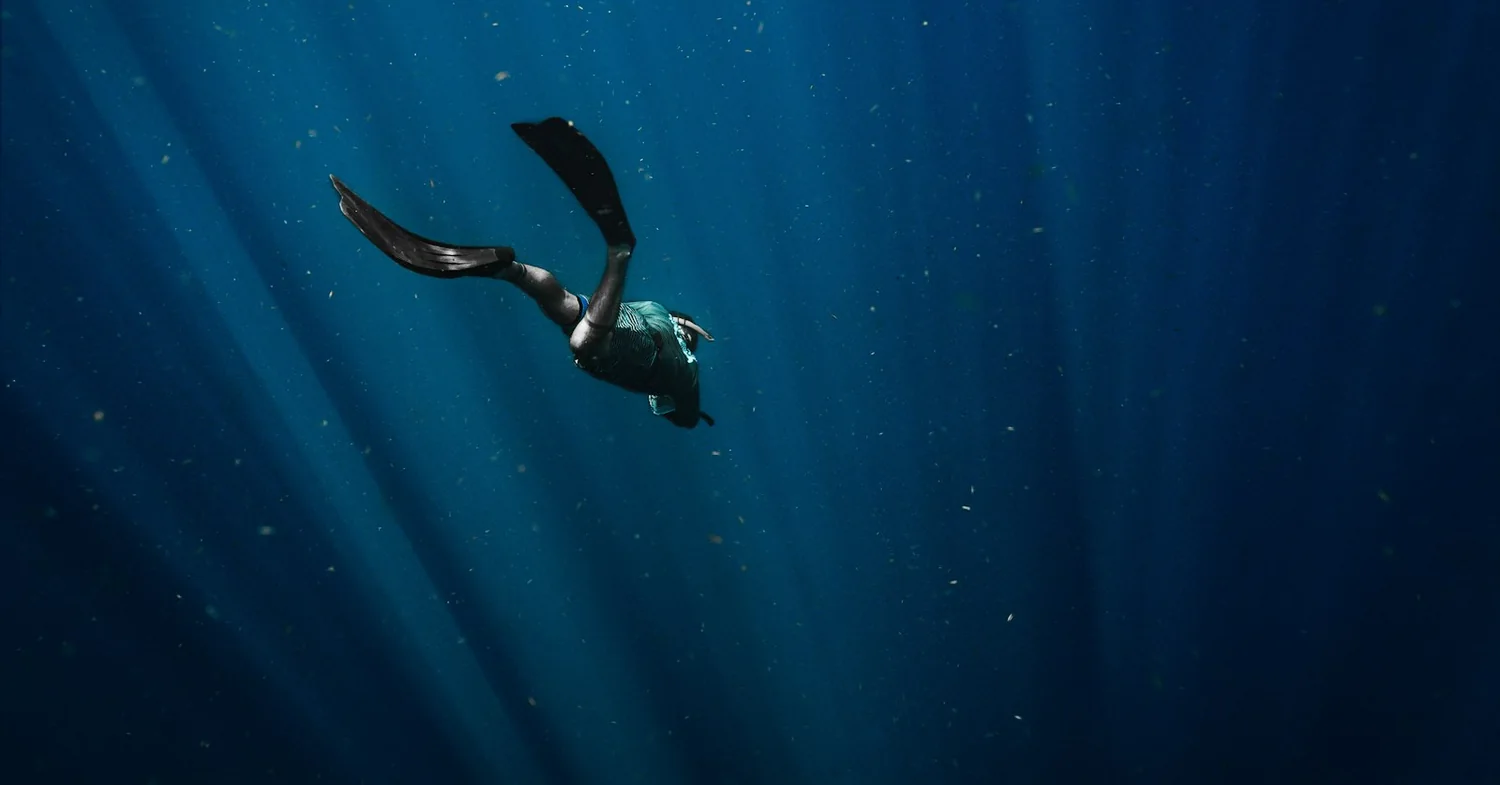
Photo: Unsplash (free licence).
Key takeaways
- The Garajau reserve is 376 hectares of pure seabed off Caniço de Baixo, created by Decreto Legislativo Regional 23/86/M on 4 October 1986, running out to the 50-metre isobath
- All commercial and sport fishing inside it is prohibited, with caça submarina named separately; swimming, amateur diving and non-motorised watersports are the permitted uses
- Fish biomass inside Garajau measured 2.4 times that of fished water around Madeira, with top predators at 15% of biomass against under 4% outside
- Madeira has almost no insular shelf: the seabed drops from 200 to 500 metres within roughly 10 kilometres of the coast, and rock turns to sand at about 22 metres in the reserve
- Surface sea temperature measured at the Molhe da Pontinha in Funchal since 1987 has ranged between monthly means of 17.1°C and 24.8°C
Garajau: 376 hectares off Caniço where all fishing stops
Most dive destinations sell you a species. Madeira sells you a prohibition, and the fish are the consequence. The Reserva Natural Parcial do Garajau was created by Decreto Legislativo Regional 23/86/M on 4 October 1986 and it contains no land at all: the management plan describes it as an exclusively marine reserve, 376 hectares of seabed on the south coast of the island, east of Funchal.
The boundaries are drawn with unusual precision for something this old. To the west, a plane perpendicular to the coast at Ponta do Lazareto. To the east, the same at Ponta da Oliveira. To the north, the line of maximum spring high tide. To the south, the vertical plane of the 50-metre bathymetric line, and where that line is disputed, a limit never closer than 600 metres to the northern one.
Its length is the one number the official documents disagree on. The plan’s characterisation section puts the coastline at roughly 7 kilometres; the preamble to its own regulation says roughly 11. Take 7 as the working figure, since the same document uses it twice and counts 7 caves along that stretch, and treat any tidier number you meet elsewhere with suspicion.
What is forbidden is the part worth memorising. The decree prohibits any commercial or sport fishing activity and names caça submarina, underwater hunting, separately so that nobody can argue the point. It also prohibits capturing marine animals or plants, extracting sand and geological material, dumping solid or liquid waste from land or from a vessel, running effluent pipes into it, and navigating inside the limits under motor except to beach a small boat.
The permitted list is short and it is the one divers live on: swimming, amateur diving for recreational, tourist or scientific purposes, and non-motorised watersports. Amateur diving got its own instrument later, Decreto Regulamentar Regional 1/97/M, which disciplined the activity and let the park service charge a dive fee. The fees in the management plan are almost comically small, on the order of a euro or two for a day dive, and the sums are historic rather than a current tariff.
One label needs handling carefully. Garajau is widely described as Portugal’s first marine reserve, and that is plausible, but the phrase does not appear in the decree or in the plan. Both call it an exclusively marine reserve created in 1986. That is the claim with a citation behind it, and it is the one used here.
What four decades of that ban did to the fish at Garajau
Protection stories usually arrive as adjectives. This one arrives as ratios. A survey published in PLOS ONE, which sampled Madeira in July 2016 and the remote Selvagens in September 2015, found fish biomass at Garajau 2.4 times that of areas around Madeira open to fishing, and 2.2 times that of the partially protected Rocha do Navio.
The composition matters more than the total. Top predators made up 15% of biomass inside Garajau and under 4% both at Rocha do Navio and in fished water around the island. That is the signature of a place where the large slow fish were allowed to get old. Garajau still came in around a third below the Selvagens, which is 280 kilometres away from almost everybody, so the reserve is a recovery rather than a wilderness.
The emblematic animal is the dusky grouper, Epinephelus marginatus, which the management plan singles out by name as the species that attracts and arouses the curiosity of divers. Groupers that have never been shot at behave differently from groupers that have, and the dive press reports animals over 50 kilogrammes and up to 1.5 metres approaching divers at close range. Those descriptions are triangulated across operator and magazine accounts rather than taken from a survey.
Around the grouper sits an ordinary Atlantic cast doing well: the island grouper Mycteroperca fusca, white and zebra seabream, parrotfish Sparisoma cretense, ornate wrasse, and the Madeiran chromis Chromis limbata in clouds. On the sand between 15 and 45 metres the plan records large colonies of garden eels, Heteroconger longissimus, which retract into their burrows as a diver approaches.
There is a seasonal entry too. Groups of devil rays, Mobula mobular, are recorded in the reserve generally from the middle of September into October, along with big schools of amberjack, barracuda and white trevally. And the reserve leaks in the useful direction: the plan notes an export of biomass from the protected water into adjacent zones, which benefits the commercial and recreational fishing that the ban excluded.
Madeira has almost no shelf, and the drop-off starts at the shore
This is the fact that quietly shapes every dive on the island. Madeira is an intraplate volcano that grew in deep ocean, roughly 700 kilometres off northwest Africa, and it never built a continental shelf to stand on. A 2021 study in Frontiers in Marine Science puts it plainly: the insular shelf is narrow and steep, dropping from 200 to 500 metres within about 10 kilometres of the coastline.
Inside the reserve the same geometry appears in miniature. The plan describes rocky bottom down to approximately 22 metres, then fine sand or crushed shell, with the transition sharply marked, steeply inclined, and carrying some abrupt walls. Along the 7 kilometres of coast it counts 7 caves. Above water the coast is high and regular rock, broken by small cobble beaches.
For a diver this has three practical consequences. Depth arrives fast, so a shore entry that looks like a swim becomes a 30-metre profile if attention wanders. There is no shallow sandy lagoon in which to practise, which is why training dives here happen on rock at depth rather than on sand at 5 metres. And the entries themselves are the awkward part: rounded cobble, swell on an exposed coast, and fins going on in knee-deep water.
The reserve has infrastructure for this, which is easy to miss. The plan lists five mooring buoys placed to support diving, named Lazareto, Pináculo, Mamas, Garajau and Canavieira, plus three marker buoys. Permanent surveillance has run since 1996 from a station at the Cais do Lazareto, on the reserve’s western edge, which also holds a small compressor for filling cylinders.
One more piece of geometry is worth carrying. An underwater ridge of roughly 100 metres depth connects Madeira to the Desertas, which is why those islands read as an extension of the same system rather than as separate rocks, and why the monk seals move between them.
Funchal sea temperature, from 17.1°C to 24.8°C since 1987
Madeira sits at about 32 degrees north in open Atlantic, under the influence of the cool Canary Current. That is not the Caribbean and it is not the Mediterranean either, and the numbers exist to prove it. The regional statistics office has measured surface sea temperature at the Molhe da Pontinha in Funchal since 1987, which makes it one of the longer usable series for any dive destination.
Across that whole series, the highest monthly mean is 24.8°C, in August 2012. The lowest is 17.1°C, recorded in February 1994 and again in March 2006. Annual means run from 19.7°C in 1993 to 21.7°C in 2023, and the office notes that the high values cluster in recent years and the low ones in distant years.
A single recent year fills in the shape. In 2024 the annual mean was 21.4°C. August was the warmest month at 23.6°C; March and April were the coldest, both at 19.3°C. December 2024 came in at 20.9°C, which the office flagged as 1.4°C above the normal for that month.
Translate that into neoprene and the planning becomes simple. A 5 mm suit covers the year for most people, a hood and gloves earn their place from February to May, and a 7 mm or a semi-dry is the choice if you dive repetitively in spring. Nobody needs a drysuit and nobody should show up with a 3 mm shorty in March.
Clarity is the softer number. The Garajau plan describes water clear enough for observation beyond 20 metres of depth, and the regional tourism board says visibility off Porto Santo is considered excellent down to around 40 metres. No official visibility series exists for either island, so treat those as descriptions rather than as measurements, and expect a Saharan easterly to drop haze into the water along with the heat.
The Desertas, the monk seals, and the rest of Madeira’s protected water
Garajau is the famous piece of a much larger system. The Parque Natural da Madeira was created on 10 November 1982 by Decreto Regional 14/82/M and covers roughly two thirds of the island. Alongside it the region runs nature reserves at the Selvagens, the Desertas, Rocha do Navio and Garajau, a protected area at Cabo Girão that includes a marine park, and a network of marine protected areas around Porto Santo.
The Desertas exist as a reserve because of one animal. The Mediterranean monk seal, Monachus monachus, is the rarest seal in the world, and the IFCN states that when conservation work began in Madeira in 1988 the population was estimated at just 6 to 8 individuals. That programme is what drove the legal protection of the Desertas in 1990, and the islands now hold the species’ principal habitat.
Then comes the correction that makes the file worth reading. Until 2014 the conservation work supported a belief that the population had grown to about 40 animals. In 2019 a new methodology applied under the LIFE Madeira Lobo-Marinho project revealed a colony of 21 individuals, on 2018 data. The number did not fall; the measurement improved. Global population sits at roughly 750.
The IFCN names the pressures on that population explicitly, and tourism and leisure activities are on the list beside commercial fishing. That is the context for the rules below, and for the fact that a monk seal in Madeira is something you might meet rather than something you can book. Seals have been recorded with some regularity inside the Garajau reserve since 1997, which is a quiet sign that the protected water works.
The ships Madeira sank on purpose, from Baía d’Abra to Porto Santo
An island with no shelf has little natural structure on sand, so the region built some. The regional marine portal dates the first artificial reefs to 1983 at Baía d’Abra, assembled from recycled material including tyres and vehicle hulks, which is a 1980s solution nobody would repeat today but which makes Madeira an early mover.
The concrete came next. Between 2000 and 2004 cubic modules were laid on the south coast between Paul do Mar and Jardim do Mar at depths of 18 to 22 metres, covering about 22,500 square metres, and that area now holds roughly 9,225 cubic metres of artificial reef. A further 100 modules went down off Calheta in 2004 at 27 metres.
The ships are what people travel for. The cargo vessel Madeirense, which spent decades working between the mainland and Funchal, was sunk off the south coast of Porto Santo on 21 October 2000, inside what is now that island’s marine protected area network. The regional tourism board puts it at around 30 metres; other published accounts say 32 or 34, so confirm the depth with whoever is briefing the dive.
Two Portuguese Navy corvettes followed. The General Pereira d’Eça was sunk at Porto Santo on 13 July 2016 at 30 metres, and a first monitoring campaign between 31 October and 4 November that year inventoried more than 20 species of fish, invertebrates and algae on her. The Afonso Cerqueira went down on 4 September 2018 in the Cabo Girão protected area, on the main island’s south coast.
The practical reading is that Madeira and Porto Santo are two different dive holidays sharing an airport code region. Garajau is protected reef at recreational depth, close to the towns. Porto Santo is wrecks at 30 metres in water the tourism board calls clear to about 40, reached by ferry or a short flight, and better suited to a diver with an advanced or deep card than to somebody on their fourth dive.
Whale watching off Madeira runs on a licence, not a voluntary code
Madeira sells cetacean trips hard, and the governing rule is younger than most visitors assume. Decreto Legislativo Regional 15/2013/M, of 14 May 2013, approved the Regulamento da Atividade de Observação de Vertebrados Marinhos for the region. It covers all marine mammals, sea turtles and pelagic seabirds occurring in inland waters, the territorial sea and the exclusive economic zone, plus land areas holding pelagic seabird colonies.
The structure is worth knowing before you book. The regulation splits the archipelago’s waters into two zones, described as área I and área II, each with its own set of rules. Operating requires an authorisation from the IFCN, granted against criteria that include a carrying capacity, and the IFCN is also the body that inspects and prosecutes. Portaria 97/2013 sets the procedures and Portaria 46/2014 regulates that carrying capacity.
Before 2013 there was no such instrument here. A 2007 dissertation from the University of Lisbon, monitoring the activity in the archipelago, records Madeira as the Portuguese region without legislation for it, with boats instead following a voluntary code proposed by the Museu da Baleia in 2002: a 50-metre minimum approach, a maximum of 30 minutes shared between all boats present, and only one vessel within 300 metres.
Those figures belong to the old voluntary code and not to the current law, so do not quote them at a skipper. What they do show is the direction of travel, from a code a boat could ignore to a licence a boat can lose. The marine mammals themselves have had separate regional protection since Decreto Legislativo Regional 6/86/M of 30 May 1986, the same year Garajau was drawn.
Where Madeira’s 12 dive centres sit, and what a register settles
Twelve dive businesses on Madeira appear in the SSI register of affiliated centres, read on 3 September 2026, and 10 of the 12 publish a website. They cluster in Caniço de Baixo, Funchal, Caniçal and Santa Cruz, and the largest cluster is not an accident: Caniço de Baixo sits on the doorstep of the Garajau reserve, which is the reason the industry grew there rather than in the capital.
What an entry in that register settles is narrow. It says the body lists the business, on the date given. It says nothing about the teaching, the equipment, the boats, the briefings or whether the centre is trading this season. Every entry on the Madeira operator list links back to the page it was read from, so each affiliation can be checked at the source instead of taken on trust.
The state licence is a separate question with a separate answer. Portugal licenses maritime-tourism activities through the RNAAT register kept by Turismo de Portugal, and Decreto Legislativo Regional 10/2017/M applies that regime to the Autonomous Region of Madeira, so the obligation plainly reaches these businesses. This directory reads RNAAT for mainland locations. Madeira has not been matched against it, so nothing is claimed either way about any Madeira business, in either direction.
That distinction matters because a licence and a membership prove different things, and neither proves the third thing people actually want. What an RNAAT licence settles, and what it does not sets out the limits of the Portuguese register, and which registers can be read logs what each source returned and on what date.
If the plan is to stay rather than visit, Portugal’s D8 route is the one that applies, and Madeira is part of Portugal for every purpose that matters to it. The Portugal digital nomad visa page covers the income thresholds and the paperwork. Sort the visa from the mainland rules and sort the diving from the reserve rules, because the two have nothing to do with each other.
FAQ: scuba diving in Madeira
What makes diving in Madeira different from the Mediterranean?
Two things, and neither is the fish list. The island has almost no insular shelf, so the seabed falls from 200 to 500 metres within about 10 kilometres of the coast and deep water sits close enough to swim to. And the water is Atlantic at 32 degrees north rather than Mediterranean: monthly means measured at the Molhe da Pontinha in Funchal since 1987 have run between 17.1 and 24.8 degrees Celsius, which is a narrower band than most of southern Europe manages.
What is the Garajau reserve and why do divers go there?
The Reserva Natural Parcial do Garajau is 376 hectares of seabed on the south coast of Madeira, east of Funchal, created by Decreto Legislativo Regional 23/86/M on 4 October 1986. It is an exclusively marine reserve: there is no land in it. Divers go because every form of fishing inside it has been banned for four decades, and the dusky grouper, Epinephelus marginatus, is the species the management plan itself calls emblematic of the place.
Is spearfishing allowed in the Garajau reserve in Madeira?
No. The decree that created the reserve prohibits any commercial or sport fishing activity and names underwater hunting, caça submarina, separately so there is no argument about it. Capturing marine animals or plants, extracting sand or geological material, dumping waste and running motor vessels inside the limits are prohibited in the same article. Swimming, amateur diving for recreational, tourist or scientific purposes and non-motorised water sports are the permitted uses.
Has the fishing ban at Garajau actually worked?
The measured answer is yes. A survey published in PLOS ONE, with Madeira sampled in July 2016, found fish biomass at Garajau 2.4 times that of areas around Madeira open to fishing and 2.2 times that of the partially protected Rocha do Navio. Top predators made up 15 per cent of biomass inside Garajau and under 4 per cent both at Rocha do Navio and in fished water. The reserve total came in only about a third below the remote Selvagens.
How cold is the water for diving in Madeira?
Cooler than the postcards suggest and steadier than almost anywhere else. The regional statistics office has measured surface sea temperature at the Molhe da Pontinha in Funchal since 1987. The highest monthly mean in that series is 24.8 degrees Celsius in August 2012 and the lowest is 17.1 degrees, recorded in February 1994 and again in March 2006. In 2024 the annual mean was 21.4 degrees, with August at 23.6 and both March and April at 19.3.
Does diving in Madeira have a closed season?
No month closes. The thing that actually stops a Madeira dive day is sea state on an exposed volcanic coast rather than a calendar, and the south coast where the Garajau reserve sits is the sheltered side. Spring is the cold end of the year underwater, with March and April the coolest months in the Funchal series, and late summer into autumn is the warm end. Devil rays, Mobula mobular, are recorded in the reserve mainly from the middle of September into October.
Which wrecks can you dive in Madeira and Porto Santo?
The deliberate ones. The cargo ship Madeirense was sunk off the south coast of Porto Santo on 21 October 2000, and the Portuguese Navy corvette General Pereira d’Eça followed on 13 July 2016 at 30 metres, both inside the Porto Santo marine protected area network. A second corvette, the Afonso Cerqueira, was sunk on 4 September 2018 in the Cabo Girão protected area off the main island. Published depths for the Madeirense vary between roughly 30 and 34 metres depending on the source.
Can you dive with monk seals in Madeira?
Not as a booked activity. The Mediterranean monk seal colony lives in the Reserva Natural das Ilhas Desertas, protected in 1990 largely for that reason, and the IFCN names tourism and leisure activities among the pressures on the population. Observation of marine mammals in Madeira is a licensed activity under Decreto Legislativo Regional 15/2013/M, not a matter of getting lucky with a boat. Seals have been seen with some regularity inside the Garajau reserve since 1997, which is an encounter rather than an excursion.
How many dive centres are there on Madeira?
Twelve dive businesses on Madeira appear in the SSI register of affiliated centres, read on 3 September 2026, and 10 of the 12 publish a website. They cluster in Caniço de Baixo, Funchal, Caniçal and Santa Cruz. Caniço de Baixo sits on the doorstep of the Garajau reserve, which is why the largest cluster is there. A register entry settles that the body lists the business on the date given and nothing about the teaching, the kit or the boats.
Are Madeira dive operators listed in Portugal’s RNAAT register?
Portugal licenses maritime-tourism activities through the RNAAT register, and Decreto Legislativo Regional 10/2017/M applies that regime to the Autonomous Region of Madeira. This directory reads RNAAT for mainland locations. Madeira has not been matched against it, so nothing is claimed either way about any business on the Madeira list, in either direction. The register is public, so a Madeira operator can be looked up in it directly.
Founder of NOMADREEF and a former digital nomad. This guide is sourced from the references below; conditions, prices and rules change, so verify current details, and follow qualified local guidance and safety briefings. About the author · LinkedIn ↗
Sources
- The reserve, its limits and its seabed. Total area 376 hectares, coastline given as approximately 7 kilometres in the characterisation and approximately 11 kilometres in the preamble to the regulation, boundaries at Ponta do Lazareto and Ponta da Oliveira out to the 50-metre bathymetric line with a 600-metre fallback, rock to approximately 22 metres then fine sand or crushed shell with abrupt walls, 7 caves, garden eels between 15 and 45 metres, devil rays from mid-September into October, monk seals recorded with some regularity since 1997, five mooring buoys for diving support, permanent surveillance from the Cais do Lazareto since 1996, dive fees under Decreto Regulamentar Regional 1/97/M, and biomass export to adjacent zones. Serviço do Parque Natural da Madeira, Plano Especial de Ordenamento e Gestão da Reserva Natural Parcial do Garajau: PEOGRNPG (PDF). Read 20 September 2026. The fee figures in it are historic and not a current tariff.
- The prohibition itself. Decreto Legislativo Regional 23/86/M, of 4 October 1986, creating the Reserva Natural Parcial do Garajau: any commercial or sport fishing activity including caça submarina, capture of marine animals or plants, extraction of sand and geological material, dumping of waste, effluent pipes and motorised navigation inside the limits are prohibited; swimming, amateur diving for recreational, tourist or scientific purposes and non-motorised watersports are excepted. Index entry at Diário da República, whose viewer renders as a JavaScript shell; the article text was taken from the consolidated copy published by the Portuguese Navy’s coastal command, Marinha Portuguesa. Both read 20 September 2026.
- What protection measured. Fish biomass at Garajau 2.4 times that of areas open to fishing around Madeira and 2.2 times that of Rocha do Navio; top predators 15% of biomass at Garajau against under 4% elsewhere; total roughly a third below the Selvagens; Madeira sampled July 2016, Selvagens September 2015. Friedlander et al., Contrasts in the marine ecosystem of two Macaronesian islands, PLOS ONE (2017). Read 20 September 2026.
- Every sea temperature figure. Series measured at the molhe da Pontinha, Funchal, since 1987: highest monthly mean 24.8°C in August 2012, lowest 17.1°C in February 1994 and March 2006, highest annual mean 21.7°C in 2023 and lowest 19.7°C in 1993, 2024 annual mean 21.4°C with August at 23.6°C and March and April at 19.3°C. Direção Regional de Estatística da Madeira, Série retrospetiva da informação meteorológica (1976-2024), section 8. The December 2024 mean of 20.9°C and its 1.4°C anomaly come from the same office’s monthly release of 15 January 2025. Both read 20 September 2026.
- The shelf that is not there. Insular shelf narrow and steep, dropping from 200 to 500 metres within roughly 10 kilometres of the coastline, with an underwater ridge of about 100 metres connecting Madeira to the Desertas, and the island roughly 700 kilometres off northwest Africa: Impact of Flash Flood Events on the Coastal Waters Around Madeira Island, Frontiers in Marine Science (2021). Read 20 September 2026.
- The monk seals. Conservation work from 1988 with a population then estimated at 6 to 8 individuals; legal protection of the Desertas in 1990; a belief until 2014 that the population had reached 40; a 2019 result of 21 individuals on 2018 data under LIFE Madeira Lobo-Marinho; global population about 750; commercial fishing and tourism and leisure activities named among the pressures; protection under Decreto Legislativo Regional 6/86/M and Decreto Legislativo Regional 15/2013/M. Instituto das Florestas e da Conservação da Natureza, IP-RAM, Lobo-marinho (PDF). Read 20 September 2026.
- Every wreck and reef date. First artificial reefs in 1983 at Baía d’Abra from recycled material; concrete modules between Paul do Mar and Jardim do Mar at 18 to 22 metres from 2000 to 2004 over about 22,500 square metres, now roughly 9,225 cubic metres, plus 100 modules at 27 metres off Calheta in 2004; Madeirense sunk 21 October 2000 off southern Porto Santo; corvette General Pereira d’Eça sunk 13 July 2016 at 30 metres with a first monitoring campaign from 31 October to 4 November 2016 recording more than 20 species; corvette Afonso Cerqueira sunk 4 September 2018 in the Cabo Girão protected area. Governo Regional da Madeira, Mar Madeira, Recifes Artificiais e Património Subaquático. Read 20 September 2026.
- Porto Santo depth and clarity. The Madeirense taken to the bottom in 2000 at a depth of around 30 metres, the corvette at the same depth, and visibility considered excellent to around 40 metres: Madeira Islands Tourism Board, diving in Porto Santo. Read 20 September 2026. Depths of 32 and 34 metres appear in operator and dive-press accounts, so the figure is triangulated rather than settled.
- Cetacean watching. Decreto Legislativo Regional 15/2013/M of 14 May 2013 approving the Regulamento da Atividade de Observação de Vertebrados Marinhos na RAM, covering marine mammals, sea turtles and pelagic seabirds, dividing the archipelago’s waters into área I and área II, with IFCN authorisation and enforcement, Portaria 97/2013 on procedures and Portaria 46/2014 on carrying capacity: IFCN, observação de vertebrados marinhos, legislação. Read 20 September 2026. The specific approach distances in the current regulation could not be retrieved from an official source, because the Diário da República viewer serves a JavaScript shell and the gazette mirrors return HTTP 403, so no distance is stated here as law. The 50-metre approach, 30-minute limit and 300-metre single-vessel rule quoted in the text belong to the voluntary code proposed by the Museu da Baleia in 2002, as recorded in Ferreira, Monitorização da actividade de observação de cetáceos no arquipélago da Madeira, Universidade de Lisboa (2007). Read 20 September 2026.
- The licence that covers Madeira. The RNAAT register for tourism animation agents and maritime-tourism operators, kept by Turismo de Portugal, with the regime established by Decreto-Lei 108/2009 and adapted to the Autonomous Region of Madeira by Decreto Legislativo Regional 10/2017/M of 12 April: Registo Nacional de Turismo, RNAAT search and Turismo de Portugal, registo dos agentes de animação turística. Read 20 September 2026. This directory reads RNAAT for mainland locations; Madeira has not been matched against it, and the limits of the register are set out on the RNAAT page and which registers can be read.
- The twelve businesses. Twelve dive businesses on Madeira from the SSI register of affiliated centres, read 3 September 2026, of which 10 publish a website, clustered in Caniço de Baixo, Funchal, Caniçal and Santa Cruz. From divessi.com, with every entry linked to the page it was read from on the Madeira operator list.
- Grouper behaviour and size. Animals over 50 kilogrammes and up to 1.5 metres, and close approaches to divers, are reported by the dive press and by operators rather than by a survey, and are triangulated across those accounts: Oceanographic Magazine, diving Garajau. Read 20 September 2026.