Gran Canaria Diving: El Cabrón, Sardina and a Marine Reserve Still Waiting to Be Declared
 by Yannick Schroth
Sep 25, 2026
14 min read
by Yannick Schroth
Sep 25, 2026
14 min read
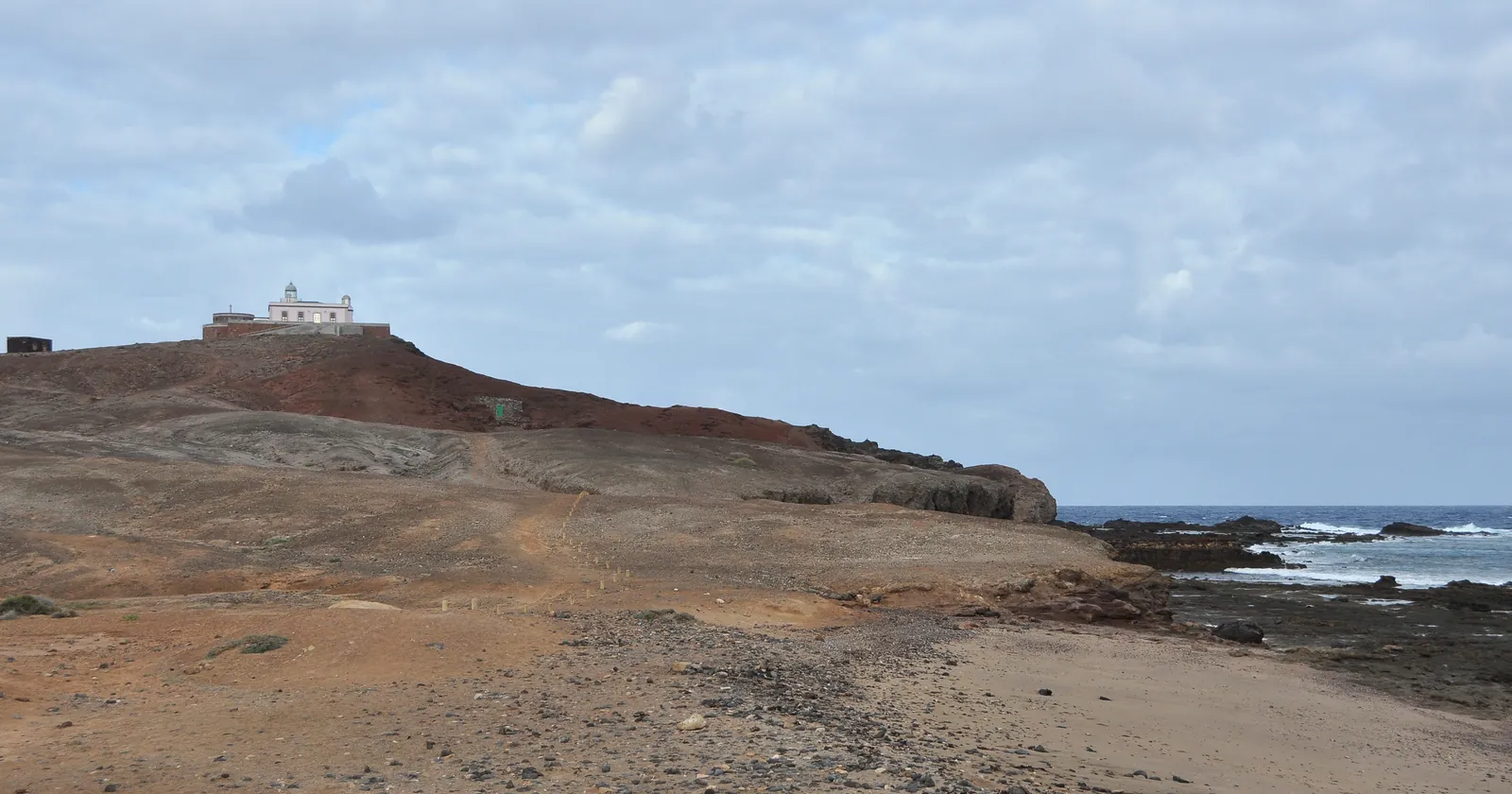
Photo: Marc Ryckaert (MJJR), Wikimedia Commons, CC BY 3.0, cropped.

Key takeaways
- El Cabrón lies inside ZEC ES7010053 Playa del Cabrón, declared by Orden ARM/2417/2011 for one habitat, sandbanks permanently covered by shallow seawater
- The Canary government lists three marine reserves of fishing interest, at La Graciosa, La Restinga and La Palma; the island’s tourism site calls Arinaga a future reserve
- The 2011 plan names scuba diving as the main activity in the zone, and fish feeding, collecting and uncontrolled finning as the pressures it brings
- Decreto 35/2006 makes every Canary dive center keep an emergency plan with a hyperbaric chamber reachable within two hours of the dive site
- El Cabrón and Sardina del Norte were two of the four places with the most angelshark sightings in a 2014 to 2015 survey of the whole archipelago
El Cabrón in Gran Canaria is a Natura 2000 site, not one of the Canaries’ marine reserves
El Cabrón, off the beach of the same name at Arinaga in the municipality of Agüimes, is the dive the island’s tourism board ranks among the best on Gran Canaria. Several dive-center pages on the island call it a marine reserve, and one calls it “one of only three Marine Reserves in the Canary Islands”.
The Canary government’s fisheries department settles that by listing them. The archipelago has three reservas marinas de interés pesquero: around La Graciosa and the islets north of Lanzarote, at La Restinga and the Mar de las Calmas off El Hierro, and around La Palma. Spain’s fisheries ministry lists the same three for the Canaries. None of them is on Gran Canaria.
The Cabildo’s own tourism site is more careful than the dive shops. Its page for El Cabrón says the area is rich enough to have been nominated to become the future Reserva Marina de Arinaga. At La Graciosa, as the Lanzarote guide describes, the reserve means a no-take core and scuba diving only with express authorization. El Cabrón has neither.
What it does have is a European designation. The same dive-center page dates an EU listing to December 2001, and that part is right, although the list was not of reserves. Spain proposed the stretch as a Site of Community Importance in October 1999, the European Commission approved it in the Macaronesian list of 28 December 2001, and Orden ARM/2417/2011 of 30 August declared it Special Area of Conservation ES7010053, Playa del Cabrón, in force from 15 September 2011.
Gran Canaria’s El Cabrón zone was protected for its sand, not its reef
The management plan annexed to the order draws the site along the coast from Punta de la Sal to La Caleta, north of the port of Arinaga, out to a maximum depth of about 50 to 60 meters. It covers 956.20 hectares off Agüimes and takes in part of the Monumento Natural de Arinaga on land.
The reason for the designation is narrow. The site was declared for one habitat type, code 1110, sandbanks permanently covered by shallow seawater, which on this coast means the sebadal, the seagrass meadow. The plan maps 135.36 hectares of it, 14 percent of the site, and calls it one of the most important seagrass meadows on Gran Canaria, a place where many fish and bottom-dwelling invertebrates breed, grow and feed.
The rock that divers come for is not the reason. The plan records reefs and submerged or semi-submerged sea caves inside the zone, along with loggerhead and green turtles, and proposes studying them so they could be added to the designation later. In 2011 the walls and caves of El Cabrón were present and noted, but not protected in their own right.
The plan is frank about the state of the place. It reports that the area covered by the seagrass Cymodocea nodosa had shrunk, for reasons unknown, and that shellfish stocks were so degraded that the slipper lobster Scyllarides latus had fallen radically. It counts the seahorse Hippocampus hippocampus at fewer than 500 individuals and the gold coral Gerardia savaglia at fewer than 50.
The dive itself, as the Cabildo describes it, is a shore entry with an average depth of 19 meters and a maximum of 22, rated medium difficulty, with current described as frequent. The same page puts a rock platform at about 12 meters with a drop of 23 meters below it, which does not square with its own 22-meter maximum. Ask the center which part of the wall it plans to dive. The same trade wind that powers the wave sailing at Pozo Izquierdo blows along this south-east coast.
What the 2011 rules ban for Gran Canaria divers at El Cabrón
Annex II of the order sets general rules for every marine ZEC it declared in the Canaries, and four of them reach a diver or the boat that carries one. No dumping of any kind from a boat or platform. No anchoring on seagrass meadows, anchoring meaning the fixing of any anchor system to the seabed. No catching or collecting any species that has a protection status. And no feeding animals to attract them or change their behavior.
The feeding rule fits this coast. The plan for El Cabrón names scuba diving as the main activity in the zone and lists how it harms the seagrass habitat: collecting specimens, the practice of “feeding”, and the uncontrolled finning of divers. Free anchoring by recreational and fishing boats is named separately as a threat to the meadows.
The environment ministry’s current leaflet for the site repeats the anchoring ban and says that authorized mooring buoy fields exist inside or near the protected area. It names two seagrasses: Cymodocea nodosa, on sand and mud at 6 to 20 meters, and Halophila decipiens, which in Spain grows only in the Canaries, down to 40 meters. Both, the leaflet says, are protected species under Spanish rules.
Read the rest of annex II with care, because part of it is softer than it sounds. Keeping spearguns and any other gear for catching or extracting marine life off a dive is not a rule in the 2011 text. It is a recommendation that the administrations “adopt the necessary measures” to prohibit it, and limiting the number of divers in sea caves sits in the same recommendation.
The plan also set itself tasks: a study of how much scuba diving the zone can carry, ecological moorings to organize recreational diving, codes of good practice for divers and fishers, and at least two volunteer campaigns a year with local dive centers and clubs to control the long-spined sea urchin Diadema antillarum. It drew no zones at all. The plan says the information needed to draw them did not yet exist.
Gran Canaria’s marine ZECs still run on the 2011 plan, and the 2022 draft is not law
The 2011 measures were given six years and then extended automatically until something replaces them. The environment ministry drafted a replacement: an order approving a second management plan for the 24 Macaronesian marine ZECs in its care, Playa del Cabrón among them, open for comments from 24 January to 7 March 2022. The BOE’s record of the 2011 order, read on 25 September 2026, lists no later order that amends or replaces it.
The draft still shows where the rules are heading. Its general annex would apply the responsible-diving criteria of the state marine reserves to all 24 sites, keep swimmers and divers at least 5 meters from turtles and protected rays and sharks, and forbid chasing, touching or feeding turtles. In any area mapped as critical for angelsharks, organized scuba diving would need a declaración responsable, a signed statement filed in advance, whenever more than four people including crew take part or a company runs the trip.
None of that binds a diver today. Until a new order appears in the BOE, the 2011 text is the one that applies at El Cabrón.
Gran Canaria’s angel sharks: El Cabrón and Sardina are two of the archipelago’s four hotspots
The animal that draws divers to this island lies flat on the sand. The angelshark, Squatina squatina, has sat in the highest category of the Spanish Catalogue of Threatened Species, en peligro de extinción, since Orden TEC/596/2019 of 8 April. The listing covers the Canary populations of all three angelshark species that occur here.
The best map of where they are was drawn by divers. Between April 2014 and March 2015 a citizen-science program run from the University of Las Palmas de Gran Canaria gathered 678 sightings from 22 dive centers across the islands, and seven of those centers were on Gran Canaria, more than on any other island. Four grid cells stood out for sighting frequency across the whole archipelago: Las Teresitas on Tenerife, Puerto del Carmen on Lanzarote, and Sardina del Norte and El Cabrón on Gran Canaria.
The same paper’s habitat model singled out the bay of Sardina as particularly suitable, and flagged three of the four hotspots as potential nursery areas. It also places Sardina on the north-eastern side of the island. The village is in Gáldar, on the north-west coast, which is worth knowing before you plan a drive around a map.
The calendar is the useful part. Sightings peaked twice, in June and July and in December to February; most newborns turned up between April and July, and large males were commoner in winter, which the authors link to mating. Earlier doctoral work at El Cabrón, summarized in the paper, found more sightings in winter and spring with the water between 17 and 21°C. The Tenerife guide covers the same species at its nursery on the next island.
On the sand, the rules in force are the ZEC’s bans on feeding animals and on catching protected species. The 5-meter distance is the 2022 draft’s number and not yet law.
Sardina del Norte, the Gran Canaria shore dive that starts from a harbor staircase
The Cabildo’s dive guide calls Sardina, in the Gáldar district of the same name, one of the most frequented dive points on the island. It describes a large bay sheltered from the ocean swell and the wind, suited to people starting out, to underwater photographers and to night dives. A promenade runs from the small beach to the last pier, so you kit up on the flat, and you enter and leave the water by the steps of one of the piers.
The same 2011 order declared a second marine ZEC named after this coast, ES7010066 Costa de Sardina del Norte: 1,426.55 hectares off the Gáldar shore between Punta Cardonal and Punta Ortiz, out to the 50-meter contour. It was declared for one habitat only, submerged and semi-submerged sea caves (code 8330). Like El Cabrón, it is a Natura 2000 conservation site, not a marine reserve.
The guide’s numbers are gentle: an average depth of 12 meters, a maximum of 18, low difficulty, little current, about 50 minutes. Its species list reads like the angelshark survey’s shortlist: seahorses, amberjacks, angelsharks, stingrays, butterfly rays, grunts, garden eels and giant anemones.
That shelter is the exception on this coast. The angelshark paper notes that across the Canaries most dive sites sit on the eastern and southern sides of each island because of exposure and hydrodynamics, and the Cabildo guide’s own map clusters most of its sites in the east and south. Next door to Sardina, the guide lists Caleta Baja, at the Caleta de Abajo beach, with the same 12 and 18 meters but an entry and exit that need some skill.
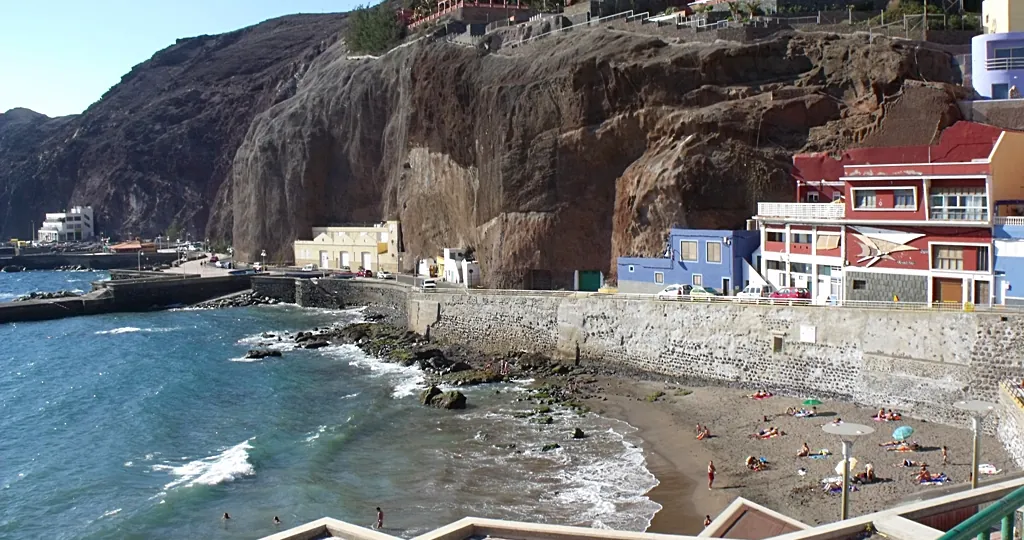

Gran Canaria boat dives: two sunken vessels in the south and a 1991 artificial reef
In the south-west the diving moves onto boats, and the Cabildo guide names three sites built by people rather than volcanoes. The Cermona II, a 32-meter steel fishing boat sunk in May 2002, lies heeled to starboard at about 20 meters, five minutes south-west of Puerto de Mogán, with the bridge, the holds and the engine room open to a look.
The Meteor II is stranger: a Russian-built tourist hydrofoil, 30 meters long and 8 wide, sunk in 2003 at El Pajar, no more than ten minutes from the Pasito Blanco marina. The guide says it sits almost whole and upright, and that you can swim in through the boarding door and along the rows of passenger seats. Average depth 17 meters, maximum 22, low difficulty.
Off the beach at Montaña Arena, near Arguineguín, several dozen concrete modules of four designs sit on sand at 23 meters. The guide dates this artificial reef to 1991, placed by the Canary government and monitored by the University of Las Palmas de Gran Canaria, and says garden eels, angelsharks and electric rays use the sand between the blocks. Our wreck diving list collects coasts built around this kind of dive.
North, at La Isleta outside Las Palmas, the guide’s La Catedral starts in a large cave with an opening in its roof, which the guide calls a siphon, at about 10 meters, then follows vaults and corridors. It rates the dive low difficulty at an average of 17 meters and a maximum of 22, and adds that the outer walls drop to 45 or 50 meters, which is below what Spanish law allows a recreational diver.
A Gran Canaria dive center needs a chamber within two hours under Decreto 35/2006
Recreational dive centers in the Canaries have a regional decree of their own. Decreto 35/2006 of 25 April requires every business whose main or side activity is recreational diving or its teaching to hold an administrative authorization. It hands that power to the island Cabildos once the competence is transferred; the Canary government’s procedure page, archived in March 2026, still shows its Dirección General de Pesca resolving the applications.
Article 4 sets the conditions. The technical director must hold a sports technician qualification in underwater activities. The center needs civil liability insurance and an emergency and evacuation plan. Its support boats must carry a spare breathing set, normobaric oxygen, markers for the dive area and a radio that reaches both the center and the Canary 1-1-2 emergency coordination center.
Article 5 holds the line that matters most. The emergency plan must guarantee a decompression chamber located so that a diver can be moved there within two hours at most from the dive site, plus a first-aid kit, oxygen and medical staff of its own or under contract.
The plan must name the chamber’s location and attach the title that entitles the center to use it. A 2011 notice in the Canary gazette shows the rule enforced: a center whose chamber contract had ended was told to prove a new one or face proceedings to end its authorization.
Two details help a visitor. The authorization must be displayed prominently in the center, and it states the maximum number of users, the support boats by name and registration, and the area of activity. Ask to see it, and ask where the plan sends you in an accident. This page does not name the chamber: public reports disagree about which chambers serve Gran Canaria divers, and no health-service page settling it could be reached.
This is the decree that covers recreational centers; the 2008 professional-diving decree discussed in the Lanzarote guide excludes them. For cover that pays for an inter-island transfer, our dive insurance guide works through the policies.
Spain’s national dive rules in Gran Canaria: 40 meters, air or nitrox, no planned stops
On top of the Canary decree sits Real Decreto 550/2020, Spain’s safety decree for diving, amended by Real Decreto 1188/2025. Article 18 caps recreational scuba at 40 meters on air or nitrox only, with direct access to the surface and a buddy pair as the minimum unit. Planned decompression stops are not allowed, nor are overhead dives where the light is lost and the penetration runs past 30 meters. Every recreational diver must carry accident and civil liability insurance.
Hold that 40-meter line against the sites above. The El Cabrón zone runs to 50 or 60 meters and La Catedral’s outer walls to 45 or 50, so the deepest water at both lies past the 40-meter line. Article 18.3 opens diving beyond the depth and gas limits only to adults, and only with the extra equipment listed in annex III of the decree. The try-dive ratio and the age limits are set out in the Mallorca guide, since the national decree applies the same way in both island groups.
Gran Canaria water temperature: 18 degrees in winter, and the warmest water in September
The Cabildo’s dive guide gives the water as 18°C in winter and 22°C the rest of the year. The state ports agency has better numbers than a round figure. Its Gran Canaria deep-water buoy has carried a temperature sensor since 2001, and on 27 July 2022 it measured 23.32°C, its highest reading for any July. The coastal buoy off Las Palmas reached 23.5°C on 26 and 27 July of the same year.
The agency adds the part a trip planner needs: in this area the historical maximums usually fall in September, not in July or August. So the summer water outruns the guide’s 22, and the warmest month comes late. The angelshark season runs the other way, with more sightings at El Cabrón in the cooler months, so a winter trip means a thicker suit rather than a worse dive; our travel wetsuit guide covers what to pack.
The Gran Canaria operator list holds 11 businesses, three of them filed at Arinaga
The Gran Canaria operator list holds 11 watersports businesses, read on 20 September 2026: 9 dive centers published by SSI in its register of affiliated centers, 1 windsurf station published by VDWS and 1 kite school published by IKO. Ten of the 11 publish a website in the register.
Where the dive centers are filed follows the diving described above. Three of the nine are filed at Arinaga, the town beside El Cabrón. The others are spread one each across Las Palmas, Gáldar, which is the municipality of Sardina, Telde, Arguineguín, San Agustín and Playa del Inglés. The windsurf station is filed at San Agustín and the kite school at Playa del Inglés.
SSI rates three of the nine for extra programs: two for Freediving, one of them also for Mermaid and the other for Extended Range, and one for Rebreather. That is a statement about the listing and not proof that a course runs this season. None of these registers is the authorization that Decreto 35/2006 requires, which is why the displayed document in the shop is the one to look for. Which registers can be read sets out what each source can and cannot tell you.
FAQ: scuba diving in Gran Canaria
Is El Cabrón in Gran Canaria a marine reserve?
Not in law. El Cabrón lies inside ZEC ES7010053 Playa del Cabrón, a Natura 2000 Special Area of Conservation of 956.20 hectares declared by Orden ARM/2417/2011 for its seagrass sandbanks. The Canary government lists three marine reserves of fishing interest, at La Graciosa, La Restinga and La Palma, and the island’s own tourism site describes Arinaga as nominated to become a future reserve.
What are the rules for diving at El Cabrón?
The 2011 order bans dumping from boats, anchoring on seagrass meadows, catching or collecting protected species, and feeding animals to attract them or change their behavior. Its management plan names collecting, fish feeding and uncontrolled finning as the pressures scuba diving puts on the site. A 2022 draft of a second plan, with a 5-meter distance from turtles and protected rays and sharks, is not in force.
Can you see angel sharks diving in Gran Canaria?
Yes, and at two named sites. In a survey of 678 sightings between April 2014 and March 2015, Sardina del Norte and El Cabrón were two of the four places in the Canaries with the highest sighting frequency. Sightings peaked in June and July and again from December to February. The Canary population is listed as en peligro de extinción in the Spanish Catalogue of Threatened Species.
How warm is the water for diving in Gran Canaria?
The Cabildo’s dive guide gives 18°C in winter and 22°C the rest of the year. The state ports agency’s Gran Canaria buoy measured 23.32°C on 27 July 2022, its highest July reading since its sensor was fitted in 2001, and the agency says the historical maximums in this area usually come in September.
Do dive centers in Gran Canaria need an authorization?
Yes. Decreto 35/2006 requires every recreational dive center in the Canaries to hold an administrative authorization, with an emergency plan that guarantees a hyperbaric chamber reachable within two hours of the dive site. The authorization must be displayed prominently in the center and states the maximum number of users, the support boats and the area of activity.
Note: Conditions, safety guidance and regulations change. Verify current information with official sources, including the dive operator, the park authority and the relevant government department, before you travel or dive.
Founder of NOMADREEF and a former digital nomad. This guide is sourced from the references below; conditions, prices and rules change, so verify current details, and follow qualified local guidance and safety briefings. About the author · LinkedIn ↗
Sources
- The designation, the plan and the rules (primary). Orden ARM/2417/2011, de 30 de agosto, declaring the Macaronesian marine sites of community importance as Special Areas of Conservation and approving their conservation measures, BOE 221 of 14 September 2011, in force 15 September 2011: annex II.A.I.1 (a) no dumping from a boat or platform, (b) no anchoring on meadows of marine phanerogams, anchoring defined as fixing an anchor system on the seabed, (c) no capture or collection of species with a protection status, (d) no feeding species to attract them or modify their behavior, (f) reserved power to regulate underwater activity in sea caves; annex II.A.II.2.8, the scuba recommendations on gear for capture or extraction and on limiting cave dives; the second final provision on six years’ validity, extended until replaced. The management plan for ZEC ES7010053 Playa del Cabrón (BOE pages 97518 to 97538): proposal as a site of community importance in October 1999 and approval by Decision 2002/11/CE of 28 December 2001; limits from Punta de la Sal to La Caleta, maximum depth of about 50 to 60 m, 956.20 ha, overlap with the Monumento Natural de Arinaga; declaration for habitat 1110 only, 135.36 ha or 14 percent; reefs, sea caves, Caretta caretta and Chelonia mydas recorded but not part of the declaration; the regression of Cymodocea nodosa, the decline of Scyllarides latus, fewer than 500 Hippocampus hippocampus and fewer than 50 Gerardia savaglia; scuba diving as the main activity, with collecting, feeding and uncontrolled finning as pressures and free anchoring as a threat; measures 2.7.2 (carrying capacity), 1.2.1 [U] (ecological moorings), 1.1.1 [S] (codes of good practice), 2.2.1 [I] (two Diadema campaigns a year with dive centers and clubs); section 6, no zoning. The management plan for ZEC ES7010066 Costa de Sardina del Norte (from BOE page 97581): limits from Punta Cardonal to Punta Ortiz out to the 50 m contour, Gáldar, 1,426.55 ha, declaration for habitat 8330 (submerged or semi-submerged sea caves) only. BOE-A-2011-14661, text and record and full PDF with annexes. Read 25 September 2026. The BOE record lists no later provision amending or replacing the order.
- The site today, and the seagrasses (primary). Ministerio para la Transición Ecológica y el Reto Demográfico, page for ZEC ES7010053 (956.20 ha off Agüimes, a ZEC since September 2011), with its current leaflet on seagrass anchoring: anchoring on seagrass meadows prohibited in the ZEC, authorized anchoring buoy fields inside or near the protected area, Cymodocea nodosa on sand and mud at 6 to 20 m, Halophila decipiens found in Spain only in the Canaries, to 40 m, and both described as protected by Spanish regulations. MITECO, ZEC ES7010053 Playa del Cabrón; leaflet (PDF, English). Read 25 September 2026.
- The 2022 draft (primary, not in force). Public consultation on the draft ministerial order approving the second management plan for the 24 Macaronesian ZECs, open 24 January to 7 March 2022, with Playa del Cabrón in its list; the draft annex I, section E (the responsible-diving criteria of Orden APA/126/2019, 5 m from turtles and protected elasmobranchs, no chasing, touching or feeding turtles) and the critical area for angelsharks (a declaración responsable for organized scuba diving, organized meaning more than four people including crew, or run by an association or company). MITECO, consultation page, draft order (PDF) and draft annex I (PDF). Read 25 September 2026.
- The three marine reserves (primary). Gobierno de Canarias, fisheries department, “Reservas Marinas de Canarias”: “En Canarias existen tres reservas marinas de interés pesquero”, La Graciosa, La Restinga-Mar de las Calmas and La Palma. gobiernodecanarias.org (archived 16 May 2026); the same three Canary reserves in the national list of the Ministerio de Agricultura, Pesca y Alimentación. Read 25 September 2026. The Canary government’s servers did not answer from our location on that day, so its pages were read through the Internet Archive.
- The common version of the claim (secondary, quoted as the claim). Dive-center pages naming the site a marine reserve, among them brothersdiving.com (“Reserva Natural Marina de El Cabrón”) and karapatdive.com (“reserva marina del Cabrón”), both as titled in search listings; and one stating that the “El Cabrón Marine Reserve was listed as a Site of Special Scientific Interest by the European Union in December 2001 and is one of only three Marine Reserves in the Canary Islands”. davyjonesdiving.com. Read 25 September 2026.
- The dive sites (Cabildo de Gran Canaria tourism board). El Cabrón page: one of the best dive points on the island, nominated for the future Reserva Marina de Arinaga, shore access, average 19 m, maximum 22 m, medium difficulty, frequent current, a platform at about 12 m with a 23 m drop. grancanaria.com, El Cabrón. The island dive guide (undated brochure): water between 18°C in winter and 22°C the rest of the year; Cermona II (32 m steel fishing boat sunk in May 2002, about 20 m, five minutes south-west of Puerto de Mogán); Meteor II (Russian hydrofoil, 30 by 8 m, sunk 2003 at El Pajar, average 17 m, maximum 22 m); the Arguineguín artificial reef (off Montaña Arena at 23 m, four module types, placed in 1991 by the Canary government under University of Las Palmas monitoring); La Catedral (La Isleta, siphon at about 10 m, outer walls at 45 to 50 m, average 17 m, maximum 22 m); Caleta Baja; Sardina (sheltered bay, beginners, photography and night dives, entry by the pier steps, average 12 m, maximum 18 m, low difficulty, species list); access routes to El Cabrón via the Arinaga lighthouse. Guía de Inmersiones (PDF). Read 25 September 2026. Site descriptions rest on this single official source.
- The angelshark listing (primary). Orden TEC/596/2019, de 8 de abril, amending the annex of Real Decreto 139/2011: the Canary populations of Squatina squatina, S. oculata and S. aculeata in the category en peligro de extinción. BOE-A-2019-8317. Read 25 September 2026.
- The angelshark survey (peer-reviewed). Meyers, Tuya, Barker, Jiménez Alvarado, Castro-Hernández, Haroun and Rödder, “Population structure, distribution and habitat use of the Critically Endangered Angelshark, Squatina squatina, in the Canary Islands”, Aquatic Conservation (2017): 678 sightings from April 2014 to March 2015 through the POSEIDON tool of the Universidad de Las Palmas de Gran Canaria, from 22 dive centers including seven on Gran Canaria; high sighting frequency in four cells, Las Teresitas, Sardina del Norte, El Cabrón and Puerto del Carmen, three of them potential nursery areas; the bay of Sardina highlighted by the habitat model and placed on the north-eastern side of the island; peaks in June to July and December to February; neonates mostly April to July; large males more frequent in winter; Narvaez (2013) on more sightings at El Cabrón in winter and spring at 17 to 21°C; most dive sites on the eastern and southern sides of each island. Full text (PDF). Read 25 September 2026.
- The Canary dive-center decree (primary). Decreto 35/2006, de 25 de abril, regulating dive centers and recreational underwater teaching in the Canary Islands, BOC 86 of 5 May 2006: article 2 (definitions), article 4 (technical director, insurance, emergency plan, boat equipment including normobaric oxygen and a link to 1-1-2), article 5.1.j (a chamber reachable within two hours at most, its location and the title to use it), article 5.3 (contents of the authorization), article 5.5 (displayed in a preferred and perfectly visible place), the additional provision on the Cabildos. BOC 2006/086 (archived copy). Its current use: the procedure “Autorización a los centros de buceo”, resolved by the Dirección General de Pesca, listing the title to use a hyperbaric chamber among the documents, sede electrónica, trámite 2391 (archived 6 March 2026); the Juriscan record listing no later amending provision, Juriscan, Decreto 35/2006 (archived June 2024); and the enforcement notice of 1 September 2011 on a center whose chamber contract had ended, BOC 2011/201, anuncio 5336 (archived copy). Read 25 September 2026.
- Spain’s national safety rules (primary). Real Decreto 550/2020, de 2 de junio, consolidated text as amended by Real Decreto 1188/2025: article 18 (40 m, air or nitrox, direct access to the surface, buddy pair, no planned decompression, overhead limit of 30 m where light is lost, beyond the limits only for adults with the annex III equipment, accident and civil liability insurance). BOE-A-2020-6745. Read 25 September 2026.
- Water temperature (primary). Puertos del Estado, “The temperature of the Mediterranean exceeded 31°C this summer”, 19 September 2022: the Gran Canaria buoy, with a water temperature sensor since 2001, at 23.32°C on 27 July 2022; the Las Palmas Este coastal buoy, with data since 2014, at 23.5°C on 26 and 27 July; historical maximums in this area usually in September. puertos.es. Read 25 September 2026.
- The 11 businesses. The Gran Canaria operator list, read 20 September 2026: 9 dive centers from the SSI register of affiliated centers, 1 station from the VDWS register and 1 school from the IKO register; 10 publish a website; filed as Arinaga 3 and one each in Las Palmas, Gáldar, Telde, Arguineguín, San Agustín and Playa del Inglés for diving. The register’s town field records where a body files a business, not necessarily where it operates; the limits of each source are on which registers can be read.
- Left out, and why. The location of the hyperbaric chamber that serves Gran Canaria divers: press reports in 2026 describe the unit at the Hospital Universitario de Canarias on Tenerife as the only one in the islands (Canarias7, 13 April 2026), while other public pages describe chambers on Gran Canaria, and no Servicio Canario de la Salud page settling it could be reached, so this page names none. Trade-wind statistics by month for the dive coast were not read at AEMET, so no wind season is given. Monthly water temperatures from a buoy climatology were not found, so only the guide’s range and the 2022 readings are quoted.