Barcelona Diving: The Maresme and Garraf Coasts, Spain's Insurance Rule and Catalonia's Spearfishing Ban on Scuba
 by Yannick Schroth
Nov 10, 2026
9 min read
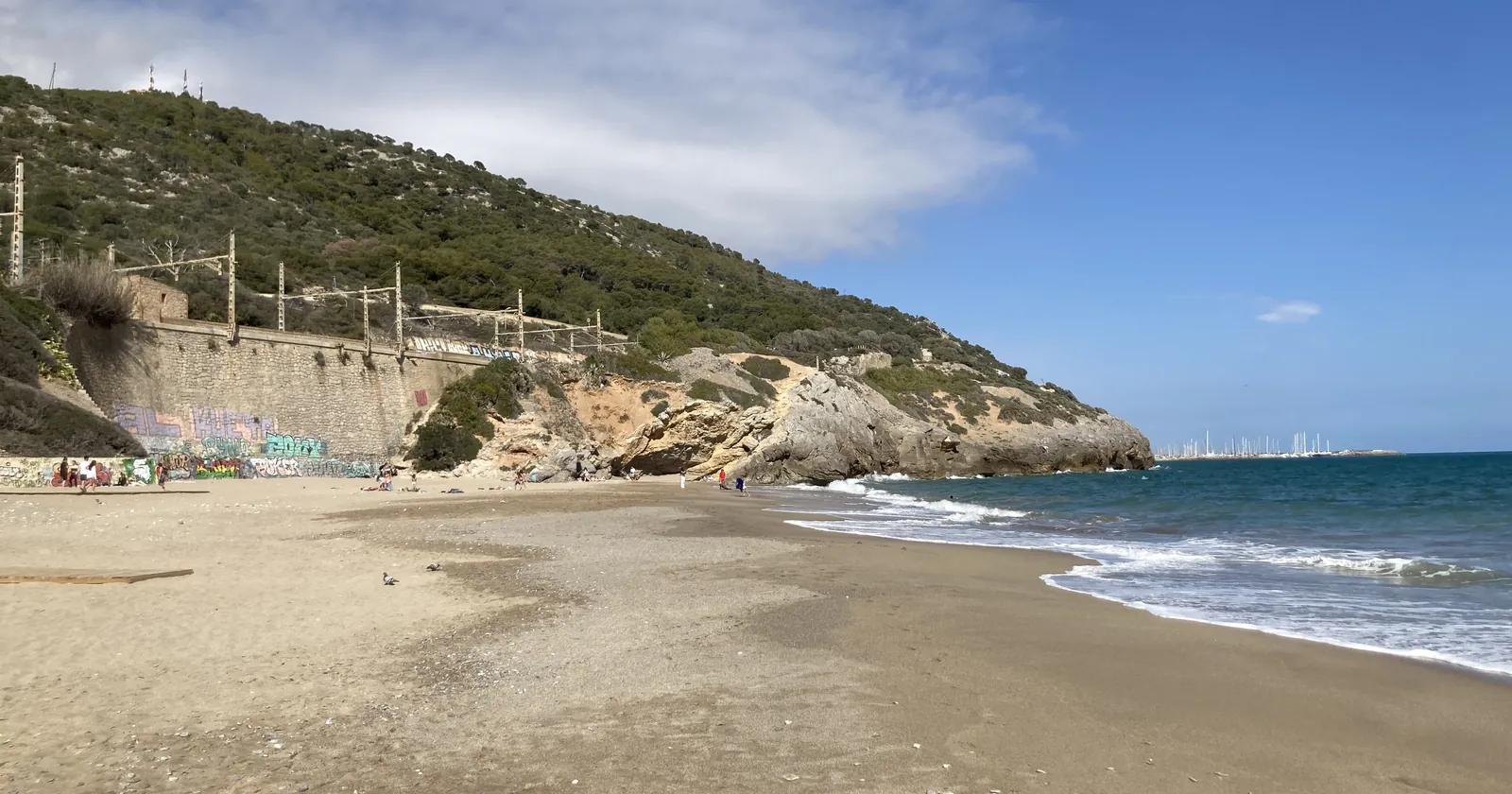
The beach at Garraf, south-west of Barcelona. Mattsjc, Wikimedia Commons, CC BY 4.0, cropped.

Key takeaways
- The coasts either side of Barcelona, the Maresme and the Garraf, are both listed Natura 2000 sites; the Medes Islands reserve is further north on the Costa Brava
- Spain requires accident and civil-liability insurance for every recreational diver, a signed health questionnaire before any dive, and limits recreational scuba to 40 meters on air or nitrox
- Catalan law makes spearfishing with scuba, and taking shellfish or other invertebrates without authorization, serious offences with fines of €151 to €30,000
- NOAA's averages put the sea off Barcelona at about 13.0 °C in February and 25.3 °C in August, slightly warmer off the Garraf and slightly cooler off the northern Maresme
- A public hyperbaric unit runs at Hospital Moisès Broggi in Sant Joan Despí; we could not confirm it is staffed around the clock, so call 112 first
Barcelona diving: a city between two protected coasts
Barcelona is a city dive base rather than a dive resort. Spain's environment ministry lists two Natura 2000 sites on the coast either side of it: ES5110017, the Costes del Maresme, running north-east towards Mataró, and ES5110020, the Costes del Garraf, running south-west towards Sitges. Further north, the Medes Islands off L'Estartit sit inside a third site, ES5120016, El Montgrí-Les Medes-El Baix Ter. Natura 2000 status protects habitats and species under EU law; it is not a dive permit system, and we found no approved management plan for either coast near Barcelona that sets rules for divers.
SSI's own register of affiliated centres files dive centres in three places around the city: Barcelona itself, Sant Adrià de Besòs, and Mataró in the Maresme. The town in a register entry is where the training body files the business, not proof of where its boats go, so ask a centre which coast it dives before you book.
Where to dive: the Maresme, the Garraf and the Medes
We found no official list of dive sites for this coast, so the names here come from the centres' own pages. In the city, Vanas Dive works from the beach at Mar Bella and runs shore dives off Barcelona's rock breakwaters; one of them, at Nova Marbella, it calls the Darth Vader breakwater after a sunken bust. North of the city it lists a sunken fish farm off Arenys de Mar, which it says opened in 1996 as a floating platform for raising gilthead bream, and the wreck of the Boreas, and it also runs trips up to the Costa Brava and the Medes.
In Mataró, two centres work from the port. Blaumar's dive calendar names El Sastre at 18 to 22 meters, a fish-farm dive, a night dive and a dive to monitor Posidonia seagrass; Easy Diving prices a reef trip separately from its standard boat dives. Those depths are the centres' own figures. We found no centre page naming sites on the Garraf, south of the city, so ask before you book whether a centre goes there at all, and ask any centre for the depth range of each site and whether it dives from the shore or a boat.
For a bigger day, there is the Medes Islands reserve off L'Estartit. Its rules are stricter than anything we found for the coasts near Barcelona: centres need a Generalitat authorization to take divers into the strictly protected zone, and the number of dives is capped. Our Costa Brava diving guide covers the Medes sites, the cap and the authorization in detail, so book through a centre that holds it rather than turning up at the harbour.
Spain's diving rules: insurance, 40 meters and the surface marker
Spain's Royal Decree 550/2020 sets the safety rules for diving in all Spanish waters, so it applies off Barcelona as it does everywhere else. Four of its rules matter most to a visiting diver.
Insurance first. The decree says every recreational diver must hold accident and civil-liability insurance that can cover any incident or accident during the dive. Bring proof of a policy that covers diving, or ask the centre whether it can sell you one; our guide to dive insurance for nomads explains what to look for.
Health next. For every recreational dive, including a first try dive, the centre must ask you to sign a health questionnaire. If your answers show a condition that could affect your safety, you may only dive with a medical exam passed within the year.
Depth and gas. Recreational scuba is limited to 40 meters on air or nitrox, diving in pairs, with no planned decompression stops and no penetration of caves, wrecks or other overhead environments where the light is lost and the penetration goes beyond 30 meters. Diving outside those depth and gas limits is allowed only for divers over 18 who carry the extended equipment the decree lists.
Marking. A surface marker buoy is compulsory when you dive without a boat or in an area that is not marked, and all vessels other than the support boat must keep at least 50 meters from the dive zone. No support boat is required within 200 meters of a beach or 50 meters of the rest of the coast, and any boat taking part in a dive must fly the international "Alfa" flag.
Catalonia's rules: dive centres, spearfishing and taking sea life
Catalonia regulates dive businesses under its own fishing and maritime law, Llei 2/2010. It defines a dive centre as a business that lets people practise underwater activities, with or without a guide or instructor, or that trains them. Opening and running one requires prior notification to the Generalitat department in charge of fisheries and maritime affairs, and centres go on the Catalan register of maritime-activity centres. We could not find a public search page for that register.
The same law is blunt about what divers may take. Spearfishing without the required licence is a serious offence. So is spearfishing with scuba, semi-closed equipment or any other system that lets you breathe underwater, and so is removing marine plants, molluscs or other invertebrates whose extraction is not authorized. Serious offences in recreational fishing carry fines of €151 to €30,000. Spain's national rule for outer waters says the same in other words: recreational spearfishing is breath-hold only, it needs a licence from a coastal region, it is banned from sunset to sunrise, and it is banned when a boat carries spearfishing gear and breathing equipment at the same time. In practice, plan to take nothing while you are on scuba.
We found no Catalan rule comparable to the Balearic ban on anchoring on Posidonia seagrass, and no published diving rules specific to the Garraf or Maresme Natura 2000 sites. That doesn’t mean anything goes. Local and port rules may apply, so follow your centre's briefing.
When to dive: sea temperature by month
We computed monthly sea-surface averages for 1991 to 2020 from NOAA's OISST satellite record for three cells near Barcelona: one about 15 kilometers off the city (41.375°N 2.375°E), one off Sitges and the Garraf (41.125°N 1.875°E) and one off the northern Maresme (41.625°N 2.625°E). These are surface values; in summer the water at 20 or 30 meters is colder.
| Month | Off Barcelona | Off the Garraf | Northern Maresme |
|---|---|---|---|
| January | 13.5 °C | 13.7 °C | 13.4 °C |
| February | 13.0 °C | 13.2 °C | 12.8 °C |
| March | 13.3 °C | 13.5 °C | 13.2 °C |
| April | 14.4 °C | 14.7 °C | 14.2 °C |
| May | 17.0 °C | 17.3 °C | 16.7 °C |
| June | 20.6 °C | 21.1 °C | 20.3 °C |
| July | 23.8 °C | 24.3 °C | 23.4 °C |
| August | 25.3 °C | 25.8 °C | 24.9 °C |
| September | 23.7 °C | 24.1 °C | 23.4 °C |
| October | 20.9 °C | 21.3 °C | 20.3 °C |
| November | 17.3 °C | 17.7 °C | 17.0 °C |
| December | 14.9 °C | 15.1 °C | 14.8 °C |
February is the coldest month and August the warmest, and the water stays above 20 °C from June to October. For comparison, a cell off the central Costa Brava (41.875°N 3.375°E) averages about 23.1 °C in August, roughly two degrees cooler than off Barcelona, which is worth knowing if you plan a Medes trip in summer.
Winter storms: the levante
The weather that closes this coast is the easterly levante. Spain's weather agency AEMET describes storm Harry in January 2026 as a strong levante gale across Catalonia from 17 to 21 January, the most adverse for a January since storm Gloria in 2020; Catalonia averaged about 94 mm of rain between 16 and 20 January, double what it normally gets in the whole month. We could not find a published normal for the number of strong-wind days a month at Barcelona, so treat winter diving as day-by-day and expect cancellations when an easterly is forecast.
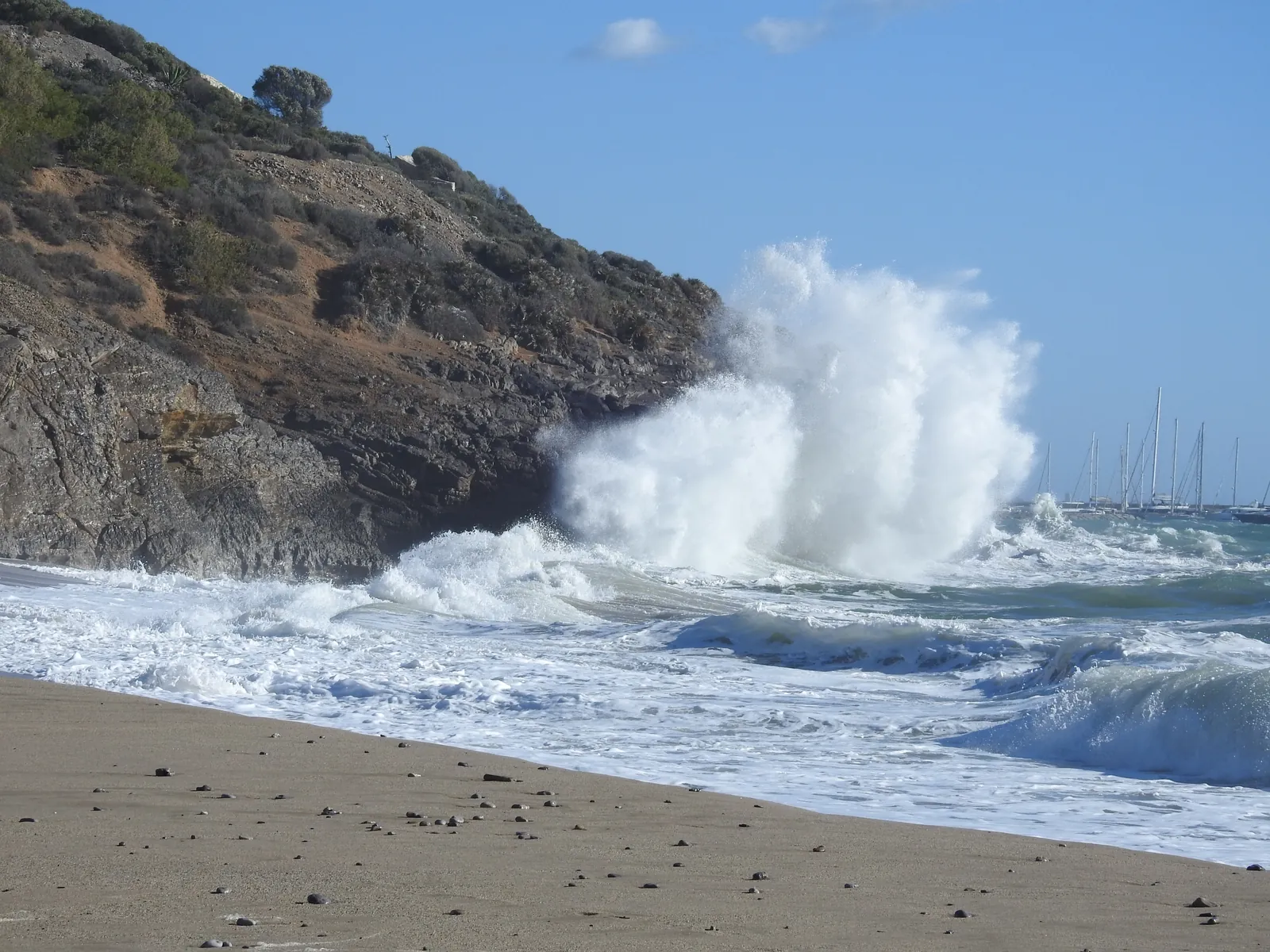
A rough sea on the Garraf coast. Brian Adamson, Wikimedia Commons, CC BY 2.0, cropped.

Hyperbaric chamber and emergencies
Spain's emergency number is 112, the single European emergency number. For decompression illness the nearest unit is the hyperbaric medicine service at the Hospital de Sant Joan Despí Moisès Broggi, at Carrer Oriol Martorell 12 in Sant Joan Despí. The Consorci Sanitari Integral, the public health consortium that runs the hospital, said in July 2024 that it would run the service itself from that October with renewed equipment. The Catalan health department's event listing shows the unit hosting a cardiology and diving day on 28 November 2025 that included a visit to the chambers, so it is active. Neither source says whether the chamber is staffed 24 hours a day, and we could not confirm it. The same listing names a hyperbaric medicine unit at the Hospital de Palamós on the Costa Brava.
Call 112 in an emergency, ask your centre where it would send you, and check that your insurance covers chamber treatment and transport.
What diving costs in Barcelona
Prices from the centres' own pages, read on 10 November 2026. Boat dives in Mataró start at about €35 to €38 with a tank, and the packs bring the price per dive down for a longer stay.
| Centre | Item | Price |
|---|---|---|
| Easy Diving, Mataró | Boat dive with tank, guide included | €35 |
| Easy Diving, Mataró | Boat dive with tank and full equipment | €61 |
| Easy Diving, Mataró | Pack of 10 boat dives plus 2 free | €350 |
| Easy Diving, Mataró | Try dive from the boat | €100 |
| Blaumar, Mataró | One dive with tank, air or nitrox | €38 or €44 |
| Blaumar, Mataró | One dive with full equipment, air or nitrox | €72 or €78 |
| Blaumar, Mataró | Pack of 12 boat dives with air tank | €380 |
| Saita Diving, Fòrum | Boat dive with tank, non-members | €30 |
| Divertysub, Barcelona | Pool try dive | €60 |
| Divertysub, Barcelona | Open Water course | €520 |
Saita works as a club with lower prices for members. None of these pages says whether the price includes the insurance Spanish law requires, so ask.
Getting to the dive centres
The register-listed centres are in Barcelona, Sant Adrià de Besòs and Mataró, so you can base yourself in the city and travel out on dive days, either to a centre or to meet its boat. We couldn’t confirm current train times for these routes, so check them on the day. For the Medes, you travel up to L'Estartit on the Costa Brava; our Costa Brava guide covers the dive side of that trip.
Barcelona as a remote-work base
Spain's international telework permit, set out in its law supporting entrepreneurs (Ley 14/2013), is for nationals of countries outside the EU who work remotely for companies based outside Spain. Freelancers may take up to 20% of their work from Spanish clients. You need a degree or at least three years of professional experience, the company you work for must have been active for at least a year, and your work relationship must have lasted at least the last three months. The visa lasts up to a year; from inside Spain you can apply for a residence permit of up to three years, renewable for two at a time.
The income bar is 200% of Spain's minimum wage. The Spanish consulate in Washington puts that at €2,442 a month for a single applicant, twice the 2026 monthly minimum wage of €1,221, plus 75% of the minimum wage for the first family member and 25% for each further one. Other sources, our Spain visa guide among them, spread the annual minimum wage of 14 payments over 12 months and arrive at about €2,849, so confirm the amount with the consulate where you apply. You also need health insurance from an insurer authorized to operate in Spain that covers what the public system covers; travel insurance is not accepted. Our Spain digital nomad visa guide walks through the paperwork.
Who Barcelona diving suits
Barcelona suits a remote worker who wants a large city with diving within reach on free days rather than a dive resort: training, weekend dives on the Maresme or the Garraf, and a public hyperbaric unit nearby. From December to April the surface sits between 13 and 15 °C, and it passes 20 °C only from June to October. It suits less well anyone who wants named reef sites with published depths before arriving, or calm winter seas, since a levante storm can stop diving for days. If the Medes are the goal, plan them as a separate trip.
FAQ: Barcelona diving
Can you scuba dive near Barcelona?
Yes. Centres run shore dives off the city's breakwaters and boat dives from the port of Mataró. SSI's register files dive centres in Barcelona itself, in Sant Adrià de Besòs and in Mataró. The coasts on either side of the city, the Maresme to the north-east and the Garraf to the south-west, are both protected Natura 2000 sites. The Medes Islands reserve on the Costa Brava is a separate trip north.
Do you need insurance to dive in Spain?
Yes. Royal Decree 550/2020 requires every recreational diver to hold accident and civil-liability insurance that can cover any incident during the dive. Centres must also ask you to sign a health questionnaire before any dive, including a try dive.
Can you spearfish while scuba diving in Catalonia?
No. Catalonia's fishing law makes spearfishing with scuba or any other breathing equipment a serious offence, and spearfishing without a licence is one too. Fines for serious recreational fishing offences run from €151 to €30,000. Taking shellfish or other invertebrates without authorization is also a serious offence.
How warm is the sea in Barcelona?
NOAA's satellite averages for 1991 to 2020 put the surface about 15 kilometers off the city at 13.0 °C in February, the coldest month, and 25.3 °C in August, the warmest. It stays above 20 °C from June to October. Water at depth in summer is colder than the surface.
Where is the nearest hyperbaric chamber to Barcelona?
At Hospital Moisès Broggi in Sant Joan Despí, Carrer Oriol Martorell 12, run by the public Consorci Sanitari Integral. We could not confirm that it is staffed 24 hours a day. In an emergency call 112.
Note: Conditions, safety guidance and regulations change. Verify current information with official sources, including the dive operator, the park authority and the relevant government department, before you travel or dive.
Founder of NOMADREEF and a former digital nomad. This guide is sourced from the references below; conditions, prices and rules change, so verify current details, and follow qualified local guidance and safety briefings. About the author · LinkedIn ↗
Sources
- Protected coasts (primary). Ministerio para la Transición Ecológica, Catalonia's Natura 2000 sites (LIC / ZEC), entries ES5110017, ES5110020 and ES5120016. Read 10 November 2026.
- Dive centres (primary). SSI training centre register, for example a Sant Adrià de Besòs entry; the full list is on our Barcelona operator list. Read 10 November 2026.
- Spanish diving rules (primary). Real Decreto 550/2020, consolidated (PDF), articles 1, 8, 14, 15 and 18. Read 10 November 2026.
- Catalan rules (primary). Llei 2/2010 de pesca i acció marítimes, consolidated (PDF), articles 114 to 116, 135 and 151; Real Decreto 347/2011 on recreational fishing in outer waters, consolidated (PDF), articles 3, 13, 14 and 16. Read 10 November 2026.
- Sea temperature (primary dataset). NOAA PSL, OISST v2.1 monthly long-term means 1991–2020, four grid cells, computed for this page. Read 10 November 2026.
- Storms (primary). AEMET, Catalonia climate summary, January 2026 (PDF). Read 10 November 2026.
- Chamber and emergencies (primary). Consorci Sanitari Integral, hyperbaric medicine service (July 2024); Departament de Salut, programme of the cardiology and diving day, 28 November 2025 (PDF); Real Decreto 903/1997 on the 112 number (PDF). Read 10 November 2026.
- Staying and working (primary). Ley 14/2013, consolidated (PDF), articles 74 bis to 74 quinquies; Consulate General of Spain in Washington, telework visa. Read 10 November 2026.
- Dive sites and prices (operators' own pages). Vanas Dive, dive trips; Blaumar, dive trips and prices; Easy Diving, prices; Saita Diving, prices; Divertysub, prices. Read 10 November 2026.
- Left out. An official list of dive sites, and depths and visibility beyond the centres' own figures; sites on the Garraf; the artificial reefs off the city; whether the Sant Joan Despí chamber is staffed around the clock; a normal for strong-wind days at Barcelona; official train times to the coast and to L'Estartit; and the conditions of the Catalan spearfishing licence.