Jeddah Diving: Every Dive Needs a Permit, and Visitors Get Theirs Through a Dive Center
 by Yannick Schroth
Sep 25, 2026
14 min read
by Yannick Schroth
Sep 25, 2026
14 min read
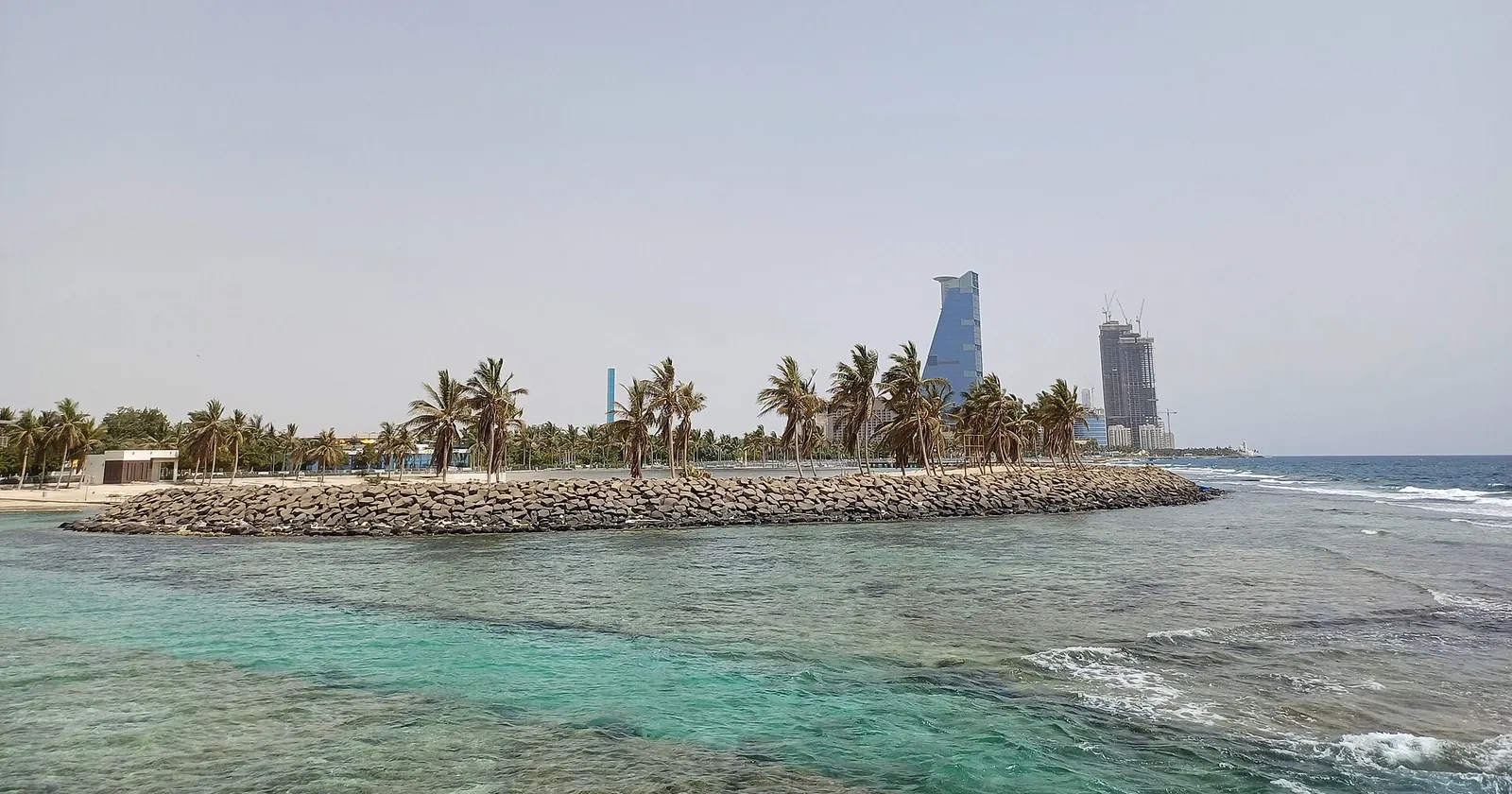
Photo: Radosław Botev, Wikimedia Commons, CC BY 3.0 PL.

Key takeaways
- Article 30 of Saudi Arabia's Diving Sport Regulation bars groups and individuals from diving without a permit issued by a dive center
- Article 25 lets a lawful tourist or visitor dive on a card from any federation-approved agency, through a licensed center's permit
- Trips without a center are limited to holders of a Saudi ID or iqama, with every scuba diver certified Rescue Diver or higher
- The federation's site register files five Jeddah sites, all shore entries in the city's north and all classed as private beaches
- A marine regulation published on 21 August 2026 bans anchoring on coral and prices coral damage at up to SAR 200,000 per cubic meter
Every dive in Jeddah needs a permit issued by a licensed dive center
Saudi Arabia regulates recreational diving as a sport rather than as a tourism product. The rulebook is the Diving Sport Regulation (اللائحة التنظيمية لرياضة الغوص), issued under the Ministry of Sport and administered by the Saudi Water Sports and Diving Federation. It covers recreational, technical and freediving, and article 3 leaves military and commercial diving outside it.
Article 30 is the one that shapes a trip to Jeddah. Dive centers are the body competent to organize dive trips and to issue the permits for them, in a pool, in internal waters, in the territorial sea or in the exclusive economic zone. Paragraph 30.2 then says it plainly: groups and individuals are not allowed to dive without a permit issued by a dive center. Paragraph 30.3 lets the center charge for that permit.
None of this shuts visitors out. Article 25 gives the non-professional diver, “whether a citizen, a lawful resident, a lawful tourist or a lawful visitor”, the right to dive on a license from one of the agencies the federation approves, through a permit from a licensed center. Article 1 defines those agencies as the training organizations under the umbrella of the World Recreational Scuba Training Council.
The federation's rules for non-professional divers close the loop. The card an approved agency issued you, printed or electronic, counts as a license in its own right, and no other license is asked of you. Two limits follow from the regulation itself: a center may rent core scuba equipment only to divers holding a valid card, and recreational diving is defined as no-stop diving to no more than 40 meters (130 feet), or less if your certification says so.
Jeddah dive permits run through Zawil, and visitors cannot open an account
The permit itself is now digital. Zawil is a portal the federation runs in partnership with the General Directorate of Border Guard and in cooperation with the company Elm, and it issues four kinds of dive permit: recreational diving from a public beach, recreational diving from a private beach, training from the shore, and open-sea diving from a boat. The federation's page names who usually activates each one: the Border Guard for public beaches, the beach operator for private ones, the center for training.
The user guide for divers draws the line that matters to a traveler. In its words, registration is possible “for citizens and residents only; visitors cannot register, and can use the system's services through dive centers”. Signing up takes a national ID or iqama number, a date of birth and a code sent to the phone number registered in Absher.
For a resident, the same guide sets four conditions on a beach dive permit: at least two divers, everyone aged 10 or over, a companion older than 18 whenever a diver in the group is between 10 and 14, and a maximum duration of 72 hours. Permits are paid for in points, topped up through a SADAD bill.
Before Zawil, the federation ran the same rule on paper under an interim mechanism, and that document shows what the system is for. The professional in charge took the signed permit to the Border Guard station covering the public beach before the dive, and brought it back afterward “to confirm the divers' return and their safety”. Boat dives ran on a sailing permit from the Border Guard station of the marina the boat left from; Zawil has since added an open-sea track for boats.
The interim mechanism also settles three questions divers ask. Cameras of every kind are allowed at permitted sites without any extra permit or procedure. Snorkeling with mask, fins and snorkel, from the shore or from a boat, needs no permit at all. Night dives from shore or boat are open to every diver whose certification level qualifies them for it.
Diving Jeddah without a dive center takes a Saudi ID or iqama and a Rescue Diver card
The federation's rules for dive and snorkel trips, version 2 dated 1447 AH (2025), split every trip into two kinds. A commercial trip is organized by a dive center, for money, and paragraph 4.4 lets anyone join it on a national ID, an iqama, a Gulf citizen's ID, a passport, a border number or any lawful visa valid in the Kingdom. Under paragraph 4.5, children under 15 may join when accompanied by an adult, a dive professional or a relative.
A private trip is the buddy dive most divers picture: friends, no instructor, no fee. Section 6 allows it from public and private beaches and then fences it in. It is for recreation only, never training. Every participant needs a card from an approved agency, and for scuba the minimum is Rescue Diver or its equivalent. Freedivers need a level that allows them below 30 meters, technical divers a level that allows 50 meters.
Paragraph 6.6 is the one a visitor runs into. Private trips are open only to holders of a valid national ID or iqama, and those holding “any other type of ID or visa” are not permitted to take part. Everyone must register with the federation and be approved, the trip may not be advertised, and no money may change hands. Private boat trips add a fixed list of divers, twice the boat's passenger capacity, that can change only after a calendar year.
So the answer for someone arriving on a tourist visa is short: in Jeddah you dive with a licensed center or you do not dive. Residents with a Rescue Diver card have a second route through Zawil, and with it the duties a center would otherwise carry, from checking every participant against the permit to reporting any accident to the federation within 24 hours.
The federation lists five dive sites under Jeddah, all of them shore sites in the city's north
Paragraphs 4.7 and 4.8 of the trip rules allow diving only at places the federation and the relevant authorities have approved, and the federation publishes its register of those places. Read on 25 September 2026, it files five sites under Jeddah: Scubamaster Beach, La Mer Beach, Sheraton, La Plage and Sol. All five sit between 21.70 and 21.76 degrees north, and four fall under the Border Guard's Obhur center, with La Mer under Khor Saud.
The records carry more than names. Four describe the site as a wall. Sheraton is graded for beginners, with the note “easy access to deep water”; Scubamaster Beach, La Mer and Sol are graded advanced; La Plage carries no grade. Every graded site is approved for recreational and training dives. La Mer's record lists turtles, rays, giant trevally and lionfish, and names hammerhead and tiger sharks among its organisms too.
One field contradicts itself. All five are classed “Private Beach” under accessibility, while the notes on La Mer and Sheraton say “Public beach”. On a private beach, the trip rules make the beach operator activate and close the permit and count divers in and out, logging each entry and exit time. The register files no offshore reef under Jeddah at all, so the reefs a Jeddah boat visits sit on the open-sea track, not on this list.
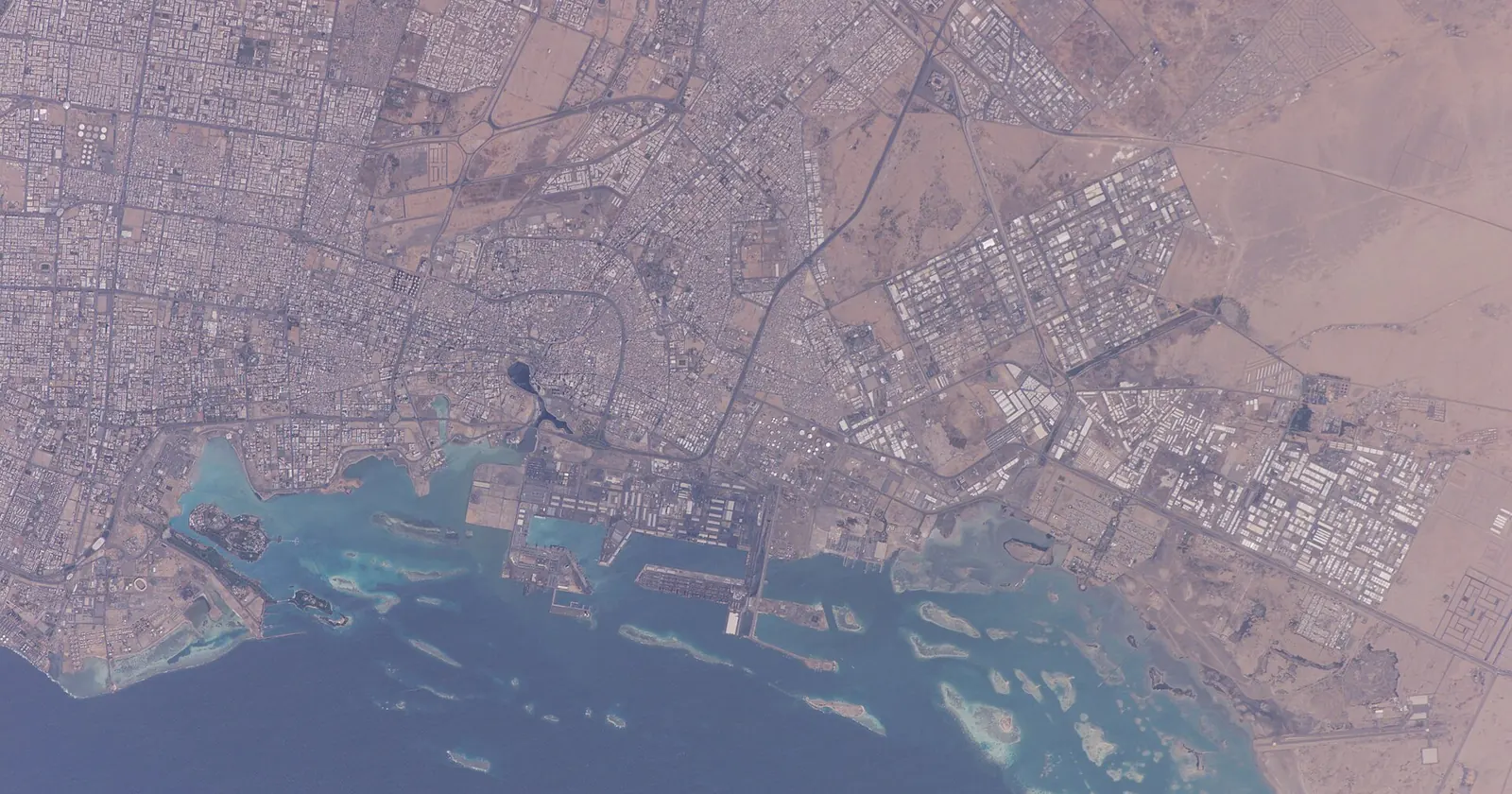
Jeddah's shoreline, its port and the reefs on the shelf in front of it, photographed from the International Space Station during Expedition 10 (frame ISS010-E-20261). Photo: NASA Johnson Space Center, Earth Science and Remote Sensing Unit, Wikimedia Commons, public domain.

What a Jeddah dive boat has to carry under the 2025 trip rules
Section 9 of the trip rules reads like a checklist, and it is a fair one to run your eye over on the jetty. The boat needs a ladder for safe entry and exit, the alpha flag and a divers-down flag, a float or life ring on a line at least 10 meters long, a first aid kit, a map of the sites and an emergency and evacuation plan. Emergency oxygen is sized to the group: one 4-liter cylinder for every four divers.
Two rules protect the people in the water. Nobody may enter until the engines are switched off and the boat has stopped, and the engines may not run while anyone is in the water. The rules also recommend hanging a spare cylinder with a regulator and a weight belt 5 meters under the boat for the safety stop, and make it compulsory on dives deeper than 18 meters.
The consumer rules are unusually specific. A diver who cancels at least 72 hours before a commercial trip gets the full price back, and if the center cancels, you choose between a full refund and another trip. The center must give you written terms and an invoice. Neither a boat owner nor a freelance instructor may organize or advertise dive trips under their own name; that is reserved to the center.
Group sizes come from the interim permit mechanism. A recreational instructor may take eight students, plus two for each qualified assistant, up to twelve. A freediving instructor may take four, plus four with assistants, to a ceiling of eight. A technical instructor may take three, plus one with an assistant, to a ceiling of four.
A dive boat answers to more than the federation. Paragraph 4.3 of the trip rules names the Transport General Authority, the Saudi Red Sea Authority and the Border Guard among the bodies whose requirements it must also meet. The Red Sea Authority's classification regulation lists dive boats and dive ships among the motorized craft of coastal tourism, inside a scope it defines as the Saudi territorial sea in the Red Sea, military and security areas excepted.
Jeddah's reefs fall under marine rules published on 21 August 2026
The environmental rulebook changed a month before this guide was written. The Executive Regulation for the Sustainable Management of the Marine and Coastal Environment, made under the Environment Law of Royal Decree M/165 of 19/11/1441 AH, appeared in the official gazette Umm al-Qura on 21 August 2026. Article 2 applies it to the Kingdom's whole marine environment, internal waters and territorial sea included. The published text carries no separate commencement date.
Three provisions reach a dive boat directly. Article 5 bans dropping anchor outside the places the authority designates, “including coral reefs, seagrass, marine protected areas” and other sensitive habitats, and article 6 repeats the ban for coral and seagrass. Article 5 also bans spearguns for hunting in coral reef areas and marine protected areas. And article 6 requires a vessel to report any accidental contact with coral at once; not reporting is a violation of its own.
Table 1 sets the fines as ceilings. Anchoring where the National Center for Wildlife prohibits it costs SAR 5,000 to 50,000. Damaging coral or sponges starts at SAR 5,000 and runs up to the table 3 value, which for coral is SAR 200,000 per cubic meter. Not reporting contact with coral runs from SAR 10,000 to 500,000. All three are classed as serious, so the 25 percent rate the regulation grants individuals for non-serious violations does not apply.
The provision divers should read twice is on “interaction”. Article 5 prohibits interacting with marine wildlife except for the species, sites and purposes the authority designates, and then only with a prior license. It defines interaction as activities by people “that lead to a positive or negative effect” on marine wildlife, and table 1 prices the unlicensed kind at SAR 5,000 to 100,000 per animal. The text does not say whether watching a turtle from a distance counts. The federation's trip rules already ban feeding marine life outright.
Ras Hatiba, northwest of Jeddah, became a national marine protected area in November 2025
On 11 November 2025 the National Center for Wildlife announced a Council of Ministers decision adding two marine sites to the national list of protected areas: the Blue Holes, between the Makkah and Jazan regions, and Ras Hatiba, which lies northwest of Jeddah Governorate. With both added, the center says, the protected share of the Kingdom's marine area rose from 6.5 percent to 16.1 percent.
The center's protected-areas page describes Ras Hatiba as barrier reefs and hundreds of patch reefs, seagrass meadows and mangroves, with eight mostly sandy islands where seabirds and sea turtles nest. Its notable animals are the common bottlenose dolphin, Bryde's whale, whale shark, green turtle and rays. The page and the announcement give two different areas for the site, so no figure is given here.
Neither page publishes a boundary or visitor rules yet, which leaves open the question every diver asks: which reefs north of the city lie inside. Two rules of the August 2026 regulation apply there regardless, because they name marine protected areas as a category: no anchoring outside designated places, and no spearguns.
Reef platforms north of Jeddah can swing more than 5°C in a single day
Water temperature near Jeddah depends on where you are on the reef as much as on the month. A team of oceanographers logged nine offshore reef platforms on the shelf north of Jeddah in 2009 and 2010 and found the variation dominated by the daily cycle. On the reefs, the daily range at times exceeded 5°C, as large as the whole annual range of the water on the shelf.
The swing was greatest in the middle of large reef flats and on reefs sheltered from direct waves, and smallest on small knolls and at the edges of the flats. The study also found distinct thermal microclimates within a single reef platform, which is worth remembering on any shallow entry: the water where you wade in need not match the water a short swim away.
For the seasonal range, the clearest record comes from three reefs in the central Saudi Red Sea, 3, 10 and 25 kilometers offshore, logged at 7.5 to 9 meters from September 2012 to September 2013. The water peaked at 33°C in summer and fell to 24°C in winter, both extremes on the nearshore reef; the reef 25 kilometers out stayed between 25.3°C and 32.1°C. In spring and fall the water moved through 8.97°C within three months.
Both ends can go further. In January 2020, loggers on central Red Sea reef flats recorded overnight water as cold as 18°C during an extreme low tide, and branching corals on a nearby reef flat bleached, which the authors attribute to cold stress. At the other end, seven offshore reefs between Rabigh and Yanbu, north of Jeddah, measured 31.9 to 32.7°C in October 2020; 65 percent of the coral colonies surveyed showed some bleaching, and nearly half had suffered partial or complete mortality by 2022.
A Jeddah hospital lists diving-accident treatment in its hyperbaric service
The accident report form attached to the trip rules asks whether the injured diver needs a recompression chamber, so the question belongs in the pre-dive briefing. Dr. Soliman Fakeeh Hospital in Jeddah describes its Hyperbaric Oxygen Service as the first well-established one in the city, and lists the treatment of diving accidents, decompression sickness and air or gas embolism, as well as certificates of fitness to dive.
Its page does not say whether the chamber is staffed around the clock. Ask your center which chamber its emergency plan names, and check that your dive insurance pays for evacuation and recompression treatment before you book the boat.
Eleven Jeddah dive centers to start from, and the federation list to check them against
The Jeddah operator list holds 11 dive centers, read on 20 September 2026, all published by SSI in its register of affiliated centers. Nine publish a website there, one of them a Facebook page. SSI rates eight of them for freediving, and one, Al-Haddad Scuba, also for extended range and rebreather diving. A register listing is a starting point and says nothing about teaching or equipment.
The federation keeps a register that goes further, because the permit system runs on it. Read on 25 September 2026, its list of dive centers held 92 across the Kingdom, 50 of them filed under Jeddah: 44 with membership valid through 31 December 2026, four expired and two pending. Federation membership is the approval a center needs before it can apply for its Ministry of Sport license, which makes the list the closest public check a visitor can run.
All eleven centers on the Jeddah list appear on it with valid membership, nine under the same name and two under what look like shortened ones, JFS and Future Experts. If you plan to start freediving here, the eight rated centers are the place to ask. Which registers can be read explains what an affiliation register does and does not prove.
FAQ: scuba diving in Jeddah
Can tourists go scuba diving in Jeddah?
Yes, through a licensed dive center. Article 25 of the Diving Sport Regulation lets a lawful tourist or visitor dive on a card from any federation-approved agency, through a permit from a licensed center, and the trip rules accept a passport or any lawful visa for commercial trips. What a tourist cannot do is dive without a center: Zawil accounts are for citizens and residents only, and private trips need a Saudi ID or iqama.
Do you need a permit to dive in Jeddah?
Yes. Paragraph 30.2 of the Diving Sport Regulation says groups and individuals may not dive without a permit issued by a dive center. Permits now run through the Zawil portal of the federation and the Border Guard, which the Border Guard usually activates for public beaches and the beach operator for private ones. Snorkeling with mask, fins and snorkel needs no permit.
Can you shore dive in Jeddah without a dive center?
Only as a resident. The federation’s trip rules allow private trips from public and private beaches, but only for holders of a valid national ID or iqama, every participant certified Rescue Diver or equivalent, registered with the federation, with no advertising and no money involved. A Zawil beach permit also needs at least two divers aged 10 or over and lasts at most 72 hours.
Where are the dive sites in Jeddah?
The federation’s register files five approved sites under Jeddah: Scubamaster Beach, La Mer Beach, Sheraton, La Plage and Sol. All five are shore sites between 21.70 and 21.76 degrees north, four under the Border Guard’s Obhur center and La Mer under Khor Saud, and all are classed as private beaches. Sheraton is graded for beginners; Scubamaster Beach, La Mer and Sol are graded advanced.
How warm is the water for diving in Jeddah?
A year-long record from three reefs in the central Saudi Red Sea found 33 degrees Celsius at the summer peak and 24 in winter, both on the nearshore reef, with the reef 25 kilometers out between 25.3 and 32.1. On reef platforms north of Jeddah the daily range at times exceeded 5 degrees, and central Red Sea reef flats dropped to 18 degrees overnight in January 2020.
Note: Conditions, safety guidance and regulations change. Verify current information with official sources, including the dive operator, the park authority and the relevant government department, before you travel or dive.
Founder of NOMADREEF and a former digital nomad. This guide is sourced from the references below; conditions, prices and rules change, so verify current details, and follow qualified local guidance and safety briefings. About the author · LinkedIn ↗
Sources
- The Diving Sport Regulation (primary). اللائحة التنظيمية لرياضة الغوص, Ministry of Sport and Saudi Water Sports and Diving Federation, as the federation publishes it: article 1 defining recreational diving as no-stop diving to depths not exceeding 40 m (130 ft) or less according to the diver's license, and the approved agencies as those under the World Recreational Scuba Training Council; article 3 excluding military and commercial diving; article 25 on the non-professional diver “whether a citizen, a lawful resident, a lawful tourist or a lawful visitor”; article 27 on renting core equipment only to divers with valid licenses; articles 30.1 to 30.3 on dive centers as the body that organizes trips and issues permits, the ban on diving without a center's permit, and the fee; article 33 on sanctions; article 34 on entry into force on the Minister's approval. The text carries no date; the file the federation serves was produced on 8 May 2020. Diving Sport Regulation (PDF, Arabic), listed on the federation's regulations page. Read and translated 25 September 2026.
- Non-professional divers (primary). Section D, rules for non-professional divers, version 1, 1442 AH (2021): paragraph 1.1, the approved agency's card, printed or electronic, is sufficient as a license and no other license is required; paragraph 1.4, diving only at permitted places. Section D (PDF, Arabic). Read 25 September 2026.
- The trip rules (primary). Section H, rules for organizing diving and snorkeling trips, version 2, 1447 AH (2025), 35 pages, read to the accident report form on the last page: 4.3 on the Transport General Authority, the Saudi Red Sea Authority and the Border Guard; 4.4 on the identity documents accepted for commercial trips; 4.5 on under-15s; 4.7 and 4.8 on permitted places; 4.11 and 4.12 on harming and feeding marine life; 5.11 and 7.22 on the 72-hour refund; 5.18, 7.24 and 7.25 on who may organize and advertise trips; section 6 on private trips, with 6.3 (Rescue Diver), 6.4 (freediving below 30 m), 6.5 (technical, 50 m), 6.6 (“national ID or iqama” only; “any other type of ID or visa” not permitted), 6.7 to 6.9, 6.10.3 (24-hour accident report) and 6.11 (private-beach headcount); 8.3 on the fixed list for private boats; section 9 on boat equipment including the alpha flag, the 10 m line and one 4-liter oxygen cylinder per four divers; 15.1.19 and 15.1.20 on engines; 15.2.4.15 on the spare cylinder at 5 m, compulsory beyond 18 m. Section numbers follow the Arabic text, read right to left. Section H (PDF, Arabic). Read and translated 25 September 2026.
- The interim permit mechanism and the beach permit form (primary). The federation's mechanism for issuing dive permits from public beaches, described in its own text as trial and temporary until the Zawil e-service launched (file produced December 2024): permits issued only through approved centers and professionals holding the national license; submission to the Border Guard station before the dive and return afterward “to confirm the divers' return and their safety”; divers holding any international agency's card, “citizen, resident, tourist or lawful visitor”; night diving; instructor ratios of 8 (+2 per assistant, maximum 12), 4 (+4, maximum 8) and 3 (+1, maximum 4); boat dives on a Border Guard sailing permit; cameras without extra permits; snorkeling without any permit. The bilingual beach permit form repeats the Border Guard steps. Permit mechanism (PDF, Arabic) and beach permit form (PDF). Read 25 September 2026.
- Zawil (primary). The federation's Zawil page: a portal of the federation and the General Directorate of Border Guard with Elm; four permit tracks and who usually activates each. The diver user guide, version 2 (file produced July 2025): registration “for citizens and residents only”, visitors served through dive centers; beach permit conditions of two or more divers, age 10 or over, a companion over 18 for divers aged 10 to 14, and a 72-hour maximum; payment in points through SADAD. Zawil dive permits and diver user guide (PDF, Arabic). Read 25 September 2026.
- Approved dive sites (primary). The federation's dive-site register, entries filed under Jeddah: Scubamaster Beach (21.7355 N, 39.0666 E), La Mer Beach (21.7526 N, 39.0548 E), Sheraton (21.7324 N, 39.0684 E), La Plage (21.7092 N, 39.0830 E) and Sol (21.7329 N, 39.0681 E), with their Border Guard centers, accessibility, grades, site features, permitted activities and listed organisms as quoted above. Dive sites. Read 25 September 2026.
- Dive centers with federation membership (primary). The federation's list of dive centers: 92 entries nationwide, 50 filed under Jeddah, of which 44 valid through 31 December 2026, four expired and two temporary pending. The definition of membership as the approval that lets a center apply for the Ministry of Sport license is in the definitions of the trip rules (source 3). Dive centers. Read 25 September 2026.
- The Saudi Red Sea Authority (primary). Regulation on the classification of watercraft used in coastal tourism: the geographic scope as the Kingdom's territorial sea in the Red Sea, excluding military and security areas; dive boats and dive ships among motorized craft; entry into force 90 days after publication in the official gazette. Only this one of the authority's regulations was read for this guide. Saudi Red Sea Authority, regulations. Read 25 September 2026.
- The marine environment regulation (primary). Executive Regulation for the Sustainable Management of the Marine and Coastal Environment under the Environment Law, Royal Decree M/165 of 19/11/1441 AH, published in Umm al-Qura on 8 Rabi al-Awwal 1448 AH (21 August 2026), read in full to table 3: article 2 (scope); article 5, part one, 1(e) on anchoring, part two, 5 on spearguns, part three on interaction; article 6, 1(e) on anchoring and 4 and 5 on reporting contact with coral; article 7 on environmental permits for marine tourism; article 8 on fines as ceilings and the 25 percent rate for individuals' non-serious violations; table 1, items 15, 17, 28 and 36; table 3, SAR 200,000 per cubic meter of coral. The published text contains no commencement article. Umm al-Qura, the regulation (Arabic). Read and translated 25 September 2026.
- Ras Hatiba (primary). National Center for Wildlife announcement of 11 November 2025 on the Council of Ministers decision adding the Blue Holes and Ras Hatiba to the national list, and the rise in protected marine area from 6.5 to 16.1 percent; the center's protected-areas page (last updated 24 August 2026) on Ras Hatiba's location, habitats, islands and species. The announcement gives 5,715 km² and the page 4,995 km²; because the two disagree, no area is stated in the text. NCW announcement (Arabic) and NCW protected areas. Read 25 September 2026.
- Daily temperature on reef platforms north of Jeddah (peer-reviewed). Davis KA, Lentz SJ, Pineda J, Farrar JT, Starczak VR, Churchill JH (2011), Observations of the thermal environment on Red Sea platform reefs: a heat budget analysis, Coral Reefs 30: 25–36: nine offshore reef platforms north of Jeddah, 2009 and 2010; daily range at times exceeding 5°C, as large as the annual range on the shelf; largest in the center of larger reef flats and on protected reefs. doi:10.1007/s00338-011-0740-8. Abstract read 25 September 2026.
- Seasonal temperature (peer-reviewed). Roik A, Röthig T, Roder C, Ziegler M, Kremb SG, Voolstra CR (2016), Year-long monitoring of physico-chemical and biological variables provide a comparative baseline of coral reef functioning in the central Red Sea, PLOS ONE 11(11): e0163939: three reefs at 3, 10 and 25 km from the coast, stations at 7.5 to 9 m, September 2012 to September 2013; highest summer temperature 33°C, lowest winter 24°C, 8.97°C spanned within three months in spring and fall; table 2 gives the nearshore reef a range of 24.09 to 33.06°C and the offshore reef 25.32 to 32.07°C. doi:10.1371/journal.pone.0163939. Read 25 September 2026.
- Cold on the reef flats (peer-reviewed). Rich WA, Carvalho S, Berumen ML (2022), Coral bleaching due to cold stress on a central Red Sea reef flat, Ecology and Evolution 12: e9450: loggers on reef flats recording overnight seawater as low as 18°C three days before bleaching was observed in January 2020, coinciding with an extremely low tide. doi:10.1002/ece3.9450. Read 25 September 2026.
- Heat on the reefs north of Jeddah (peer-reviewed). Dunn N and co-authors (2025), Unprecedented 2020 coral bleaching reveals unexpected taxa-specific responses in the central Red Sea, PLOS ONE 20(9): e0331235: seven offshore reefs between Rabigh and Yanbu; in situ temperatures of 31.9 to 32.7°C in October 2020; 65 percent of colonies bleached; nearly half with partial or complete mortality by 2022. doi:10.1371/journal.pone.0331235. Read 25 September 2026.
- Hyperbaric treatment (primary). Dr. Soliman Fakeeh Hospital, Hyperbaric Oxygen Service: “first well-established hyperbaric oxygen therapy in Jeddah”; management of decompression sickness, air or gas embolism, treatment of diving accidents and certificates of fitness to dive. The page states no opening hours for the chamber. DSFH, Hyperbaric Oxygen Service. Read 25 September 2026.
- The eleven businesses. Eleven dive centers on the Jeddah operator list, read 20 September 2026, all published by SSI in its register of affiliated centers; nine publish a website there; SSI rates eight for Freediving and Al-Haddad Scuba also for Extended Range and Rebreather. The match against the federation's list (source 7) is by name.
- Gaps. The Border Guard's Safety and Security Regulation for marine activities, which the beach permit form commits every center to, could not be read: the Ministry of Interior, the Bureau of Experts' law portal and the Ministry of Sport sites did not respond from our location on 25 September 2026. No primary source was found describing named offshore sites such as the reefs and wrecks Jeddah boats visit, so none are described. Saudi Arabia's emergency numbers are left out for want of a primary source read on the day. Ras Hatiba's boundary and area are open, as is the commencement date of the August 2026 regulation.