Aqaba Diving: Seven Kilometres of Coast, and the Wrecks Put There on Purpose
 by Yannick Schroth
Sep 20, 2026
12 min read
by Yannick Schroth
Sep 20, 2026
12 min read
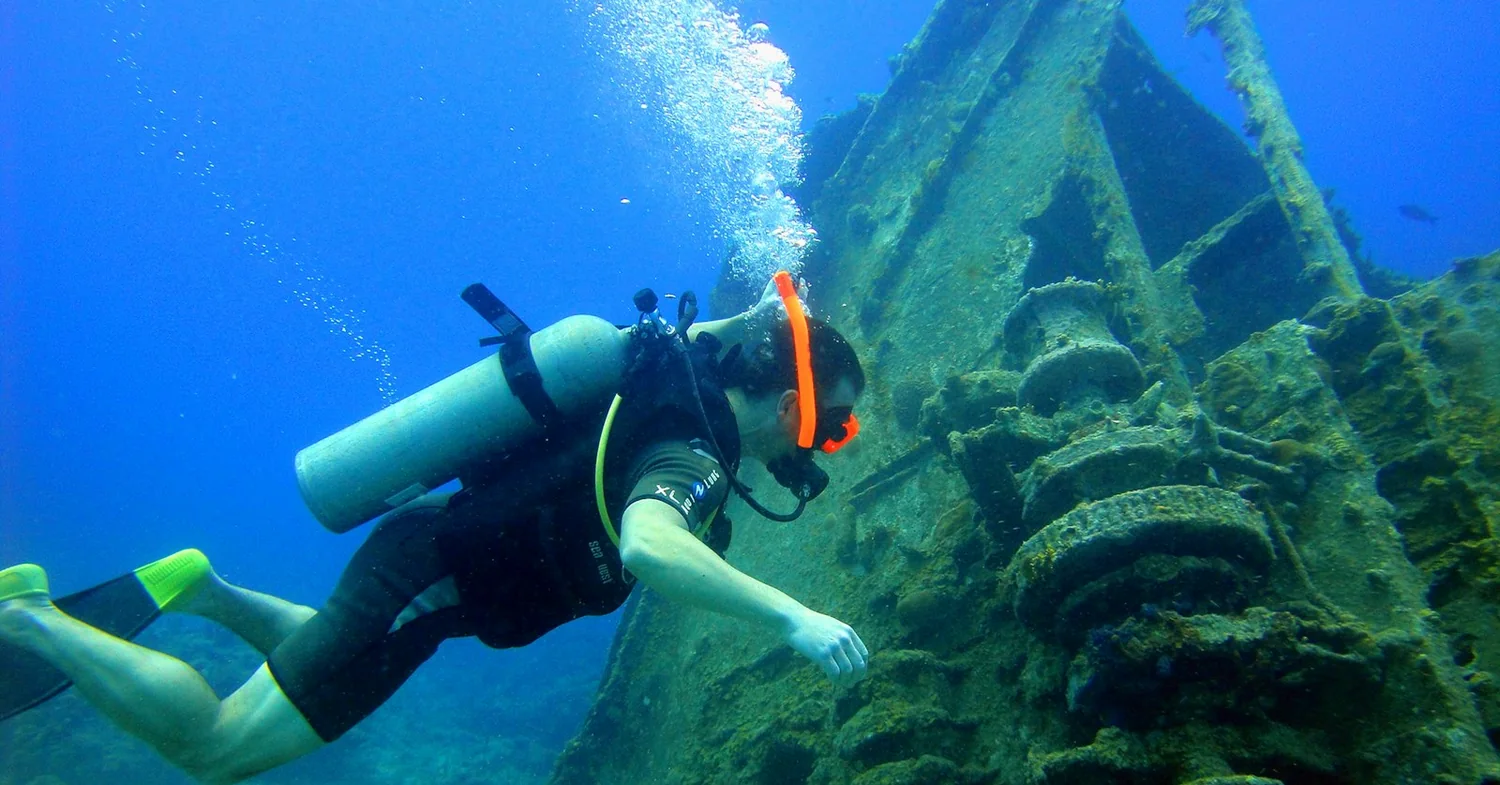
Photo: Unsplash (free licence).
Key takeaways
- Jordan’s entire shoreline reaches a maximum of 27 kilometres; the marine reserve covers 7 of them and 2.8 of the country’s 96 square kilometres of territorial water
- The reserve is a strip, not a circle: 50 metres inland from the mean high water mark, 350 metres out to sea, from the passenger port down to the Royal Diving Club
- Of the 30 dive sites listed inside those limits, one is boat-access only and one is closed to recreational diving, so the shore does nearly all the work
- The Cedar Pride was scuttled in 1985, the C-130 Hercules in 2017 and the Underwater Military Museum in 2019, the last using vehicles donated by the Jordan Armed Forces-Arab Army
- The 2024 marine heatwave in this gulf ran 113 days, peaked at 32.6°C and hit 30 degree heating weeks, the highest thermal stress recorded anywhere that year, and the tagged corals did not bleach
Jordan has 27 kilometres of coast, and 7 of them are the reserve
Start with the number that shapes everything else. The Jordanian shoreline falls entirely within the Gulf of Aqaba and extends to a maximum of 27 kilometres. That is the country’s only access to the sea, and it carries the commercial ports, the industrial complex, the tourist beaches, a marine science station and every dive site in the kingdom at once.
A third of it was bought. In 1965 King Hussein traded 6,000 square kilometres of Jordanian desert to Saudi Arabia in exchange for another 12 kilometres of coast south of Aqaba. The reefs divers now visit sit on ground that entered Jordan through a land swap.
Along that coast runs a discontinuous belt of fringing reef about 13 kilometres long. The Aqaba Marine Reserve protects 7 kilometres of the shoreline: from the southern boundary of the Passenger Terminal in the north to the Royal Diving Club in the south. Its landward limit lies 50 metres east of the mean high water mark and its seaward limit 350 metres west of it.
So the protected area is a ribbon. It comes to 2.8 square kilometres out of the 96 square kilometres of Jordanian territorial water, roughly 3 per cent. Seven of 27 kilometres works out at 26 per cent of the coast, which is the figure the management plan uses; the IUCN Green List entry for the same site says 27 per cent, and Green Fins has published 30.
The gulf itself is 180 kilometres long and between 5 and 25 kilometres wide, with mountains rising steeply on both sides. Jordan holds the eastern corner of its head, Israel holds Eilat to the north-west, Saudi Arabia the coast to the south, and Egypt the Sinai shore opposite, where Dahab sits.
Who writes the diving rules here: ASEZA, a by-law and Instruction 85
There is no national parks agency between you and the water in Aqaba. The Aqaba Special Economic Zone Authority is the autonomous manager, regulator and developer of the zone, and it established the Aqaba Marine Park in 1997. The governing instrument is the Aqaba Marine Park By-Law No. 22 of 2001, issued under the Aqaba Special Economic Zone Law No. 32 of 2000.
The status changed recently. King Abdullah II directed on 3 June 2020 that the park be declared a national marine reserve. A Board of Commissioners decision, No. 38 of 2020, started the process, and the cabinet declared the Aqaba Marine Reserve on 8 December 2020, the first in Jordan. In 2024 the site was added to the IUCN Green List of Protected and Conserved Areas under IUCN category VI.
Six sets of instructions sit under the by-law and they are worth knowing by number. Instruction No. 85 of 2005 regulates diving, covering licensing, registration and entry points. Instruction No. 84 governs boats and what dive boats must do on entering. Instruction No. 86 covers underwater clean-up dives, No. 82 covers scientific research and No. 161 of 2014 covers marine sports.
Instruction No. 83 of 2005 is the one that changes what you will see. It regulates entry to the park and prohibits all forms of fishing inside it, naming the taking of coloured coral reef fish explicitly, and it prohibits transferring or removing any organisms, sediments or corals for any purpose without a special permit from the chief commissioner.
One narrow exception survives. Inside the reserve, fishing is permitted only for the collection of live bait, and only in the early morning hours until nine o’clock, a concession to fishermen who have almost nowhere else to work. Everything else is pushed outside the boundary, to pelagic water within 100 metres of depth and away from ports, docks and border areas.
Enforcement is the park’s own staff. Ten of the 26 people on its books are rangers, and the team issues the annual permits that dive centres, glass-bottom boats and recreational boats operate under, runs clean-up dives and acts as lifeguards. Entry to the beaches is free.
The Cedar Pride, the C-130 and the tanks were all put there deliberately
A 7-kilometre reef strip cannot absorb unlimited divers, and Aqaba’s answer has been to manufacture attractions on sand where the coral is not. The oldest is the Cedar Pride, a Lebanese freighter that took extensive fire damage and was scuttled for divers in 1985, roughly 150 metres offshore, lying on her port side across two reefs at a maximum depth of 26 metres.
Two details around her are triangulated rather than official. The engine-room fire that finished her is dated to 1 August 1982 in Aqaba port, and the scuttling to 16 November 1985, by the dive press and by operators rather than by a government record. Published maximum depths vary between 26 and 28 metres.
The C-130 Hercules followed in 2017. It is 30 metres long with a 40-metre wingspan, it lies flat on its belly on a sand bed at an average maximum depth of 16 metres, and it is almost always visible from the surface. It sits close enough to the Cedar Pride and to the tank that experienced divers string them together.
Then came the Underwater Military Museum in 2019, and it is the most unusual thing in the water here. Decommissioned hardware donated by the Jordan Armed Forces-Arab Army was laid out along the seabed to mimic a tactical battle formation: tanks of different sizes, an ambulance, a military crane, a troop carrier and a combat helicopter.
The count is disputed. The reserve management plan says 21 relics of battle; reports from the launch in July 2019 say 19 pieces of hardware. Both agree on what matters environmentally, which is that the location was chosen specifically for its lack of coral and other marine life, and both agree that snorkellers and glass-bottom boats can see part of it.
Two more wrecks round out the list and neither is a beginner dive. The cargo ship Al Shorouq was scuttled in 2008, drifted from the shallower position intended for her, and now has her bow at 38 metres and her stern near 60. The crane barge Tayoung lies on her starboard side near the Japanese Gardens, with a swim-through at the wheelhouse.
The oldest relic was not placed at all. An M42 Duster tank, found in 1999, sits on sand under just 6 metres of water, which makes it a snorkelling and freediving site as much as a scuba one, and a useful safety stop on the way back from the canyons nearby.
Almost every dive site in Aqaba starts on the beach
This is the practical fact that sets Aqaba apart from the rest of the Red Sea. The reserve management plan tabulates 30 dive sites inside the boundary. Exactly one of them, Paradise, is described as reachable by boat only. One more, the Marine Science Station site, is accessible by beach or boat but open only for research with permission.
Everything else can be walked into. The sites are strung in a line down the coast road in rough north-to-south order, each one a bay or a reef with a shore entry, and the boats mostly exist to link two of them in a single dive rather than to reach anything unreachable. That is a very different day from a liveaboard coast.
The profiles reflect it. Gorgone I has an entry channel 3 metres wide and 4 metres deep through the reef and bottoms out at 18 metres. Seven Sisters begins at 3 metres and runs down to 16. Black Rock starts as a coral garden just below the surface and extends about 30 metres out before dropping away steeply. The reef zones dived here run from flat and crest to upper and lower slope, down to a maximum of 30 metres.
There is a purpose-built shallow as well. Baby Bubbles offers standing depth down to 5 metres on flat sand, described in the plan as a place to practise without any danger of damaging corals. Six public beaches sit inside the reserve with parking, kiosks, camping areas and rescue units, mooring has been installed at King Abdullah Reef South, and the Cedar Pride is marked by a surface buoy. The shore diving list collects coasts that work this way.
The deep exceptions are real and they are sharp. Tarmac Five drops into a gulley starting at 40 metres and falling past 75, known as Kleta’s Wall after the German dive master who explored it in 1996. Moon Valley and Paradise reach past 40. The shallow coast has a technical basement, and the two are a few fin kicks apart.
What the water does through the year in the Gulf of Aqaba
Sea surface temperature in this gulf runs from a winter low of about 20.5°C in February to over 27°C in late summer, usually September. That is a warm-temperate winter and a tropical summer in the same 27 kilometres, and it is the single planning number that decides what you pack.
The column beneath behaves in a way that matters if you go deep. Through summer the gulf is thermally stratified with a strong thermocline, and below roughly 200 metres the water sits at a constant 21.5°C. As the surface cools in winter the thermocline collapses and the upper and lower layers mix, which is the annual event that resets the whole basin.
A measured series exists for the Jordanian side. A study of offshore water off Jordan between 2013 and 2015 sampled the upper 400 metres and put the average temperature across all of it at 23.03 ± 1.58°C, with the column well mixed from February to April and stratified in July and August. Average salinity came out at 40.60 ± 0.10 practical salinity units, against an ocean average nearer 35.
The salt is worth a thought before you weight yourself. Gulf salinity runs between 40.3 and 41.6 practical salinity units because there is no freshwater input and evaporation is relentless, so a belt set for the Andaman Sea will be light. For neoprene, a 5 mm suit covers the cold end from January into April, a 3 mm is comfortable through the late-summer peak, and a hood earns its place in February. Our travel wetsuit guide covers the trade-offs.
The long trend is upward and it has been measured. Monthly instrument casts at a station in the northern gulf from January 2003 to December 2022 found warming at every depth: about 0.025°C per year at 20 metres, roughly 0.014 at 150 metres and 0.015 in deep water. The authors link it to fewer winter deep-mixing events and to heat carried north from the southern part of the gulf.
Why researchers keep coming back to these reefs
Aqaba sits inside the one piece of the Red Sea that has become a scientific argument. The northern end of this gulf holds reef-building corals that keep not bleaching when the thermal stress says they should, and the case for it is published rather than promotional.
The landmark comparison appeared in Global Change Biology in 2018. Examining sea surface temperature and bleaching records from 1982 to 2012, it found that the northern Red Sea had not experienced mass bleaching despite Degree Heating Weeks above 15, while severe bleaching was restricted to the central and southern Red Sea, where thermal stress was far less intense at under 4 Degree Heating Weeks. The paper proposed the region as a thermal refuge of global importance.
Then the heatwaves came and the claim held. A Category II marine heatwave in summer 2021 pushed sea surface temperature in this gulf to 31°C, 3.5°C above the local summer maximum of 27.5, for 34 days and 8 Degree Heating Weeks at bleaching alert level 2. Tagged colonies of Stylophora pistillata and Pocillopora damicornis came through with no mortality and no bleaching.
A 2025 paper followed four consecutive summers, moderate in 2022, strong in 2021 and 2023 and severe in 2024. The 2024 event lasted 113 days, sea surface temperature reached 32.6°C, 3.4°C above the long-term average, and it accumulated 30 Degree Heating Weeks, the highest thermal stress recorded anywhere on earth that year. Both species persisted without bleaching and held their energy reserves.
One boundary matters to the claim. That tagged-colony work is done at the head of the gulf on the Israeli side, at the Interuniversity Institute in Eilat, not on Jordanian reefs. It is the same semi-enclosed basin a short distance across the water, and Aqaba’s own management plan and its IUCN Green List entry both record reefs unaffected by bleaching, but the measurements and the reserve are not the same place.
What lives on those reefs is well counted. 157 hard coral species are recorded in the gulf and all of them confirmed inside the reserve: 153 scleractinian corals, one organ pipe coral and three fire corals, across 15 families and 59 genera. Fifteen of the 23 known Red Sea endemic coral species have been found in Jordan.
The fish count disagrees with itself. The management plan and the IUCN Green List both give 507 species in 109 families; the authority’s own reserve page says 512. Hawksbill turtles are the most widely distributed of the three confirmed turtle species, with the highest recorded population toward Black Rock.
The port moved south and took 32,509 square metres of coral with it
The same 27 kilometres that hold the diving hold Jordan’s entire seaborne trade, and the collision has a number attached. Relocating ports to the southern beach of Aqaba near the Saudi border directly affected an estimated 32,509 square metres of hard coral, which is the kind of figure a management plan usually rounds away.
The response was transplantation, and some of it is now a dive site. Coral has been moved onto damaged reefs since 2012 using cement and metal structural units. In 2013 many corals were carried from the Saudi border area to the Japanese Gardens to save them from destruction by the new port facility, so part of one of the best reefs here arrived by boat.
The Artificial Tunnel, also called the Cave, exists for the same reason. It was established after the port relocation, planted with coral by local specialists and protected until the reef regenerated. It sits just south of the tank site and is reachable from shore.
Two ports still bracket the reserve to the north. The passenger port sits at its northern edge, just above the Marine Science Station beach, and the Aqaba Container Terminal lies north of that. Shipping and port activity is credited with 30 per cent of the marine litter recorded here, against 3 per cent from the fishing industry.
The ferry across to Egypt has its own line in the ledger. An estimated 19 million items enter the sea from the ferryboat each year, and the seasonal distribution of litter tracks passenger movements through late spring and summer. That is the traffic the reserve sits underneath.
Green Fins in Aqaba, and what a Certified Gold score actually is
Jordan became the fifteenth country to implement Green Fins, the UN Environment Programme initiative for marine tourism operators, announced on 28 June 2023. Five certified assessors and two coordinators were trained over a week that June, drawn from the Royal Jordanian Navy Forces, the Aqaba Marine Reserve and the University of Jordan, and the programme is run by the zone authority itself.
The scheme’s own definitions matter more than the badge. A Certified Member is an operator that has received an in-person assessment from a trained Green Fins assessor within the last 12 months. Assessors score the business out of 330 against a 15-point code of conduct, and the lower the score the lower the impact. Gold is 50 or less, Silver 150 or less, Bronze 200 or less, and 201 or more is a Restricted Member.
A Digital Member is a different thing entirely. The operator completes a self-evaluation of its own practices, picks four recommended solutions and builds an action plan. No assessor visits, and there is no minimum score to clear. Both appear in the same public register, so the membership type is the part to read.
The programme has published results for Aqaba. In its second year Green Fins reported a 51 per cent reduction in threats from marine tourism among members, anchoring damage eliminated, a 69 per cent reduction in diver contact with reefs, display and sale of marine life halted entirely, waste management improved by 46 per cent and chemical discharge cut by 28 per cent. Eleven Aqaba operators were listed as certified in May 2025.
Our own list is narrower and reads differently. The Aqaba operator list holds 10 businesses, read on 13 September 2026. Seven of the 10 are published by SSI in its register of affiliated centres, and 8 of the 10 publish a website. Three of the 10 appear in the Green Fins register, read on 15 August 2026.
Those three split in the way that counts. Two are Certified Gold Members, which means an assessor was physically on the boat within the previous 12 months and the operation scored 50 or less out of 330. The third is a Digital Member that self-evaluated. An in-person Green Fins assessment is rare across this directory, and Aqaba is one of the few places that has one.
Registers are also messier than they look. Of the 10 entries, 6 are filed under “Aqaba”, 1 under “AQABA” and 3 carry no town field at all, which is why a place-name search of a register misses businesses that are plainly there. Which registers can be read logs what each source returned and on what date.
The Jordan Pass, and the two-night rule that carries the visa fee
Entry to Jordan has one product attached to it that divers should know about before they book a flight. The Jordan Pass is a prepaid sightseeing package covering entry to more than 40 attractions, and it waives tourist entry visa fees on a condition: it must be bought before arrival in Jordan and the stay must be a minimum of two nights, which the operator counts as three days.
Three tiers are sold and the difference between them is small. Jordan Wanderer costs 70 Jordanian dinars and includes one day at Petra; Jordan Explorer costs 75 and includes two consecutive visit days; Jordan Expert costs 80 and includes three. All three carry the same visa fee waiver and the same list of attractions.
For a dive trip the arithmetic is simple. Any itinerary built around Aqaba clears the two-night threshold without trying, so the question is only whether you will use the inland entries.
Two things the pass does not cover are worth budgeting separately. Diving inside the reserve runs through centres holding an annual permit from the zone authority, and that is priced by the operator, not by the park. And hyperbaric cover sits outside any tourism product, which is what our dive insurance comparison is for.
FAQ: scuba diving in Aqaba
Where can you dive in Aqaba, and how much of the coast is protected?
The Jordanian shoreline extends to a maximum of 27 kilometres, and the Aqaba Marine Reserve covers 7 of them. It runs from the southern boundary of the Passenger Terminal in the north to the Royal Diving Club in the south, reaching 50 metres inland from the mean high water mark and 350 metres out to sea. That is 2.8 square kilometres of the 96 square kilometres of Jordanian territorial water. The management plan tabulates 30 dive sites inside those limits.
What are the rules for diving in the Aqaba Marine Reserve?
The Aqaba Special Economic Zone Authority runs the reserve under the Aqaba Marine Park By-Law No. 22 of 2001. Instruction No. 85 of 2005 regulates diving itself, covering licensing, registration and entry points. Instruction No. 83 of 2005 prohibits all forms of fishing inside the park, including the taking of coloured reef fish, and bans removing organisms, sediment or coral without a special permit from the chief commissioner. Park staff issue the annual permits that dive centres and dive boats operate under.
Is diving in Aqaba shore diving or boat diving?
Overwhelmingly shore diving. Of the 30 sites the reserve management plan tabulates, only Paradise is described as reachable by boat alone, and the Marine Science Station site is open only for research with permission. Everything else can be entered from the beach, including the Cedar Pride, which lies about 150 metres offshore, and the C-130 Hercules, which sits flat on sand at an average maximum depth of 16 metres. Boats still run, mostly to combine two wrecks in one dive.
Which wrecks can you dive in Aqaba?
The Cedar Pride, a Lebanese freighter gutted by fire, was scuttled for divers in 1985 on its port side at a maximum depth of 26 metres across two reefs. A C-130 Hercules went down in 2017 with a length of 30 metres and a wingspan of 40 metres. The cargo ship Al Shorouq was scuttled in 2008, drifted, and came to rest with her bow at 38 metres and her stern near 60. A crane barge, the Tayoung, and an M42 Duster tank found in 1999 under 6 metres of water complete the list.
What is the Underwater Military Museum in Aqaba?
It is a line of decommissioned military hardware placed on the seabed in 2019 to mimic a tactical battle formation. The vehicles were donated by the Jordan Armed Forces-Arab Army and include tanks of different sizes, an ambulance, a military crane, a troop carrier and a combat helicopter. The reserve management plan counts 21 relics; press reports from the launch count 19 pieces. The site was chosen for its lack of coral and other marine life, and snorkellers can see parts of it.
How warm is the water for diving in Aqaba?
Sea surface temperature in the Gulf of Aqaba runs from a winter low around 20.5 degrees Celsius in February to over 27 degrees in late summer, usually September. Below roughly 200 metres the water stays at a constant 21.5 degrees through the summer. A study of the upper 400 metres of water off the Jordanian coast between 2013 and 2015 measured an average of 23.03 degrees, with the column well mixed from February to April and stratified in July and August.
Why are the corals in the Gulf of Aqaba studied for heat tolerance?
Because they keep not bleaching when the numbers say they should. A 2018 study in Global Change Biology found the northern Red Sea had recorded no mass bleaching despite thermal stress above 15 degree heating weeks, while the central and southern Red Sea bleached severely below 4. A 2025 study of four consecutive summers found that the 2024 heatwave lasted 113 days, peaked at 32.6 degrees Celsius and accumulated 30 degree heating weeks, the highest recorded anywhere that year, and the two study species persisted without bleaching.
What does a Green Fins Certified Gold rating mean for an Aqaba dive centre?
Green Fins scores Certified Members out of 330 against a 15-point code of conduct, and the lower the score the lower the impact. Certified Gold means 50 or less, Silver 150 or less and Bronze 200 or less. A Certified Member has received an in-person assessment from a trained Green Fins assessor within the last 12 months. A Digital Member has completed a self-evaluation instead, with no assessor visit, so the two labels answer different questions.
Do you need a visa to dive in Aqaba, and what is the Jordan Pass?
The Jordan Pass is a prepaid sightseeing package covering entry to more than 40 attractions, and it waives tourist entry visa fees on one condition: buy it before arriving in Jordan and stay a minimum of two nights, which is three days. Three tiers are sold, at 70, 75 and 80 Jordanian dinars, and the only difference between them is one, two or three consecutive visit days at Petra. A dive trip that runs longer than two nights clears the condition by itself.
Founder of NOMADREEF and a former digital nomad. This guide is sourced from the references below; conditions, prices and rules change, so verify current details, and follow qualified local guidance and safety briefings. About the author · LinkedIn ↗
Sources
- The coastline, the reserve and nearly every site detail. Jordanian shoreline to a maximum of 27 kilometres; 13 kilometres of fringing reef; reserve of 7 kilometres from the Passenger Terminal to the Royal Diving Club, 50 metres landward and 350 metres seaward of the mean high water mark, 2.8 of 96 square kilometres of territorial water; declaration on 8 December 2020 after the royal directive of 3 June 2020 and Board of Commissioners decision No. 38 of 2020; the 1965 land exchange of 6,000 square kilometres for 12 kilometres of coast; Aqaba Marine Park By-Law No. 22 of 2001 under Aqaba Special Economic Zone Law No. 32 of 2000; Instructions 82 to 86 of 2005 and 161 of 2014; bait fishing until nine o’clock; annual permits for dive centres and boats; 26 park staff including 10 rangers; the table of 30 dive sites with the Cedar Pride at 1985 and 26 metres, the C-130 at 2017 and 16 metres, the Military Museum at 2019 with 21 relics, the M42 Duster found 1999, Al Shorouq scuttled 2008 at 38 to 60 metres, Kleta’s Wall named in 1996; six public beaches; 157 hard coral species and 507 fish species; sea temperature from 20.5°C in February to over 27°C in September with 21.5°C below 200 metres; salinity 40.3 to 41.6; 32,509 square metres of coral affected by port relocation, with transplantation from 2012 and the 2013 move to the Japanese Gardens; and the ferry and shipping litter figures. Aqaba Special Economic Zone Authority and UNDP, Aqaba Marine Reserve Management Plan 2022-2026 (PDF). Read 20 September 2026.
- The authority’s own reserve page. Declaration on 8 December 2020 as Jordan’s first marine reserve; free entry to all the reserve’s beaches; over 30 dive sites through registered diving centres; a prohibition on collecting or breaking marine organisms, standing on coral, fishing, fires and litter; 157 hard coral species and 512 fish species. ASEZA, Aqaba Marine Reserve. Read 20 September 2026. Its fish count of 512 disagrees with the 507 given by the management plan and the IUCN Green List; both are stated rather than averaged.
- The Green List entry. Aqaba Marine Reserve first listed in 2024, IUCN category VI, WDPA ID 17239, site agency the Aqaba Special Economic Zone Authority; 157 hard coral species including 153 scleractinian, one organ pipe and three fire corals, with 15 Red Sea endemics recorded in the reserve; roughly 507 fish species; reefs showing no major effects from bleaching. IUCN Green List, Aqaba Marine Reserve. Read 20 September 2026. This page gives the reserve as 27 per cent of the coastline, the management plan 26 per cent and Green Fins 30 per cent; 7 kilometres of 27 is 26 per cent, the figure used in the text.
- The northern Red Sea as a thermal refuge. Sea surface temperature and bleaching records from 1982 to 2012; no mass bleaching in the northern Red Sea despite Degree Heating Weeks above 15; severe bleaching restricted to the central and southern Red Sea at under 4 Degree Heating Weeks; heat stress assays confirming regional differences. Osman et al., Thermal refugia against coral bleaching throughout the northern Red Sea, Global Change Biology 24 (2018), read from the open-access copy at KOPS. Read 20 September 2026.
- The 2021 heatwave. A Category II marine heatwave in summer 2021 in the Gulf of Aqaba, peak sea surface temperature 31°C, 3.5°C above the local summer maximum of 27.5°C, the anomaly persisting 34 days, 8 Degree Heating Weeks at bleaching alert level 2, and no mortality or bleaching in tagged Stylophora pistillata and Pocillopora damicornis. Kochman-Gino and Fine, Reef building corals show resilience to the hottest marine heatwave on record in the Gulf of Aqaba, Frontiers in Marine Science (2023). Read 20 September 2026. The work is carried out at the Interuniversity Institute in Eilat, on the Israeli side of the gulf, not on Jordanian reefs.
- Four summers and the 2024 event. Moderate in 2022, strong in 2021 and 2023 and severe in 2024; the 2024 heatwave lasting 113 days, sea surface temperature reaching 32.6°C, 3.4°C above the long-term average, 30 Degree Heating Weeks and the highest thermal stress recorded globally that year, with both species persisting without bleaching. Kochman and Fine, Gulf of Aqaba as a thermal refuge: insights from four years of intensifying marine heatwaves, Science of the Total Environment 1000 (2025), doi 10.1016/j.scitotenv.2025.180463, summarised by Phys.org. Both read 20 September 2026.
- Measured water off Jordan. Average temperature of 23.03 ± 1.58°C across the upper 400 metres of offshore water at the Jordanian site between 2013 and 2015, well mixed from February to April and stratified in July and August, with average salinity 40.60 ± 0.10 practical salinity units. Manasrah et al., Physical and chemical properties of seawater during 2013-2015 in the 400 m water column in the northern Gulf of Aqaba, Environmental Monitoring and Assessment 192 (2020). Read 20 September 2026.
- The warming trend. 270 monthly instrument casts at Station A in the northern gulf from January 2003 to December 2022, showing warming at every depth of roughly 0.025°C per year at 20 metres, 0.014°C at 150 metres and 0.015°C in deep water, attributed to fewer winter deep-mixing events and to heat carried north. Sengupta, Gildor and Ashkenazy, Depth-dependent warming of the Gulf of Eilat (Aqaba), Climatic Change 177 (2024). Read 20 September 2026.
- What Green Fins membership means. Certified Members receive an in-person assessment from a trained Green Fins assessor within the last 12 months and are scored out of 330 against a 15-point code of conduct, with a lower score meaning lower impact: Gold at 50 or less, Silver at 150 or less, Bronze at 200 or less and 201 or more classed as Restricted. Digital Members complete a self-evaluation and build an action plan with no assessor visit and no minimum score. Jordan is one of the countries with an active assessor team. Green Fins, certified membership and digital membership. Both read 20 September 2026.
- Green Fins in Jordan. Jordan announced as the fifteenth Green Fins country on 28 June 2023, with five certified assessors and two coordinators trained from 10 to 15 June 2023 and drawn from the Royal Jordanian Navy Forces, the Aqaba Marine Reserve and the University of Jordan, and the programme implemented by the Aqaba Special Economic Zone Authority. Green Fins launch announcement. The 51 per cent reduction in threats, the anchoring, diver contact, marine life display, waste and chemical discharge figures and the eleven certified Aqaba operators come from Aqaba’s Dive Operators Reduce Environmental Impact on Reefs, 15 May 2025. Both read 20 September 2026.
- The ten businesses. Ten dive businesses on the Aqaba operator list, read 13 September 2026, of which 7 are published by SSI in its register of affiliated centres and 8 publish a website. Three appear in the Green Fins member register, read 15 August 2026: two as Certified Gold Members and one as a Digital Member. Six entries are filed under “Aqaba”, one under “AQABA” and three carry no town field. The limits of each source are set out on which registers can be read.
- The Cedar Pride dates. The engine-room fire of 1 August 1982 and the scuttling on 16 November 1985, together with a maximum depth given as about 28 metres, are reported by the dive press and by operators rather than by a government record, and are triangulated across those accounts: DIVE Magazine, an introduction to the wreck dives of Aqaba and PADI, wreck of the Cedar Pride. Read 20 September 2026. The management plan gives 26 metres, so the two figures are stated separately rather than reconciled.
- The Underwater Military Museum count. Nineteen pieces of hardware sunk at depths of up to 28 metres and launched on 25 July 2019, against the 21 relics counted in the reserve management plan: Blooloop and Middle East Eye. Read 20 September 2026. The C-130 date of 16 November 2017 is likewise triangulated across Scubaverse and DIVE Magazine, read 20 September 2026; the management plan gives only the year.
- The Jordan Pass. Waiving of tourist entry visa fees on purchase before arrival and a minimum stay of two nights, prepaid entry to over 40 attractions, and three packages at 70, 75 and 80 Jordanian dinars for one, two and three consecutive visit days at Petra. Jordan Pass, what is Jordan Pass and packages. Both read 20 September 2026.