El Quseir Diving: Shore Reefs, Chambers Out of Town and Oxygen at Every Entry
 by Yannick Schroth
Sep 25, 2026
15 min read
by Yannick Schroth
Sep 25, 2026
15 min read
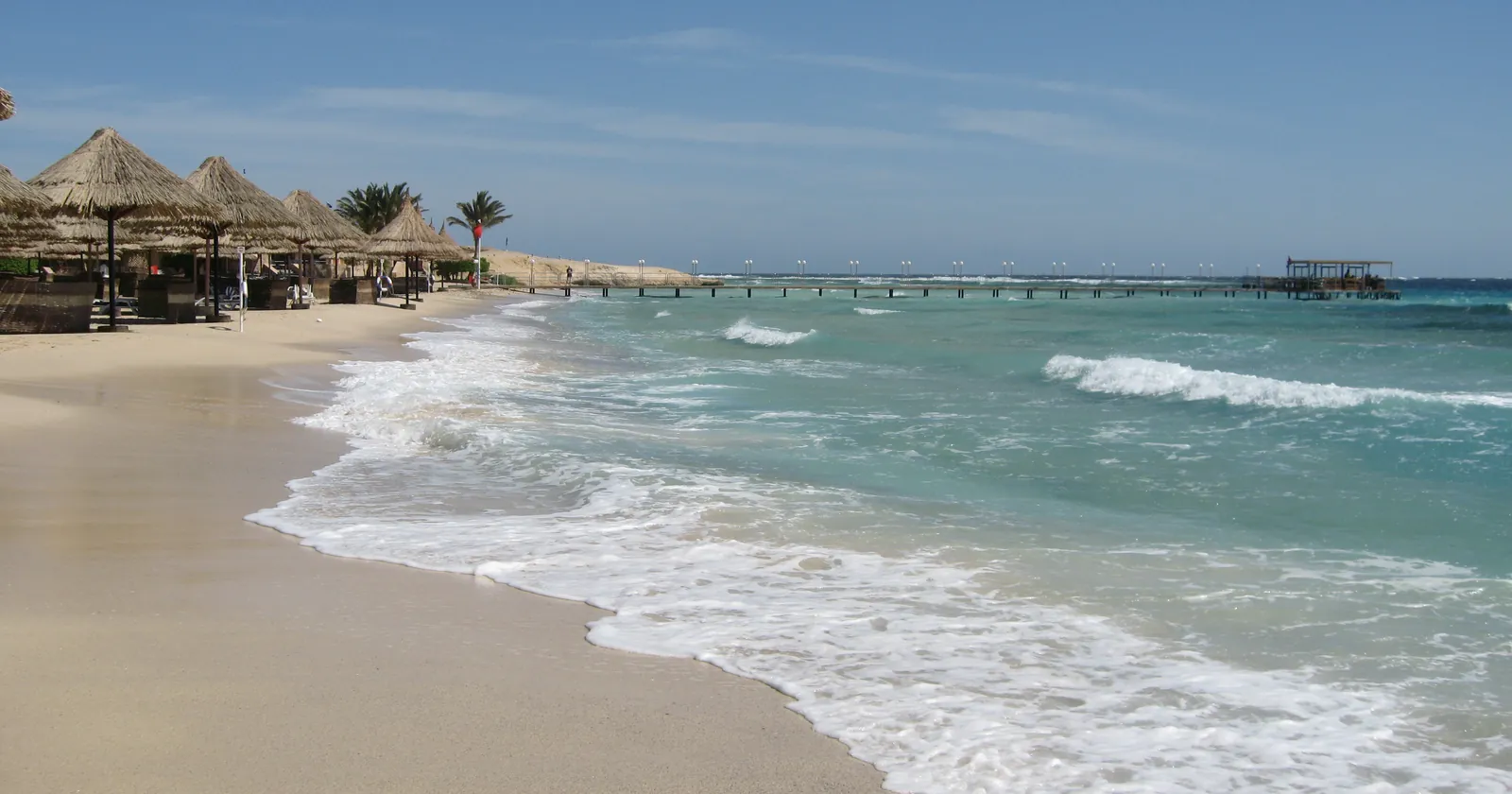
A jetty out over the reef flat on the El Quseir coast, 2008. Photo: J. Hutsch, Wikimedia Commons, CC BY-SA 3.0, cropped.

Key takeaways
- The Chamber of Diving and Water Sports describes El Quseir as a town where “all dives here are performed from shore”, and also as the main departure point for liveaboards to the Brother Islands
- Neither the Chamber’s list of medical facilities nor DECO International’s own list names a recompression chamber in El Quseir; both list one at Safaga and others around Marsa Alam
- Ministry of Tourism Decree 444 of 2011 requires an emergency oxygen unit delivering 15 liters a minute for at least 20 minutes at every site where diving takes place, plus one at the center
- Prime Ministerial Decree 4419 of 2025 made the Great Fringing Reefs a 1,800 km² protectorate in the Red Sea Governorate; its coordinates were not found, but every description of its extent includes the El Quseir shore
- The shore bays here are wadi mouths: the Roman port of Myos Hormos, 8 km north of town, sat in one until its lagoon silted up
El Quseir’s shore diving and the wadi bays that cut its fringing reef
The Chamber of Diving and Water Sports, the body Egypt’s Ministry of Tourism set up in 2007 for the industry, describes El Quseir in two sentences that seem to contradict each other. The town is “adorned with a long, almost continuous fringing reef”, and “all dives here are performed from shore”. A paragraph later it is “the main departing point for liveaboards heading towards the fabled Brother Islands”.
Both are true of the same coast. The day diving walks in, and the offshore diving sails out. What shapes the walking-in part is geology. The reef runs parallel to the shore, and where a wadi, a dry desert valley, reaches the sea it can cut a bay through it, a marsa in Arabic. The one such bay near El Quseir that has been studied closely shows what that means for the water.
The first study of it was archaeological. The University of Southampton began excavating Quseir al-Qadim, about 8 km north of the modern town, in 1999, and the papyri, ostraca and finds there now confirm it was Myos Hormos, a Roman port for the trade with India. Lucy Blue’s 2007 paper places it at the head of a mersa where a small inlet “cuts the Late-Pleistocene coral reef which runs parallel to the shore”.
Behind it lay a lagoon reaching about 700 meters inland and 2 km long, fed by two wadis. The Roman harbor inside it was used from the 1st century BC to the 3rd century AD. More than 100 sediment cores traced how it silted. By the 12th century only a small bay at the old entrance was left, and at the start of the 16th century the port appears to have moved to the present town.
The water still behaves the way that history suggests. A 2005 reef survey of El Quadim Bay, whose recorded coordinates sit a few hundred meters east of where the Pleiades gazetteer places Myos Hormos, calls the bay the relict of a fossil riverbed and the estuary of a wadi that floods after rare, heavy rain in the mountains. In 1994 it washed away the paved road along the bay. The survey found the water inside “frequently turbid” from sediment.
For a shore diver that is practical, not academic. The same wadi that made the bay an easy way in also brings the silt. After a desert downpour, ask the center how the wadi ran before you judge a site by one murky morning.
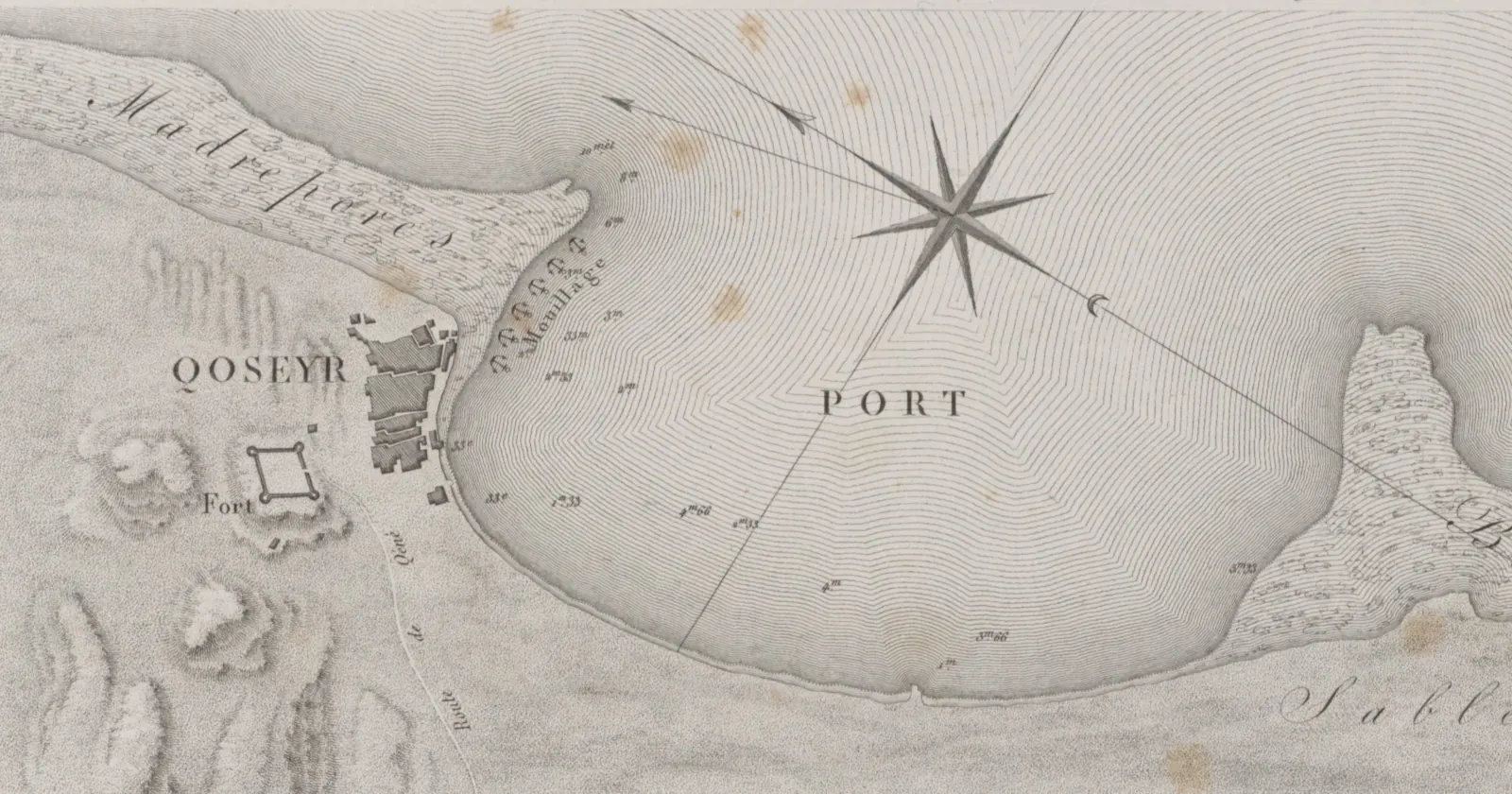
The port of Qoseyr, with the coral banks (“madrépores”) either side of the bay and the anchorage off the town, from the Description de l’Égypte. Imprimerie impériale, Wikimedia Commons, public domain, cropped.
_(NYPL_b14212718-1268713)_(cropped).jpg)
A quarantine doctor described El Quseir’s reef corals in the 1870s
Before El Quseir had dive centers it had a reef scientist. Carl Benjamin Klunzinger, a German physician, says in the preface to his 1878 book Upper Egypt that from 1863 to 1869, and again from 1872 to 1875, he lived at “the little Upper Egyptian seaport of Koseir on the Red Sea, as sanitary or quarantine doctor, appointed by the Egyptian government”. The foreword to the 2005 survey dates his arrival to 1864; his own account says 1863.
He used the posting. His three-part monograph Die Korallthiere des Rothen Meeres, published in Berlin from 1877 with support from the Prussian Academy of Sciences, opens by saying that during his long stay in Koseir he gave the corals “special attention” and brought home “a very rich collection” of them. He also wrote on the fishes of the Red Sea, in a synopsis published from 1870.
The book reads, in places, like a dive log from the town’s own reef. One soft coral is “sehr gemein auf der Korallklippe bei Koseir, oben in der Nähe des Abhangs”, very common on the coral reef at Koseir, up near the drop-off. Another he found only once, “an der Südklippe bei Koseir”, on the south reef. He was describing the reef edge, the part of the reef a shore diver here still heads for.
What a 2005 survey counted on El Quseir’s El Quadim Bay house reef
A published survey of one El Quseir house reef deserves a careful reading, including who paid for it. SUBEX, whose dive center is attached to the Mövenpick resort in El Quadim Bay, commissioned it, and Reef Check e.V. carried it out in October 2005. That makes it a dated baseline from the operator’s own bay, not an independent monitoring series.
Between 3 and 25 meters the team counted 153 fish species from 40 families, damselfish the most abundant. From the reef flat to 30 meters they recorded 144 species of stony coral, 4 hydrocorals and 15 genera of soft coral, with an average coral cover of 36.6 percent. Fishing was not allowed in the bay, and the authors credit that with part of the healthy fish count.
The damage they found has a pattern worth knowing before you enter any El Quseir bay. Most broken coral lay on the inner southern side, where diving was most intense, and the authors think snorkelers share the blame: swimming at the surface they drift close to the reef crest and get pushed onto it by waves. Keep off the crest on the swim out, whatever you are breathing through.
Two further details are worth keeping with their dates attached. Satellite records for 1983 to 2004 put the coldest monthly sea surface average at about 21°C in February and the warmest at 28 to 29°C in August. And a phosphate loading harbor at El Hamrawein, about 20 km north, was named as a possible source of the turbidity. The survey could not settle whether it was.
El Quseir has no listed recompression chamber; Safaga and Marsa Alam do
The Chamber of Diving and Water Sports publishes a list of “Baromedical Diving Emergencies & Hyperbaric Medicine Facilities”. Its hyperbaric entries are in Dahab, Sharm El-Sheikh, El Gouna, Hurghada, Safaga, Marsa Alam and Hamata. For Safaga it gives DECO International at the Safaga General Hospital. Around Marsa Alam it gives Baromedical at Marsa Shagra, 22 km north of Marsa Alam, and DECO International in Port Ghalib Hospital. It lists nothing in El Quseir.
The operator’s own history agrees. DECO International says its chambers opened in El Gouna, where the hospital opened in 1998, in Marsa Alam in October 2000, in Safaga in July 2003, in Dahab in September 2005 and in the port of Hamata in February 2010. El Quseir does not appear in either account.
That shapes the week. A diver who needs recompression here is driven out of town. Ask the center before your first dive which chamber it would use and how it would get you there, and check that your dive insurance covers the evacuation, not only the treatment. The Marsa Alam guide covers the flight home after a multi-day week, which is the other half of the same decompression arithmetic.
Decree 444 puts emergency oxygen at every El Quseir dive site
Egypt’s licensing rulebook for dive centers is Ministry of Tourism Decree 444 of 2011, issued on 6 September 2011. Article 8 lists the minimum kit a center must hold, and item 10 is the one that matters most on a coast without a chamber in town. It requires emergency oxygen units “allowing pure oxygen to be breathed at a rate of fifteen liters per minute for no less than twenty minutes”.
The same item says where they go: one at every site where the activity is carried out, in addition to the unit kept at the center. On a boat that means the boat. On a coast where the dives start from a beach, a jetty or a bay a drive away, it means a unit at that entry, not one back at the dive shop.
The Chamber’s audit manual, in its July 2025 version, asks for the same thing in its own words: medical oxygen ready “in the facility, in all boats and locations of service offering”, and staff who know how to use it.
This is enforced. In January 2025 the Ministry suspended technical managers of dive and marine activity centers in South Sinai under Decree 444: for running activities without an emergency oxygen cylinder on site, for an oxygen cylinder not ready for use, and for staff not competent with medical oxygen. On the same list, in the Red Sea Governorate, a diving instructor was suspended for selling dives online and running them outside licensed establishments.
The decree was made under the Hotel and Tourist Establishments Law of 1973, which Law 8 of 2022 repealed. Article 5 of the 2022 law keeps existing decisions in force until new ones are issued, provided they do not conflict with it, and the Chamber still cites Decree 444 in its 2025 penalty list. It has been amended since 2011; the wording above is the 2011 text as the Chamber publishes it.
What an El Quseir dive center’s license rests on
An Egyptian dive center is usually identified by its Chamber membership number, and that number is easy to mistake for a license. The decree draws the line differently. Article 1 says a dive center may not be operated or managed except under a license from the Ministry of Tourism. Law 8 of 2022 now defines diving centers as tourist establishments, which need that ministry license.
Chamber membership is a condition of the license, not the license itself. Article 4 lists a letter confirming membership among the documents a center must file, and article 5 repeats it as a technical condition. The same article 4 list asks for civil liability insurance covering accidents, bodily injury and death, of at least one million Egyptian pounds, valid for the license period.
Article 10 explains the paperwork at the counter. A center must keep a daily register of visitors with their nationality, passport number, date of birth, the sites they dive, a medical declaration and their signature on the dive instructions, together with a release of liability. The Chamber’s audit manual adds that a beginner’s intro dive needs a medical declaration in a language the client understands.
The intro dive itself has hard numbers in that manual: skills first at no more than 2 meters, one instructor to one participant, and a maximum depth of 12 meters, with a note that the standard is under review. For certified divers on guided dives the Chamber sets no ratio and leaves it to the manager. For snorkelers it is 12 to one guide.
One further rule is specific to this governorate. In April 2024 the Ministry of Tourism and Antiquities announced a decree obliging every hotel and every diving and marine activity center in the Red Sea Governorate to obtain a certificate, from an accredited international or local body, that it applies green, environmentally friendly practices, with six months to comply. The release did not give the decree’s number.
El Quseir’s reef and the December 2025 Great Fringing Reef protectorate
On 4 December 2025 the acting Minister of Environment announced Prime Ministerial Decree 4419 of 2025, declaring the Great Fringing Reef of the Red Sea a marine protectorate. According to the State Information Service it “defines the full extent of the reef area as a protected zone, based on official maps and coordinates”, and tasks the governors of the Red Sea and South Sinai with protecting and managing it.
The Egyptian Environmental Affairs Agency now lists it as protectorate number 31, the Great Fringing Reefs: 1,800 km² in the Red Sea Governorate, classed as a “sustainable use of natural resources” protected area rather than a national park. The State Information Service says projects inside it stay allowed “under strict environmental regulations”. Nothing in the announcement closes the reef to divers.
What the announcement did not include is the map, and the decree’s coordinates could not be found. A peer-reviewed 2026 paper in Sustainability describes the protected area as “extending from Hurghada to the southern border at latitude 22° N, with a coastal width of ≈2–5 km”. El Quadim Bay, at 26°09′N, sits inside that stretch, and so does the town south of it.
Other descriptions differ in reach. HEPCA, the Hurghada conservation group that worked toward the designation, describes the reef as roughly 2,000 km of coast plus the reefs of about 44 islands. A preprint that has not been peer reviewed maps three separate segments, the main one a narrow ribbon along the shore past El Quseir. None of them is the decree, but every one of them includes this coast.
So the answer to “is my house reef protected?” is almost certainly yes, pending the official coordinates. Dive it that way: no touching, no collecting, no standing on the crest. The Hurghada guide covers the mooring buoys that protect the boat sites.
Brothers trips from El Quseir enter a protectorate with its own fee
The offshore half of El Quseir diving is older protected ground. Prime Ministerial Decree 642 of 1995, which rewrote Decree 450 of 1986, made the Red Sea islands between 27°15′N and 22°N a protectorate, with 1 km of water around each island’s land. The list names the Brothers, Juzur al-Akhawayn, alongside Daedalus and Zabargad.
Two rules follow a boat into that water. Environment Ministry Decree 202 of 2019 requires every company running dive, snorkel or safari programs inside the protectorates of South Sinai and the Red Sea to hold an activity permit from the Egyptian Environmental Affairs Agency. And the agency’s own leaflet for the islands protectorates sets the conduct: no anchoring, use the mooring buoys, no feeding fish, no fishing, no collecting shells or coral, and no touching, walking or standing on coral.
The same leaflet prices the trip. For the southern “far islands”, which it names as the Brothers, Rocky, Zabargad and Abu el-Kizan, a foreign visitor pays $5 a day. The agency’s fee page, which it says is being updated, also gives $5 for a foreigner, doubled when the visit runs past sunset on camping and sea or land safaris. Boats longer than 17 meters pay by length, from $10 up to $60 above 30 meters.
A newer schedule exists. Decree 360 of 2025, in force from 15 December 2025, raises the foreign rate for the Northern Islands to $10 and for Erg and Fanous to $15, and the agency notes that its activation there and at Ras Mohammed is postponed. Its Red Sea table has no row for the far islands. The leaflet also lists a protectorate office in El Quseir, next to those in Hurghada and Marsa Alam.
For what draws divers out to the Brothers, our shark diving list and liveaboard list have the detail.
El Quseir dive centers: 17 businesses in two registers
The El Quseir operator list, compiled on 13 September 2026, holds 17 diving businesses. Twelve carry a Chamber of Diving and Water Sports membership number, recorded as active when the Chamber’s register was read on 15 August 2026. Eight are published by SSI in its register of affiliated centers.
Only three names appear in both. That overlap is probably understated: a Ducks and an Extra Divers each appear once under the Chamber’s spelling and once under SSI’s, and the list keeps them apart because the names do not match. Eight of the 17 publish a website in a register. SSI rates three centers for Freediving and one for Extended Range, which describes the listing, not a course running this season.
None of that says how a center dives. For the one question this page keeps returning to, ask to see the oxygen unit that will be at your entry point. For comparison down the coast there are lists for Safaga and Marsa Alam, and which registers can be read sets out what each source can and cannot show.
FAQ: scuba diving in El Quseir
Is there a recompression chamber in El Quseir?
Neither published list names one. The Chamber of Diving and Water Sports lists hyperbaric facilities in Dahab, Sharm El-Sheikh, El Gouna, Hurghada, Safaga, Marsa Alam and Hamata, among them DECO International at the Safaga General Hospital, Baromedical at Marsa Shagra and DECO International in Port Ghalib Hospital. DECO International’s own history lists the same towns and not El Quseir. Ask your center which chamber it would use.
Is diving in El Quseir done from the shore?
Day diving mostly is. The Chamber of Diving and Water Sports says “all dives here are performed from shore”, along a long, almost continuous fringing reef, and on the same page calls El Quseir the main departing point for liveaboards to the Brother Islands. Where a wadi reaches the sea it can cut a bay through the reef, and El Quadim Bay north of town is one.
What emergency oxygen must an El Quseir dive center have?
Article 8 of Ministry of Tourism Decree 444 of 2011 requires emergency oxygen units that deliver pure oxygen at fifteen liters a minute for at least twenty minutes, one at every site where the activity is carried out plus one at the center. The Chamber’s audit manual, July 2025 version, asks for medical oxygen ready in all boats and locations of service, and staff who can use it.
Is the CDWS number an Egyptian dive center’s license?
Not by the decree’s wording. Article 1 of Decree 444 of 2011 says a dive center may only be operated under a license from the Ministry of Tourism. A letter confirming membership of the Chamber of Diving and Water Sports is one of the documents the center files for it, alongside civil liability insurance of at least one million Egyptian pounds.
Is El Quseir’s reef inside a protected area?
Almost certainly, since December 2025. Prime Ministerial Decree 4419 of 2025 made the Great Fringing Reefs a 1,800 square kilometer protectorate in the Red Sea Governorate. Its coordinates were not found, but a 2026 peer-reviewed paper describes it as running from Hurghada to 22 degrees north along a 2 to 5 km coastal strip, which takes in El Quseir. The Brothers were already protected under Decree 642 of 1995.
Note: Conditions, safety guidance and regulations change. Verify current information with official sources, including the dive operator, the park authority and the relevant government department, before you travel or dive.
Founder of NOMADREEF and a former digital nomad. This guide is sourced from the references below; conditions, prices and rules change, so verify current details, and follow qualified local guidance and safety briefings. About the author · LinkedIn ↗
Sources
- How the Chamber describes El Quseir. Chamber of Diving and Water Sports, destination page for El Qusier: “adorned with a long, almost continuous fringing reef”, “all dives here are performed from shore”, and “the main departing point for liveaboards heading towards the fabled Brother Islands”; the Chamber as “founded by Egypt’s Ministry of Tourism in 2007”. CDWS, Scuba Diving in El Qusier. Read 25 September 2026. Primary for what the Chamber says; the description itself is the Chamber’s own.
- Where the chambers are. Chamber of Diving and Water Sports, “Baromedical Diving Emergencies & Hyperbaric Medicine Facilities”: entries for Dahab, Sharm El-Sheikh, El Gouna, Hurghada, Safaga (DECO International at the Safaga General Hospital), Marsa Alam (Baromedical at Marsa Shagra, 22 km north of Marsa Alam; DECO International in Port Ghalib Hospital) and Hamata; no entry for El Quseir. A further entry under Sahl Hasheesh reads like a placeholder and is not used here. CDWS, Medical Facilities. Read 25 September 2026. Primary. Emergency telephone numbers are on that page and are not copied here, so that a stale copy cannot outlive a change.
- The chamber operator’s own history. DECO International (Diving Emergency Center Organization): the El Gouna hospital opened in 1998 with a chamber center; further chambers in Marsa Alam (October 2000), Safaga (July 2003), Dahab (September 2005) and the port of Hamata, 135 km south of Marsa Alam (February 2010); the chamber support program names treatment in Safaga, Marsa Alam, Hamata and El Gouna. Über DECO and CSP. Read 25 September 2026. Primary for the operator’s own sites; the site footer is dated 2018.
- The dive center decree. Minister of Tourism Decree 444 of 2011 on diving and marine activity centers, tourist yachts and launches and the conditions and procedures for licensing them, issued 6 September 2011 (Arabic, scanned): article 1 (no operation or management without a Ministry of Tourism license); article 4 (application documents, item 6 a letter confirming membership of the Chamber, item 9 civil liability insurance for accidents, bodily injury and death of not less than one million pounds for the license period); article 5 (membership letter as a technical condition); article 8, item 10 (“عدد وحدات أوكسجين طوارئ”, emergency oxygen units delivering pure oxygen at fifteen liters a minute for no less than twenty minutes, one at every site where the activity is carried out plus the unit at the center); article 10 (the daily visitor register, medical declaration and release of liability). Translations are ours. Decree 444 of 2011 (PDF, as published by the Chamber); publication 11 September 2011 and entry into force 12 September 2011 per Manshurat Qanuniya. Read 25 September 2026. Primary. Version read: the 2011 text. A legal database lists a decree amending it (East Laws), whose text could not be read, so the provisions quoted may have changed.
- Whether Decree 444 still applies. Law 8 of 2022 issuing the Hotel and Tourism Establishments Law, issued 6 March 2022 (certified English translation): article 4 of the issuing law repeals Law 1 of 1973; article 5 keeps existing regulations and decisions in force until the new implementing decisions are issued, provided they do not conflict; article 1(6) of the attached law counts “tourist activities centers such as diving, safari and marine activities” among tourist establishments licensed by the competent ministry. Law 8 of 2022 (PDF, English). Read 25 September 2026. Primary.
- Decree 444 applied in 2025. Chamber of Diving and Water Sports, penalty decisions of the Ministry of Tourism and Antiquities, March 2025, “طبقاً لقرار 444 لسنة 2011” (under Decree 444 of 2011): in South Sinai, decisions 30 and 42 of 2025 (activities without an emergency oxygen cylinder present), 45 of 2025 (emergency oxygen cylinder not ready for use) and 59 of 2025 (staff not competent with the medical oxygen cylinder); in the Red Sea Governorate, decision 31 of 2025 (an instructor advertising and selling online and diving outside licensed establishments). Penalties decrees, March 2025 (PDF, Arabic). Read 25 September 2026. Primary. Translations are ours.
- What an audit checks. Chamber of Diving and Water Sports, Manual and Protocol of Audits for Diving Centers and Safari Boats, version 4, July 2025: medical oxygen cylinders ready for use “in the facility, in all boats and locations of service offering”; staff familiar with the medical oxygen cylinder; a written emergency plan at each site with data on recompression chamber availability; the mandatory medical declaration in a language the client understands; intro dives by an instructor of at least level 2, skills at no more than 2 meters, one to one, maximum 12 meters, noted as under review; the incorporated ISO 24803:2017 requirement for an emergency oxygen unit of at least 15 l/min for at least 20 minutes. The 2019 version 2 carries the same wording on oxygen and intro dives. Audit manual, July 2025 (PDF) and CDWS Ratios (no ratio for guided dives; 12 snorkelers to one guide). Read 25 September 2026. Primary.
- The Red Sea Governorate green certificate. Ministry of Tourism and Antiquities, news of 15 April 2024: a ministerial decree by Minister Ahmed Issa obliging all hotel establishments and diving and marine activity centers in the Red Sea Governorate, as a second phase after Sharm El-Sheikh in 2022, to obtain a certificate from an accredited international or local body confirming green, environmentally friendly practices, with six months to comply. Ministry of Tourism and Antiquities (Arabic). Read 25 September 2026. Primary for the announcement. The release gives no decree number, and the decree text was not read.
- Myos Hormos and its silted harbor. Blue L (2007), Locating the Harbour: Myos Hormos/Quseir al-Qadim: a Roman and Islamic Port on the Red Sea Coast of Egypt, International Journal of Nautical Archaeology 36(2): 265–281: the Southampton re-investigation from 1999; evidence that “now confirms that Quseir al-Qadim was the Roman port of Myos Hormos”; the port at the head of a mersa whose inlet “cuts the Late-Pleistocene coral reef which runs parallel to the shore”; the lagoon about 700 m inland and 2 km long with two wadis; the Roman harbor from the 1st century BC to the 3rd century AD; over 100 sediment cores; a small bay by the 12th century; the shift to the present town about 8 km south at the beginning of the 16th century. doi:10.1111/j.1095-9270.2007.00151.x. Read 25 September 2026. Primary.
- Where Myos Hormos lies. Pleiades gazetteer, place 786069, representative point 26.1566°N, 34.2440°E. Pleiades: Myos Hormos. Read 25 September 2026. The distance to the survey area in the next source is our reading of the two sets of coordinates.
- The El Quadim Bay survey. Heiss G, Kochzius M, Alter C, Roder C (2005), Assessment of the status of coral reefs in the El Quadim Bay, El Quseir, Egypt, Reef Check e.V., commissioned by SUBEX Red Sea Diving Centers with support from the Mövenpick Resort El Quseir, fieldwork October 2005: study area 26°09′25″–26°09′41″N, 34°14′48″–34°14′59″E; the bay as a fossil riverbed and wadi estuary, the 1994 flood and frequent turbidity; 153 fish species in 97 genera and 40 families between 3 and 25 m; 144 stony coral species, 4 hydrocorals and 15 soft coral genera to 30 m; average coral cover 36.6 percent; breakage concentrated on the inner southern side; the fishing ban; satellite sea surface temperatures for 1983 to 2004 (Reynolds et al. 2002, 1° by 1°); the phosphate loading harbor at El Hamrawein about 20 km north; the foreword’s date of 1864 for Klunzinger. Reef Check e.V. report (PDF). Read 25 September 2026. Primary for its own measurements; commissioned by the operator whose bay it surveyed, and 21 years old.
- Klunzinger at Koseir. Klunzinger CB (1878), Upper Egypt: Its People and Its Products, New York: title page (“Formerly Egyptian Sanitary Physician at Koseir, on the Red Sea”) and preface (residence at Koseir from 1863 to 1869 and from 1872 to 1875). Internet Archive. Klunzinger CB (1877), Die Korallthiere des Rothen Meeres, part 1, Berlin, with support of the Prussian Academy of Sciences: foreword on his long stay in Koseir and his coral collection; species accounts “sehr gemein auf der Korallklippe bei Koseir, oben in der Nähe des Abhangs” and “an der Südklippe bei Koseir”. Internet Archive. Klunzinger CB (1870), Synopsis der Fische des Rothen Meeres. Internet Archive. Read 25 September 2026. Primary. Translations are ours.
- The Great Fringing Reef decree. State Information Service, 4 December 2025: Prime Minister’s Decree No. 4419 of 2025 “defines the full extent of the reef area as a protected zone, based on official maps and coordinates”; projects allowed “under strict environmental regulations”; the governors of the Red Sea and South Sinai tasked with protecting and managing it. SIS. Middle East News Agency via the National Media Authority, same day: the decree completes the protectorates of Decrees 450 of 1986, 143 of 2003 and 1618 of 2006 by adding marine areas. Maspero (Arabic). Read 25 September 2026. Primary for the announcement. Gap: the decree text, its maps and its coordinates were not found.
- The protectorate in the agency’s list. Egyptian Environmental Affairs Agency, Nature Conservation Sector, protectorates declared under Law 102 of 1983: no. 31, Great Fringing Reefs, declared 2025, 1,800 km², Red Sea governorate, sustainable use of natural resources protected area, Prime Minister’s Decree No. 4419 of 2025. EEAA list of protectorates (PDF). Read 25 September 2026. Primary.
- Where the protectorate runs. El-Asmar HM, Felfla MS, Ahmed E, Gamal M, Elbayomi GM, Abo Zeid SM (2026), Toward Sustainable Marine Governance in the Egyptian Red Sea, Sustainability 18(14): 7456, published 21 July 2026, peer reviewed: the protected area under Decree 4419/2025 “extending from Hurghada to the southern border at latitude 22° N, with a coastal width of ≈2–5 km”. doi:10.3390/su18147456. Read 25 September 2026. The publisher refused automated requests on that day, so the wording rests on the indexed abstract and the bibliographic record rather than the full text. HEPCA, “Egypt Declares the Great Fringing Reef a Protected Area”, 6 December 2025: roughly 2,000 km of coast and the reefs of approximately 44 islands. HEPCA. Abd AlMalk MNRK (2026), preprint, Research Square, not peer reviewed: three non-contiguous segments, with an interactive map whose main segment runs along the shore at El Quseir. doi:10.21203/rs.3.rs-10503934/v1. Secondary. The three disagree on the total extent, so none of their figures is quoted; all three include the El Quseir coast. Gap: the decree’s own coordinates.
- The islands protectorate and the Brothers. Prime Ministerial Decree 642 of 1995, 1 April 1995, replacing the text of Decree 450 of 1986: the coastal mangroves and Red Sea islands between 27°15′N and 22°N, with 1 km of water around each island, listing “جزر الأخوين” (the Brothers), Daedalus and Zabargad; marked as in force. Decree 642 of 1995 (Arabic). Read 25 September 2026. Primary text, reproduced by a legal database.
- Activity permits inside protectorates. Minister of Environment Decree 202 of 2019, al-Waqa’i al-Misriya issue 189, 26 August 2019: companies organizing dive, snorkel, safari and boat programs inside the protectorates of South Sinai and the Red Sea must obtain an activity permit from the Egyptian Environmental Affairs Agency. FAOLEX (PDF, Arabic). Read 25 September 2026. Primary.
- Protectorate fees. Egyptian Environmental Affairs Agency, visit fees for protectorates, with the notice that the pages are being updated: Red Sea and South Sinai protectorates including “الجزر البعيدة” (the far islands), foreign visitor $5, doubled after sunset for camping and sea or land safaris, children under seven exempt; vessels over 17 to 20 m $10, over 20 to 25 m $20, over 25 to 30 m $40, over 30 m $60, up to 17 m exempt; and Decree 360 of 2025 with activation postponed for Ras Mohammed, the Northern Islands and Erg and Fanous. EEAA fees page (Arabic) and Decree 360 of 2025 (PDF), dated 2 December 2025, in force from 15 December 2025, Red Sea table: Northern Islands $10, Erg and Fanous $15, Wadi El Gemal $10 for a foreign visitor, no row for the far islands. Read 25 September 2026. Primary.
- The islands leaflet. Egyptian Environmental Affairs Agency, General Administration of Red Sea Protectorates, leaflet for the Red Sea Islands and Northern Islands protectorates (Arabic, undated): visit fee for the southern “far islands” (the Brothers, Rocky, Zabargad, Abu el-Kizan) of $5 per foreigner per day and 5 pounds per Egyptian per day; no landing on any Red Sea island except the south-eastern part of Giftun Kebir; no anchoring and use of the mooring buoys; no feeding, fishing, collecting shells or coral, or touching, walking or standing on coral; offices in Hurghada, El Quseir and Marsa Alam. EEAA leaflet (PDF, Arabic). Read 25 September 2026. Primary. Undated, and the agency says its fee pages are being updated, so the amount may change. Translations are ours.
- The El Quseir businesses. Seventeen diving businesses on the El Quseir operator list, compiled 13 September 2026: twelve with a Chamber of Diving and Water Sports membership number recorded as active in the Chamber’s register on 15 August 2026, and eight published by SSI in its register of affiliated centers on 13 September 2026; three names in both; eight publish a website in a register; SSI rates three for Freediving and one for Extended Range. The limits of each source are set out on which registers can be read.
- Gaps. No primary source was found for named El Quseir shore sites beyond El Quadim Bay, for current water temperatures more recent than the 2005 survey’s satellite series, or for currents, so none are given. Driving times from El Quseir to the chambers in Safaga and around Marsa Alam are not given for the same reason.