Best Liveaboard Diving Destinations
 by Yannick SchrothAug 3, 20266 min read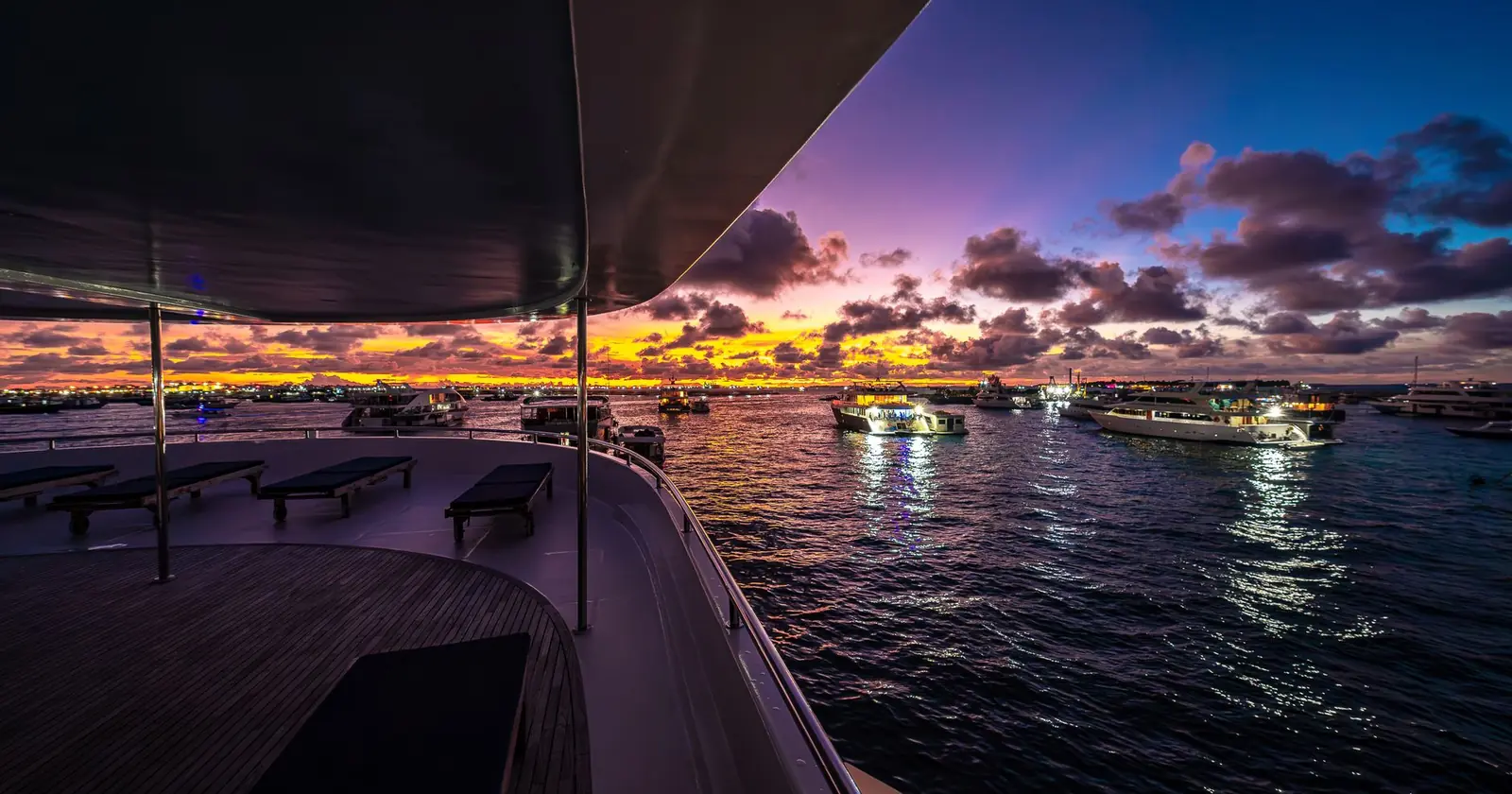
Photo: Asad Photo Maldives / Pexels.
What makes a liveaboard route worth the week
A liveaboard is chosen by the route, not the boat: which sites the itinerary reaches, in which season, and how much of the trip is spent moving. We weighted access to sites you genuinely cannot day-dive, since that is the only reason to pay for a liveaboard. Chamber distance is worth asking about before booking, and it is a question few operators volunteer.
Raja Ampat
The ultimate liveaboard destination: the richest reefs on earth, reached across remote West Papua.
Richest reefsRead the guide → 8°29′S 119°53′E · IndonesiaLabuan Bajo (Komodo)
Liveaboards reach Komodo's full spread of manta and current sites without long daily transfers.
Mantas, currentsRead the guide → 8°38′N 98°15′E · ThailandKhao Lak (Similan)
The Similan Islands are classic Andaman liveaboard territory, granite swim-throughs and mantas.
Similans, graniteRead the guide → 3°54′N 73°21′E · MaldivesMaldives local islands
Liveaboards link far-flung atolls for mantas and whale sharks; local islands are the budget shore base.
Atolls, big animalsRead the guide → 25°04′N 34°53′E · EgyptMarsa Alam
Southern Red Sea liveaboards reach Elphinstone, the Brothers and deep-south reefs.
Red Sea offshore reefsRead the guide → 4°29′N 118°37′E · MalaysiaSemporna (Sipadan)
Some operators run liveaboard-style trips to Sipadan and the Celebes Sea walls.
Sipadan, wallsRead the guide →What the registers say about these ports: and what they do not
Operator records cover all six of these departure points: 209 dive centers, with a training-register affiliation and, where it exists, a Green Fins assessment. Here is what that looks like, and then the caveat that matters more than the table.
| Departure point | Centres we list | In the SSI register | Green Fins, assessed in person | Green Fins, self-assessed |
|---|---|---|---|---|
| Labuan Bajo (Komodo) | 29 | 18 | 12 | 1 |
| Semporna (Sipadan) | 19 | 6 | 10 | 1 |
| Marsa Alam | 58 | 16 | 8 | — |
| Maldives local islands | 89 | 73 | — | 11 |
| Khao Lak (Similan) | 8 | 8 | — | — |
| Raja Ampat | 16 | 13 | — | 3 |
| All six | 209 | 123 | 30 | 16 |
Semporna has the highest share, ten of nineteen centers assessed in person, two of them gold. Marsa Alam has the most gold ratings, four, alongside four silver. Labuan Bajo has the largest absolute count at twelve. Seven centers across the set are in the VDWS register and one in IKO; two at Semporna are marked restricted rather than certified.
The Maldives is the odd one out: 89 operators, excellent training coverage at 73 in the SSI register, and eleven Green Fins members of whom none has been inspected: every one is a self-assessed Digital Member. Training accreditation and behaviour around animals are different questions, and the country with the most mantas answers only the first.
Corrected on 1 September 2026. This page said every record behind the table was a dive center on shore. Five of the 196 are boats, listed by SSI with a town and an address exactly as a shop is, and they are now named above. Found while building an operator page for Mactan, where the same register carries Philippines Aggressor II under the city Lapu-Lapu City.
Why this table cannot tell you which boat to book
Here is the limit, and it applies to every liveaboard article including this one. 203 of the 209 records behind that table are dive centers on shore, and the other six are boats. SSI lists a vessel the same way it lists a shop, with a town and an address: Cajoma Liveaboard, Liveaboard Indonesia and Wunderpus Liveaboard at Labuan Bajo, Maldives Aggressor II at Malé, Raja Ampat Aggressor at Raja Ampat, and Green Fins does the same with La Galigo Liveaboard there. Six out of 209 is the point rather than an exception to it: the register neither carries the boats completely nor keeps them apart from the shops, so counting it tells you about the shore. A liveaboard is a vessel, sold by a boat operator, and the boat is frequently a different company from any shop in the port. A gold Green Fins rating on a Marsa Alam dive center says nothing about the boat leaving from the same quay next Tuesday.
So read the table as what it is: a measure of how seriously the dive industry in that port takes external assessment, which is a reasonable proxy for the culture a boat operating there swims in, and nothing stronger. If you want to know about the vessel, the questions that work are the ones no register answers, how many divers per guide, whether nitrox is included or sold, what the cabin actually is, and whether the itinerary changes when the weather does.
The counts are the compiled records for these six ports, read in August 2026 from the SSI training-center register and the Green Fins member register, and for Raja Ampat again on 21 September 2026, when the thirteen SSI centres there were added. Green Fins publishes no per-operator page, so that column cannot be linked entry by entry. Raja Ampat is still a short list, sixteen operators, and should be read as such rather than as a finding about a region with far more boats than that.
The two dates a liveaboard actually turns on
A liveaboard is booked on the route. It is ruined by two dates nobody puts in the brochure: the day you fly home, and the day the park shuts.
Flying home. A week of liveaboard diving is the exact profile the flying-after-diving rules were written for. DAN's consensus guidelines give a minimum preflight surface interval of 12 hours after a single no-decompression dive, but 18 hours for multi-day repetitive diving, and “substantially longer than 18 hours” after dives involving compulsory decompression or trimix. The caveat in the guidelines is worth carrying too: the trials behind them were run “in a dry hyperbaric chamber with resting volunteers”, so longer may be needed for divers who were immersed and working. A boat that docks at 9am and an afternoon flight is not a plan; an extra night ashore is the plan.
The park shutting. Seasonality on a liveaboard route is often not weather but law. Thailand's Mu Ko Similan and Mu Ko Surin national parks close to visitors for roughly five months each year, on the order of the Department of National Parks, reopening in mid-October and closing again in mid-May. The Similan liveaboard season is that window and nothing else, which is why a Khao Lak route cannot be compared like-for-like with a Red Sea or Maldives route that runs all year. Dates for the closure are triangulated from Thai national press and operators rather than read from the department's own announcement, so confirm the year's dates before booking.
Planning a liveaboard trip
- For the richest reefs: Raja Ampat and Komodo.
- For classic warm-water value: the Similans (Khao Lak) and the Maldives.
- Assume little to no connectivity for three to six days at sea, and plan your work around it.
FAQ: Liveaboard Diving Destinations for Nomads
What is a liveaboard?
A liveaboard is a dive boat you live aboard for several days, sleeping, eating and diving from it, which lets you reach remote reefs far from any shore base and dive them multiple times a day. It is the only practical way to dive places like Raja Ampat and the Similans properly.
Can I work from a liveaboard?
Realistically, no. Assume little to no usable connectivity for the three to six days you are at sea, so treat a liveaboard as offline time and plan your remote work around it. Base yourself in the gateway town with wifi before and after.
Sources
- Flying after diving. Divers Alert Network, guidelines for flying after diving: a minimum 12-hour surface interval after a single no-decompression dive, “a minimum 18-hour surface interval for multi-day repetitive diving”, and “substantially longer than 18 hours after diving involving compulsory decompression, or using heliox and trimix”. The guidelines note that because the trials were conducted “in a dry hyperbaric chamber with resting volunteers, longer guidelines might be needed for divers who were immersed and exercising”. dan.org. Read 11 September 2026.
- The Similan and Surin closure, triangulated. Reported consistently by Thai national press and by Phuket and Khao Lak operators: Mu Ko Similan and Mu Ko Surin close to tourism for about five months a year on the order of the Department of National Parks, with reopening in mid-October and closure in mid-May. The department's own announcement is not among the sources here, so this is marked as triangulated rather than sourced at origin, and the exact days shift by a day or two between years. nationthailand.com. Read 11 September 2026.
- Each entry links to our full guide for that place, and those guides carry the external sources and read dates behind every cost, season and register claim summarised here. They are the place the readings are recorded, not the evidence for them: Raja Ampat, Labuan Bajo (Komodo), Khao Lak (Similan), Maldives local islands, Marsa Alam, Semporna (Sipadan).
- The register counts are our own compiled records for these six ports, read in August 2026, and for Raja Ampat on 21 September 2026, from the SSI training-centre register and the Green Fins member register. 203 of the 209 records are shore-based dive centers; six are boats the register lists the same way, named in the article.