Thailand Diving: Gulf or Andaman, the 2025 Rules on Every Dive Boat, Park Fees and Closures, and Where the Chambers Are
 by Yannick Schroth
Nov 10, 2026
12 min read
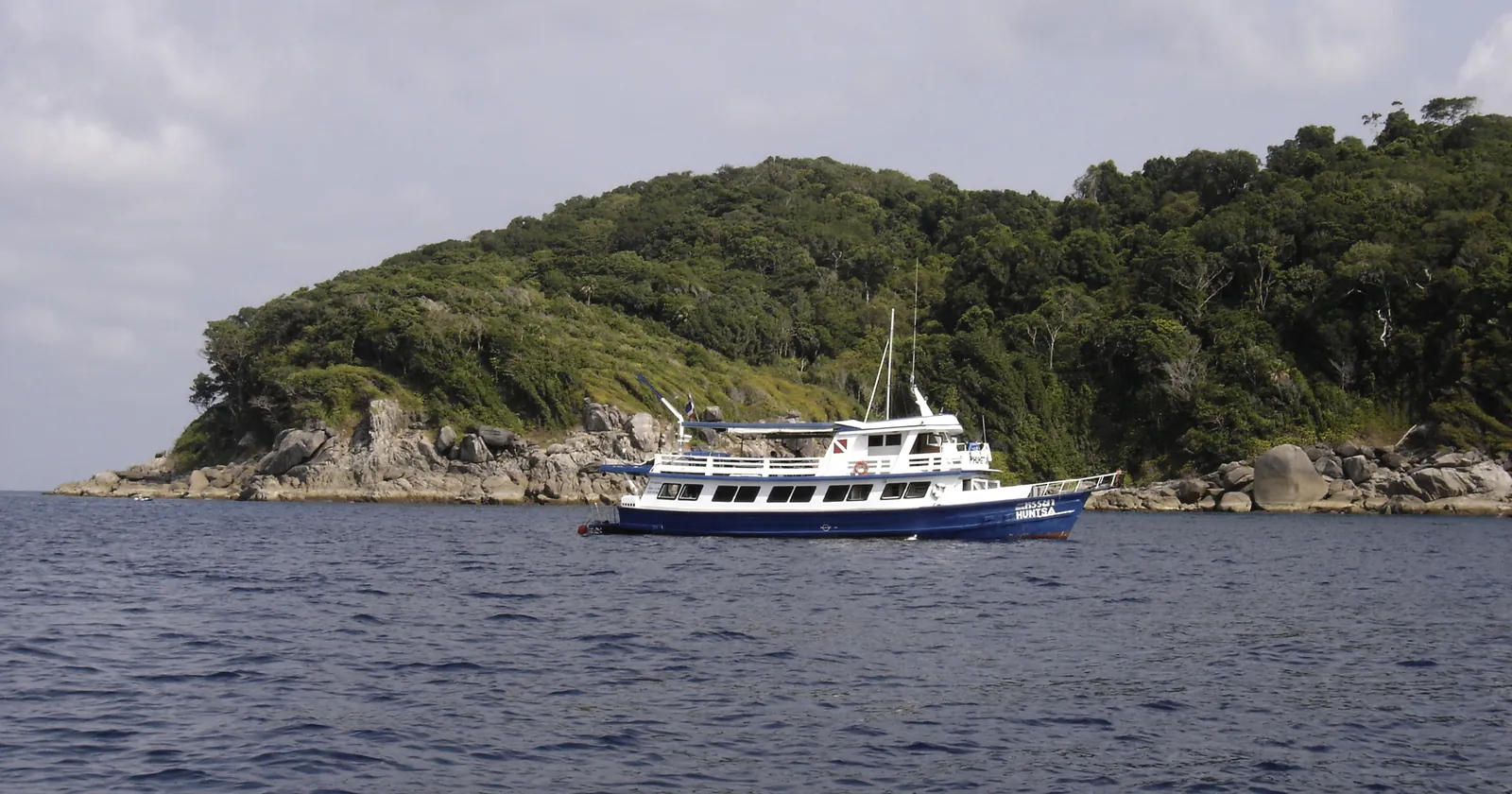
A liveaboard at the Similan Islands. Hanumanix at English Wikipedia, Wikimedia Commons, public domain, cropped.

Key takeaways
- A 2025 national measure makes dive businesses send a trained controller with every reef trip: one per four scuba divers, two try-divers or twenty snorkellers, with training only on sand
- Under the same measure, scuba divers may take a camera only with an Advanced-level course or at least 40 dives, and nobody photographs during scuba courses except photo courses
- National parks charge foreign adults 100 to 500 baht under a fee regulation in force since 7 June 2022; the Similan and Surin islands are the only parks in the 500 baht group
- Andaman parks close in the southwest monsoon (the Similans from 16 May to 14 October), while Gulf parks such as Ang Thong and Mu Ko Chumphon have closed from 1 November to 15 December
- The chamber at Bangkok Hospital Siriroj in Phuket runs a 24-hour line and serves the whole west coast; from 15 September 2026 visa-free visitors from 60 countries and territories get 30 days
Thailand diving: two seas, opposite seasons
Thailand has two coasts, and for a diver they behave like two countries. The Gulf of Thailand runs down the east side of the peninsula, with Pattaya near Bangkok and the Koh Tao, Koh Phangan and Koh Samui group further south. The Andaman Sea is the west coast, from the Similan and Surin islands off Phang Nga down through Phuket, Phi Phi and Koh Lanta to Koh Lipe near the Malaysian border. The rains reach the two coasts at different times of year, and the parks follow them, so the month you can travel often picks the coast for you. This page covers what applies everywhere: the national rules, park fees and closures, seasons, chambers and visas. Each regional guide linked below has the local detail.
The Gulf of Thailand: Koh Tao, Koh Phangan, Koh Samui and Pattaya
For Koh Tao, our open water course guide has the island's published course prices, and Koh Tao for digital nomads covers living there. Koh Tao and Koh Phangan share Sail Rock, and Koh Tao vs Koh Phangan sets the two side by side.
Koh Phangan diving and Koh Samui diving are day-boat bases for Sail Rock, Koh Tao and Chumphon Pinnacle. The Samui guide also covers the 2025 environmental notification that bans anchoring on reefs and pinnacles around the three islands, and Ang Thong, the national park west of Samui. For choosing an island to live on, see Koh Samui vs Koh Tao and Koh Phangan vs Koh Samui.
Pattaya diving is the closest to Bangkok: navy wrecks sunk as artificial reefs, islands off the city and the Samae San area near Sattahip. Off the coast of Chumphon province, north-west of Koh Tao, lies Mu Ko Chumphon National Park, which we have no guide for yet. In the Tourism Authority of Thailand's 2023 park list, its islands close from 1 November to 15 December. Mu Ko Chang National Park, in the east of the Gulf, is another park we do not cover.
The Andaman Sea: Phuket, the Similans, Phi Phi, Koh Lanta and Koh Lipe
On this coast, Phuket diving explains why the Similan closure decides what a Phuket dive week can hold, and Khao Lak and the Similan Islands covers the liveaboard and day-trip routes from the mainland. Khao Lak vs Phuket weighs the two as bases, and Phuket vs Krabi covers Krabi.
Further south, Phi Phi diving is ruled by its national park and its announcements, Koh Lanta diving covers Hin Daeng and Hin Muang and the months they shut, and Koh Lipe diving follows Tarutao National Park's calendar, which the park department rewrites every year.
Two Andaman areas have no guide of their own. The Surin islands, north of the Similans, are the other park in the top fee group, and the 2023 list gave them the same closure as the Similans, 16 May to 14 October. Off Trang, Hat Chao Mai National Park's islands, Ko Muk and Ko Kha Dan among them, were listed as closed from 1 June to 30 September.
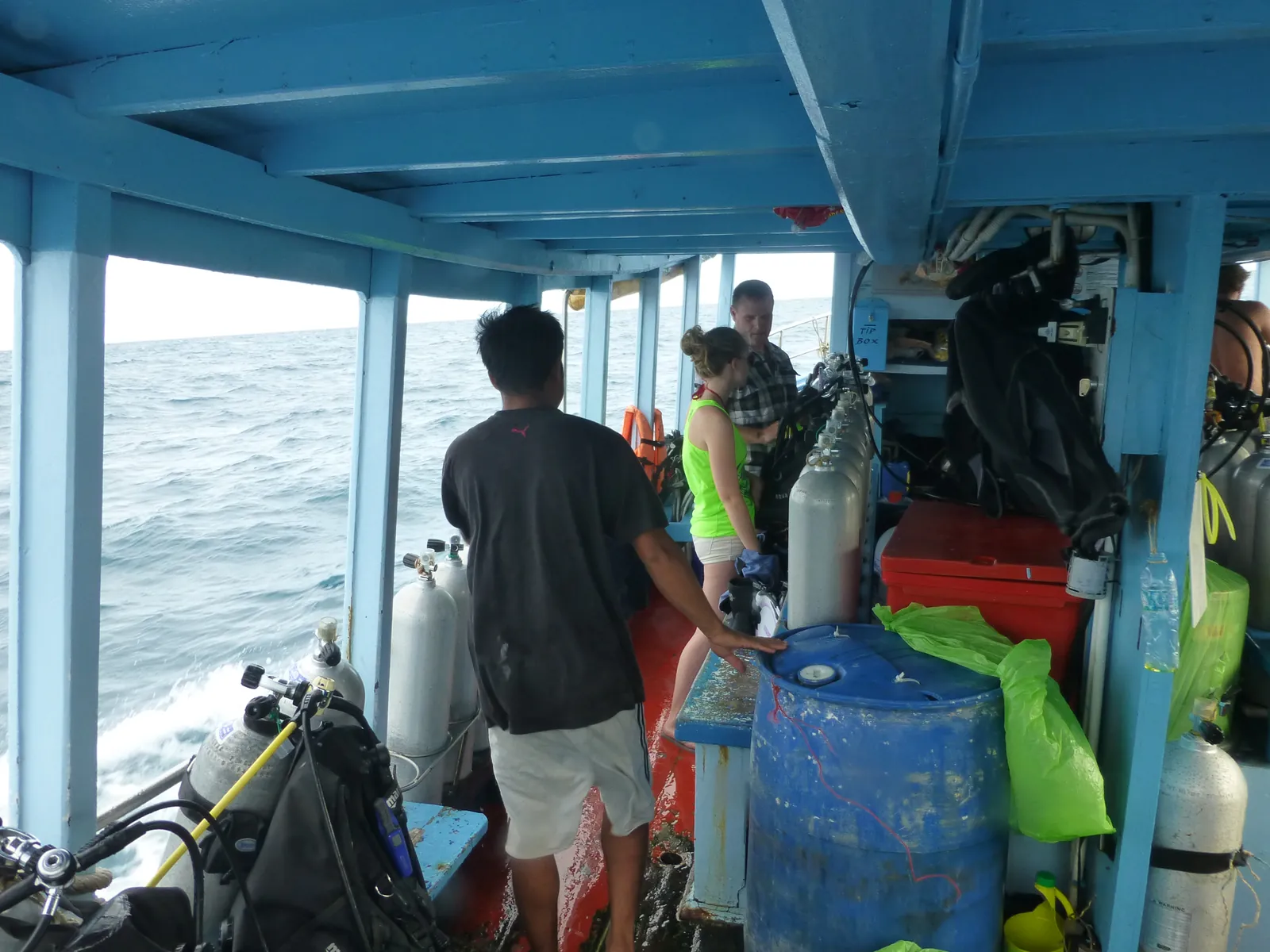
On board a dive boat off Koh Tao. Amada44, Wikimedia Commons, CC BY-SA 4.0, cropped.

The 2025 rules every dive boat now works to
The rule most likely to change a dive day anywhere in Thailand is national. The Ministry of Natural Resources and Environment's measure to protect coral from dive tourism was published in the Royal Gazette on 22 April 2025, took effect at once and runs for five years, according to Thai PBS's Policy Watch. Two days later, the director-general of the Department of Marine and Coastal Resources set out its content, as Thai PBS reported. We could not open the Gazette text, so what follows is the summary in those two reports.
The measure is aimed at businesses that run dive trips. Each trip over coral must carry a controller or assistant controller who has passed the department's training. That person briefs customers on the law and on diving without harming the reef before they get in. The limits per controller are:
| Activity | Most per controller |
|---|---|
| Scuba diving | 4 divers |
| Snorkelling and freediving | 20 |
| Try-dive (Discover Scuba) | 2 students |
| Scuba courses and exams | 4 students, on sand, never on the reef |
Two rules reach the diver directly. On scuba, a camera goes in only with someone who holds an Advanced-level course or has at least 40 dives, and neither instructor nor student may take photos during a scuba course or exam, except on a photography course. Snorkellers over a reef need at least 2 meters of water above the coral and must wear a life jacket unless they have done a scuba or freediving course.
Policy Watch lists further bans: a controller may not move any animal to show it to customers, and nobody may touch or kick coral or sea life, or stir sediment onto the reef. An operator that breaks the measure faces up to two years in prison or a fine of up to 200,000 baht under section 29 of the 2015 marine and coastal resources act. When it was announced, 1,946 guides, dive leaders and instructors had done the training. If a shop offers you a reef dive with eight divers to one guide, or a photo session on your first open water dive, it is not following the measure.
National parks: fees, closures, sunscreen and plastic
Many of the sites in our guides, from the Similans to Hin Daeng and Koh Lipe, lie inside national parks, and a park brings a fee, a calendar and its own rules. The fees come from a park department regulation published in the Royal Gazette on 9 December 2021 and in force from 7 June 2022, as two Thai news reports of the department's announcement set out. It puts every park in one of four groups:
| Group | Parks | Foreign adult / child | Thai adult / child |
|---|---|---|---|
| 1 | 67 | 100 / 50 baht | 20 / 10 baht |
| 2 | 55 | 200 / 100 baht | 40 / 20 baht |
| 3 | 9 | 300 / 150 baht | 60 / 30 baht |
| 4 | 2: Mu Ko Similan and Mu Ko Surin | 500 / 250 baht | 100 / 50 baht |
Phi Phi charges its own, older rate, which our Phi Phi guide explains. Some operators include the park fee in the trip price and some do not, so ask.
Closures follow the monsoon. The Tourism Authority of Thailand's 2023 list of park status shows the pattern: the Similan and Surin islands closed from 16 May to 14 October; Hin Daeng, Hin Muang, Ko Rok and Mu Ko Ha in the Lanta park from 1 July to 30 September; Maya Bay and two other Phi Phi bays from 1 August to 30 September. On the Gulf side, Ang Thong and the Mu Ko Chumphon islands were listed as closing from 1 November to 15 December. The list is from 2023 and the department sets each year's dates, so treat it as the shape, not the calendar. For 2026 the Similan park chief again announced 16 May to 14 October, timed to the Andaman monsoon, as the environment ministry's policy office reported. Our regional guides carry the current dates where we could read them.
Two bans apply in every national park. Sunscreen containing oxybenzone, octinoxate, 4-methylbenzylidene camphor or butylparaben may not be brought in or used, under a park department notice published in the Royal Gazette on 3 August 2021, with fines up to 100,000 baht, according to the Tourism Authority of Thailand. The same body says single-use plastics and foam containers are banned in all 155 national parks, with the same maximum fine. Our reef-safe sunscreen guide covers what to pack.
When to dive Thailand: monsoons and sea temperature by region
The UK Foreign Office puts Thailand's rainy season at generally May to October, and on Koh Samui and in the south-east usually November to March. The Thai Meteorological Department's long-term rainfall averages, published through the World Meteorological Organization, show how far apart the coasts are:
| Station | Driest month | Wettest month | May to October |
|---|---|---|---|
| Phuket (Andaman) | January, 23 mm | September, 387 mm | Every month above 230 mm |
| Ko Samui (Gulf) | February, 58 mm | November, 490 mm | About 110 to 150 mm a month until October's 290 mm |
| Pattaya (upper Gulf) | December, 6 mm | October, 243 mm | Wettest in September and October |
So the Andaman is at its wettest when Samui is relatively drier, and Samui's worst months, October to December, are when the Andaman parks reopen. The averages do not say how rough the sea is, and one wet month says little about a given week.
Temperature hardly decides anything. NOAA's satellite averages for 1991 to 2020, calculated for this page, keep every cell we checked between 27.6 and 30.5 °C:
| Area (OISST cell) | January | May | September | November |
|---|---|---|---|---|
| Koh Tao (10.125°N 99.875°E) | 27.7 °C | 30.2 °C | 29.0 °C | 28.5 °C |
| Pattaya (12.875°N 100.875°E) | 27.6 °C | 30.5 °C | 29.3 °C | 28.9 °C |
| Similan Islands (8.625°N 97.625°E) | 28.4 °C | 29.8 °C | 28.6 °C | 28.7 °C |
| South of Phuket, Racha Yai (7.625°N 98.375°E) | 28.4 °C | 30.0 °C | 29.0 °C | 28.8 °C |
| Koh Lipe (6.375°N 99.375°E) | 28.6 °C | 30.3 °C | 29.5 °C | 29.1 °C |
The Gulf cells run about 0.7 to 1 °C cooler in January, and the Andaman cells vary less over the year. These are surface figures over cells a quarter of a degree, roughly 28 km, across and say nothing about thermoclines at depth. Recent years ran warmer: our Koh Samui vs Koh Tao comparison uses NOAA data for 2021 to 2025, which reads slightly higher.
Chambers and emergency numbers
The chamber whose own page promises round-the-clock service is SSS Phuket, run by Hyperbaric Services Thailand at Bangkok Hospital Siriroj. It opened in 1996 as the first diver recompression chamber in southern Thailand and says it serves the whole west coast, from the Myanmar border to the Malaysian one. It is a multiplace chamber for up to four people including the attendant, can be pressurised to 50 meters, and offers 24-hour emergency service on 081-0819000. Its page calls it one of two facilities the network runs in Thailand.
In the Gulf, our Koh Tao and Koh Phangan comparison recorded an SSS chamber on Koh Tao from the operator's own page in September 2026; the operator's site blocked automated reading this time, so confirm it with your dive center. Bangkok Hospital Pattaya runs a monoplace chamber that lists decompression sickness among its uses, on +66 3825 9986; its page does not say the chamber is staffed around the clock. Our Koh Samui guide found no hyperbaric unit in the Samui hospital's list of clinics.
In an emergency, call 1669 for an ambulance; 191 is the police and 199 the fire service, according to the UK Foreign Office. The Tourist Police hotline is 1155. The same office advises asking a dive operator how it would get an injured diver to a chamber, and checking your insurance; our dive insurance guide covers what to look for.
Staying longer: the DTV and the 30-day exemption
From 15 September 2026, travellers from 60 countries and territories, the UK, the US, Australia, Canada and Germany among them, may enter without a visa for up to 30 days for tourism. This replaced the 60-day exemption, under Interior Ministry announcements published on 31 August 2026, according to the Tourism Authority of Thailand. Entries over land borders under the exemption are generally limited to two a calendar year. Every arrival needs a digital arrival card, and overstaying costs 500 baht a day up to 20,000 baht, according to the UK Foreign Office.
For a season, the Destination Thailand Visa is the route for remote workers. The Ministry of Foreign Affairs lists it for digital nomads, remote workers and freelancers: valid five years with multiple entries, 180 days per entry, extendable once per entry by up to 180 days, with financial evidence of at least 500,000 baht. Its infographic lists a fee of 10,000 baht, and each embassy or consulate sets what it charges. Our DTV guide covers the checklist and what tends to stall an application.
Gulf or Andaman: how to choose
Start with the month. From mid-May to mid-October the Similan and Surin islands are shut, so a liveaboard trip belongs in the other half of the year; in those months Samui's rainfall stays moderate and the Gulf parks are open. In November and December, Samui's wettest stretch and when Gulf park closures have fallen, the Andaman parks are open again.
Then the kind of diving. Learning and long stays point to Koh Tao and its neighbours, where our guides cover course prices and island life. Liveaboards and the remote parks point to the Andaman, with the west-coast chamber in Phuket. Pattaya suits a diver based in Bangkok who wants navy wrecks on a day trip. Wherever you go, the 2025 measure applies, so expect small groups, a briefing and camera rules tied to your logbook.
FAQ: Thailand diving
When is the best time to dive in Thailand?
It depends on the coast. On the Andaman side, the Similan and Surin parks close from 16 May to 14 October and Phuket's rain peaks in September. On the Gulf side, Koh Samui's rain peaks in November, and some Gulf parks have closed from 1 November to 15 December. The sea stays between about 27.6 and 30.5 °C all year.
What are Thailand's 2025 diving rules?
A measure published in the Royal Gazette on 22 April 2025 makes dive businesses send a trained controller on every trip over coral, with at most four scuba divers, two try-divers or twenty snorkellers each. Scuba divers may only take a camera with an Advanced-level course or 40 dives, and training must take place on sand.
How much are national park fees for divers in Thailand?
Under the fee regulation in force since 7 June 2022, foreign adults pay 100, 200, 300 or 500 baht depending on the park's group. Only the Similan and Surin islands are in the 500 baht group. Phi Phi charges its own rate under an older announcement.
Where is the nearest recompression chamber in Thailand?
On the Andaman coast it is SSS Phuket at Bangkok Hospital Siriroj, which runs a 24-hour line on 081-0819000 and serves the whole west coast. In the Gulf, an SSS chamber has been listed on Koh Tao, and Bangkok Hospital Pattaya has a one-person chamber. The ambulance number is 1669.
Is sunscreen banned in Thai national parks?
Sunscreen containing oxybenzone, octinoxate, 4-methylbenzylidene camphor or butylparaben has been banned in all national parks since a notice published on 3 August 2021, with fines up to 100,000 baht. Single-use plastics and foam containers are banned in national parks too.
Note: Conditions, safety guidance and regulations change. Verify current information with official sources, including the dive operator, the park authority and the relevant government department, before you travel or dive.
Founder of NOMADREEF and a former digital nomad. This guide is sourced from the references below; conditions, prices and rules change, so verify current details, and follow qualified local guidance and safety briefings. About the author · LinkedIn ↗
Sources
- The 2025 coral-protection measure (news reports of the Gazette notice). Thai PBS Policy Watch, summary of the measure, 25 April 2025 (Gazette publication 22 April 2025, in force at once for five years; the further bans); Thai PBS, report of the director-general's announcement, 24 April 2025 (controllers, ratios, cameras, snorkelling, penalty, 1,946 trained). The Royal Gazette site refused automated requests. Read 10 November 2026.
- Park fees (triangulated). The park department's 2021 fee regulation, in force 7 June 2022, as reported by Thansettakij and Amarin TV, consistent with the department's news of 2 June 2022 cited in our Koh Samui guide. The department's own sites did not answer automated requests. Read 10 November 2026.
- Park closures, sunscreen and plastic (official). Tourism Authority of Thailand, opening and closing status of Thailand's national parks, 7 July 2023, and sunscreen ban, 30 August 2021; Office of Natural Resources and Environmental Policy and Planning, Similan closure 2026, 22 May 2026. Read 10 November 2026.
- Seasons. Thai Meteorological Department rainfall averages for Phuket, Ko Samui and Pattaya, published by the WMO World Weather Information Service: Phuket, Ko Samui, Pattaya (primary data, averaging period not stated); UK Foreign, Commonwealth and Development Office, Thailand safety and security. Read 10 November 2026.
- Sea temperature. NOAA PSL, OISST v2.1 monthly long-term means 1991–2020, five cells as named in the table, computed for this page (primary). Read 10 November 2026.
- Chambers (primary for each facility). Bangkok Hospital Siriroj, Hyperbaric Chamber Facility; Bangkok Hospital Pattaya, Hyperbaric Oxygen Therapy Center. Read 10 November 2026. The Koh Tao chamber as read for our Koh Tao and Koh Phangan comparison on 5 September 2026; the operator's site refused automated reading on 10 November 2026.
- Emergency numbers. UK Foreign, Commonwealth and Development Office, getting help; Tourist Police Bureau, hotline 1155 (primary). Read 10 November 2026.
- Visas. Tourism Authority of Thailand, 30-day and 15-day visa exemption rules, 1 September 2026; UK Foreign, Commonwealth and Development Office, Thailand entry requirements; Ministry of Foreign Affairs, DTV infographic (primary). Read 10 November 2026.
- Left out. The Royal Gazette text of the 2025 measure and whether it covers wrecks and artificial reefs; the Thai Meteorological Department's own season definitions, whose site blocks automated reading; current-year closure notices for each marine park from the park department; whether Bangkok Hospital Pattaya's chamber or any navy chamber treats divers around the clock; 1669 from the emergency medical institute itself; national rules on spearfishing and fish feeding; internet speeds and coworking.