Koh Lanta Diving: Hin Daeng, Hin Muang and the Season
 by Yannick Schroth
Aug 15, 2026
5 min read
by Yannick Schroth
Aug 15, 2026
5 min read
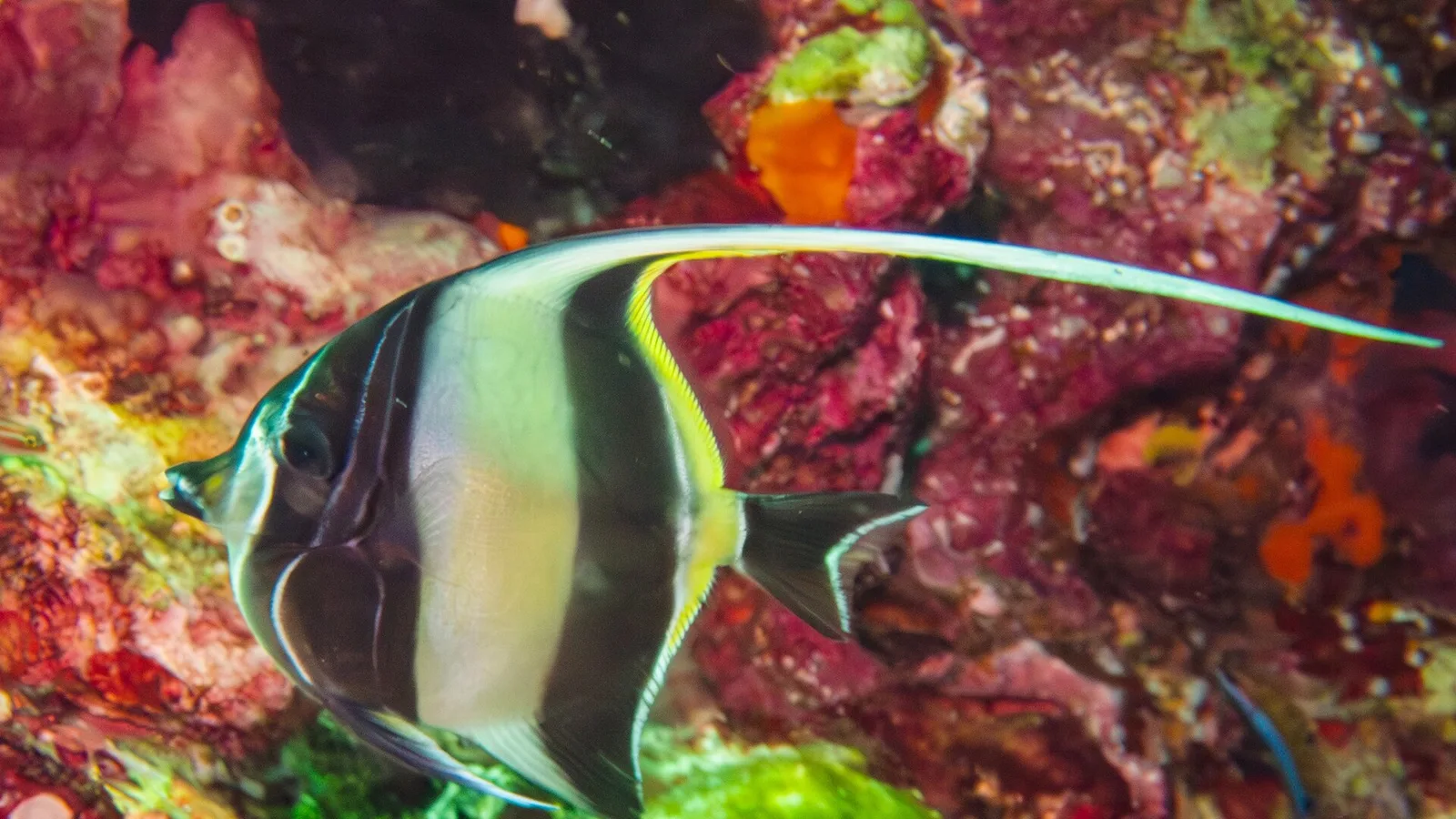
Photo: portioid, Wikimedia Commons, CC BY-SA 4.0.

Key takeaways
- Hin Daeng and Hin Muang close 1 July to 30 September, together with Ko Rok and Mu Ko Ha. The park itself stays open, so a page saying “the park is open” tells you nothing useful.
- All 6 register members were assessed in person within the last twelve months. The spread is 5 Silver and 1 Bronze.
- The closure covers exactly the months when cheap low-season accommodation appears. That is not a coincidence and it is worth planning around.
- Not one of the 13 publishes which languages their instructors teach in.
The park is open. The dive sites are not.
The Tourism Authority of Thailand's listing of national park status gives Mu Ko Lanta National Park as “Open”, and then, in the same entry, lists what is not: “Ko Rok, Mu Ko Ha (Tukon Lima), Kong Hin Daeng - Hin Muang and Tham Khao Mai Kaeo (Khao Mai Kaeo Cave), and Ko Rok Campground - Closed from 1 July until 30 September”.
Read those two lines together, because separately each misleads. Hin Daeng and Hin Muang are the reason most divers choose Koh Lanta, and they are shut for a quarter of the year. A site that repeats only the first line is technically accurate and practically useless.
That listing carries a last-updated date of 7 July 2023, and the Department of National Parks portal carried no current closure announcement on 2026-08-21. Treat 1 July to 30 September as the shape of it and confirm your year with the park or your operator.
Green Fins dive centers in Koh Lanta
Green Fins is run by the Reef-World Foundation with the UN Environment Programme, and its assessments are made in person by trained assessors rather than by self-declaration. The register, read on 2026-08-14, carried 6 members in Koh Lanta: 5 Silver and 1 Bronze.
All 6 carry an assessment marked in person within the last 12 months, which makes this one of the more complete lists here. There is no Gold member here and no Restricted one either; it is a tight band. Every name and what each field rests on is on the Koh Lanta operator list.
What the operators in Koh Lanta say about themselves
Separately from the register, each operator's own site carries more: All 13 responded. Training agencies they name themselves, which is their claim and not a check by anyone: SSI on 7, PADI on 6, AIDA on 2 and CMAS on 1. That comes from reading 13 sites, 48 pages in all. The operator list for Koh Lanta gives the page each name was read on.
Not one of the 13 publishes which languages their instructors teach in. Hin Daeng and Hin Muang are deep, current-swept sites where the briefing matters, so if you need it in a particular language, ask before you pay.
What an Open Water certification covers at Hin Daeng and Hin Muang
The sites that bring people here are a boat ride offshore, and they are sold to anyone with an entry-level certification. That is normal and it is not automatically wrong: but it is worth knowing what the certification was designed around, because the standard is public and it is narrower than most divers remember.
The World Recreational Scuba Training Council writes the minimum course content that the major agencies' entry-level courses are built to. Its open water standard puts the training dives “during daylight hours at depths between 15 and 60 feet (5 to 18 metres)”, and adds a condition that rules out overhead environments outright: “Dives shall not be conducted in any situation where direct vertical access to the surface is not possible.” Instructor ratios are capped at “eight students per instructor”, rising to “a maximum of 12 students per instructor” with certified assistants, and the standard says plainly that these are ceilings rather than targets: “These ratios are considered maximum and should be reduced if environmental conditions or other factors are not optimum.”
And the sentence that frames the rest of it, from the standard's own scope: “these requirements should under no conditions be considered to define a level of optimum training”. A card issued to this standard says the holder met a floor. It does not say they have dived a current, a deep wall, or anything at all beyond 18 m.
What follows for a trip here is one question, asked before you pay rather than on the boat: what is the planned maximum depth, what is the current likely to do, and how many divers is the guide taking? A shop that answers with numbers is telling you whether the dive fits the certification you hold. A shop that answers “it's fine, we'll look after you” is telling you something too.
The same standard is the reason the extra qualification exists, rather than a shop upsell: past 18 m the entry-level course simply has nothing to say about the dive. The people qualified to judge whether a given dive suits you are the instructor in front of you and your own logbook.
FAQ: Koh Lanta
Are Hin Daeng and Hin Muang open all year?
No. The Tourism Authority of Thailand's park listing has them closed from 1 July until 30 September, along with Ko Rok and Mu Ko Ha, even though Mu Ko Lanta National Park itself is listed as open.
How many Koh Lanta operators are independently assessed?
All 6 in the Green Fins register carry an in-person assessment from the last twelve months. The spread is 5 Silver and 1 Bronze.
Is Koh Lanta worth it in low season?
That depends what you came for. The cheap months overlap the closure of the two best-known dive sites, so the saving and the loss are the same three months.
Writes NOMADREEF and compiles its operator directory. This guide is desk research, not a trip report, and says so at the top. About the author
Sources
- What an entry-level course is built to. World Recreational Scuba Training Council (WRSTC), Open Water Diver minimum course content standard: “All dives prior to open water certification shall be conducted during daylight hours at depths between 15 and 60 feet (5 to 18 metres). Dives shall not be conducted in any situation where direct vertical access to the surface is not possible”; “The maximum number of students for in-water training is eight students per instructor. Two additional students per certified assistant may be added up to a maximum of 12 students per instructor”; “These ratios are considered maximum and should be reduced if environmental conditions or other factors are not optimum”; and, on its own scope, “these requirements should under no conditions be considered to define a level of optimum training”. wrstc.com (PDF). Read 14 September 2026.
- Tourism Authority of Thailand, opening and closing status of Thailand's national parks, last updated 7 July 2023. Status of Mu Ko Lanta National Park and the sites closed within it, read 2026-08-14.
- Department of National Parks, Wildlife and Plant Conservation, portal.dnp.go.th. Checked 2026-08-21 for a current closure announcement; the portal carried none.
- Green Fins member register, Reef-World Foundation with the UN Environment Programme, greenfins.net. Membership levels and assessment status for 6 operators, read on 2026-08-14.
- Each operator's own website, opened between 2026-08-16 and 2026-08-24, for the training agencies they name. Recorded on our operator list.