Phi Phi Diving Is Set by the Park, Not by the Season
 by Yannick Schroth
Sep 20, 2026
12 min read
by Yannick Schroth
Sep 20, 2026
12 min read
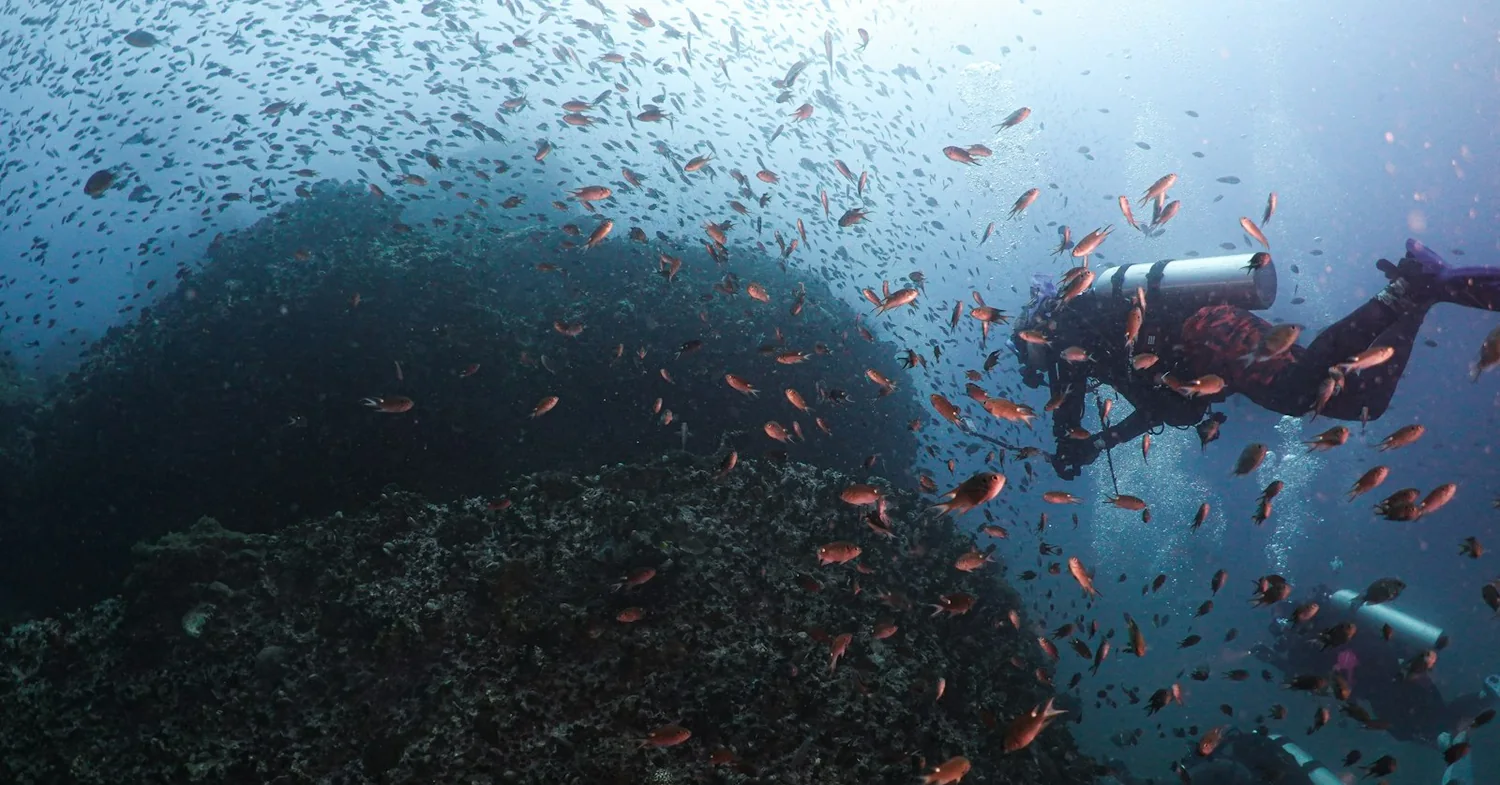
Photo: Unsplash (free licence).
Key takeaways
- Hat Noppharat Thara – Mu Ko Phi Phi National Park was gazetted on 6 October 1983 and covers 242,437.17 rai, or 387.90 square kilometres, of coast and sea
- The islands charge 400 baht for a foreign adult under a 2007 announcement; the 2021 fee regulation places the same park in a 200 baht band, so the two numbers differ
- Maya Bay reopened on 1 January 2022 with 375 visitors per hourly round, 11 rounds a day, no swimming, and boats moored at a floating pier in Loh Samah Bay
- Maya Bay, Loh Samah and Lo Ko close from 1 August to 30 September every year for the southwest monsoon
- Reef around Phi Phi grows to about 8 to 10 metres at most sites and 15 to 20 metres at Ko Phi Phi Le, with published visibility of 5 to 25 metres
- The IUCN Shark Specialist Group named the islands an Important Shark and Ray Area in 2024, for blacktip reef shark breeding and leopard shark resting
Six limestone islands, and a reef that stops at 8 to 10 metres
Phi Phi is six limestone islands, about 40 kilometres southeast of Phuket and about 30 kilometres west of Krabi, standing in a large shallow bay that a 2010 coral study describes as nowhere deeper than 30 metres. Three pinnacles belong with them: Hin Bida, roughly 8 kilometres from Ko Phi Phi Le, and Hin Mu Sang and Hin Jom, roughly 15 kilometres from Ko Phi Phi Don.
The reef follows the same logic. The same study records well developed fringing coral on the eastern sides of the islands and in places sheltered from southwest storms, growing down to about 8 to 10 metres at most sites and to about 15 to 20 metres at Ko Phi Phi Le. Massive Porites lutea, branching Acropora and the tabular Acropora hyacinthus dominate it, and gorgonian fans are common around Ko Phi Phi Don.
So depth at Phi Phi does not come from the reef. It comes from the limestone: the walls of Bida Nok and Bida Nai, the pinnacles further out, the sand between the rocks. A diver who wants 25 metres finds it beside a cliff, not on a slope. Published visibility in the same survey ran from 5 to 25 metres, which is a wide band and a fair warning.
The whole archipelago sits inside Hat Noppharat Thara – Mu Ko Phi Phi National Park, gazetted in the Royal Gazette of 6 October 1983 and now covering 242,437.17 rai, which the Department of National Parks converts to 387.90 square kilometres. The park has two halves, mainland beaches near Ao Nang and the islands, and they are priced differently.
The islands cost 400 baht, and the fee regulation says 200
Two Thai instruments set a price for this park and they do not agree. The first is the department regulation published on 9 December 2021 and in force from 7 June 2022, which sorted every national park in Thailand into four bands. Hat Noppharat Thara – Mu Ko Phi Phi sits in band two: 40 baht for a Thai adult, 20 for a Thai child, 200 for a foreign adult and 100 for a foreign child.
The second is older and is the one you actually pay. A department announcement dated 22 November 2007 fixes the rate for entering the Mu Ko Phi Phi part of the park, every island in it, naming Ko Phi Phi Le, Ko Mai Phai, Ko Yung, Ko Bida and Ko Poda. Thai adults 40 baht and children 20; foreign adults 400 baht and children 200. That rate has run unchanged since 2007.
It survived a serious attempt to cut it. In February 2017 some 500 Krabi tour and boat operators asked for the foreign rate to be halved to 200 and 100. The park advisory committee kept 400 and 200 and attached conditions: transparent collection, quality controls on tourism, and a grip on boat numbers, which had grown from about 500 vessels to about 2,000.
The money is not small. In the 2025 Thai financial year, October 2024 to September 2025, this park collected 648,920,480 baht, more than any other national park in the country, out of a national total of 2,208,128,028.86 baht. Second place, Mu Ko Similan, took 197,258,000. Budget the fee per park per day rather than per trip, and read the ticket: it is issued for the island area, not for the mainland beaches.
Maya Bay closed on 1 June 2018 and reopened without water access
The bay on Ko Phi Phi Le that a film made famous was shut by the Department of National Parks on 1 June 2018. It stayed shut for more than three years. It reopened on 1 January 2022, and the reopening is better understood as a new set of rules than as a return to normal.
Capacity is capped at 375 visitors per one hour round, from 07:00 to 18:00, which the department described as 11 rounds a day. Entry to the water is not allowed, a rule the department justified by visitor safety and by damage to coral. So Maya Bay is a beach you stand on, briefly, in a numbered slot.
Boats no longer enter the bay at all. The park built a floating pier and a raised walkway in Loh Samah Bay, on the opposite side of the island, along with mooring buoys and marker floats, plus toilets, a cooking building, benches and a viewing deck. Visitors arrive at the back and walk through.
Booking runs through the QueQ app and nothing else, opened on 20 December 2021 for arrivals from 1 January 2022, with reservations possible up to 60 days ahead. The same scheme broke this park into 42 separately bookable sites. None of that is a dive, but it shapes the boat traffic: the tour fleet is funnelled into Loh Samah on timed rounds, which is exactly where several Phi Phi Le dive sites sit.
The blacktip count at Maya Bay went from 161 to 278
The closure produced a measurable animal. During the years the bay was shut, the department recorded blacktip reef sharks, adults and juveniles, living in front of Maya Bay, and put the number at about 161.
The 2026 figure is larger and better documented. In September 2026, during the annual closure, the Marine National Park Study and Research Centre 3 in Trang surveyed the bay with the park and recorded a peak of 278 adult blacktip reef sharks close to the beach at first light on 2 September 2026, the highest reading in that financial year.
Fifteen drone flights gave an early morning mean of 251.67 ± 22.91 sharks and an evening mean of 57.25 ± 15.42. Most animals were adults over a metre, with three to five juveniles under a metre in the shallows. Twenty three baited video deployments recorded up to four juveniles in one frame, and twenty two water readings gave a mean temperature of 30.25°C and a mean salinity of 33.10 parts per thousand.
Counting sightings is not the same as counting animals. Photo identification, which works on individual fin markings, ran 333 blacktips through a Phi Phi catalogue between 1993 and 2019, and identified 62 individuals in Maya Bay alone between November 2022 and April 2023: 36 mature and 26 immature. Video and drone work from 2018 to 2024 found newborns of 30 to 60 centimetres and adults using the area all year, and a shark was seen giving birth in the bay in December 2019.
That is why the bay is treated as a nursery, and it is also the bay where nobody may enter the water. Divers meet blacktips elsewhere around the islands, in ones and twos, not in a column of 278.
Leopard sharks rest on the sand at Bida and lay eggs at Ko Yung
In 2024 the IUCN Shark Specialist Group named the Phi Phi Islands an Important Shark and Ray Area, 481.77 square kilometres of water from the surface to 35 metres. Two species qualified it. One is the blacktip. The other is the Indo-Pacific leopard shark, Stegostoma tigrinum, which the Red List classes as Endangered.
Phi Phi qualified as a resting area for it, and the reason is the behaviour. Unless divers disturb them, these animals are lying on the sand in more than 90 per cent of recorded observations. Between 2008 and 2010 it was common to see two or three resting close together at Bida Nok, Bida Nai, Hin Bida and Shark Point, and groups of up to five have been logged.
The scale of that is easier to grasp against the rest of the country. A dive log study covering 9,524 dives at 153 sites across Thailand between 2012 and 2016 found sightings of two or more leopard sharks at 15 sites. Eleven of those 15 sit inside the Phi Phi area.
The eggs are the other half. Divers have photographed leopard shark egg cases here since 1990, at 10 to 15 metres and often around gorgonians, with two main laying locations, Ko Yung and Ko Phi Phi Don. Laying starts with the northeast monsoon in October and November, and near term embryos are seen until April or May.
The trend under those numbers is downward. Earlier years produced up to 100 egg cases on a single dive; recent years are closer to ten. Thailand added the species to its schedule of protected wild animals in a ministerial regulation published in the Royal Gazette on 24 September 2024, where it is listed under its older name, Stegostoma fasciatum.
Maya Bay, Loh Samah and Lo Ko close from 1 August to 30 September
Every year the park shuts three bays on Ko Phi Phi Le: Maya Bay, Loh Samah and Lo Ko, from 1 August to 30 September. The department gives two reasons and both are literal. One is recovery, on land and underwater. The other is safety, because that window falls in the southwest monsoon and the sea runs rough.
The rest of the park stays open and keeps working through it. That is the distinction worth carrying, because a page saying the national park is open in August is true and useless: what closes is the named bay, and what stops a dive day is the state of the sea.
The park describes its own climate in terms that surprise people who have read the usual Thailand shorthand. Its rainy season runs from early May to December and its hot season from early January to April. That is eight wet months and four dry ones, not the six and six that brochures imply.
The traffic shows the shape of it better than a rainfall table. Krabi’s provincial administration counts every passenger through Pak Khlong Jilad, the port the Phi Phi ferries leave from, and logged 49,831 in January 2025 against 16,178 in September, the low point, out of 376,154 over the year.
The pattern inside that total matters more. All three Phi Phi operators carried passengers in every one of the twelve months, while the Ko Lanta operator at the same pier recorded none at all from May to October. Phi Phi thins in the wet season, it does not stop, and the crossing stays timetabled at two hours by ferry and one by speedboat. For choosing a mainland base, see Phuket versus Krabi.
The 2024 bleaching shut Phi Phi dive sites for ten months
In 2024 the Andaman bleached, and the park responded with closures rather than with advice. Announcements dated 13 May 2024 and 22 June 2024 suspended snorkelling and diving at a list of sites, starting on the Krabi mainland side of the park: Ko Kai, Ko Poda, Ko Daeng, Ao Railay and the deeper water at Ko Yawasam.
From 30 June 2024 the closure reached the islands themselves: Ao Loh Bakao, the north side of the Viking Cave, and the water in front of Ao Pileh. Park staff who dived those sites reported reef that had turned almost entirely white. The orders were made under sections 25 and 35(4) of the National Park Act B.E. 2562.
They were lifted on 17 April 2025, when the head of the park revoked the announcement of 22 June 2024 and reopened nine sites, having found recovery under way. The gap was close to ten months and it covered a full high season.
The lesson for anyone booking Phi Phi is procedural rather than ecological. Site closures here come from the park office, they are issued mid season, they name individual rocks and bays, and they are lifted the same way. The park next door runs on the same mechanism with its own calendar: Hin Daeng and Hin Muang have an annual closure of their own while Mu Ko Lanta around them stays open.
The King Cruiser wreck lies between Phuket and Phi Phi
The best known wreck in this corner of the Andaman is a ferry that sank on the way to Phi Phi. The King Cruiser went down on 4 May 1997 after striking a submerged rock near Hin Mu Sang, the pinnacle sold to divers as Shark Point. The Royal Thai Navy, which dived and surveyed the wreck on 5 April 2021, records that nobody was killed.
Where it lies is worth pinning down, because the marketing and the map disagree. Hin Mu Sang and its neighbour Hin Jom, known as Anemone Reef, sit about 15 kilometres from Ko Phi Phi Don, while operator accounts put the wreck somewhere between 25 and 32 kilometres from Phuket. Those distance figures come from dive businesses rather than from a chart and are triangulated rather than settled.
Depth is disputed in the same way. Published accounts put the seabed at 30 to 33 metres, and they agree on the direction of change: the shallowest point was once about 10 to 12 metres and is now nearer 16 to 18, because the superstructure has fallen in. The year of the major collapse is given as 2003 by some accounts and 2004 by others.
Hin Mu Sang itself carries real legal protection, and it is more recent than the dive literature suggests. A Department of Marine and Coastal Resources order, number 1148/2563, took effect on 23 September 2020 under section 17 of the Marine and Coastal Resources Management Promotion Act B.E. 2558. It bans traps and nets of every kind there, along with anchoring on reef and dumping waste, with a penalty of up to a year in prison, a fine of up to 100,000 baht, or both. The pinnacle it names in Krabi province is Hin Daeng.
What the 2004 tsunami did to the Phi Phi reefs, island by island
The waves reached western Thailand at about 09:55 on 26 December 2004, on a high spring tide. Run-up measured afterwards on Ko Phi Phi Don was 5.84 metres on the north coast, read from a trace on the wall of a house, and 4.58 metres on the south coast. The highest figure recorded anywhere in Thailand that day was 19.6 metres, at Ban Thung Dap.
Underwater the damage was smaller than the shoreline damage and much more local. A rapid assessment of 174 sites along the west coast found 105 unaffected or barely touched, 30 with 11 to 30 per cent of coral cover affected, 16 with 31 to 50 per cent, and 23 severely damaged with more than half the cover affected. That is 13 per cent severe against 60 per cent little or none.
The north took the worst of it: Ranong, Phang Nga and the Surin and Similan islands. The south came off lighter, with one exception the survey named, and the exception was Phi Phi. Around the islands the heaviest damage, up to 50 per cent, was at Ko Pai and Lolana Bay, with 30 to 50 per cent at the northern end of Ko Phi Phi Le.
Four sites came through almost untouched: Ko Yung, Laem Tong, Hin Phae and the southeast of Ko Phi Phi Le. Long term monitoring going back 15 to 25 years found coral cover reductions of 5 to 16 per cent at the worst four of 17 stations, and about 40 per cent at the southwest tip of Pai Island. Sedimentation killed coral at two sites around Phi Phi.
Recovery was measured rather than assumed. Settlement plates carried more than 17 coral spat per tile after four months, at damaged and undamaged sites alike, and recruit densities on natural substrate reached 7.2 per square metre per year three years on. The published estimate was full recovery in 5 to 10 years, provided nothing else went wrong. Bleaching went wrong.
Six dive businesses at Phi Phi, and three of them are filed under Krabi
The operator picture here is small and unusually uniform. Six dive businesses at Phi Phi appear in the SSI register of affiliated centres, read on 4 September 2026, and all six are SSI entries. None of them appears in the IKO or VDWS registers, and none is a Green Fins member. Five of the six publish a website in the register.
The addresses in that register look wrong until you check a map. It files three of the six under Krabi, one under Mueang Krabi, Krabi, and two under Koh Phi Phi. The islands are in Krabi province, so a register entry that says Krabi is recording an administrative fact rather than making a mistake.
What an entry settles is narrow. It says the body lists the business on the date given, and nothing about the teaching, the boats, the briefings, the kit or whether the centre is trading this season. Every entry on the Phi Phi operator list links back to the register page it was read from.
Thailand keeps no compulsory register or licence for a recreational dive centre that a reader could look up, which is why absence from a membership list proves nothing: which registers can be read logs what each source returned and on what date.
So the checkable part of a Phi Phi trip is the park, not the school. The fee, the closure dates, the bay rules and the site suspensions are all published, dated and enforceable. Plan around those, and treat what a brochure says about the diving itself as a claim rather than a fact.
FAQ: scuba diving at Phi Phi
Do you have to pay a national park fee to dive at Phi Phi?
Yes. Every island in the Mu Ko Phi Phi half of Hat Noppharat Thara - Mu Ko Phi Phi National Park sits inside the park, and a Department of National Parks announcement of 22 November 2007 sets the rate there at 400 baht for a foreign adult and 200 baht for a foreign child, with 40 and 20 baht for Thai adults and children. The department's 2021 fee regulation puts this park in its 200 baht band for foreign adults, so the two instruments carry different numbers, and 400 baht is the figure charged at the islands.
Can you swim or dive at Maya Bay?
No. When the Department of National Parks reopened the bay on 1 January 2022 it reopened it without water access: going into the water is not permitted, for visitor safety and to keep the coral from being damaged. Boats no longer land on the beach either. They tie up at a floating pier in Loh Samah Bay on the far side of Ko Phi Phi Le, and visitors cross to the beach on a raised walkway. Maya Bay is a look, not a dive.
When is Maya Bay closed?
From 1 August to 30 September every year, together with Loh Samah Bay and Lo Ko Bay. The Department of National Parks gives two reasons: letting the reef and the beach recover, and visitor safety in the southwest monsoon, when the sea around the islands turns rough. The rest of the park stays open through those two months. In 2026 the closure ran on those dates and the bay was due back on 1 October.
How many blacktip reef sharks are there at Maya Bay?
Counts and identifications give different answers. The highest count is 278 adults, recorded close to the beach at first light on 2 September 2026 by the Marine National Park Study and Research Centre 3 in Trang, working with the park; across 15 drone flights that month the early morning average was 251.67 sharks. Photo identification, which counts individuals rather than sightings, put 62 animals in Maya Bay between November 2022 and April 2023, 36 of them mature.
Where do you see leopard sharks at Phi Phi?
On the sand, mostly. Unless divers disturb them, Indo-Pacific leopard sharks are resting on the bottom in more than 90 per cent of recorded observations here. Between 2008 and 2010 it was common to see two or three lying close together at Bida Nok, Bida Nai, Hin Bida and Shark Point, and groups of up to five have been recorded. Their egg cases have been photographed around the islands since 1990 at 10 to 15 metres, with Ko Yung and Ko Phi Phi Don as the two main laying sites.
How deep do the corals grow around Phi Phi?
Shallower than most divers expect. A study of coral recruitment around the islands records reef growing down to about 8 to 10 metres at most sites, and to about 15 to 20 metres at Ko Phi Phi Le. The well developed fringing reef sits on the eastern sides of the islands and in places sheltered from southwest storms. Depth on a Phi Phi dive therefore comes from walls and pinnacles rather than from the reef itself.
What is the underwater visibility at Phi Phi?
The published range is 5 to 25 metres, from that same study. It is wide because Phi Phi sits in a large shallow bay that is nowhere deeper than about 30 metres, so rain, run off and swell change the water fast. The park describes its own rainy season as running from early May to December and its hot season from early January to April, which is a longer wet season than the usual shorthand for Thailand suggests.
Is the King Cruiser wreck a Phi Phi dive or a Phuket dive?
It is sold mostly from Phuket and it lies between the two. The ferry sank on 4 May 1997 after striking a submerged rock near Hin Mu Sang, and the Royal Thai Navy records that nobody was killed. Hin Mu Sang and the neighbouring Hin Jom sit about 15 kilometres from Ko Phi Phi Don, while operator accounts place the wreck 25 to 32 kilometres from Phuket. Published depths disagree too, putting the seabed between 30 and 33 metres.
Did coral bleaching close dive sites at Phi Phi?
Yes, for most of a year. Park announcements of 13 May and 22 June 2024 closed snorkelling and diving at a list of sites, and from 30 June 2024 the closure covered Ao Loh Bakao, the north side of Viking Cave and the water in front of Ao Pileh, where park staff found reef that had turned almost entirely white. The orders were made under sections 25 and 35(4) of the National Park Act B.E. 2562. Nine sites reopened on 17 April 2025.
How badly did the 2004 tsunami damage the Phi Phi reefs?
Less than the shoreline damage suggests, and very unevenly. A rapid assessment of 174 sites along the west coast of Thailand found 13 per cent severely damaged, meaning more than half the coral cover affected, and 60 per cent with little or no damage. The north was hit harder than the south, and the one southern exception the survey named was Phi Phi. Around the islands the worst damage, up to 50 per cent, was at Ko Pai and Lolana Bay, with 30 to 50 per cent at the northern end of Ko Phi Phi Le.
How many dive centres are there on Phi Phi?
Six dive businesses at Phi Phi appear in the SSI register of affiliated centres, read on 4 September 2026, and five of the six publish a website there. None of them appears in the IKO or VDWS registers and none is a Green Fins member. A register entry settles that the body lists the business on the date given, and nothing about the teaching, the boats or whether the centre is trading this season.
Founder of NOMADREEF and a former digital nomad. This guide is sourced from the references below; conditions, prices and rules change, so verify current details, and follow qualified local guidance and safety briefings. About the author · LinkedIn ↗
Sources
- The park itself. Gazetted in the Royal Gazette volume 100, part 160, of 6 October 1983; area 242,437.17 rai or 387.90 square kilometres; the park’s own climate description, rainy season from early May to December and hot season from early January to April. Department of National Parks, Wildlife and Plant Conservation, park record for Hat Noppharat Thara – Mu Ko Phi Phi. Read 20 September 2026.
- The 2021 fee bands. Department regulation on service charges in national parks, B.E. 2564, published in the Royal Gazette on 9 December 2021 and in force from 7 June 2022, sorting parks into four bands, with Hat Noppharat Thara – Mu Ko Phi Phi in band two at 40 and 20 baht for Thai adults and children and 200 and 100 for foreign adults and children. Department of National Parks press office, new entrance rates from 7 June 2022. Read 20 September 2026.
- The 400 baht island rate. The department announcement of 22 November 2007 setting the rate for entering the Mu Ko Phi Phi area of the park, every island including Ko Phi Phi Le, Ko Mai Phai, Ko Yung, Ko Bida and Ko Poda, at 40 and 20 baht for Thai adults and children and 400 and 200 for foreign adults and children, unchanged since 2007; the February 2017 request by about 500 Krabi operators to halve it and the advisory committee decision to keep it, with conditions including control of a fleet grown from about 500 boats to about 2,000. Thai PBS, report of 28 February 2017, quoting the director-general. Read 20 September 2026. The 400 and 200 baht rate is also what dive and boat operators publish for 2025 and 2026, so current practice is triangulated across operator pages.
- Park revenue. 648,920,480 baht at Hat Noppharat Thara – Mu Ko Phi Phi in the 2568 financial year, October 2024 to September 2025, first of all Thai national parks, against a national total of 2,208,128,028.86 baht, with Mu Ko Similan second at 197,258,000 baht; figures released by the department’s director-general. MGR Online, report of 5 November 2025. Read 20 September 2026.
- Maya Bay, the closure and the reopening rules. Closed from 1 June 2018 for more than three years; about 161 blacktip reef sharks recorded in front of the bay during the closure; reopened 1 January 2022 at 375 visitors per one hour round from 07:00 to 18:00 in 11 rounds a day; no entry to the water; floating pier, raised walkway, mooring buoys and marker floats at Loh Samah Bay; QueQ booking from 20 December 2021, up to 60 days ahead; 42 bookable sites in this park. Department of National Parks, press conference of 23 December 2021. Read 20 September 2026.
- The 2026 shark survey. Peak of 278 adult blacktip reef sharks at first light on 2 September 2026, the highest reading of the 2569 financial year; 15 drone flights with an early morning mean of 251.67 ± 22.91 and an evening mean of 57.25 ± 15.42; most animals over one metre, three to five juveniles under a metre inshore; 23 baited video deployments, four juveniles in one frame; 22 water readings at a mean 30.25°C and 33.10 parts per thousand; closure 1 August to 30 September 2569. Department of National Parks with the Marine National Park Study and Research Centre 3, Trang, release of 14 September 2026. Read 20 September 2026.
- The sharks, the pinnacles and the egg cases. Area 481.77 square kilometres, 0 to 35 metres; Hin Bida about 8 kilometres from Ko Phi Phi Le, Hin Mu Sang and Hin Jom about 15 from Ko Phi Phi Don; gorgonian fans around Ko Phi Phi Don; blacktip Vulnerable, leopard shark Endangered; 333 blacktips photo-identified 1993 to 2019 and 62 in Maya Bay from November 2022 to April 2023, 36 mature and 26 immature; neonates of 30 to 60 centimetres and adults year-round in surveys 2018 to 2024; a birth in Maya Bay in December 2019; leopard sharks on sand in over 90 per cent of observations, two or three together at Bida Nok, Bida Nai, Hin Bida and Shark Point between 2008 and 2010 and groups of up to five; egg cases since 1990 at 10 to 15 metres, up to 100 per dive once and nearer ten now, laid at Ko Yung and Ko Phi Phi Don from October to November with near term embryos to April or May; and the dive log figures of 9,524 dives at 153 Thai sites from 2012 to 2016 with two or more leopard sharks at 15 sites, 11 of them at Phi Phi, from Ward-Paige, Westell and Sing, Ocean & Coastal Management 163 (2018). IUCN SSC Shark Specialist Group, Phi Phi Islands ISRA Factsheet (2024, PDF), reviewed by the ISRA Independent Review Panel. Read 20 September 2026. Several figures in it are credited to unpublished project and department data, and the factsheet says which.
- Leopard shark protection in Thailand. Ministerial regulation designating certain wild animals as protected wild animals, B.E. 2567, published in the Royal Gazette volume 141, part 58 Kor, page 34, on 24 September 2024, listing Stegostoma fasciatum as entry 18 in the schedule of protected aquatic wild animals, alongside hammerheads and sawfishes. Gazette text (PDF), Department of National Parks. Read 20 September 2026.
- The 2024 bleaching closures. Park announcements of 13 May and 22 June 2024 suspending snorkelling and diving at Ko Kai, Ko Poda, Ko Daeng, Ao Railay and Ko Yawasam, and the extension from 30 June to Ao Loh Bakao, the north side of the Viking Cave and the water in front of Ao Pileh, where reef was found almost entirely white, under sections 25 and 35(4) of the National Park Act B.E. 2562. Thai PBS, 24 June 2024, and Thairath, 23 June 2024. The revocation and reopening of nine sites on 17 April 2025: MGR Online, 17 April 2025. All read 20 September 2026.
- The reef, the depths, the visibility and the recruitment. Six limestone islands about 40 kilometres southeast of Phuket and about 30 west of Krabi in a bay not deeper than 30 metres; fringing reef on the eastern sides and where sheltered from southwest storms; coral to about 8 to 10 metres at most sites and 15 to 20 at Ko Phi Phi Le; visibility 5 to 25 metres; dominant Porites lutea, branching Acropora and tabular Acropora hyacinthus; tsunami damage up to 50 per cent at Ko Pai and Lolana Bay and 30 to 50 at the north end of Ko Phi Phi Le, with Ko Yung, Laem Tong, Hin Phae and Phi Phi Le southeast slightly damaged or untouched; over 17 coral spat per settlement tile after four months and recruit densities up to 7.2 per square metre per year. Sawall, Phongsuwan and Richter, Helgoland Marine Research 64:357–365 (2010), DOI 10.1007/s10152-010-0192-5. Read 20 September 2026.
- The tsunami and the reefs. Waves striking the west coast at about 09:55 on 26 December 2004 on a high spring tide; a rapid assessment of 174 sites with 105 unaffected or barely damaged, 30 at 11 to 30 per cent of coral cover affected, 16 at 31 to 50 and 23 severe at more than 50, summarised as 13 per cent severe and 60 per cent little or none; the north hit harder than the south, Phuket, Krabi except Phi Phi, Trang and Satun; four of 17 long term stations down 5 to 16 per cent and about 40 per cent at the southwest tip of Pai Island; sedimentation killing coral at two sites around Phi Phi; recovery estimated at 5 to 10 years. Phongsuwan and Brown, Atoll Research Bulletin 544:79–91 (2007). Read 20 September 2026. Readings of the same 2005 assessment are worded differently: this paper gives 60 per cent with little or no damage, Sawall et al. almost 40 per cent with none measurable.
- The run-up heights. Ko Phi Phi Don north coast 5.84 metres, measured from a trace on the wall of a house, and south coast 4.58 metres; 123 Thai run-up records for the event, the highest 19.6 metres at Ban Thung Dap. NOAA National Centers for Environmental Information, Global Historical Tsunami Database, queried through its run-up API for Thailand in 2004 on 20 September 2026. The Phi Phi measurements are credited there to the Kyoto University field survey around Phuket by Matsutomi and colleagues, 2005.
- The King Cruiser. Sinking on 4 May 1997 after striking a submerged rock near Hin Mu Sang, with no deaths, the wreck lying between Phuket and Phi Phi, and the Royal Thai Navy Area 3 survey of 5 April 2021. Royal Thai Navy. Read 20 September 2026. The 25 to 32 kilometres from Phuket, the seabed at 30 to 33 metres, the shallowest point moving from about 10 to 12 metres to about 16 to 18, and the collapse year of 2003 or 2004 are triangulated across dive operator and dive press accounts, which disagree among themselves, and no chart figure was published for them.
- Protection at Hin Mu Sang. Department of Marine and Coastal Resources order 1148/2563, in force from 23 September 2020 under section 17 of the Marine and Coastal Resources Management Promotion Act B.E. 2558, naming the Hin Mu Sang pinnacle and Ko Dok Mai in Ko Yao district, Phang Nga, and Hin Daeng in Krabi, banning traps and all nets, anchoring on reef and dumping of waste, with up to one year in prison, a fine of up to 100,000 baht, or both. Department of Marine and Coastal Resources. Read 20 September 2026.
- The ferry traffic. Passenger counts at Pak Khlong Jilad for 2568, January 49,831, September 16,178, year 376,154, with Andaman Wave Master, URIP Travel and PP Chookit Thongkerd recording passengers in all twelve months and the Ko Lanta operator none from May to October; and the published timetable, two hours by ferry and one by speedboat. Krabi Provincial Administrative Organization, port statistics and sailing timetable. Read 20 September 2026. The totals are for the whole port, not for the Phi Phi routes alone.
- The six businesses. Six dive businesses at Phi Phi in the SSI register of affiliated centres, read 4 September 2026, all six SSI, none in IKO or VDWS and none a Green Fins member, five publishing a website, with the register filing three under Krabi, one under Mueang Krabi, Krabi and two under Koh Phi Phi. divessi.com, with every entry linked to the page it was read from on the Phi Phi operator list; register limits on which registers can be read.