Florida Diving: The Keys Sanctuary's Two Rulebooks, Gulf Wrecks, the Springs and the State Dive Laws
 by Yannick Schroth
Nov 10, 2026
12 min read
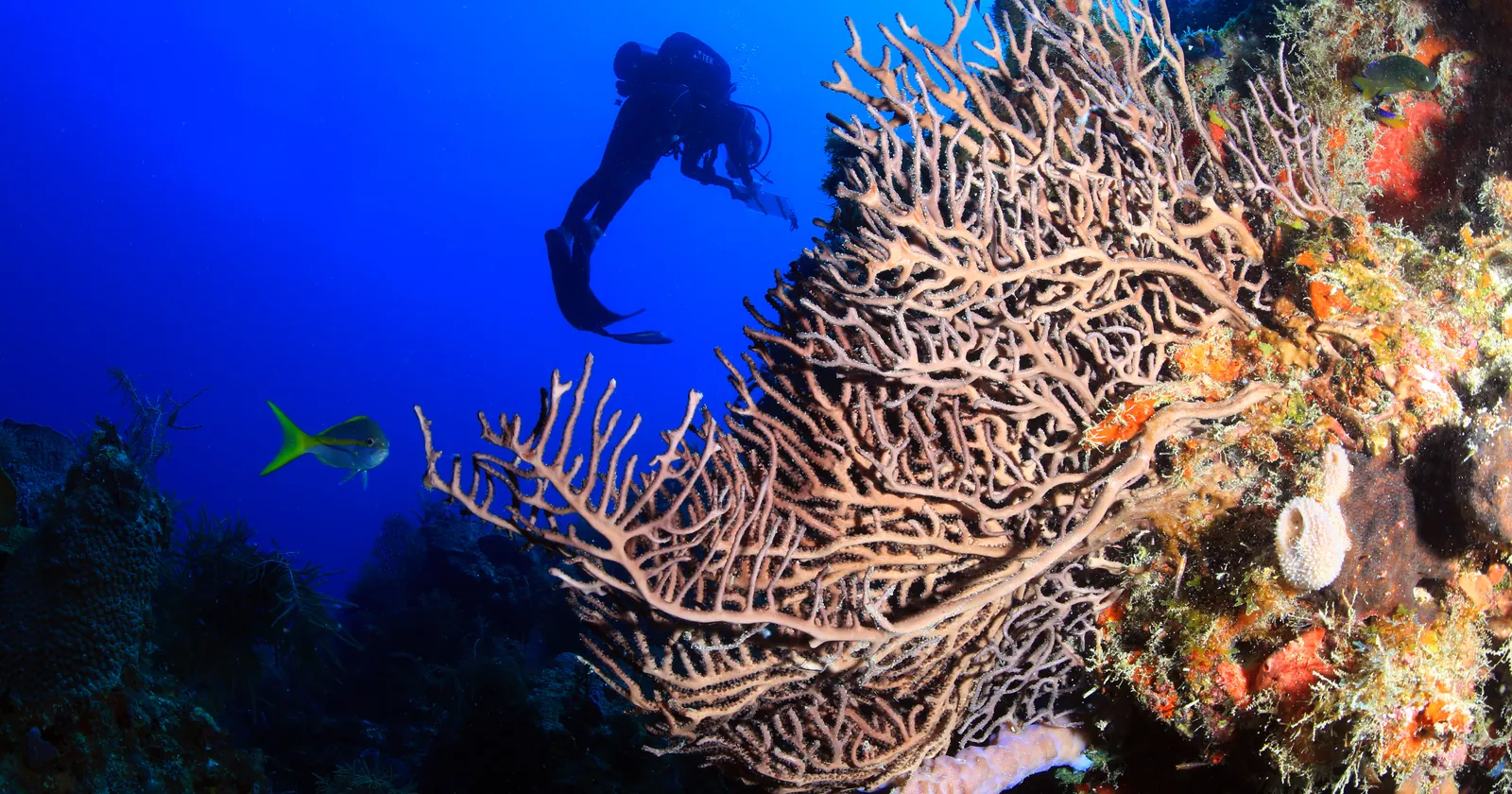
A diver on a reef in the Florida Keys National Marine Sanctuary. National Marine Sanctuaries, Wikimedia Commons, public domain, cropped.

Key takeaways
- Florida law makes every diver display a divers-down flag or buoy and try to stay within 300 feet (about 90 meters) of it in open water, 100 feet in rivers, inlets and channels
- NOAA's 2025 Florida Keys sanctuary rule does not apply in state waters, where Governor DeSantis certified it unacceptable on 3 March 2025; NOAA had still published no effective-date notice by 10 November 2026
- Taking lobster or fish needs a Florida licence; nonresidents pay $15.50 for three days or $28.50 for seven, plus a $5 lobster permit, and rebreather divers may take only lionfish
- The Dry Tortugas ferry and seaplane cannot carry scuba tanks, so divers need their own boat or a charter; entry is $15 a person for seven days
- We could not confirm any Florida chamber that treats divers around the clock from its own page; call 911 first, then DAN on +1-919-684-9111
Florida diving by region: four kinds of water
Florida is less one dive destination than four. The Keys run south-west from Key Largo to Key West, and NOAA says the waters of its Florida Keys National Marine Sanctuary hold part of the only coral barrier reef in the continental United States. North of the Keys, the south-east coast from Miami through Fort Lauderdale to Palm Beach dives reef lines, artificial reefs and the Gulf Stream close to shore. The Gulf coast, from Tampa Bay to the Panhandle, is mostly wrecks and artificial reefs in water that is much colder in winter. Inland, the springs north of Orlando offer clear fresh water and caves, and Crystal River adds manatees in winter.
This page is the state layer: the laws, seasons and emergency arrangements that apply wherever you dive, with a short orientation to each region. Our city guides go into the detail, and two comparisons set the most common pairs of bases side by side: Key Largo vs Key West and Fort Lauderdale vs Miami.
The Keys: one sanctuary, two rulebooks
NOAA published a rewrite of the sanctuary's rules, the Restoration Blueprint, on 17 January 2025. It grows the sanctuary from 3,800 to 4,539 square miles, about 11,760 square kilometers, adds 37 marine zones and removes five, among them the Rock Key and French Reef preservation areas, while keeping fishing open in 95 per cent of the sanctuary. It also adds a sanctuary-wide ban on feeding or attracting fish, sharks included, from a boat or while diving.
The rule carried a condition: any part Florida's governor certified as unacceptable would not take effect in state waters. On 3 March 2025 Governor Ron DeSantis certified the designation documents and the final rule unacceptable within the state's seaward boundary and wrote that the prior rules "will remain in place". The rule also promised a Federal Register notice announcing its effective date. A search of the register's database on 10 November 2026 found none, and no other sanctuary regulation published since.
For a diver this means the line between state and federal water decides which rules apply. Our Key Largo guide explains why the best-known Upper Keys reefs sit in federal water, where the 2025 rule applies, and our Key West guide explains why the reefs off Key West sit in state water, where the 1997 rules still govern.
Some things hold everywhere. NOAA's summary of the sanctuary rules bans diving or snorkelling without a dive flag, boats faster than idle speed within 300 feet of a divers-down flag, anchoring on living coral, and removing or possessing coral or live rock. The sanctuary has 17 Sanctuary Preservation Areas covering about 12 square miles, marked by round yellow buoys of 30 inches. Diving and snorkelling are allowed in them; fishing and collecting are not. From 2027, NOAA says, anchoring of any kind will be banned in the preservation areas except Hen and Chickens, Cheeca Rocks, Newfound Harbor Key, Eastern Dry Rocks, Rock Key and Sand Key, so dive boats elsewhere will need the mooring buoys.
Dry Tortugas National Park: bring your own boat for scuba
The Dry Tortugas lie about 113 kilometers west of Key West and can be reached only by ferry, seaplane, private boat or permitted charter. The National Park Service is blunt about one point: the ferry and the seaplane cannot carry compressed cylinders, so divers must arrive on their own boat or a charter with their tanks. Snorkelers on the ferry can swim the moat wall around Fort Jefferson. Entry costs $15 a person for seven days, with under-16s free, and the ferry ticket includes it.
The park calls the Windjammer, an iron sailing ship wrecked in 1901, its most popular dive, at 0 to about 6 meters; its mooring ball was listed as damaged and off-station, so call the park on VHF channel 16 before you plan on it. In the Research Natural Area anchoring is banned and the mooring buoys are for daytime use only, two hours at most. The park has no food, water or fuel, and anyone carrying lobster or speared fish from outside must report it on channel 16 before entering. Our Key West guide covers the park permit for private boats.
Miami, Fort Lauderdale and Palm Beach: reefs close to shore
Off Miami, much of the diving is inside Biscayne National Park, with a buoyed heritage trail of wrecks, plus the county's artificial reefs north of it. Fort Lauderdale has three reef lines running parallel to the beach, close enough at Lauderdale-by-the-Sea to dive from shore. West Palm Beach offers two very different dives: Blue Heron Bridge, a shallow shore dive timed to the tide, and drift dives offshore where the Gulf Stream runs close to the coast.
One state law matters most along this coast. The Florida Coral Reef Protection Act covers the reefs off Broward, Martin, Miami-Dade, Monroe and Palm Beach counties. A boat owner whose vessel runs aground on or damages a reef must tell the state's environment department within 24 hours. Anchoring on coral, or damage up to one square meter, carries a civil penalty of $225, with a warning letter instead for a first offence by a lawfully registered recreational boat. Larger damage costs $450 per square meter up to 10 square meters and $1,500 per square meter above that, more inside a state park or aquatic preserve, capped at $375,000 per occurrence.
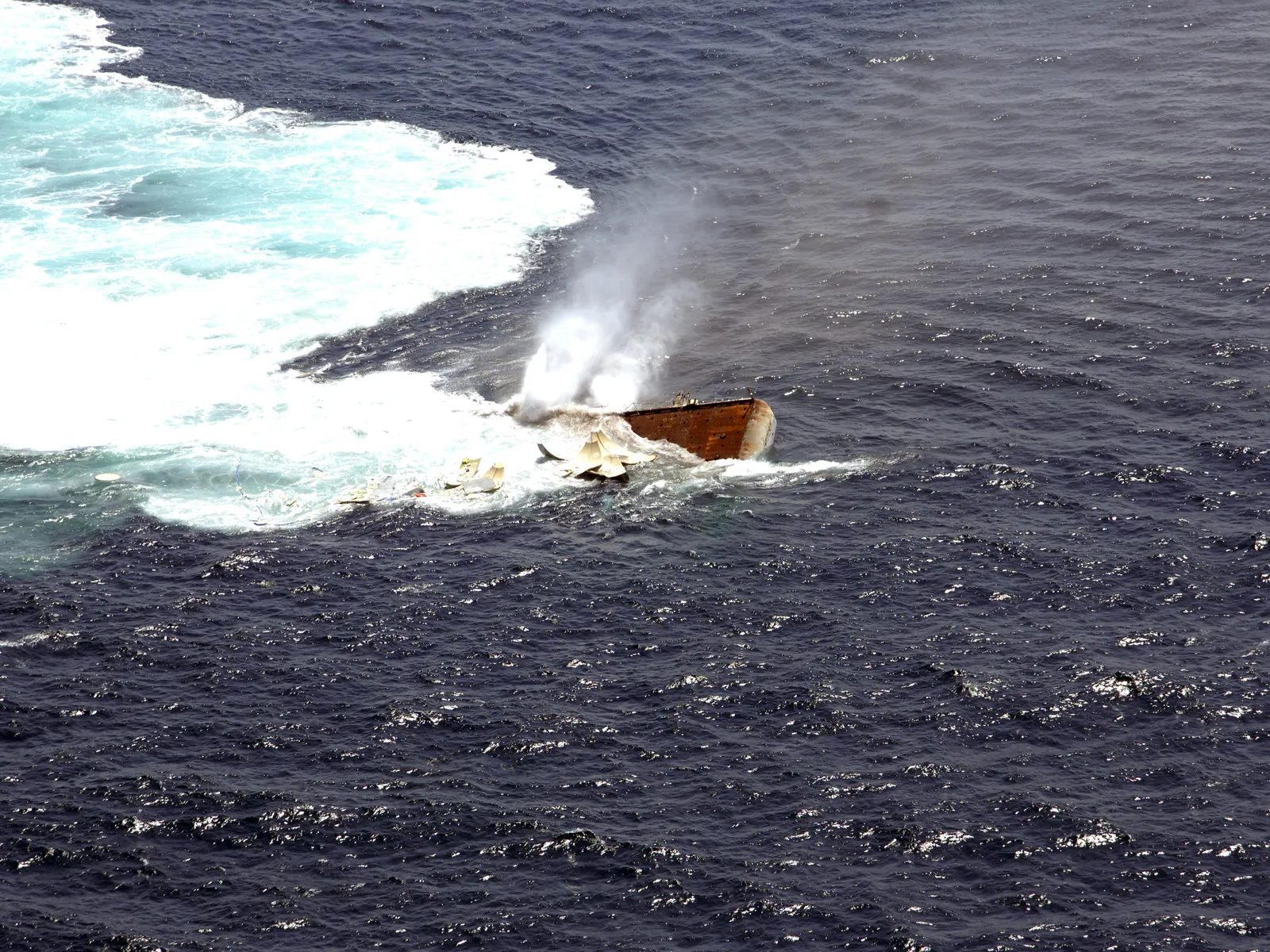
The ex-USS Oriskany going down off Pensacola in May 2006. U.S. Navy photo by Photographer's Mate 2nd Class Jeffrey P. Kraus, Wikimedia Commons, public domain, cropped.

The Gulf: Tampa Bay's artificial reefs and the Oriskany off Pensacola
On the west coast, Tampa diving happens in the Gulf off Pinellas County rather than in the bay, on artificial reefs, ledges and two deep wrecks. In winter the Gulf side has the coldest sea in the state, as the table below shows.
Far to the north-west, the Panhandle's best-known dive is the USS Oriskany, a former aircraft carrier sunk off Pensacola in May 2006, according to the US Navy's photo record, to form an artificial reef. MBT Divers in Pensacola says the ship sits upright in about 67 meters, with the top of the smokestack at about 26 meters, most of the island structure shallower than 40 meters, the flight deck at about 44 and the hangar bay at about 53. It notes that nothing may be removed from the ship and that many Pensacola charters run trips. Official figures for the depth differ slightly between sources we could not open, so treat the operator's numbers as a guide. We have no Panhandle page yet, and Destin and Panama City are not covered here.
The springs: Crystal River's manatee rules and cave access
Crystal River National Wildlife Refuge, about an hour north of Tampa according to the US Fish and Wildlife Service, is the only refuge dedicated to the West Indian manatee. Its manatee season runs from 15 November to 31 March, when seven warm-water sanctuaries close to all activity. Scuba is allowed at King Spring all year, but in season only inside a buoyed "keyhole" or outside the sanctuaries, and at Three Sisters Springs only from 1 April to 14 November. Snorkelling is allowed all year, though not inside the marked sanctuaries. Throughout Kings Bay it is illegal to chase, corner, ride, feed or dive down onto a manatee, to touch one that is resting or feeding, or to separate a mother and calf. The refuge runs no tours; it issues permits to local businesses.
The cave springs further north are mostly privately run, and each sets its own entry rules. Ginnie Springs says certified cave and cavern divers can explore its Devil's Spring System, that every diver must show a card from a recognised agency or dive under direct instructor supervision, that it does not combine cards, and that intro-to-cave training or higher requires an age of 18. It calls the water a constant 72 °F, about 22 °C, and charges $65 a day for a rental scuba package without a light, read on 10 November 2026. Our Orlando guide covers the springs within a day's drive, including which ones ban scuba and which bar cave entry. We couldn't find the state parks' cave rules.
Florida's dive rules: the flag, licences, lobster and spears
The flag. Florida Statutes section 327.331 requires every diver, with a snorkel or with scuba, to display a divers-down flag or buoy wherever they dive, except in areas used only for swimming. The red symbol with a white diagonal stripe must be at least 30 by 30 centimeters on a float and 51 by 61 on a boat, flown from the boat's highest point. Divers must make reasonable efforts to stay within 300 feet, about 90 meters, of it in open water and 100 feet, about 30 meters, in rivers, inlets and channels; boats must keep the same distance or slow to the minimum speed needed to steer. The flag comes down once everyone is out of the water. A violation is a noncriminal infraction.
Licences. Taking saltwater fish in Florida needs a licence, with exceptions set out in the statute. For nonresidents the law sets $15.50 for three days, $28.50 for seven and $45.50 for a year, and anyone taking spiny lobster needs a separate permit for $5 a year.
Lobster. The regular season runs from 6 August to 31 March, and the season is closed from 1 April to 5 August. A two-day sport season for recreational divers falls on the last Wednesday and Thursday of July. In Monroe County during those two days, lobster diving at night is banned and the waters of John Pennekamp Coral Reef State Park are closed to it. The daily limits differ by area; our Fort Lauderdale vs Miami comparison sets them out for those two bases.
Spearfishing. State law bans spearfishing inside Pennekamp and across the Upper Keys, from the Miami-Dade county line down to Long Key, and treats carrying a spear in the water there as evidence of it. State rules also ban it within 100 yards, about 90 meters, of public bathing beaches, fishing piers and fishing bridges, near the exposed part of jetties, and in all waters managed by the state parks division. Divers on a rebreather may take only lionfish, powerheads may not be used to take fish, and spearfishing in fresh water is banned. Our spearfishing primer covers the technique; Florida's full species rules sit with the state wildlife commission, whose site we could not read.
Florida sea temperature by region
NOAA's satellite averages for 1991 to 2020 show the Atlantic side warm all year and the Gulf side much colder in winter. Monthly surface means, in °C, for four ocean cells:
| Region (grid cell) | Feb | Apr | Jun | Aug | Oct | Dec |
|---|---|---|---|---|---|---|
| Keys, off Key Largo (25.1°N 80.4°W) | 24.0 | 25.7 | 28.6 | 29.9 | 28.1 | 25.2 |
| Palm Beach (26.6°N 79.9°W) | 25.0 | 26.0 | 28.3 | 29.5 | 28.4 | 26.1 |
| Tampa offshore (27.9°N 83.1°W) | 18.0 | 22.3 | 28.0 | 29.9 | 27.0 | 20.4 |
| Panhandle, off Pensacola (30.1°N 87.1°W) | 18.0 | 21.0 | 27.9 | 29.4 | 26.1 | 20.6 |
The Palm Beach cell, sitting near the Gulf Stream, is the warmest in winter at about 25 °C. From June to September all four regions are within about a degree of each other. These are surface figures; deeper water on the Gulf wrecks is colder. Our city guides use buoy, pier or recent-year data, so their figures differ from this table by a few tenths of a degree, in places by a degree or so.
Hurricane season: June to November across the state
The National Hurricane Center gives the Atlantic hurricane season, which includes the Gulf, as 1 June to 30 November, with the peak on 10 September and most activity between mid-August and mid-October. An average season brings 14 named storms, seven hurricanes and three major hurricanes. The Dry Tortugas park adds that a tropical storm can form in the Gulf in any month, and that summer there is usually calmer and wetter, winter windier and drier.
Chambers and emergencies in Florida
For a medical emergency in Florida, call 911. Divers Alert Network tells divers to do that first in a life-threatening emergency and then to call its hotline, +1-919-684-9111, staffed 24 hours a day, which tracks which chambers are available. At sea, VHF channel 16 is the distress channel, and the Coast Guard keeps a listening watch on it.
We could not confirm from any facility's own page that a Florida chamber treats injured divers around the clock. DAN warned as far back as 2011 that hospitals long open to divers at any hour were restricting chamber access, and that two Florida facilities had told it to look elsewhere. Our Key Largo guide names the hospital chamber in the Upper Keys as its operator described it in October 2026. Ask your dive operator which chamber it would use, and check that your dive insurance covers chamber treatment and evacuation in the US.
Entering the US and staying to work
Florida follows US federal entry rules. Citizens of the 42 Visa Waiver Program countries can visit for business or tourism for up to 90 days without a visa, after getting an ESTA approval online; CBP advises applying before buying tickets and says the officer at arrival, not the ESTA, decides admission. Without the waiver, a visitor for pleasure comes in the B-2 class. The regulations allow a B-2 visitor up to a year, with extensions of up to six months at a time, and state that a visitor for pleasure "may not engage in any employment". The US has no digital nomad visa: no visa class in the regulations covers remote work. Whether working remotely for a foreign employer counts as employment is not defined there, and we could not read the State Department's guidance, so check with a lawyer before planning months of work on a visitor status.
How to choose between Florida's regions
For coral reef in warm water all year, the Keys and the south-east coast are the choice. Key Largo puts you nearest the Upper Keys reefs and big wrecks; Key West is the base for the Dry Tortugas and the Vandenberg wreck. Fort Lauderdale and Palm Beach suit divers who want shore entries, and Miami adds a national park. The Gulf suits wreck divers comfortable with deeper dives and colder winter water; on the Oriskany, everything from the flight deck at about 44 meters down lies beyond the 130-foot recreational limit that MBT Divers cites. The springs suit cave and cavern divers, and anyone wanting manatees in winter, but cave entry needs cave training, and our Orlando guide finds the springs a base only for people with a car.
Who Florida diving suits
Florida suits a diver who wants variety within a day's drive: reef, wrecks, drift dives, caves and manatees under one set of state rules. It suits divers who read the rules before going in, because they change at the state line, the park line and the sanctuary zone. It suits less well anyone who needs a work visa, a chamber confirmed around the clock, or a quiet September, which is the peak of hurricane season.
FAQ: Florida diving
Do you need a dive flag to dive in Florida?
Yes. Florida Statutes section 327.331 requires every diver, snorkeler or scuba diver, to display a divers-down flag or buoy, except in areas used only for swimming. Divers must try to stay within 300 feet of it in open water and 100 feet in rivers, inlets and channels, and boats must keep the same distance or slow down. The Florida Keys sanctuary also bans diving or snorkelling without a dive flag.
Which rules apply on the Florida Keys reefs?
It depends on whether the reef is in federal or state water. NOAA's 2025 sanctuary rule applies in federal water, but Florida's governor certified it unacceptable in state water on 3 March 2025, so the earlier rules remain there. Everywhere in the sanctuary you need a dive flag, may not anchor on living coral, and may not collect marine life in the preservation areas.
Do you need a licence to catch lobster while diving in Florida?
Yes. Taking saltwater fish needs a Florida licence, which for nonresidents costs $15.50 for three days, $28.50 for seven or $45.50 for a year, and spiny lobster needs a $5 permit on top. The season runs from 6 August to 31 March, with a two-day sport season on the last Wednesday and Thursday of July.
Can you scuba dive in Dry Tortugas National Park from the ferry?
No. The National Park Service says the ferry and seaplane cannot carry compressed cylinders, so scuba divers need their own boat or a charter. Ferry passengers can snorkel around the moat wall of Fort Jefferson. Entry costs $15 a person for seven days and is included in the ferry ticket.
Can you work remotely in Florida as a visitor?
The US has no digital nomad visa. Visa Waiver travellers can stay up to 90 days for business or tourism, and federal rules say a B-2 visitor for pleasure may not engage in any employment. The rules do not say whether remote work for a foreign employer counts, so get legal advice before planning a long working stay.
Note: Conditions, safety guidance and regulations change. Verify current information with official sources, including the dive operator, the park authority and the relevant government department, before you travel or dive.
Founder of NOMADREEF and a former digital nomad. This guide is sourced from the references below; conditions, prices and rules change, so verify current details, and follow qualified local guidance and safety briefings. About the author · LinkedIn ↗
Sources
- Florida Keys sanctuary rule (primary). NOAA, 90 FR 6104, Restoration Blueprint final rule (PDF), effective-date clause, 2027 delay and fish-feeding ban; Restoration Blueprint page; Federal Register search, documents since 2025. Read 10 November 2026.
- Governor's certification (primary). Letter from Governor Ron DeSantis to Secretary of Commerce Howard Lutnick, 3 March 2025, in the copy published by Bonefish & Tarpon Trust (PDF). Read 10 November 2026.
- Sanctuary rules and zones (primary). NOAA, regulations summary and Sanctuary Preservation Areas. Read 10 November 2026.
- Dry Tortugas (primary). National Park Service, directions, fees, swimming, snorkeling and diving, boating. Read 10 November 2026.
- Florida law (primary). Florida Statutes 2026, sections 327.331 (divers-down flag), 379.354 (licences and fees), 379.2425 (spearfishing) and 403.93345 (coral reef protection). Read 10 November 2026.
- Florida wildlife rules (primary text, LII reproduction). Florida Administrative Code rules 68B-20.003 (spearing), 68B-4.012 (rebreathers and powerheads) and 68B-24.005 (lobster seasons), read in the Legal Information Institute copies because the state rules portal did not respond. Read 10 November 2026.
- Pensacola and the Oriskany (operator). MBT Divers, dive sites; US Navy photo 060517-N-7992K, as captioned on Wikimedia Commons. Read 10 November 2026.
- Springs. US Fish and Wildlife Service, Crystal River National Wildlife Refuge: refuge page, visit us and scuba diving (primary); Ginnie Springs, diving (operator). Read 10 November 2026.
- Sea temperature and storms (primary). NOAA PSL, OISST v2.1 monthly long-term means 1991–2020, four grid cells, computed for this page; National Hurricane Center, tropical cyclone climatology. Read 10 November 2026.
- Emergencies (primary). Divers Alert Network, emergency assistance and Hyperbaric Chambers for Dive Injuries (Alert Diver, 2011); US Coast Guard Navigation Center, VHF channels. Read 10 November 2026.
- Entry and stay (primary). US Customs and Border Protection, Visa Waiver Program and ESTA; 8 CFR 214.1 and 214.2, 2025 edition. Read 10 November 2026.
- Left out. The state wildlife commission's own pages, including lobster bag limits and species spearfishing rules, because its site blocks our crawler; state-park cave-diving rules, for the same reason; any Florida hyperbaric chamber confirmed as open around the clock by its own page; Escambia County's figures for the Oriskany, because its site did not resolve; the Panhandle beyond Pensacola; whether remote work counts as employment for a US visitor; and temperatures at depth.