Fort Lauderdale vs Miami: Which Base for a Month of Diving?
 by Yannick SchrothOct 27, 202611 min read
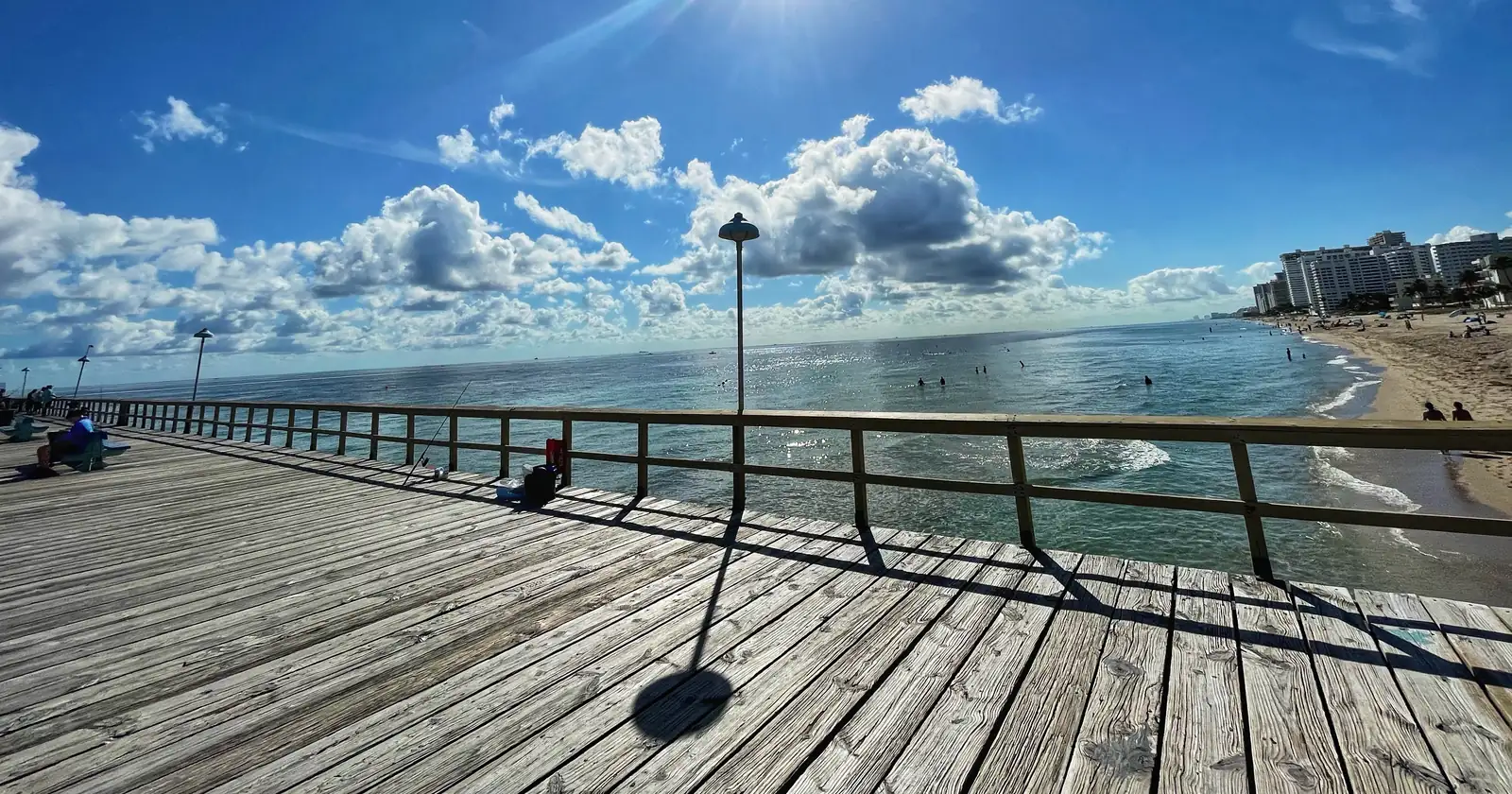
Looking south from Anglin's Pier at Lauderdale-by-the-Sea, just north of Fort Lauderdale, November 2020: the Fort Lauderdale side of this comparison. Photo: Rob Olivera, Wikimedia Commons, CC BY 2.0, cropped.
| Fort Lauderdale (Broward) | Miami (Miami-Dade) | |
|---|---|---|
| Diving from the beach | Lauderdale-by-the-Sea: three reefs within 100 yards, a tank rack at the Datura Avenue portal | Biscayne's wreck trail is boat only, about 38 km south of downtown |
| Artificial reefs on the state list | 128 deployments, 1967–2022 | 277 deployments, 1947–2026 |
| Sunken vessels at 60 ft or less | 3 of 74 | 23 of 106 |
| Who protects the reef | Kristin Jacobs Coral Aquatic Preserve (state) | The same preserve north of Biscayne National Park; the park to the south |
| Lobster mini-season, per person per day | 12 | 12, or 6 inside Biscayne National Park |
| Federal speargun ban zone | None on the list | Key Biscayne special management zone |
| Sea surface, February / August | 24.7 / 30.3 °C | 24.6 / 30.4 °C |
| Dive businesses on our list | 8, all SSI | 4 SSI dive centers, plus 2 IKO kite schools |
Rules, timetables and tax rates as read on the issuing body's own pages and data on 27 October 2026. Artificial reef counts are from the Florida Fish and Wildlife Conservation Commission's statewide layer; water is NOAA satellite data for 2021 to 2025, explained below.
Fort Lauderdale's reef starts at the sand; Miami's buoyed wrecks are a boat ride south
The first difference between Fort Lauderdale vs Miami is how you get to the reef. Broward County has 24 miles of Atlantic coast, and it divides the reef that follows it into an Inner Reef in 20 to 30 feet of water, a Middle Reef in 40 to 60 feet and an Outer Reef in 50 to 100 feet. At one town the reef is close enough to swim to.
The usual entry is Lauderdale-by-the-Sea, the small town just north of Fort Lauderdale. Its government calls itself “Florida’s Beach Diving Capital”, keeps a tank rack at the Datura Avenue beach portal and says three coral reefs lie within 100 yards of the beach. Two marked snorkel trails run in 10 feet of water. The SS Copenhagen, a state underwater preserve, lies less than a mile out and is reached by boat.
Miami's buoyed wreck trail is farther away. Biscayne National Park's Maritime Heritage Trail has six mapped wrecks with mooring buoys, and the Park Service states that “access to the sites on the trail is by boat only”. The buoys over the Mandalay sit about 38 km from MiamiCentral station in a straight line, about as far as Brightline's Fort Lauderdale station. Plan on a charter, not a walk.
Closer to town, the shallowest new entries are off the beaches. In October 2025 Miami-Dade placed 22 concrete cars, the ReefLine project, at its South Beach artificial reef site in 22 feet of water. The shore diving list covers other coasts where the reef begins at the sand, as it does at Lauderdale-by-the-Sea.
Broward's 128 artificial reefs sit deeper than Miami-Dade's 277
Both counties have sunk ships for decades, and the state keeps one list of all of it. The Florida Fish and Wildlife Conservation Commission's artificial reef layer, last edited in May 2026, files 128 deployments in Broward and 277 in Miami-Dade. That count includes boulders, concrete modules and memorial reef balls as well as ships.
The ships are where the counties differ. Counted by the depth the state records:
| Sunken vessels on the state list | Broward | Miami-Dade |
|---|---|---|
| 60 ft or less | 3 | 23 |
| 61 to 100 ft | 35 | 22 |
| 101 to 130 ft | 11 | 16 |
| Deeper than 130 ft | 24 | 42 |
| All vessels (some without a depth) | 74 | 106 |
Nearly half of Broward's wrecks, 35 of 74, lie between 61 and 100 feet. Miami-Dade has more at both ends: shallow hulls and barges off Key Biscayne and Miami Beach, and a long tail below 130 feet. A few of the shallow Miami-Dade entries lie inside Biscayne Bay rather than on the ocean side. Broward's own page counts differently and says the county has created “over 150 artificial reefs” since 1982.
For a new diver this matters more than the totals. A month of wreck diving from Fort Lauderdale means many dives in the 60 to 100 foot band, which is where a deeper certification and the nitrox question come in. In Miami a first-week diver has more shallow steel to choose from. The wreck diving guide compares other coasts built the same way.
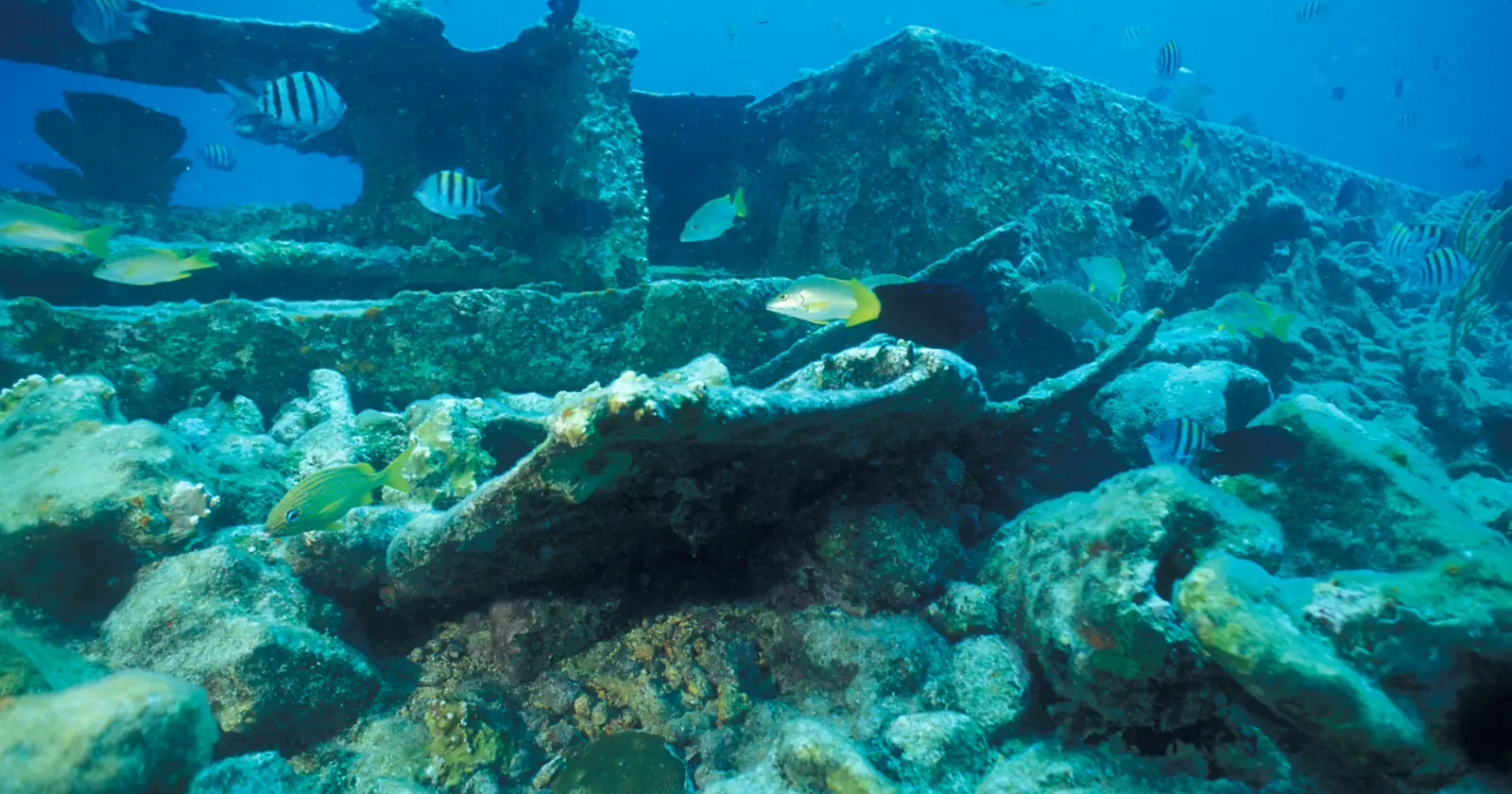
Biscayne National Park off Miami: no entrance fee, boat only, buoys at 8 to 22 feet
Biscayne is Miami's answer to Fort Lauderdale's beach reef, and it costs nothing to enter. The Park Service states that “the park has no entrance fees” and that the park is 95% water. The trail wrecks are shallow. The park's buoy list puts the Mandalay at 8 to 11 feet, the Erl King at 15 to 20, the Alicia at 16 to 20 and the Lugano at 18 to 22. It names the Erl King, Alicia and Lugano as best suited to scuba, and the Mandalay as the snorkeler's wreck.
Two rules come with the buoys. Mooring buoy use is limited to four hours by any one boat. And anchoring anywhere in the Legare Anchorage, the box over HMS Fowey east of Elliott Key, is prohibited except in an emergency. The Fowey Rocks Lighthouse is on the trail too, with its own ring of mooring buoys; the tower itself is closed to the public.
Fishing law inside the park is mostly Florida's. The Park Service writes that fishing regulations “are set by the Florida Fish and Wildlife Conservation Commission”, and that fishing with a spear “shall be in accordance with State law”. The exceptions that matter to divers are about lobster, below. The Miami diving guide covers the trail's history and the park's founding law.
One aquatic preserve covers the Fort Lauderdale and Miami reefs, and stops where Biscayne begins
Since 1 July 2024 the reef off both cities has had a state name and status: the Kristin Jacobs Coral Aquatic Preserve, formerly the Kristin Jacobs Coral Reef Ecosystem Conservation Area. Florida Statutes section 258.39 sets its boundary as “the sovereignty submerged lands and waters of the state offshore of Broward, Martin, Miami-Dade, and Palm Beach Counties from the St. Lucie Inlet to the northern boundary of the Biscayne National Park”.
The Department of Environmental Protection gives it 240,782 acres over 105 miles. So in the Fort Lauderdale vs Miami choice, the state reef rules are the same on both sides of the county line. South of that boundary the reef is inside Biscayne National Park, where the Park Service applies Florida's fishing rules plus the park-specific ones.
The rule that reaches a diver's boat is the Florida Coral Reef Protection Act, section 403.93345, which covers the reefs off Broward and Miami-Dade among five counties. Anchoring on a coral reef costs $225 per occurrence, with another $225 inside an aquatic preserve; a lawfully registered recreational boat gets a warning letter at least once instead. A grounding must be reported within 24 hours and the vessel removed within 72. The department says nearly 300 mooring buoys sit inside the preserve. Use one instead of the anchor.
Lobster mini-season: 12 a day off Fort Lauderdale, 6 in Biscayne
Florida's two-day sport season runs on “the last Wednesday and successive Thursday of July”, which next falls on 28 and 29 July 2027. Rule 68B-24.004 splits the limit by place. Outside Monroe County and Biscayne National Park, a diver may take 12 spiny lobster a day. In Biscayne National Park the limit is 6. Off Fort Lauderdale you get the higher number; off Miami it depends on which side of the park line the boat stops.
Some of the park is closed outright. Lobster harvest is banned in its five Coral Reef Protection Areas, Fowey Rocks Lighthouse among them, and in the Biscayne Bay/Card Sound Lobster Sanctuary. The night-diving ban of the mini-season applies in Monroe County only, so it does not reach either city.
The regular season runs from 6 August to 31 March, with 6 lobster per person per day everywhere. The carapace must measure more than 3 inches, measured in the water with a gauge you carry. Egg-bearing females stay. Any device that could puncture the shell is banned, so no spears. A visitor needs a nonresident saltwater fishing license, set in statute at $15.50 for three days, $28.50 for seven or $45.50 for a year, plus a $5 spiny lobster permit, unless an exemption applies.
Spearfishing off Fort Lauderdale and Miami: one federal box and a 100-yard rule
Neither county sits inside Florida's statutory spearfishing ban, which section 379.2425 limits to Pennekamp, Collier County and the Upper Keys down to Long Key. What applies on both coasts is rule 68B-20.003. It bans spearfishing within 100 yards of public bathing beaches, commercial or public fishing piers and fishing bridges, within 100 feet of a jetty, and in water run by the state parks division.
That rule bites hardest where Fort Lauderdale is strongest. The town puts Lauderdale-by-the-Sea's three shore reefs within 100 yards of its public beach, inside the distance the rule protects. Shore diving there is for looking.
Miami adds a federal line. Federal rule 50 CFR 622.182 draws the Key Biscayne/Artificial Reef-H special management zone, a box between 25°41.32′ and 25°42.82′ N, and says that there “Use of spearfishing gear is prohibited”. It is one of two such zones in the rule, and none of the section's zones lies off Broward. Plotted against the state's reef coordinates, 37 of Miami-Dade's artificial reef deployments fall inside the box, among them the Rio Miami, the Belzona wrecks and the Neptune Memorial Reef. Before you pack a gun, read our guide to starting spearfishing.
Dive-flag distances are the same in Fort Lauderdale and Miami, and channels cut them to 100 feet
Florida Statutes section 327.331 applies statewide, so this part of Fort Lauderdale vs Miami is a tie. “All divers must prominently display a divers-down warning device in the area in which the diving occurs, other than when diving in an area customarily used for swimming only.” The symbol must be at least 12 by 12 inches from the water and 20 by 24 inches from a boat.
On open water, divers must make reasonable efforts to stay within 300 feet of the flag and boats to keep 300 feet away. On rivers, inlets and navigation channels both figures drop to 100 feet. That matters near the Port Everglades and PortMiami entrances. A boat inside those distances must slow to the speed needed to keep headway and steerage. The flag has to come down once every diver is aboard or ashore.
The swimming-area exception is narrow. A shore diver at Lauderdale-by-the-Sea who heads out to the second reef has left the swimming area, so tow a buoy with a flag.
Fort Lauderdale vs Miami water temperature: the same sea, a few tenths apart
The two coasts share one current and one sea surface. NOAA's satellite record puts them within 0.3 °C of each other in every month:
| Month | Off Fort Lauderdale | Off Miami and Key Biscayne |
|---|---|---|
| January | 24.8 °C (76.6 °F) | 24.5 °C (76.2 °F) |
| February | 24.7 °C (76.4 °F) | 24.6 °C (76.2 °F) |
| March | 25.1 °C (77.1 °F) | 25.2 °C (77.3 °F) |
| April | 25.9 °C (78.7 °F) | 26.0 °C (78.8 °F) |
| May | 27.5 °C (81.5 °F) | 27.7 °C (81.9 °F) |
| June | 28.6 °C (83.4 °F) | 28.8 °C (83.8 °F) |
| July | 29.9 °C (85.8 °F) | 30.0 °C (86.0 °F) |
| August | 30.3 °C (86.6 °F) | 30.4 °C (86.8 °F) |
| September | 30.0 °C (86.0 °F) | 30.0 °C (86.1 °F) |
| October | 28.7 °C (83.7 °F) | 28.7 °C (83.7 °F) |
| November | 27.4 °C (81.4 °F) | 27.2 °C (81.0 °F) |
| December | 26.2 °C (79.1 °F) | 25.9 °C (78.6 °F) |
Monthly means of NOAA's OISST v2.1 sea surface temperature, January 2021 to December 2025, for the quarter-degree cells centered at 26.125° N 80.125° W (the Fort Lauderdale shore from Port Everglades to Lauderdale-by-the-Sea) and 25.625° N 80.125° W (Key Biscayne and Fowey Rocks), read from NOAA PSL's monthly file sst.mon.mean.nc.
From November to January the Fort Lauderdale cell runs 0.2 to 0.3 °C warmer; from March to July the Miami cell is warmer by up to 0.2 °C. Single months ran cooler than the average: the coldest monthly mean in the five years was 24.1 °C off Fort Lauderdale (February 2024 and January 2025) and 23.5 °C off Miami (January 2025). A cell is about 25 km across, so it shows the open sea, not a cold morning on one reef. Pack the same wetsuit for both: a thicker one from December to March, a thin one from June to October.
Storm season does not split either. The National Hurricane Center gives the Atlantic season as 1 June to 30 November, with its peak on 10 September and most activity between mid-August and mid-October.
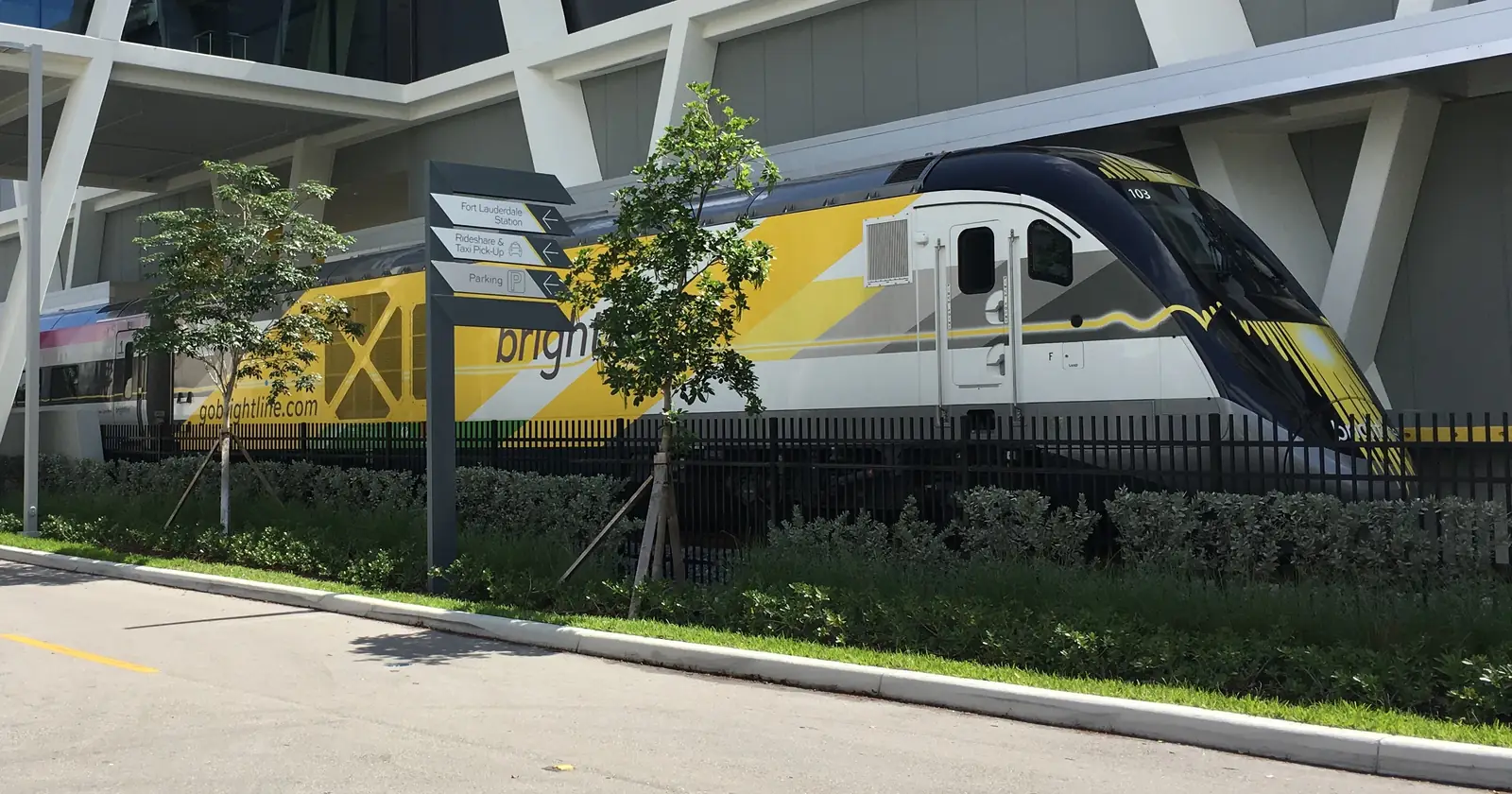
Brightline and Tri-Rail between Fort Lauderdale and Miami, and from FLL and MIA
You do not have to choose one city for a whole month. Brightline runs between its Fort Lauderdale station and MiamiCentral 18 times each way on a weekday, by its own timetable data for Wednesday 28 October 2026. Southbound takes 38 minutes and northbound 33. The first train leaves Miami at 05:45 and the last southbound leaves Fort Lauderdale at 23:53.
Tri-Rail is the commuter line, and it serves both airports. On a weekday its timetable has 25 trains each way between Fort Lauderdale station and Miami Airport station, 46 to 54 minutes, and 15 each way on a Saturday. The line stops at Fort Lauderdale Airport station, where a Tri-Rail shuttle bus loops to the terminals, 65 times on a weekday. Miami Airport station is the southern end of the main line. MiamiCentral is reached by a separate Tri-Rail link from the Metrorail Transfer station, 13 trips a weekday.
Brightline's South Florida stops are Miami, Aventura, Fort Lauderdale, Boca Raton and West Palm Beach; its one airport stop is Orlando's. From FLL or MIA, Tri-Rail is the train that starts at the airport. Check how your dive boat's marina connects to the station before you book a room by the tracks.
What a month in Fort Lauderdale or Miami costs in tax and licences
A furnished rental of six months or less carries Florida's transient rental taxes. The Department of Revenue's rate sheet, revised in October 2026, lists a local rate of 6% in Broward and 6% in Miami-Dade, except 7% in Miami Beach and 4% in Surfside and Bal Harbour. Both counties add a 1% discretionary sales surtax to the 6% state sales tax. On a one-month rental that is 13% in Fort Lauderdale and in Miami-Dade outside those three towns, and 14% in Miami Beach.
The diving extras cost the same too. Biscayne charges no entrance fee, the reef protection act applies on both sides, and the fishing licence is statewide. Rent is the line to compare yourself, for your own dates.
Fort Lauderdale and Miami dive businesses on our lists
Both lists come from training-body registers, so they show who is affiliated, not who is good.
| Fort Lauderdale | Miami | |
|---|---|---|
| Businesses listed | 8 | 6 |
| Dive centers listed by SSI | 8 | 4 |
| Kite schools listed by IKO | 0 | 2 |
| SSI-rated for freediving | 4 | 2 |
| Green Fins members | 0 | 0 |
The Fort Lauderdale list was compiled on 1 September 2026 and the Miami list on 20 September, with one IKO school added on 25 September. Only one of the eight Fort Lauderdale entries is filed in Fort Lauderdale itself: SSI files three in Pompano Beach, two in Dania Beach, one in Sunrise and one in Lauderhill. All four Miami dive centers are filed in Miami. SSI also rates one center on each list for extended range, and Ace Diving in Miami for rebreathers.
The Fort Lauderdale operator list and the Miami operator list link each entry to its register page. Before a deep wreck month, check that your dive insurance covers chamber treatment. Divers Alert Network's guidance is to call 911 first in a life-threatening emergency, then its hotline on +1-919-684-9111.
Fort Lauderdale vs Miami in five lines
- Fort Lauderdale has shore diving: three reefs within 100 yards of the beach at Lauderdale-by-the-Sea.
- Miami has the national park: six buoyed trail wrecks at 8 to 22 feet, boat only, no entrance fee.
- Wrecks: 35 of Broward's 74 sunken vessels lie at 61 to 100 feet; Miami-Dade has 23 at 60 feet or less.
- Lobster mini-season: 12 a day off Fort Lauderdale, 6 in Biscayne National Park.
- The water is the same within 0.3 °C, and Brightline joins the two in 33 to 38 minutes.
Fort Lauderdale for walk-in reef and 60-to-100-foot wrecks, Miami for Biscayne
Base in Fort Lauderdale if you want to dive without a boat on some days, if you are certified for the 60 to 100 foot band where nearly half of Broward's wrecks sit, or if lobster season is the point. Lauderdale-by-the-Sea is the address that matters. The Fort Lauderdale diving guide covers the SS Copenhagen and the Lady Luck. Do not plan to spear from the beach.
Base in Miami if you are newly certified or snorkel as much as you dive, because the Biscayne trail and the Key Biscayne barges are shallow. Expect to book boats for nearly everything. For a long stay, Fort Lauderdale vs Miami need not be either/or: Brightline makes a split month easy. Heading on south, Key Largo vs Key West picks up where Biscayne ends.
FAQ: Fort Lauderdale vs Miami for diving
Is Fort Lauderdale or Miami better for scuba diving?
Fort Lauderdale for shore diving and wrecks in the 61 to 100 foot band: Lauderdale-by-the-Sea puts three reefs within 100 yards of the beach, and 35 of Broward's 74 sunken vessels lie between 61 and 100 feet. Miami for Biscayne National Park's boat-only wreck trail at 8 to 22 feet and more shallow artificial reefs: 23 of Miami-Dade's 106 vessels lie at 60 feet or less.
Can you dive from the beach in Fort Lauderdale or Miami?
In Fort Lauderdale, yes: the usual entry is the Datura Avenue beach portal at Lauderdale-by-the-Sea, which has a tank rack, two snorkel trails in 10 feet of water and three reefs within 100 yards. In Miami the buoyed Maritime Heritage Trail wrecks are in Biscayne National Park, where the Park Service says access to the trail sites is by boat only.
How many lobsters can you take during mini-season in Fort Lauderdale vs Miami?
Off Fort Lauderdale, and in Miami-Dade outside Biscayne National Park, the limit is 12 spiny lobster per person per day. Inside Biscayne National Park it is 6, and the park's five Coral Reef Protection Areas and the Biscayne Bay/Card Sound sanctuary are closed to lobster. The next two-day season is 28 and 29 July 2027.
Can you spearfish off Fort Lauderdale and Miami?
Yes, with limits. Florida bans spearfishing within 100 yards of public bathing beaches, fishing piers and fishing bridges, which rules out the shore reefs at Lauderdale-by-the-Sea. Off Miami, federal rule 50 CFR 622.182 prohibits spearfishing gear in the Key Biscayne special management zone. In Biscayne National Park spearing follows state law.
How long is the train from Fort Lauderdale to Miami?
Brightline takes 38 minutes from its Fort Lauderdale station to MiamiCentral and 33 minutes back, with 18 trains each way on a weekday in October 2026. Tri-Rail runs 25 trains each way on a weekday between Fort Lauderdale station and Miami Airport station, taking 46 to 54 minutes, and also stops at Fort Lauderdale Airport station.
Is the water warmer in Fort Lauderdale or Miami?
Neither, in practice. NOAA satellite data for 2021 to 2025 put the two coasts within 0.3 °C in every month: about 24.7 °C off Fort Lauderdale and 24.6 °C off Miami in February, and 30.3 °C and 30.4 °C in August. Fort Lauderdale runs a few tenths warmer from November to January.
Note: Fishing and lobster rules change by commission vote, and timetables change with the season. Check the current rule with the Florida Fish and Wildlife Conservation Commission and the timetable with the operator before you dive or travel.
Sources
- Broward's reef tract and artificial reef count: 24 miles of coastline; Inner Reef 20–30 ft, Middle Reef 40–60 ft, Outer Reef 50–100 ft; “Since 1982, Broward County has created over 150 artificial reefs”. Broward County, Reefs, read 27 October 2026.
- Shore diving at Lauderdale-by-the-Sea: “Florida’s Beach Diving Capital”, the Datura Avenue beach portal with a tank rack, the Anglin’s Pier Reef Snorkel Trail and the Shipwreck Snorkel Trail in 10 feet, “three the coral reefs within 100 yards off the beach” [sic], and the SS Copenhagen “less than a mile offshore”, reachable by boat. Town of Lauderdale-By-The-Sea, Snorkeling & Scuba Diving, read in the Internet Archive copy of 6 December 2025, because the town's server refused connections on 27 October 2026.
- Artificial reef deployments: 128 in Broward (1967 to 2022) and 277 in Miami-Dade (1947 to 2026), each with a material category, a recorded depth and coordinates. The vessel counts by depth band, and the 37 deployments whose coordinates fall inside the Key Biscayne zone, are counted for this page from those fields. Florida Fish and Wildlife Conservation Commission, Artificial Reef Locations in Florida, last edited 13 May 2026, queried 27 October 2026.
- Miami-Dade's program: established 1981, 11 inshore and 17 offshore sites, and the ReefLine concrete cars at the South Beach site in 22 feet, October 2025. Miami-Dade County, Artificial Reef Deployments, read 27 October 2026.
- Biscayne National Park: “Biscayne National Park is 95% water”, park home page; “The park has no entrance fees”, Fees & Passes; six mapped wrecks, access “by boat only”, the Erl King, Alicia and Lugano best suited to scuba, the Mandalay for snorkelers, the lighthouse structure not open to the public, Maritime Heritage Trail; buoy depths, buoy coordinates and the four-hour limit, Mooring Buoy Locations; fishing regulations set by the state commission, spears “in accordance with State law”, the Legare Anchorage anchoring ban and the lobster closures, Fishing and Lobstering. All National Park Service, read 27 October 2026.
- The aquatic preserve: the boundary wording in Florida Statutes 258.39(33) (2026 edition); 240,782 acres, 105 miles, the former name and designation on 1 July 2024, Kristin Jacobs Coral Aquatic Preserve; “Nearly 300 mooring buoys are in the Kristin Jacobs Coral Aquatic Preserve”, Florida Department of Environmental Protection, Coral Reef Conservation Program, Mooring Buoy Maps. Read 27 October 2026.
- Florida Coral Reef Protection Act: the five counties, notice within 24 hours, removal within 72 hours, $225 per anchoring occurrence with a warning letter at least once for a lawfully registered recreational vessel, and another $225 within a state park or aquatic preserve. Florida Statutes 403.93345 (2026 edition), read 27 October 2026.
- Spiny lobster: the sport season on “the last Wednesday and successive Thursday of July”, the regular season of 6 August to 31 March and the Monroe-only night ban, rule 68B-24.005; 6 a day, and 12 or 6 in the sport season, 68B-24.004; carapace over 3 inches and the measuring device in the water, 68B-24.003; devices that puncture the shell, 68B-24.006(10); egg-bearing lobster, 68B-24.007; Biscayne's Coral Reef Protection Areas, 68B-7.008. Florida Administrative Code, read through Cornell's Legal Information Institute on 27 October 2026, because the commission's site and flrules.org refused automated requests that day. The 2027 dates are counted from the rule's wording.
- Licence fees: nonresident saltwater fishing licence $15.50 for 3 days, $28.50 for 7 days and $45.50 a year, and the $5 annual spiny lobster permit. Florida Statutes 379.354 (2026 edition), read 27 October 2026.
- Spearfishing: the Pennekamp, Collier County and Upper Keys ban, Florida Statutes 379.2425; the 100-yard, 100-foot and state park rules, rule 68B-20.003; the Key Biscayne/Artificial Reef-H box and “Use of spearfishing gear is prohibited” for zones (xix) and (xxi), 50 CFR 622.182, eCFR text current to 23 October 2026. Read 27 October 2026.
- Divers-down flag: Florida Statutes 327.331 (2026 edition), subsections (1)(e) and (2) to (7), read 27 October 2026.
- Sea surface temperature: NOAA/NCEI OISST version 2.1, monthly means as published by NOAA PSL in sst.mon.mean.nc, cells 26.125° N 80.125° W and 25.625° N 80.125° W, January 2021 to December 2025, 60 months each, averaged by calendar month for this page, with Fahrenheit converted for this page. Product page. Read 27 October 2026.
- Hurricane season, 1 June to 30 November, peak 10 September, most activity mid-August to mid-October. NOAA National Hurricane Center, Tropical Cyclone Climatology, read 27 October 2026.
- Trains: Brightline's published GTFS timetable feed, feed.gobrightline.com, and Tri-Rail's, gtfs.tri-rail.com, both downloaded 27 October 2026 and counted for Wednesday 28 and Saturday 31 October 2026: departures, travel times, stations, the FLL airport shuttle loop and the link to MiamiCentral. Straight-line distances are calculated for this page from the feeds' station coordinates and the park's buoy coordinates.
- Rental taxes: Florida Department of Revenue, DR-15TDT, Local Option Transient Rental Tax Rates (R. 10/26), and DR-15DSS, Discretionary Sales Surtax. Read 27 October 2026.
- Emergency line: call 911 first in a life-threatening emergency, then the DAN hotline on +1-919-684-9111. Divers Alert Network, Emergency Assistance, read 27 October 2026.
- SSI and IKO registers, read for the operator lists. divessi.com, ikointl.com