Tampa Diving: Pinellas County's Artificial Reefs, the Sheridan and Blackthorn Wrecks, and Florida's Dive-Flag Law
 by Yannick Schroth
Nov 10, 2026
12 min read
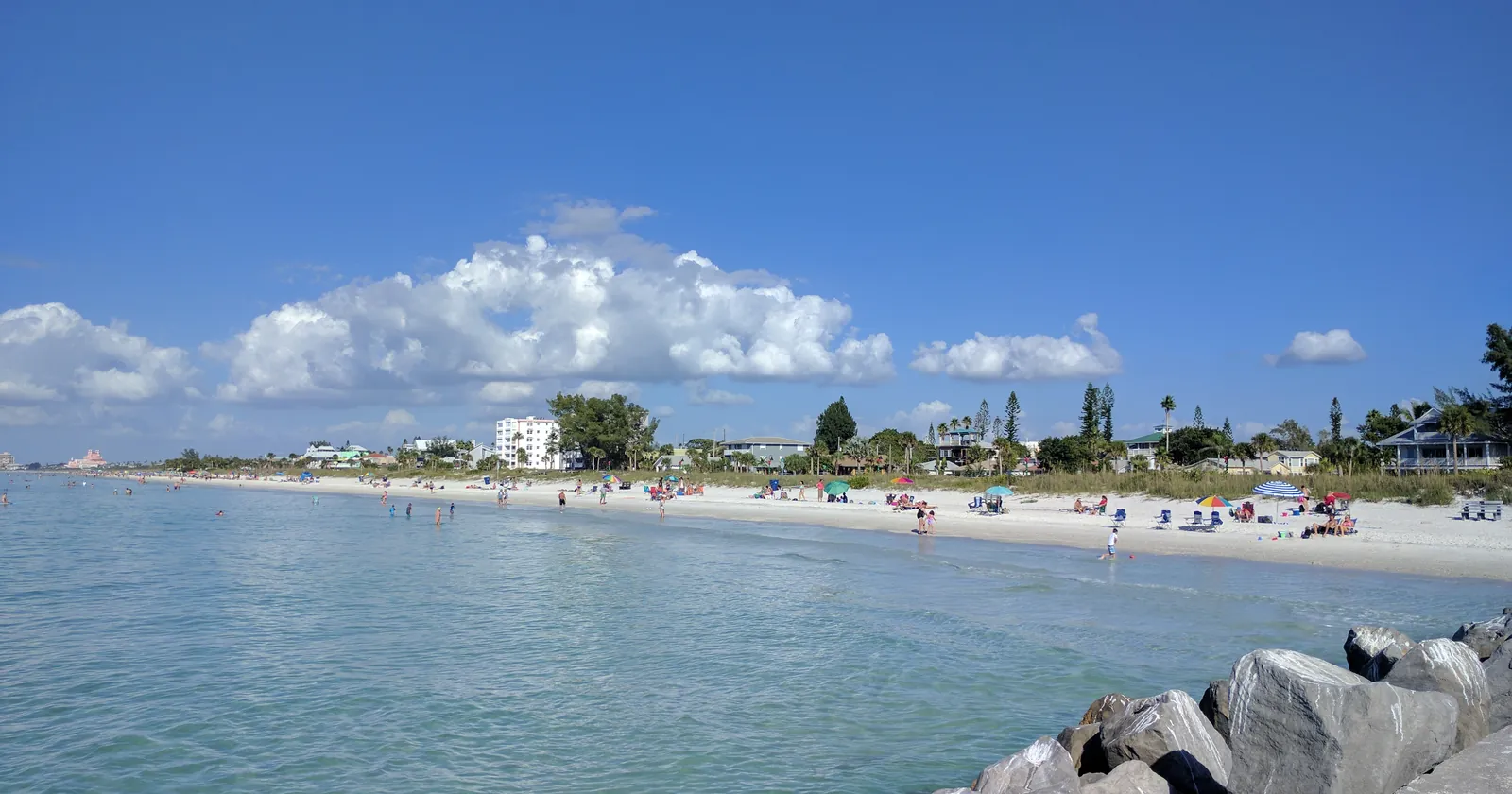
Pass-a-Grille beach, at one of the passes the county measures its reefs from. Grendelkhan, Wikimedia Commons, CC BY-SA 3.0, cropped.

Key takeaways
- Pinellas County lists 43 artificial reefs from Tarpon Springs to St. Pete Beach; its reef sheets give depths from 8 meters at Clearwater Reef to 30 meters at Treasure Island #2, and none has a maintained buoy
- Florida law requires every diver to display a divers-down flag or buoy, stay within 300 feet (about 90 meters) of it in open water, and take it down once everyone is out
- NOAA's satellite averages put the sea off Clearwater at about 18.0 °C in February and 29.9 °C in August; the hurricane season runs from June to November and peaks around 10 September
- We found no official source confirming a chamber in the Tampa Bay area that takes injured divers around the clock; call 911 first and then DAN on +1-919-684-9111
- The US has no digital-nomad visa: visitors under the Visa Waiver Program stay up to 90 days, and federal rules bar B-2 visitors from any employment
Tampa diving: the Gulf off Pinellas, not the bay
Tampa sits on the bay, but the reefs, wrecks and ledges lie to the west, off the Pinellas County peninsula, the strip of beach towns between Clearwater and St. Pete Beach, and the county gives its reef distances from the passes at Clearwater, John's Pass and Pass-a-Grille. The water is the Gulf, which US federal agencies and Pinellas County now call the Gulf of America. Much of what is there was put there on purpose: Pinellas County's Solid Waste department has been sinking clean concrete, steel and whole ships since 1975, about 50,000 tons so far, to create habitat where the bottom is featureless.
The county's main reef sites lie several kilometers or more offshore and have no maintained buoy, so plan on boat dives. The springs of inland Florida are part of the local diving week too: two of the shops we read run training dives or day trips in freshwater springs north of the city.
Pinellas County's artificial reefs
The county counts 43 artificial reefs along its Gulf coast, from Tarpon Springs to St. Pete Beach, between about 180 meters and 61 kilometers offshore: 14 offshore sites, 29 inshore reefs and one in Tampa Bay itself, north of the St. Pete Pier. It publishes a sheet for each of the main ones, with GPS points for every piece of material. The depths and contents below are the county's. We converted them to meters and worked out the distances from Clearwater Beach from its coordinates.
| Reef | Depth | What lies there |
|---|---|---|
| Clearwater Reef, about 7 km off Clearwater Beach | 8 to 9 m | The county's oldest reef, from the early 1960s, with a barge in the middle |
| Tarpon Springs Reef | 8 m | Live bottom with culverts and concrete slabs |
| Treasure Island Reef | 9 to 10 m | High-profile pyramids, established in 2004 |
| St. Pete Beach Reef, 8 km (five miles) off Pass-a-Grille | 10 to 11 m | Bridge rubble from 1976, a 61-meter barge sunk in 1984 and ten US Army tanks sunk in 1995 |
| Indian Shores Reef | 13 to 14 m | Two 61-meter Second World War Navy landing ships, an intact 73-meter hopper barge and bridge columns |
| South County Reef, 16 km (ten miles) from John's Pass | 14 m | Three steel barges and the 24-meter tug Orange, which the county calls 100 years old |
| Pinellas #2, about 37 km off Clearwater Beach | 24 m | The tug Sheridan, the cutter Blackthorn and a steel barge |
| Treasure Island #2, about 55 km off Clearwater Beach | 30 m | A 26-meter shrimp boat, a 15-meter trawler, three sailboats and reef balls |
Every sheet says the same thing about moorings: no maintained buoy. The county publishes GPS points instead, and warns that storms can shift reef material, so the coordinates may not be exact. The sheets were uploaded in 2022, before Hurricanes Helene and Milton; we found no later survey, so ask a shop what is still where. The county has a permit for a future site, Pinellas #3, in about 40 meters of water, meant for larger vessels and decommissioned military ships, and in September 2023 it expanded King's Reef off Tierra Verde and Fort De Soto with a grant from the state's wildlife commission.
The deep wrecks: Sheridan and Blackthorn
Pinellas #2 is the site the county singles out: it says many divers consider it the best wreck dive in west central Florida. Its sheet lists a 55-meter (180-foot) steel tug, the Sheridan, fully intact and upright, and a 55-meter US Coast Guard cutter, the Blackthorn, upside down in two pieces, plus a steel barge and concrete culverts, all at about 24 meters. The county lists grouper, snapper, amberjack, crevalle jack, Spanish mackerel, triggerfish and barracuda among the fish. It lies about 37 kilometers out by our measurement, so ask the shop which certification and experience it asks for before you book.
Treasure Island #2 lies farther out and deeper, at about 30 meters, with a shrimp boat, a fishing trawler and three sailboats among reef balls. St. Pete Scuba's course list caps its deep specialty at 130 feet, about 40 meters, which is also the depth of the future Pinellas #3 site.
Ledges, charters and what a dive costs
Not all of it is man-made. Gulfport Dive Center in St. Petersburg says it is one of the few shops in the city with its own boat fitted for diving, and that its standard weekly trip dives wrecks and natural reef ledges at roughly 50 feet, about 15 meters. It lists goliath groupers, rays, eels, sea turtles, sharks and octopus as possible sightings, and runs deeper charters less often. We found no visibility figure for the Gulf off Pinellas from a shop or an official source.
Prices on the shops' own pages, read on 10 November 2026:
| Shop and service | Price |
|---|---|
| Gulfport Dive Center, two-tank reef charter, tanks and weights included | $130 |
| Gulfport Dive Center, Open Water course, up to six students | $550 |
| St. Pete Scuba, Tierra Verde, Open Water course | $499 |
| St. Pete Scuba, air fill / nitrox fill | $15 / $20 |
| St. Pete Scuba, rental of regulator and gauges / BC / dive computer | $25 / $20 / $20 |
| Gulf Coast Divers, Tampa, Open Water course | $500, or $299 on a promotion for sign-ups by 31 March 2027 |
| Gulf Coast Divers, Rainbow River dive day | $70, plus a $30 park entry |
St. Pete Scuba rents gear only against a certification card, a credit card and a driver's license, and opens daily from 6 a.m. to 7 p.m. Gulfport Dive Center charges $999 for a one-to-one Open Water course and $699 each for two.
Springs and manatees inland
Springs are part of training here. Gulfport Dive Center spends the Saturday of its second course weekend at Lake Denton, Rainbow River or Devil's Den, and about once a month it takes certified divers to Rainbow River, Devil's Den or Blue Grotto. Gulf Coast Divers runs Rainbow River days at Dunnellon with a boat ride upriver to the entry point and a drift dive with the current; it says visibility often exceeds 100 feet, about 30 meters, and divers must bring a full set of gear, because there is no rental on site.
Crystal River, which the US Fish and Wildlife Service puts an hour north of Tampa, has the only national wildlife refuge created specifically to protect the Florida manatee. From 15 November to 31 March, seven warm-water sanctuaries close to all activity. Scuba is allowed all year at King Spring near Banana Island, but in season only inside the buoyed "keyhole" or outside the sanctuaries, and scuba at Three Sisters Springs is allowed only from 1 April to 14 November. Snorkelling is allowed all year, and snorkellers may not enter the marked sanctuaries. In all of Kings Bay it is banned to chase, corner, touch, ride or feed a manatee, to dive onto a resting or feeding one, or to separate a mother and calf; the service asks for passive observation from the surface. The refuge runs no tours itself; it issues permits to local businesses.
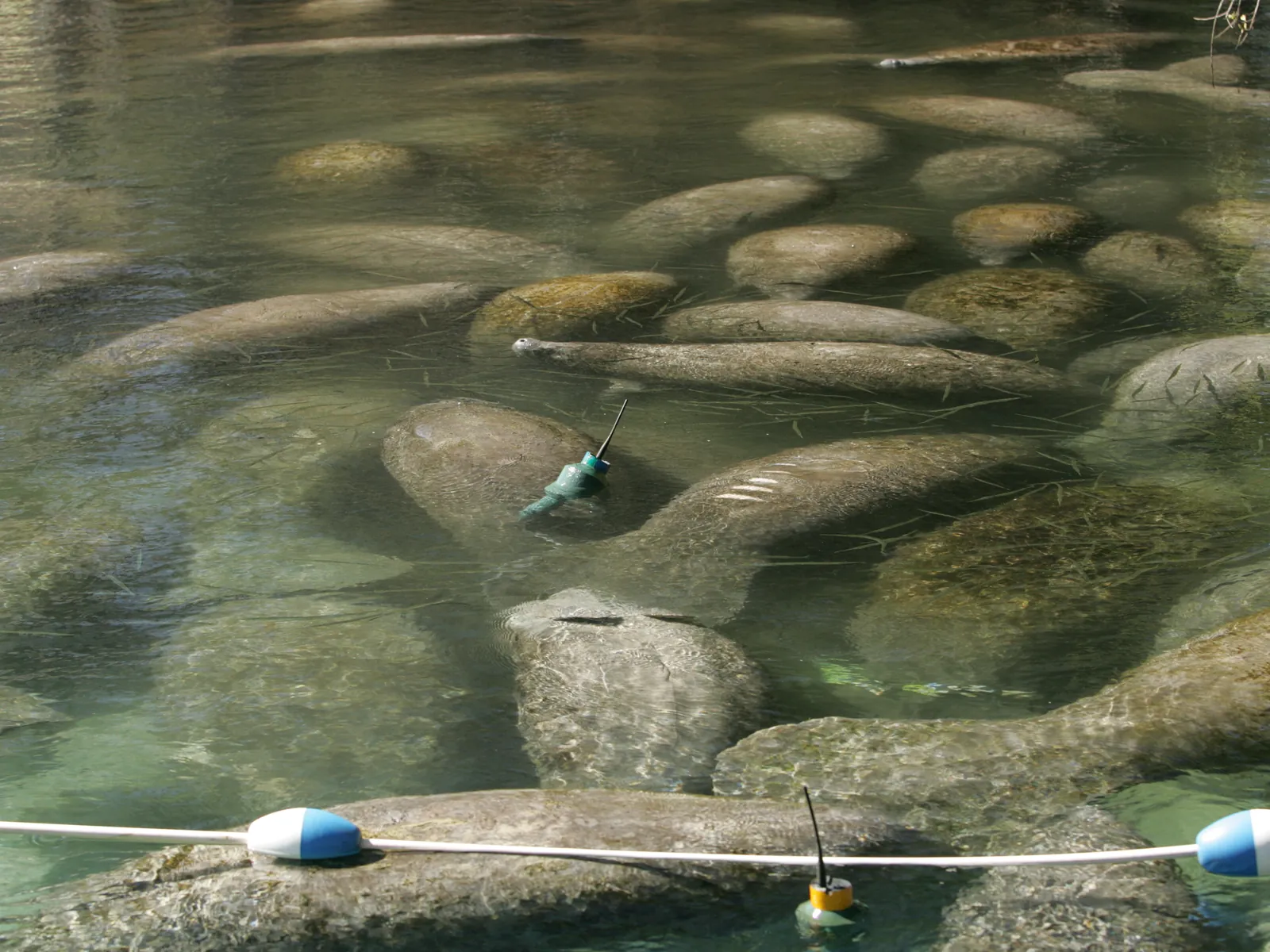
Manatees at Three Sisters Springs, Crystal River. Steve Hillebrand / USFWS, Wikimedia Commons, public domain, cropped.

Florida's dive rules: the flag, licenses and protected corals
Florida's dive-flag law, section 327.331 of the state statutes, applies to anyone in the water with a mask and snorkel or with breathing apparatus. Every diver must display a divers-down flag or buoy where they dive, except in areas used only for swimming. The red symbol with its white diagonal stripe must be at least 12 by 12 inches, about 30 centimeters square, when shown from the water, and 20 by 24 inches, about 51 by 61 centimeters, when flown from a boat, from its highest point or wherever nothing blocks the view of it. In open water, divers must try to stay within 300 feet, about 90 meters, of the flag, and boats must try to keep 300 feet away; in rivers, inlets and channels both distances are 100 feet, about 30 meters. A boat that comes closer must slow to the minimum speed that keeps it steering. The flag must come down once all divers are out of the water. Breaking the law is a noncriminal infraction.
Taking fish is licensed. Florida law requires a license to take saltwater fish, with exemptions set out in a separate section, and a nonresident pays $15.50 for three days, $28.50 for seven or $45.50 for a year, plus $5 for a spiny lobster permit. The detailed rules on spearfishing, bag limits and the bay-scallop season come from the state's Fish and Wildlife Conservation Commission, whose rule pages we could not read for this guide, so check them with the commission or your shop before you take anything.
Far offshore, federal rules protect the corals of the Florida Middle Grounds. Bottom longlines, bottom trawls, dredges, pots and traps are banned there all year. The nearest corner of the protected area lies about 117 kilometers from Clearwater Beach by our measurement, and none of the shop pages we read sells trips there.
When to dive: sea temperature and hurricanes
NOAA's satellite averages for 1991 to 2020, for the grid cell at 27.875°N 83.125°W, about 31 kilometers west of Clearwater Beach, put the sea at about 18.3 °C in January and 18.0 °C in February, 19.5 °C in March, 22.3 °C in April and 25.4 °C in May. It reaches 28.0 °C in June, 29.5 °C in July and 29.9 °C in August, then falls to 29.2 °C in September, 27.0 °C in October, 23.3 °C in November and 20.4 °C in December. A cell off Egmont Key, at the mouth of the bay, reads within half a degree. These are surface figures; no source we read gives the temperature at depth.
Summer brings warm water and storms. NOAA's National Hurricane Center gives the Atlantic hurricane season, which includes the Gulf, as 1 June to 30 November, with a peak on 10 September and most activity between mid-August and mid-October; an average season from 1991 to 2020 had 14 named storms, seven hurricanes and three major ones. In 2024, Hurricane Helene brought what the center calls dangerous storm surge to Tampa Bay, with 5 to 7 feet, about 1.5 to 2 meters, of water above ground inside the bay, and Hurricane Milton made landfall on Siesta Key in October as a category 3 storm, causing major damage around Sarasota and Tampa Bay. If you book between August and October, keep your plans flexible.
Chamber and emergencies
We found no official source confirming that any hyperbaric chamber in the Tampa Bay area treats injured divers around the clock. Florida Medical Clinic Orlando Health lists decompression sickness among the conditions its wound care center in Wesley Chapel treats with hyperbaric oxygen, but its page gives no emergency hours. The pages of several hospital groups in the area could not be read. In an emergency call 911, which Pinellas County says is for any police, fire or medical emergency; on a mobile phone your location may not show, so say where you are. Then call the Divers Alert Network on +1-919-684-9111. At sea, VHF channel 16 is the distress channel, and the Coast Guard keeps a listening watch on it. Ask your shop which chamber it would use, and check that your dive insurance covers chamber treatment and evacuation in the US.
Getting to Tampa Bay
Tampa International Airport's own list of nonstop international routes, read on 10 November 2026, includes Amsterdam, Frankfurt, London Heathrow and Zurich in Europe, Toronto, Montreal, Ottawa, Calgary and Halifax in Canada, and Mexico City, Cancun, Bogotá, Panama City, San José, Havana and several Caribbean islands; it does not say which routes are seasonal. HART and PSTA buses stop at the airport's rental car center, reached by the SkyConnect train. The airport gives approximate distances of 20 miles, about 32 kilometers, to St. Petersburg and Clearwater, 20 to 25 miles to Clearwater Beach and 27 miles, about 43 kilometers, to St. Pete Beach. The reefs are reached from the Pinellas side, so a diver is better based there than in Tampa itself.
Tampa Bay as a remote-work base
The United States has no digital-nomad visa, and none of its visitor categories is for remote work. Citizens of the 42 Visa Waiver Program countries can come for business or tourism for up to 90 days without a visa, with an e-passport and an approved ESTA; the ESTA does not guarantee entry, because a border officer decides admission on arrival. A federal fee notice for fiscal year 2027 sets the ESTA at $40.62, or $10.62 if it is refused, from a start date we could not confirm. Others need a B-2 visitor visa, under which a visitor is admitted for at least six months and at most a year, with extensions of up to six months at a time.
Federal rules say a B-2 visitor "may not engage in any employment", and they define pleasure travel as recreational: tourism, amusement, visiting and rest. They do not say whether answering email for a foreign employer from a rented flat in St. Petersburg counts as employment, and we found no official guidance that does. Do not count on it being allowed; if your stay depends on working, ask an immigration lawyer before you fly.
Who Tampa diving suits
Tampa Bay suits a diver who likes wrecks and artificial reefs, can plan around a boat schedule and is happy to drive north for springs and manatees in winter. It suits a stay of weeks rather than months, given the 90-day limit on the visa waiver, and summer visitors should plan around the hurricane season. It suits less well anyone who wants shore entries, buoyed sites or a confirmed chamber nearby. For diving farther south in Florida, see our guides to Key Largo, Key West and Miami, and for shops registered in the area, our Tampa Bay operator list.
FAQ: Tampa diving
Can you scuba dive in Tampa?
Yes, but the diving is in the Gulf off Pinellas County, not in Tampa Bay itself. Boats visit artificial reefs and natural ledges from about 8 to 30 meters deep, and some shops also run trips to freshwater springs north of the city.
How deep are the Sheridan and Blackthorn wrecks?
About 24 meters (80 feet), at the Pinellas #2 artificial reef, according to Pinellas County. The tug Sheridan sits upright and intact; the Coast Guard cutter Blackthorn lies upside down in two pieces. There is no maintained buoy; the county publishes GPS coordinates for each wreck.
How warm is the water off Tampa Bay?
NOAA's 1991 to 2020 satellite averages for a cell off Clearwater give about 18 °C in January and February, 25.4 °C in May and 29.9 °C in August at the surface. The hurricane season runs from 1 June to 30 November.
Do you need a dive flag in Florida?
Yes. Florida law requires every diver to display a divers-down flag or buoy, stay within 300 feet (about 90 meters) of it in open water and 100 feet (about 30 meters) in rivers, inlets and channels, and lower it once all divers are out. Boats must slow down within the same distances.
Can you work remotely in the US on ESTA or a B-2 visa?
The US has no digital-nomad visa. Visitors under the Visa Waiver Program can stay up to 90 days, and federal rules say B-2 visitors may not engage in any employment. The rules do not say whether remote work for a foreign employer counts, so get legal advice before relying on it.
Note: Conditions, safety guidance and regulations change. Verify current information with official sources, including the dive operator, the Florida Fish and Wildlife Conservation Commission and the relevant government department, before you travel or dive.
Founder of NOMADREEF and a former digital nomad. This guide is sourced from the references below; conditions, prices and rules change, so verify current details, and follow qualified local guidance and safety briefings. About the author · LinkedIn ↗
Sources
- Artificial reefs (primary). Pinellas County, Artificial Reef Program, FAQ and GPS coordinates; reef sheets (PDF) for Pinellas #2, Pinellas #3, Treasure Island #2, Treasure Island, Indian Shores, South County, St. Pete Beach, Clearwater and Tarpon Springs. Distances measured from NOAA's Clearwater Beach tide station. Read 10 November 2026.
- Shops (each primary for itself). Gulfport Dive Center, local charters, courses and spring trips; St. Pete Scuba, courses and rentals; Gulf Coast Divers, Rainbow River day and Open Water course. Read 10 November 2026.
- Springs and manatees (primary). US Fish and Wildlife Service, Crystal River National Wildlife Refuge, visiting and scuba diving. Read 10 November 2026.
- Florida law (primary). The 2026 Florida Statutes, section 327.331 (divers-down warning devices) and section 379.354 (licenses and fees). Read 10 November 2026.
- Florida Middle Grounds (primary). 50 CFR 622.74, edition of 1 October 2025, via GovInfo; distance our measurement. Read 10 November 2026.
- Sea temperature. NOAA PSL, OISST v2.1 monthly long-term means 1991–2020, cell 27.875°N 83.125°W, with a cross-check at 27.625°N 82.875°W, computed for this page (primary). Read 10 November 2026.
- Hurricanes (primary). NOAA National Hurricane Center, tropical cyclone climatology and tropical cyclone reports on Helene (PDF) and Milton (PDF). Read 10 November 2026.
- Chamber and emergencies (primary). Florida Medical Clinic, hyperbaric oxygen therapy; Divers Alert Network, medical services; Pinellas County, About 9-1-1; US Coast Guard Navigation Center, VHF channels. Read 10 November 2026.
- Getting there (primary). Tampa International Airport, international nonstop routes and ground transportation. Read 10 November 2026.
- Staying and working (primary). US Customs and Border Protection, Visa Waiver Program and ESTA; DHS notice on fiscal year 2027 fees (PDF); via GovInfo, 8 CFR 214.1, 8 CFR 214.2 and 22 CFR 41.31. Read 10 November 2026.
- Left out. The state wildlife commission's spearfishing, bag-limit and bay-scallop rules, whose pages we could not read; a chamber in the Tampa Bay area confirmed to take divers around the clock; the Coast Guard sector's own contact details; visibility and temperature at depth; any survey of the reefs after the 2024 hurricanes; the depths of King's Reef and Veterans Reef; the State Department's visitor-visa pages; the start date of the 2027 ESTA fee; and internet and coworking costs.