Philippines Diving: Luzon, the Visayas, Palawan and Mindanao, the National Dive Rules, the Chamber Network and the Typhoon Months
 by Yannick Schroth
Nov 10, 2026
12 min read
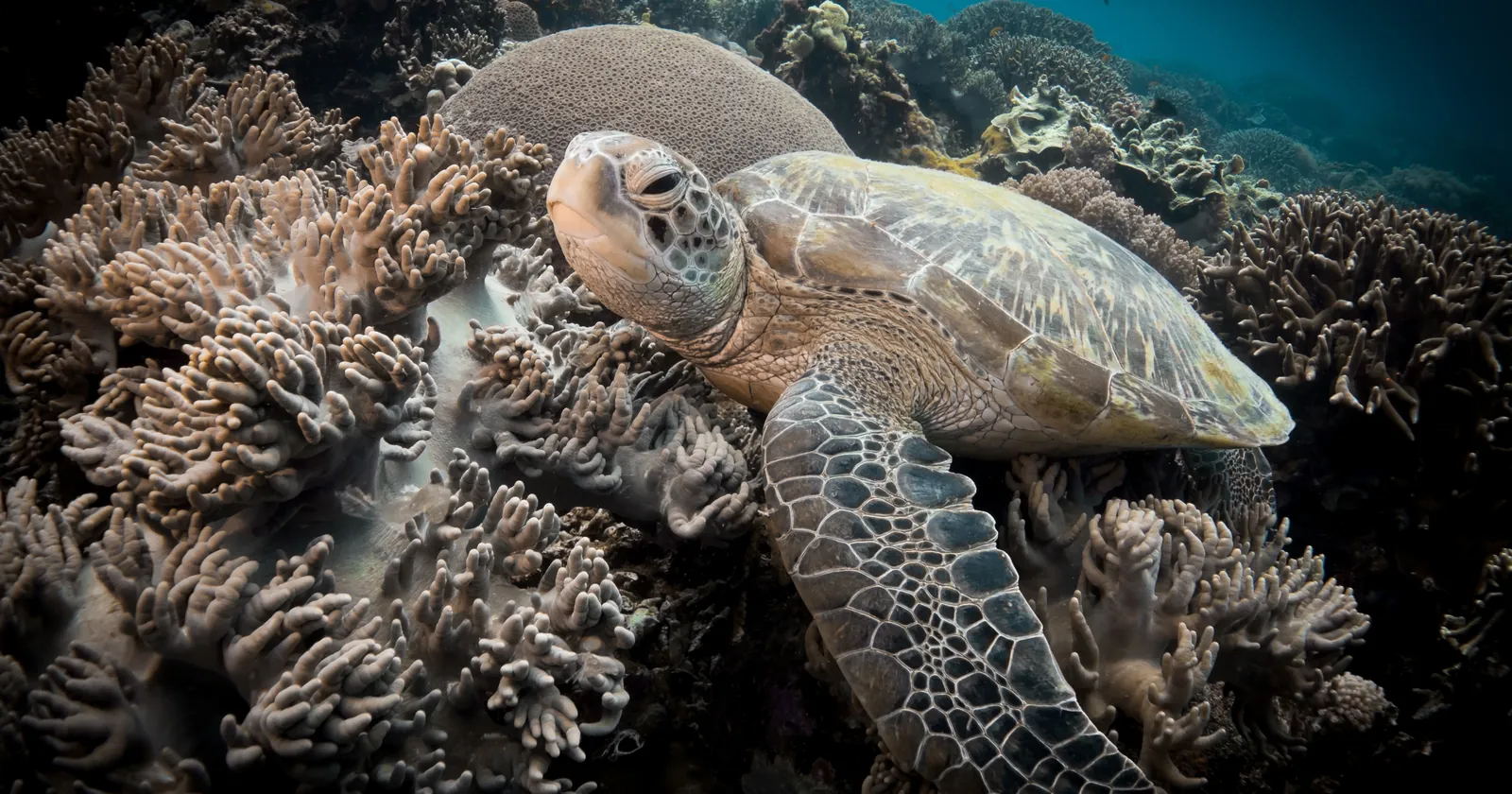
A green turtle in the Apo Island marine sanctuary. Anna Varona, Wikimedia Commons, CC BY 4.0, cropped.

Key takeaways
- By law, no one may run a dive establishment in the Philippines without a licence from the Philippine Commission on Sports Scuba Diving, valid for one year, and shops must carry accident liability insurance
- Tañon Strait, Apo Island, Panglao, Apo Reef and Siargao are protected areas named in the 2018 protected areas law; inside them, taking wildlife or using reef-destroying gear carries fines of ₱200,000 to ₱1 million
- The tourism infrastructure agency has contracted repairs for chambers in Mandaue, Panglao, Mabini and Puerto Princesa and is building more, but we found no official statement that any chamber is open around the clock
- NOAA's 1991 to 2020 averages give 26.3 °C in February in the Verde Island Passage and 29.0 to 29.9 °C in May and June in the Visayas
- Nationals of 157 countries can enter visa-free, most for an initial 30 days; the digital nomad visa created in April 2025 was not listed on the foreign affairs department's visa page on 10 November 2026
Philippines diving: four regions and where our guides fit
The Philippines is an archipelago, and its diving does not work as one destination. Divers usually pick a base and stay, so the useful question is which region, not which site. This page is the national layer: the rules that apply everywhere, the protected areas, the season, the water, the chamber situation and the visa. Each region below gets a short orientation and a link to our detailed guide, which carries the sites, fees and local detail.
For towns we cover in depth: Anilao, Puerto Galera, Moalboal, Malapascua, Mactan, Panglao, Dauin and Apo Island and Palawan, with Coron and El Nido on their own pages.
Luzon and Mindoro: the Verde Island Passage
South of Manila, Anilao in Batangas and Puerto Galera on the northern tip of Mindoro face each other across the Verde Island Passage. Anilao is a macro and muck coast whose sites are split between two municipalities, each collecting a conservation fee; our Anilao guide explains the fee, the sanctuaries and the oil spill of 2023. Puerto Galera is a UNESCO biosphere reserve, not a World Heritage Site, as our Puerto Galera guide sets out. Both have operator lists: Anilao and Puerto Galera.
One national detail matters for this coast. The Tourism Infrastructure and Enterprise Zone Authority (TIEZA), the tourism department's infrastructure arm, awarded a contract in January 2025 to repair a hyperbaric chamber in Mabini, the municipality that holds Anilao. Further west, Apo Reef Natural Park off Occidental Mindoro, 15,799.23 hectares, is one of the protected areas written into the 2018 law. We have no page on Apo Reef or on the wrecks of Subic Bay, whose authority's website we could not load.
The Visayas: Cebu, Bohol and Negros
The central islands hold most of the country's dive towns. On Cebu, Moalboal is known for the sardine shoal and turtles off Panagsama Beach, and Malapascua, off the northern tip, for its dawn thresher shark dives. Thresher Shark Divers, a Malapascua shop, says pelagic threshers now visit a cleaning station at Kimud Shoal every day of the year, after moving from Monad Shoal. Our Malapascua vs Moalboal comparison sets the two side by side, and our Mactan guide covers the dive shops on the island that holds Cebu's international airport.
Much of Cebu's west coast faces the Tañon Strait, the channel between Cebu and Negros. A 1998 proclamation declared it a protected seascape, with a boundary running along Cebu's western shoreline, and the 2018 law gives it 534,589.05 hectares across Cebu, Negros Occidental and Negros Oriental. Off Bohol, the Panglao Island Protected Seascape covers 2,445.08 hectares; our Panglao guide covers Balicasag and the town.
On Negros, Dauin is a black-sand muck coast, and Apo Island offshore is a protected landscape and seascape of 691.40 hectares under the same law. The Apo Island fee is reported at different amounts, and we could not read the order that sets the national rate, so check it locally. Boracay is on our site as a kite base rather than a dive guide. Operator lists cover Moalboal, Malapascua, Cebu, Bohol and Dauin.
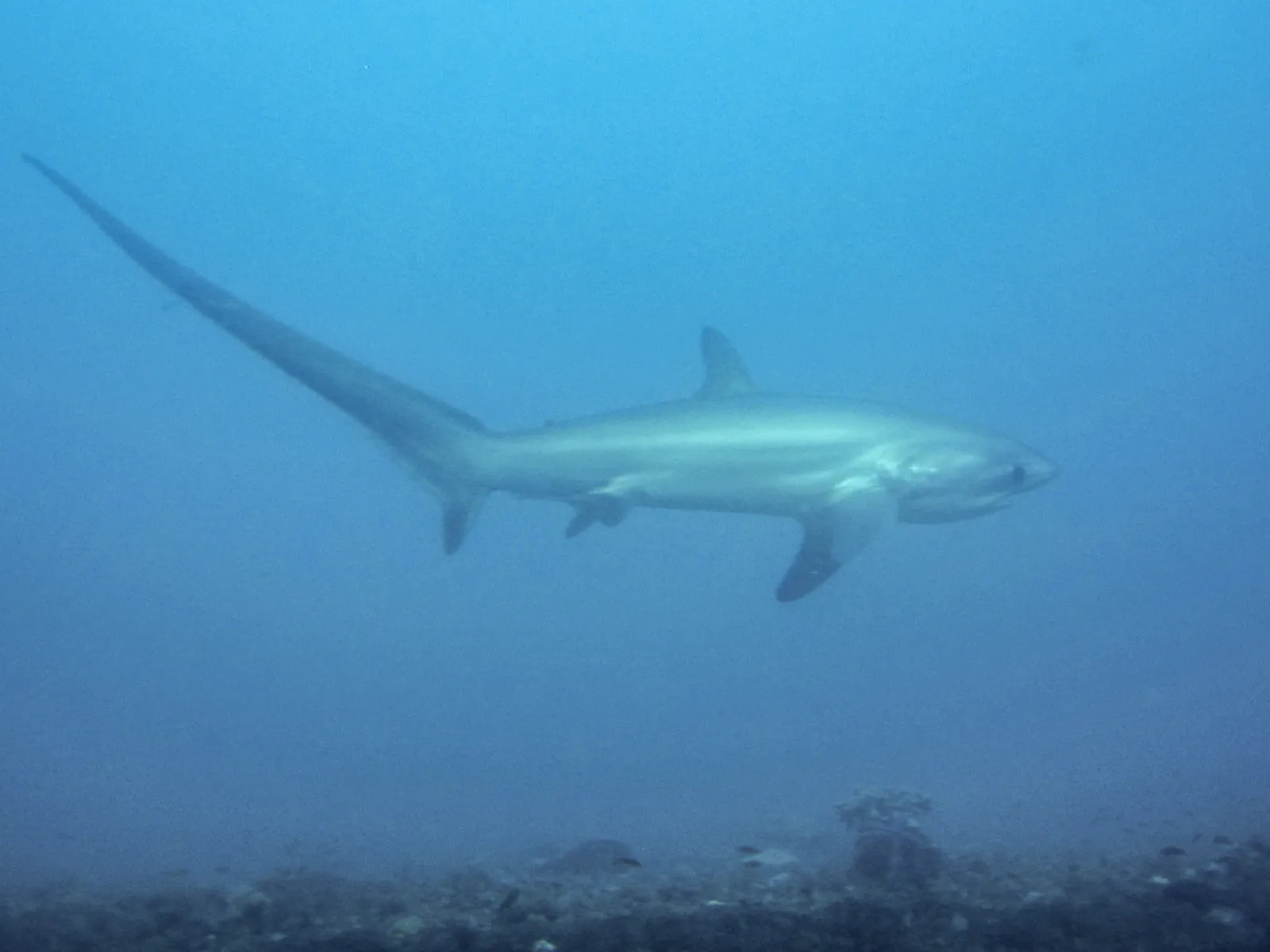
A pelagic thresher shark off Malapascua. Petter Lindgren, Wikimedia Commons, CC BY-SA 3.0, cropped.

Palawan: wrecks, a protected bay and a liveaboard-only park
Palawan is the long province to the west. Coron is a wreck town, El Nido sits inside a managed resource protected area, and Tubbataha, out in the Sulu Sea, can only be visited on permitted liveaboards in a short spring season. Our Palawan diving guide has the park fees, the wreck depths and the water by month; the Coron vs El Nido comparison helps choose a base. Since that guide went up, we found a TIEZA notice to proceed of March 2026 for moving a chamber from Zamboanga to Coron, including testing and commissioning. We could not confirm that it is running.
Mindanao: what official travel advice says
We do not cover diving in most of Mindanao, and the reason is official advice. The UK Foreign, Commonwealth and Development Office advises against all travel to western and central Mindanao and the Sulu archipelago, and against all but essential travel to the rest of Mindanao, except Camiguin, Dinagat and Siargao, citing terrorist activity and clashes between the military and insurgent groups. It warns of piracy and armed robbery in the Sulu and Celebes seas and says boats to offshore islands and dive sites are possible targets. It also notes that travel insurance can be invalidated by travelling against its advice.
The exceptions are where our coverage sits. Siargao Island is a protected landscape and seascape of 283,974.77 hectares under the 2018 law, and our Siargao guide treats it as a surf base. Camiguin is on TIEZA's list of places for a new walk-in chamber. Our only other Mindanao page is rafting in Cagayan de Oro. Check your own government's advice before you book anything in the south.
The national rules every dive trip runs under
A licensed shop, a licensed instructor
The Tourism Act of 2009 attaches the Philippine Commission on Sports Scuba Diving to the tourism department and tells it to set standard dive rules, regulate recreational and technical diving and regulate accredited dive establishments. Its rules of 28 January 2009 say no one may operate or manage a scuba diving establishment without first being licensed by the commission. The licence lasts one year from issue and must be displayed in the shop. Shops and dive professionals must carry accident liability insurance, and every course must be taught by a licensed, certified instructor or an assistant instructor with current teaching status.
The same rules list acts that shops and professionals must prohibit: collecting or destroying coral, capturing or harming endangered species, using toxic chemicals, spearfishing using scuba, and salvaging sunken artefacts without a permit. For fills, a cylinder's hydrostatic test may be no more than five years old, and customers must show a certification card; rentals of regulators, BCDs, computers and cylinders must be recorded against the renter's card. The commission's website showed no list of accredited shops when we checked, so ask to see the licence on the wall and its date.
Protected areas and their fees
Several of the dive areas on this page lie inside protected areas under the national protected areas system, set up in 1992 and expanded by Republic Act 11038 of 22 June 2018. Areas proclaimed before then, including fish sanctuaries and protected seascapes, are part of the system. Inside them, the law bans taking or collecting wildlife without a permit, using fishing gear that destroys coral reefs, running a motorized boat without a permit from the area's management board, and littering. Taking wildlife or using destructive gear carries a fine of ₱200,000 to ₱1 million or one to six years in prison.
Fees are set area by area. Each protected area's management board sets fees and charges under national guidelines and keeps 75 percent of what it raises for that area; the other 25 percent goes to the national treasury. Municipalities may add their own charge on top, based on what they contribute to protecting the area. That is why a day's diving can carry both a park fee and a municipal fee. We could not read the environment department's current fee order, so we give no national figure; the regional guides list the fees we could confirm.
Coral, whale sharks and manta rays
Two national bans apply everywhere, inside protected areas or not. The fisheries code, as amended in 2015, makes it unlawful for anyone to gather or possess coral, except for research, or to damage coral reefs, and bans taking species on CITES Appendix I or classed as threatened. A fisheries order of 25 March 1998 makes it unlawful to take or catch whale sharks and manta rays, or to sell, buy, possess, transport or export them, dead or alive; any caught by accident must be released unharmed. Buy no coral, touch no reef, and leave the big animals alone.
When to dive: monsoons, typhoons and water temperature
PAGASA, the weather service, divides the year into a rainy season from June to November and a dry season from December to May, with a cool dry stretch from December to February and a hot dry one from March to May. It counts about 20 tropical cyclones entering or forming in the Philippine area of responsibility in an average year, eight or nine of which make landfall. Their tracks run north-west, which spares Mindanao most direct hits. The UK travel advice adds that most typhoons come between June and November and that ferry accidents are more frequent from June to December, when storms build quickly. For dive trips, that means building spare days into the second half of the year and following PAGASA's bulletins.
The water changes little. NOAA's satellite averages for 1991 to 2020, computed for this page for four grid cells near the main dive areas, give these surface means:
| Area (NOAA grid cell) | Coolest month | Warmest month | November |
|---|---|---|---|
| Verde Island Passage off Anilao (13.625°N 120.875°E) | February, 26.3 °C | June, 29.7 °C | 28.2 °C |
| Tañon Strait off Moalboal (9.875°N 123.375°E) | February, 27.1 °C | June, 29.5 °C | 29.0 °C |
| Off Malapascua (11.375°N 124.125°E) | February, 26.9 °C | June, 29.9 °C | 28.7 °C |
| Off Dauin and Apo Island (9.125°N 123.375°E) | February, 26.9 °C | June, 29.4 °C | 28.9 °C |
The northern passage runs 0.5 to 0.8 of a degree cooler than the three Visayas cells in January and February, at 26.5 °C and 26.3 °C. Tubbataha's cell, on our Palawan page, peaks at 29.8 °C in May. These are surface figures; a thermocline can be colder.
Chambers and emergencies
The emergency number is 911, made the national hotline in place of 117 by an executive order of 25 May 2018. The chamber picture is patchy. This is what the authorities have put in writing. TIEZA contracted the move of a hyperbaric chamber to its Cebu field office in Mandaue in 2021 and the repair of its oxygen line in 2022. It awarded repairs for chambers in Panglao and Mabini in January 2025 and ordered repairs to the chamber at Ospital ng Palawan in Puerto Princesa in September 2025. In December 2023 it tendered five walk-in multi-place chambers for Boracay, Dumaguete, Camiguin, Puerto Galera and Daanbantayan, the municipality that includes Malapascua, and it has chamber centre projects for Malapascua, Coron and Dauin.
None of those notices says whether a chamber is open, who staffs it or at what hours. A February 2025 report in The Freeman said only three chambers in the country were then operational, naming one at the Lung Center owned by the dive commission, one at TIEZA's office in Mandaue and one at Ospital ng Palawan. We found no source confirming any chamber is staffed around the clock. The UK travel advice tells divers to check a shop's credentials, make sure oxygen is on the boat and ask how it would get a diver to a chamber; ask that question before you book, and make sure your dive insurance covers evacuation.
How to choose a region
Match the region to the diving you want and the months you have. For small animals on sand and rubble, our guides cover two muck coasts, Anilao and Dauin. For one big encounter, Malapascua's threshers and Moalboal's sardines are the draws on Cebu. For wrecks, Coron's Second World War fleet is the reference, and for remote reef walls, Tubbataha by liveaboard in its spring window. If you will be there between June and November, the typhoon pattern covers the whole country, with Mindanao spared most direct hits, and most of Mindanao is where official advice says not to go.
Also weigh the paperwork. Inside protected areas, expect park fees on top of municipal ones; on Tubbataha, a liveaboard permit system. Wherever you dive, the shop's licence and the nearest working chamber are worth asking about on day one.
Getting in and staying as a remote worker
The foreign affairs department's eVisa policy page lists 157 countries whose nationals can enter without a visa, with a passport valid six months beyond the stay and a return or onward ticket. The initial stay is 30 days, except for Brazilians and Israelis, who get 59. Indian nationals have had 14 days visa-free, not extendible, since 8 June 2025, and Chinese nationals the same from 16 January 2026. The UK travel advice says arrivals need a QR code from the free eTravel registration, made within 72 hours before landing, that extensions are applied for inside the country, and that anyone who has stayed six months or more on a tourist visa needs an emigration clearance certificate before leaving. The Bureau of Immigration's website did not load for us, so we could not confirm the extension steps or the maximum stay from the bureau.
The digital nomad visa exists in law. Executive Order No. 86 of 24 April 2025 lets the foreign affairs department issue it to people aged 18 and over who work remotely for employers or clients abroad, with foreign income, health insurance and a clean record, and only to nationals of countries that offer a similar visa to Filipinos and host a Philippine foreign service post. It allows a stay of up to one year and can be renewed, with no limit on renewals in the order. The order left the details to department guidelines due within 30 days; on 10 November 2026 the eVisa page still listed no digital nomad category. Plan a long stay on visa-free entry and extensions until that changes.
Who the Philippines suits
The Philippines suits a diver who is happy to choose one region and settle in: a macro photographer in Anilao or Dauin, a wreck diver in Coron, a remote worker in Moalboal or Panglao who dives before work. It suits people who travel in the dry months, or who leave spare days in the typhoon season. It suits less well anyone who needs a confirmed round-the-clock chamber close to the dive site, wants to dive in most of Mindanao, or needs a long-stay visa settled before arrival.
FAQ: Philippines diving
Do dive shops in the Philippines need a licence?
Yes. The 2009 rules of the Philippine Commission on Sports Scuba Diving say no one may operate or manage a scuba diving establishment without first being licensed by the commission. The licence lasts one year, must be displayed in the shop, and shops must carry accident liability insurance.
When is typhoon season in the Philippines?
PAGASA gives the rainy season as June to November and the dry season as December to May. It counts about 20 tropical cyclones in the Philippine area of responsibility in an average year, eight or nine of which make landfall, and says their north-west tracks spare Mindanao most direct hits.
What is the water temperature for diving in the Philippines?
NOAA's 1991 to 2020 averages give about 26.3 to 27.1 °C in February and 29.4 to 29.9 °C in June at the surface off Anilao, Moalboal, Malapascua and Dauin. The Verde Island Passage in the north is the coolest of the four in January and February.
Is there a hyperbaric chamber in the Philippines?
The tourism infrastructure agency has chambers or chamber projects in Mandaue, Panglao, Mabini, Puerto Princesa and several dive towns, according to its procurement notices. We found no official confirmation of which are open or whether any is staffed around the clock. The emergency number is 911.
Can I get a digital nomad visa for the Philippines?
An executive order of April 2025 created one for remote workers from countries that offer Filipinos a similar visa, valid for up to a year and renewable. On 10 November 2026 the foreign affairs department's eVisa page listed no such category, so most people still enter visa-free for 30 days and extend.
Note: Conditions, safety guidance and regulations change. Verify current information with official sources, including the dive operator, the park authority and the relevant government department, before you travel or dive.
Founder of NOMADREEF and a former digital nomad. This guide is sourced from the references below; conditions, prices and rules change, so verify current details, and follow qualified local guidance and safety briefings. About the author · LinkedIn ↗
Sources
- Dive-business rules (primary). Republic Act 9593, Tourism Act of 2009, section 31; Philippine Commission on Sports Scuba Diving, Rules and Regulations Governing the Business of Sport Scuba Diving, 28 January 2009, Supreme Court E-Library; commission website. Read 10 November 2026.
- Protected areas (primary). Lawphil: Republic Act 11038 (E-NIPAS Act), sections 5, 16, 20, 21 and 26 and the list of protected areas; Proclamation No. 1234, 1998 (Tañon Strait). Read 10 November 2026.
- Coral and protected species (primary). Republic Act 10654, sections 96 and 102; Fisheries Administrative Order No. 193, 1998, Supreme Court E-Library. Read 10 November 2026.
- Malapascua (operator, for its own claims). Thresher Shark Divers. Read 10 November 2026.
- Season and water. PAGASA, climate of the Philippines and FAQs (primary); NOAA PSL, OISST v2.1 monthly long-term means 1991–2020, four grid cells, computed for this page (primary). Read 10 November 2026.
- Chambers and emergencies. Executive Order No. 56, 2018 (primary); TIEZA procurement notices: Mandaue chamber transfer, 2021, Cebu chamber oxygen line, 2022, five walk-in chambers, 2023, Malapascua chamber centre, 2024, Panglao and Mabini repairs, 2025, Ospital ng Palawan repairs, 2025 and Coron chamber transfer, 2026 (primary); The Freeman, More hyperbaric chambers coming soon, 8 February 2025 (secondary). Read 10 November 2026.
- Travel advice (primary, UK government). Foreign, Commonwealth and Development Office, Philippines: warnings and insurance, safety and security and entry requirements. Read 10 November 2026.
- Staying and working (primary). Department of Foreign Affairs, eVisa visa policy; Executive Order No. 86, 2025. Read 10 November 2026.
- Left out. Whether any chamber is operating now, for divers and around the clock; the national protected-area dive fee in the environment department's fee order, which we could not reach; the commission's list of licensed shops, as its website shows no text; the Bureau of Immigration's extension rules and maximum stay, as its site did not load; guidelines for the digital nomad visa; Apo Island's current fee and diver cap; the Subic Bay wrecks; a monthly typhoon count by region from PAGASA; and a national price comparison, which stays on the regional guides.