Palawan Diving: Tubbataha's Liveaboard Season, Coron's Wrecks, El Nido's Protected Bay and the Rules Behind Them
 by Yannick Schroth
Nov 10, 2026
12 min read
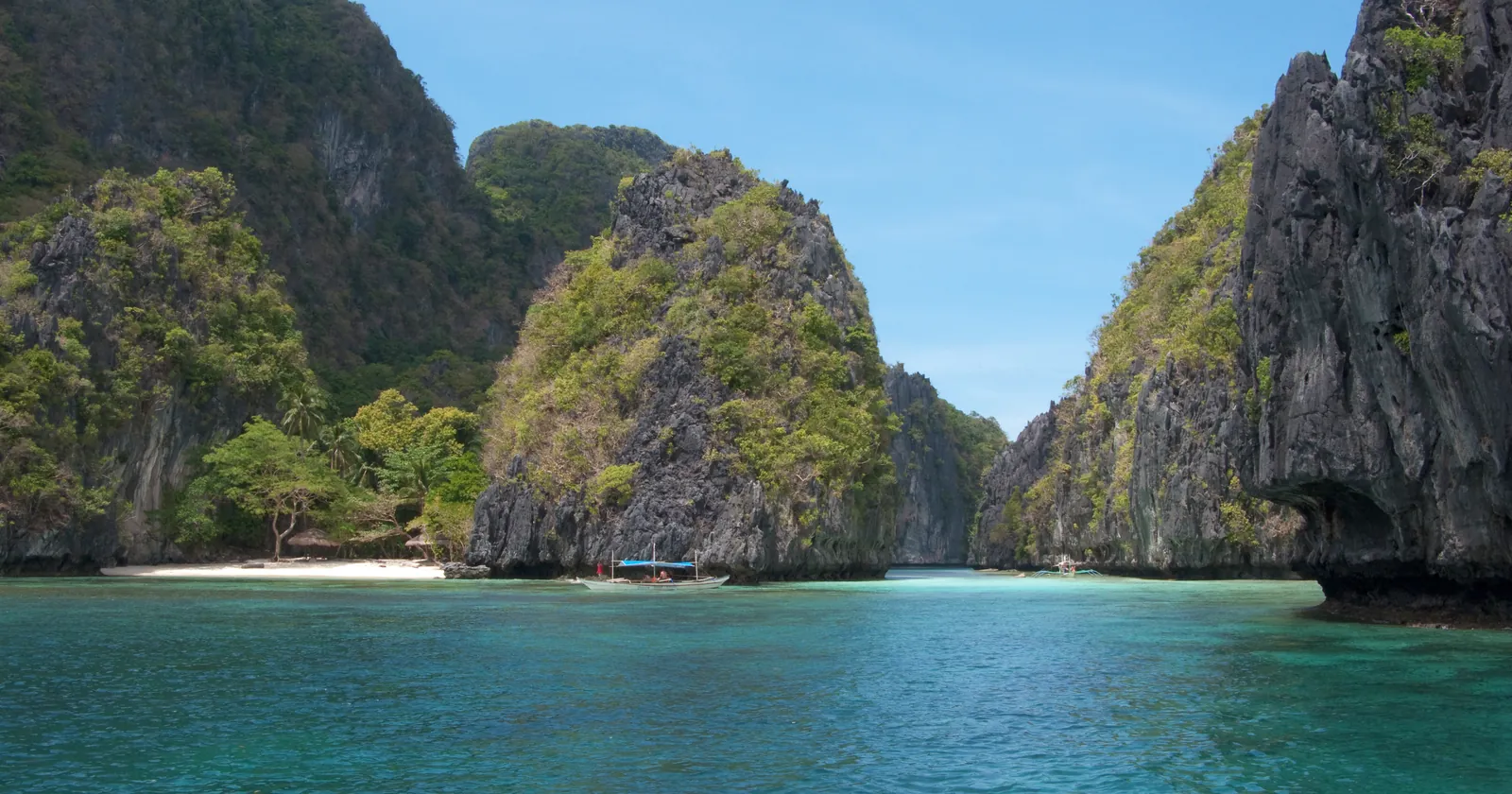
A limestone lagoon in Bacuit Bay, El Nido. Vyacheslav Argenberg, Wikimedia Commons, CC BY 4.0, cropped.

Key takeaways
- Tubbataha is closed to navigation except for permitted trips; every visitor pays a ₱5,000 conservation fee, boats must use park moorings, and taking anything, living or not, is banned
- The park's 2013 tourism plan gives mid-March to mid-June as the workable window, but its 2024 report shows boats entering from 20 February to 29 July
- In Coron, one shop lists its wrecks from the Lusong Gunboat at 0 to 10 meters to the Irako, whose deck is at 30 and sand at 45, a deep-certified dive
- NOAA's averages put Palawan's surface water at about 27.2 to 28.0 °C from January to March and 29.6 to 30.0 °C in May and June
- A 2025 news report lists a hyperbaric chamber at Ospital ng Palawan in Puerto Princesa among the country's three operational ones; we could not confirm it from the hospital, and nothing says it is staffed around the clock
Palawan diving: three kinds of trip in one province
Palawan is a long province, and its diving does not work as one destination. Tubbataha is an atoll park far out in the Sulu Sea that you can only visit on a licensed liveaboard for a few months a year. Coron, in the north around Busuanga, is a town where you base yourself and go out by day boat to the wrecks of a Japanese supply fleet. El Nido, on the north-west tip of the main island, is better known for its limestone islands and lagoons than for its scuba, and sits inside a protected area. Puerto Princesa, the provincial capital, is mainly where Tubbataha trips start. For life on the ground, see our Coron guide, our El Nido guide and the Coron vs El Nido comparison.
Tubbataha: liveaboard only, a short season and a no-take park
Tubbataha Reefs Natural Park covers 97,030 hectares, including the Tubbataha Reefs and Jessie Beazley Reef, in the municipality of Cagayancillo. It is protected under its own law, Republic Act 10067, the Tubbataha Reefs Natural Park Act, and is run by a protected area management board through the Tubbataha Management Office in Puerto Princesa. UNESCO listed it as a World Heritage Site in 1993. The office calls it the largest marine protected area in the Philippines and a strict no-take zone.
You cannot go on your own. The board's revised rules of 2024 declare the park off limits to navigation except for activities it sanctions, such as tourism and research, and entering without permission carries six months to a year in prison and a fine of ₱100,000 to ₱300,000. The management office does not run trips itself; it issues permits to accredited liveaboards, which sell the trips. To get a permit to operate, a boat needs accreditation from the Philippine Commission on Sports Scuba Diving, a holding tank and an AIS transceiver, and must apply at least two months before its first entry.
The office's own figures for getting there: fly to Puerto Princesa, then 10 to 12 hours at sea. Commercial trips stay five to seven days, or longer if the permit says so; private and non-commercial boats are limited to seven days. It says most visitors go on liveaboards, some booked as early as a year ahead, and quotes trip costs from about US$1,000 to more than US$4,000.
Fees and rules inside the park
Each visitor pays a conservation fee of ₱5,000 before entry, in pesos; dive masters pay ₱500, and children aged 12 and under pay nothing. Boats pay a separate entry fee by size, from ₱5,500 up to 100 gross tons to ₱11,000 above 200. Liveaboards usually bundle these: the one we priced lists a park and port surcharge per person on top of its fare. The office's 2024 report notes that a fee increase was announced for the 2025 season; its permits page did not say whether the ₱5,000 already includes it.
The rules are short and strict. Taking, gathering, disturbing or possessing any resource, living or not, is banned. Anchoring or tying up to the reef is banned, and every boat must use the park's mooring buoys, with fines of ₱50,000 to ₱100,000. Damage to the reef costs at least ₱12,000 a square meter in fines plus at least the same again for restoration. Drones need a permit, and dive masters may not carry cameras. Rangers drawn from the office, the navy, the coast guard and Cagayancillo are stationed on two-month rotations all year in a station on a sandbar on the North Atoll. We found no published rules for visitors landing at the station; ask your boat.
When the boats go
The management office's 2013 tourism plan says the south-west and north-east monsoons make the sea rough, and that moderate north-east winds from mid-March to mid-June allow regular visits, so the business runs for about 12 weeks a year. Practice has stretched that. In its 2024 tourism report the office records the first boat entering on 20 February and the last leaving on 29 July, with 217 trips and 3,686 visitors. The same report notes that 141 of the 187 trips leaving Puerto Princesa got a face-to-face briefing from park staff before departure.
The 2013 plan describes the diving as generally good for experienced and less experienced divers, with optimal depths of 10 to 30 meters, visibility up to 40 meters in season and 15 dive sites with moorings, not counting Jessie Beazley. The liveaboard we priced sets a higher bar of its own: Advanced Open Water and at least 50 logged dives.
Coron: the wreck fleet
Coron's diving rests on Japanese ships of the Second World War. Divernet's account of the site says US carrier aircraft attacked a supply fleet at anchor in Coron Bay and around Busuanga on 24 September 1944. Corto Divers in Coron town publishes its wrecks with lengths and depths, which give a good picture of the range:
| Wreck (Corto Divers' description) | Lies | Depth | Shop's minimum |
|---|---|---|---|
| Lusong Gunboat, 25 m | On a reef | 0 to 10 m | Open Water or try-dive |
| Teru Kaze, submarine hunter, 45 m | Nearly upright | Bow 3 m, stern 18 m | Open Water or try-dive |
| Okikawa, tanker, 160 m | Upright | Deck 13 m, sand 26 m | Advanced |
| Olympia, cargo ship, 128 m | Upright | Deck 20 m, sand 32 m | Open Water |
| Kogyo Maru, 141 m | Capsized | Hull 22 m, sand 34 m | Not stated |
| Akitsushima, seaplane tender, 118 m | Capsized | Hull 22 m, sand 36 m | Advanced |
| Irako, supply ship, 147 m | Upright | Deck 30 m, sand 45 m | Deep certification |
Corto says the Akitsushima is the only one classed as a warship. Off the wrecks, it takes Open Water divers to Barracuda Lake on Coron Island, reached over about 20 steps of limestone, where layers of water with different densities and temperatures sit on top of each other. Its prices include the marine park fees for its sites, but it says other sites' entrance fees are extra. We could not find Coron's municipal fee ordinance or an official list of the lake fees, so ask what is included before you book.
El Nido: diving inside a protected area
El Nido's waters are a protected area. Presidential Proclamation No. 32 of 8 October 1998 declared the El Nido Marine Reserve a managed resource protected area under the national protected areas law, 89,134.76 hectares of land and water under the environment department. Managed resource is the category meant to protect biodiversity while still allowing local use, so the rules of the national protected areas law apply on top of any local ones (see the rules section below).
Visitors also pay a municipal eco-tourism development fee. Tarawis El Nido Island Tours lists it at ₱200 per person, valid for ten days and paid separately from its dives. Higher figures circulate on travel sites, and we could not read the municipal ordinance, so carry cash and check the amount on arrival. Tarawis charges ₱5,000 a person for two fun dives, with at least two divers, and ₱5,500 for a two-dive try-scuba to a maximum of 12 meters. For El Nido's lagoons, tours and work set-up, see our El Nido guide.
Puerto Princesa: the jump-off for Tubbataha
Puerto Princesa is where the Tubbataha Management Office sits, and in 2024 it was the departure port for 187 of the 217 Tubbataha trips, by the office's count; the liveaboard we priced picks guests up at the airport or their hotel. It is also where emergencies from the park end up. The office's 2024 report records a diver found unconscious on a Tubbataha liveaboard on 24 March 2024 who was pronounced dead on arrival at a hospital in Puerto Princesa, and a guest with a dislocated hip taken back to the city for surgery. For Honda Bay, near the city, we found no operator page with its dive sites and no city page with its fees.
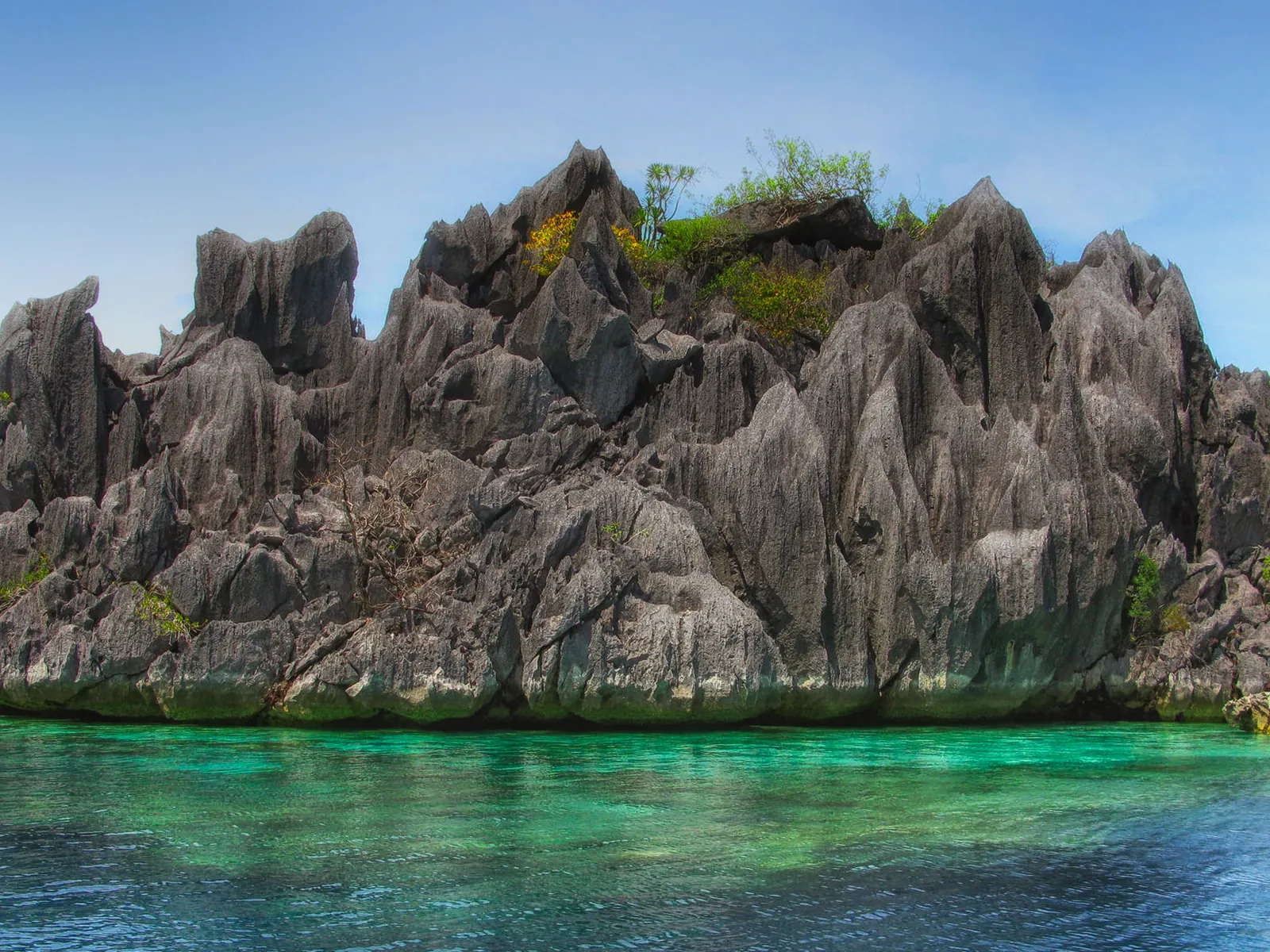
Limestone at Coron Island, above the bay where the wrecks lie. Ray in Manila, Wikimedia Commons, CC BY 2.0, cropped.

Palawan's rules: the province, protected areas and the fisheries law
Palawan has its own environmental law. The Strategic Environmental Plan for Palawan Act of 1992, Republic Act 7611, created the Palawan Council for Sustainable Development, under the Office of the President, and set up a graded system of protection over the whole province, including coral reefs, seagrass and the surrounding sea. In its coastal and marine zones, core zones, which can include selected coral reefs, are to be free from any human activity.
Inside national protected areas, which include Tubbataha and El Nido, the protected areas law as amended in 2018 bans taking or collecting wildlife without a permit, using gear that destroys coral reefs, littering, and running a motorized boat without a permit from the area's management board. Taking wildlife or using destructive gear carries a fine of ₱200,000 to ₱1 million or one to six years in prison. Everywhere in the country, the fisheries code as amended in 2015 makes it unlawful for any person to gather or possess corals, except for research, or to damage coral reefs, and bans taking species on CITES Appendix I or classed as threatened by the IUCN and the government. In plain terms: take nothing, touch nothing, and do not buy coral.
When to dive Palawan: season, typhoons and water
PAGASA, the Philippine weather service, divides the year into a rainy season from June to November and a dry season from December to May, with a cool dry stretch from December to February and a hot dry one from March to May. It counts about 20 tropical cyclones entering or forming in the Philippine area of responsibility in an average year, eight or nine of which make landfall, and notes that their north-west tracks spare Mindanao most direct hits. PAGASA publishes no Palawan-specific figure that we found, so treat the second half of the year as the risk period and follow its bulletins.
The water barely changes. NOAA's satellite averages for 1991 to 2020 give, for Coron Bay (cell 11.875°N 120.125°E), about 27.4 °C in February and 29.8 °C in May and June; for the sea off El Nido (11.125°N 119.125°E), 27.2 °C in February and 30.0 °C in May; for Tubbataha (8.875°N 119.875°E), 27.3 °C in February, 29.8 °C in May and 29.1 °C in September and October; and for the sea off Puerto Princesa (9.875°N 118.875°E) almost the same. No month in any of the four cells averages below 27 °C. These are surface figures.
Chamber and emergencies
The emergency number is 911, which an executive order of 25 May 2018 made the national hotline in place of 117. For a chamber, the only lead we found is a February 2025 report in The Freeman, which says the country had only three operational hyperbaric chambers and names one of them as being at Ospital ng Palawan, the government hospital in Puerto Princesa. We found nothing from the hospital or the tourism department confirming that the chamber treats divers or is staffed around the clock. The tourism infrastructure agency TIEZA ordered a chamber moved from Zamboanga to Coron, testing and commissioning included, with a notice to proceed posted on 2 March 2026; we could not confirm that it is running. We found no chamber in El Nido. Before a trip, ask your shop or boat for its evacuation plan, and check that your dive insurance covers evacuation from a liveaboard 10 to 12 hours from port.
What diving in Palawan costs
Prices on the operators' own pages, read on 10 November 2026:
| Operator | Item | Price |
|---|---|---|
| Corto Divers, Coron | Three dives, with equipment, torch, computer, park fees and lunch | ₱6,900 |
| Corto Divers, Coron | Open Water course, one pool session and five dives | ₱24,500 |
| Corto Divers, Coron | Wreck specialty, four dives over two days | ₱19,500 |
| Tarawis, El Nido | Two fun dives, minimum two divers | ₱5,000 |
| Tarawis, El Nido | Try-scuba, two dives, to 12 m | ₱5,500 |
| Philippine Siren (Master Liveaboards) | Tubbataha, six nights from Puerto Princesa, departing 30 March 2027 | US$4,350 per space, plus US$120 park and port fees |
Corto adds nitrox at ₱600 a tank. The Siren fare covers a shared cabin, full board, up to four dives a day, an 11-liter tank and weights; flights, nitrox, rental and tips are extra, and the page showed that departure as full.
Getting there
For Tubbataha, the route is a flight to Puerto Princesa and then the boat; most operators arrange the transfers, the management office says. For Coron and El Nido, routes and schedules change often; our Coron guide and El Nido guide cover them.
Palawan as a remote-work base
Many nationalities can start visa-free. The foreign affairs department's eVisa policy page lists the nationalities that may enter without a visa for an initial 30 days, among them Germany, France, Spain, Italy, the Netherlands, Switzerland, the UK, the US, Canada and Australia, with a passport valid six months beyond the stay and a return or onward ticket; Brazilians and Israelis get 59 days. Longer stays go through extensions at the Bureau of Immigration. We could not confirm the current extension rules or the maximum stay from the bureau itself.
The Philippines created a digital nomad visa by Executive Order No. 86 of 24 April 2025. It is for people aged 18 and over who work remotely for employers or clients outside the country, with income earned abroad, health insurance, a clean record and no local job, and only for nationals of countries that offer a similar visa to Filipinos. It lasts up to a year and can be renewed; the order sets no income figure and left the details to guidelines from the foreign affairs department. On 10 November 2026 the department's eVisa policy page listed no digital nomad category, and we found no published guidelines, so do not plan a long stay around it yet. Internet and coworking in Coron and El Nido are covered in our town guides.
Who Palawan suits
Palawan suits a diver who will plan around it: a Tubbataha trip booked months ahead for a spring window, with the logged dives and the Advanced card some boats ask for, or a longer stay in Coron working through wrecks from shallow to deep. It suits a remote worker who is content with a 30-day start and extensions. It suits less well anyone who wants Tubbataha outside its season, cheap open-ocean diving without a liveaboard, or a confirmed chamber within easy reach of the dive sites.
FAQ: Palawan diving
When is the Tubbataha diving season?
The park's 2013 tourism plan gives mid-March to mid-June as the window when winds allow regular visits. In 2024 the first boat entered on 20 February and the last left on 29 July, according to the park's tourism report. The management office says most visitors go on liveaboards, some booked as early as a year ahead.
How much is the Tubbataha conservation fee?
The Tubbataha Management Office lists ₱5,000 per visitor and ₱500 per dive master, paid in pesos before entry, with children aged 12 and under exempt. Liveaboards usually collect it as a surcharge; one charges US$120 per person for park and port fees.
How deep are the Coron wrecks?
Corto Divers lists them from the Lusong Gunboat at 0 to 10 meters to the Irako, with its deck at 30 meters and sand at 45, which it limits to deep-certified divers. The Okikawa, Olympia and Akitsushima lie between about 13 and 36 meters.
Is there a hyperbaric chamber in Palawan?
A February 2025 news report places one at Ospital ng Palawan in Puerto Princesa. We could not confirm from the hospital or the government that it is operating for divers or staffed around the clock. The national emergency number is 911.
What is the water temperature in Palawan?
NOAA's 1991 to 2020 averages give about 27.2 to 27.4 °C in February and 29.6 to 30.0 °C in May and June at the surface off Coron, El Nido, Tubbataha and Puerto Princesa. No month averages below 27 °C.
Note: Conditions, safety guidance and regulations change. Verify current information with official sources, including the dive operator, the park authority and the relevant government department, before you travel or dive.
Founder of NOMADREEF and a former digital nomad. This guide is sourced from the references below; conditions, prices and rules change, so verify current details, and follow qualified local guidance and safety briefings. About the author · LinkedIn ↗
Sources
- Tubbataha (primary). Tubbataha Management Office: permits and fees, tourism, about Tubbataha, visitor questions and law enforcement; Revised implementing rules, Administrative Order No. 01 s. 2024 (PDF), sections 4, 19 to 22 and 26; Comprehensive Tourism Management Plan, 2013 (PDF); Tourism Report 2024 (PDF); Republic Act 10067. Read 10 November 2026.
- Coron (operator primary for itself). Corto Divers, diving in Coron and prices; the raid date from Divernet, Attack on Coron Bay (secondary, attributed). Read 10 November 2026.
- El Nido. Department of Environment and Natural Resources, Proclamation No. 32, 1998 (PDF) (primary); Tarawis El Nido Island Tours, scuba packages (operator). Read 10 November 2026.
- Palawan and national rules (primary). Lawphil: Republic Act 7611, sections 7, 8, 10 and 16; Republic Act 11038, amended sections 20 and 21; Republic Act 10654, sections 96 and 102. Read 10 November 2026.
- Season and water. PAGASA, climate of the Philippines and FAQs (primary); NOAA PSL, OISST v2.1 monthly long-term means 1991–2020, four grid cells, computed for this page (primary). Read 10 November 2026.
- Emergencies. Executive Order No. 56, 2018 (primary); The Freeman, More hyperbaric chambers coming soon, 8 February 2025 (secondary). Read 10 November 2026.
- Prices (each operator primary for itself). Corto Divers; Tarawis El Nido Island Tours; Master Liveaboards, Philippine Siren, Tubbataha, 30 March 2027. Read 10 November 2026.
- Staying and working (primary). Executive Order No. 86, 2025; Department of Foreign Affairs, eVisa visa policy. Read 10 November 2026.
- Left out. Whether the Ospital ng Palawan chamber is running and when; the current El Nido eco-tourism fee from the ordinance itself; Coron's municipal and lake fees; Puerto Princesa's city fee and Honda Bay's dive sites; the Bureau of Immigration's extension rules, as its site did not load; published guidelines for the digital nomad visa; Tubbataha's ranger-station visitor rules and the details of the announced fee increase; and a primary record of the 1944 raid.