Naxos for Windsurfers and Kiters: Two Lagoons and One Wind
 by Yannick Schroth
Sep 19, 2026
11 min read
by Yannick Schroth
Sep 19, 2026
11 min read
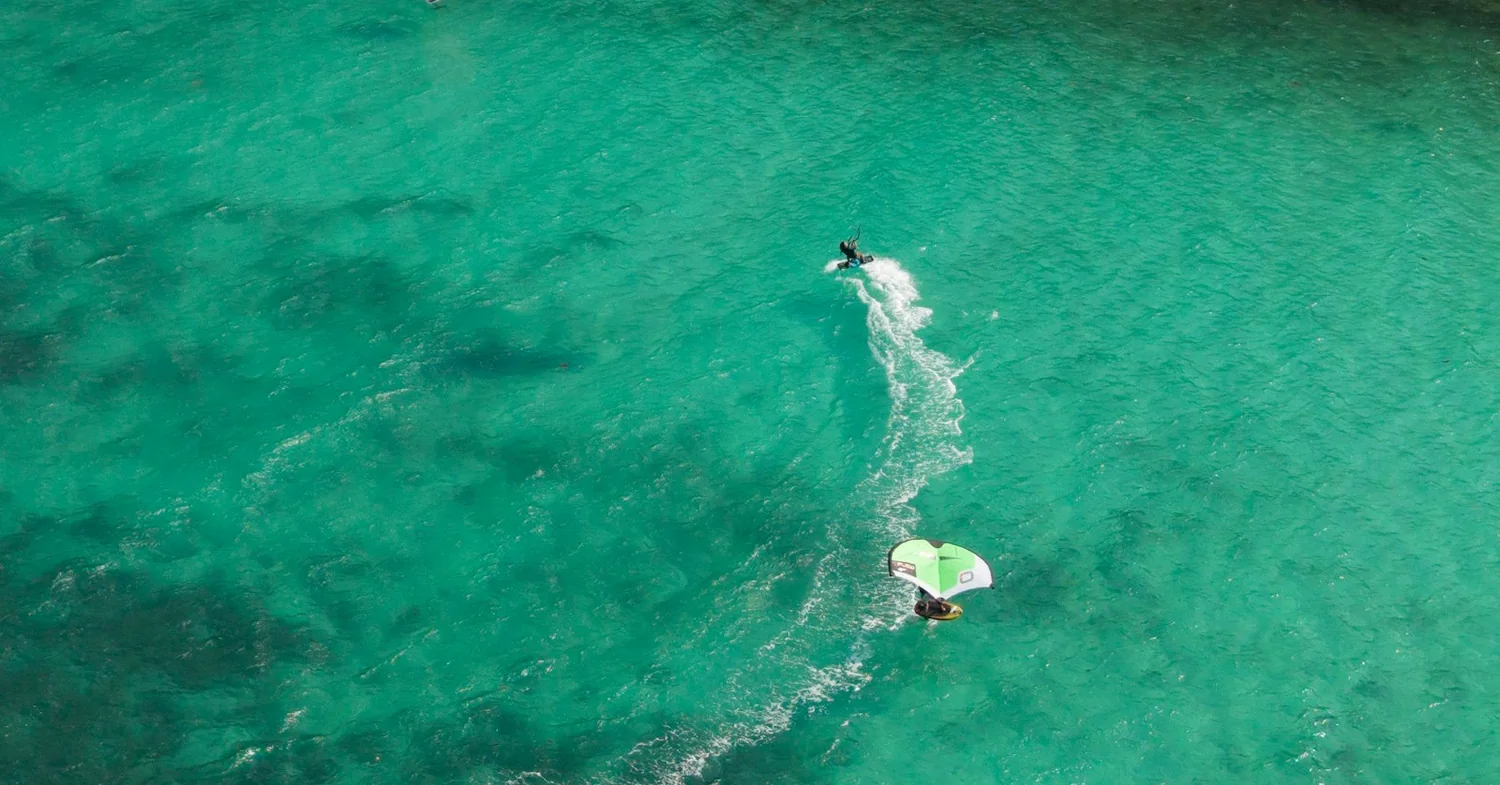
Photo: Unsplash (free licence).
Key takeaways
- The Laguna next to Agios Georgios is roughly a metre deep over sand and a fifteen-minute walk from Naxos Chora
- A rocky headland splits Mikri Vigla: the north bay takes the meltemi side-onshore, the south bay (Limanakia, also called Sahara) is sheltered from it
- An ordinary etesian day falls from about 15 knots at midday to under 10 at midnight; an outburst can hold for up to seven consecutive days with no night drop
- Greek port rules bar kitesurfing under 16 and require a certified lifeguard and a rescue vessel above 6 Beaufort
- The Bristol Beaufighter off Naxos was shot down in 1943, so the 50-year wreck rule applies and it is a registered-provider dive
Mikri Vigla: the Naxos kitesurfing bay, and the sheltered beach behind it
Mikri Vigla sits on the west coast about twelve kilometres south of Chora, nearer sixteen by the coast road, and the thing that makes it work is a lump of rock. A low headland runs out into the sea and cuts one long beach into two. Vigla is an old word for a lookout, which is what the rock was used for. For a rider it does something more useful: it gives the same stretch of sand two different answers to the same wind, on the same afternoon.
North of the headland the beach faces the open Aegean and takes the meltemi side-onshore, blowing across the sand and slightly onto it. That angle is why the spot has a kitesurfing industry rather than a rescue problem. Someone who goes down drifts back toward the beach instead of out to sea, and the bottom is sand. Behind a sandbar the water stays shallow and flat, which is the surface freestylers and first-week kiters both want.
South of the headland the picture inverts. Limanakia, also called Sahara, is a long sandy beach that the north wind largely misses, and it is used locally as a family beach rather than a sports one. On a day when the north bay is unrideable at force 8, the south side is where people swim. Shelter and exposure a few hundred metres apart, decided by a rock, is a rare arrangement in the Cyclades.
The dunes behind the beach are not scenery. Part of central and southern Naxos sits inside the Natura 2000 network, and the municipality describes the protected stretch as running from Vigla to Mavrovouni, naming seasonal coastal lagoons at Alyki, Mikri Vigla, Glyfada and Agios Prokopios among the habitats. The juniper forest at Alyko, a few kilometres down the same coast, is one of the densest in Greece. Park where the schools park, and stay off the dunes.
The Laguna at Agios Georgios: waist-deep windsurfing water beside Naxos Chora
Agios Georgios is the town beach of Naxos Chora, three or four hundred metres from the edge of the old town. Five minutes further along it, the water changes. The Laguna is a shallow pocket roughly a metre deep over sand, with a reef between it and the open sea. Waves break outside the reef. Inside it, they do not.
That is an unusual thing to have within a fifteen-minute walk of a Cycladic town centre. Most Greek wind destinations put the good water an hour’s drive from the nearest bank and pharmacy. Naxos puts a standing-depth training lagoon at the end of the promenade, and that changes the shape of a trip: no hire car, no shuttle timetable, and a learner who is finished at lunchtime can walk home.
The windsurf and wingfoil station on that water opens on 22 May and runs supervised rentals with VDWS-licensed instructors, rescue boats out on the water and cover from ten in the morning until seven in the evening. The wind comes in side-onshore from the right. Outside the lagoon, the swell that breaks over the reef is what gives the club its wave and freestyle ground, and it can reach two metres.
The trade-off is plain. A metre of water is forgiving, and it is also only a metre of water. Once you can hold a course upwind, the Laguna stops being interesting and the answer is the drive south. Plenty of people do both inside a week: learn in town, then ride at Mikri Vigla when the gybes start to stand up.
The meltemi over Naxos: June to September, and the outbursts that run for days
Meltemi is the everyday name. Meteorologists call these winds the etesians, from the Greek for yearly, and they are the dominant summer feature of the Aegean rather than a local sea breeze. They come out of a steep pressure gradient between high pressure over central Europe and the Balkans and the low over Anatolia, and the published work ties their rhythm to the Indian summer monsoon. Peak intensity and persistence fall in July and August.
The working numbers are these. Most meltemi days sit at 5 to 7 Beaufort, roughly 17 to 33 knots, and stronger episodes over the Aegean reach 8 or more. Wind speed over the Aegean often exceeds 15 metres per second, about 29 knots. One climatology places the etesian season between 1 June and 22 September, which is close to what the Naxos schools do with their calendars.
The detail that catches people out is the daily shape, and the fact that it sometimes vanishes. An ordinary etesian day has a clear swing: about 15 knots at midday and under 10 at midnight. At Mikri Vigla the wind typically arrives around ten in the morning and builds through the afternoon. During an outburst the swing goes away entirely. Direction and strength hold for up to seven consecutive days, through the night, without a lull to wait for.
That matters three ways. Rig for the afternoon, because the sail you were comfortable on at eleven is a different decision at four. Expect the sea surface to run cooler than the air during a long blow, which is why a shorty is fine in July and a longer suit earns its space in May and October. And do not build a seven-day trip around a forecast window, because on Naxos the window sometimes does not open.
Kitesurfing rules in Greece that bite at Mikri Vigla
Greece regulates kitesurfing through General Port Regulation No 20, published in the Government Gazette in April 1999 and amended since, most recently in December 2022. The rules are national and the local port authority enforces them, so they apply at Mikri Vigla exactly as they do at Prasonisi or on Paros. Two of them decide how a trip here is actually organised.
The first is age, and it surprises families. Kitesurfing is barred outright for anyone under 16. Fourteen- and fifteen-year-olds may ride on written parental consent, with proof that they can swim and an instructor supervising inside 100 metres. Below fourteen there is no route in, whatever a school somewhere else was willing to do.
The second is wind, and it surprises riders. Above 6 Beaufort, kitesurfing requires a certified lifeguard and a rescue vessel on the spot. In a Naxos August that is not an edge case, because 6 Beaufort is an ordinary afternoon. It is a large part of why riding here runs through a school with a boat rather than off the roof of a hire car.
The rest is geometry. Keep 200 metres from swimmers, anchored vessels, rocks and buoys marking underwater activity, and, outside a marked kite area, 200 metres off the coastline itself. Stay out of ports, marinas and fishing shelters, and inside one nautical mile of shore. No riding before sunrise or after sunset. A centre renting kit marks a launch corridor at least 100 metres wide with yellow buoys, posts a takeoff sign in Greek and English, and puts a kite up only when nobody is within 100 metres.
Diving and freediving on Naxos: the Beaufighter at 33 metres, and what Greek law allows
Naxos diving is reef, cavern and metal rather than big animals. Graviera, also called Frouros, lies ten minutes from the harbour and tops out at 18 metres: small canyons with octopus, moray and nudibranchs, and an Open Water dive. The Marianna sits with her stern at 24 metres and roughly 35 metres of hull still intact. The cave at Panteronisi, forty minutes out toward Antiparos, has an entrance at 12 to 15 metres and an air space you can surface into before swimming back out through the tunnel.
The dive that sets the legal question is the Bristol Beaufighter. The aircraft was shot down in 1943 and lies at a maximum of 33 metres, an Advanced-level boat dive. It crossed the fifty-year line in 1993, which puts it squarely under the rule that a wreck submerged more than 50 years may be dived only in the company of a registered provider of recreational diving services.
Greek diving is younger than the diving itself. Recreational scuba was opened by Law 3409/2005 and carried forward by Law 4688/2020. Before that the seabed was largely closed, for the protection of what lies on it.
The prohibitions that remain are specific. Diving is barred in marine areas designated by the culture ministry, in fragile marine areas, in shipping lanes and anchorages, in military areas, and within 100 metres either side of the launch point of rented recreational motorboats. Dives from one hour after sunset to one hour before sunrise need a registered provider as well.
Freediving is taught here too. The centre up at Kampos runs PADI Free Diver courses and stays open all year, which is not the Cycladic norm. None of the legal restrictions is something you will notice on a normal boat day, because the boats work inside them. You would notice them arriving with your own tanks and a chart.
Watersports schools in and around Naxos: twelve entries in three registers
Twelve watersports businesses in and around Naxos appear across three membership registers: three in SSI’s register of training centres, five in IKO’s and four in VDWS’s, as they stood on 21 August 2026. Only four of the twelve publish a website in the register entry itself. The other eight are findable, just not from there.
The phrasing matters more than it looks. A few of those twelve entries carry a town that is not on Naxos at all, Paros or Athens, because the bodies file addresses loosely and a business that teaches here may be registered somewhere else. So: twelve entries for Naxos in these registers, rather than twelve schools on Naxos. That difference is the sort of thing that turns into a wasted drive.
What a membership listing settles is narrow, and worth stating plainly. It says the body lists the business, on the date given. It says nothing about the teaching, the kit, the boats, the insurance, or whether the school opens this season. Every entry on the Naxos operator list links back to the register page it came from, so the affiliation can be checked at the source instead of taken from here.
The listing that would settle more does not come out. Greece requires providers of recreational diving services to register through the port police directorate of the shipping ministry, renewed every five years with the local port authority, and Law 3409/2005 also requires the certification organisations to keep registries of the providers they recognise. The state register exists. The list does not: ynanp.gr and gov.gr both answer a plain request with HTTP 403, checked 19 September 2026. The situation is recorded on which registers can be read.
Ferries to Naxos in a meltemi: the fast craft stop before the Blue Stars
Naxos is about five and a half hours from Piraeus on a conventional Blue Star and between three and a quarter and four and a half on a high-speed catamaran, with up to seven crossings a day in season. In a meltemi those two numbers stop being interchangeable, and the cheap assumption that a faster boat is a better boat inverts.
A sailing ban, the apagorevtiko, is an administrative decision by the port authority about the state of the sea. The ferry company is complying with it, not choosing. Catamarans and fast craft are usually held first, around 6 to 7 Beaufort, while conventional ships generally keep sailing until 8 and above. The boat booked to save two hours is the boat most likely to be cancelled.
14 August 2026 is a fair example of how that looks. A general sailing ban went on ships departing Rafina and Lavrio, gusts were locally over 100 kilometres an hour, and among the cancellations was the Super Speed 4 service to Paros, Naxos and Koufonisia.
The airport is a weak backup rather than a way around it. Naxos Island National Airport sits about three and a half kilometres south-west of Chora with a 901-metre asphalt runway, which limits it to small turboprops, and it is domestic: Athens with Olympic Air and Sky Express, plus seasonal Aegean flights to Heraklion and Thessaloniki. Small aircraft on a short strip in a gale are not the aircraft that keeps flying. Put a day of slack in front of an international connection in August.
Naxos Chora and the Portara: where to base for wind and for work
Naxos is the largest island of the Cyclades at roughly 430 square kilometres, and Mount Zas at 1,001 metres is the highest point in the group. About 20,600 people lived on it at the 2021 census, close to 8,900 of them in Chora. That population is what decides how a month here feels: a year-round town with a hospital, banks and a bus network, not a strip of businesses that shutters in October.
At the harbour entrance, on the islet of Palatia, stands the Portara. It is a marble doorway of four blocks weighing roughly twenty tonnes each, and it is all that was ever built of a temple of Apollo begun around 530 BC under the tyrant Lygdamis. The plan was 59 metres by 28, with the entrance on the western side, unusual for an Ionic temple. Lygdamis fell, the peripheral colonnade was never finished, and a church was later built into the foundations.
Where to sleep follows from the geography. Chora gives you the Laguna on foot, the ferries, the shops and the Portara at sunset, with a twenty-minute drive on the days you want Mikri Vigla. Mikri Vigla gives you the kite bay out of the front door, the sheltered beach behind the headland when it blows too hard to ride, and a short list of places to eat. Riders on a week usually take the beach. People staying a month usually take the town.
Internet in Naxos: fibre in Chora and mobile at Mikri Vigla
Naxos had a fixed line long before it had a reputation for remote work. The European Commission’s 2026 Digital Decade country report for Greece records steady progress in fibre deployment while placing the country below the EU average, with significant disparities remaining between urban and rural areas. On an island, that reads as good in the town and variable outside it.
The practical split follows the same line as everything else here. Chora and the larger villages have fixed connections worth working on. Mikri Vigla and the west-coast beaches are a mobile-data proposition, and a spot whose own operators put windy days above 80 per cent is also a spot where you will be outdoors from ten until sunset. The workable pattern is calls and heavy uploads in town in the morning, beach once the wind fills.
On staying legally, Greece runs a digital nomad visa under Law 4825/2021 for non-EU nationals, with an income test set out in the Paros guide. EU and EEA passport holders need none of it.
FAQ: windsurfing and kitesurfing in Naxos
When is the windsurfing and kitesurfing season in Naxos?
The meltemi blows from June to September, with peak intensity and persistence in July and August, and one published climatology puts the wider etesian season between 1 June and 22 September. The windsurf and wingfoil station on the Laguna beside Naxos Chora opens on 22 May. May and October are the shoulders: rideable, less certain, far emptier. Outside that window Naxos is a Greek island with beaches, not a wind destination.
Where do you kitesurf on Naxos?
At Mikri Vigla, about twelve kilometres south of Chora on the west coast. A rocky headland splits the beach in two: the north bay takes the meltemi side-onshore with shallow flat water behind a sandbar, and that is where the kite schools sit. The south bay, called Limanakia or Sahara, is sheltered from the same wind and is used for swimming instead.
Is Mikri Vigla good for beginners, or only for strong wind?
The wind at Mikri Vigla is side-onshore, so a rider who goes down drifts back toward a sand beach rather than out to sea, and the water behind the sandbar is shallow and flat. The geography is beginner-friendly. The strength often is not: 5 to 7 Beaufort is a normal July or August afternoon, and Greek port rules require a certified lifeguard and a rescue vessel above 6 Beaufort. A first week is usually easier on the Laguna at Agios Georgios.
How strong does the meltemi get on Naxos?
Most meltemi days sit at 5 to 7 Beaufort, roughly 17 to 33 knots, with stronger episodes over the Aegean reaching 8 or more, and wind speed over the Aegean often exceeds 15 metres per second. An ordinary etesian day swings from about 15 knots at midday to under 10 at midnight. During an outburst that daily swing disappears and the wind can hold for up to seven consecutive days. Rig for the afternoon rather than for the morning you are standing in.
What are the kitesurfing rules in Greece, and do they apply at Mikri Vigla?
They apply everywhere, through General Port Regulation No 20 and the local port authority. Kitesurfing is barred under 16, with 14- and 15-year-olds allowed only on written parental consent, proof of swimming ability and an instructor supervising within 100 metres. Above 6 Beaufort a certified lifeguard and a rescue vessel are required. Riders keep 200 metres from swimmers, anchored vessels, rocks and dive buoys, stay within one nautical mile of shore, and stay off the water before sunrise and after sunset.
Can you dive and freedive on Naxos, and what does Greek law allow?
Yes to both, and PADI Free Diver courses run on the island. Recreational diving in Greece was opened by Law 3409/2005 and carried forward by Law 4688/2020. Diving is prohibited in marine areas designated by the culture ministry, in fragile marine areas, in shipping lanes and anchorages, in military areas, and within 100 metres either side of the launch point of rented recreational motorboats. Wrecks submerged more than 50 years, and dives between one hour after sunset and one hour before sunrise, are allowed only with a registered provider.
What are the best dive sites on Naxos?
The Graviera reef, also called Frouros, is ten minutes from the harbour with a maximum depth of 18 metres and small canyons holding octopus, moray and nudibranchs. The Marianna wreck lies with its stern at 24 metres and about 35 metres of hull intact. The Bristol Beaufighter, shot down in 1943, is an Advanced boat dive at a maximum of 33 metres, and being more than 50 years down it is a registered-provider dive. The cave at Panteronisi has an entrance at 12 to 15 metres.
How many watersports schools are there in and around Naxos?
Twelve entries for Naxos appear across three membership registers: three SSI, five IKO and four VDWS, as they stood on 21 August 2026. Four of the twelve publish a website in the register entry itself. A few entries carry towns that are not on Naxos, such as Paros or Athens, because the bodies file addresses loosely, so twelve entries for Naxos is the accurate phrase rather than twelve schools on Naxos.
What happens to Naxos ferries when the meltemi blows?
The port authority issues a sailing ban and the operators cancel whatever cannot run under it. High-speed catamarans are usually held first, around 6 to 7 Beaufort, while conventional ships such as the Blue Stars generally keep sailing until 8 and above. On 14 August 2026 a general sailing ban covered departures from Rafina and Lavrio and the Super Speed 4 service to Paros, Naxos and Koufonisia was cancelled. Leave a day of slack in front of a flight home in August.
Do you need a car on Naxos for windsurfing and kitesurfing?
Not to learn. The Laguna beside Agios Georgios is about a metre deep and a fifteen-minute walk from Chora. For Mikri Vigla, twelve kilometres south, you need a car, a scooter or a school shuttle. Buses cross the island on a timetable built around beach days rather than around a wind window.
Founder of NOMADREEF and a former digital nomad. This guide is sourced from the references below; conditions, prices and rules change, so verify current details, and follow qualified local guidance and safety briefings. About the author · LinkedIn ↗
Sources
- Mikri Vigla’s two bays, and the Natura 2000 coast behind them. The municipality of Naxos and the Small Cyclades describes the protected stretch as running from Vigla to Mavrovouni with seasonal coastal lagoons at Alyki, Mikri Vigla, Glyfada and Agios Prokopios, and the juniper forest at Alyko: naxos.gr. The split into a north bay exposed to the meltemi and a southern beach (Limanakia or Sahara) sheltered from it, and the 12 km distance from Chora, from greeka.com; the road distance of about 16 km and the side-onshore wind direction from the school on the beach, kiteandsurfnaxos.com. Read 19 September 2026.
- The etesian season, strength and daily cycle. Peak intensity and persistence in July and August, wind speed over the Aegean often exceeding 15 m/s, and the driving pressure gradient between the central European and Balkan high and the Anatolian low: Weather and Climate Dynamics 3, 811–830 (2022). The season placed between 1 June and 22 September, the diurnal swing of about 15 kt at noon against under 10 kt at midnight, and outbursts of up to seven consecutive days without that swing: Atmósfera 35(1), 89 (2022). The everyday figures of 5 to 7 Beaufort on most days and 8 or more in stronger episodes are triangulated across marine and meteorological sources rather than taken from a single station series. Read 19 September 2026.
- The Laguna, its depth and the windsurf station. A lagoon about 1 m deep with a reef between it and the open sea, five minutes from Agios Georgios and fifteen minutes on foot from Naxos Town: greeka.com. The 22 May opening, VDWS-licensed instructors, rescue boats, supervision from 10:00 to 19:00, side-onshore wind from the right and a swell outside the lagoon reaching two metres, all operator-published: flisvos-sportclub.com. The figure of over 80 per cent windy days is likewise operator-published, from flisvos-kitecentre.com. Read 19 September 2026.
- Greek kitesurfing rules. General Port Regulation No 20 (Government Gazette B 444 of 26 April 1999, amended 30 May 2018 and 21 December 2022): minimum age 16, with 14- and 15-year-olds on written parental consent, proof of swimming and supervision inside 100 m; a certified lifeguard and rescue vessel required above 6 Beaufort; 200 m from swimmers, anchored vessels, rocks and dive buoys, and from the coastline outside a marked area; a limit of one nautical mile offshore; no riding before sunrise or after sunset; a marked launch corridor at least 100 m wide and a 100 m clear radius for launching. Set out by Safe Water Sports, which publishes the Greek water-sports legislation: kitesurf rules and General Port Regulation No 20. Read 19 September 2026.
- What Greek law allows underwater. Law 3409/2005 (Government Gazette A 273 of 4 November 2005) on recreational diving, as carried forward by Law 4688/2020. The prohibitions are in Article 11: marine areas designated by the culture ministry, ship transit and anchorage, military exercise areas, 100 m either side of the launch points of rented recreational motorboats, and the hours from one hour after sunset to one hour before sunrise. Article 3 places the duty to keep registries of recognised providers on the certification organisations. Full text at Article 11 and Article 3. The 50-year threshold for wrecks comes from the same framework as amended. Read 19 September 2026.
- The Greek provider register, and why it is not cited per operator. Registration of recreational diving service providers runs through the port police directorate of the shipping ministry, with a five-year renewal at the local port authority. No public list is served: ynanp.gr and gov.gr both answer a plain request with HTTP 403, checked 19 September 2026. Recorded on which registers can be read.
- Naxos dive sites and depths. Graviera (Frouros) at a maximum of 18 m ten minutes from base; the Marianna with her stern at 24 m and about 35 m intact; the Bristol Beaufighter shot down in 1943 at a maximum of 33 m, Advanced level; the Panteronisi cave near Antiparos with an entrance at 12 to 15 m. Operator-published by the dive centre that runs them: naxosdivingcenter.gr. PADI Free Diver training on the island, and a centre open all year at Kampos, from the municipality: naxos.gr. Read 19 September 2026.
- Sailing bans and the 14 August 2026 cancellations. A general sailing ban on ships departing Rafina and Lavrio, gusts locally over 100 km/h, and the Super Speed 4 service to Paros, Naxos and Koufonisia cancelled: protothema.gr, 14 August 2026. The thresholds at which fast craft are held before conventional ships (roughly 6 to 7 Beaufort against 8 and above) are triangulated across ferry and charter operators rather than taken from a published port-authority rule. Read 19 September 2026.
- Naxos airport and island geography. A 901 m asphalt runway, domestic service to Athens with Olympic Air and Sky Express plus seasonal Aegean flights, an island area of about 430 km², Mount Zas at 1,001 m as the highest point of the Cyclades, and a 2021 census population of 20,578 with 8,897 in Chora. Encyclopaedic secondary sources, cross-read against each other: Naxos Island National Airport and Naxos. The Portara details (530 BC, the tyrant Lygdamis, the islet of Palatia, four blocks of about 20 tonnes, a plan of 59 by 28 m, the western entrance) come from the municipality: naxos.gr. Read 19 September 2026.
- Fibre and mobile. Steady progress in fibre deployment, below the EU average, with significant disparities remaining between urban and rural areas: European Commission, Greece’s 2026 Digital Decade country report. Read 19 September 2026.
- The twelve register entries. Counts from the SSI register of training centres and the IKO and VDWS registers of affiliated centres as they stood on 21 August 2026: three SSI, five IKO, four VDWS, with four of the twelve publishing a website in the entry. Sources: divessi.com, ikointl.com and vdws.de. Each entry links to its register page on the Naxos operator list.