Rhodes for Windsurfers and Divers: Two Wind Coasts and a Late Season
 by Yannick Schroth
Sep 19, 2026
9 min read
by Yannick Schroth
Sep 19, 2026
9 min read
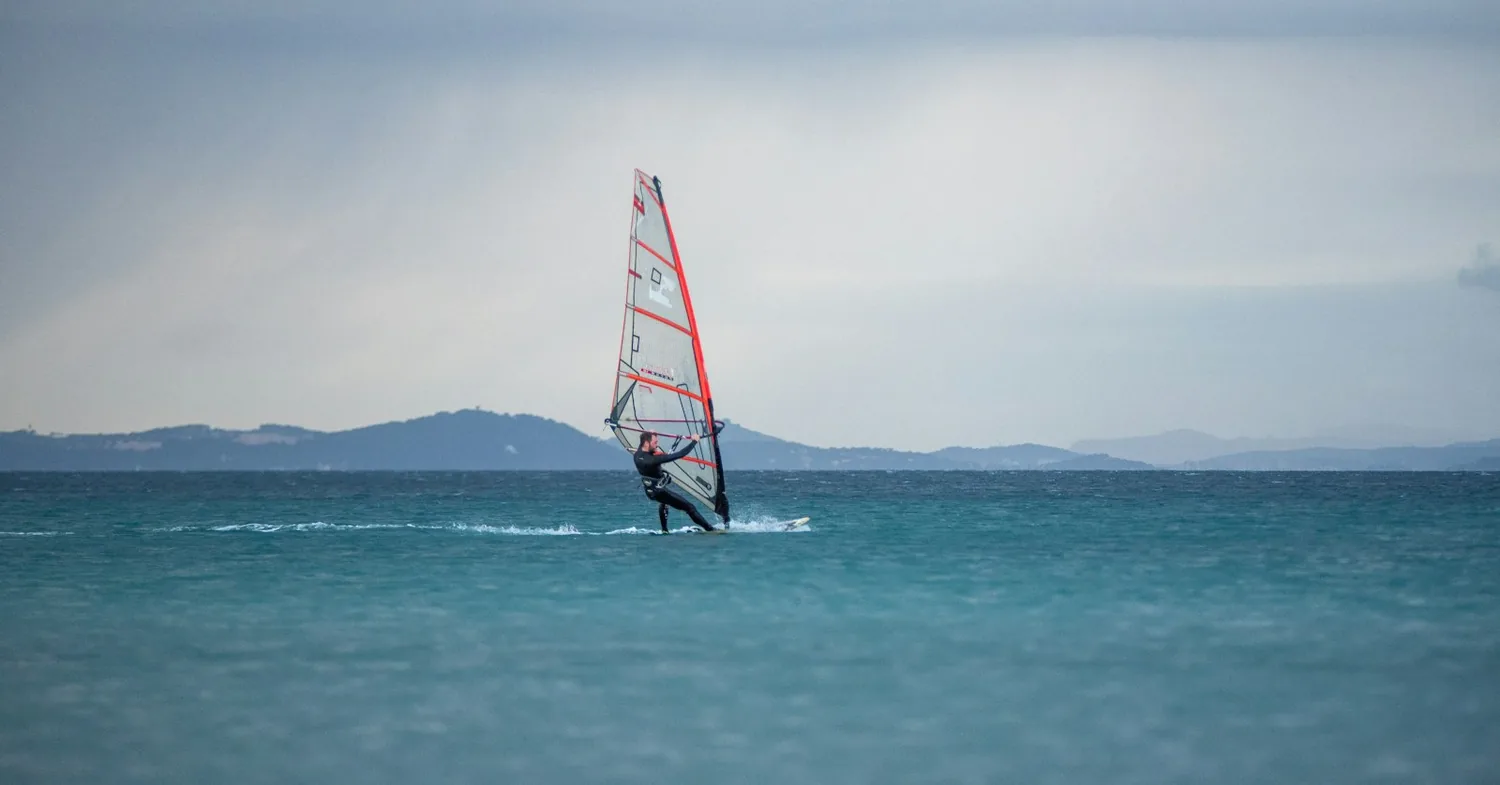
Photo: Unsplash (free licence).
Key takeaways
- The meltemi runs June to September, strongest in July and August, most days 5 to 7 Beaufort and stronger episodes at 8 or more
- Prasonisi is a tombolo: flat, standing-depth water on one side of the sand strip and chop or wave on the other, a few hundred metres apart
- Five of the ten registered schools sit on the west coast near Rhodes Town, not at Prasonisi, which is 90 km south
- Recreational diving in Greece was only opened by Law 3409/2005; antiquity zones, 50-year-old wrecks and night dives are still restricted
- Greece registers diving providers but publishes no readable list: ynanp.gr and gov.gr both return HTTP 403
Prasonisi: the sandbar at the southern tip, and why two seas matter
Rhodes runs roughly north-east to south-west for eighty kilometres, and it ends in a curiosity. Prasonisi is a small island off the southern tip, joined to Rhodes by a narrow strip of sand, a tombolo. The Aegean presses on one side of that strip and the Levantine Sea on the other, and the meltemi crosses it. The practical result is that within a few hundred metres you have flat, shallow water on the lee side and chop or wave on the windward side.
That is the whole reason the place has a windsurf industry. A learner and someone doing loops can use the same car park on the same afternoon and never share water. The flat side is standing depth a long way out, which is what makes it forgiving; the other side is where the swell comes from and where the good sailors go.
The sand strip itself is not permanent furniture. It widens and narrows with the season and the swell, and in a strong meltemi it takes water across the top. Walking to the island is a thing people do in calm early summer and not a thing to plan a day around.
The other wind coast: Trianda, Ixia and Theologos on the west side
Prasonisi gets the photographs, and most of the schools are somewhere else. The island's west coast faces the open Aegean and takes the meltemi square on, and it is where five of the ten registered centres sit: Trianda just outside Rhodes Town, Theologos twenty minutes further down, and the bays either side of them.
The difference is not the wind, which is the same system, but the water and the drive. The west coast is a shore break onto shingle in places rather than a shallow lagoon, and it is twenty minutes from the airport instead of ninety. For a two-week trip with a hire car that matters less than it sounds. For a month of working and riding, it decides where you sleep.
The south-east coast is the quiet one. Plimmiri and Kiotari have centres attached to resorts, which is a different proposition again: shorter carry, gear included, less choice of kit.
The meltemi: when it blows, how hard, and what else it does
The meltemi, the etesian wind of the Aegean, is a summer northerly driven by the pressure difference between a high over the Balkans and the thermal low over Anatolia. It is not a sea breeze and it does not switch off at dusk. The season runs June to September, with the strongest and most persistent stretch in July and August.
Most meltemi days sit at 5 to 7 Beaufort, which is roughly 17 to 33 knots, and stronger episodes over the Aegean reach 8 or more. It generally builds through the morning and peaks in the afternoon, which is why the sail size you rig at eleven is a different decision from the one you would make at three. Windsurf centres at Prasonisi open around 25 April and close at the end of October, and the shoulder months are where the lighter days are.
Two side effects are worth knowing before you book. The meltemi cools the Aegean surface noticeably during a strong run, which is why a shorty is fine in July and a long suit earns its space in May and October. And it closes ferries: island-hopping plans made in advance meet a port authority decision on the morning, not a timetable.
Diving Rhodes, and what Greek law allows underwater
Greek diving is younger than the diving itself. Until 2005 recreational scuba was heavily restricted across the country, for the protection of a seabed that holds a great deal of antiquity. Law 3409/2005 opened it, and Law 4688/2020 carried the framework forward and added underwater museums. The registration duty that falls on anyone selling guided dives is set out on gov.gr.
What that means for a diver on Rhodes is a short list of places you cannot go and rules that do not bend. Diving is prohibited in declared underwater antiquity zones, in areas designated as fragile marine environments, in shipping lanes and anchorages, in military areas, and within 100 metres of the launch point of rented recreational motorboats.
Two further rules catch visitors out. A wreck that has lain on the bottom for more than 50 years may only be dived in the company of a registered provider of recreational diving services, and so may a night dive: anything from one hour after sunset to one hour before sunrise needs one.
None of that is a limitation you will feel on a normal day out of a Rhodes centre, because the centres work inside it. It is a limitation you would feel if you arrived with your own tanks and a map.
The ten registered schools on Rhodes, and what a listing settles
Ten watersports businesses on Rhodes appear in the registers this site reads: three in the SSI register of training centres, two in IKO's and five in VDWS's, read on 21 August 2026. They are spread across five places, which tells you something about the island: this is not one bay with a strip of schools, it is a large island with wind on two coasts.
What a register entry settles is narrow and worth stating plainly. It says the body lists the business, on the date given. It says nothing about the teaching, the kit, the boats or whether the school is open this season. Every entry on the Rhodes operator list links back to the register page it was read from, so you can check the affiliation at the source instead of taking it from here.
There is one thing this site cannot give you for Greece, and it is the thing that would be most useful. Greece does require anyone providing recreational diving services to register, under the same Law 3409/2005, through the port police directorate of the shipping ministry, renewed every five years with the local port authority. The register exists.
The list does not come out. ynanp.gr and gov.gr both answer an ordinary request with HTTP 403, checked on 19 September 2026. It is the same situation as Thailand, described on which registers can be read: a licence that exists and nothing to check it against.
Getting to Rhodes, and moving between the two coasts
Rhodes has its own international airport at Paradisi (RHO) on the west coast, which is the easy part: it is about twenty minutes from Trianda and fifteen from the Ixia hotel strip. The hard part is the island's length. Prasonisi is roughly 90 kilometres south of Rhodes Town, and the drive is an hour and a half on a road that gets slow behind coaches in August.
That distance is the practical decision of the trip. Basing at Prasonisi means committing to the south, where the village is small and the choice of dinner is short. Basing near Rhodes Town or Ixia means a town, an airport twenty minutes away, and a drive on the days you want the lagoon. Buses run the island but not on a rider's schedule, and a hire car is the normal answer.
Working from Rhodes between sessions
Rhodes is a full-sized island with a year-round population and a large tourist economy, and the connectivity follows: fixed lines in Rhodes Town, Ixia and the larger villages, and solid mobile coverage on the main roads. It is a better remote-work base than most wind destinations of this size, and the constraint is not the connection but the calendar. August prices are August prices, and the meltemi peaks in the same weeks.
On staying legally, Greece runs an operational digital nomad visa under Law 4825/2021 for non-EU nationals, which is covered in the Paros guide alongside its income test. EU and EEA passport holders need none of it.
Safety on Rhodes: an offshore-capable wind and a rocky coast
The meltemi is a north wind on a north-facing coast, which is the direction that matters. On the west coast it is largely cross-shore to cross-on, which is workable; at Prasonisi the two sides of the sandbar have different answers, and the one that sends you toward open water is the one to be certain about before launching. Ask at the centre which side is which today. It changes with the wind angle.
Second, it builds. A comfortable late morning becomes an overpowered afternoon often enough that it is the normal pattern rather than an exception, and the failure mode is being on the water with too much sail and a long upwind back. Rig for the afternoon or plan to come in.
Third, for divers, the boat is the safety system on a rocky, exposed coast. The prohibition on unaccompanied dives at old wrecks and at night is not bureaucratic decoration: a shore entry in a meltemi swell is how people get hurt on islands that look this calm from a hotel balcony.
FAQ: windsurfing and diving in Rhodes
When is the windsurfing season in Rhodes?
The meltemi blows from June to September, strongest and steadiest in July and August, and the Prasonisi centres run from late April to the end of October. May and October are the shoulders: rideable, less certain, far emptier. Outside that window Rhodes is a Greek island with a beach, not a wind destination.
What makes Prasonisi different from other Greek windsurf spots?
It is a tombolo, a sandbar joining a small island to the southern tip of Rhodes, with the Aegean on one side and the Levantine Sea on the other. Within a few hundred metres you have flat water on the lee side and wind-driven chop or wave on the other, which is why a beginner and an advanced rider can use the same beach on the same day.
Is Rhodes good for beginners, or only for strong wind?
Both, but not in the same place or the same month. The flat side at Prasonisi and the bays on the west coast work for learning early and late in the season. In July and August the meltemi regularly runs 5 to 7 Beaufort, which is not a first lesson, and schools move beginners to sheltered water or to the morning.
How strong does the meltemi get on Rhodes?
Most meltemi days sit at 5 to 7 Beaufort, roughly 17 to 33 knots, with stronger episodes reaching 8 or more over the Aegean. It builds through the morning and typically peaks in the afternoon. Sail and kite selection is a morning decision here, not an afternoon one.
Can you dive in Rhodes, and what does Greek law allow?
Yes. Recreational diving in Greece was opened by Law 3409/2005 and regulated further by Law 4688/2020. Diving is prohibited in declared underwater antiquity zones, fragile marine areas, shipping lanes and anchorages, and military areas. Wrecks that have lain more than 50 years may only be dived with a registered provider, and night diving needs one too.
How many dive and watersports schools are there on Rhodes?
Ten appear in the registers this site reads: three in the SSI register of training centres, two in IKO's and five in VDWS's, read on 21 August 2026. They sit in five different places on the island, from Trianda in the north-west to Plimmiri and Theologos in the south.
Is there a Greek licence I can check an operator against?
Not one you can read. Greece requires providers of recreational diving services to register under Law 3409/2005 through the port police directorate of the shipping ministry, with a five-year renewal at the local port authority. No public list of registrants came out: both ynanp.gr and gov.gr answer an ordinary request with HTTP 403.
Do you need a car on Rhodes?
For wind, effectively yes. Prasonisi is about 90 kilometres from Rhodes Town at the far southern tip, and the west-coast spots are spread along the coast road. If you are basing at one centre and riding there daily you can manage without, but you will be tied to its shuttle and its hours.
Founder of NOMADREEF and a former digital nomad. This guide is sourced from the references below; conditions, prices and rules change, so verify current details, and follow qualified local guidance and safety briefings. About the author · LinkedIn ↗
Sources
- What Greek law allows underwater. Law 3409/2005 on recreational diving, as carried forward by Law 4688/2020: diving prohibited in declared underwater antiquity zones, fragile marine environments, shipping lanes and anchorages, military areas, and within 100 m of the launch point of rented recreational motorboats; wrecks submerged more than 50 years and dives between one hour after sunset and one hour before sunrise only with a registered provider. The obligation to register as a provider is described on the state's own service page, gov.gr. Read 19 September 2026.
- The Greek provider register, and why it is not cited per operator. Registration of recreational diving service providers runs through the port police directorate of the shipping ministry with a five-year renewal at the local port authority. No public list could be read: ynanp.gr and gov.gr both answer a plain request with HTTP 403, checked 19 September 2026. Recorded on which registers can be read.
- The meltemi season and strength. The etesian northerly of the Aegean blows June to September, strongest and most persistent in July and August, most days at 5 to 7 Beaufort with stronger episodes reaching 8 or more. Triangulated across meteorological and marine sources rather than taken from a single station series; the Hellenic National Meteorological Service issues the daily marine bulletins by sea area, which is the forecast to read on the morning rather than a monthly average.
- Prasonisi's two sides and the operating season. The windsurf centre on the sandbar publishes a season of 25 April to 31 October, flat water on the lee side and wave on the other, and wetsuit guidance of a long suit in April, May and October against a shorty from June to September: severnesails.com and the centre's own site at prasonisi.com. Operator-published, read 19 September 2026.
- The ten schools. Counted from the SSI register of training centres and the IKO and VDWS registers of affiliated centres, read 21 August 2026: three SSI, two IKO, five VDWS, from divessi.com, ikointl.com and vdws.de. Each entry links to its register page on the Rhodes operator list.