Best Kitesurfing Destinations for Digital Nomads (2026)
 by Yannick Schroth
Jul 28, 2026
7 min read
by Yannick Schroth
Jul 28, 2026
7 min read
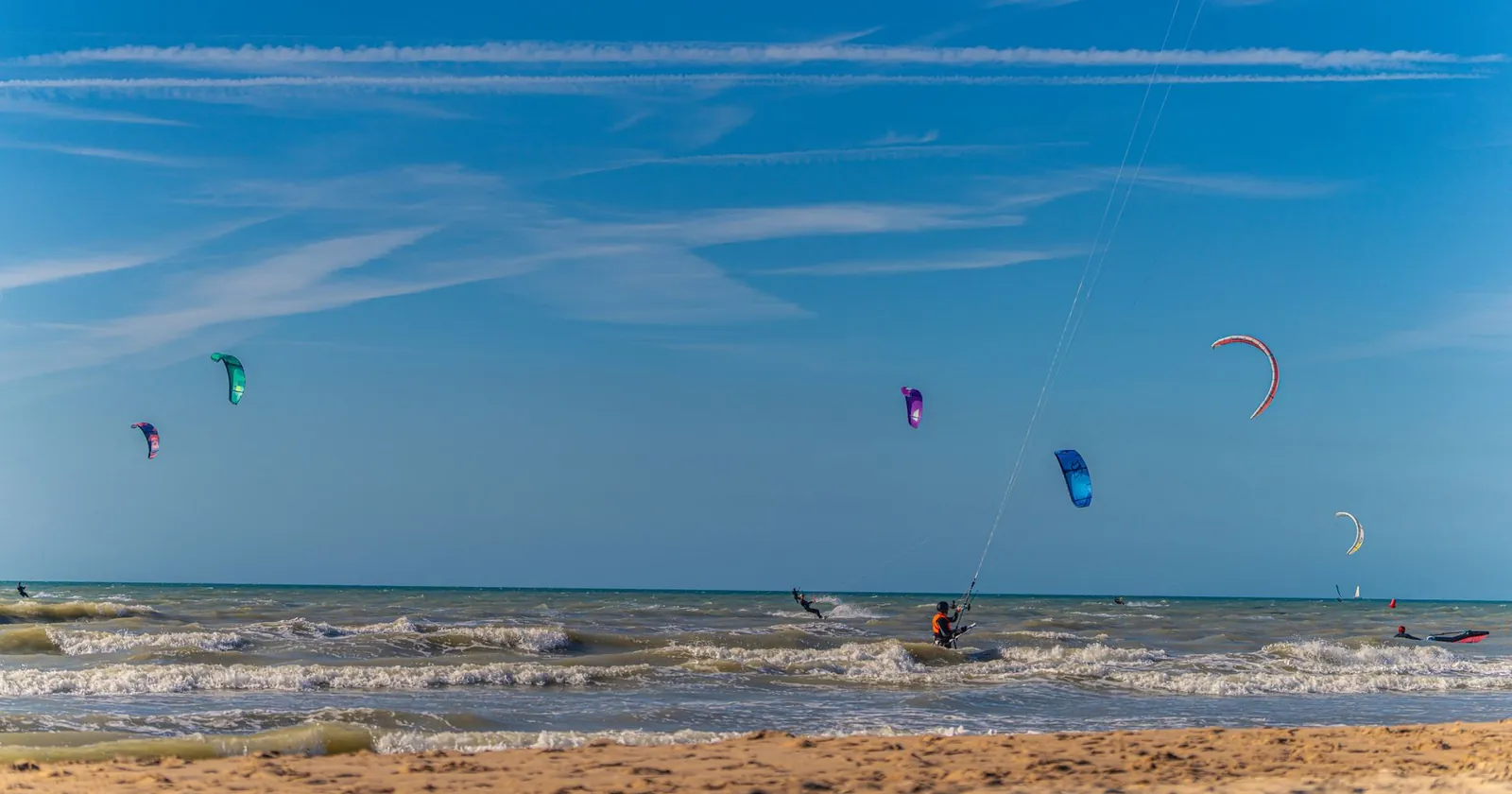
Photo: MPL Original via Pexels (free license).
Costs, wind and conditions are "as of 2026" and seasonal, verify before you rely on them.
How to read this list
- Most reliable wind: Tarifa, Dakhla and Cumbuco (near-constant in season).
- Best flat-water learning: the lagoons at Dahab, Kalpitiya, Dakhla and Cauípe (Cumbuco).
- Two sports in one: Cabarete (kite plus surf and windsurf).
- Best value: Dahab and Kalpitiya.
What makes a kite spot worth the trip
This is an honest list of the wind destinations we have researched and written full guides for, not a claim to have kited every spot on earth. It spans reliable-wind classics, flat-water learning lagoons and warm-water trade-wind coasts, and it keeps growing as we cover more. Each destination links to its own guide. Above all: kitesurfing is a powered sport, so never self-teach, take lessons wherever you go.
Tarifa
Europe's kitesurfing capital on the Strait of Gibraltar: near-constant Levante and Poniente winds, long beaches, dozens of schools, and full EU comforts.
Most reliable wind · EU wifi Read the guide → 19°45′N 70°25′W · Dom. Rep.Cabarete
The Caribbean's watersports capital: reliable afternoon thermal winds for kite and windsurf, plus Atlantic surf at Encuentro, from one affordable base.
Kite + surf · Caribbean Read the guide → 28°30′N 34°30′E · EgyptDahab
A famous flat-water lagoon that is superb for learning, alongside world-class Red Sea diving and the lowest costs on our list.
Flat-water lagoon · best value Read the guide → 8°14′N 79°46′E · Sri LankaKalpitiya
Sri Lanka's kite hub: a huge, shallow flat-water lagoon with reliable monsoon wind, very cheap living and a new nomad visa.
Flat lagoon · cheapest Read the guide → 23°43′N 15°57′W · MoroccoDakhla
A world-class flat-water lagoon beside the Atlantic with near-constant wind, in a stark desert setting in Morocco's far south.
World-class lagoon · desert Read the guide → 3°37′S 38°44′W · BrazilCumbuco
Relentless trade winds on Brazil's Ceará coast near Fortaleza: warm water, learning lagoons, downwinders and a nomad visa.
Relentless wind · warm water Read the guide →Picking your kite base
- Total beginner? Flat lagoons win: Dahab, Kalpitiya, Dakhla and Cumbuco's Cauípe are forgiving classrooms.
- Want the most wind? Tarifa in Europe, Dakhla in the desert, and Cumbuco's relentless trade winds.
- Want variety? Cabarete lets you kite, surf and windsurf from one town.
- On a budget? Dahab and Kalpitiya are the cheapest; Dahab also doubles as a diving base.
- Warm water? Cumbuco and Kalpitiya; Dakhla and Tarifa are wetsuit water.
Kitesurf gear for a trip like this
Do not buy a kit before your first lessons, but when you are ready, our beginner kitesurf gear guide explains kites, boards and the safety gear. A wetsuit or rashguard helps in cooler or sun-heavy spots, and travel health insurance that covers watersports is worth sorting first.
How these kite destinations differ from each other
Kite spots differ far more than surf spots do, because wind, water state and space are three separate variables. Two places with identical wind statistics can be a beginner paradise and an expert-only spot.
| Base | What it is best at | Monthly cost |
|---|---|---|
| Tarifa | kitesurfing and windsurfing, the most reliable wind in Europe | roughly €1,300 to €2,200 a month; a sharp summer premium |
| Cabarete | kitesurfing, windsurfing and surfing from one Caribbean base | roughly $1,200 to $2,200 a month; moderate for the Caribbean |
| Dahab, Egypt | budget nomad divers and freedivers who want warm water year-round and a slow pace | among the cheapest dive bases, roughly $470 to $1,175 a month |
| Kalpitiya | flat-water kitesurfing and learning, on a tight budget | roughly $800 to $1,500 a month; among the cheapest kite bases |
| Dakhla | world-class flat-water kitesurfing with near-constant wind | roughly $1,000 to $1,900 a month; town cheaper than lagoon resorts |
| Cumbuco | reliable trade-wind kitesurfing with easy access and warm water | roughly $1,000 to $1,900 a month; near Fortaleza keeps it practical |
Who these kite destinations are wrong for
The wrong kite spot is not merely disappointing, it is where you break gear or get hurt. These are the reasons to strike one off your list.
- Tarifa:
think twice if constant wind tires you, or you need a quiet, cheap year-round base
- Cabarete:
think twice if you need polished infrastructure and rock-solid internet and power
- Dahab, Egypt:
think twice if you need fast, reliable internet or city amenities
- Kalpitiya:
think twice if you need fast wifi, nightlife or year-round wind
- Dakhla:
think twice if you want a city, fast lagoon-camp wifi, or warm tropical water
- Cumbuco:
think twice if you want wind outside the July to December season
Two numbers a kitesurfing list should be measured against
Spot lists are about wind and water. The two things that decide whether a spot is safe to learn at are neither, and both are written down.
The bar. Since 14 February 2020, ISO 21853 has covered quick-release systems on kite bars and safety leashes, with limits you can check rather than trust: a maximum release force of 170 N or less and an opening time of two seconds or less. It is tested clean and dry, in dry sand, in water with and without sand, and cold and wet: which is to say, in the state a rental bar is actually in at the end of a busy season. When you rent abroad, the useful question is not the brand but whether the bar postdates the standard.
And the shape of the sport at the top. The International Kiteboarding Association's Formula Kite class rules, in force 8 May 2026, record that the class “was adopted as a World Sailing international class in 2013”. The quiver limit is the part a traveller can borrow: a competitor may register a maximum of four kites for an event, and “Not more than one production kite shall be registered per size range”, Large at 15 m and above, Medium 11 to 15 m. World-tour racers travel with four kites. A list like this does not need to send you anywhere with more.
FAQ: Kitesurfing Destinations for Digital Nomads
What makes a kite spot good rather than just windy?
Reliable wind on a schedule, water you can drift downwind in safely, and space. Consistency beats strength: a spot with 15 knots every afternoon is more useful than one with 30 knots twice a week. Cross-onshore wind is safer than offshore, which pushes you out to sea.
Does my travel insurance cover kitesurfing?
Check, because this is the sport insurers most often exclude. SafetyWing's Nomad Insurance Essential names Kite-Surfing on its exclusion list, while Genki names kitesurfing as covered. See our watersports coverage matrix for the wording, and get any answer in writing.
When should I go?
Every spot here has a wind season, and outside it you may get nothing for a week. The linked guide gives the window for each. Trade-wind destinations are the most reliable; thermal spots depend on daily heating and tend to work in the afternoon only.
Sources
- The quick-release standard. Global Kitesports Association on ISO 21853:2020, in force “14th February 2020”, covering “quick-release systems on kite bars and safety leashes” with a “maximum release force (equal to or less than 170N) and opening time (equal to or less than 2 seconds)”, tested across dry and clean conditions, dry sand, water with and without sand, and cold and wet. global-kitesports.org. Read 12 September 2026.
- The class rules, and the quiver limit. International Kiteboarding Association, Formula Kite class rules, effective 08-May-2026, status Approved: “The IKA Formula Kite Class was adopted as a World Sailing international class in 2013”; C.4, “a maximum of four registered series production kites shall be registered for an event” and “Not more than one production kite shall be registered per size range: Large: Nominal Size of 15m or bigger; Medium: Nominal Size of 11m to 15m”. sailing.org. Read 12 September 2026.
- Each entry links to our full guide for that place, and those guides carry the external sources and read dates behind the claims summarised here. They are where the readings are recorded, not the evidence for them: Tarifa, Cabarete, Dahab, Egypt, Kalpitiya, Dakhla, Cumbuco.