Xiaoliuqiu Diving: The Turtle Law, the 200-Meter Conservation Belt and the Freediving Areas
 by Yannick Schroth
Sep 25, 2026
14 min read
by Yannick Schroth
Sep 25, 2026
14 min read
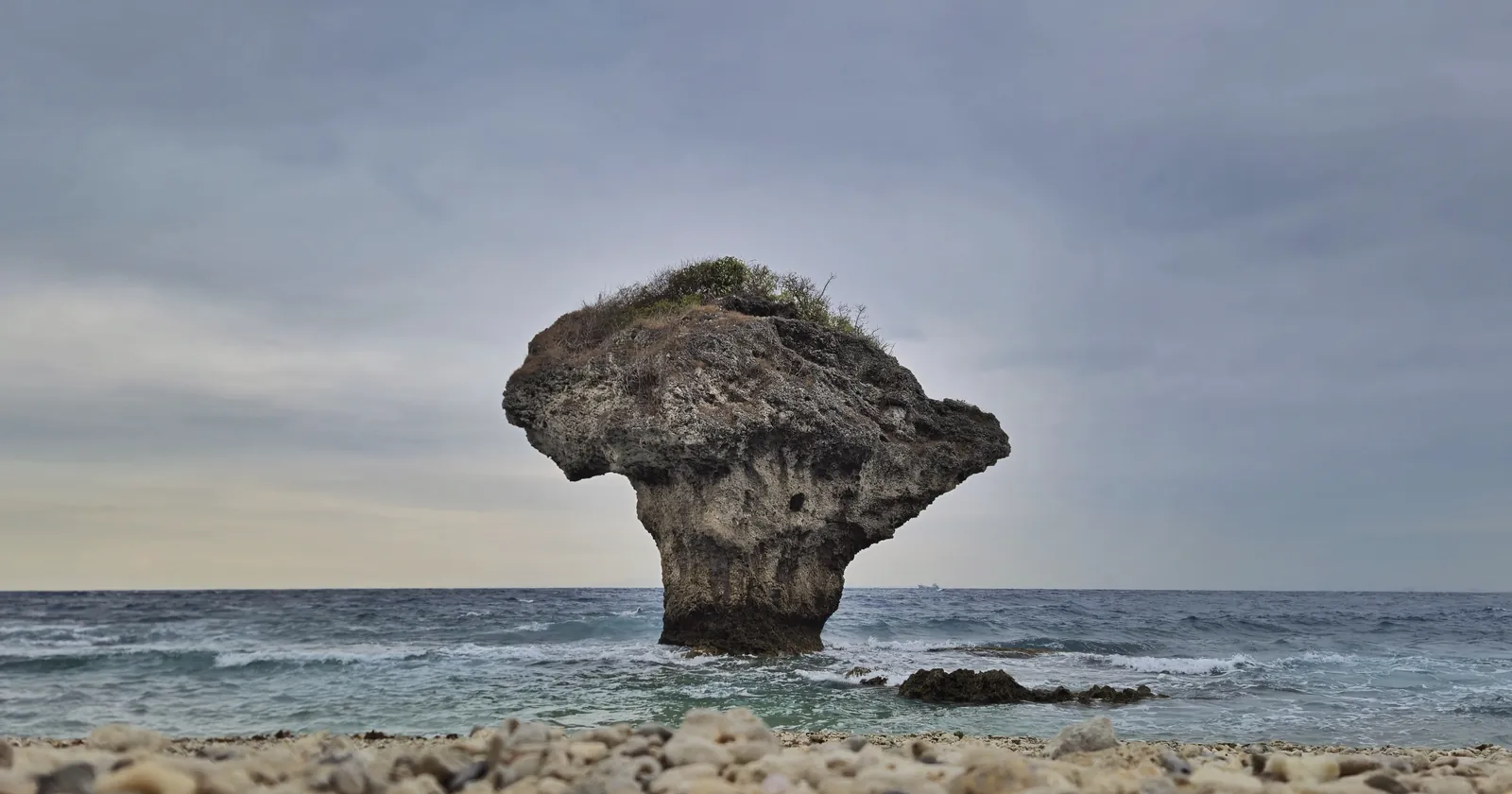
Photo: Jun Jie Yam, Wikimedia Commons, CC BY 4.0.
.jpg)
Key takeaways
- Pingtung County’s notice of 20 June 2025 makes a 200-meter belt round the island a conservation area where listed species may not be taken, with fines of NT$30,000 to NT$150,000 under the Fisheries Act
- The Duzaiping and Lobster Cave core zones are closed to all persons except local residents and people the county has approved
- Harassing a green turtle is a crime under the Wildlife Conservation Act, but no distance appears in the Act: Liuqiu guidance says 5 meters, the national turtle leaflet says more than 1.5
- Freedivers are told to use two trial zones, Vase Rock with Beauty Cave, and Dafu West, drawn because freediving kept clashing with fishing
- Taiwan’s water recreation regulation caps a scuba instructor at eight divers and a freediving instructor at four, or six with an assistant
Xiaoliuqiu’s coast is a conservation area out to 200 meters, and taking by hand counts
Xiaoliuqiu, also written Liuqiu or Lambai Island, is a coral island about 12 kilometers round, half an hour by boat from Donggang according to the national scenic area that has run it since 2000. The rule a diver meets first, though, is a county fisheries notice covering the whole shoreline.
On 20 June 2025 the Pingtung County Government published notice 屏府農漁字第11490041131號, which sets up the Liuqiu Aquatic Plants and Animals Breeding Conservation Area (琉球水產動植物繁殖保育區) under the Fisheries Act. It replaced the county’s notice of 19 July 2024 from that date. The area’s history runs back to 2000, when the county first drew a fishery resources conservation area 200 meters out from the island.
The current notice divides that belt into zones. The northwest zone runs from Vase Rock to Shanfu fishing harbor, 200 meters out from the high-tide line, and protects lobster, sargassum, sea urchins, giant clams, coral reef fish, coral and other aquatic animals, migratory fish excepted. The round-island zone covers the rest of the 200-meter belt and protects lobster, sea urchins, giant clams, coral and sargassum.
Inside both, the restriction is the same. Nobody may take any of the listed species “by any means (including by hand)” or damage its habitat, unless the county has approved it as research, a biological removal project or management work. That bracketed phrase closes the gap divers tend to assume: taking something with bare hands, without any tool, is still taking.
The penalty is set out in the notice itself: NT$30,000 to NT$150,000 under article 65(6) of the Fisheries Act. Older rules still sit underneath it. A county notice of 27 April 1995 bans taking coral, including coral reef, in Pingtung County’s coastal waters except for approved research, and the Fisheries Agency grades the Liuqiu zones by protection level, with the core zones at level 1.
Two core zones on Xiaoliuqiu are closed to all but residents, and the tide pools need a guide
The same notice draws two core zones, one at Duzaiping and one at Lobster Cave, each protecting all aquatic animals and plants. The rule for them is one sentence long: except local residents and those the county has permitted, all persons are prohibited from entering. Nothing in the notice carves out divers or snorkelers.
The boundaries are defined by coordinate points in the notice’s annexes, four for Duzaiping and twenty-five for Lobster Cave, rather than by landmarks you can see from a boat. Before a shore entry anywhere near either name, ask the operator to show you where the lines run.
Four intertidal demonstration areas sit alongside them: Shanfu, Yuchengwei, Duzaiping and Geban Bay. Entering one needs the county’s permission and a certified guide of the Liuqiu natural and cultural ecological landscape area. No more than 300 people may be in each at once, and only on the routes the county marks out with ropes or similar.
The calendar is written into the notice. From 1 December to 31 March the areas are a rest period and closed to everyone except residents and approved researchers. From 1 April to 15 June they close at night, 8 pm to 5 am, for breeding. From 16 June to 30 November, night guiding must use red light. The county can also close them for typhoon or tsunami warnings, as it did on 24 July 2026 when the warning for Typhoon Noul went up.
A second law covers the same rock. In March 2015 the county and the transport ministry jointly designated five intertidal areas, Duzaiping, Shanfu, Geban Bay, Yuchengwei and Lobster Cave, as a natural and cultural ecological landscape area under the Development of Tourism Act. Article 19 of that Act requires visitors to enter with a professional guide, and article 62 lets the authority fine anyone who does not up to NT$30,000.
There is a fee as well. News reports agree that Shanfu, Yuchengwei and Duzaiping have charged a conservation fee of NT$60 per visitor since 1 July 2024, and that Geban Bay was added on 1 July 2025, with its paddling area left free.
The Xiaoliuqiu turtle distance is guidance, and two agencies give different numbers
Green turtles here are protected wildlife. The Ocean Affairs Council’s marine list, announced on 9 January 2019, covers every species in the family Cheloniidae plus the leatherback, and the Ocean Conservation Administration confirms that all five species seen round Taiwan, green turtle included, are protected.
What the Wildlife Conservation Act forbids is written in articles 16 and 18: protected wildlife may not be harassed, abused, hunted or killed. Article 3 defines harassment as interfering with wildlife by drugs, implements or other methods. Article 42 is a criminal provision: harassing protected wildlife carries up to a year in prison, detention or a criminal fine of NT$60,000 to NT$300,000, and up to two years, or a fine of NT$100,000 to NT$500,000, if the animal dies.
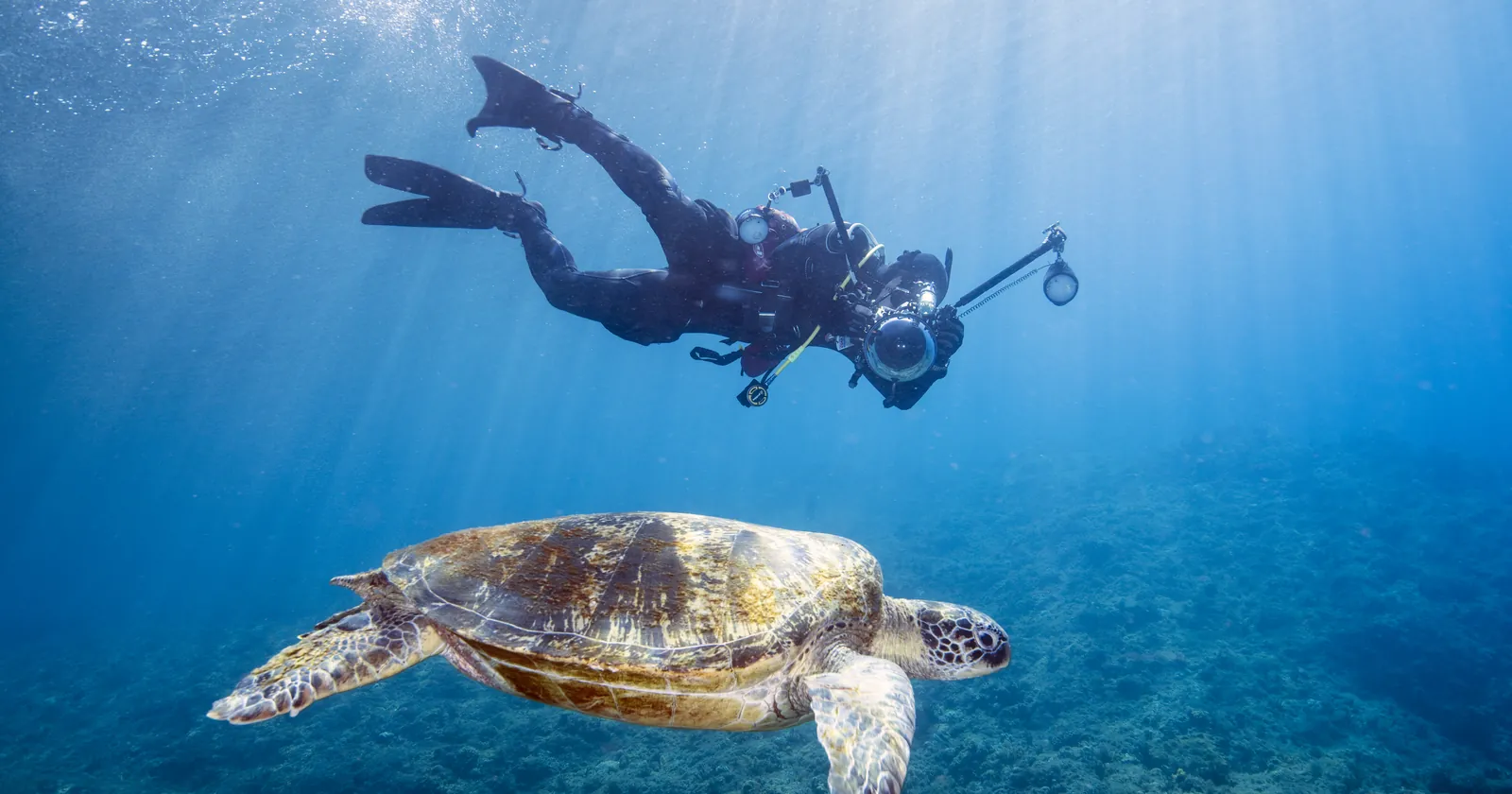
No distance appears anywhere in the Act. The number divers hear comes from guidance, and the guidance does not agree with itself. The scenic area’s turtle code for Liuqiu says keep at least 5 meters, do not touch, catch, startle, chase or circle a turtle, do not block its path, leave resting turtles alone and do not feed them. The county’s intertidal site repeats the 5 meters.
The Ocean Conservation Administration, the national agency for marine wildlife, prints a different figure. Its national sea turtle watching leaflet shows more than 1.5 meters, underwater and on land, next to the five rules: do not touch, disturb, feed, chase or harm. So the version on travel pages, that Taiwanese law fixes a distance and hands out a NT$300,000 ticket, is wrong twice over.
The law sets no distance, and NT$300,000 is the ceiling of a criminal fine a court imposes, not a fixed penalty. For a diver the working rule is simple: the 5 meters asked for on Liuqiu is the stricter number, and keeping it is the simplest way to stay clear of anything that could be called interference. The scenic area’s code also asks you to cut sunscreen use or pick a reef-safe sunscreen.
If you see someone handling a turtle, the Ocean Conservation Administration asks for photos or video, the time and the place, sent to the local government, to the administration itself or to the Coast Guard on 118. The scenic area also lists the Pingtung County Government’s animal protection and conservation section, 08-7653860.

How many turtles live off Xiaoliuqiu depends on how they were counted
Liuqiu’s turtle monitoring measures three different things, and none of them is a census, so no single population figure is given here.
A 2019 paper in Zoological Studies by Cheng and colleagues identified turtles by their facial scales in the nearshore waters from 2011 to 2017 and counted a foraging population of 432. About 90 percent stayed one year or less and used a single foraging site; fewer than 3 percent stayed all seven years. The core residence area ran from Beauty Cave to Vase Rock, and the authors called the island a temporary development and foraging site for immature green turtles.
A 2025 paper in BMC Ecology and Evolution by Fong and colleagues used TurtleSpot Taiwan, a crowdsourced photo project, for 2017 to 2022. Liuqiu produced 584 identified individuals from 3,024 sightings, 76.7 percent of the turtles identified in Taiwan, and 49 percent of those 584 stayed more than a year. Across all Taiwan sightings nearly 10 percent showed line entanglement, debris, missing flippers or injuries, most of them at Liuqiu.
That paper’s recommendation is aimed at boats: reduce speeds in hotspot areas and regulate coastal activity strictly. For a diver it is one more reason to surface close to the flag and the boat.
The third count is official. A survey commissioned by the Ocean Conservation Administration flew the coast once a month in 2024 and averaged 514 turtle counts a flight, a figure in counts rather than individuals. October was highest at 954 and January lowest at 77. The Duzaiping coast averaged 113 a flight, the stretch from Guizailujiao to Yufu harbor 85.
The same survey found that on average three females nest on the island a year, mainly on the beach at Duzaiping, and that hatching success in 2024 was about 40 percent. The scenic area credits the island’s net ban for the rise in turtles: a county notice has barred all gillnet fishing within three nautical miles of Liuqiu since 1 January 2013, and bans carrying gillnets in or out of its fishing harbors.
Freediving at Xiaoliuqiu is steered to Vase Rock, Beauty Cave and Dafu West
The Dapeng Bay National Scenic Area Administration keeps a set of Diving Activity Notes (大鵬灣國家風景區潛水活動注意事項), made under article 9 of the national water recreation regulation. The current version took effect on 21 August 2024, and point 5 is the one that changes a Liuqiu trip: freedivers shall freedive inside two trial freediving areas.
Area A is Vase Rock and Beauty Cave (花瓶岩及美人洞). Area B is Dafu West (大福西), named for Dafu on the island’s east coast. Both are defined by coordinates in the annexes. The administration’s revision table gives the reason plainly: freediving and fishing in the Liuqiu scenic area waters kept conflicting, and the areas were drawn after repeated meetings to separate the two.
Read the same table before you treat point 5 as law. The 2024 revision deleted the old penalty point, and explained why: the notes are an administrative rule, not a public notice or a restriction order under article 60 of the Development of Tourism Act, so that article’s fines do not attach to them. The notes carry no fine of their own, which makes the trial areas an instruction backed by the operators who follow it.
Operators must also tell customers not to dive alone or after drinking, to follow the dive plan and to stay within the depth of their training. Point 7 asks divers not to tie lines to the reef and to watch their depth so weights do not crush coral, then points them back to the county’s conservation area rules.
Businesses must file their registration, insurance and instructor certificates with the administration before taking customers out, and report emergencies to the fire service, the Coast Guard and the administration together. Our freediving safety guide covers the buddy rules the notes assume.
Taiwan’s water recreation rules set dive group sizes on Xiaoliuqiu
The national rulebook is the Regulations for the Management of Water Recreation Activities (水域遊憩活動管理辦法), made under article 36 of the Development of Tourism Act and last amended on 16 April 2024. That amendment is what brought freediving into the regulation. Under article 4, when water sits inside a scenic area its managing agency is the authority, which on Liuqiu means the Dapeng Bay administration.
Article 17 requires anyone scuba diving or freediving to hold a certificate for that activity from a domestic or foreign diving organization; snorkeling needs none. Article 18 requires a dive flag in the water and a surface marker buoy, lift bag or freediving float, and says a scuba diver or freediver must be accompanied by someone who knows the area and is certified.
Article 19 sets the ratios. A scuba instructor may lead eight people at a time. A freediving instructor may lead four, or six with an assistant who meets article 17. A snorkel guide needs a recognized training certificate and may lead ten. The instructor must brief time limits, maximum depth, current, bottom, hazards and conservation rules, and stop the dive if a diver will not comply.
A dive boat needs a platform or ladder and a waterproof, GPS-capable phone for the instructor. The skipper must stay on site until every diver is back, and search if one is overdue. Jet skis may not share the same time and place as diving or swimming.
Commercial operators must carry liability insurance of at least NT$3 million per person for bodily injury and NT$24 million per accident. Breaking an authority’s published restrictions costs NT$10,000 to NT$50,000 under article 60, or NT$50,000 to NT$200,000 for a business. That cover does not replace your own dive insurance.
On 9 September 2026 the Tourism Administration added a national diving management guideline, written with National Taiwan Ocean University. It presents itself as a reference, not a rule. It warns that underwater scooters can disturb turtles, recommends diving insurance that covers decompression illness, and lists emergency numbers: 119 for rescue and emergency medical care, 118 for the Coast Guard and injured marine wildlife, 110 for the police and 112 from a mobile phone.
The guideline also recommends that operators find out in advance where the nearest decompression treatment facilities are. Ask your operator that question before you book, and get the answer in writing.
Xiaoliuqiu dive centers: 14 SSI listings, seven rated for freediving
The Xiaoliuqiu operator list holds 14 dive businesses, read on 2 September 2026, all of them published by SSI in its register of affiliated centers. The register files them under Pingtung County rather than a street, and only four publish a website there.
The program ratings fit the rules above. Seven of the 14 are rated by SSI for freediving, three for Extended Range, one for rebreather diving and five for the Mermaid program. Those ratings describe the listing, not a course running this season, and nobody assessed any of these businesses for the list.
The filing the scenic area requires, with insurance and instructor certificates, is the document that matters here, and no public register of businesses licensed for these activities in Taiwan was found to check the list against. Which registers can be read sets out what each source returned. Other turtle foraging grounds are on our list of places to swim with turtles.
FAQ: scuba diving in Xiaoliuqiu
How close can you get to turtles when diving at Xiaoliuqiu?
The Wildlife Conservation Act sets no distance. It forbids harassing protected wildlife, defined as interfering with it by drugs, implements or other methods, and article 42 makes that a crime punishable by up to a year in prison, detention or a criminal fine of NT$60,000 to NT$300,000. The scenic area’s turtle code for Liuqiu asks for at least 5 meters; the Ocean Conservation Administration’s national leaflet shows more than 1.5 meters. Both are guidance, and 5 meters is the stricter figure.
Do you need a certification to dive at Xiaoliuqiu?
For scuba and freediving, yes. Article 17 of Taiwan’s water recreation regulation requires a certificate for that activity from a domestic or foreign diving organization, and article 18 requires a certified companion who knows the area. Snorkeling needs no certificate. A scuba instructor may lead eight people at a time, a freediving instructor four, or six with an assistant.
Where can you freedive at Xiaoliuqiu?
The scenic area’s Diving Activity Notes, in force since 21 August 2024, tell freedivers to use two trial freediving areas: Area A at Vase Rock and Beauty Cave, and Area B at Dafu West, both defined by coordinates. They were drawn because freediving and fishing kept conflicting. The notes are an administrative rule and carry no fine of their own.
Are there places around Xiaoliuqiu where divers cannot go?
Yes. Pingtung County’s notice of 20 June 2025 closes the Duzaiping and Lobster Cave core zones to all persons except local residents and people the county has permitted. The four intertidal demonstration areas need county permission and a certified guide, hold no more than 300 people at once, and close completely from 1 December to 31 March.
When are the most turtles seen around Xiaoliuqiu?
In the Ocean Conservation Administration’s 2024 monthly aerial surveys, October had the highest count, 954, and January the lowest, 77, against an average of 514 per flight. Those are counts, not individual turtles. The Duzaiping coast was the busiest stretch, averaging 113 a flight.
Note: Conditions, safety guidance and regulations change. Verify current information with official sources, including the dive operator, the park authority and the relevant government department, before you travel or dive.
Founder of NOMADREEF and a former digital nomad. This guide is sourced from the references below; conditions, prices and rules change, so verify current details, and follow qualified local guidance and safety briefings. About the author · LinkedIn ↗
Sources
- The conservation area, its zones, core zones and intertidal calendar (primary). Pingtung County Government notice 屏府農漁字第11490041131號 of 20 June 2025, “琉球、車城水產動植物繁殖保育區及有關限制事宜”: the northwest zone from Vase Rock (W1) to Shanfu fishing harbor (W2), 200 m from the high-tide line, and its protected species; the round-island zone; the four intertidal demonstration areas (Shanfu, Yuchengwei, Duzaiping, Geban Bay); the Duzaiping core zone (C1–C4) and Lobster Cave core zone (L1–L25); restriction 8(1) on taking “以任何方式採捕(含徒手)”; 8(2) on county permission, certified guides, 300 persons, the 1 December to 31 March rest period, the 1 April to 15 June night closure, red light from 16 June to 30 November and warning closures; 8(3) closing the core zones to all but residents and permit holders; point 9 on fines of NT$30,000 to NT$150,000 under Fisheries Act article 65(6); point 10 ending the notice of 19 July 2024. Also listed there: the 27 April 1995 Pingtung coral notice, the 18 September 2012 gillnet notice (三浬 ban from 1 January 2013), and the 20 March 2015 designation of five intertidal areas with their areas. Full text as published by the county on its Liuqiu intertidal site, marine protected area notices and history on its protected area page; closures on the site’s news list (Typhoon Noul, 24 July 2026). Read 25 September 2026. The county’s own news page for the notice refused connections on that date. The same table dates the marine protected wildlife list to 9 January 2020 (109.1.9); the Ocean Affairs Council’s own announcement gives 9 January 2019, which is the date used here.
- The same notice at the central agency (primary). Fisheries Agency, Ministry of Agriculture, Pingtung County Liuqiu Aquatic Plants and Animals Breeding Conservation Area: notice date and number, the zones and restrictions, and protection levels (core zones level 1, intertidal demonstration areas level 2, the rest level 3). Fisheries Agency, Liuqiu conservation area. Read 25 September 2026.
- The Fisheries Act (primary). 漁業法, current text as amended 26 December 2018: article 44 (restrictions by notice), article 45 (breeding conservation areas), article 65(6) (NT$30,000 to NT$150,000 for breaching notices under article 44(1)(4) to (9)). Laws & Regulations Database, Fisheries Act. Read 25 September 2026.
- The Wildlife Conservation Act (primary). 野生動物保育法, current text as amended 18 February 2025: article 2 (Ocean Affairs Council as central authority for marine wildlife), article 3(10) (definition of 騷擾, harassment), articles 16 and 18(1) (protected wildlife may not be harassed, abused, hunted or killed), article 42 (up to one year, detention or a criminal fine of NT$60,000 to NT$300,000; up to two years and NT$100,000 to NT$500,000 if the animal dies). Laws & Regulations Database, Wildlife Conservation Act. Read 25 September 2026.
- Protected status of green turtles (primary). Ocean Conservation Administration, announcement of the marine protected wildlife list effective 9 January 2019, including “蠵龜科所有種、革龜”: OCA news, 9 January 2019; and the current “友善賞龜” page (updated 24 April 2026) naming all five species round Taiwan as protected, the five “don’t” rules and the reporting route via 118: OCA, friendly turtle watching. Read 25 September 2026.
- The 1.5-meter figure (primary). Ocean Conservation Administration, Sea Turtle Watching Guide (English leaflet), showing “>1.5m” for encounters underwater and on land, and the penalty wording “imprisonment for up to one year, detention, or a fine ranging from NT$60,000 to NT$300,000”. OCA, Sea Turtle Watching Guide (PDF). Read 25 September 2026.
- The 5-meter figure (primary guidance). Dapeng Bay National Scenic Area Administration, turtle-watching code for Liuqiu (看龜守則): at least five meters, the list of prohibited conduct, sunscreen, the Pingtung County animal protection and conservation section number. DBNSA, 看龜守則. Read 25 September 2026.
- The scenic area and the island (primary). Dapeng Bay National Scenic Area, Xiaoliuqiu page: about 12 km round, half an hour by boat from Donggang, under the scenic area since 2000, and the statement crediting the coastal net ban for the increase in green turtles. DBNSA, 小琉球. Read 25 September 2026.
- The freediving areas and diving notes (primary). 大鵬灣國家風景區潛水活動注意事項, version effective 21 August 2024, points 1 to 7, with annexes 1 and 2 (coordinates of trial freediving areas A and B) and the revision table (deletion of the former penalty point because the notes are “行政規則,非屬公告或限制命令”; point 5 added because of conflict between freediving and fishing). Tourism Administration regulations site, DBNSA diving notes. Read 25 September 2026.
- The national water recreation regulation (primary). 水域遊憩活動管理辦法, current text as amended 16 April 2024: articles 1, 4, 9, 10, 13, 16 to 21. Laws & Regulations Database, water recreation regulation. Read 25 September 2026.
- The Development of Tourism Act (primary). 發展觀光條例, current text as amended 28 November 2025: article 2(5) (natural and cultural ecological landscape area), article 19 (entry with a professional guide), article 36, article 60 (NT$10,000 to NT$50,000; NT$50,000 to NT$200,000 for a business; NT$30,000 to NT$150,000 for missing insurance), article 62(2) (up to NT$30,000 for entering without a guide). Laws & Regulations Database, Development of Tourism Act. Read 25 September 2026.
- The 2026 national diving guideline (primary guidance). Tourism Administration, 潛水活動(含浮潛、水肺潛水及自由潛水)管理指引, September 2026, version dated 9 September 2026, commissioned from National Taiwan Ocean University: its status as a reference, the scooter and turtle passage, insurance advice, the emergency number table (119, 110, 112, 118) and the advice to know decompression treatment facilities in advance. Tourism Administration regulations site, diving guideline. Read 25 September 2026.
- The 2011 to 2017 population (primary, peer-reviewed). Cheng WH, Chan YT, Hong H, Johnson B, Cheng IJ (2019), Using Programming Languages and Geographic Information System to Determine Spatial and Temporal Variability in a Green Turtle Foraging Population on Liuchiu Island, Taiwan, Zoological Studies 58: 432 turtles, about 90 percent resident one year or less, under 3 percent for all seven years, core residence area Beauty Cave to Vase Rock. doi:10.6620/zs.2019.58-18. Read 25 September 2026 (abstract via Europe PMC).
- The 2017 to 2022 photo-ID and injuries (primary, peer-reviewed). Fong C-L, Hoh DZ, Su H and co-authors (2025), Crowdsourcing conservation: unveiling Taiwan’s sea turtle foraging grounds, emerging threats, and residency with broad societal engagement, BMC Ecology and Evolution 25: 584 individuals from 3,024 sightings at Liuqiu (76.7 percent); 49 percent of the 584 staying over a year; nearly 10 percent of all sightings with entanglement, debris or injuries, most at Liuqiu; the boat-speed recommendation. doi:10.1186/s12862-025-02354-2. Read 25 September 2026.
- The 2024 aerial counts and nesting (primary, official monitoring). Ocean Conservation Administration, commissioned project 113年小琉球產卵母龜生殖暨周邊海龜調查, published 8 January 2025: monthly aerial surveys averaging 514 turtle counts (隻次) along the coast, 954 in October, 77 in January, Duzaiping coast 113 and Guizailujiao to Yufu harbor 85; three nesting females a year on average; hatching about 40 percent in 2024; Duzaiping beach as the main nesting site. OCA, 2024 Liuqiu turtle survey. Read 25 September 2026.
- The intertidal conservation fee (triangulated, secondary). NT$60 per visitor at Shanfu, Yuchengwei and Duzaiping from 1 July 2024, extended to Geban Bay on 1 July 2025 with its paddling area excluded, agreed across three independent reports: Commercial Times, 20 June 2025, Liberty Times and Mirror Media, 16 April 2024. Read 25 September 2026. The fee notice itself was not reached.
- The 14 businesses. Fourteen dive businesses on the Xiaoliuqiu operator list, read 2 September 2026, all published by SSI in its register of affiliated centers: four publish a website there; SSI program ratings as listed (Freediving 7, Extended Range 3, Rebreather 1, Mermaid 5). The limits of each source are set out on which registers can be read.
- Gaps. The location of the nearest recompression chamber is not given, because the hospital pages that would state it refused automated requests on 25 September 2026 and a safety fact needs its primary source: unverified, needs human check. Water temperature and visibility by month are not given for want of a primary source. A 2026 mark-resight study of two Liuqiu reef sites (Global Ecology and Conservation, doi:10.1016/j.gecco.2026.e04208) could not be read in full, so its figures are not used. No separate public notice attaching a fine to the freediving areas was found.