Okinawa Diving: The Kerama Islands and How to Get There
 by Yannick Schroth
Aug 15, 2026
6 min read
by Yannick Schroth
Aug 15, 2026
6 min read
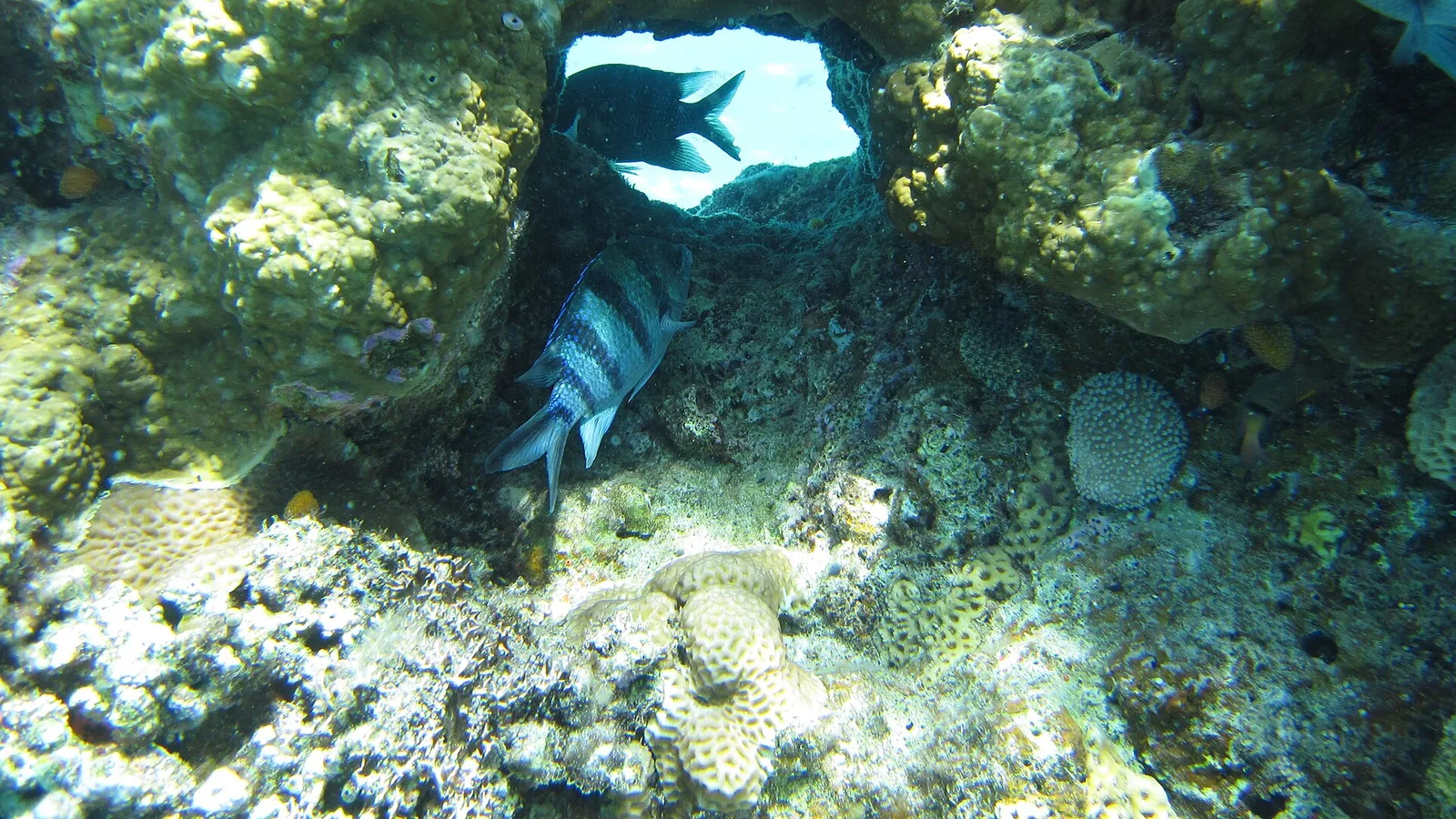
Photo: keiyac, Wikimedia Commons, CC BY-SA 2.0.

Key takeaways
- 37 operators. 16 are in the Green Fins register and 15 of those carry an in-person assessment from the last twelve months. The spread is 5 Gold, 6 Silver, 3 Bronze, 1 Digital and 1 Restricted, which is the most Gold-heavy list here.
- The reef in the photographs is Keramashoto National Park, made Japan's 31st national park on 5 March 2014, with a land area of 3,520 hectares. It is a separate island group, not the shoreline of the main island.
- Nearly all of these businesses are on Okinawa main island, around Onna, Seragaki and Manza. Reaching the Kerama reefs from there is a day trip, and that shapes both the cost and the timing of a dive day.
- Not one of the 37 publishes which languages their instructors teach in. In a place where most operator sites are written in Japanese, that blank matters more than usual.
Where the diving is in Okinawa: the main island and the outer groups
Two places get called "Okinawa diving" and they are not the same. The operators in this list are almost all on Okinawa main island, clustered on the west coast around Onna, Seragaki and Manza. The reef that fills the photographs is the Kerama Islands, roughly 40 km to the west.
The Kerama group is protected as Keramashoto National Park. Japan's national parks portal, run by the Japan National Tourism Organization with contents provided by the Ministry of the Environment, gives the establishment date as 5 March 2014 and the park area as 3,520 ha. Read that number carefully: it is the land area. Figures you will see quoted for the surrounding sea are larger, and none appears on a reachable official page, so none is printed here.
The practical consequence is simple and nobody tells you it up front. If the Kerama reefs are why you are going, you are booking boat days, not shore dives, and the operator you choose has to run them.
Green Fins dive centers in Okinawa
Green Fins is run by the Reef-World Foundation with the UN Environment Programme, and its assessments are made by trained assessors in person rather than by self-declaration. The register, read between 2026-08-14 and 2026-09-21, carried 16 members in Okinawa: 5 Gold, 6 Silver, 3 Bronze, 1 Digital and 1 Restricted.
That is the strongest spread in this directory. Five Gold members in one location is more than anywhere else here, and 15 of the 16 carry an assessment marked in person within the last 12 months. The one exception is a Digital Member, which means the business is registered but nobody has assessed it, and that difference is the whole reason we publish the tier rather than a tick.
Every name, with what each field rests on, is on the Okinawa operator list.
What the operators in Okinawa say about themselves
Separately from the register, each operator's own site carries more: 33 of the 37 responded. Training agencies they name themselves, which is their claim and not a check by anyone: PADI on 12 and SSI on 8. That comes from reading 33 sites, 113 pages in all. One more could not be read. One more has not been opened yet. The operator list for Okinawa gives the page each name was read on.
Not one of the 37 publishes which languages its instructors teach in. That gap is worth more attention here than in most places, because a large share of these sites are written in Japanese and a visitor's first question is whether a dive can be briefed in a language they share with the guide. A site with an English version answers a question about the website, not about the boat. Ask directly.
Island diving ends with a flight, and the number is 18
Okinawa is reached by air and left by air, often on a short hop to Naha and then a longer leg to the mainland or beyond. That makes the surface interval before departure part of the dive plan rather than an afterthought, and the figure most divers remember is the wrong one for a dive trip.
DAN's consensus guidelines set a minimum preflight surface interval of 12 hours after a single no-decompression dive, but 18 hours after multi-day repetitive diving, and “substantially longer than 18 hours” after dives involving compulsory decompression or trimix. Three days of two-tank boat trips is the 18-hour case. The guidelines also note that the trials behind them ran “in a dry hyperbaric chamber with resting volunteers”, so longer may be wise after a week of being immersed and working.
In practice: plan the last dive for the morning of the day before you fly, not the day itself. It costs one night of accommodation and removes the one risk on a dive trip that is entirely within your control.
FAQ: Okinawa
Is the diving on Okinawa main island or in the Kerama Islands?
Both, and they are different trips. Nearly all 16 register members sit on the main island around Onna, Seragaki and Manza. Keramashoto National Park is about 40 km west, so those reefs are a boat day.
When did Kerama become a national park?
5 March 2014, as Japan's 31st national park, with a land area of 3,520 hectares, according to the national parks portal run by the Japan National Tourism Organization with contents provided by the Ministry of the Environment.
How many Okinawa operators are independently assessed?
15 of the 16 in the Green Fins register carry an in-person assessment from the last twelve months. The spread is 5 Gold, 6 Silver, 3 Bronze, 1 Digital and 1 Restricted.
Can I be taught in English?
The register does not say. Not one of the 37 publishes which languages their instructors teach in, so ask the operator directly before booking.
Writes NOMADREEF and compiles its operator directory. This guide is desk research, not a trip report, and says so at the top. About the author
Sources
- Flying after diving. Divers Alert Network, guidelines for flying after diving: a minimum 12-hour surface interval after a single no-decompression dive, “a minimum 18-hour surface interval for multi-day repetitive diving”, and “substantially longer than 18 hours after diving involving compulsory decompression, or using heliox and trimix”; the guidelines note that because the trials were conducted “in a dry hyperbaric chamber with resting volunteers, longer guidelines might be needed for divers who were immersed and exercising”. dan.org. Read 11 September 2026.
- National Parks of Japan, Keramashoto National Park, run by the Japan National Tourism Organization with contents provided by the Ministry of the Environment, Government of Japan. Establishment date and land area, read 2026-08-14.
- Green Fins member register, Reef-World Foundation with the UN Environment Programme, greenfins.net. Membership levels and assessment status for 16 operators, read between 2026-08-14 and 2026-09-21.
- Each operator's own website, opened between 2026-08-24 and 2026-09-21, for the training agencies they name. Recorded on our operator list.