Maldives Diving: The Atolls from Baa to Addu, the 30-Meter Rule and How Far You Are from a Chamber
 by Yannick Schroth
Nov 11, 2026
13 min read
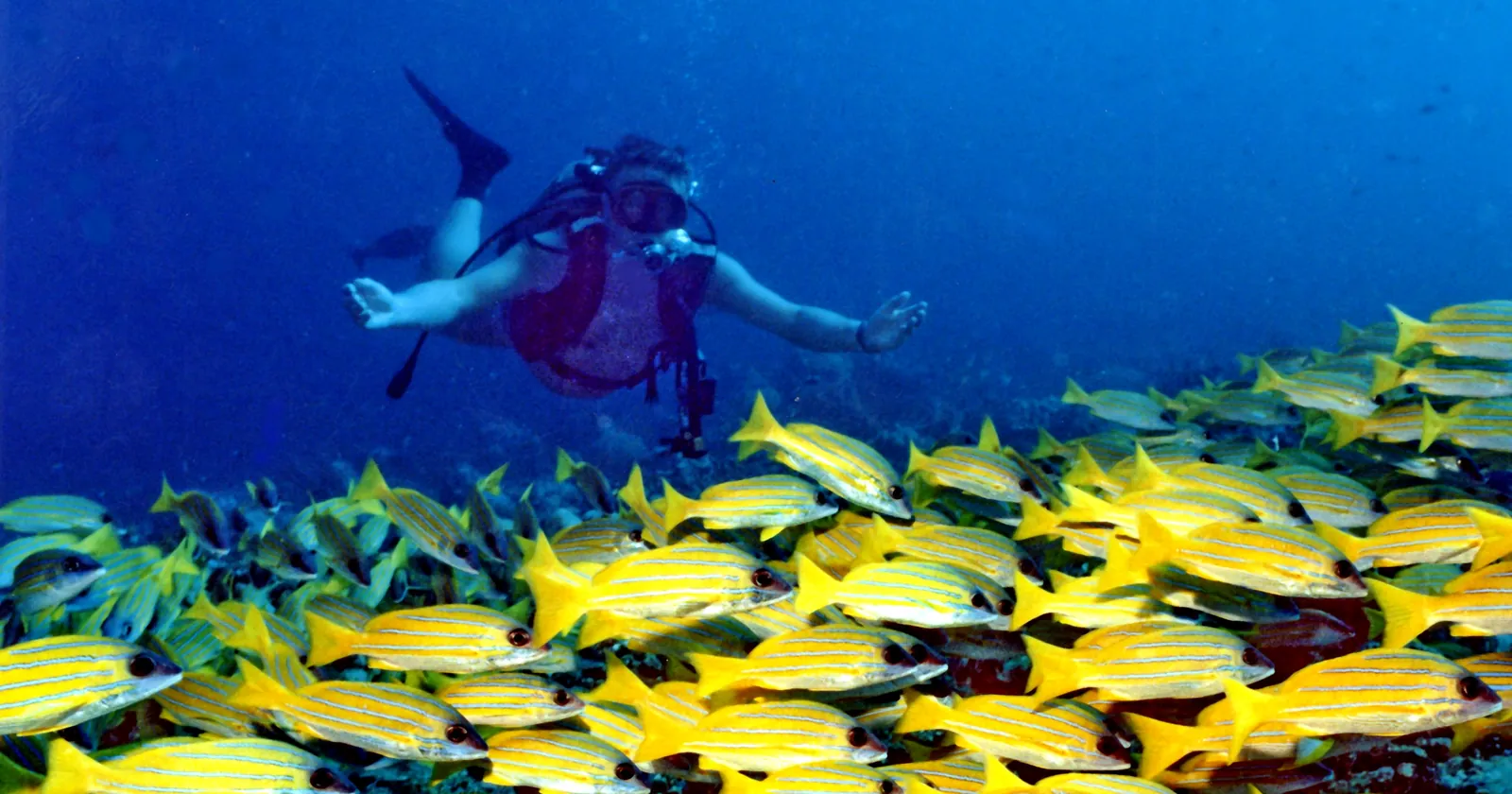
A diver over a school of fish on Banana Reef, North Malé Atoll. Royonx, Wikimedia Commons, CC0, cropped.

Key takeaways
- The national limit is 30 meters, 20 for entry-level divers, with no decompression diving and no dive in the 12 hours before a flight; it applies on liveaboards without exception
- Bring your card and your logbook: without proof of 30 dives, or after three months out of the water, the regulation asks for an orientation dive
- After five Italian divers died in a cave in Vaavu Atoll in May 2026, the Tourism Ministry suspended their liveaboard's licence and the government announced a law to regulate technical diving; we found no sign it has been enacted
- Sharks have been protected since 2010, Hanifaru Bay is snorkel-only with an MVR 310 permit, and South Ari's whale shark area bans anchoring and feeding
- DAN Europe counts five chambers; Kuredu in the north is the only multiplace one and states 24/7 hotlines. From Fuvahmulah or Addu the nearest is 8 to 10 hours by speedboat. The emergency number is 911
Maldives diving: one rulebook, a long chain of atolls
The Maldives runs more than 823 km north to south, from Thuraakunu to Addu, with about 1,100 islands, in DAN Europe's description. Many of the named dive sites are thilas, submerged reefs such as Maaya Thila, and the 2003 regulation says plainly that "drift boat diving is the norm in Maldives". You can do it from three kinds of base: a resort island with its own dive centre, a guesthouse on an inhabited local island, or a liveaboard moving between atolls. This overview goes atoll by atoll from north to south, links to our detailed guides, and then covers what is the same everywhere: the dive rules, protected areas, water temperature, chambers and visas.
The north: Baa's Hanifaru Bay and the Kuredu chamber
Baa Atoll is a UNESCO biosphere reserve, and one of its core areas is Hanifaru Bay, where reef mantas and whale sharks gather to feed from May to December, according to the government's management plan. It is snorkel-only: scuba is banned, entry needs a permit, which the Ministry of Climate Change, Environment and Energy's portal prices at MVR 310 a person, and visits run on alternating days for resorts, dive schools and guesthouses. The airline Maldivian flies to Dharavandhoo, the inhabited island beside the bay. Our Hanifaru Bay guide covers the rules, the season and how to get there.
Lhaviyani matters to every diver in the north for one reason: Kuredu. The resort's medical clinic runs the only multiplace chamber in the country, which DAN Europe places about 122 nautical miles north of Malé. The clinic says it treats resort guests and passing liveaboards alike.
Malé and Ari: thilas, wrecks and the South Ari whale sharks
Malé sits at the southern edge of North Malé Atoll, also called Kaafu. The environment ministry's portal lists Lankan Thila in Kaafu as a protected site, with a top at 10 to 15 meters, overhangs and caves between 15 and 20, and sharks, mantas and eagle rays. It also lists the Maldives Victory, an 83-meter cargo ship that hit Hulhule reef in Malé Atoll in 1981 and has been protected since 2021. The portal gives its depth as 37 meters, which is below the national limit, so plan the dive around 30.
Ari Atoll holds two of the best-known protected sites. Maaya Thila in North Ari, a protected area since 1995, is a square submerged reef with its top at about 7 to 12 meters and grey reef and whitetip reef sharks. South Ari Marine Protected Area, protected since 5 June 2009 and 5,610.58 hectares in size, is where whale sharks "can be seen here throughout the year", in the portal's words. Its rules ban anchoring, feeding marine life, touching protected species and lighting up the area at night, and in 2025 the Environmental Protection Agency opened a register for boats working there. The UK government warns that there have been fatal propeller accidents in the area and that propeller-guard rules are not yet fully enforced. Our list of whale shark destinations sets out the in-water distances, and our local islands guide covers Dhigurah and other guesthouse bases in Ari and around Malé.
Vaavu and the May 2026 cave deaths
On 14 May 2026 five Italian divers died during a cave dive in Vaavu Atoll. The President's Office said the incident happened during a dive in Felidheatholhu, the Dhivehi name of the atoll, and that the coast guard's dive team was part of the search. The military said the first diver was found inside the cave at about 60 meters, twice the national limit, according to The Edition and MV+.
Two official steps followed. The Ministry of Tourism suspended the operating licence of the liveaboard the group had dived from, pending an investigation, according to reports by MV+, The Edition and Atoll Times; MV+ adds that the ministry urged operators to comply fully with the regulations. Later in May, the government's chief spokesperson announced a law to permit and regulate technical diving, which is currently prohibited, with permits for researchers and certified technical divers. By November 2026 we found no sign that it had been passed, and no published finding on the cause of the deaths. Until a new law exists, the 30-meter, no-decompression rules below apply to every recreational dive in the country, including on liveaboards.
The deep south: Fuvahmulah and Addu
Fuvahmulah, a single island in the far south, is known for the tiger sharks that gather at its harbour, drawn by the tuna fishery's waste and fed by dive operators. The 2003 guidelines say shark feeding is not permitted, and our Fuvahmulah tiger shark guide explains how the dive works and where the rules and practice part ways.
Addu, the southernmost atoll, is another of the country's three biosphere reserves. Its best-known protected site is the British Loyalty, a 140-meter ship lying on its side at 33 meters between Maradhoo and Hithadhoo, which the portal describes as popular with liveaboards. It has been protected since 2018 and is managed by Addu Nature Park. We have no Addu guide yet. Both atolls share one problem: DAN Europe says the nearest chamber is at Kandima, about eight hours by speedboat from Fuvahmulah and up to ten from Addu.
Atolls we do not cover yet
We have no guide yet for Vaavu, Laamu, Huvadhoo or the other outer atolls. The environment ministry's portal lists protected areas in Vaavu and Laamu among others, with rules and booking details on each site's page. Before diving an outer atoll, note that the 2003 regulation counts atolls "where tourism is undeveloped" as restricted areas, except at designated dive sites, and that DAN Europe handled a decompression case from Huvadhoo in which getting the diver to a chamber took 28 hours.
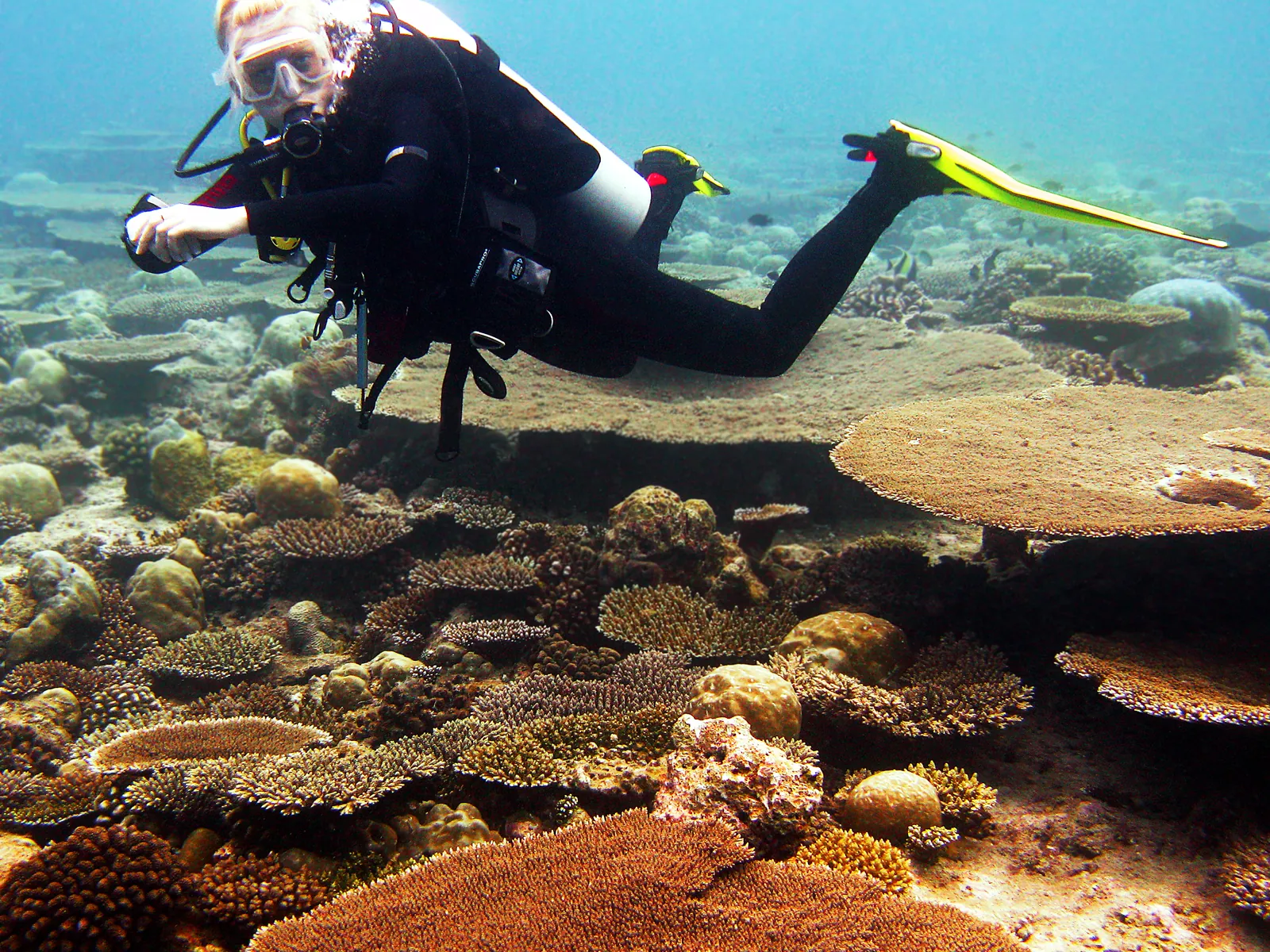
A diver over table corals in the Maldives. Ondřej Havelka, Wikimedia Commons, CC BY-SA 4.0, cropped.

Resort, local island or liveaboard: the same rules apply
The Tourism Act licenses resorts, guesthouses and tourist vessels separately, and every dive centre has to be registered with the Ministry of Tourism and hold an operating licence. The dive rules do not change with the base: the regulation states that its depth limit applies "without exception" on liveaboards and safari boats, and the no-decompression rule likewise.
What does change is daily life and access. The UK government notes that alcohol is only available on resort islands. A guesthouse puts you in an inhabited community, where the same advice asks for covered shoulders and upper legs, including on beaches used by locals, and Maldives Immigration requires a prepaid booking at a registered facility, so the guesthouse must be licensed. On a liveaboard, the UK advice reminds divers that accidents on diving safaris can occur and are in rare cases fatal, and Kuredu's clinic says its chamber also serves liveaboards passing through. At Hanifaru, resorts, dive schools and guesthouses take turns on alternating days.
The national dive rules: 30 meters, no decompression, logbook
The Maldives Recreational Diving Regulation, issued by the Ministry of Tourism in February 2003 and still read in English through its unofficial translation, sets the rules for every recreational diver and dive centre. The core is short. The maximum depth for all recreational diving is 30 meters, for tourists and for instructors on or off duty. Entry-level divers stop at 20 meters until trained in deep diving. "Only no decompression diving is allowed", with no exception. A diver who repeatedly and deliberately breaks these rules may be excluded from further diving.
To dive, you show a certification card from a recognised training agency and a logbook. If you cannot show at least 30 dives, or have not dived in the last three months, you make an orientation dive in shallow, calm water first; the guidelines add a logbook of at least 900 minutes and a medical certificate or self-declaration. On every dive you carry a time and depth device, a surface marker and a whistle, and dive computers are "highly recommended". Solo diving is not allowed, every dive ends with a safety stop of at least three minutes at 5 meters, and the guidelines list dives less than 12 hours before flying as prohibited, which matters before a domestic flight.
The regulation requires dive centre staff to carry insurance covering diving accidents and chamber treatment, but it sets no insurance duty for guests. Centres must have oxygen and an emergency plan that covers transport to medical care. Harbours and ports need the port authority's permission, dive boats may not anchor on dive sites, and for wrecks the rule is "look but don't touch".
Protected areas, the shark sanctuary and what you may not take
The environment ministry's portal lists 93 protected areas covering 66,007 hectares, with three UNESCO biosphere reserves, and says each one lists its rules, zones and fees. Several protected dive sites, such as Maaya Thila and South Ari, show a booking price of MVR 0; Hanifaru charges MVR 310. The 2003 regulation warns that a permit to dive in a marine protected area may be required, so check the site's page or ask the centre.
The protections reach beyond the parks. The cabinet banned shark fishing from 1 March 2010 and trade in shark products from 1 July 2010, and in 2021 the Fisheries Ministry said the whole exclusive economic zone is a shark sanctuary and urged divers and the tourism industry not to feed or chum sharks. The government's Hanifaru code of conduct states that all sharks, including whale sharks, and all rays, including both manta species, are protected. The 2003 guidelines say nothing should be taken out of the sea, and the UK government adds that taking coral or tortoiseshell out of the country is illegal.
Seasons and water temperature by atoll
The Maldives has two monsoons. The government's Hanifaru plan dates the southwest monsoon, Hulhangu, from May to October; a 2026 study from Fuvahmulah, citing meteorological data, puts the northeast monsoon from December to April with transition months in May and November. We could not read the Maldives Meteorological Service's own data. The big animals follow their own calendars: Hanifaru's aggregations run from May to December, South Ari's whale sharks are present all year, and our Fuvahmulah guide has the tiger shark and hammerhead months.
Water temperature barely moves. These are NOAA's satellite averages for 1991 to 2020, one ocean cell per atoll:
| Atoll (NOAA grid cell) | January | April | July | October |
|---|---|---|---|---|
| Baa (5.1°N 73.1°E) | 28.1 °C | 29.8 °C | 28.8 °C | 28.6 °C |
| North Malé (4.1°N 73.6°E) | 28.1 °C | 29.8 °C | 29.0 °C | 28.6 °C |
| South Ari (3.4°N 72.9°E) | 28.1 °C | 29.7 °C | 29.1 °C | 28.7 °C |
| Fuvahmulah (0.4°S 73.4°E) | 28.6 °C | 29.8 °C | 29.3 °C | 29.0 °C |
| Addu (0.6°S 73.1°E) | 28.6 °C | 29.8 °C | 29.3 °C | 29.0 °C |
April is the warmest month everywhere, at 29.7 to 29.8 °C, and January the coolest, at 28.1 °C in the north and 28.6 °C in the south. Lhaviyani and Vaavu read within 0.2 °C of their neighbours all year. These are surface values.
Chambers and emergency numbers
DAN Europe, which assessed every facility in 2023, wrote in October 2026 that the Maldives has five hyperbaric chambers. Only one, at Kuredu in Lhaviyani, is multiplace, so medical staff can be inside with the patient; all the others, including the one at ADK Hospital in Malé, are monoplace. DAN describes a case in which a diver's condition got worse inside a monoplace chamber and, because no one could assist inside, the diver died. In the south, DAN names Kandima, about 120 nautical miles south of Malé, as the only chamber, and gives average speedboat times to it of five hours from Huvadhoo, eight from Fuvahmulah and up to ten from Addu, at about €5,000 to €10,000. It adds that air evacuation is often unavailable when needed.
Of the facilities we could read, Kuredu states round-the-clock cover: its hotlines, +960 790 7510 and +960 790 1754, are "available 24/7" and answered by a diving doctor. ADK Hospital confirms its monoplace chambers and lists decompression sickness among the conditions it treats, but we found no current statement of 24-hour chamber cover. In September 2025 the President's Office announced the state's Senahiya Hyperbaric Centre at Guraidhoo in Thaa Atoll and pledged chambers for Addu, Fuvahmulah, Villingili, Rasdhoo, Thinadhoo and Malé within four months; we found no report that any of those has opened. We could not confirm the chambers at other resorts from their own pages.
In an emergency, call 911. The police list it as the emergency number, and since its launch in November 2024 it connects callers to the police, ambulance, coast guard and fire service, according to the launch reports. The UK government lists 102 for an ambulance, and the police run a tourist hotline on 1478. Ask your dive centre for its emergency plan, which the regulation requires, and check that your dive insurance pays for a long boat or air evacuation.
Getting in and staying as a remote worker
Maldives Immigration grants the tourist visa on arrival without pre-approval. You need a machine-readable passport valid for at least one month, a confirmed return ticket, a prepaid booking at a registered facility and enough funds, and you submit the free Traveller Declaration within 96 hours before arrival. The UK government gives the visa on arrival as 30 days. Since 23 April 2026 extensions are applied for on the IMUGA portal and are expected within 48 hours; we found no official statement of the maximum stay or the fee.
Maldives Immigration offers no remote-work or digital-nomad visa. Its site lists tourist, work, business, dependent, marriage, meeting, resident and sponsorship categories, and nothing else. A remote-working visa has been announced as a plan but does not appear there, and the UK government says anyone who intends to work in the Maldives needs a work visa before travelling. Our local islands guide covers daily costs and connectivity for a longer stay.
How to choose between the Maldives' atolls
Choose Baa if mantas are the point and a snorkel-only encounter between May and December suits you, with the multiplace chamber at Kuredu in the north. Choose Malé or Ari for protected thilas such as Lankan and Maaya Thila and for whale sharks in South Ari in any month. Choose Fuvahmulah or Addu for big sharks and the British Loyalty wreck, if you accept long evacuation times and a fed shark dive at Fuvahmulah. A liveaboard can link several atolls in one trip. The Maldives suits less well a diver who wants to go past 30 meters or into caves, anyone who needs a long-stay remote-work visa, and anyone who is not willing to plan their dive trip around the distance to a chamber.
FAQ: Maldives diving
What is the maximum dive depth in the Maldives?
30 meters for all recreational diving, under the Ministry of Tourism's 2003 diving regulation, and 20 meters for entry-level divers until they are trained in deep diving. Decompression diving is not allowed at all, and the limits apply on liveaboards without exception.
Do I need a logbook to dive in the Maldives?
Yes. The regulation asks every diver for a certification card and a logbook. If you cannot show at least 30 dives, or have not dived in the last three months, the dive centre will ask for an orientation dive in shallow water first.
What happened in the Maldives diving accident in May 2026?
Five Italian divers died during a cave dive in Vaavu Atoll on 14 May 2026. The Ministry of Tourism suspended the licence of their liveaboard pending an investigation, and the government announced a law to regulate technical diving. No official cause had been published by November 2026.
When is the water warmest in the Maldives?
In April, at 29.7 to 29.8 °C in NOAA's 1991 to 2020 averages for Baa, Malé, South Ari, Fuvahmulah and Addu. January is the coolest month, at 28.1 °C in the north and 28.6 °C in the south.
Where are the hyperbaric chambers in the Maldives?
DAN Europe counts five. Kuredu in Lhaviyani has the only multiplace chamber and states 24/7 hotlines; ADK Hospital in Malé has monoplace chambers; Kandima, about 120 nautical miles south of Malé, is the only one DAN names in the south. A state chamber opened at Guraidhoo in Thaa in 2025. Call 911 in an emergency.
Note: Conditions, safety guidance and regulations change. Verify current information with official sources, including the dive operator, the park authority and the relevant government department, before you travel or dive.
Founder of NOMADREEF and a former digital nomad. This guide is sourced from the references below; conditions, prices and rules change, so verify current details, and follow qualified local guidance and safety briefings. About the author · LinkedIn ↗
Sources
- National dive rules (primary). Ministry of Tourism, Maldives Recreational Diving Regulation 2003 (PDF, unofficial translation): Tourism Act sections 29, 42 and 46; chapter two sections 1 to 11 on certification, the 30 and 20 meter limits, no decompression diving, oxygen and emergency plans, equipment, safety stops, solo diving, staff insurance and orientation dives; chapter three on prohibited dives, the 900-minute logbook guideline, restricted areas, wrecks, shark feeding, protected areas and anchoring. Read 11 November 2026.
- Vaavu, May 2026 (primary and triangulated). President's Office, condolences to Italy and visit to the search site, 15 May 2026. Licence suspension and the technical-diving law triangulated from MV+ on the suspension and the planned law, The Edition on the depth of the cave and the recovery and suspension, Atoll Times and The Scuba News, 14 to 24 May 2026. Read 11 November 2026.
- Protected areas (primary). Ministry of Climate Change, Environment and Energy, Maldives Protected Areas portal, with the pages for South Ari Marine Protected Area, Maaya Thila, Lankan Thila, Maldives Victory, British Loyalty and Hanifaru. Ministry of Tourism and Environment, Hanifaru MPA Conservation Action Plan 2025–2030 (PDF) and its executive summary with the code of conduct (PDF). Read 10 and 11 November 2026.
- Shark protection (primary). President's Office, cabinet decisions of 9 March 2010. Ministry of Fisheries, Marine Resources and Agriculture, media statement (PR)30-D/30/2021/6 of 20 April 2021, as reproduced by X-Ray Magazine (PDF). Read 10 and 11 November 2026.
- Seasons and sea temperature. Hanifaru MPA Conservation Action Plan, as above, for the southwest monsoon. Perisic et al., Marine Biology 173:111, 2026, doi:10.1007/s00227-026-04865-y, for the northeast monsoon. NOAA PSL, OISST v2.1 monthly long-term means 1991–2020, seven 0.25° grid cells, read for this page (primary dataset, our calculation). Read 11 November 2026.
- Chambers. DAN Europe, Beyond the chamber map, 15 October 2026; Kuredu Medical Clinic and Hyperbaric Centre (facility); ADK Hospital (facility); President's Office, health infrastructure announcement, 25 September 2025, and The Edition, Guraidhoo chamber, 26 September 2025. Read 11 November 2026.
- Emergency numbers and safety. Maldives Police Service, important contacts (primary); The Edition, 911 launch, 15 November 2024; UK Foreign, Commonwealth & Development Office, getting help, health and safety and security. Read 11 November 2026.
- Entry (primary). Maldives Immigration, tourist visa, extension process from 23 April 2026 and the list of visa types; UK Foreign, Commonwealth & Development Office, entry requirements. Island Aviation, Malé and Dharavandhoo. Read 11 November 2026.
- Left out. The Maldives Meteorological Service's monsoon and cyclone data, which we could not read; the Ministry of Tourism's own pages, which blocked us, including its chamber list, its statement on the Vaavu incident and any regulation newer than 2003; any official finding on the cause of the Vaavu deaths; hours and status of the chambers at Kandima, Bandos and Kuramathi, of 24-hour chamber cover at ADK and Guraidhoo, and of the regional chambers promised in 2025; the coast guard's own direct line; the maximum tourist-visa stay and extension fee; dive prices, which are on the Hanifaru and Fuvahmulah guides.