Best Places to Dive with Manta Rays
 by Yannick SchrothSep 6, 202610 min read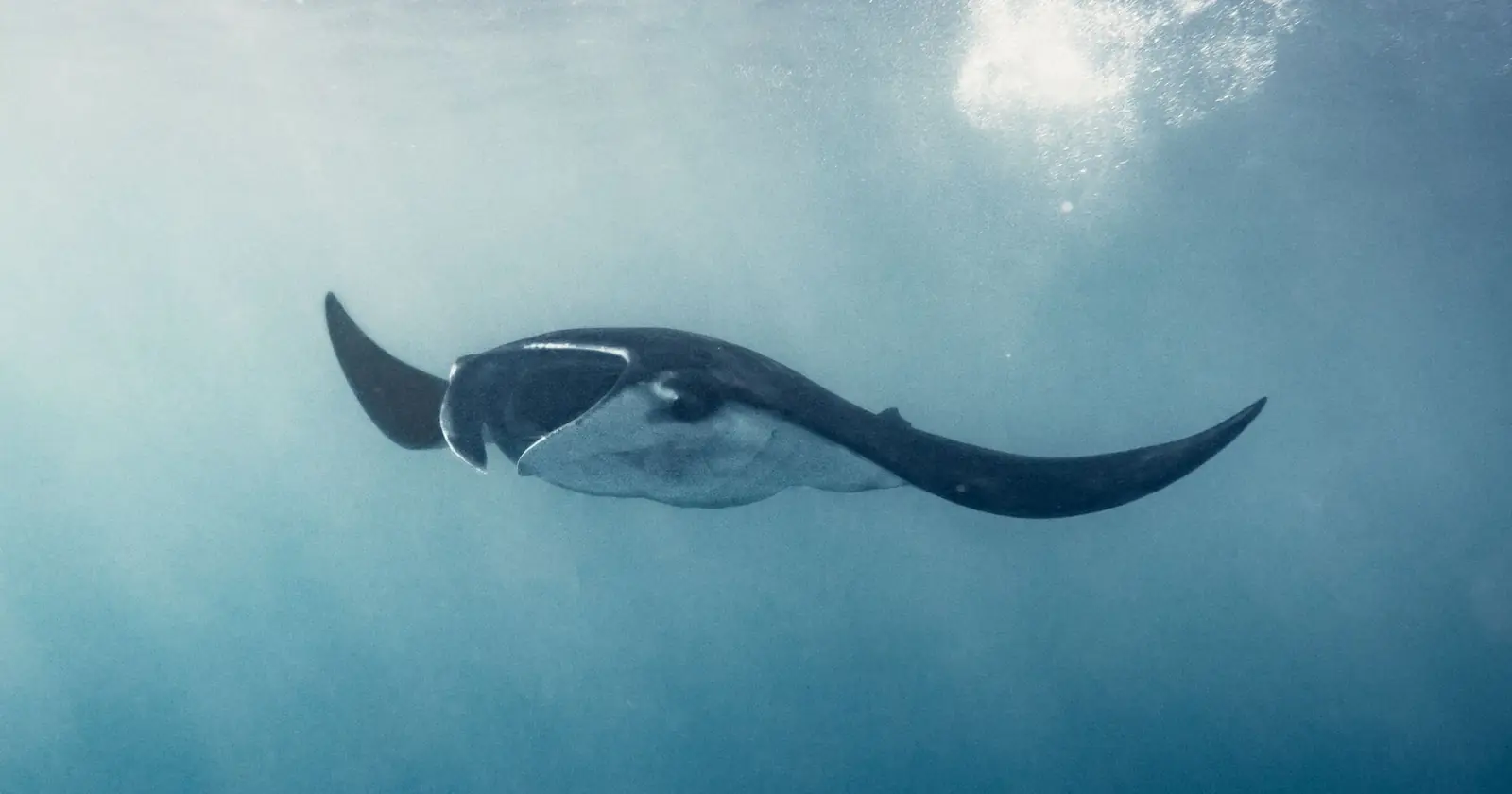
Photo: Nick Wehrli / Pexels.
What makes a manta site worth the flight
Three things separate a site where you will see mantas from a site where somebody once did.
Which species is there. There are two, and they behave differently. Reef mantas (Mobula alfredi) reach about five meters across, stay near coasts, and return to the same cleaning stations, which is what makes them dependable. Oceanic mantas (Mobula birostris) reach about seven meters, live offshore, and turn up seasonally in places that are usually a long boat ride away. The IUCN lists the reef manta as Vulnerable and the oceanic manta as Endangered. A destination is really offering you one or the other, and most articles do not say which.
Cleaning station or feeding aggregation. A cleaning station is a rock that mantas visit to be picked clean; it works most of the year and delivers a few animals at a time. A feeding aggregation is a plankton event; it is seasonal, it is unreliable week to week, and when it fires it produces numbers nothing else matches. Knowing which one a place is tells you when to go and what to expect.
Whether sightings are holding. This is the one nobody publishes, and it is the reason one former headline destination is no longer on this list.
1. Maldives: the largest reef manta population on earth
Not a close call. The Manta Trust's Maldivian Manta Ray Project has been photographing this population for more than fifteen years and passed 5,000 individually identified reef mantas, which the project describes as the largest manta database in the world and the largest reef manta population in the world “by a large margin”. The project has separately identified more than 1,000 individual oceanic mantas in Maldivian water, most of them around Fuvahmulah.
The set-piece is Hanifaru Bay in Baa Atoll, a feeding aggregation that has produced reports of up to two hundred mantas in the bay at once. It is also the most tightly managed manta site on this list: gazetted as a protected area in 2009, inside the Baa Atoll UNESCO Biosphere Reserve declared in 2011, and run on rules that exist because the site was being loved to death. Scuba is banned outright, exhaust bubbles break up the feeding columns, so it is snorkeling only, entry is by licensed boat with a ranger controlling how many people are in the water, sessions run about forty-five minutes, and there is a fee per person per day at the ranger station.
Away from Hanifaru the atolls carry cleaning stations that work through the year, which is why the Maldives is both the seasonal spectacle and the safe bet. It is the one place on this list where you can plan around either mechanism.
2. Puerto López, Ecuador: 22,000 oceanic mantas off Isla de la Plata
The most under-reported manta destination in the world, and the reason this list is not simply a list of the usual six.
Researchers working at Isla de la Plata, reached by boat from the town of Puerto López in Ecuador's Machalilla National Park, identified more than 2,800 individual oceanic mantas from photographs taken between 2005 and 2018, and estimated the total population at more than 22,000. For scale: other known subpopulations of this species are typically estimated at one to two thousand animals, so Ecuador's is more than ten times larger than any other known subpopulation. The work was led by Fundación Megafauna Marina del Ecuador with the Manta Trust, the Marine Megafauna Foundation and Oregon State University, and published in Marine Ecology Progress Series.
The catch is the calendar: the aggregation forms around August and September. Outside that window you are somewhere else entirely. But if you want the biggest of the two species in the place where there are demonstrably the most of them, this is it, and it is a fraction of the price of a Pacific liveaboard.
3. Indonesia: Komodo, Nusa Penida and the world's largest manta sanctuary
In February 2014 Indonesia's Ministry of Maritime Affairs and Fisheries banned the hunting, sale and trade of manta rays across the country's roughly 5.8 million square kilometres of exclusive economic zone, creating the largest manta ray sanctuary in the world. Breaching it carries up to six years in prison and a fine of around US$100,000. The argument that carried it was economic: a government-backed review valued a single living manta at about a million dollars in tourism over its lifetime, against forty to five hundred dollars caught and killed.
What that buys a visitor is two very different sites in one country. Nusa Penida's Manta Point is a reef manta cleaning station that works all year in a sheltered bay no deeper than about twelve meters, a short boat from Bali, the most accessible dependable manta dive anywhere on this page. Komodo's Karang Makassar is a dry-season site and a bigger, wilder day out. Raja Ampat has the richest reefs of the three and is a liveaboard proposition.
Indonesia is also where the operator records are strongest, which matters here more than usual, see the last section.
4. Revillagigedo, Mexico: if you can take a liveaboard
San Benedicto, Socorro, Roca Partida and Clarión sit several hundred kilometres off Baja California and hold one of the world's largest oceanic manta populations, with a reputation for animals that approach divers rather than tolerate them.
The archipelago was made a UNESCO World Heritage site in 2016 and a national park in 2017, covering 148,087 square kilometres with no extractive activity permitted at all, Mexico's largest fully protected marine reserve. That is the strongest legal protection of any site on this list.
It is also the hardest to reach: liveaboard only, no day boats, no shore option, and a crossing measured in days rather than hours. Rank it fourth on access, not on animals.
5. Kona, Hawaii: the night dive, and why it is so reliable
Kona is not on this list for population size. The Manta Pacific Research Foundation's identification catalog holds a few hundred individual mantas for the Kona coast, which is small next to the Maldives. It is here because of what the site does to the odds.
The encounter is engineered: lights on the sea floor draw plankton, plankton draws reef mantas, and divers and snorkellers kneel or float in a ring around the light. Operators report sighting rates in the high eighties to low nineties per cent, and one site published a 96% season. Those are the operators' own figures rather than independent monitoring, so treat them as a claim with a commercial interest: but the mechanism is real and it is the reason this is the one manta encounter you can put in the middle of a fixed itinerary.
The trade-off is that the same lights that make it reliable make it crowded, and the practice has drawn criticism locally. If you go, go with a boat that caps numbers.
6. Thailand: Koh Bon and the Similans, when the park is open
Koh Bon and the northern Similan sites are genuine reef manta encounters and the most convenient on this list for anyone already in Southeast Asia. They are last because the season is short at both ends.
Mu Ko Similan National Park closes every year: 16 May to 14 October in 2025, and announced as 15 May to 15 October for 2026. That removes five months, and the shoulder months are weather-dependent on top. If your dates are flexible this is a fine trip; if they are not, look at the Andaman calendar before you book anything.
Mozambique: Tofo has lost its mantas
This page used to list Tofo as a year-round manta destination. That is no longer defensible, and the reason is one of the better long-term datasets in the field.
The Marine Megafauna Foundation has monitored the southern Mozambique aggregation since the early 2000s. Modelling that accounts for temporal and environmental variables reports declines of 97% in reef manta sightings and 89% in oceanic manta sightings. The Foundation's own account of Tofo specifically puts the fall at about 88% over the first decade of monitoring and as much as 99% over the second. Nearby Zavora is down around 82% and still produces seasonal aggregations, sometimes dozens on a dive.
None of that makes Tofo a bad place to dive, and the research operation there is worth supporting. It does mean that recommending it for mantas, on this evidence, would be selling somebody a memory of the place rather than the place. Our Tofo guide covers what is still there.
Which operators have been assessed
Mantas are the encounter where the operator decides the outcome: a boat that drops eight divers on top of one animal empties a cleaning station for the afternoon. Green Fins, run by The Reef-World Foundation with the UN Environment Programme, publishes a code of conduct written for exactly this, and grades members two very different ways. Certified Members have had an in-person assessment by a trained assessor within the last twelve months, graded gold, silver or bronze. Digital Members make the same written commitment and then evaluate themselves online, for a joining fee and with no minimum score.
| Place | Centres we list | Assessed in person | Self-assessed only |
|---|---|---|---|
| Labuan Bajo (Komodo) | 29 | 12 | 1 |
| Nusa Penida | 18 | 3 | 1 |
| Maldives local islands | 89 | 0 | 11 |
| Khao Lak (Similan) | 8 | 0 | 0 |
| Raja Ampat | 3 | 0 | 3 |
Labuan Bajo is the outlier and the one to book from. Twelve of its twenty-nine centers have been assessed in person, which is every in-person assessment across all five places put together. For a Komodo manta trip that is the strongest operator evidence on this page.
The Maldives row is the one to read twice. Eighty-nine operators, eleven of them Green Fins members, and not one of the eleven has been inspected. Every one is a self-assessed Digital Member. That is not an accusation about any particular boat; it means that on the specific question of behaviour at a cleaning station, the country with the most mantas offers the least external evidence about the people taking you to them. Ask about group size and distance rules before you book, and treat the answer as the actual test.
The short version
- Most reef mantas anywhere: the Maldives, with over 5,000 individuals identified and the world's largest manta database.
- Most oceanic mantas anywhere: Ecuador's Isla de la Plata, estimated at 22,000-plus, August and September only.
- Most dependable, easiest to reach: Nusa Penida's Manta Point, a year-round cleaning station a boat ride from Bali.
- Best-protected: Revillagigedo, 148,087 km² with no extraction, liveaboard only.
- Do not plan a manta trip around Tofo. Sightings there are down by up to 99%.
The full guides behind these manta sites
Nusa Penida
A reef manta cleaning station that works all year, in under 12 metres, a short boat from Bali.
Year-round, near BaliRead the guide → 8°29′S 119°53′E · IndonesiaLabuan Bajo (Komodo)
Karang Makassar in the dry season, and the only place here with a cluster of assessed operators.
Komodo, dry seasonRead the guide → 3°54′N 73°21′E · MaldivesMaldives local islands
Cleaning stations year-round and the Hanifaru aggregation in season, from budget local islands.
Atolls, aggregationsRead the guide → 8°38′N 98°15′E · ThailandKhao Lak (Similan)
Koh Bon and the northern Similans, inside a park that closes for five months a year.
Similans, Koh BonRead the guide → 0°14′S 130°31′E · IndonesiaRaja Ampat
Mantas among the richest reefs on earth, inside the world's largest manta sanctuary.
Remote, world-classRead the guide → 23°51′S 35°33′E · MozambiqueTofo
Still a fine place to dive. No longer a manta destination, and the data says why.
Whale sharks, researchRead the guide →Two of these now have guides of their own: Puerto López and Isla de la Plata and the Kona night dive. Revillagigedo has no settlement, so the departure port Los Cabos stands in for it.
FAQ: Places to Dive with Manta Rays
Where are there the most manta rays in the world?
Two answers, one per species. For reef mantas it is the Maldives: the Manta Trust's project there has identified more than 5,000 individuals over fifteen years and calls it the largest reef manta population in the world by a large margin. For oceanic mantas it is Ecuador, where researchers identified more than 2,800 individuals off Isla de la Plata between 2005 and 2018 and estimated the population at over 22,000, more than ten times any other known subpopulation.
What is the most reliable place to see manta rays?
Nusa Penida's Manta Point, if you want dependable and easy: a reef manta cleaning station that works all year in water no deeper than about twelve meters, a short boat from Bali. Kona in Hawaii is arguably more reliable still, operators report sighting rates in the high eighties to low nineties per cent: but those are the operators' own figures, and the site works by drawing plankton with lights rather than by being a natural aggregation.
Can you still see manta rays in Tofo, Mozambique?
Rarely. Research on the southern Mozambique aggregation reports declines of 97% in reef manta sightings and 89% in oceanic manta sightings, and the Marine Megafauna Foundation puts Tofo's own fall at about 88% over the first decade of monitoring and up to 99% over the second. Tofo remains a good dive destination for other reasons, but it is no longer a place to plan a manta trip around.
Do I need to be a diver to see mantas?
No, and at the single biggest aggregation you are not allowed to be. Scuba is banned at Hanifaru Bay in the Maldives because exhaust bubbles break up the feeding columns, so it is snorkeling only. Nusa Penida's Manta Point is shallow enough to snorkel too. Most cleaning stations elsewhere are dive sites. Either way, watch from below, stay still, and never touch or chase them.
Sources
- Maldives reef manta population: more than 5,000 individuals identified over fifteen years, described as the world's largest manta database and the largest reef manta population “by a large margin”. The Manta Trust, read 6 September 2026. mantatrust.org
- Maldives oceanic mantas: more than 1,000 individuals identified, most around Fuvahmulah. The Manta Trust. mantatrust.org
- Ecuador's oceanic manta population: 2,800-plus individuals identified from 2005 to 2018, total estimated above 22,000, more than ten times any other known subpopulation. Published in Marine Ecology Progress Series; summary by The Manta Trust, read 6 September 2026. mantatrust.org
- Mozambique declines: 97% in reef manta sightings and 89% in oceanic manta sightings, and the Tofo and Zavora figures. Marine Megafauna Foundation's manta and devil ray project, read 6 September 2026. marinemegafauna.org and the published analysis in Environmental Biology of Fishes
- Indonesia's manta sanctuary: the 2014 Ministry of Maritime Affairs and Fisheries ban across roughly 5.8 million km², the penalties, and the tourism-value review. Read 6 September 2026. MacArthur Foundation and ICRI
- Revillagigedo: UNESCO World Heritage 2016, national park 2017, 148,087 km² fully protected with no extractive activity. Read 6 September 2026. IUCN World Heritage Outlook and Pew
- Hanifaru Bay and Baa Atoll: protected area 2009, UNESCO Biosphere Reserve 2011, scuba banned, ranger-controlled numbers, roughly 45-minute sessions. As published by licensed operators and dive media; no government decree setting out the operating rules was found. Read 6 September 2026. ZuBlu
- Kona sighting rates: high eighties to low nineties per cent, published by Kona operators; the Manta Pacific Research Foundation's identification catalog for the Kona coast. Read 6 September 2026. mantapacific.org
- Similan closure dates: 16 May to 14 October in 2025, announced as 15 May to 15 October for 2026. Tourism Authority of Thailand. tatnews.org
- Green Fins membership levels, Certified against Digital. greenfins.net, and the member register for the counts
- SSI training center register, read whole and filtered to each place. divessi.com
- Counted from the registers above: Labuan Bajo 21 August 2026, Nusa Penida 26 August, Khao Lak 25 August, Raja Ampat 18 August and Maldives 3 September 2026.