Fuvahmulah Tiger Shark Diving: A Fed Harbour Dive, 239 Known Sharks and a Long Way to a Chamber
 by Yannick Schroth
Nov 10, 2026
13 min read
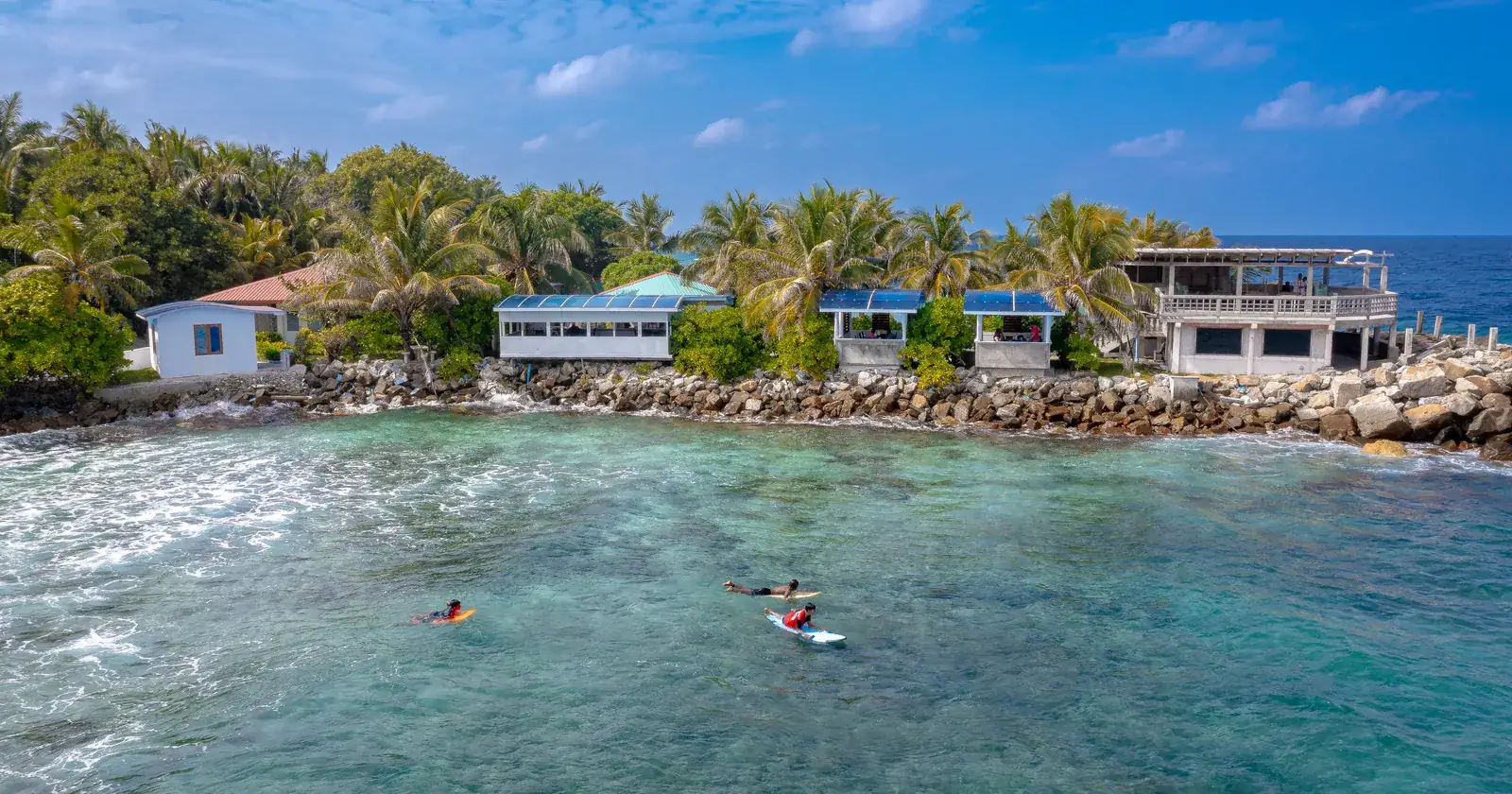
The water beside Fuvahmulah's harbour, filed on Commons as the Shark Harbour surf area. Asaymirus, Wikimedia Commons, CC BY 4.0, cropped.

Key takeaways
- The tiger sharks gather because tuna discards from the harbour feed them, and since the mid-2010s operators have dived the spot with bait every day
- A 2024 study in Scientific Reports identified 239 individuals, 84.5% of them female; a 2026 study found them year-round, with more sightings from December to April
- The Maldives' 2003 diving guidelines say shark feeding is not permitted, the Fisheries Ministry asks divers not to feed sharks, and the harbour dive is baited daily anyway
- Diving in the Maldives stops at 30 meters, with no decompression diving and no dive in the 12 hours before a flight, which covers the hop back to Malé
- No chamber on Fuvahmulah or in nearby Addu is confirmed working; DAN Europe puts Kandima, about eight hours by speedboat, as the nearest in the south
Fuvahmulah's tiger sharks come for the tuna fishery's waste
Fuvahmulah is a single island in the far south of the Maldives with no lagoon to speak of, and its fishers have caught tuna off it for generations. When the harbour was built in 2004, the heads, guts and bones from the catch went into the water beside it. A 2024 study in Scientific Reports by Vossgaetter and colleagues, written with researchers from the Leibniz Centre for Tropical Marine Research in Bremen and the island's oldest dive school, describes what followed: fish waste accumulated around the harbour, and the tiger sharks came with it. A report for the UK's Joint Nature Conservation Committee adds that the waste was first thrown inside the harbour and later moved outside the walls because of the mess, which turned it into a reliable food source for sharks that would otherwise range around the island and offshore.
Divers followed in the mid-2010s. The sources disagree on the year, 2015 in the government report and 2017 in the study, but agree on what the dive is now: the sharks, in the study's words, are "provisioned daily, year-round, with the fishers' tuna discards". Over 788 recorded dives between December 2016 and September 2023, the researchers told 239 individual tiger sharks apart by their markings and measured them with lasers. 202 were female. The authors call it the largest documented number of individual tiger sharks in one confined area, and nobody has published a larger count.
The Fuvahmulah tiger shark dive is shallow, short and sits in the boat channel
The site goes by several names, Tiger Harbour, Tiger Zoo or Tiger Shark Point depending on the shop, and it is the same place: the entrance to the harbour. Pelagic Divers gives its top as 6 to 10 meters and its edge as 12 to 15 meters before it slopes into the blue; Liquid Shark Divers describes a sandy plateau of 5 to 10 meters, sheltered from the main current. Once the group is down, a guide signals the boat and bait goes in away from the divers, and the sharks come up onto the sand. Fuvahmulah Dive School says it sees about ten different tiger sharks on an average dive.
The JNCC review, based on interviews with every operator on the island in December 2023, describes how the site is shared. Operators split it into two 30-minute slots each per diving day on a rota they run themselves, the whole dive lasts about 45 minutes, and shops state a maximum of four divers per guide. The site was dived on 95% of days in the year before. It is also in the middle of the boat channel, and the report notes that boats pass over divers constantly in the busy season from December to May. Ask your shop how it keeps the group clear of traffic on the ascent.
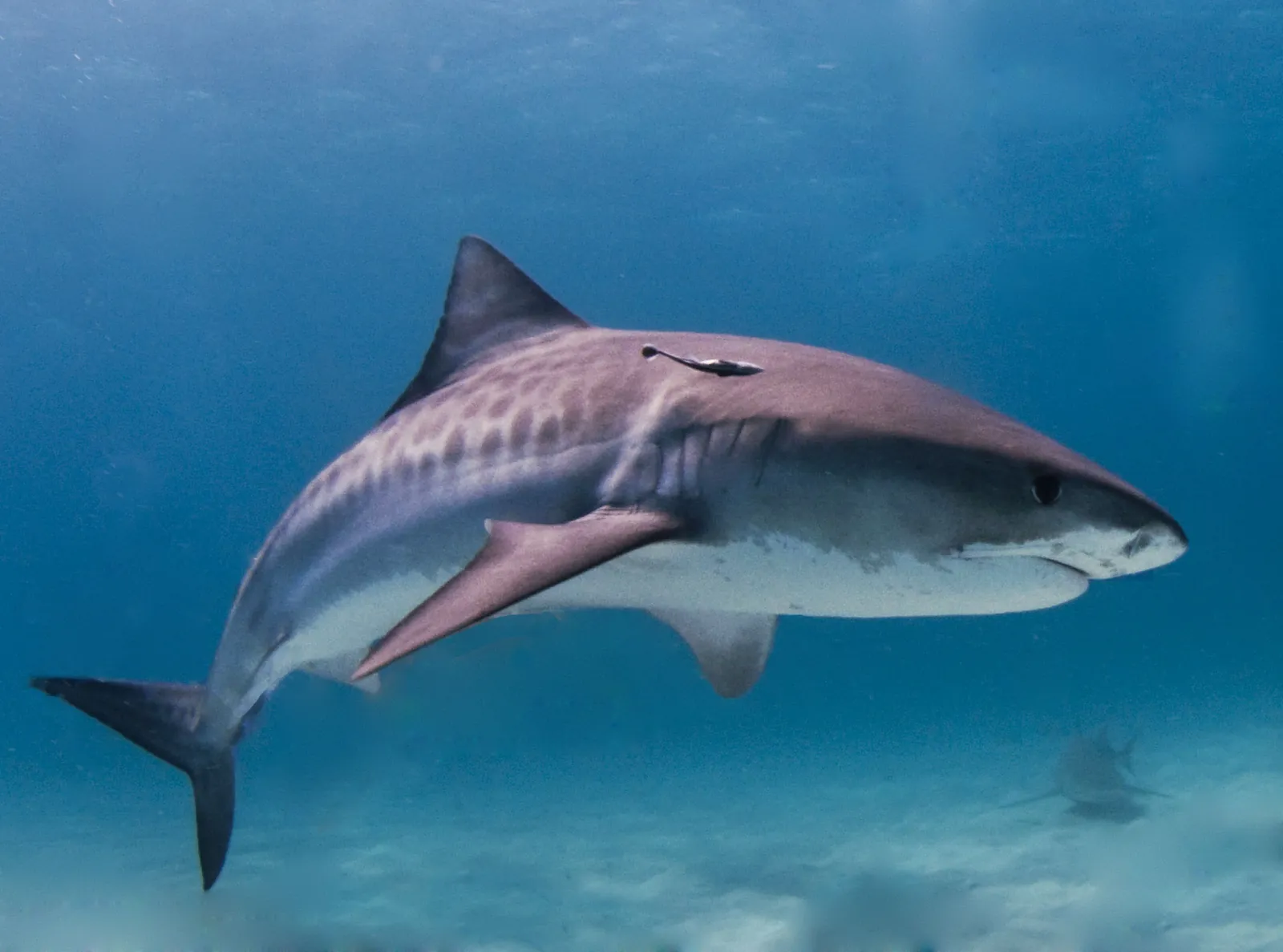
A tiger shark photographed in the Bahamas, not at Fuvahmulah. Albert Kok, Wikimedia Commons, CC BY-SA 3.0, resized.

Is shark feeding legal in the Maldives? The rules and the harbour disagree
On paper the answer leans to no. The Maldives' recreational diving regulation of 2003, in the Ministry of Tourism's translation, carries a chapter of diving guidelines whose environment section says plainly that "shark feeding is NOT permitted for the divers and the dive centre staff alike." The JNCC report reads that as a prohibition. In 2021 the Ministry of Fisheries repeated the country's shark protection and urged "the public, divers and the tourism industry to refrain from feeding or chumming as a means to attract sharks."
In the water, the harbour dive is baited every day, and the 2024 study states that the Maldives has "no laws or guidelines regulating provisioned shark dives", with codes of conduct left to each dive centre. We found nothing that reconciles the two. The same JNCC report points to a second problem with the site: the 2003 rules list harbours and boat channels as restricted areas that need the port authority's permission. Fuvahmulah's city council worked on its own regulation for dive tourism in 2022 and 2023; we found no sign that it was ever enacted.
What is settled is the fishing. The Maldives banned shark fishing from 1 March 2010 and trade in shark products from 1 July 2010, across its whole exclusive economic zone, and the 2019 Fisheries Act extended this to a ban on keeping any shark caught by a Maldivian vessel. Our list of places to dive with sharks leaves out baited dives, and Fuvahmulah is the clearest example: the encounter is real and reliable, but only because the sharks are fed.
Tiger sharks are at Fuvahmulah in every month, more from December to April
A second study, published in Marine Biology in May 2026 by Perisic and colleagues with the island's two research-minded dive centres and the Ministry of Climate Change, followed 220 sharks across 911 surveys from August 2021 to March 2024. Sightings were "consistently higher during the NE monsoon", which on Fuvahmulah runs from December to April, and significantly lower in the southwest monsoon from June to October. A small group of about thirty sharks was highly resident. So any month works for the tigers; December to April is when there are the most of them.
The other animals are where Fuvahmulah gets seasonal and deep. The IUCN shark specialist group lists the atoll as an Important Shark and Ray Area for three reasons: pelagic thresher sharks at what it calls the only known thresher cleaning station in the western Indian Ocean, seen mainly from September to March but at 40 to 88 meters, below the Maldivian limit; schools of 30 to 60 scalloped hammerheads, mostly from February to May and October to December; and oceanic manta rays, which go from almost none to hundreds of sightings in a few weeks between March and May. The Manta Trust recorded the 2023 peak as 12 to 25 April. Whale sharks appear too, mostly large females on the tourism board's account, but no scientific source we found gives Fuvahmulah its own season for them.
Fuvahmulah's other dive sites need Advanced Open Water and comfort in current
Away from the harbour the island has no reef lagoon to shelter in, and the sites are walls and plateaus in open ocean. Farikede, off the south end and inside a marine protected area, starts at 10 to 15 meters and drops to a plateau at 35 to 60 meters and more; Pelagic Divers marks it for Advanced Open Water divers with strong currents, and the JNCC report notes that operators dived it on only about 193 days a year because of down currents and depth. Thoondu at the north point starts at 5 to 7 meters and runs past 30, with vortexes in Pelagic Divers' own description. If you are coming for the hammerheads or the threshers, you are coming for these sites, and you should arrive with recent drift diving.
Who can do the Fuvahmulah tiger shark dive: it depends on the shop
There is no national minimum for the harbour dive. Fuvahmulah Dive School, Pelagic Divers and Liquid Shark Divers take Open Water divers to it; Liquid Shark recommends Advanced Open Water for the deeper sites and asks only for recent dives. Extreme Dive Fuvahmulah sets Advanced Open Water or a deep specialty as its minimum and recommends 50 to 100 or more logged dives. Pick the shop by its rule, not by which rule you would like.
The national rules apply to everyone. The 2003 regulation caps recreational diving in the Maldives at 30 meters, and at 20 meters for entry-level divers, allows no decompression diving, and bans diving less than 12 hours before flying. Fuvahmulah's only fast way out is a domestic flight, so plan the last dive around it. Divers have to show a certification card and a logbook, and the regulation recommends a dive computer for everyone without requiring one. It requires insurance only of dive centre staff, but operators set their own terms: Extreme Dive and Pelagic Divers require dive insurance, and Liquid Shark sells one-day and one-week policies at the counter. Check what your own dive insurance pays for an evacuation from a remote atoll before you rely on it.
No working decompression chamber is confirmed near Fuvahmulah
This is the part of the trip to plan before you book. In October 2026 DAN Europe described the Maldives as having five hyperbaric chambers, only one of them in the southern part of the country, at the Kandima resort about 120 nautical miles south of Malé, and put the journey from Fuvahmulah to it at about eight hours by speedboat. In September 2025 the state opened its first chamber outside Malé, at Guraidhoo in Thaa Atoll, run by the military's Senahiya Hospital, and the President said chambers would follow on several islands including Fuvahmulah and Addu within months. We found no report that either has opened. The dive regulation requires every dive centre to carry oxygen and to have an emergency plan with a way to reach medical care, so ask the shop what its plan is today and how long it takes.
A Fuvahmulah tiger shark dive costs $80 to $108
Prices read on the operators' own pages on 10 November 2026, in US dollars and including tax:
| Dive center | Tiger shark dive | Freediving with tiger sharks |
|---|---|---|
| Liquid Shark Divers | $100 | $150 |
| Pelagic Divers Fuvahmulah | $97, or $108 with equipment | $150 |
| Extreme Dive Fuvahmulah | $80, or $70 a dive for 3 to 7 | — |
The JNCC report found the same spread in 2023: $81 on average for the harbour dive, from $65 to $108, against $71 for other sites, and most shops sold three-dive packages of the harbour plus two reef or plateau sites for $200 to $250.
Getting to Fuvahmulah takes a domestic flight or the ferry from Addu
Maldivian, the state airline, flies daily between Malé's Velana International Airport and Fuvahmulah, about an hour and a half, according to the national tourism board; the island's airport at its southern end has handled commercial flights since November 2011. Check the free baggage allowance before you pack dive gear, because the excess rate on the route is charged per kilo. The other way in is through Gan in Addu City, which has international flights, and then by ferry from Feydhoo to Fuvahmulah, which takes 45 to 90 minutes depending on the weather.
A month on Fuvahmulah: a local island with guesthouses and fibre
Fuvahmulah is an inhabited island, not a resort, and it lives like one. Alcohol is sold only on resort islands, and the UK government warns that having it elsewhere can mean arrest and deportation. Outside resorts, including on local beaches, the same advice asks for covered shoulders and upper legs, and topless bathing is not allowed anywhere. Guesthouses have grown with the diving, from 6 to 25 between 2017 and 2023 in the JNCC count. Maldives Immigration grants the tourist visa on arrival against confirmed onward travel, funds and a prepaid booking at a registered facility, so book a licensed guesthouse rather than a private room.
There is no remote-work visa. Immigration lists tourist, work, business and other categories and nothing for people working for foreign employers; the tourism ministry has announced plans for one. The UK government gives the tourist visa as 30 days, and since 23 April 2026 extensions are applied for on the IMUGA portal and decided within 48 hours; the maximum length and fee are not stated on the immigration pages we read. Dhiraagu said in January 2025 that its fibre broadband reached every inhabited island, which includes Fuvahmulah, but we found no published speed or 5G coverage for it. Our guide to the Maldives local islands covers daily costs and the visa in more detail.
Who Fuvahmulah suits
Fuvahmulah suits a diver who wants big sharks close up and accepts how that is arranged: a fed dive in a working harbour, shared with other boats on a timetable. It suits an Advanced diver with current experience who can use the plateaus for hammerheads and the manta weeks around April. It suits a remote worker less well than a resort island would, unless a dry island and guesthouse life are fine. It does not suit anyone who would rather not dive with bait, and nobody should come without an answer from their shop on the chamber question.
Eight Fuvahmulah dive centers on our Maldives list
Our Maldives operator list holds 8 businesses on Fuvahmulah, each with a register entry you can open: Cozy Scuba Club, Drop Dive, Fuvahmulah Scuba Club, Liquid Shark Divers, Pelagic Divers, Scuba Shark and Shark Heaven from SSI's register of affiliated centers, and Fuvahmulah Technical Diving from International Training's. None is a Green Fins member. The JNCC review counted 11 registered dive centers on the island in December 2023, so some, including Fuvahmulah Dive School and Extreme Dive, are not in the registers we read. A register entry says a training body lists the business; it says nothing about how a shop runs the harbour dive.
FAQ: Fuvahmulah tiger shark diving
Do you need Advanced Open Water for the Fuvahmulah tiger shark dive?
Not everywhere. Fuvahmulah Dive School, Pelagic Divers and Liquid Shark Divers take Open Water divers to the harbour site, which is 5 to 10 meters deep. Extreme Dive Fuvahmulah requires Advanced Open Water or a deep specialty. The deeper sites, Farikede and Thoondu, are for Advanced divers with experience in current.
When is the best time for tiger sharks at Fuvahmulah?
Tiger sharks are there in every month. A 2026 study found more sightings during the northeast monsoon, December to April, than in the southwest monsoon from June to October. Oceanic mantas peak for a few weeks between March and May, and hammerheads are seen mostly from February to May and October to December.
How much does a tiger shark dive at Fuvahmulah cost?
Between $80 and $108 a dive on operators' own price pages in November 2026: $80 at Extreme Dive, $97 or $108 with equipment at Pelagic Divers, and $100 at Liquid Shark Divers. Freediving with the tiger sharks costs $150 at the two shops that list it.
Are the tiger sharks at Fuvahmulah fed?
Yes. The sharks gather because of tuna waste from the island's fishery, and dive operators bait the harbour site daily. The Maldives' 2003 diving guidelines say shark feeding is not permitted and the Fisheries Ministry asks divers not to feed sharks, while a 2024 study found no rules that actually regulate the provisioned dives.
Is there a decompression chamber on Fuvahmulah?
Not that we could confirm. A chamber for Fuvahmulah was announced in September 2025, but DAN Europe's October 2026 assessment still names Kandima, about eight hours away by speedboat, as the only chamber in the south. Ask your dive centre for its current emergency plan before you dive.
Note: Conditions, safety guidance and regulations change. Verify current information with official sources, including the dive operator, the park authority and the relevant government department, before you travel or dive.
Founder of NOMADREEF and a former digital nomad. This guide is sourced from the references below; conditions, prices and rules change, so verify current details, and follow qualified local guidance and safety briefings. About the author · LinkedIn ↗
Sources
- The aggregation (primary, peer-reviewed). Vossgaetter et al., "Non-invasive methods characterise the world's largest tiger shark aggregation in Fuvahmulah, Maldives", Scientific Reports 14:21998, 2024, doi:10.1038/s41598-024-73079-3: harbour built 2004, daily provisioning, 788 surveys from 7 December 2016 to 30 September 2023, 239 individuals, 202 female, and the statement that no laws or guidelines regulate provisioned shark dives. Read 10 November 2026.
- Seasonality (primary, peer-reviewed). Perisic et al., "Monsoon variability and sea surface temperature influence the presence of tiger sharks around Fuvahmulah, Maldives", Marine Biology 173:111, 2026, doi:10.1007/s00227-026-04865-y: 911 surveys, August 2021 to March 2024, 220 individuals, higher sightings in the northeast monsoon. Read 10 November 2026.
- The dive industry (primary, government report). Araujo, Scotts and Zareer, "Review of Shark Diving Practices at Fuvahmulah, Maldives", Joint Nature Conservation Committee for the UK Ocean Country Partnership Programme, 2024, data.jncc.gov.uk (PDF): fieldwork 3 to 13 December 2023, eleven operators, slots, ratios, 95% of days, boat traffic, section 10(2)(a), the draft city regulation, prices, Farikede at 193 days, guesthouses from 6 to 25. Read 10 November 2026.
- Diving rules (primary). Ministry of Tourism, Maldives Recreational Diving Regulation 2003, unofficial translation, mvlaw.gov.mv (PDF): 30 m and 20 m limits, no decompression diving, no dive within 12 hours of flying, logbook, dive computer recommended, oxygen and emergency plan, staff insurance, restricted areas, and the guideline that shark feeding is not permitted. No later amendment was found by 10 November 2026. Read 10 November 2026.
- Shark protection (primary). President's Office, press release of 9 March 2010 on the fishing ban from 1 March 2010 and the trade ban from 1 July 2010. Ministry of Fisheries, Marine Resources and Agriculture, media statement of 20 April 2021 (PR)30-D/30/2021/6, as reproduced by X-Ray Mag (PDF), on the EEZ ban under Act 5/87, the retention ban under Act 14/2019 and the request not to feed or chum sharks. Both read 10 November 2026.
- Threshers, hammerheads and mantas. IUCN SSC Shark Specialist Group, Fuvahmulah Atoll ISRA factsheet (PDF), 2023 (primary): thresher cleaning station at 40 to 88 m, mainly September to March; hammerhead schools of 30 to 60, February to May and October to December; oceanic mantas March to May. Manta Trust, Oceanic Manta Ray Summary Report 2023 (PDF) (primary), peak 12 to 25 April 2023. Whale sharks: Visit Maldives, the tourism board, on large females; no scientific season found. Read 10 November 2026.
- Dive sites and requirements (each operator primary for itself). Fuvahmulah Dive School, Tiger Zoo; Pelagic Divers, dive sites (dated 7 June 2022); Liquid Shark Divers, tiger shark diving; Extreme Dive Fuvahmulah, rules, FAQ and terms. Read 10 November 2026.
- Prices (each operator primary for itself). Liquid Shark Divers rates; Pelagic Divers price list 2026–2027; Extreme Dive prices. Read 10 November 2026.
- Chambers. DAN Europe, Alert Diver, "Beyond the chamber map", 15 October 2026: five chambers, one in the south at Kandima, about 8 hours by speedboat from Fuvahmulah. The Guraidhoo chamber and the promised island chambers: Edition, 26 September 2025, and PLUS, 27 September 2025 (news reports; the President's Office text was not read). Read 10 November 2026.
- Getting there (primary). Visit Maldives, Travel to Fuvahmulah: daily Maldivian flights of about 1 h 30, the airport opened 11 November 2011, ferries to Feydhoo in 45 to 90 minutes. Maldivian baggage policy for the per-kilo excess rate. Read 10 November 2026.
- Entry and staying. Maldives Immigration, tourist visa and extensions from 23 April 2026 (primary). UK Foreign Office, Maldives travel advice, updated 12 August 2026, for the 30-day visa, alcohol and dress (a foreign government's advice, not Maldivian law). Travel Trade Maldives, 23 March 2026, on the planned remote-working visa. Atoll Times, 8 January 2025, on Dhiraagu fibre on all inhabited islands. Read 10 November 2026.
- The eight listings. Eight Fuvahmulah entries on the Maldives operator list, from the SSI register and the International Training facility register, read 9 November 2026.
- Left out. Flight frequency beyond "daily", the maximum length and fee of a tourist visa extension, mobile coverage and speeds on Fuvahmulah, and the Maldivian legal text behind the alcohol rule were not found in a primary source. An operator's claim of more than 300 named sharks is not used; the peer-reviewed count is.