Japan Diving: Okinawa, Ishigaki, Izu and Ogasawara, and the Fishing Rules That Apply on Every Dive
 by Yannick Schroth
Nov 10, 2026
13 min read
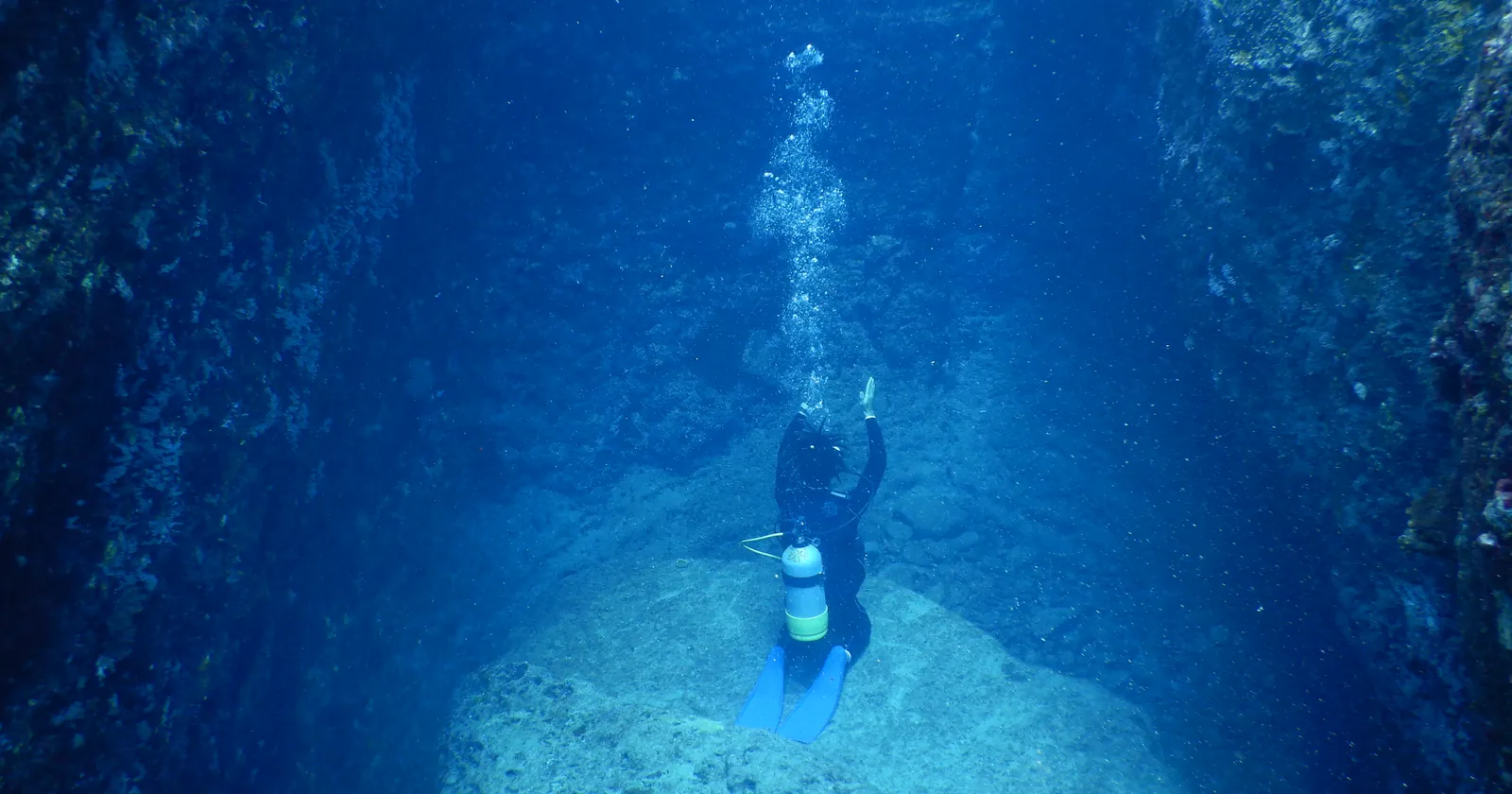
A diver at the rock formations off Yonaguni. Melkov, Wikimedia Commons, CC0, cropped.

Key takeaways
- Okinawa, Tokyo and Shizuoka all bar recreational divers from using scuba gear to take fish, shellfish or seaweed, and spiny lobsters, sea urchins and sea cucumbers sit in local fishery rights
- Since 1 April 2026 Okinawa's rewritten water-safety ordinance makes a notified dive business put its own guide in the water with you
- NOAA's 1991 to 2020 averages put February at about 21.5 °C off Okinawa's main island, 23.0 °C off Ishigaki, 20.7 °C off Ogasawara and 15.6 °C off Izu
- Typhoons approach the Okinawa region 7.7 times a year and the Izu and Ogasawara islands 5.4 times, on the weather agency's normals
- Japan's digital nomad status allows six months with no extension, for applicants earning at least ¥10 million a year from work abroad
Japan diving: two seas, five regions
Japan is long enough to hold two kinds of diving. In the south, Okinawa Prefecture strings islands across the warm water between Kyushu and Taiwan: the main island with Naha's airport, the Kerama Islands a boat ride west, Miyako, and the Yaeyama group with Ishigaki and Yonaguni. In the north, the coast nearest Tokyo is cold in winter, lava-rock diving built around weekend trips from the city, with the Izu islands and the remote Ogasawara group strung south of it in the Pacific.
Okinawa's main island and the Kerama Islands
Most visitors start at Naha. The main island has shore dives of its own: the Okinawa Convention & Visitors Bureau, the prefecture's official tourism body, names the Blue Cave at Cape Maeda, Gorilla Chop and the Sunabe seawall, where divers enter from the breakwater. The reef in most photographs, though, is Keramashoto National Park, a separate island group west of Naha. The Ministry of the Environment lists 3,520 hectares of land and one marine park zone of 8,290 hectares, designated on 5 March 2014.
The Keramas are a boat day from the main island, or a stay on Zamami or Tokashiki. Plan around the ferries: Zamami village's November timetable shows its fast boat, the Queen Zamami, out of service for dry dock from 20 October to 3 December 2026, which leaves the slower ferry. The two villages also run a local ecotourism guideline for dive groups. Our Okinawa diving guide covers the trip out, and Ishigaki vs Okinawa covers the village rules and the chamber south of Naha.
Ishigaki, the Yaeyama Islands and Yonaguni
Ishigaki is the manta island. The manta points off Kabira on its north-west coast run on rules the Yaeyama Diving Association wrote for its members, inside a national park marine zone. Okinawa Prefecture's fisheries leaflet also marks Kabira as protected water where only fish, octopus, squid and one seaweed may be taken, and nearby Nagura as protected water where nothing may be taken. The detail, from the manta rules to coral bleaching in Sekisei Lagoon, is in our Ishigaki diving guide.
Yonaguni, Japan's westernmost inhabited island, is a different kind of trip. The tourism bureau describes boat-entry drift diving in a swift current, schools of hammerhead sharks from around November to early May, and the "Underwater Ruins", rock formations found in 1986 that nobody has shown to be natural or man-made. We have no Yonaguni guide; treat the hammerhead season as the bureau's claim and check with a shop on the island.
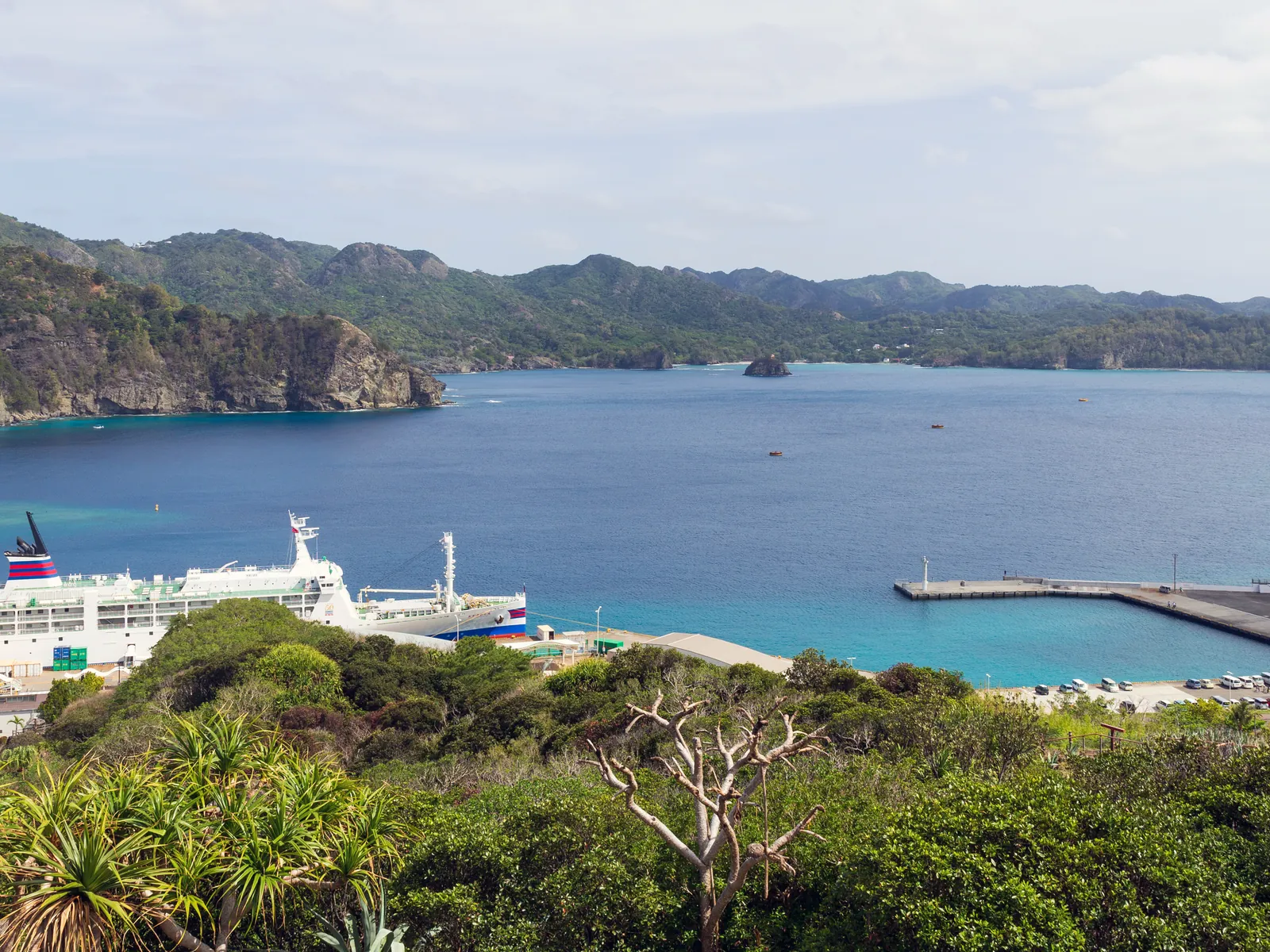
Futami Bay, Chichijima, in the Ogasawara Islands. Yasu, Wikimedia Commons, CC BY-SA 3.0, cropped.

Miyako and the other Okinawa islands
Miyako sits between the main island and Ishigaki. The tourism bureau calls it a place for caverns and arches, names W-Arch, Satan's Palace, Antoni Gaudi and the inland pond at Toriike, and says dives there are typically from boats, with some needing an advanced card; it gives Antoni Gaudi a maximum depth of about 30 meters. Kume Island, west of the main island, is the other name the bureau lists, for drop-offs and pelagic fish. We have no guide for either, and we found no official rules from Miyakojima city for its offshore reefs, so ask your shop what applies.
The Izu Peninsula near Tokyo
The Izu Peninsula is Tokyo's local dive coast, about two hours away by train, with lava-rock shore sites and small life rather than coral. Our Izu diving guide covers the east coast around Ito in detail: the sites at Futo, Izu Ocean Park, Kawana and Akazawa, shore-dive prices, the language question, and how decompression patients are usually flown out. The west coast of the peninsula is not covered on this site yet.
One local rule matters on every Izu dive. Shizuoka Prefecture's guidance says you may not take sea life using diving apparatus, scuba included, under article 37 of its fishery rules, and that recreational users may not take abalone at all. Around Ito the local cooperatives hold fishery rights over spiny lobster, abalone, turban shells, octopus, sea cucumber and sea urchin.
The Izu islands and Ogasawara
South of Tokyo, the Izu islands from Oshima to Hachijojima belong to Tokyo and sit inside Fuji-Hakone-Izu National Park. The Ministry of the Environment lists marine park zones off Oshima, Shikinejima and Kozushima, designated in September 2022, and off Miyakejima since 1994. Tokyo's fisheries rules give the local cooperatives rights within 1,000 to 2,000 meters of each island's shore, with spiny lobster and sea cucumber on every island's list. We do not cover these islands yet, and we couldn't check the main ferry company's timetable, so check sailings directly.
Ogasawara is further out: the ministry puts it about 1,000 kilometers south of Tokyo. Its national park dates from 1972 and has 14 marine park zone sites, and the World Heritage Committee decided to inscribe the islands on 24 June 2011; the heritage area takes in part of the sea around Chichijima and Hahajima. Tokyo's health bureau writes that the only transport to the mainland is a scheduled ship that sails about once every six days and takes 24 hours each way. The Ogasawara Maru leaves Tokyo at 11:00 and reaches Chichijima at 11:00 the next day; in November 2026 it sails from Tokyo on 31 October and on 7, 13, 19 and 27 November, and the cheapest one-way adult fare is ¥30,030 including the fuel surcharge. Hahajima is a further boat from Chichijima. Tokyo's fisheries page also marks waters around Chichijima, Anijima and Hahajima as a marine park area where taking any aquatic life is banned.
Taking lobster, abalone or sea urchins: the cooperatives' rights
Japan's rules on taking sea life are written prefecture by prefecture, under the national Fisheries Act. The three prefectures that cover the regions above, Okinawa, Tokyo and Shizuoka, all limit recreational users to a short list of methods, and scuba gear is not on any of them. Okinawa's fisheries leaflet allows small nets without a boat, bare hands and rakes, line fishing and a hand spear without a firing device, and draws scuba gear and spearguns under "things the public may not use". Tokyo's page says scuba and other diving apparatus, spearguns and fish-attracting lights may not be used to take fish, shellfish or seaweed.
On top of the method rules come fishery rights. In Okinawa, all spiny lobsters, the sea urchin shirahige-uni, sea cucumbers, giant clams and several shells are reserved for cooperative members, and the leaflet warns that others who take them can face a complaint for infringing the right. Under article 197 of the Fisheries Act that offence carries a fine of up to ¥1 million. Abalone, sea cucumber and glass eels are national "specified" species under article 132: taking them without a right or licence carries up to three years in prison or a ¥30 million fine.
Okinawa also bans taking reef-building corals, and its fisheries division spells out that this includes dead skeletons and broken pieces that keep their shape. The practical rule for a visiting diver is simple: take nothing, including the shell that looks empty.
National parks and marine park zones
Japan's national parks reach into the sea through marine park zones. Under article 22 of the Natural Parks Act, the Minister of the Environment designates them in national parks, and inside them you need the minister's permission to capture, kill, collect or damage the fish, corals, seaweeds and other species designated for each zone, or to change the shape of the seabed. Diving itself is not on the list. Every region on this page has such zones: the Keramas, the waters around Ishigaki and Iriomote, the Izu islands and Ogasawara. Our Ishigaki guide explains how the zones work in practice.
Okinawa makes guided diving the default
Okinawa's water-safety ordinance was wholly rewritten as Prefectural Ordinance No. 54 of 2025, in force since 1 April 2026. Under article 22, when a notified dive business has you dive, it must put its guide diver in the water to lead, watch and instruct you. It must also check the equipment first and turn you away if drink, drugs or anything else makes you unfit. For a diver used to renting tanks and buddying off elsewhere in Asia, that is the main adjustment on every Okinawa island. The full reading, with the guide ratios, is in our Ishigaki diving guide.
Japan sea temperature by region
NOAA's satellite averages for 1991 to 2020, which we computed for five sea cells near the dive areas, show how far apart the two seas are. Our Okinawa pages use the Japan Meteorological Agency's coastal normals, which run a few tenths of a degree warmer; both are surface figures, not readings at depth.
| Region (NOAA cell) | February | May | August | November |
|---|---|---|---|---|
| Okinawa main island, west coast (26.4°N 127.6°E) | 21.5 °C | 24.5 °C | 28.9 °C | 25.2 °C |
| Kerama Islands (26.1°N 127.4°E) | 21.7 °C | 24.8 °C | 28.9 °C | 25.4 °C |
| Ishigaki, north-west (24.6°N 124.1°E) | 23.0 °C | 26.2 °C | 29.1 °C | 25.9 °C |
| East Izu off Ito (34.9°N 139.1°E) | 15.6 °C | 19.1 °C | 26.1 °C | 21.0 °C |
| Ogasawara, Chichijima (27.1°N 142.1°E) | 20.7 °C | 23.3 °C | 28.2 °C | 25.6 °C |
February is the coldest month in every cell. The Okinawa cells run from about 21.5 to 29 °C over the year and Ishigaki from 23.0 to 29.1 °C, while Izu swings more than ten degrees, from 15.6 to 26.1 °C. Ogasawara sits between them, cooler than Ishigaki in winter, near 28 °C from August to September.
Typhoon season by region
The Japan Meteorological Agency counts a typhoon as approaching when its center comes within 300 kilometers of one of its stations. On the 1991 to 2020 normal, 11.7 approach Japan each year. The Okinawa region takes 7.7 a year, most in August (2.2) and September (1.9), with 1.5 in July and 1.1 in October. The Izu and Ogasawara islands are counted together at 5.4 a year, peaking later, at 1.5 in September and 1.3 in October. For any island trip from July to October, leave spare days; for Ogasawara, a missed sailing means waiting for the next ship, about six days later. Our Izu guide shows how often typhoons closed shore sites there in 2026.
Recompression chambers and emergency numbers in Japan
Call 119 for an ambulance anywhere in Japan, and 118 for the Japan Coast Guard for an incident at sea. DAN Japan runs a 24-hour hotline for its members on +81-3-3812-4999, and tells divers to call 119 or 118 first if the casualty is unconscious or struggling to breathe.
On Okinawa's main island, Nanbu Tokushukai Hospital in Yaese, south of Naha, says it treats scuba-related decompression sickness in principle 24 hours a day, 365 days a year, and accepts cases from outlying islands; it counts three large chambers in the prefecture. On Ishigaki, Okinawa Prefectural Yaeyama Hospital runs a chamber, as our Ishigaki guide sets out; its website was down for maintenance when we checked again for this page. For Izu, our Izu guide explains the helicopter route to a hospital in Kanagawa. We found no chamber confirmed by a facility on Miyako, Yonaguni or the Izu islands.
Ogasawara is the extreme case. The village clinic says only clinics serve the islands, and patients it cannot treat are flown to Tokyo by the Maritime Self-Defense Force: flying boats by day, a helicopter via Iwo To at night. Its own figures put the average from request to hospital at between 8 hours 45 minutes and 10 hours 24 minutes a year, and it tells visitors to dive within their limits and avoid diving short of sleep or hung over. Check that your dive insurance covers evacuation from an outer island.
Entering Japan and staying as a remote worker
The Immigration Services Agency sets the short-term stay status at 90, 30 or 15 days. Which nationalities can enter without a visa, and for how long, is on the Ministry of Foreign Affairs' list. We couldn't open it, so check it yourself before you book.
For longer stays Japan has a digital nomad status, a form of "Designated Activities". The agency's terms: remote work for a foreign employer or selling services to people abroad; annual income of at least ¥10 million at the time of application; nationality of a country or region on its chart, which must be visa-exempt and have a tax convention with Japan; and private medical travel insurance covering death, injury and illness, with at least ¥10 million of medical cover. The stay is six months with no extension, you must wait six months after leaving to apply again, and no residence card is issued.
The agency's Q&A, dated July 2024, adds what matters for a diver moving between islands: you need no procedure to move between cities, you may not take work from Japanese organisations or individuals, and because you cannot join Japan's public health insurance, the private policy has to carry you. If you apply from abroad, you apply at a Japanese embassy or consulate. Read the insurance line against your own policy, because a plan that meets the medical figure can still exclude diving.
How to choose a region, and who Japan suits
Choose by season and by what you want underwater. From December to April, the warm side wins: Ishigaki's water stays at about 23 to 24.5 °C, and Yonaguni's hammerhead season, by the tourism bureau's account, runs then. From May to June, before the typhoon peak, all of Okinawa warms past 24 °C. In summer and early autumn Izu is at its warmest and closest to Tokyo, while the islands carry the typhoon risk. Ogasawara needs about a week at least, since the ship sails about once every six days.
Japan suits a diver who likes structure: guided dives in Okinawa, clear park rules, a chamber near Naha, and a nomad status for six months if your income clears the bar. It suits less well a diver who wants to buddy off alone from a rented tank, collect anything from the seabed, or dive Ogasawara with a hospital nearby. For the rest of the region, see Taiwan diving and the manta ray destinations.
FAQ: Japan diving
Where do people dive in Japan?
It depends on the season and what you want. Okinawa has the warm water: the Kerama Islands off Naha, Miyako's caverns, Ishigaki's mantas and Yonaguni's hammerheads, which the prefecture's tourism bureau places from around November to early May. The Izu Peninsula near Tokyo is cooler lava-rock diving, and Ogasawara is a World Heritage site a 24-hour ferry from Tokyo.
Can you take lobster or shellfish while diving in Japan?
No. Okinawa, Tokyo and Shizuoka all bar recreational users from using scuba gear to take fish, shellfish or seaweed, and spiny lobsters, sea urchins and sea cucumbers are reserved for local fishing cooperatives. Abalone and sea cucumber are national specified species, with penalties up to three years in prison or a 30 million yen fine.
What is the water temperature for diving in Okinawa and Izu?
On NOAA's 1991 to 2020 averages, February is about 21.5 degrees Celsius off Okinawa's main island, 23.0 off Ishigaki and 15.6 off the Izu Peninsula near Ito. August reaches about 28.9 off Okinawa, 29.1 off Ishigaki and 26.1 off Izu.
When is typhoon season in Okinawa and Ogasawara?
Mainly July to October. The Japan Meteorological Agency counts 7.7 typhoon approaches a year to the Okinawa region, most in August and September, and 5.4 to the Izu and Ogasawara islands, most in September and October, on the 1991 to 2020 normal.
Is there a recompression chamber in Okinawa?
Yes. Nanbu Tokushukai Hospital in Yaese, south of Naha, says it treats scuba decompression sickness in principle around the clock all year and accepts cases from outlying islands. Okinawa Prefectural Yaeyama Hospital on Ishigaki also runs a chamber. Ogasawara has only clinics, and patients are flown to Tokyo, which the village clinic says takes about nine to ten hours.
Note: Conditions, safety guidance and regulations change. Verify current information with official sources, including the dive operator, the park authority and the relevant government department, before you travel or dive.
Founder of NOMADREEF and a former digital nomad. This guide is sourced from the references below; conditions, prices and rules change, so verify current details, and follow qualified local guidance and safety briefings. About the author · LinkedIn ↗
Sources
- Taking marine life (primary). Fisheries Act, articles 132, 190 and 197, current text from the e-Gov law database; Okinawa Prefecture fisheries division, rules for taking aquatic life (PDF, revised July 2022) and ban on taking reef-building corals; Tokyo Metropolitan Government, rules for recreational use of the sea; Shizuoka Prefecture, rules for recreational fishing at sea. Read 10 November 2026.
- National parks (primary). Natural Parks Act, article 22, from the e-Gov law database; Ministry of the Environment park overviews for Keramashoto, Ogasawara and Fuji-Hakone-Izu. Read 10 November 2026.
- Ogasawara (primary). Tokyo Metropolitan Government health bureau, island health projects, fiscal 2025 (PDF), on transport; Ministry of the Environment, press release of 24 June 2011 on the inscription decision and World Heritage area; Ogasawara Kaiun, Ogasawara Maru timetable and fares (operator); Ogasawara village clinic, medical situation and emergency transfers and advice for visitors. Read 10 November 2026.
- Okinawa regions. Okinawa Convention & Visitors Bureau dive pages for the main island, Miyako, Kume and Yonaguni (tourism body's own descriptions); Zamami village, ferry information, November 2026 (primary). Read 10 November 2026.
- Okinawa ordinance (primary). Okinawa Prefectural Ordinance No. 54 of 2025 (PDF), article 22 and supplementary provisions. Read 10 November 2026.
- Sea temperature and typhoons (primary). NOAA PSL, OISST v2.1 monthly long-term means 1991–2020, five grid cells, computed for this page; Japan Meteorological Agency, typhoon normals 1991–2020, national and regional approach counts. Read 10 November 2026.
- Chambers and emergency. Nanbu Tokushukai Hospital, hyperbaric oxygen therapy (facility); Japan Coast Guard, 118; Fire and Disaster Management Agency, guide to ambulance services (PDF); DAN Japan, emergency hotline (for its own service). Read 10 November 2026.
- Entry and remote work (primary). Immigration Services Agency, Temporary Visitor status, Designated Activities for digital nomads, eligible countries and regions (PDF) and Q&A as of July 2024 (PDF). Read 10 November 2026.
- Left out. The Ministry of Foreign Affairs' visa-exemption list, because its site refused automated requests; a facility-confirmed chamber on Miyako, Yonaguni, the Izu islands or Ogasawara; a fresh check of the Yaeyama Hospital chamber, whose site was down for maintenance; Izu islands ferry sailings, whose operator's site refused our request; Miyakojima city rules for its offshore reefs; and Mikurajima's dolphin-swim rules.