Ishigaki vs Okinawa for Diving: Mantas or the Kerama Reefs?
 by Yannick SchrothOct 13, 202610 min read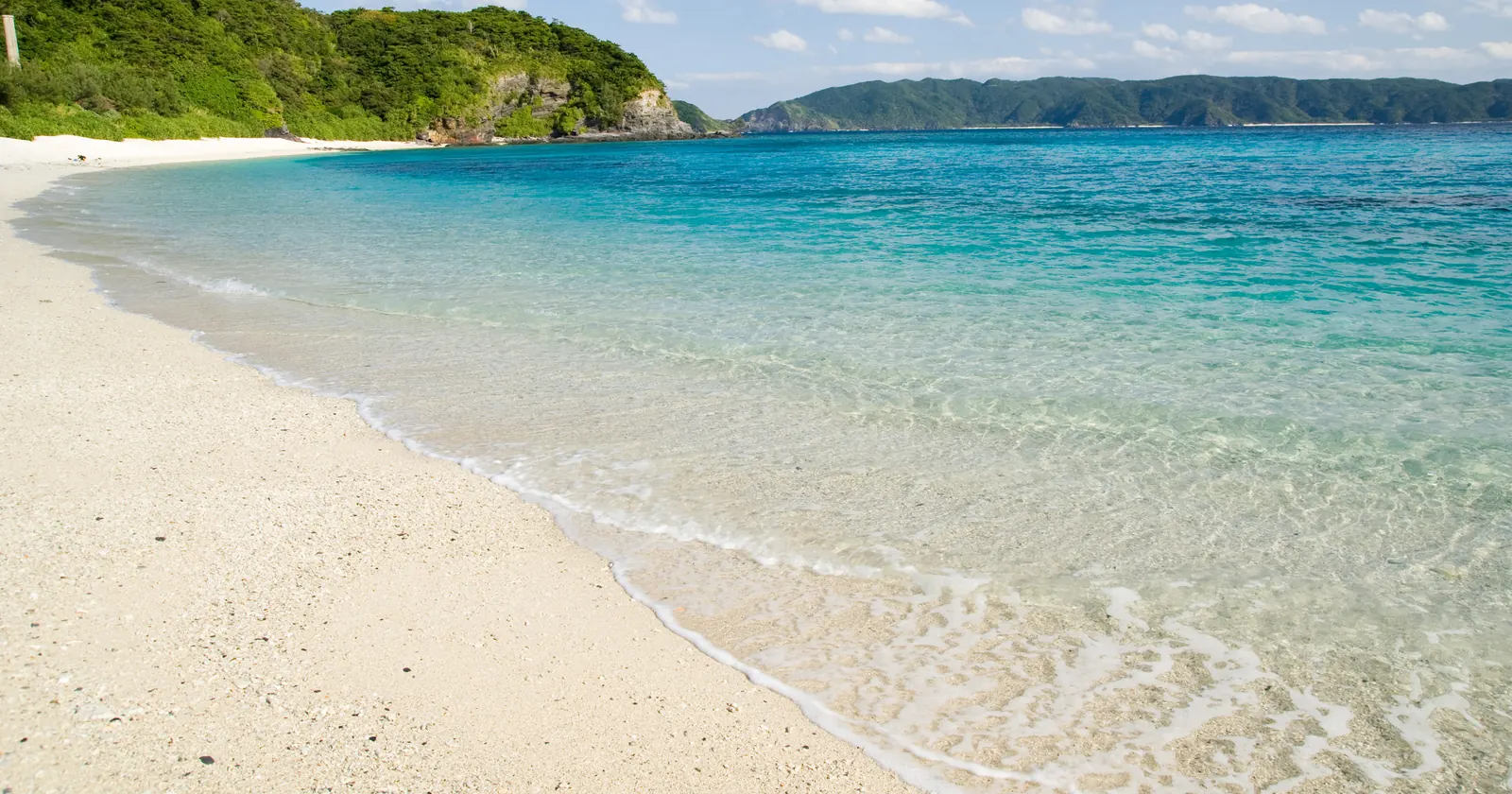
Furuzamami Beach on Zamami, in the Kerama Islands off Okinawa's main island. Photo: Hashi photo, Wikimedia Commons, CC BY 3.0.
| Ishigaki | Okinawa main island and the Keramas | |
|---|---|---|
| The dive people come for | Reef mantas at the Kabira Ishizaki manta points | Keramashoto National Park, a boat ride west of Naha |
| Who sets the rules at the signature site | The Yaeyama Diving Association, for its members: five boats at most at Manta City | Zamami and Tokashiki villages: a guideline capping group sizes per instructor |
| Sea surface, February / August normal | 23.2°C / 29.4°C | 22.2°C / 29.2°C |
| Nearest hyperbaric chamber | Okinawa Prefectural Yaeyama Hospital, on the island | Nanbu Tokushukai Hospital, Yaese, south of Naha |
| Direct international flights, October 2026 | Seoul, Taipei, Kaohsiung | 29 international airlines on the Naha terminal's list |
| Dive law, typhoons, visa | The same on both: one prefectural ordinance, one typhoon region, one national residence status | |
Water figures are the Japan Meteorological Agency's 1991–2020 normals for the sea north of Ishigaki and south of Okinawa's main island, averaged by month for this page. Flights are from each airport's own timetable or airline list, read 13 October 2026.
Ishigaki has the mantas, Okinawa has the Kerama reefs
Ishigaki vs Okinawa is mostly a question of what you want to see on a Tuesday morning, because the two islands are good at different things.
On Ishigaki it is mantas. The IUCN's Important Shark and Ray Area factsheet for the Yaeyama Islands describes “the largest known aggregation of Reef Manta Rays in Japan that occurs year-round”, with 305 individuals identified in diver logbooks from 1987 to 2009 and 80.5% of all sightings at Kabira Bay. The manta points are named after Kabira Ishizaki, which is also the name of one of the Ministry of the Environment's marine park zones in Iriomote-Ishigaki National Park, 274.8 hectares designated on 1 August 2007.
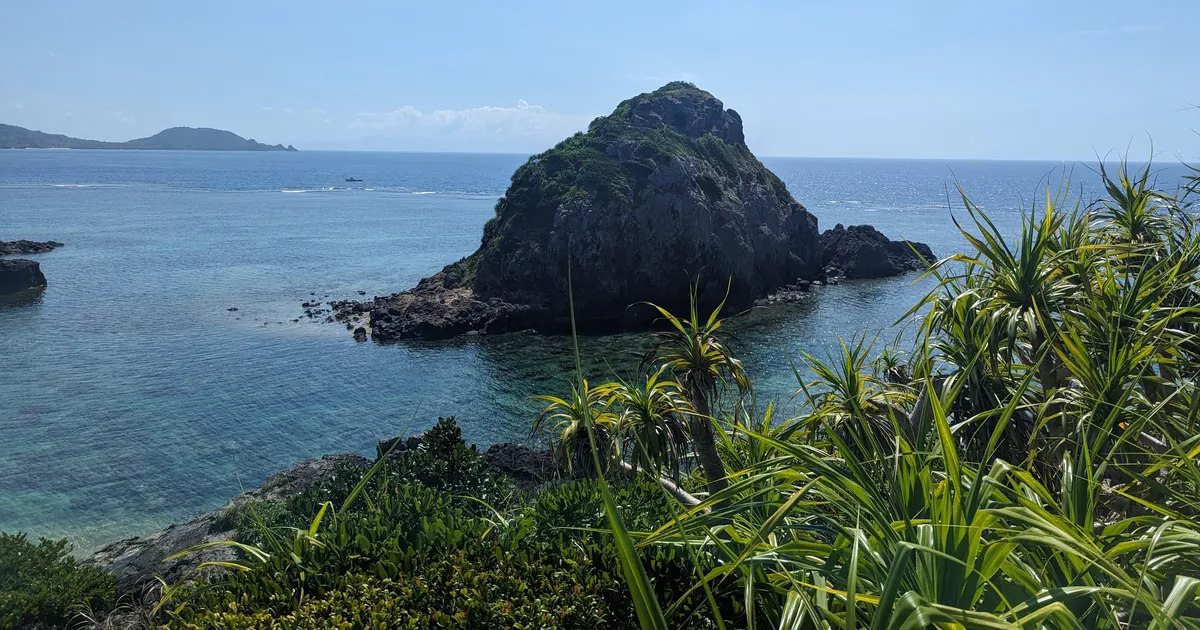
On the Okinawa side the reef in the photographs is not the main island's coast. It is the Kerama Islands, made Keramashoto National Park on 5 March 2014. The ministry lists one marine park zone there of 8,290 hectares, more than twice the park's 3,520 hectares of land. Humpback whales come to the same water to breed; the ministry's national park portal lists the Zamami whale-watching association's tours for winter and spring. Most dive businesses on the Okinawa list sit on the main island's west coast, so the Keramas are a boat day, not a shore walk.
Getting to the Kerama Islands from Naha, and the October gap
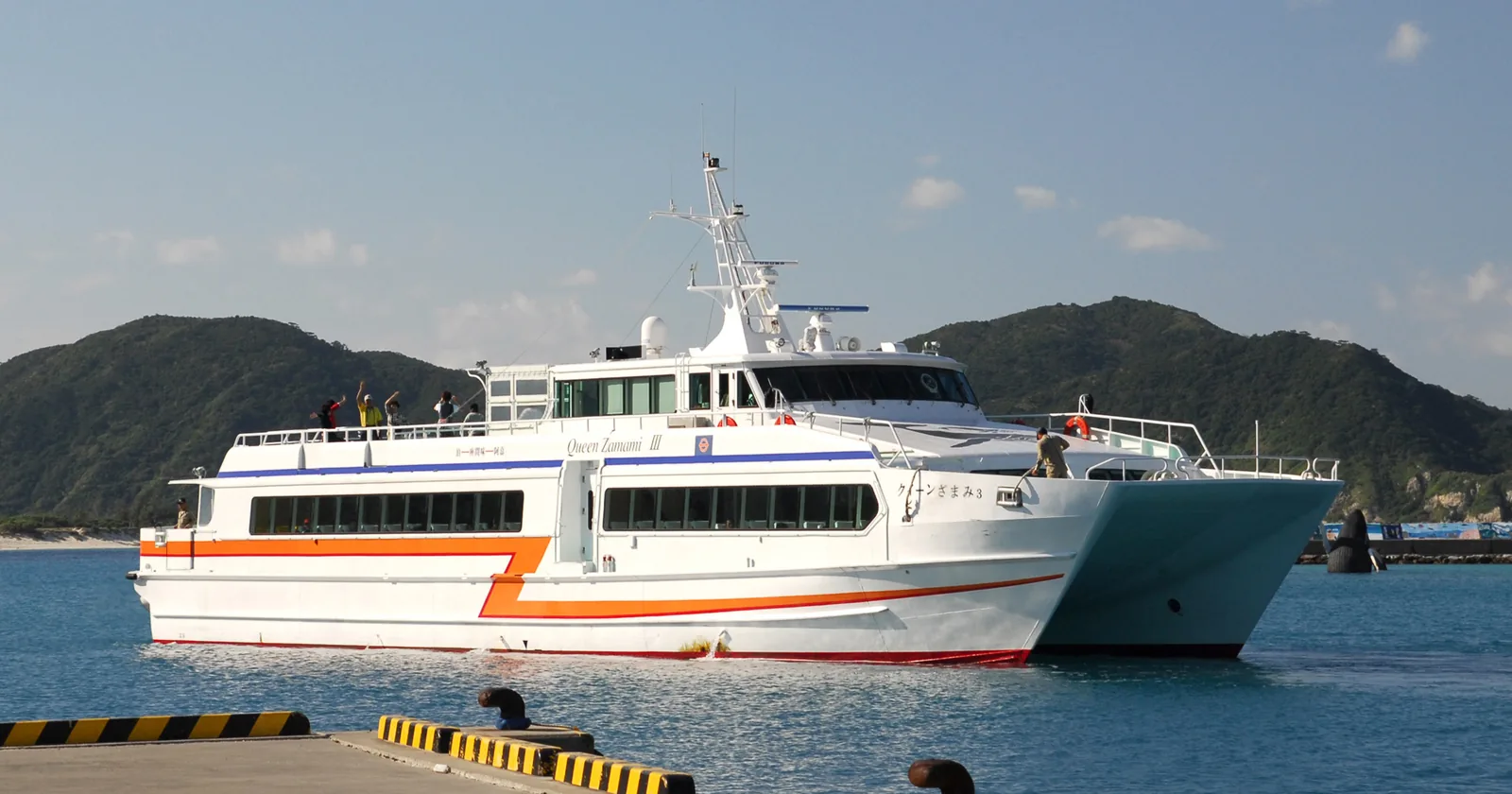
For someone based in Naha this is the practical part. Zamami village runs two boats from Tomari port, which the village puts at 10 to 15 minutes by taxi from Naha Airport.
- Queen Zamami, the fast boat: 09:00 from Naha, 09:50 at Zamami. ¥3,950 one way, ¥7,510 return.
- Ferry Zamami: about 90 minutes to Aka. ¥2,900 one way, ¥5,510 return.
- Every adult arriving from outside the village pays ¥100 “Churashima tax” on boarding.
Check the month before you plan around it. The Queen Zamami is out of service for dry dock from 20 October to 3 December 2026, according to the village timetable, which leaves the slower ferry. Tokashiki, the other Kerama village, runs its own ferry and its own fast boat, the Marine Liner Tokashiki, with new fares from 1 October 2026. If your dive shop runs its own boat to the Keramas from the main island, the ferries only matter once you want to sleep on the islands.
Kerama's village rules cap group sizes; Ishigaki's manta rules cap boats
Both signature sites run on rules written locally, and neither set is a national law.
At Kabira the Yaeyama Diving Association wrote the manta rules for its members. Manta City takes “あくまでも5艘まで”, strictly five boats at most, anchored at one of five fixed positions, with 60 minutes from anchoring to leaving as the guideline. Drift dives and towing divers on a rope to find mantas are banned, and snorkelers may not skin dive. The same association says about 150 dive and snorkel businesses operate on Ishigaki, some without the police notification the prefecture requires.
In the Keramas the limit falls on the group instead. The Kerama Ecotourism Guideline, issued by Tokashiki and Zamami villages in July 2008, sets a rough upper limit for one instructor on one dive: 8 fun divers, 2 trial divers, 4 students on a certification course and 8 snorkelers. It bans feeding and collecting, asks boats to tie to buoys rather than anchor, and spreads boats across sites rather than piling them onto one. Whale watching within 10 miles of the islands follows its own rules: three boats per whale or pod, two hours at most, and no watching from in the water, swimming included.
Behind that sits a heavier tool. In June 2012 the Ministry of the Environment certified the two villages' ecotourism plan, the first in Japan to name a specific natural tourism resource in a certified plan: the Kerama coral communities in water shallower than 30 meters. The plan lets the village mayors require approval to enter that area and set criteria for granting it. The 2012 document sets out the mechanism but no daily number.
The 2024 bleaching hit Ishigaki's Sekisei Lagoon and the Keramas alike
Neither reef got away from the summer of 2024.
In Sekisei Lagoon, between Ishigaki and Iriomote, the Ministry of the Environment's December 2024 survey across 31 sites found an average bleaching rate of 65.5% and 25.5% of the coral dead. Average cover fell from 17.4% in September to 13.7% in December. The ministry names water above 30°C lasting into late September, instead of ending in early September, as one likely cause.
In the Keramas the ministry's fiscal 2024 monitoring recorded bleaching across the whole survey area, with six spot-check sites down 80% on the year before. At Yuhina, on the transect survey, cover went from 42.0% to 3.0%. The 2025 report adds a second, later bleaching, triggered when the water passed 30°C in September, with fewer deaths than 2024. Sites on the north sides of Tokashiki and Zamami are now under 10% cover, while the shallows west of Amuro island grew sharply. The same report found almost no anchor damage at the buoyed dive sites and no damage clearly caused by divers.
So this is not a choice between a healthy reef and a damaged one. It is a choice between two reefs recovering at different speeds, site by site.
One Okinawa ordinance puts a guide in the water on both islands
Ishigaki is part of Okinawa Prefecture, so the water-safety ordinance rewritten as Ordinance No. 54 of 2025, in force since 1 April 2026, binds every notified dive business on both islands and in the Keramas.
Article 22 is the part a diver notices. When a notified business has you dive, it must “ガイドダイバーを潜水させ”: put its guide diver in the water to lead, watch and instruct you. It must check the equipment first, and turn you away if your health, experience or skill, or the wind, waves or current, make the dive unsafe. The Public Safety Commission's regulation sets how many divers one guide may lead: roughly 2 trial divers, 4 beginners, 6 intermediate divers who follow the guide's instructions, and as many advanced divers as the guide judges fit.
For a diver used to renting a tank and buddying off in Southeast Asia, that is the adjustment. Guided diving is the default here, on either island. The full article-by-article reading is in the Ishigaki diving guide.
Ishigaki water runs warmer in spring; typhoons cover the whole Okinawa region
The Japan Meteorological Agency publishes daily sea surface temperatures by coastal area. On the 1991–2020 normal, averaged by month:
| Month | North of Ishigaki | South of Okinawa main island |
|---|---|---|
| February | 23.2°C | 22.2°C |
| April | 24.8°C | 23.4°C |
| June | 28.2°C | 27.2°C |
| August | 29.4°C | 29.2°C |
| October | 27.4°C | 27.4°C |
| December | 24.5°C | 24.2°C |
The gap is a late-winter and spring one. From February to June Ishigaki's water runs 1.0 to 1.4°C warmer, which decides wetsuit thickness more than it decides anything else. By August the two are within a few tenths, and in October they match. The agency's area south of the main island is a box whose map takes in the Keramas, and its normal low is 22.1°C around 20 February, against 23.1°C north of Ishigaki.
Typhoons do not split the same way. The agency counts a typhoon as approaching the Okinawa region when its center comes within 300 km of any of its stations in the prefecture, and that happens 7.7 times a year on the 1991–2020 normal: 1.5 in July, 2.2 in August, 1.9 in September and 1.1 in October. The figure covers both islands at once and does not say which one a storm passed. Whichever you pick, leave spare days from July to October.
The nearest recompression chamber on Ishigaki and near Naha
This is where Ishigaki is better placed than its size suggests.
Okinawa Prefectural Yaeyama Hospital, in Ishigaki city, has run a hyperbaric oxygen chamber since 9 June 1997. Its clinical engineering page says it is the only prefectural hospital doing hyperbaric oxygen treatment, that decompression sickness emergencies are rising because of the island's marine leisure, and that its engineers are on call 24 hours for emergency hyperbaric treatment. It describes the unit as a transparent dome.
On the main island, Nanbu Tokushukai Hospital in Yaese, south of Naha, combines a large chamber with a one-person unit. For scuba-related decompression sickness it states treatment “原則365日24時間対応”, in principle around the clock all year, and accepts cases from outlying islands. The hospital puts the number of large chambers in the prefecture at three. From the Keramas, that means getting back across to the main island first.
At sea the Japan Coast Guard's emergency number is 118. Check what your dive insurance pays for evacuation from an outer island before the trip, not during it.
Flights: Naha is the hub, Ishigaki is an hour beyond it
For a long stay the exits matter as much as the reef.
Ishigaki's October 2026 timetable lists direct domestic flights to Tokyo Haneda, Tokyo Narita, Nagoya, Osaka Kansai, Fukuoka, Naha, Miyako, Yonaguni, Hateruma and Tarama, and international flights to Seoul Incheon, Taipei Taoyuan and Kaohsiung. The Naha route runs about a dozen departures a day, roughly an hour in the air.
Naha is the bigger door. The terminal company lists 29 international airlines, among them carriers from Korea, mainland China, Taiwan and Hong Kong, plus Scoot, Batik Air Malaysia, Thai AirAsia, Thai Vietjet Air and Thai Lion Air. If you are arriving from or moving on to Southeast Asia, Naha is the likelier place to find a direct flight. The surface interval before any of these flights is covered in the Okinawa diving guide.
Japan's digital nomad visa works the same on Ishigaki and Okinawa
Japan has a residence status for remote workers, and it is national, so the island makes no difference. The Immigration Services Agency's page sets the terms:
- Income: “Annual income of an applicant must be at least 10 million yen at the time of application.”
- Nationality: a country or region under Japan's visa exemption for temporary visitors that also has a tax convention with Japan, per the agency's chart.
- Insurance: “a private medical travel insurance which covers death, injury, illness during their stay”, with medical cover of 10 million yen or more.
- Stay: “Six months (No extension will be granted.)” After it, you wait six months to apply again. No residence card is issued.
- Work: for a foreign employer or for clients abroad, not under a contract with a Japanese organization.
Six months is enough for two seasons if you time it: the Kerama humpbacks out of Naha in winter, then Ishigaki's warmer spring water before the typhoon months. Read the insurance line against your own policy, because a travel plan that excludes diving can still meet the medical cover figure.
Choosing a dive shop on Ishigaki or around Okinawa
The two lists are very different in size, and neither is the whole market.
Japan sits largely outside the SSI register, which is why Ishigaki's list holds four centers against the roughly 150 businesses the Yaeyama Diving Association counts. Okinawa's list is longer because Green Fins, run by the Reef-World Foundation with the UN Environment Programme, has 16 members there, 15 of them assessed in person. That assessment is about environmental practice, not safety. On Ishigaki, the better question for any shop is whether it belongs to the association and follows its manta rules.
Ishigaki vs Okinawa in five lines
- Ishigaki for mantas: Japan's largest known year-round reef manta aggregation, 80.5% of sightings at Kabira Bay.
- Okinawa for the Keramas: a national park reef 50 minutes from Naha, except while the fast boat is in dry dock, 20 October to 3 December 2026.
- Ishigaki's water is 1.0 to 1.4°C warmer from February to June; by August there is little in it.
- Both have a hyperbaric chamber within reach: Yaeyama Hospital on Ishigaki, Nanbu Tokushukai south of Naha.
- Same ordinance, same typhoons, same visa: a guide in the water, 7.7 approaches a year, six months for remote workers.
Ishigaki for mantas and spring warmth, Naha for flights and the Keramas
Pick Ishigaki if mantas are the point, if you are coming between February and June and want the warmer water, and if a smaller island with a chamber at its hospital suits you. Pick Naha on Okinawa's main island if you want the Kerama reefs and the winter humpbacks, more shops to choose from, and the flights that make it easy to arrive from Southeast Asia or leave for it.
For a stay of several weeks, Ishigaki vs Okinawa does not have to be either/or. The pair works in sequence: base in Naha for the Keramas, then fly the hour to Ishigaki for the mantas. What makes no sense is picking between them on typhoon risk. The agency counts it for the whole region, and both islands sit in it.
FAQ: Ishigaki vs Okinawa
Is Ishigaki or Okinawa better for diving?
It depends on what you want to see. Ishigaki has Japan's largest known year-round reef manta aggregation, at Kabira, and water about a degree warmer from February to June. Okinawa's main island is the base for the Kerama Islands, a national park reef 50 minutes from Naha by fast boat, with winter humpbacks and more dive shops.
Can you do a Kerama Islands day trip from Naha?
Yes. Zamami village's fast boat, the Queen Zamami, takes about 50 minutes from Tomari port for 3,950 yen one way; the ferry takes about 90 minutes for 2,900 yen, plus a 100 yen village tax. The fast boat is in dry dock from 20 October to 3 December 2026. A main-island dive shop with its own boat is the other way out.
How do you get from Okinawa to Ishigaki?
By air. Ishigaki airport's October 2026 timetable shows about a dozen flights a day to Naha, each roughly an hour. Ishigaki also has direct flights to Tokyo, Nagoya, Osaka and Fukuoka, and international routes to Seoul, Taipei and Kaohsiung, so it does not have to be reached through Naha.
When is typhoon season for Ishigaki and Okinawa?
Mainly July to October. The Japan Meteorological Agency counts 7.7 typhoon approaches a year to the Okinawa region on the 1991 to 2020 normal, most in August (2.2) and September (1.9). The count covers the whole prefecture, so neither island is the safer pick; leave spare days in those months.
Can you work remotely from Okinawa or Ishigaki on Japan's digital nomad visa?
Yes, if you qualify. The Immigration Services Agency requires annual income of at least 10 million yen, nationality of a visa-exempt country with a tax convention with Japan, and private medical travel insurance with at least 10 million yen of cover. The stay is six months with no extension.
Sources
- Reef mantas in the Yaeyama Islands: “the largest known aggregation of Reef Manta Rays in Japan that occurs year-round”, 305 individuals identified from 1987 to 2009, 80.5% of sightings at Kabira Bay. IUCN SSC Shark Specialist Group, Yaeyama Islands ISRA, read 13 October 2026. sharkrayareas.org
- Kabira Ishizaki marine park zone, 274.8 ha, designated 1 August 2007. Ministry of the Environment, Iriomote-Ishigaki National Park overview, read 13 October 2026. env.go.jp
- Keramashoto National Park: designated 5 March 2014, land area 3,520 ha, one marine park zone of 8,290 ha. Ministry of the Environment, read 13 October 2026. env.go.jp. Humpback whales: National Parks of Japan portal, japan.travel; the Zamami Village Whale Watching Association tour listed for winter (December to February) and spring (March to May), env.go.jp.
- Zamami ferries: fares (fast boat ¥3,950 one way and ¥7,510 return, ferry ¥2,900 and ¥5,510), the ¥100 美ら島税 per adult, the October 2026 timetable and the Queen Zamami dry dock “10月20日から12月3日までの間”. Zamami village, read 13 October 2026. fares, timetable, access. Tokashiki's two boats and its fare revision from 1 October 2026: vill.tokashiki.okinawa.jp.
- Kabira Ishizaki manta rules (“あくまでも5艘まで”, five fixed anchoring positions, 60 minutes, no drift dives or rope towing, no skin diving for snorkelers) and the association's count of about 150 businesses. Yaeyama Diving Association, undated pages, read 13 October 2026. yda-diving.com/manta, about
- Kerama Ecotourism Guideline, Tokashiki and Zamami villages, July 2008: instructor guide limits (Fun 8, trial 2, C-card course 4, snorkeling 8), feeding and collecting bans, buoys, whale-watching rules within 10 miles. And the Kerama ecotourism plan certified 27 June 2012: coral communities shallower than 30 m as a specific natural tourism resource, entry approval criteria set by the mayors. Ministry of the Environment release of 28 June 2012 and attachments, read 13 October 2026. env.go.jp/press/15399, summary (PDF), guideline (PDF)
- Coral after the 2024 bleaching. Sekisei Lagoon, December 2024 survey of 31 sites: Ministry of the Environment, Okinawa office, release of 23 January 2025, kyushu.env.go.jp. Kerama monitoring for fiscal 2024 and 2025: 2024 (PDF), 2025 (PDF). Read 13 October 2026.
- Okinawa Prefectural Ordinance No. 54 of 2025, in force 1 April 2026, article 22; and Public Safety Commission Regulation No. 16 of 2025, article 26 (おおむね2人, 4人, 6人). Okinawa Prefectural Police, read 13 October 2026. ordinance (PDF), regulation (PDF)
- Sea surface temperature, daily 1991–2020 normals for area 707 (north of Ishigaki) and 704 (south of Okinawa main island); monthly figures are averages of the daily normals, calculated for this page. Japan Meteorological Agency, read 13 October 2026. north of Ishigaki, south of Okinawa main island
- Typhoon approaches to the Okinawa region, 1991–2020 normal and the 300 km definition. Japan Meteorological Agency, read 13 October 2026. normals, Okinawa approaches
- Yaeyama Hospital hyperbaric chamber: “県立病院で唯一高気圧酸素治療を行っています”, the on-call 24-hour line for hyperbaric treatment, and the chamber's start on 9 June 1997. Okinawa Prefectural Yaeyama Hospital, read 13 October 2026. clinical engineering, history
- Nanbu Tokushukai Hospital hyperbaric department: large chamber plus one-person unit, three large chambers in the prefecture, decompression sickness treatment in principle 24 hours a day, 365 days a year. The hospital itself, read 13 October 2026. nantoku.org. Coast Guard number 118: kaiho.mlit.go.jp
- Flights: Ishigaki airport timetable for October 2026, domestic and international; Naha Airport Building Co. airline list. Read 13 October 2026. ishigaki-airport.co.jp, naha-airport.co.jp
- Designated Activities (Digital Nomad): income, nationality, insurance, six months without extension, six months' wait to reapply, no residence card, permitted work. Immigration Services Agency of Japan, read 13 October 2026. moj.go.jp/isa
- SSI training center register and the Green Fins member register, for the counts. divessi.com, greenfins.net
- Counted from the operator lists: Ishigaki compiled 20 September 2026 and Okinawa 21 September 2026.