Izu Diving at Ito: Lava Rock Two Hours From Tokyo, if You Can Book in Japanese
 by Yannick Schroth
Nov 4, 2026
15 min read
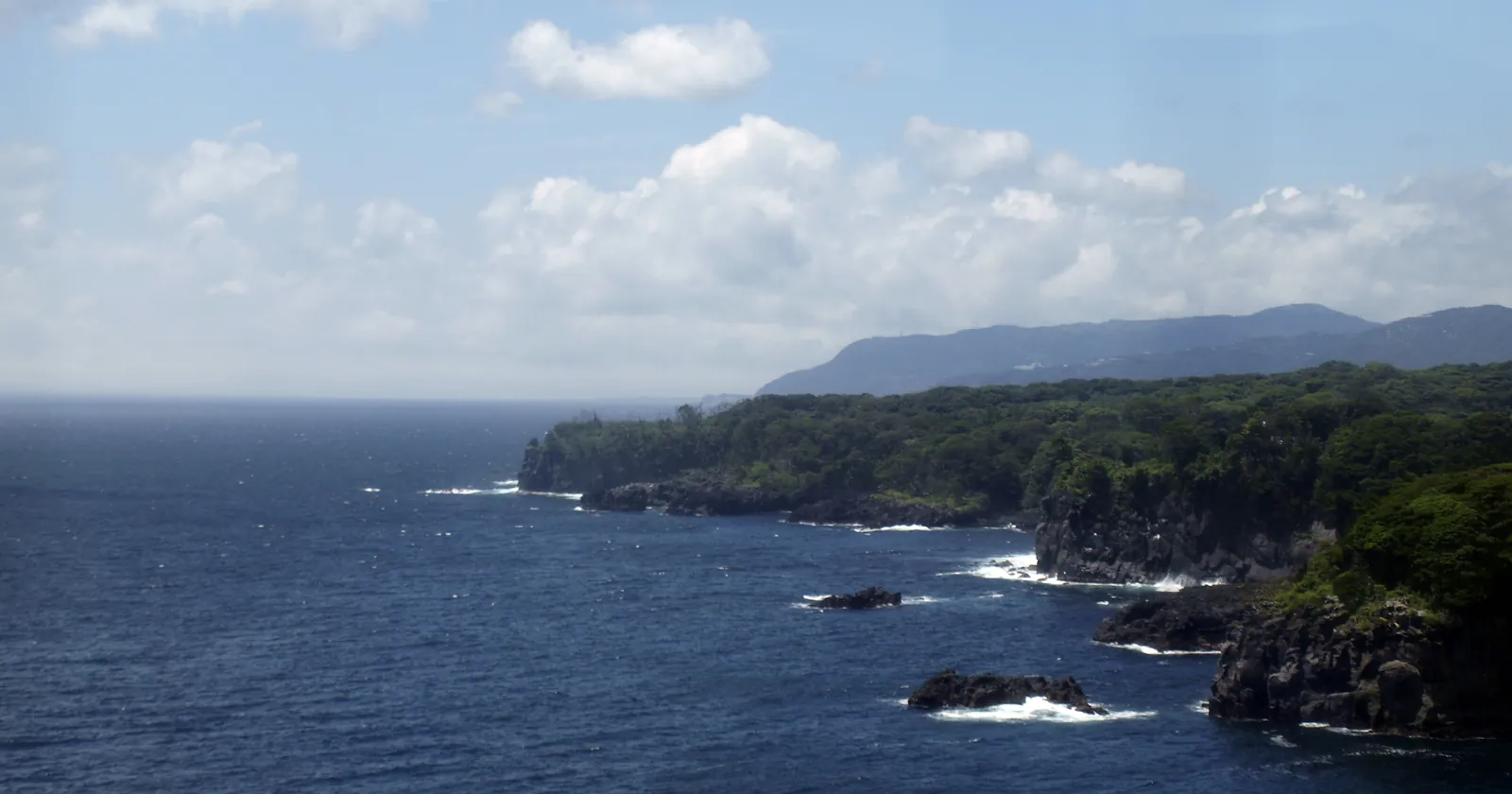
The Jogasaki coast south of Ito, on the lava shoreline. Photo: Tomo, Wikimedia Commons, CC BY 2.0, cropped.

Key takeaways
- Izumi Diving Resort declines non-Japanese speakers in writing, while East Dive sells English-speaking Izu day trips from Atami at 18,000 yen
- Two guided shore dives cost 13,200 to 16,500 yen at the shops compared here, with a refresh dive required at one of them after a six-month gap
- Prefectural readings near Ito ran from 15.2°C in January to 26.7°C in August, and in August the water at 50 meters was 10°C colder than the surface
- Typhoons shut Akazawa for two days in August and two in September 2026, with two more announced for November, and Izu Ocean Park banned diving on 4 November
- Doctors counted 119 decompression patients flown off the peninsula from 2004 to 2017, and eastern-shore cases go mainly to a hospital in Kanagawa
Ito in Shizuoka or Ito in Chiba: two dive places share the name
Check the prefecture first. This guide covers Ito city in Shizuoka, written 伊東, on the east side of the Izu Peninsula. Most dives here happen outside the town itself, at the villages and harbors south of it. The English-language dive press also uses "Ito" for a second place.
That other Ito sits on the tip of the Boso Peninsula in Chiba. Marine Diving describes one site there, a patch reef called Okimae-ne at 20 to 24 meters, where a local guide began feeding banded houndsharks in 2009 to draw them away from fishing nets. The result is "Shark City". It asks for intermediate skills, and sharks bump into divers.
If sharks brought you to this page, you want Chiba. If you want lava, macro life and a long list of shops, stay on Izu. English-language material usually says "Izu diving" rather than "Ito diving", so search for that phrase when you look for shops.
Diving in Ito mostly happens in Japanese, so settle the language first
Izu is close to Tokyo and built for Tokyo. Izumi Diving Resort in Futo says so outright on its site: “at this time we are unable to accept reservations from non-Japanese speakers as we currently do not have staff with adequate English speaking skills. For your own safety, please have Japanese native speakers accompanying you.”
The others say nothing. Their home and price pages are in Japanese, and none mentions English service. Marine Diving, the Japanese dive magazine, warns that not all Futo shops have English-speaking staff. Silence is not refusal, so ask in writing.
The dependable English route is East Dive, which Shizuoka's official tourism site lists and which names English, French and Japanese as its staff languages. It meets at Atami Station at 8:15 and bases itself around Jogasaki. Two guided shore dives cost 18,000 yen, with tanks, weights, facility fee, insurance and the transfer included. Book two days ahead and pay beforehand, because it takes no payment on the day.
An Izu dive "license" is just your C-card, but Ito shops can still make you requalify
Japanese shops say license (ライセンス) where you would say certification. Dive Healing uses "license card (C-card)" for the same plastic you already carry. East Dive states that it welcomes SSI, BSAC, CMAS and NAUI cards alongside PADI. None of the shop terms here asks for a Japanese qualification, so bring your card and a logbook.
The logbook matters. Diving Service mieux puts anyone with a gap of six months or more on its refresh dive at 17,600 yen and checks the log. Jogasaki Indies sells a refresh day at 15,950 yen. Akazawa's public set-net dive in October 2026 asked for Advanced Open Water, a free descent and steady buoyancy.
Prices run close. Two shore dives, tax included, read on 4 November 2026:
| Shop or site | Two shore dives | What to check |
|---|---|---|
| Diving Service mieux, East Izu sites | 13,200 yen | Boat combination 17,000 yen |
| Divingshop Quartet, Kawana | 13,200 yen | Futo or Yawatano 14,300 yen |
| Jogasaki Indies, Futo | 13,970 yen | Rental extra, 3,960 yen for a full set |
| Kawanabiyori, Kawana | 14,300 yen | Drysuit set 7,700 yen |
| Izu Ocean Park guide service | 15,400 yen | Moves you if the park is closed, and the price can change |
| isLIFE Diving | 16,500 yen | West Izu trips cost extra |
One local rule applies underwater. Shizuoka's guidance to anglers says you may not take marine life using diving apparatus, scuba included, under Article 37 of its fishery rules, and that recreational users may not take abalone at all.
Ito's dive sites sit on 4,000-year-old lava, and Ito Bay is not one of them
The town's own bay is where you sleep and change trains. Mieux lists the East Izu sites as Kawana, Futo, Izu Ocean Park, Yawatano, Akazawa and Hokkawa. Japan's weather agency dates the eruption of Mount Omuro, the volcano behind them, to about 4,000 years ago, and Izu Ocean Park credits that eruption's lava for its terrain. Expect rock, sand and small life. This is not a coral-reef holiday.
Izu Ocean Park, known to divers as IOP, has been at this since 1964, and in 1966 it opened a diver training center for Tokai University's marine school. It calls itself the birthplace of leisure diving, which is its own wording. It also claims a curiosity: the deepest underwater mailbox in Japan, at 20 meters.
IOP is open every day, with a one-way roped entry, a 50-meter seawater pool, nitrox and a heated tub for up to 40 people. Last exit from the water is 15:00 from 15 September to 15 May and 16:30 the rest of the year.
| East Izu site | Entry | Published depth | Worth knowing |
|---|---|---|---|
| Yokobama, Futo | Shore | 30 m | Current almost none, Futo Hole only at high tide |
| Maekado, Futo | Boat | 30 m | Five minutes out, current sometimes runs |
| Yokoiso reef, Futo | Boat | 30 m | Only from mid-September to mid-May |
| Iboyagi-iwa, Akazawa | Numbered buoy | 32 m | Lava slope with soft corals |
| Hirashima, Akazawa | Boat | 10 m | Two minutes from the port, suits beginners |
Futo is the bay most English material describes. Marine Diving calls it beginner-friendly, with concrete slopes, rails and a hot-spring tub in a converted boat. Kawana, a harbor north of it, is where Kawanabiyori, Sun La and Quartet run their dives. Akazawa has a named turtle site, and its set-net dive is the odd one out: the shop says deep-sea fish may show up inside the net.
Water off Ito swings from 15 to 27°C, and the warm layer in summer is thin
Shizuoka Prefecture's fisheries institute logs temperature from the surface down at seven points along the east coast of Izu, and station 2, at 34°57′N 139°11′E, lies in open water off Ito at the western edge of Sagami Bay. These are single-day readings over one year, not long-term averages.
| Station 2, date read | Surface | 50 m |
|---|---|---|
| 19 Jul 2025 | 26.2°C | 21.2°C |
| 25 Aug 2025 | 26.7°C | 16.7°C |
| 2 Oct 2025 | 24.2°C | 18.4°C |
| 13 Nov 2025 | 20.1°C | 20.2°C |
| 11 Dec 2025 | 18.7°C | 19.1°C |
| 26 Jan 2026 | 15.2°C | 15.5°C |
| 10 Feb 2026 | 15.3°C | 15.6°C |
| 24 Mar 2026 | 15.6°C | 15.5°C |
| 23 Apr 2026 | 18.5°C | 17.9°C |
| 20 May 2026 | 19.2°C | 17.5°C |
| 19 Jun 2026 | 22.7°C | 20.7°C |
Two things stand out. The winter floor is about 15°C, the same all the way down. East Dive gives its own year as 14 to 25°C. And the August water was warm only on top: 26.7°C at the surface, 16.7°C at 50 meters. No reading exists between those depths, so ask your guide how deep the warm layer goes that week. A summer dive to 30 meters may run colder than the surface suggests.
Shop logs fit. On 4 November 2026 Akazawa reported 23°C shallow and 22°C deep with 10 to 12 meters of visibility, and IOP gave 24 to 25°C and 15 to 20 meters for the day before. Drysuit rental is routine, at 5,500 yen for a full set at mieux and 7,700 at Kawanabiyori. A travel wetsuit alone will not cover a February dive for most people.
The seasons trade off. PADI Japan describes spring haze on Honshu's coast, and a 2010 Kawana feature blames the plankton bloom as water warms. Bigfin reef squid spawning fits around it: May at Kawana, late April to July at Yokobama, June to August in East Dive's telling. PADI names Kawana's Akane and Futo's Souri Island as summer-only sites, and warns that roads and bookings fill. It calls autumn the clear, fish-rich season. Kawana's guides praise winter's clarity.
Typhoons close Ito's shore sites at short notice, so never plan one dive day
Early November 2026 shows how it goes. On 4 November, IOP posted a ban on diving for the day because of the forecast. Akazawa reported rising swell in a northeast wind and announced a full closure for 5 and 6 November for Typhoon 31. It had also closed on 4 and 5 August for Typhoon 13, and on 20 and 21 September for Typhoon 25.
Futo shows the pattern. Its bay faces northeast, and Marine Diving calls it calm except in wind or on a falling tide. East Dive says the shallow Futo Hole depends on calm from the southwest. Shops move you when they can, at a different price: IOP and Kawanabiyori both warn of this.
Build slack into any trip. Check that morning's condition post before leaving the station, as Akazawa asks.
Decompression illness on the Izu Peninsula usually means a helicopter ride to Kanagawa
This is the fact that should shape your dive plan. Doctors at Juntendo Shizuoka Hospital, the base of the eastern Shizuoka doctor helicopter, wrote in 2018 that patients need a helicopter because there are no suitable recompression hospitals on the peninsula. Eastern-shore cases go mainly to Tokai University Hospital in Isehara, Kanagawa. Flight takes 15 to 20 minutes. An ambulance to the receiving hospitals takes at least 1.5 hours.
The same paper counted 119 decompression patients flown out between 2004 and 2017, about 8.5 a year, all from recreational scuba. In the national doctor-helicopter registry for 2015 to 2020, 44 patients had decompression illness and 70% of them flew with the eastern Shizuoka service. Those authors describe doctor helicopters as a daytime service. Juntendo's own single-person chamber, they add, does not suit severe cases.
So ask two questions before the first dive: which hospital does this shop's emergency plan use now, and who calls? The paper is from 2018 and routes can change. Fire crews, coast guard and dive-shop professionals have met yearly on this since 2011, and they use a dive-profile checklist, so keep your depth, times and dive count ready.
In an emergency, DAN Japan's order is 119 for an ambulance or 118 at sea first, then its hotline at +81-3-3812-4999, staffed around the clock for members. Check what your dive insurance says about helicopter transport. Helicopters here fly below 300 meters to protect patients, so ask your guide before you drive home over a mountain toll road after diving.
The Izu-Tobu volcano field lies under Ito's dive coast, and earthquake swarms come with it
Ito's coast is an active volcanic area. Japan's weather agency lists the Izu-Tobu volcanoes under constant watch, and the last eruption happened right offshore: on 13 July 1989 the undersea Teishi Knoll erupted off Ito, the first eruption there in recorded history.
The practical effect is earthquakes. The agency counts about 50 swarms since 1978, and one ended in an eruption. It expects future magma intrusion mainly around the sea off Kawana Point, which is the same coast you would dive. Active swarms can bring shaking of lower 5 or more on Japan's scale, and the agency publishes outlook bulletins when they start.
Do not cancel over this. Check the agency's alert level when a swarm is in the news. A tsunami warning is a firmer line. In June 2026 Japan's certification card council, in a notice DAN Japan carried, asked members to stop diving under any tsunami warning or advisory, leave the shore, and bring divers already in the water back promptly.
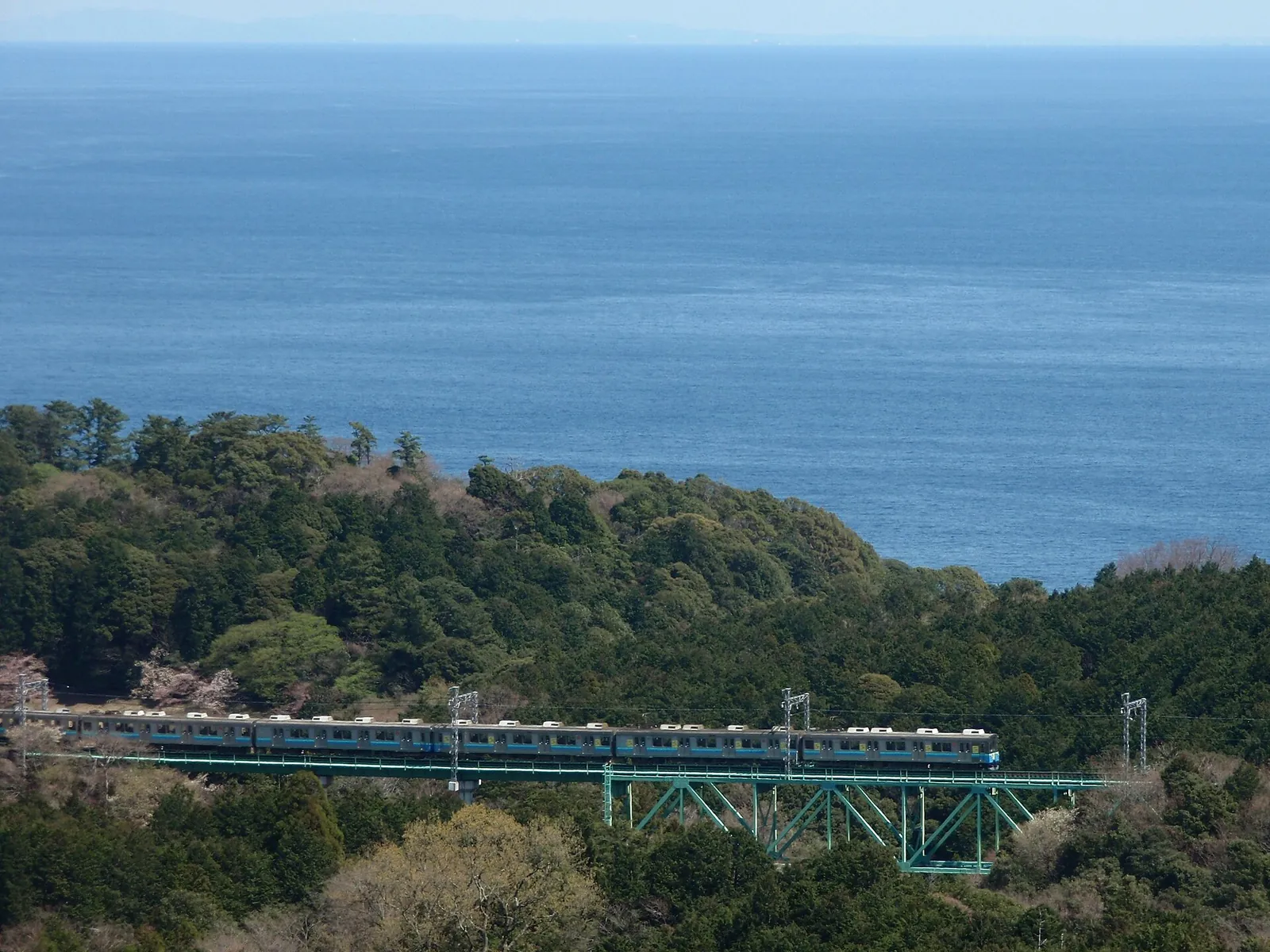

Reaching Ito for a dive by train: for Izu Ocean Park, the 8:26 from Atami is the last that works
Fly into Tokyo and take the train. Nothing here depends on a seasonal charter. The Odoriko limited express reaches Ito in about 1 hour 45 minutes from Tokyo, some trains go on to Kawana at 1 hour 52 minutes, and Izu-Kogen is about 2 hours 1 minute. Or take the Shinkansen to Atami in about 50 minutes, then 23 minutes on the JR line to Ito.
Shops schedule around a few trains. IOP collects guests at Jogasaki-Kaigan at 9:15 and says the train leaving Atami at 8:26 is the last that works, because services are few. Kawanabiyori wants you off at Kawana by about 9:00, and Dive Healing meets the 9:11 at Izu-Kogen. So sleep in Ito or Atami the night before unless you are leaving Tokyo very early.
Driving from Tokyo takes about two hours, say Marine Diving and Akazawa.
Working remotely from Ito: the coworking exists, but Japan's nomad visa needs 10 million yen
Check the visa before the desk. Japan's immigration agency sets the digital nomad status at six months, not renewable, for nationals of listed countries with personal income of at least 10 million yen and health insurance covering at least 10 million yen of treatment. You can return only six months after leaving, and no residence card is issued. Work for Japanese employers is barred.
Desks are thin but real. Eclair Hall, a converted company retreat 4 minutes on foot from Jogasaki-Kaigan Station, opened as coworking and satellite offices in 2022 at 1,500 yen a day, per its opening notice. Confirm it before relying on that price. Izu-Kogen's tourism office told the Japan Tourism Agency that lodging can fall short of what workers want on Wi-Fi and furniture, so ask for a speed test before paying for a long stay.
The low season does not shut the diving. IOP says it opens every day, and winter clarity is a selling point. Ito stays a working hot-spring town, so the shops and the trains are still there in January.
Warm water and coral are in Okinawa, not off Ito
Ishigaki and Okinawa are Japan's answer to warm water and coral. Ito asks you to plan around a language gap, and a two-day trip in typhoon season may lose a dive day. Habitual unguided divers will chafe as well. Guided diving is the norm, and IOP attaches conditions to its self-diving rate.
Ito suits a macro photographer, a cold-water diver, or anyone already in Tokyo who wants to be underwater by mid-morning. The shore diving list sets out where else that habit works.
Dive shops listed under Ito in the SSI register
The Ito operator list holds 15 businesses that SSI files under Ito, read on 1 September 2026. Addresses on their own sites spread across Kawana, Futo, Yawatano and Akazawa as well as the town. Thirteen publish a website in the register, and ten publish prices on their own sites. East Dive, the English-speaking route above, is not among them. A register entry records a training affiliation. It says nothing about language, so ask every shop on the list the same question.
FAQ: Ito diving on the Izu Peninsula
Can you go diving in Ito without speaking Japanese?
Yes, but plan around it. Izumi Diving Resort says on its site that it cannot accept reservations from non-Japanese speakers. East Dive, which Shizuoka's official tourism site lists, sells guided Izu day trips from Atami Station with English-speaking staff at 18,000 yen for two shore dives. Elsewhere, ask in writing before you book.
How cold is the water for Ito diving in winter?
About 15°C at the surface. Shizuoka Prefecture's offshore station near Ito read 15.2°C on 26 January 2026, 15.3°C on 10 February and 15.6°C on 24 March, with almost the same temperature at 50 meters. These are single-day readings. Shops rent drysuits, and full drysuit sets run from 5,500 to 7,700 yen at the two shops compared here.
Is there a recompression chamber near Ito for Izu divers?
Not one that the local emergency doctors rely on for serious cases. Doctors at Juntendo Shizuoka Hospital wrote in 2018 that patients from the eastern shore go mainly to Tokai University Hospital, usually by physician-staffed helicopter in 15 to 20 minutes. Their own hospital has one monoplace chamber, which they say does not suit severe cases.
Can you dive Izu Ocean Park without a guide?
Possibly. The Izu Ocean Park price list has a self-diving rate with a 2,530 yen facility fee and 2,310 yen for a 10-liter tank, marked as subject to the park's own conditions. Those conditions are not on the price page, so call the center on 0557-51-1129 or ask at reception. Its guided rate is 15,400 yen for two shore dives.
What is the best month for Izu diving around Ito?
Autumn has the best case and the worst risk. PADI Japan calls it the clearest, fish-rich season, with water still warm for a wetsuit, but typhoons shut sites in 2026 from August into November. Winter is colder and clear, spring brings plankton haze and squid spawning, and summer brings crowds plus the summer-only sites.
Note: Conditions, safety guidance and regulations change. Verify current information with official sources, including the dive operator, the park authority and the relevant government department, before you travel or dive.
Founder of NOMADREEF and a former digital nomad. This guide is sourced from the references below; conditions, prices and rules change, so verify current details, and follow qualified local guidance and safety briefings. About the author · LinkedIn ↗
Sources
- Water temperature (primary). Shizuoka Prefectural Research Institute of Fishery and Ocean, vertical water temperature along the east coast of Izu, eleven PDF bulletins from 19 July 2025 to 19 June 2026, station 2 at about 34°57.4′N 139°10.7′E, plus the 2026 bulletins of 20 August and 3 September, when stations 1 to 3 were not sampled. Read 4 November 2026. Single-day readings. No long-term average for this station was found. The station's position off Ito was read from its coordinates; "Sagami Bay" is general geography.
- Izu Ocean Park (primary for itself). Home page, including the dive ban and readings for 4 November 2026; price list; hours; guide service and trains; history and lava terrain; facilities; underwater mailbox; FAQ. The mailbox and "birthplace" claims are the park's own. Read 4 November 2026.
- Futo and Chiba's Ito (dive press). Marine Diving, Futo basic information, current as of October 2024, and Ito, Chiba. Read 4 November 2026.
- Akazawa (primary for itself). dive points and condition and closure posts, including 4 November 2026 with the closure of 5 and 6 November, 4 and 5 August, 20 and 21 September, and the October set-net dive. Read 4 November 2026.
- Language. Izumi Diving Resort, booking notice quoted; Explore Shizuoka, the prefecture's official tourism site, on East Dive; East Dive day-trip page for price, cards and terms, and its site page for 14 to 25°C, squid and Futo Hole. Language claims are the operators' own. Read 4 November 2026.
- Prices and refresh rules (primary for each shop, read 4 November 2026, tax included). Diving Service mieux, Kawanabiyori, Divingshop Quartet, isLIFE Diving, Jogasaki Indies and Dive Healing, for the use of "license card (C-card)", with its access page; Sun La for "Turtle Bay"; Kawanabiyori's home page for its train.
- Seasons. PADI Japan, autumn and the year round; Web-lue feature on Kawana, autumn 2010, with Kawanabiyori's guides. The squid dates differ by source and all three are given. Visibility has no official series, so only dated shop reports are used. Read 4 November 2026.
- Decompression illness (primary for their own work). Yanagawa et al., "Introduction of a Unique Medical Co-Operative System for Decompression Sickness in Izu Peninsula", 2018, and Journal of Rural Medicine, 2023; Tokai University Hospital for the address. The hospital's own page describing its chamber was not reached, so the routing rests on the Juntendo doctors' papers. Read 4 November 2026. The advice about mountain roads is our inference from the 300-meter flight rule, not a statement in the papers.
- Emergency numbers. DAN Japan, medical services, on 119, 118 and the member hotline, and the tsunami notice of 26 June 2026. Read 4 November 2026.
- Volcano (primary). Japan Meteorological Agency, Izu-Tobu Volcanoes and alert-level criteria, version of 31 March 2022. Read 4 November 2026. The current level is not quoted, since it can change.
- Fishing rule (primary). Shizuoka Prefecture, guidance for recreational sea anglers, citing Article 37 of the fishery adjustment rules. The prefecture's summary was read, not the full rules. Read 4 November 2026.
- Trains (primary). JR group, Odoriko stops and approximate times. Shinkansen and Ito Line times from Marine Diving. Read 4 November 2026.
- Remote work. Immigration Services Agency of Japan, digital nomad status (primary); Eclair Hall opening notice, May 2022; Japan Tourism Agency case on the Izu-Kogen tourism office. Read 4 November 2026. The price is from 2022.
- The 15 businesses. Recorded on the Ito operator list, read 1 September 2026 from the SSI register of affiliated centers. The limits of each source are set out on which registers can be read.
- Left out. Rent and internet speeds, for lack of a source. Long-term water-temperature normals for Ito. Wind statistics. Current volcanic alert level. The conditions for self-diving at Izu Ocean Park, which are not on its price page.