Hawaii Diving: Four Islands, Eleven Conservation Districts, the Dolphin and Sunscreen Laws and One Chamber
 by Yannick Schroth
Nov 11, 2026
11 min read
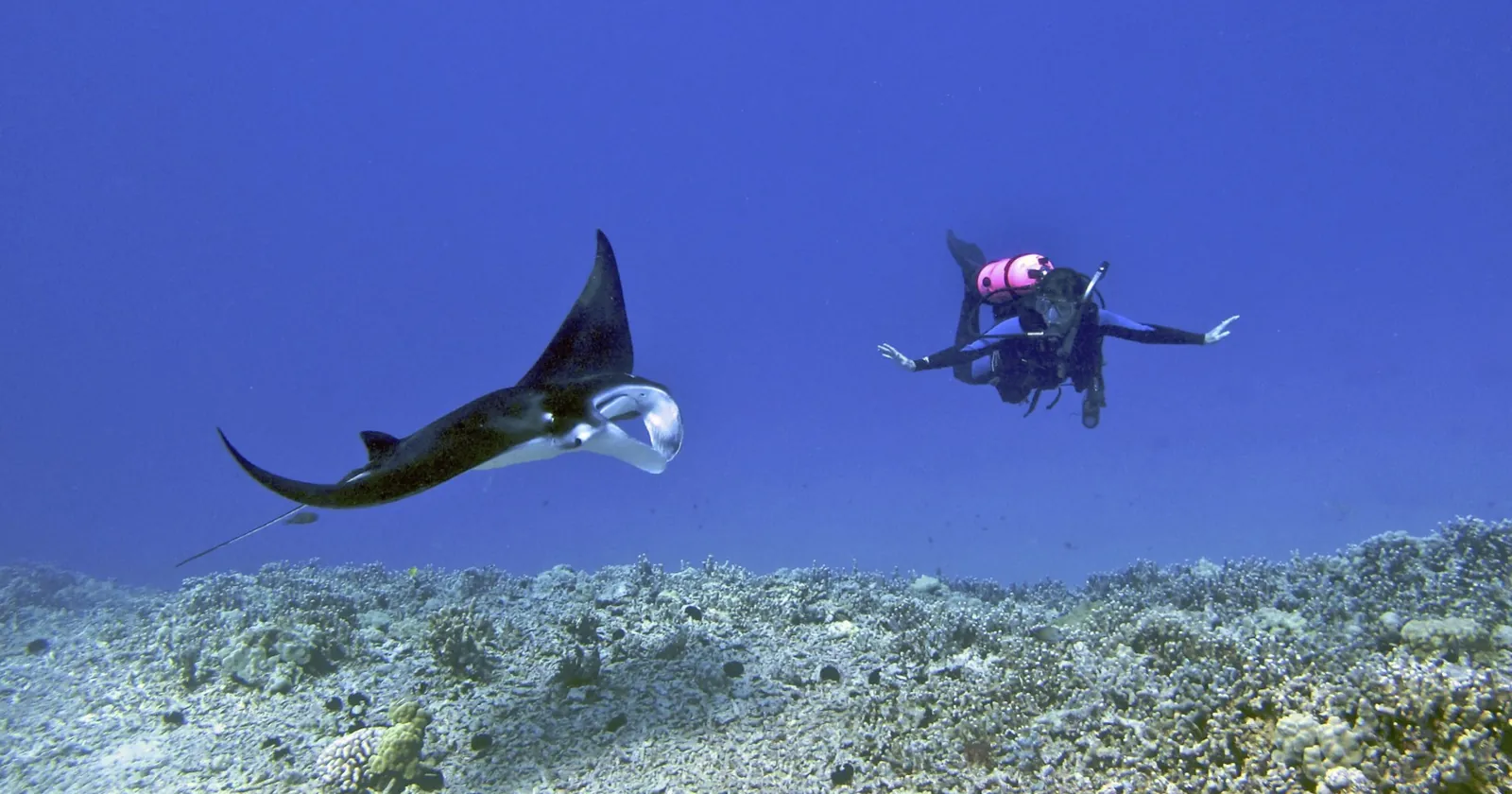
A diver with a manta ray off the Kona coast, Hawaii Island. Steve Dunleavy, Wikimedia Commons, CC BY 2.0, cropped.

Key takeaways
- Hawaii has eleven marine life conservation districts: three on Oahu, five on Hawaii Island and three in Maui County, including Molokini and Lanai's Manele-Hulopoe; Kauai has none
- Since 28 October 2021 federal law has banned approaching, remaining or swimming within 50 yards of a Hawaiian spinner dolphin within 2 nautical miles of the main islands
- State law makes it a misdemeanor to capture, take or entangle any ray or to kill any shark in state waters, with fines from $500 to $10,000
- The Hyperbaric Treatment Center at Kuakini Medical Center in Honolulu lists 24/7 emergency dive treatment; we could not confirm a chamber on any other island
- Nonresidents need a state licence to fish in the ocean, from $20 for a day, and commercial ocean tours collect a $1 stewardship fee per passenger
Hawaii diving by island: what each one is for
Hawaii is one state but four quite different dive destinations. Oahu has the city, the most famous snorkelling bay in the state and wrecks sunk on purpose as artificial reefs. Hawaii Island, usually called the Big Island, has the Kona coast, the manta night dive and Kealakekua Bay. Maui sends its boats to Molokini, a sunken crater three miles offshore, and to Lanai across the channel. Kauai dives its south shore and, in summer, the waters around Niihau.
This page is the state layer: the laws, protected areas, seasons and emergency arrangements that apply whichever island you choose, with a short orientation to each. The island guides go into the detail, and Maui vs Oahu sets the two most common bases side by side.
Oahu: Hanauma Bay, the North Shore in summer and wrecks off Waikiki
Hanauma Bay was the first of Hawaii's marine life conservation districts, created in 1967, and the state's Division of Aquatic Resources still describes it in detail: a shallow fringing reef close to the beach, an outer bay to about 21 meters that it recommends only for experienced divers, and a current near the left side of the mouth, the Molokai Express, that is hazardous on ebb tides. The state's page says the preserve is open Wednesday to Sunday and that lifeguards work there all year. The City and County of Honolulu runs the gate, the fees and the booking system.
Our Oahu diving guide covers the city's rules for guided scuba inside the bay, the North Shore conservation district at Pupukea, which is generally calm only from about May to October, the Waikiki district and the wrecks sunk off Waikiki and Waianae as artificial reefs.
Hawaii Island: the Kona manta dive and Kealakekua Bay
The Kona coast's best-known dive is a night dive with manta rays. Boats put lights on the sea floor, the lights draw plankton and the plankton draws reef mantas. Our Kona manta night dive guide explains how it works and the code of conduct Kona operators wrote for it. Jack's Diving Locker in Kailua-Kona lists its two-dive manta trip at $230 plus taxes and fees for certified divers, and the same for snorkellers, read on 11 November 2026.
No state rule written for the manta sites is in force yet. The Division of Boating and Ocean Recreation lists a "Manta Ray Viewing" package of new rules among its drafts, not among its adopted rules. What does apply is state law on rays, first passed in 2009 and amended in 2019: it is a misdemeanor to knowingly capture, take, possess, abuse or entangle any ray in state waters, or to kill one, with fines of $500 for a first offense, $2,000 for a second and $10,000 after that, plus administrative fines of up to $10,000 per ray.
Kealakekua Bay, about 30 minutes south of Kailua-Kona, is a conservation district of 315 acres, about 127 hectares, set up in 1969. The state calls Ka'awaloa Cove, near the Captain Cook monument, the bay's best diving, at about 1.5 to 37 meters, almost always calm, and reachable only by boat. Anchoring is banned in the northern subzone, feeding fish is banned throughout, and the state notes that dolphins are commonly seen in the bay, where the federal 50-yard rule below applies. Every vessel that crosses the bay, kayaks and paddleboards included, needs a State Parks permit, and permitted vessels may not land at Ka'awaloa. If you rent a kayak you need no permit yourself, but State Parks says you must check that the kayak has one.
One practical point for Big Island divers who plan a drive inland: Jack's Diving Locker suggests a surface interval of at least 18 hours before flying or driving to altitude after several dives a day or several days of diving, and 12 hours after a single dive.
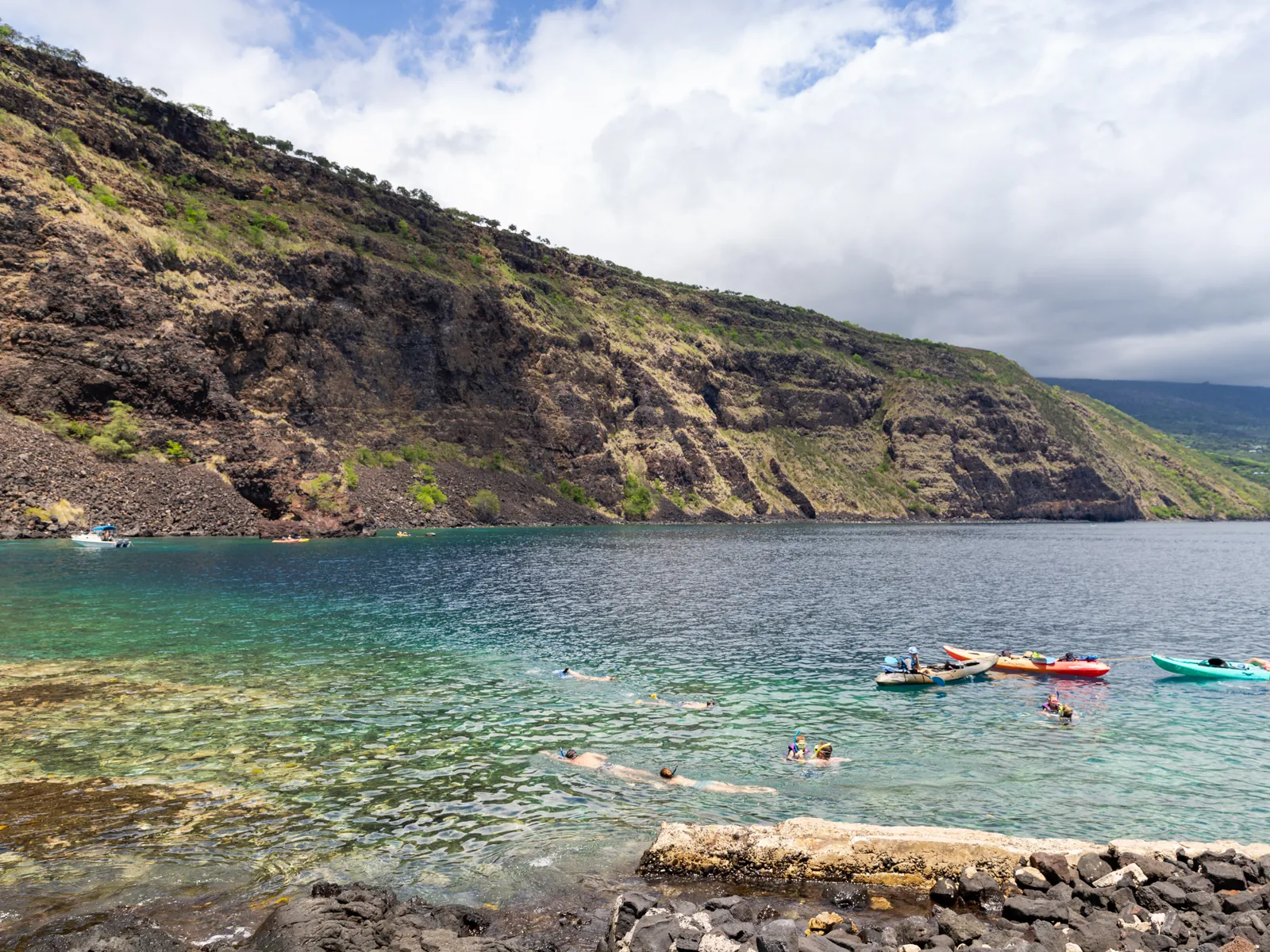
Snorkellers and kayaks at Ka‘awaloa Cove, Kealakekua Bay. dronepicr, Wikimedia Commons, CC BY 2.0, cropped.

Maui, Molokini and Lanai: crater walls and cathedrals by boat
Molokini is a crescent islet about three miles off Maui's south-west coast, the rim of a submerged crater. Its conservation district covers about 77 acres and dates from 1977. The state describes the cove sloping to about 30 meters before it drops off, and a back wall falling past 60 meters, where it tells divers to watch their depth. Currents can be a problem outside the cove at any time and may grow inside it in the afternoon when the wind picks up. Access is by boat only, the islet is a seabird sanctuary you may not land on, and commercial activity there needs a state permit under rules amended with effect from 15 March 2024. Our Maui vs Oahu comparison sets out what those amendments changed for boats.
Honolua Bay, a conservation district on Maui's north-west coast, has coral on both sides at about 3 to 12 meters, but the state says to avoid it in winter, when high surf is common. Across the channel, Lanai's Manele-Hulopoe district holds a scuba site the state calls "First Cathedrals", just outside Manele Bay near Pu'u Pehe Rock. No boats may operate in the district's inner subzone, and the state warns of dangerous swells and currents during southern kona storms. We could not read any Maui operator's current price for Molokini or Lanai.
Maui is also the island with the strictest sunscreen rule, a county ban on using any non-mineral sunscreen, covered below. Our Maui guide covers the island as a wind-sports base.
Kauai: south-shore reefs and summer trips to Niihau
Kauai has no state marine life conservation district. Its diving runs mostly from the south shore. Fathom Five Divers, based there, says it uses about 20 boat sites within 15 minutes of the harbor, including Sheraton Caverns, a set of lava tubes, and lists Koloa Landing and Tunnels as shore dives. Its two-tank boat dive starts at $239, read on 11 November 2026.
The bigger trip is to Niihau and the islet of Lehua, west of Kauai. Fathom Five runs it only from May to September, with a boat ride of about two and a half hours to get there, three dives with the first at about 26 to 32 meters, and a price of $465. It recommends a local dive first for anyone who has not dived in two years. We have no Kauai guide yet, and Molokai is not covered here.
Hawaii's dive rules: districts, coral, sharks and licences
Conservation districts. The state's eleven marine life conservation districts are created by the Department of Land and Natural Resources under chapter 190 of the Hawaii Revised Statutes, and each has its own chapter of rules. They allow little or no fishing or collecting, and several ban carrying spears or other gear in the water. Oahu has Hanauma Bay, Pupukea and Waikiki; Hawaii Island has Kealakekua Bay, Lapakahi, Old Kona Airport, Waialea Bay and Wai'opae Tidepools; Maui County has Honolua-Mokuleia, Molokini and Manele-Hulopoe. Scuba is not banned in any of the districts described here; taking, feeding and damaging are.
Coral and live rock. Statewide, it is unlawful to take, break or damage any stony coral or any live rock, meaning a natural hard surface with marine life attached, and unlawful to damage either through sediment or pollution.
Sharks and rays. Since 2021 state law has made it a misdemeanor to intentionally or knowingly capture, entangle or kill any shark in state marine waters, with the same fines as for rays and exceptions for self-defense and public safety. Whether and how state law bans feeding sharks we could not check, because we couldn't access that section on the legislature's site.
Fishing licence. Since 2024 nonresidents aged 15 and over need a Nonresident Recreational Marine Fishing License to fish in the ocean: $20 for a day, $40 for seven days or $70 for a year, plus online fees. The state's page does not say how it applies to spearfishing, so ask before you take a speargun out.
Tour operators. Since 12 January 2024, every commercial boat or water-sports business that needs a state commercial operator or commercial use permit must collect a $1 ocean stewardship fee from each passenger or customer. If a dive boat adds it to your bill, that is where it comes from.
Dolphins, turtles and monk seals: the federal layer
One distance is law, not advice. Under a NOAA rule published on 28 September 2021 and in force since 28 October 2021, it is unlawful within 2 nautical miles of the main Hawaiian Islands, and across the water enclosed by Lanai, Maui and Kahoolawe, to approach or remain within 50 yards, 45.7 meters, of a Hawaiian spinner dolphin, or to swim within that distance. A diver or snorkeller who is approached by dolphins is exempt only if they make no effort to engage and move away at once. Humpback whales get 100 yards under federal law, including when swimming.
For turtles and monk seals NOAA gives recommended distances: at least 3 meters from sea turtles and 15 meters from monk seals, on land and in the water, and about 45 meters from a mother seal with a pup. NOAA adds that all of these animals are protected under state and federal law and should never be touched, chased or fed. It estimates about 1,600 Hawaiian monk seals, some 400 of them in the main islands. The turtle swimming guide compares how other places handle the same rules. To report a stranded or injured animal, NOAA's Hawaii hotline is (888) 256-9840; to report harassment, call 643-DLNR.
Hawaii's sunscreen law, and Maui's stricter one
Section 342D-21 of the Hawaii Revised Statutes, added by Act 104 of 2018, has made it unlawful since 1 January 2021 to sell, offer for sale or distribute for sale in the state any sunscreen containing oxybenzone or octinoxate without a prescription. It regulates the shop, not your skin, and it does not cover products sold as a face cosmetic. Maui County goes further: its Ordinance 5306, in force since 1 October 2022, says non-mineral sunscreen "must not be used or applied by any person" without a prescription, and defines non-mineral as any active ingredient other than zinc oxide and titanium dioxide. Pack a mineral sunscreen and you are covered on every island; our reef-safe sunscreen guide explains what to look for.
Hawaii sea temperature by island
NOAA's satellite averages for 1991 to 2020 show water that barely changes through the year. Monthly surface means, in °C, for four ocean cells:
| Island (grid cell) | Feb | Apr | Jun | Aug | Oct | Dec |
|---|---|---|---|---|---|---|
| Oahu, off Honolulu (21.1°N 157.9°W) | 24.3 | 24.6 | 25.9 | 26.7 | 26.9 | 25.2 |
| Hawaii Island, off Kailua-Kona (19.6°N 156.1°W) | 24.7 | 25.0 | 26.1 | 27.1 | 27.1 | 25.6 |
| Maui, off Makena and Molokini (20.6°N 156.4°W) | 24.2 | 24.4 | 25.6 | 26.5 | 26.7 | 25.2 |
| Kauai, off Poipu (21.6°N 159.4°W) | 24.0 | 24.5 | 25.8 | 26.6 | 26.8 | 25.1 |
All four cells are coolest in February and March, at about 24 to 25 °C, and warmest in September and October, at about 26.7 to 27.2 °C, so the spread across a year is under 3 degrees. The Kona cell is the warmest in every month. Our Maui vs Oahu comparison uses the same satellite data for 2021 to 2025 only, and those recent years run a few tenths of a degree warmer than these 30-year means. These are surface figures; water at depth is cooler.
Hurricane season: June to November
The Central Pacific Hurricane Center, which shares an office with the National Weather Service in Honolulu, gives the Pacific hurricane season as 1 June to 30 November, and adds that tropical cyclones can and do occur all year. It notes that moderate to strong El Niño years bring more central Pacific cyclone activity and late-season storms. Swell matters more often than storms: the state warns that southern kona storms make Kealakekua and Lanai's Manele-Hulopoe dangerous, and that winter surf makes Maui's Honolua Bay and Oahu's North Shore places to avoid.
Chamber and emergencies in Hawaii
For any emergency, call 911. The Hyperbaric Treatment Center, run by University Health Partners of Hawaii on the ground floor of the HPM Tower at Kuakini Medical Center, 347 N. Kuakini Street, Honolulu, lists 24/7 emergency dive medicine and hyperbaric treatment and calls itself the only multi-place facility in the state. Its own page tells patients to call 911 first. We could not confirm a chamber that treats divers on Maui, Hawaii Island or Kauai, so ask your operator how it would get an injured diver to Honolulu.
Divers Alert Network's hotline, +1-919-684-9111, is staffed 24 hours a day, and DAN asks divers to call 911 first in a life-threatening emergency. At sea, VHF channel 16 is the distress channel, and the Coast Guard keeps a listening watch on it. Check that your dive insurance covers chamber treatment and evacuation between islands.
Entering Hawaii and staying to work
Hawaii is a US state, so US citizens need no visa and everyone else follows federal entry rules. Citizens of the 42 Visa Waiver Program countries can visit for business or tourism for up to 90 days without a visa after getting an ESTA approval; CBP advises applying before buying tickets and says the officer on arrival, not the ESTA, decides admission. Other visitors come on a B-2 visa for pleasure, which the regulations allow for up to a year, with extensions of up to six months at a time.
The same regulations say a visitor for pleasure "may not engage in any employment". They do not say whether working remotely for a foreign employer counts, and the US has no visa class for remote workers, so take legal advice before planning months of work on a visitor status. Once in, the ESTA or visa covers every island. Our Maui guide explains the 180-day line that decides whether a rental carries Hawaii's accommodation taxes.
How to choose between Hawaii's islands
Choose Oahu for diving from a city, Hanauma Bay, wrecks and the North Shore in summer. Choose Hawaii Island for the manta night dive, Kealakekua Bay and the warmest water. Choose Maui for Molokini and Lanai by boat, and for wind sports between dives. Choose Kauai for a quieter south shore and, between May and September, the long run to Niihau. On every island, plan around the swell: north shores in summer, south shores outside kona storms.
Who Hawaii diving suits
Hawaii suits a diver who wants warm, steady water, big animals under clear rules and the comfort of a US state. It suits divers who are happy to book a boat, because the headline sites, from Molokini to Ka'awaloa Cove to Niihau, are reached that way. It suits less well anyone who needs a work visa, a cheap month, or a chamber on the island they dive from, since the only one we could confirm is in Honolulu.
FAQ: Hawaii diving
Which Hawaiian island is best for scuba diving?
It depends on what you want. Oahu has Hanauma Bay and wrecks near the city, Hawaii Island has the Kona manta night dive and Kealakekua Bay, Maui has boat trips to Molokini and Lanai, and Kauai has south-shore reefs and summer trips to Niihau. The water is within about a degree of the same temperature on all four.
Can you swim with dolphins in Hawaii?
Not with spinner dolphins. Since 28 October 2021 federal law has banned approaching, remaining or swimming within 50 yards of a Hawaiian spinner dolphin within 2 nautical miles of the main islands and in the waters between Lanai, Maui and Kahoolawe. If dolphins approach you, make no effort to engage and move away.
Where is the recompression chamber in Hawaii?
The Hyperbaric Treatment Center is at Kuakini Medical Center, 347 N. Kuakini Street, Honolulu. It lists 24/7 emergency dive treatment and calls itself the only multi-place facility in the state. Call 911 first in an emergency. We could not confirm a chamber on any other island.
What is the water temperature for diving in Hawaii?
NOAA's satellite averages for 1991 to 2020 put the sea surface at about 24 to 25 degrees Celsius in February and March and about 26.7 to 27.2 degrees in September and October, depending on the island. The Kona coast is the warmest of the four cells we checked in every month.
Do you need a fishing licence to spearfish in Hawaii?
Nonresidents aged 15 and over need a Nonresident Recreational Marine Fishing License to fish in the ocean, at $20 for a day, $40 for seven days or $70 for a year. The state's page does not spell out spearfishing, so check with the Division of Aquatic Resources. Taking anything is banned in the marine life conservation districts.
Note: Conditions, safety guidance and regulations change. Verify current information with official sources, including the dive operator, the park authority and the relevant government department, before you travel or dive.
Founder of NOMADREEF and a former digital nomad. This guide is sourced from the references below; conditions, prices and rules change, so verify current details, and follow qualified local guidance and safety briefings. About the author · LinkedIn ↗
Sources
- Conservation districts (primary). Hawaii Division of Aquatic Resources, Marine Life Conservation Districts, and the district pages for Hanauma Bay, Kealakekua Bay, Molokini Shoal, Honolua-Mokuleia and Manele-Hulopoe. Read 11 November 2026.
- State rules and fees (primary). Division of Aquatic Resources, rules and public notices, past rulemaking (Molokini amendments, Ocean Stewardship User Fee), licenses and permits and coral and live rock rules; Division of Boating and Ocean Recreation, draft rules and administrative rules; Division of State Parks, Kealakekua Bay State Historical Park. Read 11 November 2026.
- State law (primary). Hawaii Revised Statutes sections 188-39.5 (rays), 188-40.8 (sharks) and 342D-21 (sunscreen). Read 11 November 2026.
- Federal wildlife rules (primary). 50 CFR 216.20, 2025 edition, and its dates in the Federal Register; NOAA Fisheries, Viewing Marine Wildlife in Hawai'i and Hawaiian monk seal. Read 11 November 2026.
- Operators. Jack's Diving Locker, manta dive and snorkel; Fathom Five Divers, boat dives and Niihau trip. Prices and claims as published by each operator. Read 11 November 2026.
- Sea temperature and storms (primary). NOAA PSL, OISST v2.1 monthly long-term means 1991–2020, four grid cells, computed for this page; National Hurricane Center, About the Central Pacific Hurricane Center and central Pacific climatology. Read 11 November 2026.
- Chamber and emergencies (primary). University Health Partners of Hawaii, Hyperbaric Treatment Center; Divers Alert Network, emergency assistance; US Coast Guard Navigation Center, VHF channels. Read 11 November 2026.
- Entry and stay (primary). US Customs and Border Protection, Visa Waiver Program and ESTA; 8 CFR 214.1 and 214.2, 2025 edition. Read 11 November 2026.
- Maui County sunscreen ordinance (primary). County of Maui, Ordinance 5306 (PDF, archived copy). Read 11 November 2026.
- Left out. The City and County of Honolulu's pages on Hanauma Bay fees, reservations and closures, and Maui County's sunscreen ordinance, because both sites refuse our crawler (our Oahu and Maui pages read them earlier); the state statute on shark feeding, which the legislature's site blocked; the content of the draft manta viewing rules and any Hawaii County rules; Maui operators' prices for Molokini and Lanai; any chamber outside Honolulu; Coast Guard contacts; whether remote work counts as employment for a US visitor; Molokai, Hilo and Puako; and temperatures at depth.