Crete Diving: Which Coast to Dive When the Meltemi Blows, and the Wrecks the State Lists
 by Yannick Schroth
Sep 24, 2026
14 min read
by Yannick Schroth
Sep 24, 2026
14 min read
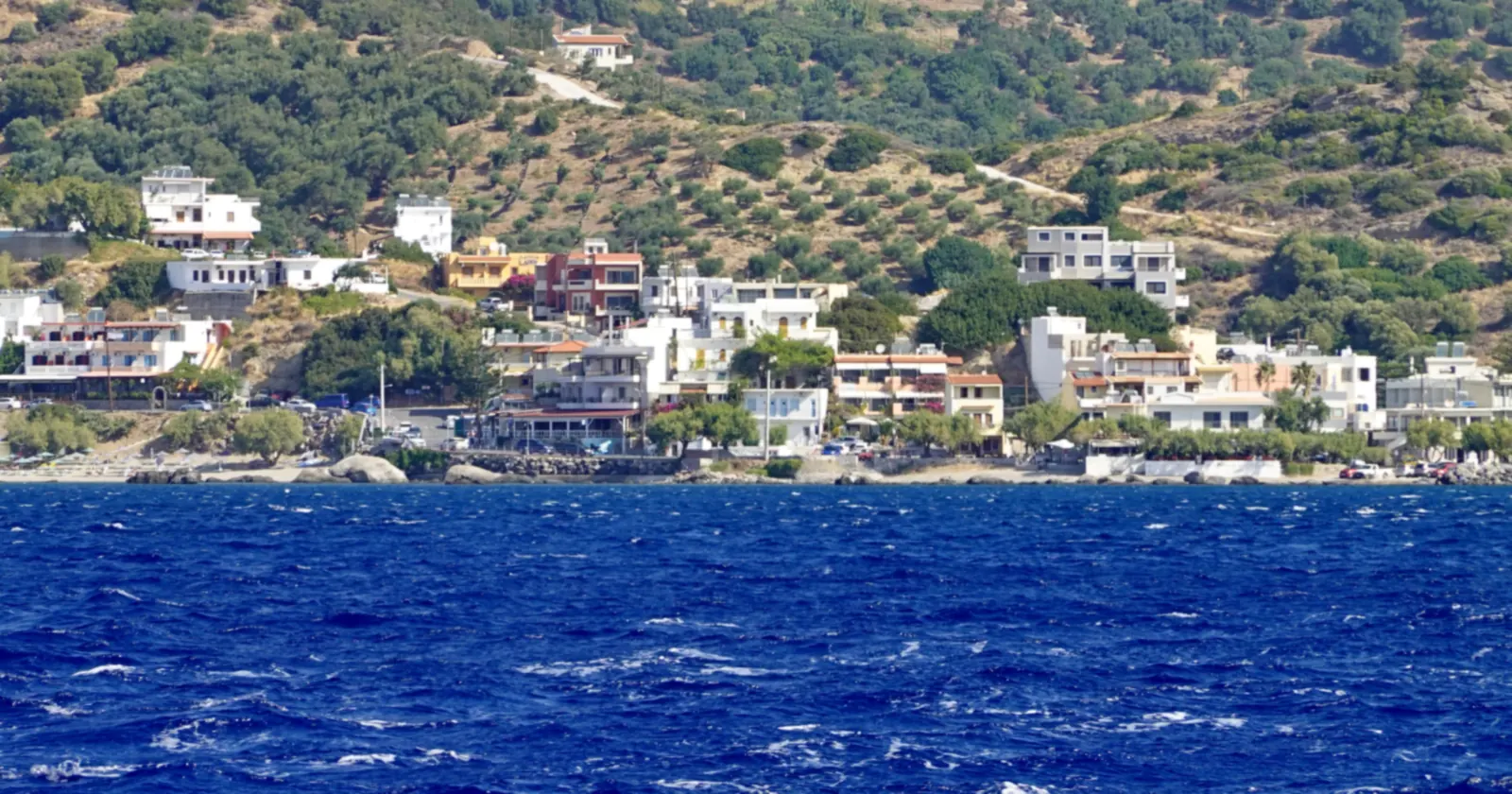
Plakias, on the south coast of the Rethymno region, seen from the water on 15 September 2020. Photo: Olaf Tausch, Wikimedia Commons, CC BY 3.0.

Key takeaways
- At Iraklio the summer wind is north-west, off the sea; at Ierapetra it is north all year, off the land, and reaches Beaufort 6 or more in 9.08 percent of observations
- In a 2007 field study, the strongest gusts along the gap between Lefka Ori and Idi came at its southern exit, up to 25 meters per second
- Off Ierapetra the sea averaged 1.4 to 1.5°C warmer than off Heraklion in October and November over 2015 to 2024, and the same in July
- Seven Crete wrecks are on the state list of 91; the first 11 opened, in June 2022, included one of them, the Minnewaska
- The Naval Hospital of Crete treats civilian diving accidents 365 days a year, but not yet cases needing intensive care or ventilation
Crete’s summer wind blows onshore at Heraklion and offshore at Ierapetra
Crete is long and narrow, with its axis running west to east, square across the path of the Aegean’s summer north wind, the meltemi. What that means for a dive boat depends on which coast it leaves from. The Hellenic National Meteorological Service publishes records for five stations on the island, running from the late 1950s to 2010.
At Iraklio, on the north coast, the prevailing direction is south from January to May and from October to December, then north-west from June to September. That summer wind arrives off the open Aegean, so on this coast it is onshore. Across the year, north-west and north together take 41.40 percent of observations, and winds of Beaufort 5 or more turn up in 11.68 percent.
Ierapetra sits on the south coast, facing the Libyan Sea, and its record looks nothing like Iraklio’s. The prevailing direction is north in all twelve months, which there means from the land out to sea. North alone takes 38.21 percent of observations, and north at Beaufort 5 or more takes 11.53 percent: almost as much as every direction at that strength combined at Iraklio.
At Ierapetra, Beaufort 6 or more from any direction reaches 9.08 percent of observations, against 3.86 percent at Iraklio. The monthly mean wind the agency publishes, which its own chart plots in knots, peaks there at 12.7 in July and 11.7 in August, the highest monthly figure at any of the five stations. Iraklio’s July figure is 9.1.
Sitia, in the east, is north-west in every month, with Beaufort 5 or more in 14.56 percent. Tympaki, on the Messara coast in the south, is calm or variable in 36.74 percent of observations, yet north at Beaufort 5 or more still takes 7.49 percent. The station the agency calls Chania Souda is the quietest: calm or variable in 30.95 percent, Beaufort 5 or more in 8.15.
Between Lefka Ori and Idi, Crete’s north wind gusts hardest at the south coast
A field study published in 2009 explains the south coast. Researchers from the University of Ioannina and the National Observatory of Athens put four weather stations along the gap between Crete’s two highest mountains, Lefka Ori at 2,453 meters and Idi at 2,456, from Rethymno on the north coast to Kerame, a coastal station at the gap’s southern exit.
They ran from July to September 2007. On 48 of the 92 days the wind at Kerame blew from the north at 5 meters per second or more through the middle of the day. On those days the northerly wind at Kerame averaged 9 meters per second, about 17.5 knots, the highest of the four stations, and the strongest gust recorded there was 25 meters per second, about 49 knots.
Peak gusts averaged 1.62 times the sustained wind at Kerame, against 1.33 at Rethymno. The paper finds that the mountains slow the north wind on the way in and produce “an intensification of the winds at the southern coasts accompanied with a temperature increase”. Three days that summer brought sustained winds of 14 to 15 meters per second at Kerame.
The highest speeds at every station came at noon and in the early afternoon. Three businesses on our list are filed under south-coast towns: a windsurfing and sailing station at Myrthios, a dive center at Plakias and one at Timpaki. Our Rhodes and Naxos guides deal with the same wind where it is the attraction.
The sea off Ierapetra runs warmer than off Heraklion, most of all in autumn
NOAA’s optimum interpolation sea surface temperature analysis publishes monthly means on a quarter-degree grid. We took three cells around Crete for the ten years 2015 to 2024: one about 30 kilometers north of Heraklion, one in the Libyan Sea off Ierapetra, and one off the west coast.
North of Heraklion the monthly means run, in degrees Celsius: January 16.9, February 16.2, March 16.4, April 17.5, May 19.7, June 23.0, July 25.4, August 26.1, September 25.3, October 23.2, November 20.9 and December 18.6.
Off Ierapetra the same months run 17.8, 16.8, 16.9, 17.8, 19.9, 23.1, 25.4, 26.8, 26.1, 24.6, 22.4 and 19.6. The southern cell is never cooler than the northern one, the two are level in July, and the gap opens in autumn: 1.4°C in October and 1.5°C in November. The ten-year means are 20.8°C in the north and 21.4°C in the south.
The west cell is the coolest of the three from March to July, at 18.9°C in May and 22.2°C in June, before drawing level with the north in August. All three stay below 18°C from January to April, so an autumn trip favors the south coast and a spring one wants the thicker suit. Our travel wetsuit guide covers the packing side.
Seven wrecks in Crete’s waters are on Greece’s list of 91 wreck monuments
Greece opened its historic wrecks to recreational divers by joint ministerial decision 92225/2022, published in the government gazette as FEK B 1273 of 18 March 2022 and made under article 7 of Law 4688/2020. Its annex names 91 wrecks of ships and aircraft that have been declared monuments. Section D of the annex is the Region of Crete, and it has seven entries.
The ministry’s announcement of 22 March 2021, when the list was first put forward, gives the details. In Souda Bay lie the Greek cargo steamer Kyriaki, sunk by German aircraft on 24 April 1941 and lying to a maximum depth of 85 meters, and the Italian supply ship Pierre Luigi, sunk by British aircraft on 20 May 1941 at 33 meters. The steamer Minnewaska lies off Marathi in the same bay, sunk by a mine in November 1916.
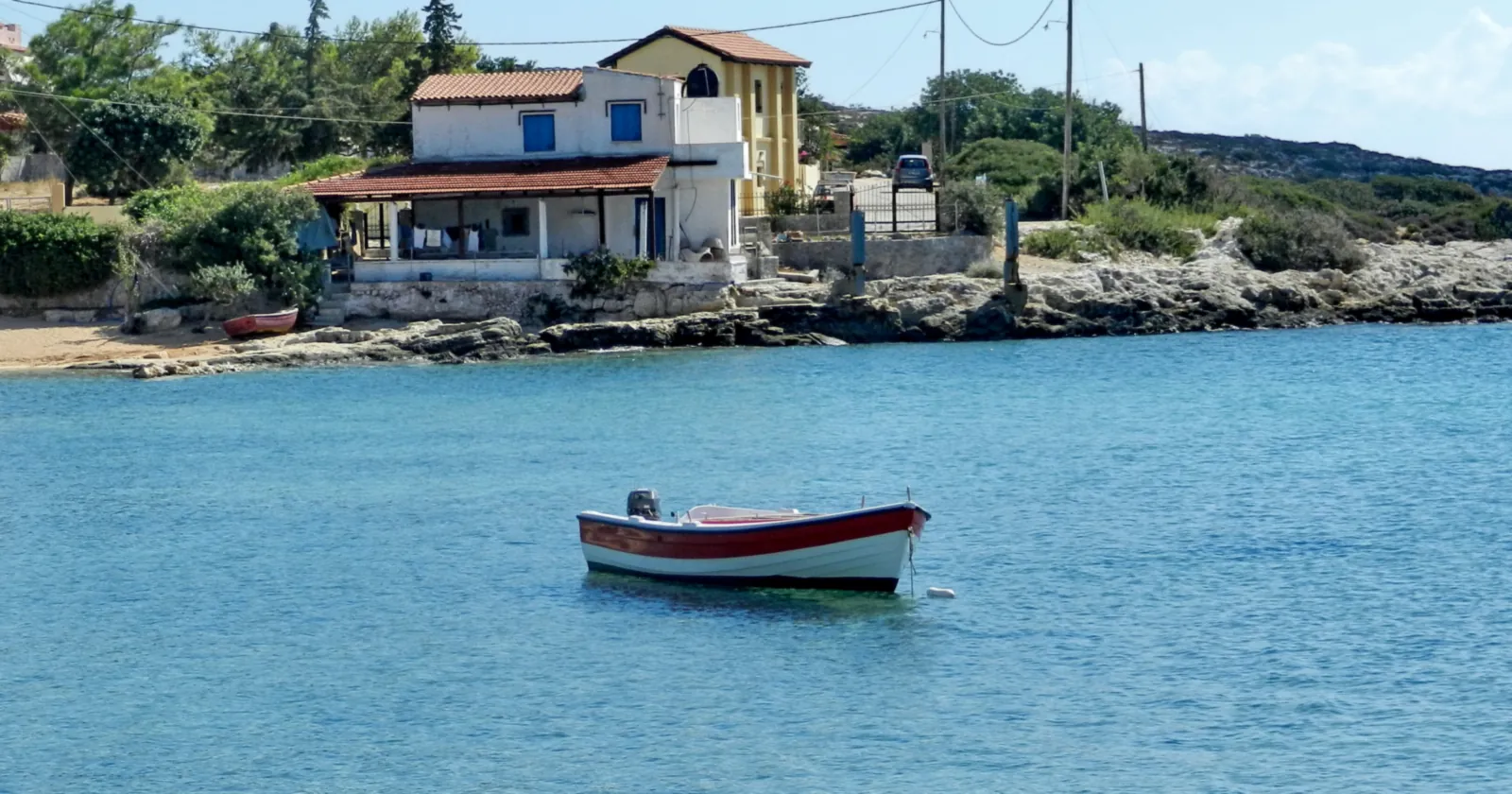
The other four are aircraft and a landing craft. A Beaufighter at Sitia lies at a maximum of 35 meters, and an Arado Ar 196 shot down near Chania on 3 August 1943 at 74. An Australian landing craft, listed as A6 or A20, lies at 12 meters at Balos, sunk in the Battle of Crete on 20 May 1941, and a German warplane from the same day lies at 8 meters at Gerani in Chania.
.jpg)
On the list is not open: diving a Crete wreck waits for documentation
Article 1(3) of the decision is the clause that matters. Diving on each listed wreck is allowed only after its documentation is complete, and the Ephorate of Underwater Antiquities issues a decision for each one, posted on the culture ministry’s website and sent to the port police and the naval staff.
On 10 June 2022 the ministry announced the first 11 wrecks opened that way. Five were off Kea and Milos, four in Chalkidiki and Evia, one between Pelion and Skiathos. One was in Crete: the Minnewaska. The other six Crete entries were not on it. The ministry said more would follow as documentation finished, and any later opening appears as an Ephorate decision on its site: check there before booking a wreck in Souda Bay or off Balos.
The day before a dive, the operator, or a private diver or snorkeler, has to notify the Ephorate and the local port authority with the date, time and length of the dive, the number of divers, the boat and its registration, and how it will anchor. The ministry adds that divers stay outside and around the wreck: penetration is forbidden except for research the ministry approves.
Article 1(4) forbids any act that results in intervention, “and therefore contact”, damage or alteration, and forbids collecting, removing or merely moving any object on the wreck or the seabed around it. Breaches fall under article 15 of Law 3409/2005 as rewritten in 2020. The Corfu guide covers the categories of Greek water closed to divers outright, and the wreck diving list puts a one-wreck island in context.
Crete’s marine Natura 2000 sites are mapped but not yet zoned
Natura 2000 site GR4340024, the marine area of western and south-western Crete, covers 163,686 hectares, all of it marine, according to its data form at the European Environment Agency. The form counts six species of marine mammal, with bottlenose dolphins and monk seals in the coastal shallows and sperm whales and Cuvier’s beaked whales among the rest, and describes gorgonian facies on coralligenous reef at 85 to 105 meters.
Closer to a recreational depth, site GR4340001 takes in Imeri and Agria Gramvousa, Tigani, Falasarna and the bay of Livadi, 5,888 hectares of which 41.36 percent is marine. Its form lists 113 hectares of Posidonia beds and 756 hectares of reef. Balos, where the landing craft lies, is in the same north-west corner of the island.
None of this closes water to divers yet. Article 2(3)(d) of Law 4688/2020 bars scuba diving where the act declaring a marine protected area, or its management plan, imposes a prohibition. For Crete, the Region announced on 2 October 2025 that the special environmental studies for its Natura sites had been approved, and that presidential decrees and management plans would follow. No such decree for Crete had been found by 24 September 2026.
Loggerhead turtles nest in the bays of Chania, Rethymno and Messara on Crete
Greek law has protected the loggerhead, the green turtle and the Mediterranean monk seal since Presidential Decree 67/1981. Its article 3 forbids, throughout the country and all year, killing, injuring, harming in any way, capturing or keeping the listed animals. The same table covers the fan mussel, Pinna nobilis. A 1998 joint ministerial decision, Greece’s transposition of the Habitats Directive, also forbids deliberately disturbing the species it protects, especially while they breed.
Crete matters for the loggerhead in particular. A 2016 paper in PLOS ONE ranked Rethymno third in Greece for nests per season, behind Zakynthos and Kyparissia Bay, with a reported average of 184 nests a year over 2008 to 2012, and noted that nest numbers were declining on Crete. The national action plan published in August 2021 names the bays of Chania, Rethymno and Messara as action areas and plans measures against harassment of turtles by speedboats at Rethymno.
Neither text sets an approach distance for divers; the offense is harm or disturbance itself. Our marine life guide covers encounters in general.
Spearfishing on scuba is banned in Crete, and so is spearfishing in May
Presidential Decree 373/1985, in the coast guard’s consolidated text, forbids recreational underwater fishers from using any surface-supplied air or portable scuba set, and forbids breathing apparatus on the boats they use. Law 3409/2005 says the same from the other side: scuba divers may not fish with a speargun or any other means.
The decree closes spearfishing entirely in May, from sunset to sunrise, and to anyone under 16. It is also closed within 200 meters of places where people usually swim, of harbor works and of anchored ships. Fish under 150 grams are off limits, underwater lights are banned, and the diver must tow a yellow buoy carrying a yellow flag with a red diagonal and stay within 50 meters of it.
Crete’s recompression chamber is at the Naval Hospital near Chania
The Hellenic Navy runs a hyperbaric and diving medicine unit at the Naval Hospital of Crete. In its own words the unit treats all diving accidents for the armed forces and for any Greek or foreign citizen, covering cases from all of Crete and the south-east Aegean 365 days a year. The hospital’s community page adds that diving accidents are handled year-round on a 24-hour basis, charged to the patient’s insurer.
Its pages place it on the Chania side of the island, describing its work for the local community of Chania and first aid across the wider Souda area. The same mission page carries the limit that matters in an emergency: the unit does not yet support cases that need intensive care or mechanical ventilation.
The hospital publishes 28210 82759 for the hyperbaric department and 28210 82538 or 28210 82414 for emergencies. The departmental lists of PAGNI and Venizeleio, two public hospitals in Heraklion, named no hyperbaric unit when read on 24 September 2026, so the chamber this guide can place is the one near Chania. Our dive insurance guide covers what a policy pays for chamber time.
The 20 watersports businesses on the Crete list, and where the registers file them
The Crete operator list holds 20 watersports businesses, read on 20 and 21 September 2026. Seventeen are dive centers in SSI’s register of affiliated centers, one is a dive center that is a Green Fins digital member on self-evaluation only, one is a VDWS windsurfing, sailing and paddleboard station and one is an IKO kite school.
The registers file sixteen of them under north-coast towns, from Platanias and Chania through Rethymno, Heraklion, Hersonissos and Agia Pelagia to Elounda. Three are filed on the south coast, at Myrthios, Plakias and Timpaki, and one has no town. A register’s town field is where it files a business, not necessarily where the boats go out.
SSI rates five of the dive centers for Freediving, three for Extended Range and two for Rebreather, which describes the listing and not this season’s courses. Greece requires dive providers to register under Law 3409/2005 through the port authorities, but the list cannot be read publicly; which registers can be read records what each source returned.
FAQ: scuba diving in Crete
Which side of Crete is better for diving when the meltemi blows?
It depends on the station. At Iraklio on the north coast the prevailing summer wind is north-west, arriving off the open Aegean. At Ierapetra on the south coast it is north in every month, which there means off the land, and Beaufort 6 or more turns up in 9.08 percent of observations against 3.86 percent at Iraklio. A 2007 field study between Lefka Ori and Idi recorded the strongest gusts, up to 25 meters per second, at the gap’s southern exit.
How warm is the sea around Crete for diving?
In NOAA’s analysis for 2015 to 2024, a grid cell about 30 kilometers north of Heraklion averaged 16.2 degrees Celsius in February and 26.1 in August. A cell off Ierapetra averaged 16.8 in February and 26.8 in August, and ran 1.4 to 1.5 degrees warmer than the northern cell in October and November.
Which wrecks can you dive in Crete?
Seven Crete entries sit on the list of 91 wreck monuments in joint ministerial decision 92225/2022, from the Minnewaska off Marathi in Souda Bay to an Australian landing craft at Balos. Diving on each is allowed only after the Ephorate of Underwater Antiquities has documented it. When the ministry announced the first 11 opened wrecks on 10 June 2022, the Minnewaska was the only one in Crete.
Where is the recompression chamber on Crete?
At the Naval Hospital of Crete, on the Chania side of the island. The Hellenic Navy says its hyperbaric unit treats diving accidents for any Greek or foreign citizen, 365 days a year, from all of Crete and the south-east Aegean, but does not yet support cases needing intensive care or mechanical ventilation. The hyperbaric department’s published number is 28210 82759.
Can you spearfish while scuba diving in Crete?
No. Presidential Decree 373/1985 forbids recreational underwater fishers from using any surface-supplied or portable breathing apparatus and forbids carrying one on their boat. Spearfishing itself is closed in May, from sunset to sunrise, to anyone under 16, and within 200 meters of places where people usually swim.
Note: Conditions, safety guidance and regulations change. Verify current information with official sources, including the dive operator, the port authority, the Ephorate of Underwater Antiquities and the hospital, before you travel or dive.
Founder of NOMADREEF and a former digital nomad. This guide is sourced from the references below; conditions, prices and rules change, so verify current details, and follow qualified local guidance and safety briefings. About the author · LinkedIn ↗
Sources
- Every station wind figure (primary). Hellenic National Meteorological Service, climatic data for the Crete stations Iraklio (35.34°N, 25.18°E, 1955 to 2010), Ierapetra (35.0°N, 25.44°E, 1956 to 2010), Sitia (1960 to 2010), Tympaki (1959 to 2010) and Chania Souda (1958 to 2010): prevailing wind direction and monthly mean wind by month, the agency’s wind chart labeling its axis in knots. Iraklio, Ierapetra, Sitia, Tympaki, Chania Souda. The direction shares and the Beaufort 5 and 6 shares are sums of the classes in each station’s annual wind frequency table, for example Ierapetra and Iraklio; each table sums to 99.85 to 99.98 percent. Read 24 September 2026.
- The gap winds (primary, peer-reviewed). Koletsis I, Lagouvardos K, Kotroni V, Bartzokas A (2009), The interaction of northern wind flow with the complex topography of Crete Island, Part 1: Observational study, Natural Hazards and Earth System Sciences 9, 1845–1855: Crete’s long, narrow shape with a west-east axis perpendicular to the prevailing northern flow; stations at Rethymno, Armeni, Mourne and Kerame from July to September 2007; Lefka Ori 2,453 m and Idi 2,456 m; 48 of 92 days of northerly flow of at least 5 m/s at Kerame between 12:00 and 19:00; mean speeds of 9 m/s at Kerame; maximum gust 25 m/s at Kerame; gust factors of 1.62 at Kerame and 1.33 at Rethymno; three days of 14 to 15 m/s sustained; peak speeds at noon and early afternoon; the quoted intensification at the southern coasts. doi:10.5194/nhess-9-1845-2009. Read 24 September 2026. The knot conversions are ours.
- Every sea temperature figure (primary data). NOAA optimum interpolation sea surface temperature v2.1, monthly means, cells centered on 35.625°N 25.125°E (north of Heraklion), 34.875°N 25.625°E (off Ierapetra) and 35.375°N 23.375°E (off the west coast), January 2015 to December 2024, retrieved from NOAA Physical Sciences Laboratory on 24 September 2026. Calendar-month averages and ten-year means are calculated from that series.
- The wreck list and its rules (primary). Joint ministerial decision 92225/2022, FEK B 1273 of 18 March 2022: article 1(1) on notice at least one day ahead to the Ephorate of Underwater Antiquities and the port authority, with the data required; article 1(3) allowing diving only after documentation, by Ephorate decision posted on the ministry’s site; article 1(4) on intervention, contact, damage and removal; article 1(5) on sanctions under article 15(3) of Law 3409/2005 as replaced by article 14 of Law 4688/2020; the annex, section D, entries 45 to 51 for the Region of Crete. FEK B 1273/2022 (PDF, National Printing Office). Read 24 September 2026.
- Depths and dates of the Crete wrecks (primary). Ministry of Culture and Sports, announcement of 22 March 2021 on the 91 wrecks: Kyriaki, 24 April 1941, maximum 85 m; Beaufighter off Sitia, maximum 35 m; Arado Ar 196 near Chania, 3 August 1943, maximum 74 m; landing craft A6 or A20 at Balos, 20 May 1941, 12 m; Pierre Luigi at Souda, 20 May 1941, 33 m; German aircraft at Gerani, 20 May 1941, 8 m. culture.gov.gr, nID 3707. Read 24 September 2026. The ministry dates the Minnewaska’s loss to 26 November 1916; the Imperial War Museum’s Lives of the First World War gives 29 November 1916. The sources disagree, so only the month is given. The ministry states no depth for the Minnewaska.
- The first 11 opened wrecks (primary). Ministry of Culture and Sports, press release of 10 June 2022: the list of 11, including the Minnewaska at Marathi; diving only outside and around the wrecks, penetration only for approved research; notification to eea-shipwrecks@culture.gr at least one day ahead. culture.gov.gr, nID 4246, read 24 September 2026 through the Internet Archive copy of 10 June 2022 because the ministry refused automated requests that day. Gap: no later Ephorate decision opening another Crete wreck was found; check the ministry’s site before booking.
- Natura 2000 sites (primary). European Environment Agency, Natura 2000 standard data forms, release of end 2024: GR4340024 (163,686.22 ha, 100 percent marine, species and gorgonian text from the quality field) and GR4340001 (5,888.46 ha, 41.36 percent marine, habitat 1120 at 113.31 ha and 1170 at 755.62 ha). Region of Crete, approval of the special environmental studies, 2 October 2025. Both read 24 September 2026. Gap: no presidential decree zoning Crete’s Natura sites and no legal ban on anchoring over Posidonia around Crete was found.
- The diving law (primary). Law 3409/2005, FEK A 273 of 4 November 2005, article 11 paragraph 6(a) on fishing by scuba divers, as originally published. The protected-area prohibition that was its paragraph 2(d) is now article 2(3)(d) of Law 4688/2020, whose article 62(a) repealed paragraph 2; FEK A 101/2020 (PDF). FEK A 273/2005 (PDF). Read 24 September 2026.
- Protected species (primary). Presidential Decree 67/1981, FEK A 23/1981, table B, with articles 2 to 10 published by correction in FEK A 43/1981 (article 3(1)); FEK A 23/1981. Joint ministerial decision 33318/3028/1998, article 11(1)(b) on deliberate disturbance, FEK B 1289/1998. National action plan for Caretta caretta, FEK B 3678 of 10 August 2021, naming the bays of Chania, Rethymno and Messara and speedboat measures at Rethymno, FEK B 3678/2021. All read 24 September 2026.
- Turtle nesting on Crete (peer-reviewed). Patel SH and co-authors (2016), Climate impacts on sea turtle recruitment at Mediterranean nesting grounds, PLOS ONE 11(6): e0157170: Zakynthos, Kyparissia Bay and Rethymno ranked first, second and third by nests per season, with recent averages for 2008 to 2012 reported as 902, 600 and 184 nests a year; nest numbers declining on Zakynthos and Crete. doi:10.1371/journal.pone.0157170. Read 24 September 2026. The 184 figure is the paper’s citation of an IUCN assessment, which was not read separately.
- Spearfishing (primary). Presidential Decree 373/1985, FEK A 131/1985, article 3, in the Hellenic Coast Guard’s consolidated text with amendments to Presidential Decree 65/2014: PD 373/1985, consolidated (PDF). Read 24 September 2026. Changes after 2014 were not checked.
- The recompression chamber (primary). Hellenic Navy, Naval Hospital of Crete: mission of the hyperbaric and diving medicine unit, community services and contact numbers. Read 24 September 2026. Gap: the departmental pages of PAGNI and Venizeleio in Heraklion named no hyperbaric unit on that date; no other chamber on Crete could be confirmed at a primary source.
- The 20 businesses. Twenty watersports businesses on the Crete operator list, read 20 and 21 September 2026: seventeen dive centers from the SSI register of affiliated centers, one VDWS station from the VDWS station register, one IKO school from the IKO register and one Green Fins digital member. The limits of each source are set out on which registers can be read.