Azores Diving: Princess Alice, Condor and the Reserves in Force Since 2026
 by Yannick Schroth
Sep 24, 2026
14 min read
by Yannick Schroth
Sep 24, 2026
14 min read
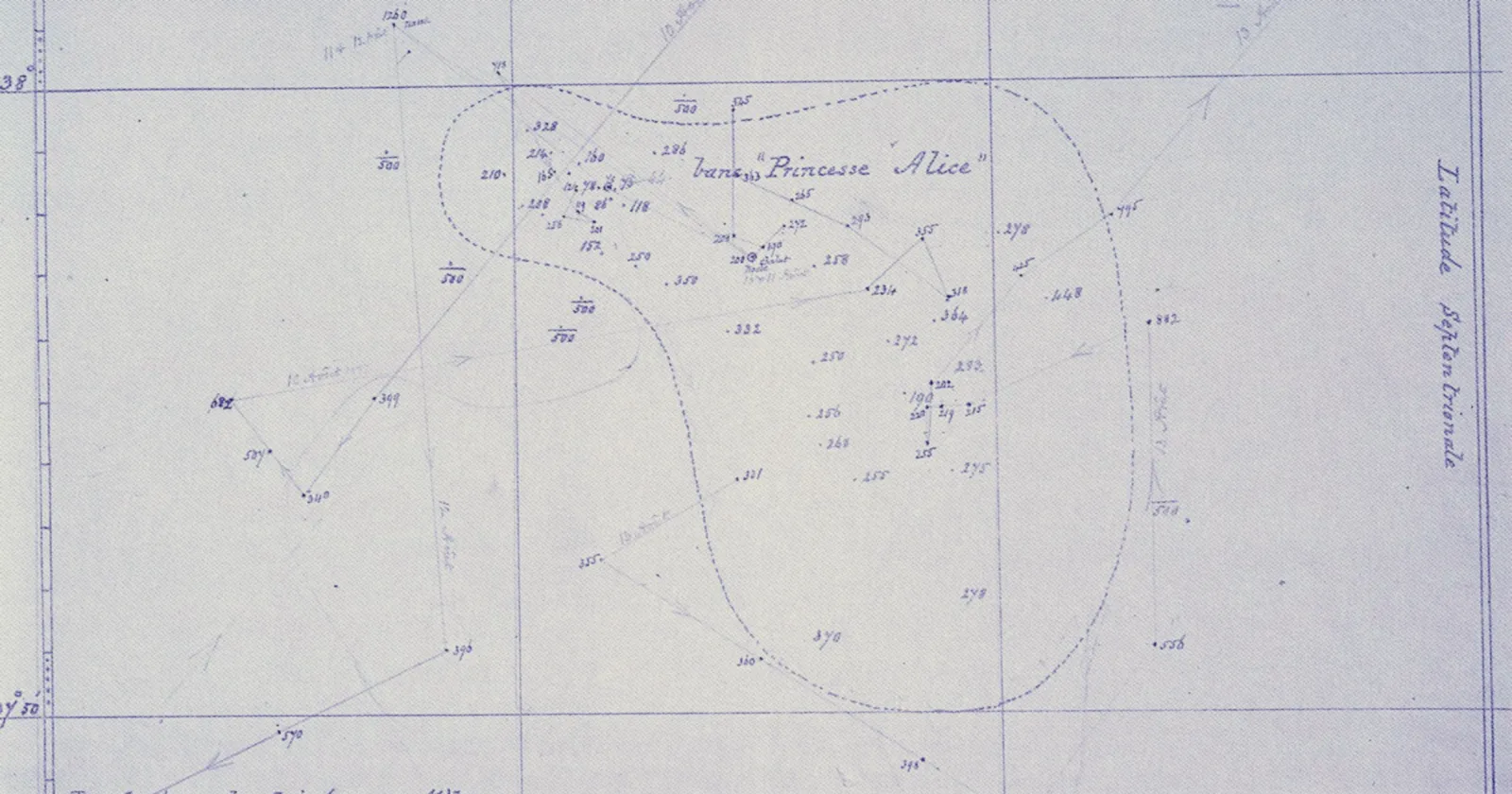
The Princess Alice bank as charted from the Monaco research yacht Princesse Alice in July 1896; soundings in meters, not for navigation. Chart: Wikimedia Commons, public domain.

Key takeaways
- Decreto Legislativo Regional 14/2024/A made Princess Alice (PMA15) and Condor (PMA14) marine nature reserves with total protection, and a 2025 amendment set its entry into force at 1 January 2026
- Inside those reserves every form of fishing is prohibited, spearfishing included, while diving, snorkeling, megafauna observation and anchoring are conditioned uses that need an authorization
- The rules for diving with pelagic sharks and mobulas are a code operators sign voluntarily: bait only more than three nautical miles offshore, no more than ten divers and one guide in the water
- The cetacean law bars scuba divers from the approach area around whales and dolphins and caps dolphin swimmers at two, for 15 minutes, within 50 meters of the boat
- A regional protocol from October 2024 routes diving accidents to the hyperbaric units at Hospital da Horta and at Hospital do Divino Espírito Santo in Ponta Delgada, starting with a call to 112
Princess Alice and Condor have been full-protection Azores reserves since 1 January 2026
The rule behind the change in Azores diving was voted in Horta on 17 October 2024 and published as Decreto Legislativo Regional 14/2024/A in the Diário da República of 24 December 2024. It is the second amendment to the 2011 decree that structures the Parque Marinho dos Açores, and it turns the park into a network, the RAMPA, with four levels of protection: total, high, light and minimal.
The vote is not the date the rules began to apply. Article 12 set entry into force at 280 days after publication, which would have been 30 September 2025. Decreto Legislativo Regional 22/2025/A then rewrote that article, and the new regime entered into force on 1 January 2026. Among the reasons its preamble gives is keeping the tuna season stable until the season ended.
Article 41 lists ten marine nature reserves, and two of them are the offshore dives this guide is about: the Reserva Natural Marinha do Banco Condor, code PMA14, and the Reserva Natural Marinha do Banco Princesa Alice, PMA15. Both had been protected areas since a 2016 amendment. What changed is the category, because under the decree a marine nature reserve is by definition an area of total protection.
Article 76 lists what is forbidden in those reserves. All commercial fishing, handline, trolling and rod included. All recreational fishing, which the text spells out as leisure, sport, tourist and underwater fishing. Fishing tourism, aquaculture, fish aggregating devices and mining. And, a detail anyone who has dived Madeira’s scuttled corvettes will notice, the sinking of ships and other structures.
Diving is not banned. Article 80 puts it in the second list, among the uses that are “condicionados e sujeitos a autorização”: recreational activities, submersible trips, diving, snorkeling, maritime-tourism trips, megafauna observation, mooring buoys and anchoring. Under article 79 each authorization needs a binding prior opinion from the regional department for sea and fisheries and a decision by the RAMPA Management Authority.
That makes the boat the thing to ask about. The regional directorate for maritime policy runs an online form for authorization requests covering the conditioned uses in general, separate from the one for commercial fishing. Before you book a Princess Alice or Condor trip, ask the operator whether it holds the authorization for the reserve it is taking you to.
The regional government’s table of oceanic protected areas inside the Azores’ exclusive economic zone lists 23 of them, and their areas add up to about 287,000 square kilometers, a little over half of it at total protection. The Reserva Natural Marinha Açores Norte alone covers 15,341,450 hectares. A March 2026 amendment, Decreto Legislativo Regional 6/2026/A, allows pole-and-line tuna fishing, and it is written for the high-protection areas, not the reserves.
What the Azores decree says about the Princess Alice bank and the Condor seamount
Each reserve comes with a classification sheet in the decree’s annexes, and those sheets give an official description of each site. Princess Alice, in annex V, is part of a large oceanic plateau 40 nautical miles south of Faial and, the sheet adds, 90 kilometers southwest of Pico. The bank runs northwest to southeast, about 70 kilometers long and 25 wide.
The shallowest point of its steep summit reaches 30 meters, while the main plateau spreads out at around 600. The sheet names the special interest of the site as the observation of elasmobranchs, “jamantas e tubarões pelágicos”, along with amberjack, barracuda, tuna and skipjack. It also records a coastal-type community on the summit in open ocean, which it calls a unique case in the Azores. The reserve covers 369.71 square kilometers.
A 2014 checklist in the Journal of the Marine Biological Association of the United Kingdom, built on new underwater images, puts at least three and possibly four mobulid species in Azores waters: the giant manta, the Chilean devil ray Mobula tarapacana, and one or both of the Mobula mobular/japanica complex. Our list of places to dive with manta rays sets the Azores against the tropical sites.
Condor, in annex IV, is a different kind of dive. It is an elongated volcanic seamount 17 kilometers southwest of Faial, with a crest 39 kilometers long, a flat summit at 185 meters and flanks falling to 2,000. Coral gardens were discovered on it in 2006. The sheet calls the seamount important for the preservation of the blue shark, and an important area for scientific research and for recreational diving. It covers 241.97 square kilometers.
At Princess Alice the summit comes within recreational range. At Condor it sits at 185 meters, far below any recreational limit, so a dive there happens in blue water above the seamount rather than on it, and the shark code in the next section shapes it more than any site map.
Azores blue shark dives run on a voluntary code, not on a law
The rules a skipper reads out before a blue shark dive in the Azores sound like regulation, and most of them are sensible enough to be. They come from the Código de Conduta para Mergulho com Tubarões Pelágicos e Jamantas nos Açores, published by the regional directorate for maritime policy. Its preamble says what it is: a set of rules “a adotar voluntariamente” by the maritime-tourism operators that offer these dives.
The code was agreed between operators, scientists and NGOs, with the regional government mediating, and it expects to become part of a future diploma after a trial phase. Until then it binds those who sign it. The signatories also commit to the RAMTA, the regional maritime-tourism regulation, and to the diving rules “previstas na lei”.
What it asks is specific. Sharks are attracted with bait but not fed, and baiting is allowed only more than three nautical miles from the coast of the islands, and never within three nautical miles of areas where other sports are under way. The bait sits in a rigid container with small openings, on a float at least 15 meters from the boat, and the crew member who handles it may not dive.
In the water, ten divers and one guide at most, placed on the vertical safety lines up-current of the bait. Boats inside the same one-nautical-mile circle work in sequence, one group in the water at a time. Divers wear a full wetsuit and gloves; camera operators may go without gloves if they accept that in writing. Dives run from an hour after sunrise to an hour before sunset. Deliberate contact is forbidden, and the guide ends the dive at any sign of disturbance.
The species list behind all this is long. A 2017 review in Frontiers in Marine Science confirmed 61 chondrichthyan species for the Azores, 39 sharks, 17 rays and five chimaeras, adding 19 to the 1997 checklist. Our list of places to dive with sharks compares the Azores with the other shark coasts.
Swimming with dolphins in the Azores: two swimmers, 15 minutes and no scuba
Whale and dolphin watching in the Azores has run on a regional law since Decreto Legislativo Regional 9/99/A of 22 March 1999, republished with amendments by Decreto Legislativo Regional 10/2003/A. Its definition of observation explicitly includes swimming with dolphins, so a snorkel swim off Pico or São Miguel is a licensed activity, not an extra a boat can improvise.
The rule a scuba diver should know sits in article 18. Among the things forbidden during observation is “a presença de mergulhadores com escafandro autónomo ou semiautónomo” in the approach area, together with underwater scooters. The approach area starts 500 meters from the nearest animal. A dolphin encounter in the Azores is a snorkel encounter by law.
Article 21 sets the swim itself. Swimming with whales is prohibited. With dolphins, putting swimmers in is the skipper’s decision alone, and a second crew member equipped to swim must watch them. Each boat gets three attempts. Swimmers, always with snorkeling gear and never more than two, stay together at the surface within 50 meters of the boat, for no more than 15 minutes, with the engine out of gear and no voluntary contact.
The boat rules frame it. No approach closer than 50 meters to any cetacean, 30 minutes at most inside the approach area, and no more than three boats within 300 meters of a group. Around whales with small calves the minimum is 100 meters, and no more than three boats may stay within 500 meters of a whale, for 15 minutes each. In April 2025 the regional government added licenses for zones A and C and capped whale-watching boats at 30 meters.
The Dori wreck off São Miguel is an Azores underwater archaeological park
Decreto Regulamentar Regional 12/2012/A of 8 May 2012 created the Parque Arqueológico Subaquático do Dori, off the south coast of São Miguel, east-southeast of Ponta de Rosto de Cão and opposite São Roque.
The ship was built as the Edwin L. Drake, one of the American Liberty ships of the Second World War, and the decree records that it took part in several military missions during that war. It describes the site as shallow and sheltered. The park is a square 800 meters on each side, centered on 37°44.602'N 25°37.695'W, with a surface buoy marking the middle.
Inside the square three things are forbidden: fishing of any kind, anchoring boats, buoys or other structures except the park’s own markers and authorized activities, and scientific work without permission. Collecting archaeological material is limited to licensed excavation. Article 5 is the line divers want: amateur diving is permitted, under the rules that govern it, and mooring buoys may be laid around the site so that boats do not need to anchor.
The decree gives neither the depth nor the date the ship went down, so take both from the dive briefing. Our wreck diving list covers other coasts built around this kind of dive.

Formigas and the Dollabarat reef: the Azores reserve that rises from 1,800 meters
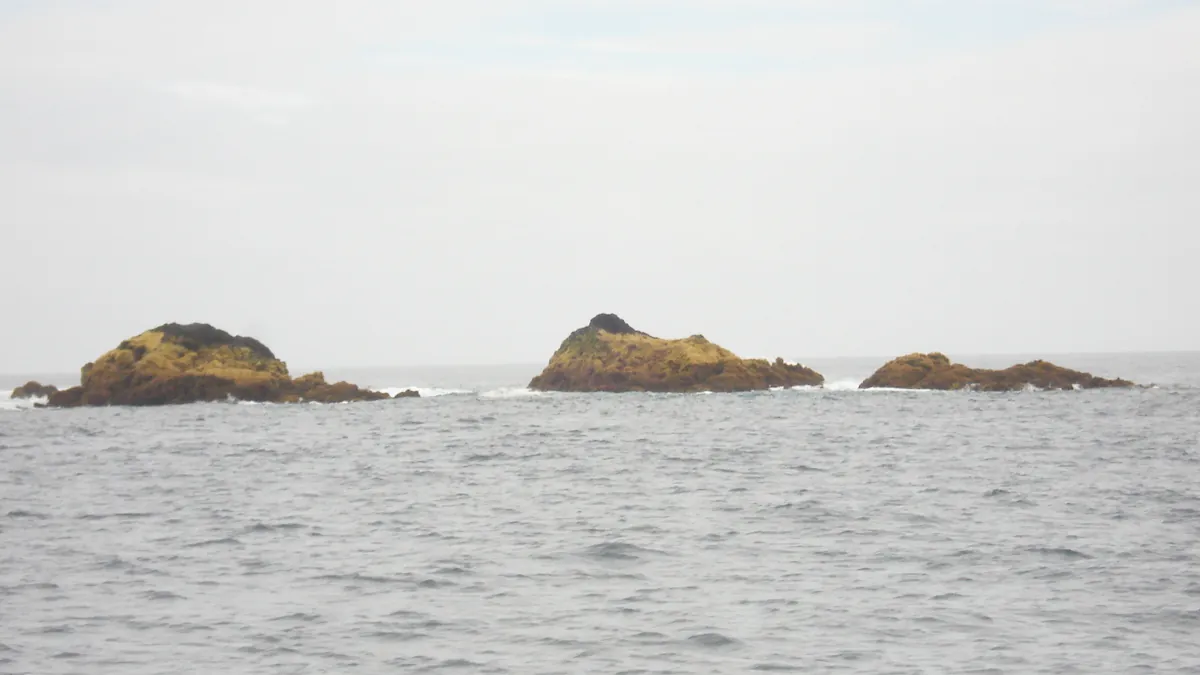
The third offshore name in Azores diving is the Formigas, a group of islets in the east of the archipelago, together with the Dollabarat reef. Until the 2024 decree it was a coastal nature reserve inside Santa Maria’s island natural park. It is now an oceanic reserve, PMA31, with total protection and the same rulebook as Princess Alice and Condor.
Its classification sheet puts the reserve at 564.23 square kilometers around a centroid at 37°14.8'N 24°45.3'W, and folds in three earlier designations: Ramsar site 1804, the OSPAR protected area of the Formigas bank and Dollabarat reef, and a Natura 2000 special area of conservation. The seamount beneath rises from abyssal depths of about 1,800 meters to about 10, around a small group of islets.
For a diver the consequence is the same as further west. Fishing of every kind is banned, and diving, snorkeling and anchoring are uses that need the management authority’s authorization. Five of the licensed diving operators in the archipelago give an address in Vila do Porto, on Santa Maria.
Azores water temperature runs from about 16°C in March to 23°C in August
NOAA’s Optimum Interpolation Sea Surface Temperature analysis, OISST version 2.1, blends satellite and in situ readings into quarter-degree cells, with monthly means back to September 1981. Averaged over 1991 to 2020, the cell just south of Faial bottoms out at 16.1°C in March and peaks at 23.3°C in August. South of São Miguel the same months read 16.2 and 23.2.
What stands out is how little the archipelago varies. A cell off Flores, in the western group, gives 16.0 and 23.4; one south of Santa Maria gives 16.6 and 23.6. From one end of the Azores to the other the long-term means differ by less than one degree in the same month. The calendar matters far more than the island. September runs almost as warm as August, 22.8 to 23.4 in the long-term means.
Recent years ran warm. In all four cells the warmest month of the whole series is August 2024, between 25.3 and 25.9°C. August 2026 came in at 24.0 south of Faial and 23.7 south of São Miguel, above the 30-year mean, while March 2026 had dropped back to 16.4 and 15.9.
These are surface values for cells roughly 25 kilometers wide, not a thermometer on a dive site, and they say nothing about temperature at depth. A suit chosen for the tropics is the wrong tool in March; our travel wetsuit guide covers the choice, and the Madeira diving guide has a measured harbor series for the island to the south.
A diving accident in the Azores is treated in Horta or Ponta Delgada
Since October 2024 the Azores have had a written protocol for diving accidents, the Via Verde Acidente de Mergulho. It is Circular Normativa DRS-CNORM/2024/12 of the regional health directorate, dated 9 October 2024, and it is addressed not only to hospitals and ambulance services but also to the Maritime Authority and to professional and recreational diving companies.
It defines the case it covers: a patient who has dived in the last 36 hours and shows suggestive symptoms, such as joint or muscle pain, numbness, headache, vertigo, altered consciousness or marbled skin. It warns that the condition can move from mild to potentially fatal in a short time. The first step is written plainly: call the European emergency number, 112, at once.
The regional health service has two hyperbaric and underwater medicine units, the circular says, one at Hospital da Horta on Faial and one at Hospital do Divino Espírito Santo in Ponta Delgada on São Miguel. On those two islands a suspected case goes straight from the scene to that hospital’s emergency department. On every other island it goes first to the local emergency or basic urgent-care unit, and the transfer to a chamber runs through the regional air evacuation unit.
That sentence is worth reading twice if you plan to dive off Pico, Terceira, São Jorge, Graciosa, Santa Maria or Flores: no unit is named on those islands. Ask your operator how it applies the protocol and whether it carries oxygen, and check that your dive insurance covers an inter-island air evacuation. Hospital da Horta lists hyperbaric medicine among its day-hospital services, and the Ponta Delgada unit hosted the presentation of the protocol on 26 November 2024.
Flying between Azores islands after a dive week: an empty cylinder and an 18-hour gap
SATA Air Açores, the airline that flies between the islands, gives diving equipment an additional allowance of 15 kg, packed as its own sturdy bag no larger than 150 by 75 by 50 centimeters. Its list of what that covers includes a cylinder, specified as an empty bottle, a regulator, mask, fins, wetsuit and underwater camera gear.
On SATA Air Açores flights, equipment that was not pre-booked can still be accepted if there is room, and it keeps the extra allowance, though it may follow on a later flight. Booking the equipment when you book the flight avoids that.
The other rule is the diver’s. The consensus from the Divers Alert Network’s flying-after-diving workshop, whose proceedings were published in 2004, is a minimum surface interval of 12 hours after a single no-decompression dive and 18 hours after multi-day repetitive diving, and substantially longer after decompression dives. A trip split between Faial and São Miguel needs a dry day at the hinge, not a morning dive before an afternoon flight.
The Azores license dive boats under their own maritime-tourism regulation
A dive boat in the Azores operates under a regional regulation, the Regulamento da Atividade Marítimo-Turística dos Açores, RAMTA. It was approved by Decreto Legislativo Regional 23/2007/A of 23 October 2007 and amended by Decreto Legislativo Regional 1/2023/A of 5 January 2023. Diving, “mergulho e escafandrismo”, is one of its licensed modalities, under article 4(1)(c).
The regional directorate for maritime policy in Horta publishes the list of licensed operators by modality, along with a list of revoked licenses. The diving list, updated on 11 September 2026, holds 37 license holders operating 79 boats between them. Licenses are numbered by sequence and year, from 03/2008 to 15/2026.
By registered address, Faial rather than São Miguel holds the most: Faial 10, São Miguel 8, Pico and Santa Maria 5 each, Terceira 4, Flores and Graciosa 2 each and São Jorge 1. Corvo has none. A registered address is not always where a boat dives, but this list is the document to check a business against. It is a regional system, separate from the mainland register described on our RNAAT page.
Where the 20 SSI dive centers in the Azores are
The Azores dive operator list holds 20 dive centers that SSI publishes in its register of affiliated centers, read on 23 September 2026. They sit on seven of the nine islands: São Miguel 7, Terceira and Faial 4 each, Pico 2, and São Jorge, Graciosa and Santa Maria one each.
Flores and Corvo carry none in any register the directory reads. Set that against the regional list above, where Flores has two licensed diving operators: absence from SSI says nothing about whether you can dive there. Nineteen of the 20 publish a website in the register, and SSI rates nine of them for Freediving, which describes the listing, not a course running this season.
A register entry settles that SSI lists the business on that date. It does not settle the license, the boat or a reserve authorization, and which registers can be read sets out what each source can and cannot show. If the plan is a longer stay, the Azores base guide covers Ponta Delgada as a place to work from.
FAQ: scuba diving in the Azores
When is the water warmest for diving in the Azores?
In August. NOAA’s OISST version 2.1 monthly means for 1991 to 2020 put the sea surface just south of Faial at 16.1 degrees Celsius in March and 23.3 in August, and south of São Miguel at 16.2 and 23.2. September runs almost as warm, 22.8 to 23.4 across four cells around the islands. August 2024 was the warmest month in the whole series, at 25.3 to 25.9 degrees. These are surface values for cells about 25 kilometers wide, not readings at depth.
Do you need a permit to dive the Princess Alice bank in the Azores?
Diving there is legal but conditioned. Since 1 January 2026 Princess Alice (PMA15) and Condor (PMA14) are marine nature reserves under Decreto Legislativo Regional 14/2024/A. Article 80 makes diving, snorkeling and megafauna observation in those reserves subject to authorization by the RAMPA Management Authority, after a binding opinion from the regional sea and fisheries department. All fishing is prohibited. Ask your operator whether the trip is authorized.
Is blue shark diving in the Azores regulated by law?
Not directly. The rules come from the Código de Conduta para Mergulho com Tubarões Pelágicos e Jamantas nos Açores, which operators adopt voluntarily and which expects to become part of a future diploma. It allows baiting only more than three nautical miles from the coast, forbids feeding and deliberate contact, and puts at most ten divers and one guide in the water at a time. Operators that sign it also commit to the regional maritime-tourism regulation.
Can you scuba dive with dolphins in the Azores?
No. Article 18 of the regional cetacean law, Decreto Legislativo Regional 9/99/A as republished in 2003, forbids scuba divers in the approach area, which starts 500 meters from the nearest animal. Dolphin swims are snorkel swims: never more than two swimmers, together at the surface within 50 meters of the boat, for up to 15 minutes, with the engine out of gear. Swimming with whales is prohibited.
Where is the recompression chamber in the Azores?
The regional health service has two hyperbaric and underwater medicine units, at Hospital da Horta on Faial and at Hospital do Divino Espírito Santo in Ponta Delgada on São Miguel, named in the Via Verde Acidente de Mergulho protocol of 9 October 2024. Call 112 first. On those two islands a suspected case goes straight to that hospital; on the other islands it goes to the local emergency unit and is moved by the regional air evacuation unit.
Note: Conditions, safety guidance and regulations change. Verify current information with official sources, including the dive operator, the regional government and the regional health service, before you travel or dive.
Founder of NOMADREEF and a former digital nomad. This guide is sourced from the references below; conditions, prices and rules change, so verify current details, and follow qualified local guidance and safety briefings. About the author · LinkedIn ↗
Sources
- The reserves, their rules and their classification sheets (primary). Decreto Legislativo Regional 14/2024/A, second amendment to Decreto Legislativo Regional 28/2011/A, Diário da República 249/2024, Series I, 24 December 2024, approved in Horta on 17 October 2024: the RAMPA and its four protection levels (preamble); article 12 on entry into force 280 days after publication; article 41 listing ten marine nature reserves, including Banco Condor (PMA14) and Banco Princesa Alice (PMA15); article 13(4), under which marine nature reserves are areas of total protection; article 76 on prohibited uses in reserves, article 79 on the authorization procedure and article 80 on conditioned uses, including diving, snorkeling, megafauna observation, mooring buoys and anchoring. Annex IV (PMA14): 241.97 km², 17 km southwest of Faial, crest 39 km, flat summit at 185 m, flanks to 2,000 m, coral gardens discovered in 2006, importance for the blue shark and for recreational diving. Annex V (PMA15): 369.71 km², 40 nautical miles south of Faial and 90 km southwest of Pico, about 70 by 25 km, summit at 30 m, plateau around 600 m, elasmobranchs, amberjack, barracuda, tuna and skipjack, coastal-type community on the summit. The annex for PMA31: 564.23 km², centroid 37°14.8'N 24°45.3'W, Ramsar site 1804, OSPAR area and Natura 2000 site, rising from about 1,800 m to about 10 m; its former status inside the Santa Maria natural park is in the preamble. Diário da República, DLR 14/2024/A. The annexes are published there as images and were read as such. Read 24 September 2026.
- The start date (primary). Decreto Legislativo Regional 22/2025/A, Diário da República 195/2025, 9 October 2025, approved 12 September 2025: article 12 of DLR 14/2024/A rewritten so that it enters into force on 1 January 2026, with the stability of the tuna season among the reasons in the preamble. Diário da República, DLR 22/2025/A. Read 24 September 2026.
- The tuna amendment (primary). Decreto Legislativo Regional 6/2026/A, Diário da República 43/2026, 3 March 2026: pole-and-line tuna fishing permitted in areas of high protection. Diário da República, DLR 6/2026/A. Read 24 September 2026.
- The network table and the authorization forms (primary). Direção Regional de Políticas Marítimas, Parque Marinho dos Açores/RAMPA: the amending decrees in force, online forms for authorization requests for conditioned uses separate from commercial fishing, and the table of 23 oceanic protected areas inside the Azores subarea of the EEZ with level and area in hectares, including Condor 24,197 ha, Princess Alice 36,971 ha and Açores Norte 15,341,450 ha. portal.azores.gov.pt, DRPM, RAMPA. Read 24 September 2026. The total of about 287,000 km² is our sum of that table, leaving out Menez Gwen and Lucky Strike, which the decree places inside PMA13-A; the regional government’s page states no total.
- The mobulids (primary, peer-reviewed). Sobral AF, Afonso P (2014), Occurrence of mobulids in the Azores, central North Atlantic, Journal of the Marine Biological Association of the United Kingdom 94(8): 1671–1675: at least three, possibly four species, from new underwater images and a re-evaluation of earlier records. doi:10.1017/S0025315414000964. Abstract read 24 September 2026.
- The shark species count (primary, peer-reviewed). Das D, Afonso P (2017), Review of the Diversity, Ecology, and Conservation of Elasmobranchs in the Azores Region, Mid-North Atlantic, Frontiers in Marine Science 4: 61 chondrichthyan species, 39 sharks, 17 rays and 5 chimaeras, adding 19 to the 1997 checklist. doi:10.3389/fmars.2017.00354. Abstract read 24 September 2026.
- The shark and mobula code (primary). Código de Conduta para Mergulho com Tubarões Pelágicos e Jamantas nos Açores: voluntary adoption, future diploma, RAMTA compliance, bait more than three nautical miles from the coast and from areas of other sports, container at least 15 m from the boat, the bait handler not diving, sequential operation within one nautical mile, ten divers and one guide, full suit and gloves, daylight window, no contact. DRPM, Mergulho com Tubarões, Código de Conduta and the code itself as a PDF linked there. Read 24 September 2026.
- The cetacean law (primary). Decreto Legislativo Regional 10/2003/A of 22 March 2003, republishing Decreto Legislativo Regional 9/99/A: the definition of observation including swimming with dolphins; article 18(3)(d) on scuba divers in the approach area; article 19 on the 500 m approach area and the 50 m minimum; article 20 on 30 minutes and three platforms within 300 m; article 21 on swimmers; article 22 on whales with calves and the 500 m, three-boat, 15-minute rule. Diário da República, DLR 10/2003/A; the later amending decree, Decreto Legislativo Regional 13/2004/A, changes license validity and not the conduct rules: DLR 13/2004/A. The list of instruments, including Portaria 45/2025 of 30 April 2025 on licenses for zones A and C and the 30 m maximum length: DRPM, Atividades de Observação de Cetáceos. Read 24 September 2026.
- The Dori (primary). Decreto Regulamentar Regional 12/2012/A of 8 May 2012, creating the Parque Arqueológico Subaquático do Dori: the Edwin L. Drake and the Liberty ships, the location off São Roque, the 800 m square around 37°44.602'N 25°37.695'W, the prohibited activities, collection only under licensed archaeology, amateur diving permitted, the central buoy and mooring buoys. Diário da República, DRR 12/2012/A. Read 24 September 2026.
- Every water temperature (primary data). NOAA/NCEI 1/4 Degree Daily Optimum Interpolation Sea Surface Temperature (OISST) Analysis, Version 2.1, monthly means, served by NOAA PSL. Our reading of four cells centered at 38.375°N 28.625°W (south of Faial), 37.625°N 25.625°W (south of São Miguel), 36.875°N 25.125°W (south of Santa Maria) and 39.375°N 31.125°W (off Flores), September 1981 to August 2026, with 1991–2020 means computed by us. NOAA PSL, OISST v2.1. Read 24 September 2026. Satellite-blended surface values, not in situ readings at dive depth.
- Diving accidents and the two chambers (primary). Direção Regional da Saúde, Circular Normativa DRS-CNORM/2024/12 of 9 October 2024, Via Verde Acidente de Mergulho: addressees, the 36-hour case definition and symptoms, the units at Hospital da Horta and Hospital do Divino Espírito Santo, direct routing on Faial and São Miguel, local units and air transfer elsewhere, 112 first. Circular Normativa DRS-CNORM/2024/12 (PDF, scanned). Hospital da Horta lists hyperbaric medicine among its day-hospital services: Hospital da Horta, Sobre nós. The HDES unit hosted the presentation of the protocol on 26 November 2024: HDES, Unidade de Medicina Hiperbárica e Subaquática. All read 24 September 2026.
- Flying after diving (primary). Divers Alert Network, Guidelines for Flying After Diving, proceedings summary of the DAN Flying After Diving Workshop (Vann RD, ed., 2004): 12 hours after a single no-decompression dive, 18 hours after multi-day repetitive diving, substantially longer after decompression dives. DAN, FAD proceedings summary (PDF). Read 24 September 2026.
- Dive kit on inter-island flights (primary). SATA / Azores Airlines, sports equipment: 15 kg additional allowance for diving equipment on SATA Air Açores flights, 150 by 75 by 50 cm, empty cylinder, acceptance without pre-booking subject to availability. azoresairlines.pt, sporting equipment. Read 24 September 2026.
- The regional license and the license list (primary). DRPM, Legislação aplicável marítimo-turísticas nos Açores: RAMTA approved by DLR 23/2007/A, amended by DLR 1/2023/A. DRPM, legislation. The list for “Mergulho e escafandrismo (RAMTA, artigo 4.º, n.º 1, c))”, updated 11 September 2026: 37 license holders, 79 boats. The island counts are ours, matched from each license number to the postcode in the list of licensed operators and their addresses published on the same page. DRPM, Atividade Marítimo-Turística. Read 24 September 2026.
- The 20 dive centers. The Azores dive operator list, read 23 September 2026 from the SSI register of affiliated centers: 20 centers on seven islands, 19 with a website in the register, nine rated by SSI for Freediving. The limits of each source are set out on which registers can be read.
- Left out, and why. Ferry routes between the islands: the Atlânticoline site refused automated access, so no crossing is described here. The depth of the Dori and the date it sank: not in the decree, and not stated here. Whether each operator holds a reserve authorization: no public list of authorizations was found, which is why the text tells you to ask. The suffix RAA that some operators print with their license number: it does not appear in the regional list, so this page quotes the numbers as the list prints them. The current operating status of each hyperbaric chamber beyond the circular and the two hospitals’ own pages: unverified, needs human check.