Australia Diving: The Great Barrier Reef, Ningaloo's Whale Sharks, Cold-Water Piers and the Rules State by State
 by Yannick Schroth
Nov 10, 2026
12 min read
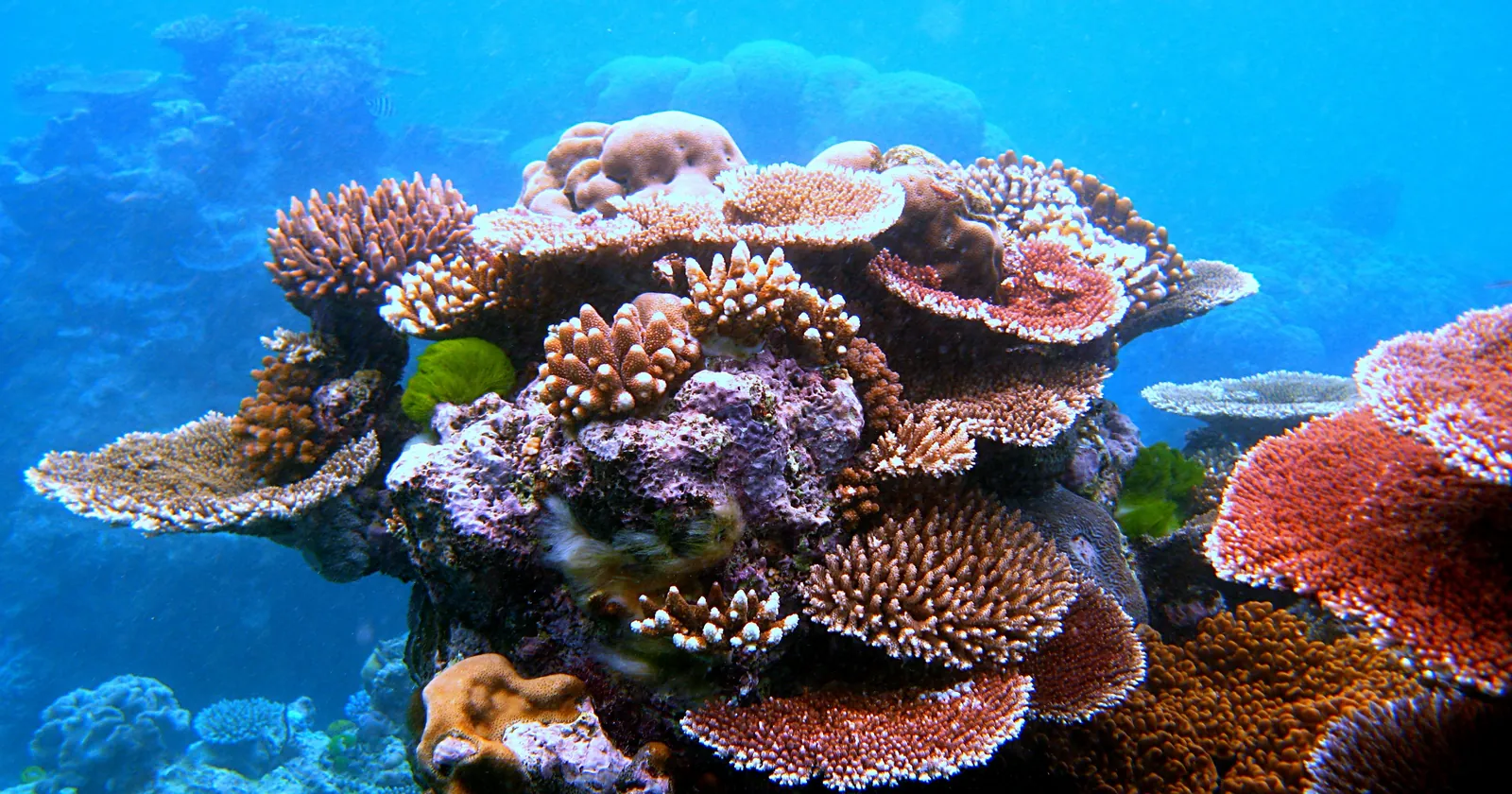
Coral on Flynn Reef, Great Barrier Reef, off Cairns. Toby Hudson, Wikimedia Commons, CC BY-SA 3.0, cropped.

Key takeaways
- Queensland's Safety in Recreational Water Activities Regulation 2024 makes every dive operator in the state take a medical declaration from trainees and try-divers, count everyone aboard twice and post a lookout out of the water
- At Ningaloo, Western Australia's rules keep swimmers at least 3 metres from a whale shark's head or body and 4 metres from its tail, with no more than 10 people in the water and no flash
- NOAA's 1991 to 2020 averages give about 24.1 °C in July and 29.0 °C in February on the outer reef off Cairns, but 18.1 °C in August off Sydney and 12.6 °C at Port Phillip Heads
- Townsville University Hospital runs the only public hyperbaric chamber in Queensland outside Brisbane and confirms a 24/7 emergency service; Brisbane, Sydney, Melbourne and Hobart have state units with on-call arrangements
- Germans can get a free eVisitor and Britons an eVisitor or ETA; neither government mentions a digital-nomad visa, and we couldn't read Australia's Home Affairs pages
Australia diving: one country, several rulebooks
Diving in Australia is not one trip. The tropical north, the subtropical east, the temperate south and the west coast differ in water, season and law. Marine parks are run by the Commonwealth, by the Great Barrier Reef Marine Park Authority and by each state, and the diving rules a boat must follow are state rules. This page is the overview. For the detail on a region, follow the link to our city guide.
Our guides so far cover Cairns, Brisbane, Melbourne and Perth, with a surf and nomad guide to Byron Bay. Sydney, Ningaloo, South Australia, Tasmania and the Northern Territory have no guide of their own yet; the sections below give what we could confirm.
The Great Barrier Reef: zones, a charge and the day boats from Cairns
The Reef is a marine park with its own authority and zoning plan. Diving is allowed in its no-take green zones, and every passenger on a commercial trip pays the Environmental Management Charge, which the operator collects. Our Cairns diving guide sets out what each zone allows, the current charge and its 2027 rise, the stinger season and the state of the coral. We couldn't reach the Reef Authority's website on 10 November 2026, so those figures aren't repeated here.
A typical Cairns day boat runs to the outer reef. Divers Den, for example, says its boats take about 90 minutes to reach its moorings on Norman, Saxon and Hastings reefs and offer up to three dives. It lets certified divers dive with a buddy or pay for a guide, and its fares include the charge. Liveaboards from Cairns also reach the Coral Sea, which is a separate park; the Cairns guide explains the difference.
Queensland's diving law covers every dive boat in the state
Queensland writes recreational diving into its own regulation. The Safety in Recreational Water Activities Regulation 2024, in force since 1 August 2024, applies to dive operators across the state. Before an entry-level course dive or a try-dive, the operator must have your medical declaration on the state's approved form, and must keep it for at least a year. If the declaration on an entry-level course says you need a doctor's evaluation, you cannot dive without a medical certificate.
The regulation also fixes how the boat counts people. A crew member counts everyone before the boat leaves for the site and again before it leaves the site; if there is only one counting crew member, the count is done twice in two ways. While people are in the water, at least one lookout must stand out of the water, see the whole area and do nothing else. The depth limits for non-certified divers and trainees sit in the state's code of practice; the Cairns guide quotes them. The UK government's travel advice puts it simply: you are required by law to complete a medical declaration for diving or snorkelling at a resort, so answer it truthfully.
Brisbane and Moreton Bay
Brisbane dives in the Moreton Bay Marine Park, a state park: the Tangalooma Wrecks off Moreton Island, Flinders Reef, Cherubs Cave, and Manta Bommie and Flat Rock off North Stradbroke Island. Queensland's zoning plan sets grey nurse shark areas there with a night-diving ban and limits on group size. Our Brisbane diving guide has the rules, the ferries and the prices.
New South Wales: Sydney's Cabbage Tree Bay and Byron's Julian Rocks
We have no Sydney diving guide yet. The NSW Government lists Cabbage Tree Bay in Manly as an aquatic reserve of about 20 hectares, from the southern end of Manly Beach to Shelly Beach, where swimming, snorkelling, scuba diving and underwater photography are allowed and fishing or collecting any marine life is not. It names weedy seadragons and grey nurse sharks among the reserve's protected and threatened species, and says the safer way in is from Shelly Beach at the end of the walkway.
Further north, the same government describes Julian Rocks off Byron Bay as an aquatic reserve where collecting or destroying animals and spearfishing are prohibited, with diving renowned for its fish, corals and sponges. Our Byron Bay guide covers the town as a surf and work base. New South Wales has its own rules for grey nurse shark sites, but we couldn't read them on the state fisheries department's site. Ask your dive shop before you dive a shark site.
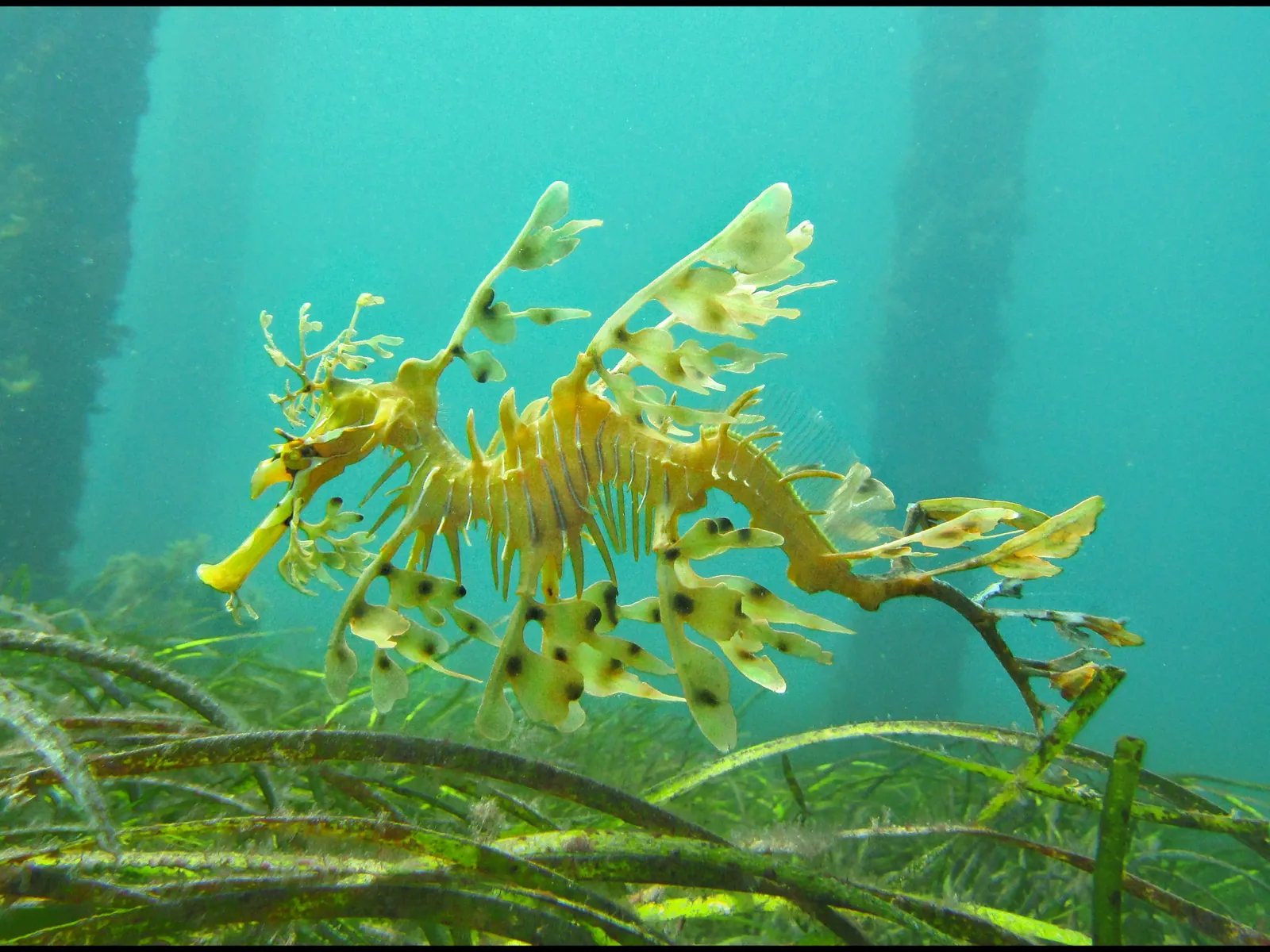
A leafy seadragon at Rapid Bay jetty, South Australia. Katieleeosborne, Wikimedia Commons, CC BY-SA 4.0, cropped.

Victoria: Melbourne's piers and the Heads
Melbourne diving happens at the bottom of Port Phillip: pier dives at Rye and Blairgowrie, slack-water walls at the Heads inside a no-take marine national park, and the scuttled ex-HMAS Canberra off Barwon Heads. It is cold water and a car trip from the city. Our Melbourne diving guide covers the parks, the protected wreck zones and the shop prices.
Western Australia: Ningaloo's whale sharks and Perth's coast
Ningaloo Marine Park, a state park on the North West Cape, is World Heritage-listed, and a Commonwealth marine park borders its western edge. The Department of Biodiversity, Conservation and Attractions (DBCA) says whale sharks are most reliably seen there from March to July, and in some years into August, September and even October; its park page gives March to August, and humpbacks from June to November. Only operators licensed by the department may run commercial whale shark tours, and it counts the rise in swimmers from about 1,000 in 1993 to over 36,000 in 2022.
The interaction rules are law, not etiquette. An approach zone of 250 metres surrounds every whale shark. One vessel at a time may work inside it, for no more than 90 minutes and at six knots or less; a second boat waits 250 metres off and any others 400 metres. Swimmers must stay 3 metres from the head or body and 4 metres from the tail, must not touch or ride the shark, and may not use flash, camera poles or scooters, with no more than 10 people in the water at once. Under state law nobody may swim within 100 metres of a whale; in-water humpback tours run only under DBCA licence. DBCA has a draft 2026 whale shark management program out for comment until 21 December 2026, so check the rules again next season. Our whale shark guide compares Ningaloo with the Maldives.
Perth itself is a different trip: shore dives in the city's marine parks, the Omeo wreck, day boats to Rottnest and, further south, Busselton Jetty and the HMAS Swan. Western Australia limits what divers may take, including no abalone on scuba near Perth. Our Perth diving guide has the detail.
South Australia: leafy seadragons at Rapid Bay
South Australia has 19 marine parks. Their sanctuary zones cover about 6 per cent of state waters; fishing is banned in them, but diving, swimming and boating are welcome. The state's parks service calls the Rapid Bay Jetty in Encounter Marine Park, south of Adelaide, world renowned for diving with the leafy seadragon, South Australia's marine emblem. The former warship HMAS Hobart lies in 30 metres inside a nearby sanctuary zone, and the parks service names the Drop-Off at Snapper Point on Aldinga Reef among the best dive sites near Adelaide. We have no Adelaide guide, and we could not read the state fisheries department's page on the seadragon's legal status.
Marine parks: who runs which water
Parks Australia manages 60 Australian Marine Parks covering 3.8 million square kilometres, 43 per cent of Australian waters. The national system adds the Great Barrier Reef Marine Park and the state and territory parks, and together they cover more than half of Australian waters. In practice a visiting diver deals with the state or Reef rules where the boat goes: Queensland's zoning plans and the Reef Authority in Queensland, aquatic reserves in New South Wales, Parks Victoria's no-take parks, DBCA sanctuary zones in Western Australia and the sanctuary zones of South Australia's parks. The common thread is that a sanctuary or green zone means look, do not take. Spearfishing and collecting rules differ by state and park, so read the guide for the region.
Sea temperature by region
We computed monthly averages from NOAA's satellite sea-surface series for 1991 to 2020 in five ocean cells. These are surface figures; water at depth can be colder.
| Cell | Coolest month | Warmest month |
|---|---|---|
| Outer reef off Cairns, 16.625°S 146.125°E | 24.1 °C, July and August | 29.0 °C, February |
| Ningaloo, west of North West Cape, 21.875°S 113.875°E | 23.1 °C, September | 28.1 °C, March and April |
| Point Lookout, off Brisbane, 27.375°S 153.625°E | 21.2 °C, August | 26.7 °C, February |
| Off Sydney, 33.875°S 151.375°E | 18.1 °C, August | 23.3 °C, February |
| Port Phillip Heads, Melbourne, 38.375°S 144.625°E | 12.6 °C, August | 19.3 °C, February |
Ningaloo runs out of step with the east coast: its warmest water comes in March and April, as the whale shark season starts, and its coolest in September. The outer-reef cell off Cairns reads a little warmer in winter than the inshore wave buoy quoted in our Cairns guide; they measure different water.
Cyclone season, region by region
The UK government says tropical cyclones affect mainly Queensland, the Northern Territory and Western Australia, and that the season normally runs from November to April. The German Foreign Office puts them on the northern coasts of those three in the same months and warns of heavy rain all year elsewhere. The counts below come from the Bureau of Meteorology's cyclone track file. Counting from July 1970, 19 tracked systems passed within 100 kilometres of Cairns, all between December and April, the latest an unnamed system on 6 March 2026. At Exmouth, by Ningaloo, it was 25, from December to May, with March alone accounting for 12. A track passing nearby does not mean cyclone-force wind in town, but in those months plan with flexible dates. Sydney had none within that distance.
Chambers and emergency numbers
Call 000 for ambulance, fire or police. DAN's diving emergency line is 1800 088 200, toll free within Australia and in English only; from outside Australia it is +1 919 684 9111. The public hyperbaric units we could confirm from their own pages:
| Unit | What its own page says |
|---|---|
| Townsville University Hospital, Queensland | Only public chamber outside Brisbane; 24/7 emergency service for decompression illness; after hours (07) 4433 1111 |
| Royal Brisbane and Women's Hospital | Statewide; 24-hour on-call service for the dive industry |
| Prince of Wales Hospital, Sydney | Serves NSW and the ACT; after hours ring the hospital switchboard on 9382 2222 and ask for the hyperbaric doctor on call |
| The Alfred, Melbourne | Victoria's statewide service; urgent out-of-hours referrals on (03) 9076 2000 |
| Royal Hobart Hospital, Tasmania | Divers call 000 and say "diving emergency" to start the diver emergency protocol |
Only Townsville and Brisbane say 24-hour or 24/7 in so many words; the others describe an on-call route. We could not open the pages of Fiona Stanley Hospital in Perth or the Royal Adelaide Hospital; our Perth guide covers what is known about the West Australian unit. For a Cairns or Whitsundays diver, Townsville is the nearest public chamber. DBCA's Ningaloo page also suggests carrying a personal locator beacon.
What diving in Australia costs
Two examples from the operators' own pages, read on 10 November 2026, in Australian dollars. Prices for Brisbane, Melbourne and Perth are in their guides.
| Operator and trip | Price |
|---|---|
| Divers Den, Cairns: outer reef day, snorkelling and two dives, full gear (SeaQuest) | A$345 |
| Divers Den, Cairns: outer reef day, two dives, full gear (AquaQuest) | from A$365 |
| Divers Den, Cairns: outer reef day, three dives, full gear (AquaQuest) | A$395 |
| Divers Den: guided dive, each | A$20 |
| Ningaloo Whaleshark Swim, Exmouth: whale shark tour, adult, main season 27 March to 14 September 2027 | A$660 |
| Ningaloo Whaleshark Swim: adult, shoulder season 15 to 26 March and 15 September to 15 October 2027 | A$630 |
Divers Den's fares are valid to 31 March 2027 and include GST and the Reef charge. Ningaloo Whaleshark Swim runs a full day from about 7 am to 4.30 pm and says it uses its own spotter plane.
Staying in Australia as a remote worker
Australia's Department of Home Affairs decides visas, but we couldn't read its pages, so this section relies on the German and British governments. The German Foreign Office says Germans need a visa or ETA before they travel. The eVisitor (subclass 651) is free online, valid for twelve months and allows any number of stays of up to three months each; the ETA (subclass 601) gives the same entry and costs A$20 plus any provider fee. It also warns that working holiday visas are currently taking longer to process. The UK government says British citizens can usually get an eVisitor with no charge or an ETA through the app, which may carry a service fee, and that the passport must be valid for the whole stay.
Neither government mentions a digital-nomad visa. Whether remote work for an employer abroad fits a visitor visa's conditions is a question for Home Affairs or a registered migration agent.
How to choose a region
Pick by season and water. For warm coral and the widest choice of day boats and liveaboards, go to Cairns and the Reef, and expect stinger suits in summer and cyclone risk from December to April. For whale sharks, go to Ningaloo between March and July, base yourself in Exmouth and accept strict rules in the water. For a city base with weekend diving, Brisbane gives subtropical water above 21 °C all year, Sydney gives shore diving from Manly, and Perth gives easy shore dives and Rottnest by boat. For cold-water specialities, Melbourne's piers and the Heads and South Australia's leafy seadragons need a thick suit and patience with tides.
Australia suits a remote worker who is happy with stays of up to three months at a time and with long trips between regions. It suits less well anyone who wants cheap walk-in diving, one set of rules or warm water everywhere all year.
FAQ: Australia diving
Where is the best diving in Australia?
It depends on what you want. The Great Barrier Reef off Cairns has tropical coral and day boats to the outer reef, Ningaloo in Western Australia has whale sharks from about March to July, Brisbane has wrecks and grey nurse sharks, and Melbourne and South Australia have cold-water piers, walls and seadragons.
When is whale shark season at Ningaloo?
DBCA, the West Australian parks department, says whale sharks are most reliably seen at Ningaloo from March to July, and in some years into August, September and October. Its park page gives March to August. Only licensed operators may run whale shark tours.
Do I need a medical certificate to dive in Australia?
In Queensland, a dive operator must have your medical declaration on the approved form before an entry-level course dive or a try-dive, and a doctor's certificate if the declaration on an entry-level course says you need one. The UK government says a medical declaration is required by law for diving or snorkelling at a resort.
Where are the hyperbaric chambers in Australia?
Public units we confirmed include Townsville University Hospital and the Royal Brisbane and Women's Hospital in Queensland, the Prince of Wales Hospital in Sydney, The Alfred in Melbourne and the Royal Hobart Hospital. Townsville confirms a 24/7 emergency service. In an emergency call 000, and DAN's line within Australia is 1800 088 200.
Is there a digital nomad visa for Australia?
Neither the German nor the British government's advice mentions one. Germans can get a free eVisitor valid for twelve months with stays of up to three months each, and Britons an eVisitor or an ETA. Ask the Department of Home Affairs whether remote work fits your visa.
Note: Conditions, safety guidance and regulations change. Verify current information with official sources, including the dive operator, the Great Barrier Reef Marine Park Authority, the state parks and fisheries agencies and the Department of Home Affairs, before you travel or dive.
Founder of NOMADREEF and a former digital nomad. This guide is sourced from the references below; conditions, prices and rules change, so verify current details, and follow qualified local guidance and safety briefings. About the author · LinkedIn ↗
Sources
- Queensland diving law (primary). Queensland Legislation, Safety in Recreational Water Activities Regulation 2024, sections 2, 10, 11, 14 to 16, 18 and 20; UK government, Australia safety and security. Read 10 November 2026.
- Great Barrier Reef day boats (primary for the operator). Divers Den, AquaQuest certified diving day trip and SeaQuest certified diving day trip. Zoning and the Environmental Management Charge: see our Cairns diving guide, from the Great Barrier Reef Marine Park Authority. Read 10 November 2026.
- New South Wales (primary). NSW Government, Cabbage Tree Bay and Julian Rocks Nguthungulli Nature Reserve. Read 10 November 2026.
- Western Australia (primary). Department of Biodiversity, Conservation and Attractions, whale shark management in Western Australia, swimming with humpback whales and Explore Parks WA, Ningaloo Marine Park; Ningaloo Whaleshark Swim, whale shark tour prices (primary for the operator). Read 10 November 2026.
- South Australia (primary). Marine Parks South Australia, about marine parks and zones; National Parks and Wildlife Service South Australia, Encounter Marine Park. Read 10 November 2026.
- Commonwealth marine parks (primary). Parks Australia, Australian Marine Parks. Read 10 November 2026.
- Sea temperature. NOAA PSL, OISST v2.1 monthly long-term means 1991–2020, cells 16.625°S 146.125°E, 21.875°S 113.875°E, 27.375°S 153.625°E, 33.875°S 151.375°E and 38.375°S 144.625°E, computed for this page (primary).
- Cyclones (primary). Bureau of Meteorology, tropical cyclone track database (file IDCKMSTM0S on the Bureau's anonymous FTP server), 1970–2026, counted for this page; UK government, Australia safety and security; German Foreign Office, Australia travel advice. Read 10 November 2026.
- Chambers and emergency numbers (primary). Townsville Hospital and Health Service, hyperbaric medicine; Metro North Health, RBWH hyperbaric medicine; South Eastern Sydney Local Health District, Prince of Wales hyperbaric medicine; Alfred Health, hyperbaric medicine; Tasmanian Department of Health, diving and hyperbaric medicine; DAN, emergency hotlines; UK government, getting help in Australia. Read 10 November 2026.
- Staying and working (primary). German Foreign Office, entry and visas, as of 10 November 2026; UK government, entry requirements. Read 10 November 2026.
- Left out. The Great Barrier Reef Marine Park Authority's own pages, which did not respond; New South Wales grey nurse shark rules and Cape Byron Marine Park zoning, whose sites blocked our requests; the text of Queensland's diving code of practice; the hyperbaric pages of Fiona Stanley Hospital and the Royal Adelaide Hospital, and 24-hour wording for Sydney, Melbourne and Hobart; the Department of Home Affairs' visa conditions, including remote work on a visitor visa; the Bureau of Meteorology's web pages; the leafy seadragon's legal status and protected shipwreck zones under federal law; Exmouth's Navy Pier and Byron Bay dive prices; the Northern Territory, Tasmania's dive sites, the Whitsundays and Lord Howe Island; airports and internet speeds.