Melbourne Diving: Rye and Blairgowrie Piers, Pope's Eye, the Rip at Slack Water and the Ex-HMAS Canberra
 by Yannick Schroth
Nov 10, 2026
12 min read
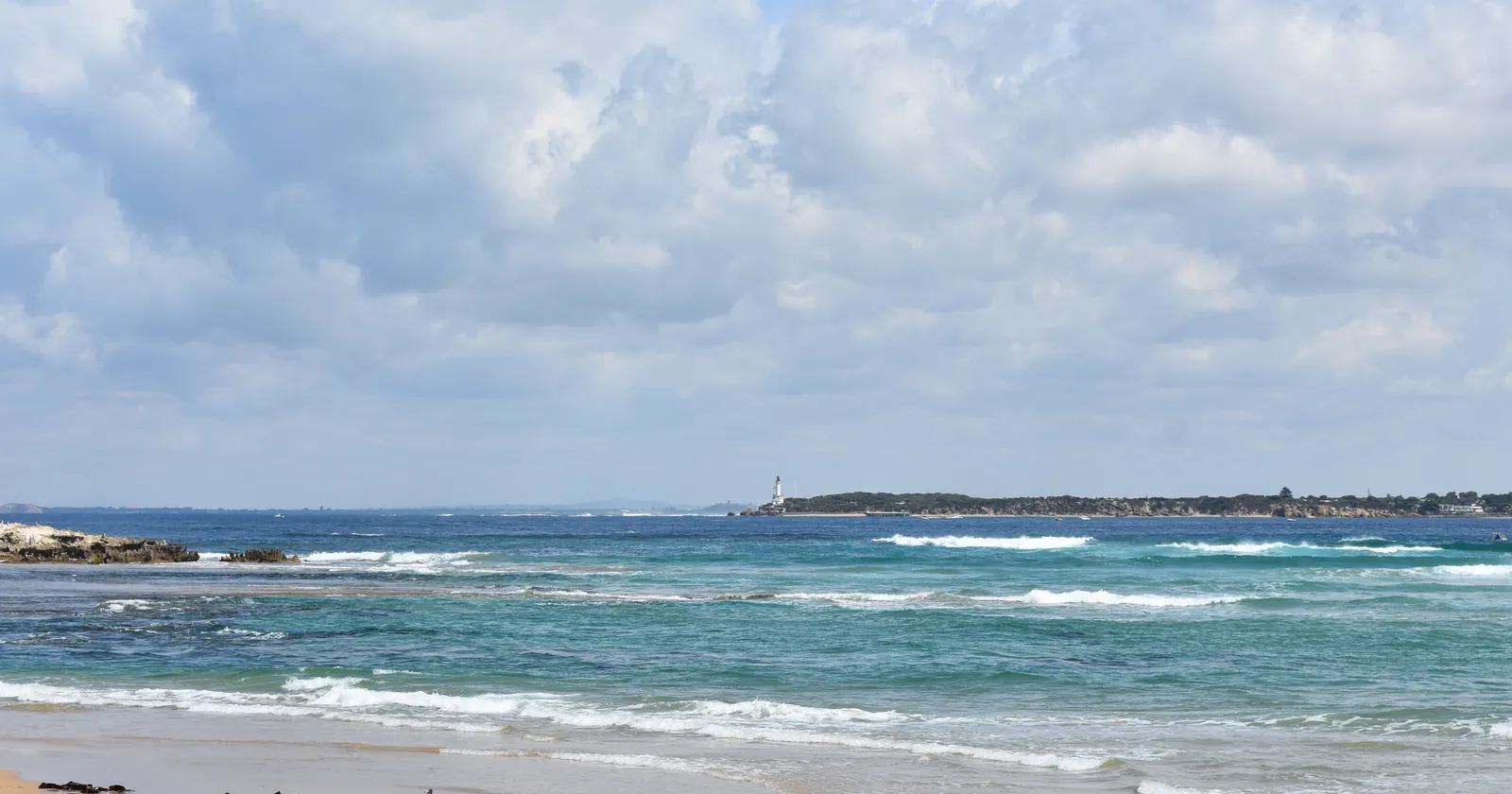
Port Phillip Heads, the entrance to the bay. Mattinbgn (talk · contribs), Wikimedia Commons, CC BY 3.0, cropped.

Key takeaways
- Most Melbourne diving starts on the Mornington Peninsula: shore dives under Rye and Blairgowrie piers, and boats from Rye, Sorrento, Portsea and Queenscliff
- In Port Phillip Heads Marine National Park all fishing, spearfishing and taking of animals, plants, objects or even shells is banned, and the Rip is dived at slack water, which can last minutes or more than half an hour
- The ex-HMAS Canberra lies in about 28 to 30 meters off Barwon Heads; Parks Victoria limits access to divers and snorkellers and sets AS4005.1 as the minimum certification
- NOAA's averages put the sea at about 19.3 °C in February and 12.6 °C in August at the Heads; Parks Victoria warns shore water can fall to 8 °C in winter
- The Alfred runs Victoria's statewide hyperbaric service with an on-call doctor out of hours; we found no digital-nomad visa in German or British government advice and could not read Home Affairs
Melbourne diving: the city dives at the bottom of the bay
The diving that people travel to Melbourne for is not in the city but around the entrance to Port Phillip, the Heads, between Point Lonsdale and Point Nepean, and along the piers inside it. Parks Victoria's divers guide says dive charters run from Sorrento, Portsea and Queenscliff, with boat ramps at Rye, Sorrento and Queenscliff. The Scuba Dive Shop in Rye tells visitors to allow at least two hours from the city centre to its shop and says its guided shore dives cannot be reached by public transport, so plan on a car or a base on the peninsula. The shop's pages also use the name The Scuba Doctor.
One local habit surprises visitors. The Rye shop says that on most Victorian charters you are briefed at the site and then dive with your buddy, independently of everyone else on the boat; if you want a guide in the water, you arrange it separately.
Pier diving at Rye, Blairgowrie and Portsea
Parks Victoria calls Rye Pier an excellent day and night dive site with some of the warmest water in Port Phillip. It is mostly sand around the pier, with small patches of seagrass, and the best conditions come at high tide in calm water. The pylons carry sponge gardens, and in winter giant spider crabs often gather there in huge numbers. Take a dive flag, because there is often boat traffic, and do not jump or dive off the pier, which is banned. Parks Victoria also names Flinders Jetty as one of the best places in the world to see the weedy seadragon, Victoria's marine emblem.
The Scuba Dive Shop lists its favourite guided shore dives: nudibranchs, blue-ringed octopus and spider crabs at Blairgowrie Pier; seahorses, an octopus garden and spider crabs at Rye Pier; and weedy seadragon colonies at Flinders and Portsea piers. It runs its Open Water training dives under Rye or Blairgowrie Pier. Parks Victoria calls Ricketts Point Marine Sanctuary Melbourne's most accessible snorkel spot, and Point Cooke Marine Sanctuary has two heritage-listed shipwrecks for snorkellers.
Port Phillip Heads: Pope's Eye, Portsea Hole and the Rip
Port Phillip Heads Marine National Park covers 3,580 hectares in six pieces: Swan Bay, Mud Islands, Pope's Eye, Point Lonsdale, Point Nepean and Portsea Hole. Parks Victoria's divers guide describes the entrance as often rough, with very strong tides, and puts it in capitals: tides and weather dictate what is safe.
Pope's Eye, about 5 kilometers north-east of Portsea, is the unfinished base of an 1870s fort, a ring under 100 meters across. Inside it is about 1.5 meters deep and outside it drops to about 10. Parks Victoria says the snorkelling inside is good but diving the outside needs more experience. Its guide gives the rule of thumb: on the ebb dive the southern side, on the flood the northern half, and expect the best visibility at the end of the flood. It became the Harold Holt Fisheries Reserve in 1979, and Australasian gannets nest on it; seals, cuttlefish, octopus and gorgonians are on Parks Victoria's list.
Portsea Hole is a depression in the bed of the old Yarra River, a 10-hectare site marked by four lit yellow buoys. Parks Victoria's site page puts it about 500 meters from Portsea Pier and its divers guide about one kilometer north-west, and they give depths of up to 30 meters and 12 to 32 meters. Both agree it is for Advanced Open Water divers, not snorkellers, and the guide calls it strictly a slack-water boat dive.
The Rip is where Parks Victoria says qualified divers find wall diving and challenging drift dives. On the Point Lonsdale side, the Lonsdale Wall runs for about a kilometer along a flooded gorge. Its guide gives Foggy Reef a top at 8 meters dropping to 25, Paradise Wall a start at 10 to 12 meters, Party Point room for technical divers to 45 meters, and the North Wall a top at about 19 meters falling to 60, part of it in the shipping channel. On the Nepean side, Nepean Bay is boat-only, because shore diving is banned at Point Nepean, and its inner east site is just 1 to 5 meters deep, while Nepean Reef is a slack-water dive where the slack can last only minutes or more than 30 minutes.
Slack-water timing is the whole game here. We could not read the Bureau of Meteorology's tidal-stream predictions for the Heads, so take slack times from your charter skipper. The waters around the Heads are a designated hazardous area where life jackets are compulsory on boats, and anchoring in the shipping channel is banned.
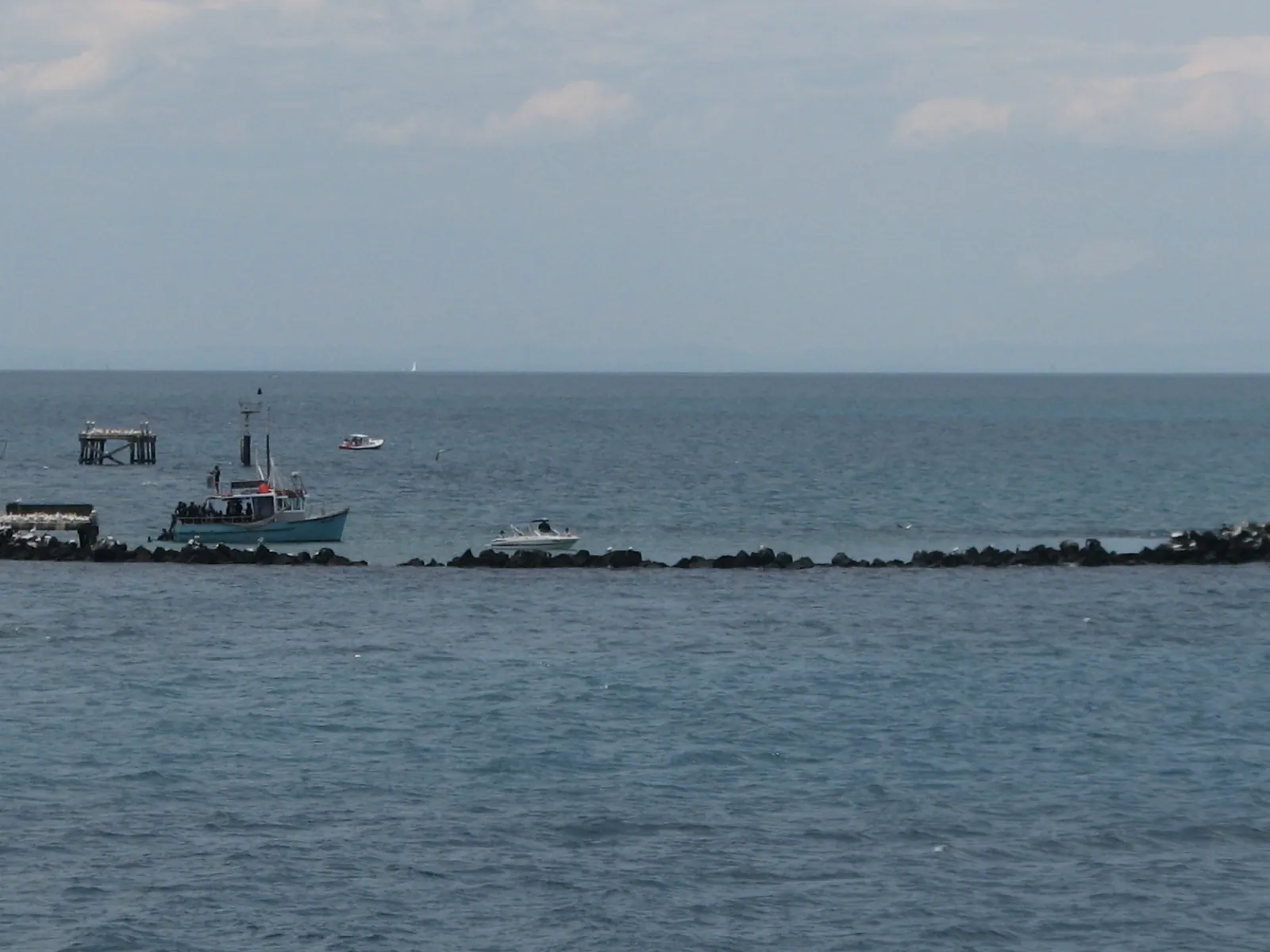
Pope's Eye in Port Phillip. Melburnian, Wikimedia Commons, CC BY 3.0, cropped.

Outside the Heads: the ex-HMAS Canberra and the ships' graveyard
The ex-HMAS Canberra served the Australian Navy from 1981 to 2005 and was scuttled off Barwon Heads in October 2009 as Victoria's first artificial reef made for diving. The frigate is 138.1 meters long, and one Parks Victoria page puts it in about 28 meters of water, another in 30. Divers can swim over the flight deck and through the bridge, engine rooms, galley and accommodation; the Navy removed the gas turbines, rudder, missile launcher, part of the mast and the propeller first. The site lies off Ocean Grove in Bass Strait, about 25 minutes by boat from Queenscliff Harbour.
Access is limited to people diving or snorkelling. Parks Victoria says divers must be trained, certified and experienced in Victorian conditions, with Australian Standard AS4005.1 as the minimum certification, and any boat with divers must fly signals by day and night. Its notices to mariners refer to an exclusion and special-use zone with mooring buoys allocated to authorised vessels. We found no current Parks Victoria page giving a permit or price for private boats, so ask your charter how access works.
Further out lie older wrecks. Heritage Victoria counts sunken submarines, steamships and ferries, and a fleet scuttled in deep graveyard waters, among Victoria's underwater heritage. The Scuba Dive Shop sells a double dive from Sorrento Pier to the Coogee and the J4 submarine in the ships' graveyard, for Advanced Open Water divers. We could not confirm the J4's depth or history from an official source.
The rules: no-take parks and protected wrecks
Victoria has 13 marine national parks and 11 marine sanctuaries, set up in 2002 as highly protected no-take areas. In Port Phillip Heads Marine National Park, fishing from the shore or a boat is banned, and Parks Victoria asks you not to take or damage any animal, plant or object, sea shells included, and to put back anything you move. Spear guns are not allowed in any of Victoria's marine protected areas. You may carry fish caught outside the park, and abalone or rock lobster only if the gear is stowed and you cross the park by the shortest route. Parks Victoria warns of strong penalties under the National Parks Act; rangers and fisheries officers patrol, and fishing offences can be reported on 13 FISH (13 3474). For catch rules outside the parks, check the Victorian Fisheries Authority before you take anything.
Every wreck is protected by law, but Heritage Victoria says you can dive most of them without permission. The exceptions are ten protected zones, six of them in Port Phillip: the SS City of Launceston and the William Salthouse within 250 meters, the Clarence and the Joanna within 100 meters, the Will O' the Wisp within 50 meters, and a half-hectare zone around HMVS Cerberus at Half Moon Bay, Black Rock. Entering, anchoring, fishing or diving in one without a permit is an offence; the zones are on charts such as AUS 143 and AUS 144. You must also report any shipwreck you find.
Parks Victoria asks boat divers to anchor securely, keep gear off the bottom and follow its Check, Clean, Dry routine for boats and gear to stop marine pests spreading.
When to dive: water temperature and visibility
NOAA's satellite averages for 1991 to 2020 show how much the bay swings. In a cell inside Port Phillip, in the open southern bay north of Rye and Dromana, the surface averages 19.8 °C in January, 20.4 °C in February, 15.4 °C in May, 11.9 °C in July, 11.4 °C in August, 14.2 °C in October and 16.3 °C in November. The cell at the Heads, centred just outside the entrance in Bass Strait, moves less: 18.5 °C in January, 19.3 °C in February, 15.7 °C in May, 13.0 °C in July, 12.6 °C in August, 14.0 °C in October and 15.4 °C in November. These are surface figures, and Parks Victoria warns that shore water can drop to 8 °C in winter.
The Scuba Dive Shop says most local divers wear a 7 mm full wetsuit in summer and add a hood, gloves and layers in winter, when some switch to drysuits. In its view, November to March brings the warmest water but plankton can cut visibility, April to July has the clearest water, and after rain it takes about two days for the bay to clear; it gives visibility as anything from 3 to 30 meters. The Alfred's hyperbaric team said in 2018 that summer is a busy time for divers with decompression illness.
The official advice we read doesn't list cyclones as a Melbourne concern. The German Foreign Office places tropical cyclones on the northern coasts of Queensland, the Northern Territory and Western Australia, from November to April, and says heavy rain is possible all year in the other states and bush fires occur in the hot summer months, mostly in the south and east. We could not read the Bureau of Meteorology's own climate pages.
Chamber and emergencies
The Alfred hospital, at 55 Commercial Road in Melbourne, runs Victoria's statewide hyperbaric service and treats decompression illness in three pressurisable rooms, the largest 3.1 by 5.8 meters. Its outpatient hours are Monday to Friday, 7.30 am to 4 pm; out of hours, doctors call (03) 9076 2000 and ask for the hyperbaric doctor on call, and patients who need immediate care go to its Emergency and Trauma Centre. The page does not say "24 hours" in so many words, though a 2018 hospital story describes a diver treated at 3 am. In an emergency call 000. DAN's diving emergency line within Australia is 1800 088 200, toll free and in English only.
What diving in Melbourne costs
The Scuba Dive Shop in Rye publishes its prices online. All figures are in Australian dollars.
| The Scuba Dive Shop, Rye | Price |
|---|---|
| PADI Discover Scuba Diving at a peninsula pier, up to four per guide | A$200 |
| PADI Open Water, two days, pool and pier dives, core gear hire included | from A$890 |
| Double boat dive, Lonsdale Wall and Castle Rock, from Rye Pier, 19 December 2026 | A$190 |
| Double wreck dive, Coogee and J4 submarine, from Sorrento Pier, 22 November 2026 | A$190 |
The Open Water price includes hire of the BCD, regulator, computer, cylinder and weight belt; you bring your own mask, snorkel, boots and fins. Both boat days need Advanced Open Water. The shop's guided shore dives need Open Water and at least five dives in the last twelve months, run in English with up to four divers, and exclude gear hire. The shop says it closes on Tuesdays for most of the year. Read 10 November 2026.
Getting to the dive sites
From the west of Melbourne, Parks Victoria's route to the park runs down the Princes Highway to Geelong and on to Queenscliff; from the east, you drive to Sorrento. Searoad's car ferry between Queenscliff and Sorrento takes 40 minutes, and Parks Victoria puts the Canberra about 25 minutes by boat from Queenscliff Harbour. We could not read Melbourne Airport's site or the public transport timetables to the peninsula, so check those yourself.
Melbourne as a remote-work base
Both the German and British governments say their citizens need a visa or electronic travel authority before travelling to Australia. According to the German Foreign Office, Germans can get a free eVisitor visa, subclass 651, valid for twelve months and allowing any number of stays of up to three months, or an ETA, subclass 601, for A$20 plus agent fees. The UK government says British citizens can usually get an eVisitor at no charge or an ETA through the app, with no application charge but possibly a service fee.
We found no digital-nomad visa in either government's advice. We couldn't access the pages of the Department of Home Affairs, which decides, so we can't confirm from the source whether remote work for an employer abroad is allowed on a visitor visa. Ask Home Affairs, or a registered migration agent, before you plan a long working stay.
If you also kite, Parks Victoria lists St Kilda Harbour in the city as a shared windsport zone for kiteboarding, paddle boarding and windsurfing.
Who Melbourne suits
Melbourne suits a remote worker who wants a large city with cold-water diving at weekends: pier dives with seahorses and seadragons for the newly certified, and tidal walls, a frigate and old wrecks for experienced divers who are happy to plan around slack water. It suits less well anyone without a car, anyone who wants warm water, or divers who expect a guide on every boat dive without asking. For warmer diving in Australia, see our Cairns diving guide; for the other side of the country, our Perth diving guide.
FAQ: Melbourne diving
Where can you dive near Melbourne?
Most diving is at the southern end of Port Phillip, which a Rye dive shop says takes at least two hours to reach from the city: pier dives at Rye, Blairgowrie and Portsea, boat dives at Pope's Eye, Portsea Hole and the walls of the Rip in Port Phillip Heads Marine National Park, and wrecks outside the Heads such as the ex-HMAS Canberra off Barwon Heads.
How cold is the water for diving in Melbourne?
NOAA's 1991 to 2020 averages give about 20.4 °C in February and 11.4 °C in August at the surface inside the bay, and 19.3 °C and 12.6 °C at the Heads. Parks Victoria warns that shore water can fall to 8 °C in winter, and a Rye dive shop says most locals wear a 7 mm wetsuit even in summer.
When is slack water at Port Phillip Heads?
It varies from day to day. Parks Victoria's divers guide says slack at Nepean Reef can last a few minutes or more than half an hour, and sites such as Portsea Hole and the Lonsdale Wall are dived only at slack water, so take timings from your charter skipper.
How deep is the ex-HMAS Canberra?
Parks Victoria gives about 28 meters on one page and 30 meters on another. The frigate was scuttled off Barwon Heads in October 2009, access is limited to divers and snorkellers, and the minimum certification is Australian Standard AS4005.1.
Where is the hyperbaric chamber for Melbourne divers?
At The Alfred hospital on Commercial Road in Melbourne, which runs Victoria's statewide hyperbaric service. For urgent referrals out of hours, the hospital asks callers to ring (03) 9076 2000 and ask for the hyperbaric doctor on call. In an emergency call 000.
Note: Conditions, safety guidance and regulations change. Verify current information with official sources, including the dive operator, Parks Victoria, Heritage Victoria and the relevant government department, before you travel or dive.
Founder of NOMADREEF and a former digital nomad. This guide is sourced from the references below; conditions, prices and rules change, so verify current details, and follow qualified local guidance and safety briefings. About the author · LinkedIn ↗
Sources
- Port Phillip Heads Marine National Park (primary). Parks Victoria, park page and rules, Pope's Eye, Portsea Hole, Point Nepean and the Port Phillip Heads divers guide. Read 10 November 2026.
- Piers and bay sanctuaries (primary). Parks Victoria, Rye Pier and Discover an underwater world, 10 February 2021. Read 10 November 2026.
- Ex-HMAS Canberra (primary). Parks Victoria, recreation reserve, dive site page and Notice to Mariners 134/2020. Read 10 November 2026.
- Wrecks and protected zones (primary). Heritage Victoria, maritime heritage. Read 10 November 2026.
- Sea temperature. NOAA PSL, OISST v2.1 monthly long-term means 1991–2020, cells 38.125°S 144.875°E (inside the bay) and 38.375°S 144.625°E (centred just outside the Heads), computed for this page (primary).
- Weather (primary). German Foreign Office, Australia travel and safety advice. Read 10 November 2026.
- Chamber and emergency numbers (primary). Alfred Health, hyperbaric medicine and news story of 27 December 2018; Divers Alert Network, contact and emergency lines. Read 10 November 2026.
- Dive shop (primary for itself). The Scuba Dive Shop, Rye: guided dives, visitor FAQ, Discover Scuba Diving, Open Water, Lonsdale Wall boat dive and Coogee and J4 wreck dive. Read 10 November 2026.
- Getting there (primary). Searoad Ferries, timetable. Read 10 November 2026.
- Staying and working (primary). German Foreign Office, entry requirements for Australia; UK government, Australia entry requirements. Read 10 November 2026.
- Kitesurfing (primary). Parks Victoria, St Kilda Harbour. Read 10 November 2026.
- Left out. The Bureau of Meteorology's climate figures and tidal-stream predictions for the Heads, which we could not read; the Department of Home Affairs' own visa pages, including whether remote work is allowed on a visitor visa; the Victorian Fisheries Authority's catch rules and the penalty amounts in the National Parks Act; any current permit fee for private boats at the ex-HMAS Canberra; the J4 submarine's depth and history from an official record; an explicit 24-hour statement for The Alfred's chamber; guided shore dive and gear hire prices; airport, public transport and ferry fares; internet speeds.