Perth Diving: Rottnest's No-Fishing Zones, the Omeo Wreck, Busselton Jetty and WA's Abalone and Lobster Rules
 by Yannick Schroth
Nov 10, 2026
12 min read
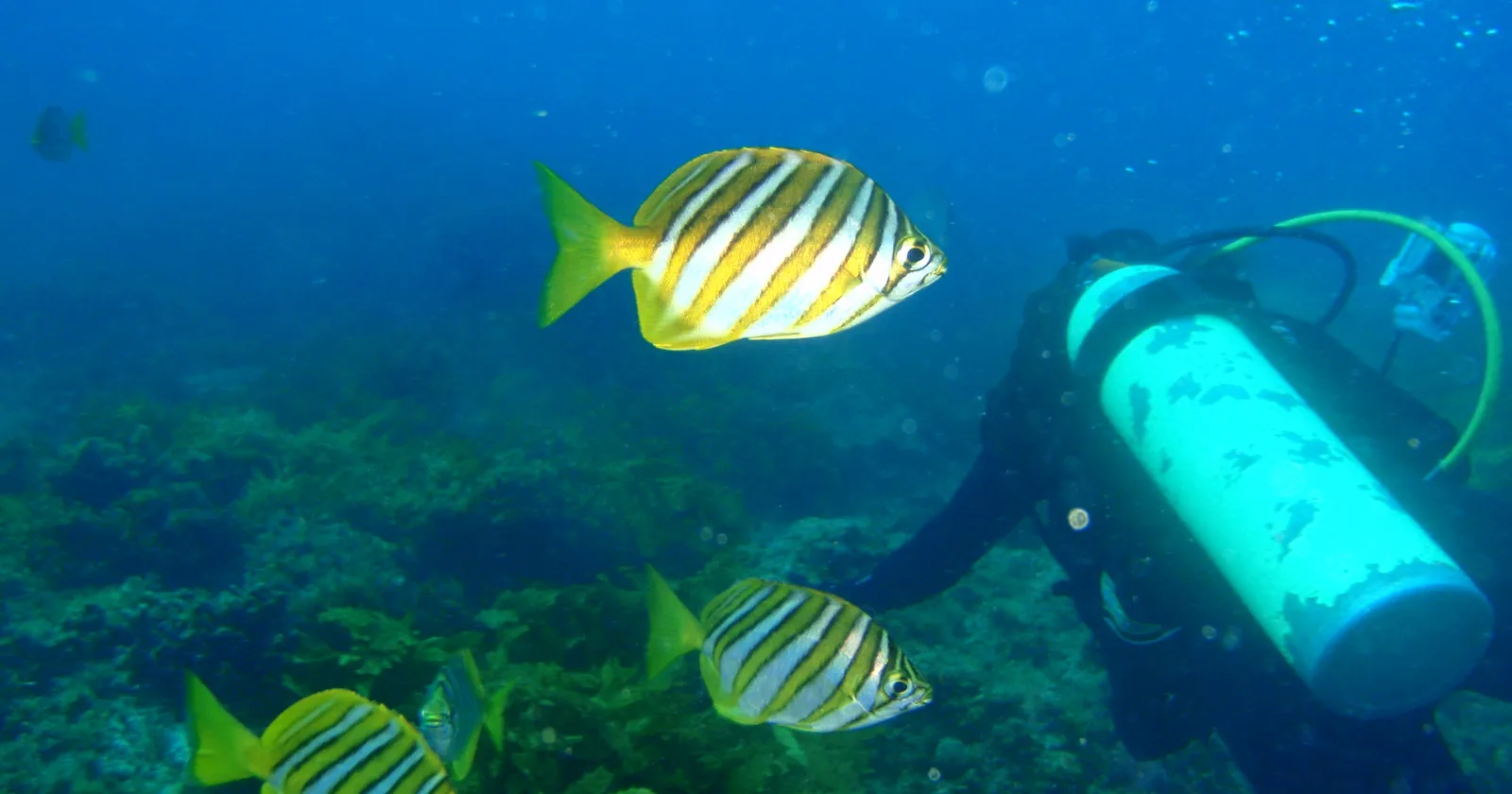
A diver with western footballers at Kingston Reef, Rottnest Island. Peter Southwood, Wikimedia Commons, CC BY-SA 3.0, cropped.

Key takeaways
- Rottnest is dived by day boat from Fremantle; a 2007 fisheries order closes five areas around the island to most fishing and protects shellfish, urchins, corals and seahorses within 800 meters of the shore
- Perth's shore dives include Boyinaboat Reef by Hillarys Boat Harbour, about 6 meters deep, which DBCA calls one of Perth's most popular dive sites, and the Omeo wreck, about 40 meters off Coogee Beach in 2 to 4 meters
- In the Western Zone, which includes Perth and Rottnest, abalone may not be taken with scuba or hookah, only in short licensed sessions; rock lobster divers may use only hand, snare or blunt crook
- NOAA's 1991 to 2020 averages put the sea off Rottnest at 18.9 °C in September and 22.5 °C in March; Geographe Bay, by Busselton, runs about 1 to 2 °C cooler
- Western Australia's diving medicine referral centre is the hyperbaric unit at Fiona Stanley Hospital; the emergency number is 000, and shark sightings go to Water Police on 9442 8600
Perth diving: a city coast, an island and the far south-west
Perth's diving falls into three parts. Along the city coast there are shore dives in two marine parks and on one historic wreck. Off Fremantle lies Rottnest Island, which local boats visit for its limestone reefs and caves. And about 275 kilometers south, by Perth Scuba's count, Geographe Bay has Busselton Jetty and the HMAS Swan, which Perth Scuba also runs trips to. The rules that matter most to a visiting diver are state rules: marine park sanctuary zones run by the Department of Biodiversity, Conservation and Attractions (DBCA), and fishing rules set by the Department of Primary Industries and Regional Development (DPIRD).
Rottnest Island: caves, wrecks and five no-fishing areas
Most Rottnest diving is done from day boats. Perth Scuba's boat leaves Fremantle at 8:00 and returns around 15:30 to 16:00, and the shop describes the island's soft limestone as cut into deep crevices, caverns and large swim-throughs with soft corals. Scuba Obsession, which sails from East Fremantle, names two of its Rottnest sites, Crystal Palace and The Shark Cave. Perth Scuba also says autumn brings light winds and the chance to see grey nurse sharks at the west end, while in winter the island's south side gives shelter. We couldn't find official depth figures for Rottnest's sites.
The island has its own fishing rules. A 2007 order under Western Australia's fisheries law bans all fishing in five protected areas: West End, Green Island, Armstrong, Parker Point and Kingston Reef in Thomson Bay. A few exceptions allow line fishing from the shore or a jetty in some of them, and trolling for pelagic fish at the west end. DPIRD's 2026 lobster guide lists the same five areas as closed. Within 800 meters of Rottnest's shore the order also bans nets and protects live shellfish other than abalone, squid, cuttlefish and octopus, as well as sea urchins, starfish, sea cucumbers, corals, anemones, seahorses, sea dragons and pipefish. Spearfishing is banned in a defined stretch between Point Clune and Salmon Point.
Rottnest charges an admission fee to visitors, and Perth Scuba says this covers the marine reserve too; it includes the waters fee in its trip price and says landing on the island costs extra. We couldn't access the Rottnest Island Authority's own pages, so its mooring, anchoring and zone-map details are missing here.
The Western Australian Museum's shipwreck database lists several wrecks at Rottnest: the steamer Macedon, lost on Transit Reef in 1883; the iron barque Denton Holme, wrecked in 1890 between Transit Reef and Kingston Spit with 1,275 tons of iron pipes for Perth's waterworks; the Uribes, lost in 1942 at Phillip Rock in Thomson Bay; and the Japanese fishing boat Kiryo Maru at Cathedral Rocks.
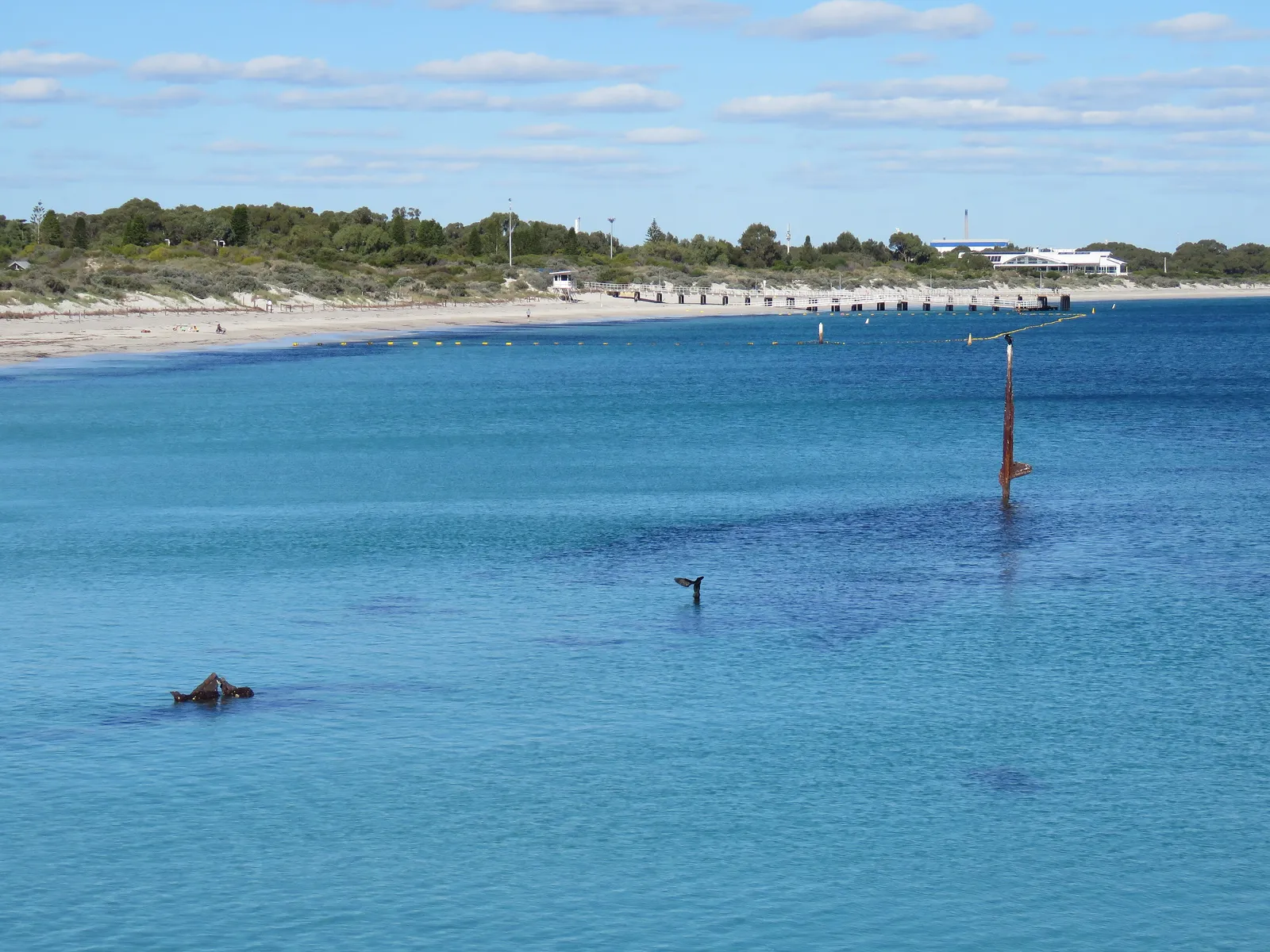
The site of the Omeo wreck off Coogee Beach, July 2024. Calistemon, Wikimedia Commons, CC BY-SA 4.0, cropped.

Perth's shore dives: Boyinaboat, Mettams Pool and the Omeo
Marmion Marine Park, which DBCA places 14 kilometers north-west of Perth, is free to enter, and DBCA says the diving there is good all year, depending on the day's weather. Its main dive site is Boyinaboat Reef, a sanctuary zone in about six meters of water, 100 meters from the Hillarys Boat Harbour sea wall, which DBCA calls one of the most popular dive sites in Perth. Part of the water around it is closed to all vessels. A 400-meter dive and snorkel trail with 20 information plinths on the seafloor runs through the park. DBCA says a boat is needed for the park's other reefs, and it lists Cow Rocks, two small reefs with caves, ledges and swim-throughs, Wanneroo Reef, Wreck Rock in eight meters and the wreck of the Centaur among its sites. Perth Scuba runs guided shore dives most mornings and says mornings are best in Perth, with lower swell and wind and better visibility.
Mettams Pool, in the same park, is a snorkelling spot rather than a scuba site: a natural lagoon less than two meters deep. DBCA warns that the surge can be strong on the outer edge of the reef. In Marmion, spearfishing is banned within 1,800 meters of the shore and spearfishing on scuba is banned everywhere. DBCA asks divers to tow a dive flag and to keep clear of boat traffic.
South of Fremantle, the Omeo lies about 40 meters off Coogee Beach in two to four meters of water. The museum's record describes the 605-ton iron steamer, built in Newcastle, England, in 1858, drifting ashore in September 1905, and calls it the premier shore-based shipwreck dive in the Perth area. Since February 2017 the wreck has been the centre of the Coogee Maritime Trail, which adds underwater sculptures and artificial reef structures. DPIRD closes a defined area around the wreck to fishing. We could not open the City of Cockburn's trail page, so check it for current rules on boats near the trail.
Shoalwater Islands and the Saxon Ranger
Shoalwater Islands Marine Park, off Rockingham, is the third of Perth's metropolitan marine parks and also free to enter. Its visitor guide, current at November 2023, names Cape Peron and The Sisters as popular dive sites and puts the Saxon Ranger dive wreck in 18 meters of water in Warnbro Sound. Diving the wreck needs a permit, sold at the Rockingham Visitor Centre. Boats must keep to 8 knots in the wreck's restricted area and may not anchor on or pass over it, and fishing there is banned.
The park has three sanctuary zones, marked with yellow buoys that stand more than a meter above the water. Diving is allowed in them and fishing is not, and the buoys are not moorings. Across the whole park, spearfishing on scuba or hookah is banned, and sea urchins and all shellfish are protected except mussels, abalone in season, squid, cuttlefish and octopus. Penguin Island, reached by ferry from Mersey Point, closes from early June to mid-October; in the open months, ferries run hourly.
Further south: Busselton Jetty and the HMAS Swan
Busselton Jetty reaches about two kilometers into Geographe Bay, according to Perth Scuba, which gives eight meters as the maximum depth under it. DBCA describes large schools of yellowtail, herring and pike around the piles, and wobbegongs, rays and occasionally seadragons in the weed and seagrass. The jetty's underwater observatory opened in 2002, and the jetty is run by a non-profit, the Busselton Jetty Environment and Conservation Association. DPIRD closes a defined area around the observatory to all fishing. We couldn't access the jetty's own website for its current rules for independent divers, so check them before you go.
The ex-HMAS Swan, a navy destroyer escort, was scuttled off Dunsborough in December 1997 to make an artificial reef and dive site, after oil, lead and wiring were stripped out, according to the Western Australian Museum. DBCA puts the wreck in 30 meters, its tower about eight meters below the surface and its upper deck at about 15 meters, and warns of currents. It lies in the Eagle Bay Sanctuary Zone, and DPIRD bans fishing within 200 meters. A permit is needed. The permit sales page says the wreck belongs to the Geographe Bay Artificial Reef Society, which sells day, month and year passes, gives a depth range of 9 to 32 meters and calls mid-September to mid-May the best season; we could not find the permit prices.
Abalone, rock lobster and what divers may take
Everything in a sanctuary zone is protected: DBCA's rules ban all fishing and collecting there. Outside them, two licensed fisheries matter to divers, and each licence costs A$50 for 12 months, with a 10% discount for more than one. Licences from other Australian states do not count in Western Australia, and DPIRD says you may not fish until you have the receipt.
Abalone near Perth is tightly limited. The Western Zone runs from Busselton Jetty to the Greenough River mouth and includes Rottnest, Carnac, Garden and Penguin Islands. In 2025/26 the season was set for four Saturday mornings from 7:00 to 8:00, with a bag of 15 Roe's abalone per session and a minimum size of 60 mm. The guide is plain: recreational fishers must not use scuba or hookah to take abalone in the Western Zone. Abalone may not be taken in sanctuary zones, and around Cottesloe no abalone or other shellfish may be taken at all. At the Watermans Reef Observation Area, all reef life is protected. In March 2026 DPIRD cancelled a replacement session for safety and said no other day would be scheduled that season. The 2026/27 dates were not published when we checked.
Rock lobster is open all year, but south of North West Cape nobody may dive for it at night: from 7:30 pm to 4:30 am between 15 October and 31 March, and from 6:00 pm to 6:00 am for the rest of the year. Divers may only catch lobster by hand, with a hand-held snare or with a blunt crook; spears and nets are illegal. A western rock lobster must measure at least 76 mm across the carapace, the daily bag is eight, females carrying eggs are protected, and each lobster you keep must be tail-clipped within five minutes. Recreational catch may not be sold.
Sharks: what the WA government tells divers
Western Australia's official shark information service is SharkSmart, run by the state government. Its Shark Monitoring Network uses acoustic receivers across the Perth metropolitan area, Geographe Bay and other spots from Yallingup to Esperance to send near real-time alerts when a tagged shark swims past. Tagging focuses on white and bull sharks and also covers tiger sharks. The SharkSmart WA app shows current alerts and warnings. The government asks people to report sightings to Water Police on 9442 8600, to dive with a buddy, to keep away from large schools of fish and seals, and, when spearfishing, not to carry dead or bleeding fish. Its A$200 rebate on approved shark deterrents is for Western Australian residents only.
When to dive Perth: water temperature and weather
Perth's sea changes little through the year. NOAA's satellite averages for 1991 to 2020, which we computed for this page, put the surface off Rottnest at 21.7 °C in January, 22.5 °C in March, 21.2 °C in June, 18.9 °C in September and 20.8 °C in December. The cell off Rockingham runs up to about half a degree cooler, and Geographe Bay, by Busselton and Dunsborough, is cooler again: 21.4 °C in March and 17.0 °C in September. Perth Scuba speaks of 24-degree water in summer, warmer than these long-term averages; these are surface figures and say nothing about the water at depth.
DBCA warns that conditions around Rockingham can change suddenly with strong summer breezes and winter storms. The UK and German foreign offices both put Australia's tropical cyclone season from November to April; the German one names the northern coasts of Queensland, the Northern Territory and Western Australia. In the Bureau of Meteorology's cyclone track database, 17 tracked systems came within 200 kilometers of Perth between 1907 and April 2026, all between January and April; the most recent was Seroja in April 2021. Humpback whales pass Hillarys at the peak of their migration from September to November, DBCA says.
Chamber and emergencies
The hyperbaric unit at Fiona Stanley Hospital in Murdoch is Western Australia's state referral centre for diving and hyperbaric medicine, according to a case report by its doctors. The University of Western Australia's diving safety page lists the unit's 24-hour number as 08 6152 2222 and a daytime line, 08 6152 5222, from 8:00 to 15:30. We could not open the hospital's own page; search results quote it as offering a 24-hour on-call service every day of the year, so treat the round-the-clock service as likely but confirm it. In any emergency call 000. DBCA advises downloading the Emergency+ app, because without mobile coverage you cannot call 000 but the app will still show your GPS position, and carrying a personal locator beacon.
What diving in Perth costs
Prices from the operators' own pages, read on 10 November 2026, in Australian dollars.
| Trip or course | Price |
|---|---|
| Perth Scuba: Rottnest double boat dive, lunch included | from A$195 |
| Perth Scuba: Rottnest deep double dive, 30 meters or more, Advanced card | from A$195 |
| Perth Scuba: temporary fuel surcharge on Rottnest trips | A$15 |
| Scuba Obsession: Rottnest double dive, two cylinders, from East Fremantle | from A$185 |
| Perth Scuba: two guided Perth shore dives with gear | from A$249 |
| Perth Scuba: HMAS Swan double dive from Port Geographe | from A$250 |
| Perth Scuba: Busselton Jetty dive | from A$95 |
| Perth Scuba: Open Water course, three days, two beach and two Rottnest dives | from A$699 |
On Perth Scuba's dive-and-snorkel trip one cylinder is supplied and divers bring or hire a second; the shop hires a 12-liter steel cylinder with fill, a regulator with depth gauge or a BCD for A$20 each per day. Scuba Obsession says it takes no more than 12 divers.
Getting to Perth's dive sites
Rottnest Express runs ferries to Rottnest from Fremantle, at B-Shed or Northport, and from Barrack Street Jetty in the city, near Elizabeth Quay train station. A same-day adult return from Fremantle costs A$87.50, of which A$21.50 is the island's admission fee; from Perth it costs A$135.50. Those fares are valid until 30 June 2027. Dive boats to Rottnest leave from Fremantle, Marmion Marine Park lies 14 kilometers north-west of Perth, and Busselton is about 275 kilometers south. We could not open Perth Airport's or Transperth's own pages, so check them for the airport train and bus links.
Perth as a remote-work base
According to the German Foreign Office, Germans can get the eVisitor (subclass 651) online for free; it is valid for 12 months and allows any number of stays of up to three months each. The ETA (subclass 601) gives the same entry rights and costs A$20 plus provider fees. The UK government says British citizens can usually get either an eVisitor, with no charge, or an ETA through the app, which may carry a service fee. Your passport must be valid for the whole stay. Many young Germans come on working holiday visas, the German Foreign Office notes, and it warns that these currently take longer to process. We could not read the Department of Home Affairs' own pages, so ask it directly whether working remotely for an employer abroad fits your visa's conditions.
Who Perth suits
Perth suits a diver who wants a big city with easy shore dives close to town, a reliable day boat to Rottnest's caves, and surface water that stays between about 19 and 22.5 °C all year off Rottnest. It suits less well anyone who wants tropical reefs, warm water in winter, or to take abalone on scuba. For tropical diving in Australia, see our Cairns diving guide.
FAQ: Perth diving
Can you shore dive in Perth?
Yes. Boyinaboat Reef, about six meters deep and 100 meters from the Hillarys Boat Harbour sea wall, and the Omeo wreck, about 40 meters off Coogee Beach in two to four meters, are two shore dives near the city; DBCA calls Boyinaboat one of the most popular dive sites in Perth. Mettams Pool is a shallow lagoon better suited to snorkelling.
How cold is the water in Perth?
NOAA's 1991 to 2020 averages put the surface off Rottnest at about 18.9 °C in September, the coldest month, and 22.5 °C in March, the warmest. Geographe Bay near Busselton is cooler, about 17.0 °C in September.
Can divers take abalone or rock lobster near Perth?
Only with a licence. In the Western Zone, which includes Perth and Rottnest, abalone may not be taken with scuba or hookah and only in a few one-hour sessions. Rock lobster may be taken by hand, hand-held snare or blunt crook, but not in sanctuary zones or at night in the banned hours.
Do I need a permit to dive the HMAS Swan or the Saxon Ranger?
Yes. The HMAS Swan needs a permit, with the money going to the Geographe Bay Artificial Reef Society; DBCA says to contact the visitor centre or a local dive shop. The Saxon Ranger in Warnbro Sound needs a permit from the Rockingham Visitor Centre.
Where is the nearest hyperbaric chamber to Perth?
At Fiona Stanley Hospital in Murdoch, the state referral centre for diving medicine. The University of Western Australia lists its 24-hour number as 08 6152 2222. In an emergency, call 000 first.
Note: Conditions, safety guidance and regulations change. Verify current information with official sources, including the dive operator, DBCA, DPIRD and the Rottnest Island Authority, before you travel or dive.
Founder of NOMADREEF and a former digital nomad. This guide is sourced from the references below; conditions, prices and rules change, so verify current details, and follow qualified local guidance and safety briefings. About the author · LinkedIn ↗
Sources
- Marine parks and dive sites (primary). DBCA Explore Parks WA: Marmion Marine Park, Boyinaboat Reef, Mettams Pool, Marmion zoning map, Shoalwater Islands Marine Park visitor guide, Zoning in Western Australia's marine parks, Ngari Capes Marine Park, Busselton Jetty and HMAS Swan wreck. Read 10 November 2026.
- Wrecks (primary). Western Australian Museum shipwreck database: Omeo, Macedon, Denton Holme, Uribes, Kiryo Maru; Coogee Maritime Trail; ex-HMAS Swan; HMAS Swan dive permits. Read 10 November 2026.
- Fishing rules (primary). DPIRD: abalone guide 2025/26, rock lobster guide 2026, licences and fees, licence application form, West Coast closed areas, abalone summary, 13 December 2025 and session cancellation, 12 March 2026; Prohibition on Fishing (Rottnest Island) Order 2007. Read 10 November 2026.
- Sharks (primary). Government of Western Australia, SharkSmart: home, Shark Monitoring Network, staying safe and safety tips. Read 10 November 2026.
- Sea temperature and storms. NOAA PSL, OISST v2.1 monthly long-term means 1991–2020, cells 32.125°S 115.375°E, 32.375°S 115.625°E and 33.625°S 115.375°E, computed for this page (primary); Bureau of Meteorology, tropical cyclone track database (file IDCKMSTM0S on the Bureau’s anonymous FTP server), 1907–2026, computed for this page (primary); UK FCDO, Australia safety and security; German Foreign Office, Australia travel advice. Read 10 November 2026.
- Chamber and emergencies. Case report by the Department of Hyperbaric Medicine, Fiona Stanley Hospital, Diving and Hyperbaric Medicine; University of Western Australia, diving and boating safety (secondary); UK FCDO, getting help in Australia (primary). Read 10 November 2026.
- Prices (each primary for itself). Perth Scuba: Rottnest dive, Rottnest dive and snorkel, Rottnest deep dive, Open Water, shore dives, HMAS Swan, Busselton Jetty and gear hire; Scuba Obsession, Rottnest double dive. Read 10 November 2026.
- Getting there and staying. Rottnest Express, fares and locations (primary for its own service); German Foreign Office, entry requirements; UK FCDO, entry requirements. Read 10 November 2026.
- Left out. The Rottnest Island Authority's own rules and zone maps, Busselton Jetty's dive access rules, and the City of Cockburn's trail rules, whose sites blocked our requests; the Fiona Stanley Hospital page and the Department of Home Affairs visa pages, which we could not open; Bureau of Meteorology climate averages for Perth; permit prices for the HMAS Swan and the Saxon Ranger; the 2026/27 abalone dates; depths at Rottnest's sites; and Perth Airport and Transperth details.