Brisbane Diving: The Tangalooma Wrecks, Flinders Reef, Point Lookout's Mantas and Moreton Bay's Grey Nurse Shark Rules
 by Yannick Schroth
Nov 10, 2026
11 min read
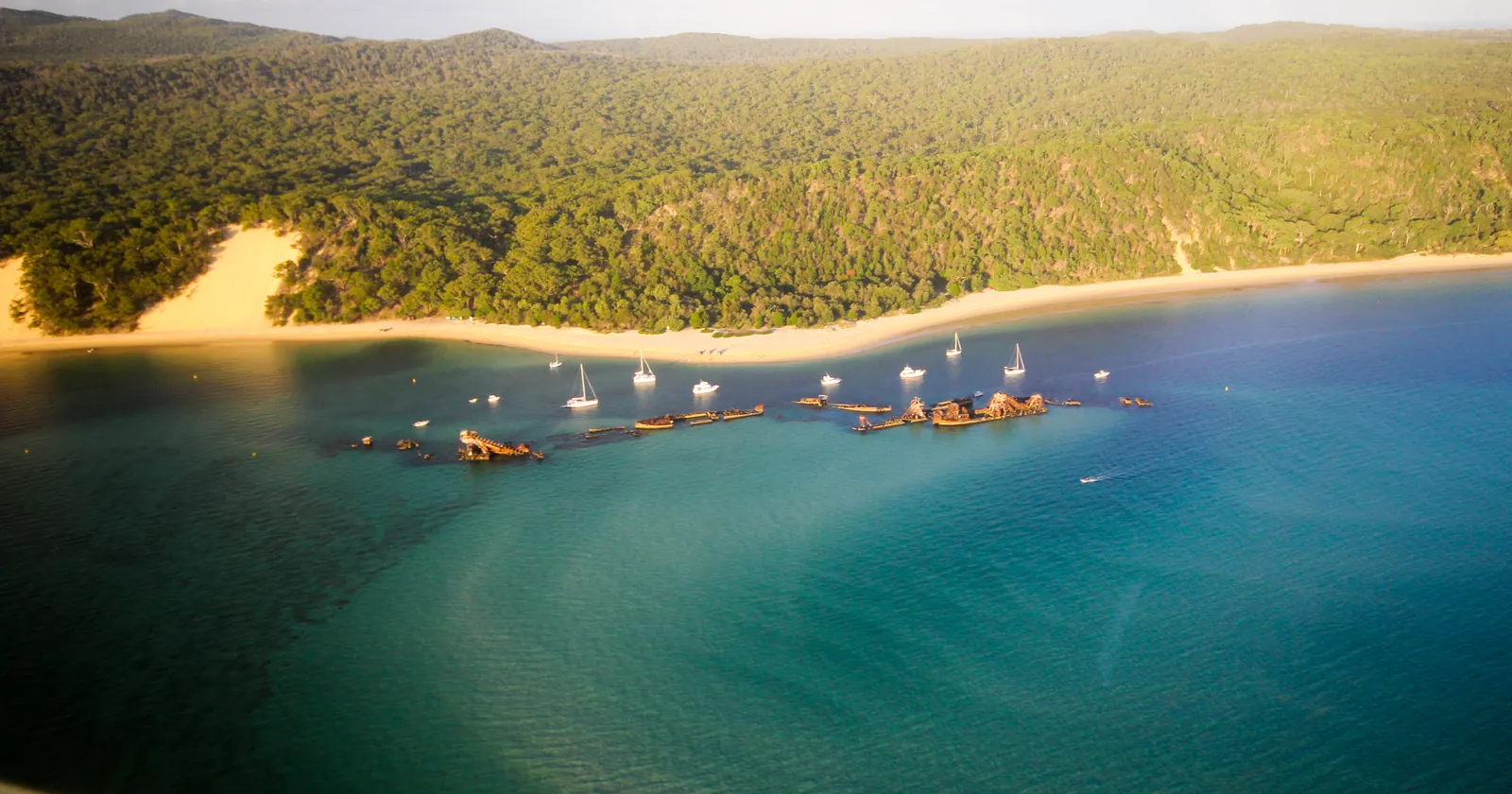
The Tangalooma Wrecks off Moreton Island. Ishara Udawela, Wikimedia Commons, CC BY-SA 4.0, cropped.

Key takeaways
- Brisbane's dive sites sit in the Moreton Bay Marine Park, reached by passenger ferry to Moreton Island, by ferry to North Stradbroke Island, or on day boats from the bayside
- Flinders Reef, Flat Rock and the Cherubs Cave and Henderson Rock area are marine national park (green) zones, and anchoring is banned on Flinders Reef and Flat Rock
- In the grey nurse shark areas at Cherubs Cave, Henderson Rock and Flat Rock, nobody may dive between 6 p.m. and 6 a.m. or touch, feed or chase the sharks, and taking fish there is banned apart from a narrow licence exception
- NOAA's 1991 to 2020 averages off Point Lookout give 26.7 °C in February and 21.2 °C in August; the UK government gives Queensland's cyclone season as November to April
- Australia has no dedicated digital-nomad visa, according to migration agents and guides; Germans and Britons can usually visit on a free eVisitor
Brisbane diving: a city on a marine park
Most Brisbane diving is out in Moreton Bay and off the eastern sides of Moreton Island and North Stradbroke Island. All of it falls inside the Moreton Bay Marine Park, governed since 1 September 2019 by the Marine Parks (Moreton Bay) Zoning Plan 2019. In practice there are three ways in: a ferry to Moreton Island for the Tangalooma Wrecks, a ferry to North Stradbroke Island to dive with the shop at Point Lookout, or a seat on a Brisbane day boat that runs out to Flinders Reef, Cherubs Cave and the Curtin Artificial Reef.
Brisbane Scuba, which runs its boat from Manly, says it runs two- and three-dive day trips around the region every weekend and often during the week, from the Gold Coast in the south to Bribie Island in the north. Not every Brisbane school dives the bay: Brisbane Dive Academy's local day trips go to the ex-HMAS Brisbane, Cook Island and a Tweed River shore dive, all outside Moreton Bay.
Moreton Island: the Tangalooma Wrecks and the east-side caves
The Tangalooma Wrecks lie off Moreton Island's western beach, just north of Tangalooma Island Resort. The resort says the Queensland Government scuttled 15 vessels there between 1963 and 1984 as a safe anchorage for recreational boats: five in 1963, five in the 1970s and five in the 1980s. It puts the wrecks 15 to 20 minutes' walk up the beach, and it warns that a strong current runs between the wrecks and the shore when the tide is running, that the beach is unpatrolled, and that many boats and jet skis pass between the wrecks and the beach. We could not read a government source on the wrecks' history. Adventure Moreton Island sells dives on the wrecks to introductory and certified divers from age 12, with the ferry from Brisbane included.
The zoning plan names a go-slow area for turtles and dugongs called Tangalooma along the island's western side, where no vessel may run in planing mode or at a speed likely to strike a turtle or dugong.
Inside the bay, the Curtin Artificial Reef was built by a dive club. The Underwater Research Group of Queensland says it began on 12 August 1968 and that the reef now holds more than 25 vessels plus concrete pipes and pontoons, among them the tug Melbourne, the whale chasers Kos I and Kos II, the car ferry Point Lookout and a Brisbane tram. The club warns that going inside the vessels is dangerous and advises divers not to. The zoning plan lets the state ban scuba diving, snorkelling, fishing or anchoring at an artificial reef by regulatory notice; we could not check whether any notice applies at Curtin.
On Moreton Island's eastern side, the zoning plan makes the stretch from 27°06.480' to 27°10.130' south a green zone called Cherubs Cave and Henderson Rock. Brisbane Scuba describes Cherub's Cave as a round cave about 20 by 15 meters with six exits, and says grey nurse sharks gather in its gutters over winter.
Flinders Reef and the Cementco
Flinders Reef lies a few kilometers north-east of the northern tip of Moreton Island, going by the zoning plan's coordinates. The plan draws a 500-meter green zone around it, inside a 2-kilometer conservation park zone, and makes the same 500-meter circle a no-anchoring area to protect its coral. Brisbane Scuba calls it the closest true coral reef to Brisbane and says it holds more than a hundred coral species, more than 175 species of reef fish and a cleaning station where green turtles rest. It pairs the reef with the Cementco, which it describes as a heavy equipment barge sunk in 1984 about 400 meters north-east of the reef. No official source we could read gives depths or visibility for Flinders Reef, Cherubs Cave, Curtin or Tangalooma.
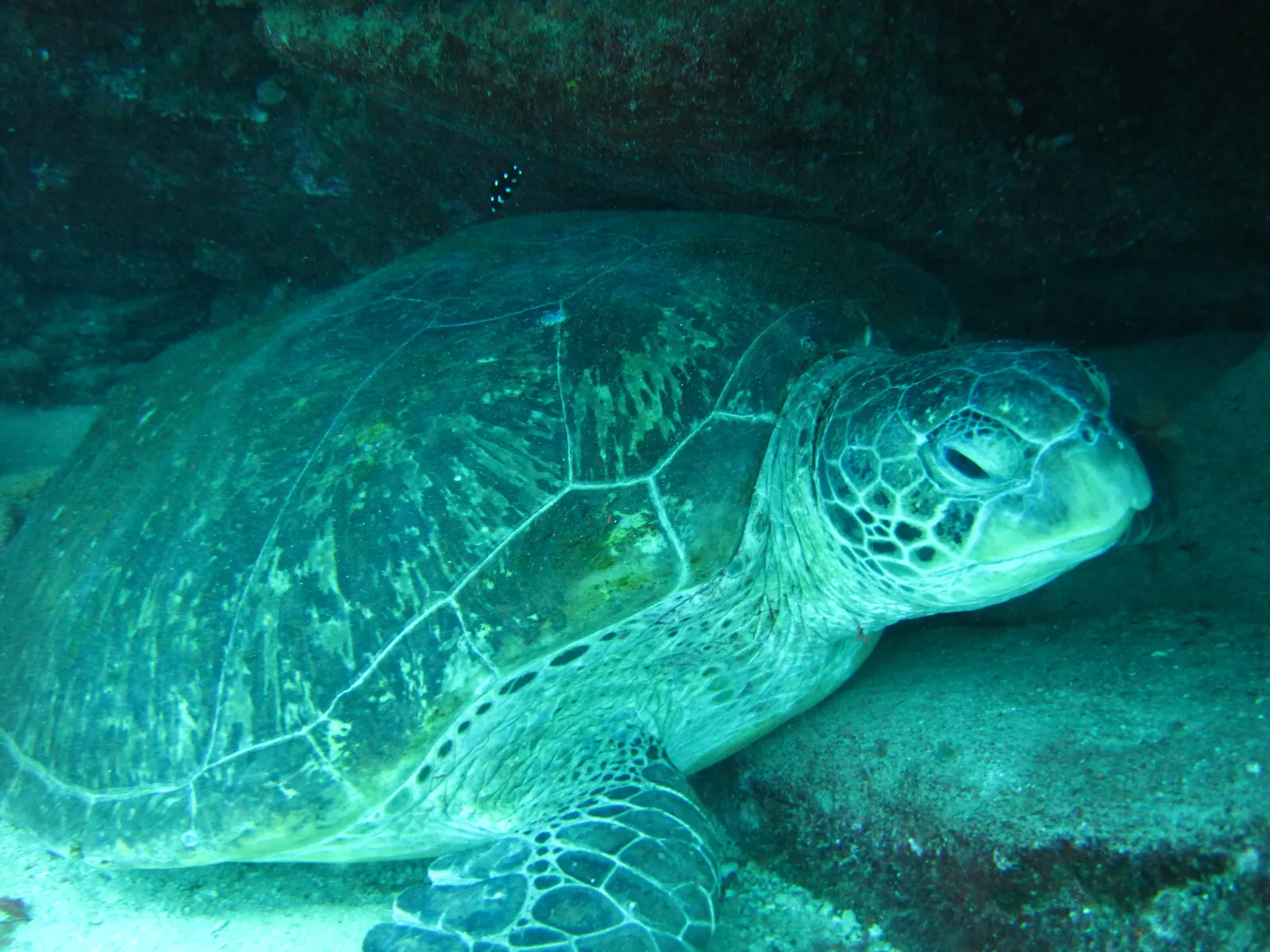
A green turtle at Flinders Reef. Xplore Dive, Wikimedia Commons, CC BY 2.0, cropped.

Point Lookout: Manta Bommie and Flat Rock
Point Lookout on North Stradbroke Island is the base for Manta Lodge and Scuba Centre, which says it has more than fifteen sites within a 10 to 15 minute boat ride. Its own site list gives these depths: Manta Bommie 5 to 15 meters, where it says manta rays visit cleaning stations from October to April; Shag Rock 5 to 18 meters, 800 meters off Home Beach; Turtle Cave 10 to 30 meters on the north-west side of Flat Rock; Shark Alley 18 to 26 meters, which it dives mainly in winter for grey nurse sharks; and a shore dive at Amity Point, 5 to 15 meters. It sums up the year as manta rays and leopard sharks in summer, grey nurse sharks and humpback whales in winter.
Flat Rock carries three layers of protection in the zoning plan: a green zone of 1.2 kilometers' radius, a grey nurse shark area of the same size, and a ban on anchoring. Manta Lodge runs trips Friday to Tuesday, not on Wednesdays, and takes only certified divers who have dived in the last 12 months; others must do a refresher first.
Marine park rules: green zones and what they allow
In a marine national park (green) zone, the zoning plan allows anyone, without a permit, to carry out a low-impact activity that involves no fishing or collecting, and to pass through by boat with fishing gear stowed or secured. The plan defines a low-impact activity as one likely to have a negligible impact on the park. Fishing and collecting are not on that list. Anchoring in a no-anchoring area carries a fine of up to 10 penalty units. Spearfishing, where the park allows it, must be done without a powerhead, firearm or light, and without any breathing apparatus other than a snorkel. We couldn't access the park service's own pages and maps, so check the zone of any site you plan to dive on the Queensland Government's zoning maps before you go.
Grey nurse sharks and manta rays: what the law says
The zoning plan sets three grey nurse shark areas, each with a radius of 1.2 kilometers: Cherubs Cave, Henderson Rock and Flat Rock. Inside them nobody may dive between 6 p.m. and 6 a.m. without a reasonable excuse. Nobody may touch or feed a grey nurse shark, try to trap one, block a cave entrance or gutter, chase a shark or interrupt its swimming, or use a scooter, horn or shark-repelling device; scuba gear itself is allowed. These offences carry up to 100 penalty units. A private group may have no more than ten divers in the water at once. Commercial operators must brief divers on the rules before they enter the water and keep to twelve in the water per group, with any diver beyond ten being an instructor or certified assistant, unless the state authorises more. The state can also close an area by gazette notice, for example when a female shark has recently given birth or is about to.
Queensland's fisheries declaration names the same three spots as grey nurse shark protection areas where nobody may take any fish, apart from holders of two kinds of fisheries licence working by hand or with scoop or seine nets between 6 a.m. and 6 p.m. It also lists manta rays as regulated fish and sets no size or bag limit for them. We read that as no take at all, but that is our reading, not a line in the law; ask Fisheries Queensland if it matters to you.
When to dive Brisbane: water temperature and cyclones
NOAA's satellite averages for 1991 to 2020, taken from the ocean cell at 27.375° S 153.625° E just east of Point Lookout, give 26.4 °C in January, 26.7 °C in February, 25.2 °C in April, 22.6 °C in June, 21.2 °C in August, 22.7 °C in October and 25.3 °C in December. The cell off Flinders Reef reads within a few tenths of a degree in every month. These are surface figures; water at depth can be colder.
The UK government says Queensland is among the parts of Australia affected by tropical cyclones and that the season normally runs from November to April. The German Foreign Office says cyclones come especially to the northern coasts of Queensland, the Northern Territory and Western Australia in those months, and that heavy rain is possible year-round in the other states. Systems do reach Brisbane: by our count from the Bureau of Meteorology's cyclone track file, 15 tracked systems since 1907 have passed within 100 kilometers of the city centre, in January, February, March or May, the latest Debbie in March 2017 and Alfred in March 2025. A track passing nearby does not mean cyclone-force wind in the city, but plan summer trips with flexible dates.
Chamber and emergencies
The Hyperbaric Medicine Service at the Royal Brisbane and Women's Hospital treats decompression illness for the whole state. The hospital says it runs a 24-hour on-call service for Queensland's recreational and commercial dive industries and a 24/7 service to its emergency department, with a large multiplace chamber and a single-person one. It is one of two publicly funded hyperbaric units in Queensland. The unit is on the ground floor of the Ned Hanlon Building, phone (07) 3646 0241; doctors reach the on-call specialist through the hospital switchboard on 07 3646 8111. In an emergency call 000. DAN's diving emergency line within Australia is 1800 088 200, toll free and in English.
What diving from Brisbane costs
Prices from the operators' own pages, read on 10 November 2026, in Australian dollars.
| Operator and item | Price |
|---|---|
| Manta Lodge, double boat dive at Point Lookout, tanks and weights included | from A$225 |
| Manta Lodge, double dive in the Cherubs Cave area | from A$250 |
| Adventure Moreton Island, scuba tour at the Tangalooma Wrecks with return ferry and gear | A$309 |
| Brisbane Scuba, Open Water course with two shore and two boat dives | from A$995 |
| Brisbane Dive Academy, ex-HMAS Brisbane day trip | A$249 |
Manta Lodge charges A$225 a diver for cancellations inside 72 hours if it cannot resell the place. Adventure Moreton Island takes a A$50 card pre-authorisation on arrival. We couldn't find Brisbane Scuba's day-trip prices, which sit in a booking calendar.
Getting to the islands
Tangalooma's passenger ferry leaves Holt Street Wharf in Pinkenba and takes 75 minutes each way, four times a day in each direction. Departures from Brisbane are at 7:30, 10:00, 12:30 and 17:30; return boats leave Tangalooma at 9:30, 14:30, 16:00 and, last, after the evening dolphin feeding, at about 19:30 to 20:30 from 15 November to 31 March and 19:00 to 20:00 the rest of the year. Check-in is at least an hour before departure and booking is required. A return transfer costs A$104 for adult resort guests, including a A$10 fuel surcharge; day visitors book a day cruise instead. It carries no cars.
For North Stradbroke, ferries leave Toondah Harbour at the end of Middle Street in Cleveland for Dunwich. Manta Lodge books its divers on the Gold Cats Stradbroke Flyer and meets them with a van at Dunwich; it says the 13:15 Flyer back gets to Cleveland at 13:45. It does not book SeaLink's ferries. We could not read either ferry company's own timetable or fares. From Brisbane Airport, Airtrain runs to the city stations.
Brisbane as a remote-work base
Australia has no dedicated digital-nomad visa, according to migration agents and guides; we couldn't check this on the Department of Home Affairs' own pages. According to the German Foreign Office, Germans can get the eVisitor (subclass 651) online for free; it is valid for 12 months and allows any number of stays of up to three months each. The ETA (subclass 601) gives the same entry rights and costs A$20 plus provider fees. The UK government says British citizens can usually get an eVisitor, with no charge, or an ETA through the app, which may carry a service fee, and that your passport must be valid for the whole stay. Ask Home Affairs directly whether working remotely for an employer abroad fits your visa's conditions.
Who Brisbane suits
Brisbane suits a remote worker who wants a large Australian city with subtropical diving at weekends: wrecks in sheltered water at Tangalooma, coral and turtles on Flinders Reef, mantas at Point Lookout in summer and grey nurse sharks in winter, with surface water that stays above 21 °C all year. It suits less well anyone who wants walk-in shore diving from the city itself, since almost every site we found needs a ferry or a boat, or night dives in the shark areas. For tropical reef diving further north, see our Cairns diving guide; for a surf base further down the coast in New South Wales, our Byron Bay guide.
FAQ: Brisbane diving
Where do you scuba dive near Brisbane?
In the Moreton Bay Marine Park: the Tangalooma Wrecks and the Curtin Artificial Reef inside the bay, Flinders Reef and Cherubs Cave off Moreton Island, and Manta Bommie and Flat Rock off Point Lookout on North Stradbroke Island. Most sites need a ferry or a day boat.
When can you see manta rays at Point Lookout?
Manta Lodge, the dive shop at Point Lookout, says manta rays visit the cleaning stations at Manta Bommie in the summer months, October to April. It says grey nurse sharks and humpback whales are the winter visitors.
Can you dive with grey nurse sharks in Moreton Bay?
Yes, but under rules. In the grey nurse shark areas at Cherubs Cave, Henderson Rock and Flat Rock, nobody may dive between 6 p.m. and 6 a.m., touch, feed or chase the sharks, block a cave or gutter, or use a scooter or shark repeller. Taking fish there is banned apart from a narrow licence exception.
How warm is the water off Brisbane?
NOAA's 1991 to 2020 averages just east of Point Lookout give about 26.7 °C in February and 21.2 °C in August at the surface. It stays above 21 °C in every month.
Is there a hyperbaric chamber in Brisbane?
Yes. The Royal Brisbane and Women's Hospital runs the state's hyperbaric medicine service with a 24-hour on-call service for divers. In an emergency call 000; DAN's diving emergency line in Australia is 1800 088 200.
Note: Conditions, safety guidance and regulations change. Verify current information with official sources, including the dive operator, Queensland Parks and Wildlife Service and the relevant government department, before you travel or dive.
Founder of NOMADREEF and a former digital nomad. This guide is sourced from the references below; conditions, prices and rules change, so verify current details, and follow qualified local guidance and safety briefings. About the author · LinkedIn ↗
Sources
- Marine park zoning (primary). Queensland Legislation, Marine Parks (Moreton Bay) Zoning Plan 2019, sections 2, 19, 35, 37, 39, 41, 46, 58, 105 and 110 and schedules 1 and 2. Read 10 November 2026.
- Fisheries rules (primary). Queensland Legislation, Fisheries Declaration 2019, sections 13 to 15 and 103 and schedule 2. Read 10 November 2026.
- Sites and operators (each primary for itself). Tangalooma Island Resort, Tangalooma Wrecks; Adventure Moreton Island, scuba diving tour; Underwater Research Group of Queensland, Curtin Artificial Reef; Brisbane Scuba, day trips, dive locations, Flinders Reef and Cherub's Cave; Manta Lodge and Scuba Centre, dive trips and dive sites; Brisbane Dive Academy, local day trips. Read 10 November 2026.
- Sea temperature. NOAA PSL, OISST v2.1 monthly long-term means 1991–2020, cells 27.375°S 153.625°E and 26.875°S 153.625°E, computed for this page (primary). Read 10 November 2026.
- Cyclones and weather (primary). Bureau of Meteorology, tropical cyclone track database (file IDCKMSTM0S on the Bureau’s anonymous FTP server), 1907–2026, counted for this page; UK government, Australia safety and security; German Foreign Office, Australia travel advice. Read 10 November 2026.
- Chamber and emergency numbers (primary). Metro North Health, RBWH Hyperbaric Medicine; DAN emergency hotlines; UK government, getting help in Australia. Read 10 November 2026.
- Prices (each primary for itself). Manta Lodge, dive trip booking catalogue; Adventure Moreton Island and Brisbane Dive Academy as above; Brisbane Scuba, Open Water course. Read 10 November 2026.
- Getting there (each primary for itself). Tangalooma Island Resort, ferry schedule; Manta Lodge, getting to Straddie; Airtrain. Read 10 November 2026.
- Staying and working. German Foreign Office, entry and visas, and UK government, entry requirements (primary); no digital-nomad visa from Visa Envoy, Wise and The Migration (triangulated). Read 10 November 2026.
- Left out. The park service's own zoning maps and any zoning-plan review, which blocked our requests; Manta Bommie's zone; any regulatory notice for the Curtin Artificial Reef; a government source for the Tangalooma Wrecks' history; depths and visibility at the Moreton Island and bay sites; the Bureau of Meteorology's web pages, which refuse automated access; the Department of Home Affairs' visa conditions, including remote work on a visitor visa; ferry companies' own timetables and fares; Brisbane Scuba's day-trip prices; penalty unit values in dollars; and kitesurfing in Moreton Bay.