Réunion Diving: Scuba Outside the Shark Ban, Deep Wrecks off Saint-Gilles and Whale Rules for July to September
 by Yannick Schroth
Nov 10, 2026
14 min read
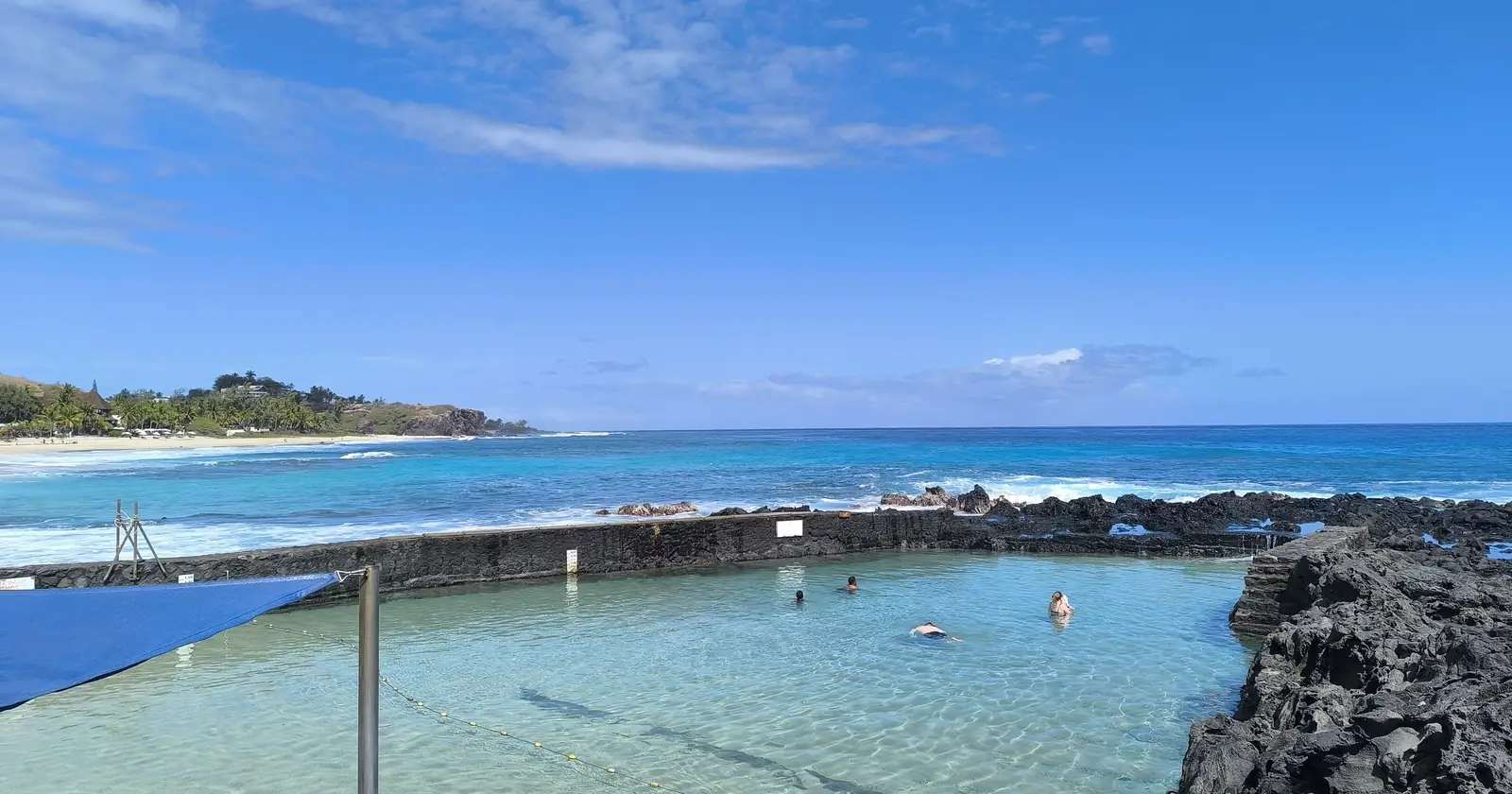
The protected natural pool at Boucan Canot, near Saint-Gilles. Outside places like this, swimming within 300 meters of the shore is banned; diving from boats is not. Clémenceau Lauret, Wikimedia Commons, CC BY-SA 4.0, cropped.

Key takeaways
- Prefectoral order no. 180 of 13 February 2026 bans swimming and wave sports within 300 meters of the coast until 15 February 2027; it does not mention scuba diving
- Diving, freediving and snorkel trails are banned in the reserve's five sanctuaries, and no boat may anchor anywhere in the reserve; 41 moorings serve the coast from Cap La Houssaye to Étang-Salé
- The Haï Siang lies at 54 meters and the Navarra and Sea Venture past 40, so French rules put them out of reach of a diver with a Niveau 2 or its equivalent
- Swimming with humpbacks is legal only from 1 July to 30 September, at the surface, outside the reserve, no closer than 15 meters and for 30 minutes
- The island's one hyperbaric chamber is at the CHU in Saint-Pierre, reached at any hour by calling SAMU on 15
Réunion's shark rules ban swimming and surfing, not scuba diving
Réunion has had a shark problem on its west coast for more than a decade, and the state answers it with a prefectoral order renewed every year. The one in force, no. 180 of 13 February 2026, runs from 16 February 2026 to 15 February 2027 and bans two things within 300 meters of the shore: swimming, and sports powered by waves, from surfing and bodyboarding to paddleboarding. Its preamble names the reason as the presence of tiger and bull sharks all around the island and lists the attacks from 2011 to 2019. The exceptions are the lagoons and reef flats, netted and supervised bathing areas, and trial zones watched by shark spotters, each under a town council's own order.
Scuba diving is not in the list. When it renewed the order in 2023, the prefecture said that other water activities, "notamment la plongée et la pêche sous-marine", remain possible within the rules "aux risques et périls de leurs usagers", at the risk of the people doing them, and it advised doing them in groups under professional supervision. That is how nearly everyone dives here: from a dive centre's boat, beyond the reef. Snorkelling with fins and mask is not named in the 2026 order either, after a 2025 version that included it was changed, according to local reporting. Towns can still close their own beaches; Saint-Paul shut its lagoon to all water activities in December 2025 over suspected pollution. The Centre Sécurité Requin posts each day's open netted areas and patrolled zones.
Réunion's marine reserve runs on moorings, not anchors
Almost every dive site on the west coast is inside the Réserve Naturelle Marine de La Réunion, created by decree in 2007. It covers 3,500 hectares from the shore out, 1,735 of them in reinforced protection zones, and 197 hectares in five sanctuaries, among them the Trois Chameaux at L'Hermitage and the Pointe des Châteaux at Saint-Leu, where scuba, freediving and snorkel trails are all banned. Elsewhere in the reserve, no boat may drop anchor; 41 mooring buoys between Cap La Houssaye and Étang-Salé take the dive boats instead, one boat of up to 12 meters per buoy. Diving lights at night need a special exemption, so night dives go only with centres that hold one, and underwater scooters are banned in the lagoons.
The reserve's own code for divers is short: no disturbing, feeding, moving or stroking animals, no souvenirs from the bottom, and avoid gloves. Dive centres need the state's authorization to work in the reserve, renewed every three years. We found no visitor or diver fee anywhere in the reserve's rules or on its pages.
The wrecks off Saint-Gilles and Saint-Leu start at 40 meters
Réunion's best-known wrecks were sunk on purpose or by storms off the west coast, and most of them are deep. The island's tourism board guide and the Le Port dive centre Le Dodo Palmé agree on the Haï Siang, a Taiwanese lobster boat scuttled in the 1980s off Saint-Gilles, lying upright on sand at 54 meters and requiring Niveau 3. Le Dodo Palmé describes the Navarra, a fishing vessel seized by the French navy and sunk off Saint-Gilles in 1996, broken in two by cyclone swell, at 40 to 53 meters, also Niveau 3. The Sea Venture, a timber freighter that sank in the Baie de Saint-Paul in 1981 and lies upside down at 40 to 49 meters, is listed as Niveau 2 by the tourism board and Niveau 3 by Le Dodo Palmé; since French rules stop a Niveau 2 diver at 40 meters, plan on the stricter answer.
Two sites suit less experienced divers. The Antonio Lorenzo, a Chilean longliner caught fishing illegally off the Kerguelen and sunk off the Pointe des Châteaux in December 1999 as an artificial reef, lies at 20 to 40 meters and is a Niveau 2 dive. Cap La Houssaye, at the north end of the reserve, runs from 4 to 18 meters over reef, seagrass, a drop-off and a small cave, with turtles on the seagrass, and the tourism board lists it for first dives, from the shore and at night.
French dive levels decide how deep you go in Réunion
Réunion is France, and French sport law governs diving here. The Code du sport caps diving on air at 60 meters and divides divers into those who may dive guided by a professional (PE) and those who may dive on their own (PA), each with a depth. A French Niveau 1 or CMAS one-star diver is PE-20, guided to 20 meters; a Niveau 2 is PE-40 and PA-20; a Niveau 3 is PE-60 and PA-60. PADI and SSI cards are not in that table. A foreign diver shows the card and logbook to the centre's dive director, who decides which French level to treat them as and may ask for a check dive first.
How a centre reads an Advanced Open Water card is therefore the dive director's decision, not a rule you can quote at the counter. Corail Plongée in Saint-Gilles sells a conversion from SSI Advanced to the French PA-40, autonomous to 40 meters, over four dives for €350, and asks for four dives past 30 meters first.
Humpback whales off Réunion: July to September, at the surface only
Humpbacks come to Réunion in the southern winter to breed and calve. Globice, the island group that has photo-identified them since 2004, gives June to October with a peak usually in August, and its counts swing hard from year to year: a record 1,271 individuals in 2023, 416 in 2024 and only 79 in 2025. If whales are the reason for the trip, read the season so far before you book.
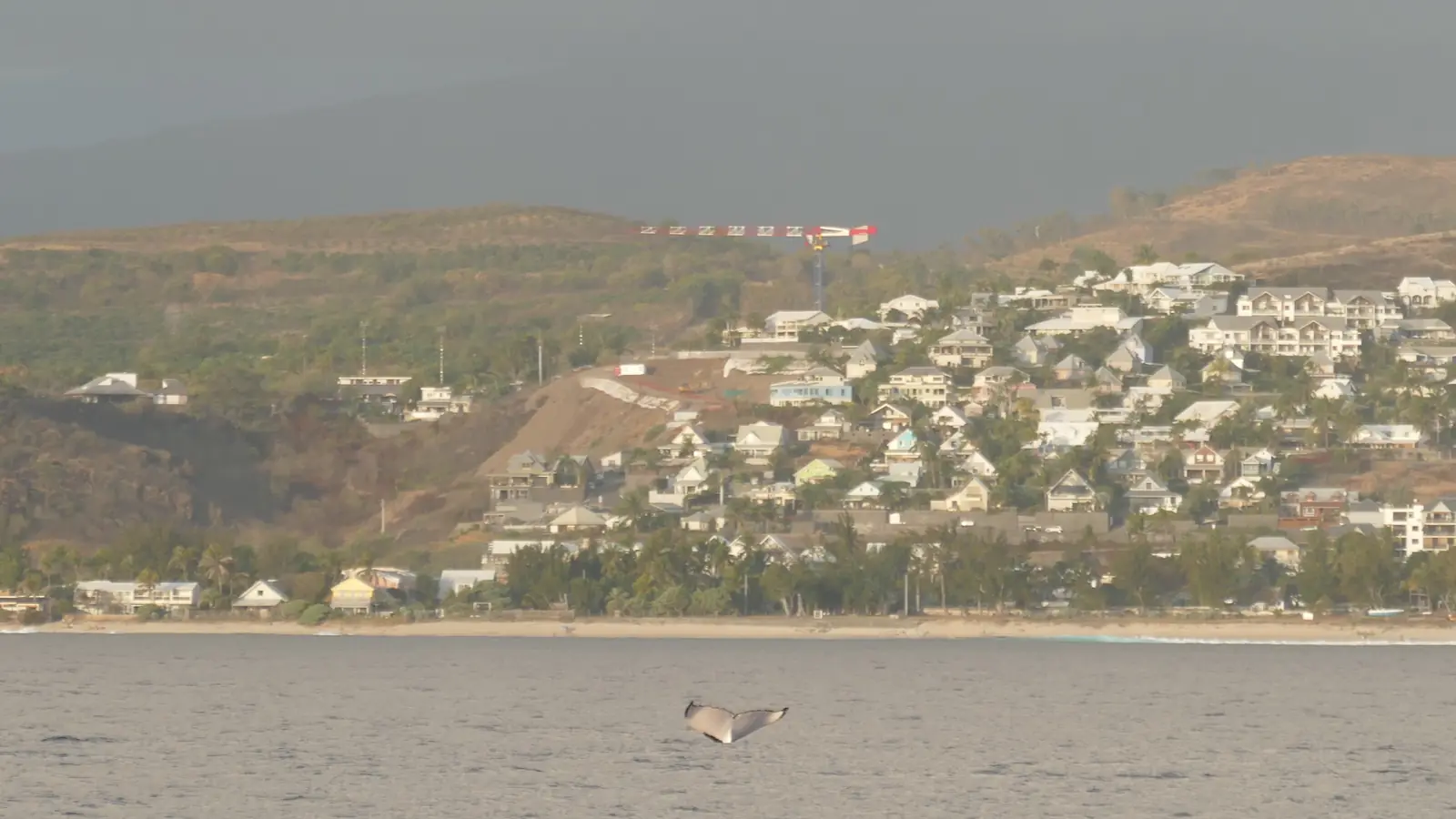
A humpback's tail off Réunion's west coast. Parchaco, Wikimedia Commons, CC0, cropped.

Prefectoral order no. 944 of 4 June 2025 sets the rules, and they are tight. Getting in the water with humpbacks is allowed only from 1 July to 30 September, only outside the marine reserve, between 09:00 and 13:00, and only at the surface: no scuba, and no freediving down toward the animals. Swimmers must stay at least 15 meters away, may not move toward a whale within 30 meters, and get 30 minutes per group of at most seven including the guide; children under eight may not take part, and jumping in from the boat is banned. Outside those dates boats must keep more than 300 meters from humpbacks. Some centres sell whale outings from July to October; in October that means watching from a distance, or dolphins.
Réunion's water: 28°C in February, 23.5°C in August
NOAA's satellite record for the sea just off Saint-Gilles, averaged by month for this page, gives a 1991 to 2020 mean of about 28.1 °C in February and 23.5 °C in August, with the last ten years a few tenths warmer. The coolest water comes with the whales. Météo-France La Réunion describes the warm season from November to April as the time when most tropical depressions form, with the heaviest rain from January to March; it has published no fixed dates for the cyclone season, and its outlook of 28 October 2026 said the 2026 to 2027 season had already begun.
Réunion's only chamber is in Saint-Pierre, reached through SAMU
The CHU de La Réunion runs the island's hyperbaric medicine service at its southern site, the Saint-Pierre hospital, building L, level -1: a double chamber that takes eight patients per compartment, treating diving accidents and gas embolism. The on-call hyperbaric doctor is reached 24 hours a day through SAMU, so a diver in trouble calls 15. The regional health agency lists it as the island's only authorized site, so there is none in Saint-Denis. By our routing on open map data it is about 54 kilometers and 45 minutes by road from Saint-Gilles in free-flowing traffic, and about 35 kilometers and 30 minutes from Saint-Leu. Check what your dive insurance pays for chamber treatment in France.
What a dive costs in Réunion: €47 to €75 guided
Prices read on the centres' own pages on 10 November 2026, for a single dive:
| Dive centre | Guided, centre's equipment | Autonomous, own equipment |
|---|---|---|
| Corail Plongée, Saint-Gilles | €65 plus €10 for equipment | €45 |
| Le Dodo Palmé, Le Port | €60 | €45 |
| Abyss Plongée, Saint-Leu | €47 | €35 |
For a long stay the packs matter more: Corail Plongée sells 20 autonomous dives for €700 and says to ask about six-month and yearly passes, and Abyss Plongée sells ten for €300, valid for a year.
Getting to Réunion: eleven hours from Paris, then the coast bus
Réunion's airport, Roland Garros in the north of the island, has daily flights from Paris: Air Austral and Air France from Charles de Gaulle, Corsair and French bee from Orly, about eleven hours. The dive coast is in the west, about an hour from the airport by the airport's own shuttle. Car Jaune's line T runs from the airport along the west coast through Boucan Canot, Saint-Gilles and Saint-Leu to Saint-Pierre, and since the network was reorganized on 1 December 2025 a ticket costs €2. The tourism board recommends booking a hire car; with a base near the harbour in Saint-Gilles or Saint-Leu, the bus covers the dive days.
Réunion as a remote-work base: France, but not Schengen
Réunion is part of France but outside the Schengen area, and that catches people out. The French government's own guidance says a Schengen visa does not cover it: a visitor who needs a visa needs one issued for Réunion, unless they hold a French or other Schengen residence permit or long-stay visa. Some nationalities need none, and France-Visas' visa assistant answers that for a given passport. A short stay is limited to 90 days in any 180.
The island is on UTC+4 all year, two hours ahead of Paris in the European summer and three in winter, so a Paris working day runs from about 11:00 or 12:00 to 19:00 or 20:00 local time and leaves the morning for diving. Connections are good: French regulator ARCEP counted 96.3% of the island's premises connectable to fibre in June 2026, and 92% of internet subscriptions in Réunion are fibre, the highest share of any French overseas territory.
Who Réunion suits
Réunion suits a certified diver, ideally with a French Niveau 2 or 3 or the experience to earn one, who wants deep wrecks, a protected reef and French infrastructure on a tropical island. It suits a remote worker on European hours, and a winter visitor who wants whales, provided they accept that the encounters are short, regulated and at the surface. It suits less well a beginner who imagines swimming off the beach between dives, which the shark order does not allow, and anyone who wants to dive the deep wrecks on an Open Water card.
Seventeen dive centres on our Réunion list
Our Réunion operator list holds 17 businesses, read on 9 November 2026: six published by SSI, among them Corail Plongée and O Sea Bleu in Saint-Gilles and Le Dodo Palmé in Le Port, and eleven by International Training, the company behind SDI and TDI, from Saint-Gilles, Saint-Leu, Saint-Paul and Étang-Salé. Many Réunion centres teach under France's own federation, whose list we can't link entry by entry, so Abyss Plongée, quoted above, is not on it. A register entry says a training body lists a centre; it does not say the reserve has authorized it, which is the paper that lets a boat work inside it.
FAQ: Réunion diving
Is scuba diving allowed in Réunion despite the shark risk?
Yes. The prefectoral order of 13 February 2026 bans swimming and wave sports within 300 meters of the shore but does not mention scuba diving, and the prefecture has said diving remains possible at the diver's own risk. It advises diving in groups with professionals, which is how dive centres run their boat dives.
When is humpback whale season in Réunion?
Roughly June to October, with the peak usually in August, according to Globice. The legal window for approaching humpbacks and getting in the water with them is 1 July to 30 September, at the surface only, outside the marine reserve and between 09:00 and 13:00.
What level do you need to dive Réunion's wrecks?
The Haï Siang at 54 meters and the Navarra at 40 to 53 meters need a French Niveau 3 or its equivalent. The Sea Venture lies at 40 to 49 meters, past the 40-meter limit of a Niveau 2. The Antonio Lorenzo, at 20 to 40 meters, is a Niveau 2 dive.
Where is the hyperbaric chamber in Réunion?
At the CHU's southern site, the hospital in Saint-Pierre. It is the island's only authorized chamber, and its on-call doctor is reached 24 hours a day through SAMU on 15. It is about 45 minutes by road from Saint-Gilles and 30 minutes from Saint-Leu.
Do you need a visa for Réunion if you have a Schengen visa?
A Schengen visa does not cover Réunion, which is outside the Schengen area. Visitors who need a visa need one issued for Réunion, unless they hold a French or Schengen residence permit or long-stay visa. Some nationalities are exempt; France-Visas' visa assistant gives the answer for a specific passport.
Note: Conditions, safety guidance and regulations change. Verify current information with official sources, including the dive operator, the park authority and the relevant government department, before you travel or dive.
Founder of NOMADREEF and a former digital nomad. This guide is sourced from the references below; conditions, prices and rules change, so verify current details, and follow qualified local guidance and safety briefings. About the author · LinkedIn ↗
Sources
- The shark order (primary). Préfecture de La Réunion, arrêté no. 180 of 13 February 2026 (PDF), in the special register of official acts no. 35, articles 1 to 3 and preamble; press release of 9 February 2023 (PDF) on diving at the user's own risk. Read 10 November 2026.
- Snorkelling and local closures. Réunion La 1ère, 27 March 2025 (news report) on the 2025 change; Saint-Paul, municipal order of 9 December 2025 (PDF) (primary); Centre Sécurité Requin, recommendations and practice zones (primary). Read 10 November 2026.
- The marine reserve (primary). Decree no. 2007-236 of 21 February 2007, as reproduced by AIDA (INERIS), articles 1, 4, 6, 9, 14, 15, 20, 21, 23 to 25; Réserve Naturelle Marine de La Réunion, diving page, boating page and authorization forms. Read 10 November 2026.
- Dive sites. Île de La Réunion Tourisme, diving guide, 2018 edition (PDF) (primary for the tourism board, dated); Le Dodo Palmé, site pages for the Haï Siang, Navarra, Sea Venture and Antonio Lorenzo (operator). Read 10 November 2026.
- French diving rules (primary). Code du sport, article A322-76 (60 m on air), article A322-77 (the dive director's assessment) and annex III-14 b (levels and aptitudes). Read 10 November 2026.
- Whales. Préfecture, arrêté no. 944 of 4 June 2025 (PDF), articles 2 to 6, and the DEAL summary (primary). Globice, humpback whales and its season reviews for 2023, 2024 and 2025 (primary, monitoring). Whale trips into October: Corail Plongée and Le Dodo Palmé. Read 10 November 2026.
- Water and weather. NOAA OISST v2.1 monthly means, grid point 21.125°S 55.125°E, averaged by month for this page. Météo-France La Réunion, climate and 2026 to 2027 cyclone outlook (primary). Read 10 November 2026.
- The chamber (primary). CHU de La Réunion, hyperbaric medicine; ARS La Réunion, working paper on the hyperbaric chamber (PDF). Road distances calculated for this page with OSRM on OpenStreetMap data, without traffic. Read 10 November 2026.
- Prices (each centre primary for itself). Corail Plongée, Le Dodo Palmé, Abyss Plongée activities and packs. Read 10 November 2026.
- Getting there. Aéroport de La Réunion Roland Garros, Paris-CDG, Paris-Orly and public transport (primary); Réunion La 1ère, 14 November 2025, on the €2 fare; Île de La Réunion Tourisme, transport on the island. Read 10 November 2026.
- Entry, time and internet. service-public.gouv.fr, visas for overseas France (primary); ARCEP, fibre deployment open data, second quarter 2026 and overseas market observatory 2025 (primary). Read 10 November 2026.
- The seventeen listings. Seventeen entries on the Réunion operator list, from the SSI register and the International Training facility register, read 9 November 2026.
- Left out. The text of the 2025 order no. 297, which we could not open; the exemption list by nationality, because France-Visas refused automated requests; Car Jaune's 2026 timetable for line T; and the phrase "zone de vigilance requin renforcée", which no official text we read uses.