Best Travel Dive Computers (2026): Compared for Nomad Divers
 by Yannick Schroth
Jul 24, 2026
14 min read
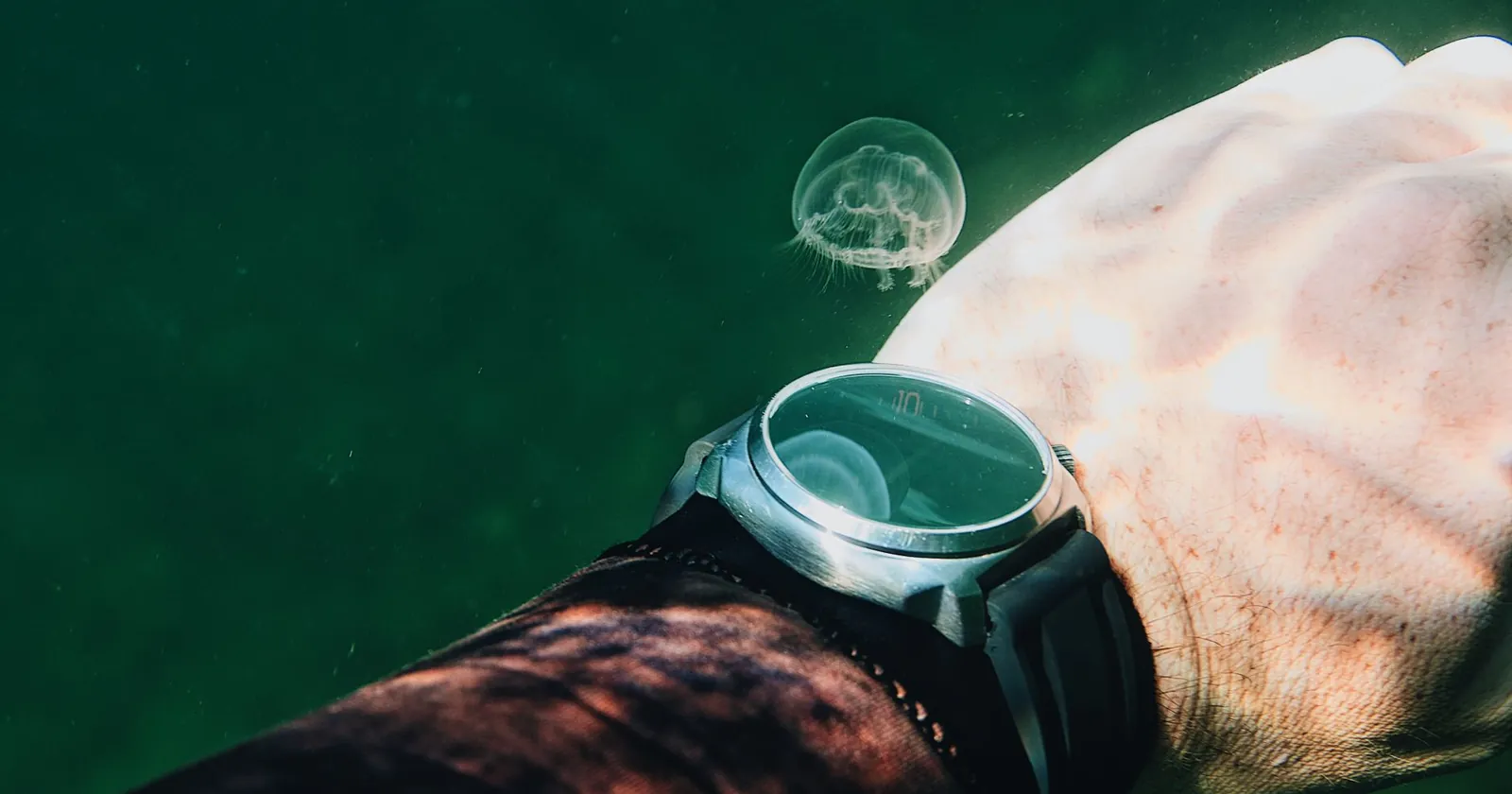
Dive instrument (illustrative). Photo: Maël Balland via Pexels (free license).
Air and nitrox, easy menus and a readable screen cover most divers.
Browse on Amazon →Doubles as an everyday watch so it is always with you.
Browse on Amazon →A reliable algorithm and readability beat feature-stuffed unknowns.
Browse on Amazon →Recommendations by type and spec, not a tested product ranking; confirm fit/size with a shop. Any price is live at the retailer. See our disclosure.
Key picks
- Best overall: Shearwater Peregrine, the value benchmark (USD 580).
- Best budget / beginner: Suunto Zoop Novo (USD 299).
- Simplest one-button option: Mares Puck Lite (USD 337.95).
- Best do-everything watch: Garmin Descent G2 (USD 699.99; smartwatch, GPS, trimix and CCR modes, no air integration).
- Best with air integration: Shearwater Peregrine TX (USD 760).
What makes a good travel dive computer
The best travel dive computer is the one that fits how you dive and travel, not the one with the most features. Weigh these:
- Readability. A large, high-contrast screen matters most exactly when conditions are worst, in low visibility or bright sun. Full-size units beat watch-style here.
- Power. Rechargeable (Shearwater, Garmin) means no hunting for an odd battery in a small dive town; a coin-cell battery means no charger, but check who may change it: Mares lists the Puck Lite's CR 2450 as user replaceable, while the Suunto Zoop Novo's user guide sends battery replacement to an authorized Suunto service center. Both are valid for travel if you plan for it.
- Nitrox as a minimum. Even if you dive air today, enriched-air nitrox extends bottom time and is standard on liveaboards. Every pick below supports it.
- Size and weight. A dedicated computer is bulkier but cheaper and more readable; a dive watch is wearable all day but pricier.
- Warranty and support. A worldwide warranty and updatable firmware matter when you are far from home.
Best travel dive computers at a glance
Shearwater and Garmin prices are the manufacturers' US list prices, read on shearwater.com and garmin.com in October 2026, and the Mares and Suunto prices are the brands' US store prices in the same month. Confirm the current price and model before buying.
| Computer | ~Price | Power | Screen | Air integration | Best for |
|---|---|---|---|---|---|
| Shearwater Peregrine | $580 | Rechargeable | 2.2" color | No | Best overall value |
| Suunto Zoop Novo | $299 | Coin cell (CR 2450), replaced at a Suunto service center | Large mono | No | Beginners, budget |
| Mares Puck Lite | $337.95 | Replaceable battery (CR 2450) | Segment display | Not listed | One button, simplest |
| Garmin Descent G2 | $699.99 | Rechargeable (clip charger) | 1.2" AMOLED watch | No | Daily-wear, do-everything |
| Shearwater Peregrine TX | $760 | Rechargeable | 2.2" color | Yes | Air integration + compass |
Best overall: Shearwater Peregrine
The Peregrine is the one we point most traveling divers to, and the benchmark the others are measured against. It pairs a big, exceptionally readable color screen with some of the simplest menus in diving, a rechargeable battery good for about 30 hours per charge, and air, nitrox and 3-gas modes that carry you from your first open-water dive to the edge of technical diving. At around $580 it is not the cheapest, but it is arguably the best value, because you are unlikely to outgrow it. Its only real gaps are air integration and a compass. We cover it in depth in the full Shearwater Peregrine review. Check the Peregrine price.
Best budget and beginner: Suunto Zoop Novo
If money is the deciding factor, the Suunto Zoop Novo is the cheapest dive computer Suunto sells, USD 299 on its US store in October 2026. It has a large monochrome display, a four-button interface, one gas from 21 to 50% oxygen and Suunto's RGBM algorithm with personal adjustment levels from 0, the default, to 2, more conservative. It is bulky, and it runs on a CR 2450 coin cell rather than recharging. Suunto's store marks that battery as user replaceable, but the Zoop Novo user guide says to “Contact an authorized Suunto service center for battery replacement” and that “Defects caused by improper battery installation are not covered by the warranty”, so on a long trip plan a service-center visit rather than a spare in your bag.
Above it, Suunto's current US lineup runs to the Nautic S (USD 549), the Nautic (USD 699) and the Ocean watch (USD 899 list), all on Suunto's own Bühlmann 16 GF algorithm. Our Garmin Descent vs Suunto comparison sets those against Garmin's dive watches.
Simplest one-button pick: Mares Puck Lite
Mares' US store no longer sells the Puck Pro. Its current entry model is the Puck Lite, at USD 337.95 on mares.com in October 2026. Mares lists the Bühlmann ZH-L16C algorithm with adjustable gradient factors, nitrox from 21 to 50% on one gas, a segment display, built-in Bluetooth with logs in the Mares and SSI apps, and a user-replaceable CR 2450 battery. One button runs it, which makes it easy for a first-timer. What you give up is gas switching: the Puck 4 adds that and nitrox to 99% at USD 437.95, but Mares' US store showed it out of stock in October 2026.
Best do-everything watch: Garmin Descent G2
If you want one device you can wear to dinner and dive in the morning, the Garmin Descent line is the other philosophy to the Peregrine. The Descent G2 (USD 699.99 on garmin.com, as of October 2026) is the entry to it: a watch with a 1.2" AMOLED screen, rated to 100 m, with smart notifications, Garmin Pay, sleep tracking and GPS on the surface. Garmin quotes up to 10 days as a smartwatch and up to 27 hours in dive mode per charge. The dive side runs Bühlmann ZHL-16c with gradient factors and lists trimix and closed-circuit rebreather (CCR) support, plus apnea modes for freediving. Its spec sheet has no air-integration line, and a watch screen is smaller to read at depth than the Peregrine's 2.2 inches. It costs USD 119.99 more than a Peregrine, but for an active nomad who wants a daily watch and a dive computer in one, it is the "everything" pick. The Descent Mk3 (from USD 1,199.99) is the bigger step, and its Mk3i version adds air integration. If the watch already on your wrist is an Apple Watch Ultra, our guide to the Apple Watch Ultra as a dive computer covers what the Oceanic+ app adds and where its 40 m limit leaves you.
Best with air integration: Shearwater Peregrine TX
Air integration puts your tank pressure on your wrist, so you are not reaching for an SPG. If you want it, the Peregrine TX (USD 760, USD 180 more than the standard Peregrine) is the clean choice: the same excellent Peregrine core plus wireless support for up to four transmitters and a digital compass. Suunto models and Garmin's Descent Mk3i and X50i also offer air integration if you prefer a watch form factor; the Descent G2 above does not list it. Just remember the transmitter is a separate purchase: Shearwater's Swift is USD 400, so the Peregrine TX and one Swift come to USD 1,160 (shearwater.com, October 2026).
Do you even need to own a dive computer?
A fair question, because many dive centers rent computers and some require one per diver anyway. The case for owning your own is not features, it is familiarity and continuity: you always dive the same interface and algorithm, so you are not learning a rental menu on the boat, and your no-decompression and surface-interval history follows you across dives and days, which is safer. If you dive more than a couple of times a year, owning one pays for itself in confidence alone. If you dive once on a holiday, renting is fine.
How to choose your travel dive computer
- New diver on a budget: Suunto Zoop Novo; if one button matters more, the Mares Puck Lite.
- Recreational nomad who dives often: Shearwater Peregrine, the best value long-term.
- You want tank pressure on the wrist: Peregrine TX (and a transmitter).
- You want a daily-wear watch that also dives: Garmin Descent G2.
- You are heading into technical diving: Shearwater Teric or Perdix, above this list.
FAQ: the best travel dive computer
What is the best travel dive computer overall?
For most traveling recreational divers, the Shearwater Peregrine is the best overall pick: a large color screen, simple menus, a rechargeable ~30-hour battery, and air, nitrox and light-tech modes at around $580. Budget divers should look at the Suunto Zoop Novo, and anyone who wants a daily-wear watch that also dives at the Garmin Descent G2 (USD 699.99 on garmin.com, October 2026).
What is the best budget dive computer for beginners?
The Suunto Zoop Novo (USD 299 on Suunto's US store in October 2026) is the cheapest simple pick: a large monochrome display, four buttons and one gas up to 50% nitrox. If you want a single button, Mares' current entry model is the Puck Lite, USD 337.95 on Mares' US store in October 2026, with nitrox from 21 to 50% on one gas.
Do I need to own a dive computer or can I rent one?
Many dive centers rent computers, and some require one per diver. But owning your own means you always dive the same familiar interface and algorithm, and your no-decompression history follows you across dives and days, which is safer. For anyone diving more than a couple of times a year, owning one is worth it.
Should a travel dive computer be rechargeable?
Rechargeable is a real advantage for travel: you avoid hunting for an odd battery in a small dive town, and you charge from a USB or wireless pad. The Shearwater Peregrine and Garmin Descent are rechargeable; budget units like the Suunto Zoop Novo and Mares Puck Lite run on a CR 2450 coin cell instead. Mares lists the Puck Lite's as user replaceable; the Zoop Novo user guide says to have an authorized Suunto service center replace it.
Which dive computer has air integration?
Air integration (tank pressure on your wrist) needs a compatible transmitter and a computer that supports it. The Shearwater Peregrine TX (USD 760), many Suunto models and Garmin's Descent Mk3i and X50i support it. The standard Peregrine and most budget computers do not.
Is a watch-style or a full-size dive computer better for travel?
Full-size computers like the Peregrine are easier to read in low visibility and usually cheaper for the same dive features. Watch-style units like the Garmin Descent are wearable all day and do far more on the surface, but cost more. Choose readability and value, or daily-wear and features.
Does my dive computer need nitrox mode?
Yes, get one with nitrox. Even if you dive air now, enriched-air nitrox extends bottom time and is common on liveaboards and dive-heavy trips. Nearly all modern computers, including budget ones, support nitrox, so there is no reason to buy one that does not.
Yannick Schroth
Founder of NOMADREEF and a former digital nomad who has based across Asia and Latin America, from Thailand to Peru. This comparison is compiled from manufacturer specs and expert and verified-buyer reviews, not a hands-on test of every unit; we rank on fit, never on payout. About the author · LinkedIn ↗
Sources
- Corrected 14 October 2026. An earlier version of this page said the Suunto Zoop Novo uses a “user-replaceable battery” so “you carry a spare”. Suunto's store lists the battery that way, but the Zoop Novo user guide says: “Contact an authorized Suunto service center for battery replacement.” and “Defects caused by improper battery installation are not covered by the warranty.” The page now follows the manual. It also gave the Zoop Novo as “under $300” (now USD 299 on Suunto's US store) and called it the “classic” pick with a “famously conservative algorithm” that “dive schools worldwide use”, claims we had no source for and have removed. Zoop Novo user guide (PDF), us.suunto.com Zoop Novo; Nautic USD 699 and Nautic S USD 549: us.suunto.com Nautic, us.suunto.com Nautic S; Ocean USD 899 list: us.suunto.com Ocean. All read 14 October 2026.
- Corrected 13 October 2026. An earlier version of this page named the Garmin Descent G1 as the best do-everything watch, with "tech modes", a solar option and optional air integration. The G1 is no longer in Garmin's US dive lineup (Descent Mk3, G2, X30/X50i, S1 Buoy, T2 Transceiver), so the pick is now the Descent G2: USD 699.99, Bühlmann ZHL-16c with gradient factors, trimix and CCR support, rated to 100 m, no air-integration line on its spec sheet. garmin.com dive lineup and Descent G2 product page, read 13 October 2026. The comparison table in that earlier version still showed the Peregrine TX at "$650" after the August correction below; it is USD 760, USD 180 more than the USD 580 Peregrine, and the Swift transmitter is USD 400. shearwater.com dive computers and Swift product page, read 13 October 2026.
- Corrected 9 August 2026. The Shearwater Peregrine TX is USD 760, not the "about $650" an earlier version of this page carried; the standard Peregrine is USD 580. shearwater.com, price checked 6 August 2026. The wrong figure survived here after being corrected on our Shearwater vs Suunto comparison, which is exactly the failure mode our rules now require us to sweep for.
- Corrected 14 October 2026. An earlier version of this page named the Mares Puck Pro, "around $200", as the cheapest simple option. Mares' US store no longer sells the Puck Pro (its catalog lists only manuals, firmware and declarations for it). The entry model is now the Puck Lite at USD 337.95: “Bühlmann ZH-L16C algorithm with adjustable gradient factors”, “Nitrox 21%-50%”, “One gas”, “User replaceable battery (CR 2450)”, “One button for intuitive operation”. mares.com Puck Lite, read 14 October 2026. Puck 4: USD 437.95, gas switching, nitrox 21 to 99%, out of stock. mares.com Puck 4, read 13 October 2026.
- DiveIn, "Best Beginner Dive Computers" and Peregrine review. divein.com.
- Frog Dive, "Dive computer buyer's guide: Shearwater, Oceanic, Suunto, Garmin compared". frogdive.com.au.
- Dive Aeris, "Best Budget Dive Computers". diveaeris.com.