Palau Diving: The Permits, the Reef Rules and a Sunscreen Ban With 42 Names On It
 by Yannick Schroth
Sep 20, 2026
14 min read
by Yannick Schroth
Sep 20, 2026
14 min read
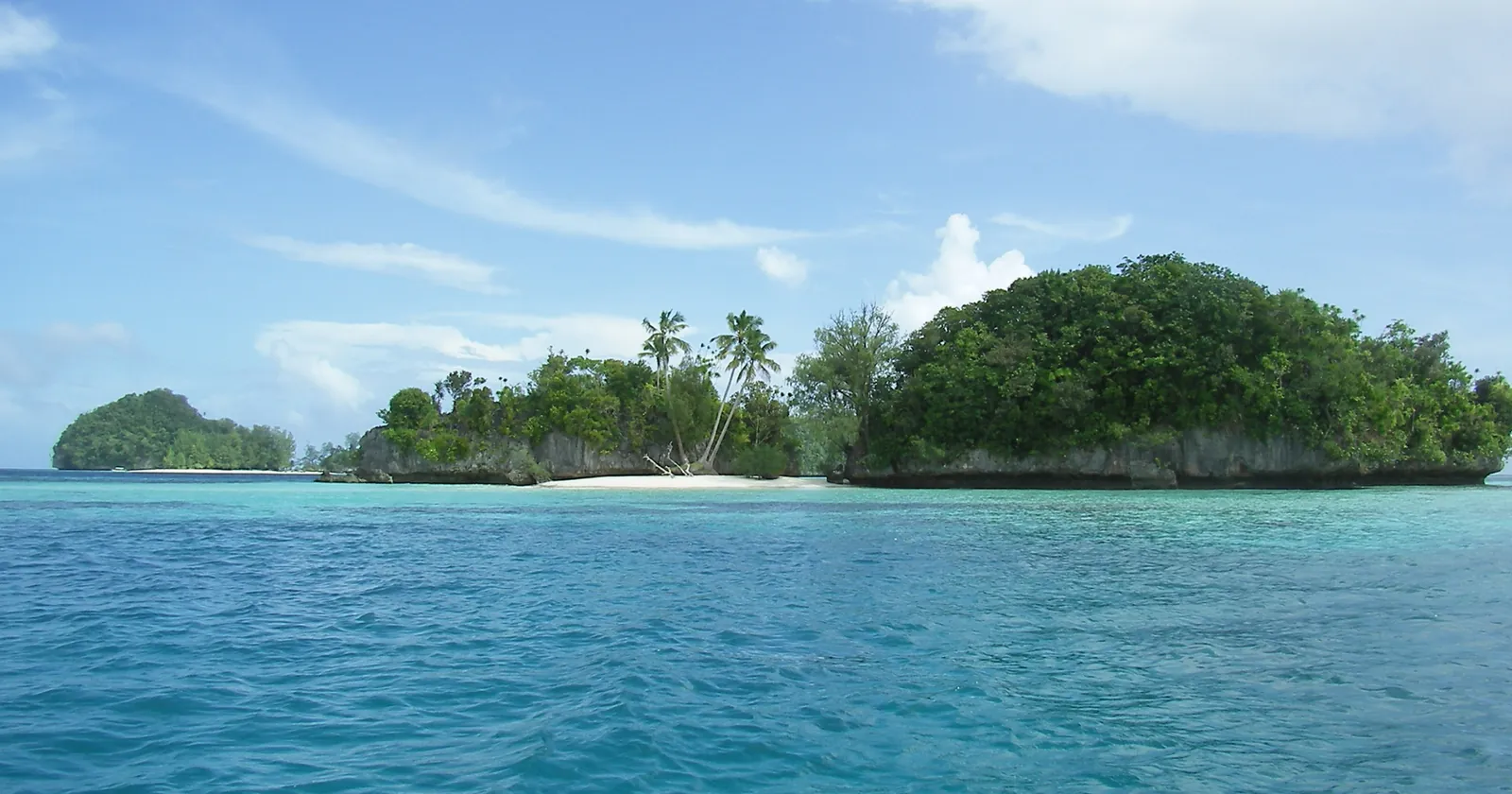
Photo: Peter R. Binter, Wikimedia Commons, public domain.

Key takeaways
- The Pristine Paradise Environmental Fee of $100 has been built into every international airline ticket into Palau since 1 January 2018; no separate departure payment replaces it
- Koror State charges $50 for a Rock Island Use Permit and $100 with Jellyfish Lake, both for visitors aged six and over, both valid ten days
- The sunscreen appendix names 42 ingredients across twelve chemical classes, and eleven of those classes ban every other member of the class as well
- Koror State sets diving at 8 divers to 1 guide, snorkelling at 10 to 1, prohibits gloves outright and requires reef hooks to be placed to minimise impact
- Fishing is barred within 100 yards of thirteen named dive sites, Blue Corner and German Channel among them, and feeding sharks is unlawful in Koror’s waters
What diving in Palau costs before you get wet: $100 in the airfare, $50 at Koror
The first fee is invisible. Under the public notice issued by the Palau Visitors Authority, the Pristine Paradise Environmental Fee of $100 has been included in the price of every international airline ticket into Palau since 1 January 2018, and the ticketing airline is responsible for collecting it. Before that date a visitor paid $50 on the way out, a $30 Green Fee plus a $20 departure tax.
That fee was written into law three years earlier. The Palau National Marine Sanctuary Act of 2015 created an Environmental Impact Fee of one hundred dollars on every passenger aged 13 or older leaving the Republic, payable no more than once in any thirty-day period. Palauan citizens, their spouses, holders of a valid Palau work visa and transit passengers are exempt. The same chapter repealed the old departure tax.
Where the hundred dollars goes is worth a minute, because it shows what the money was built for. As the 2015 Act wrote the split, $10 goes to the Fisheries Protection Trust Fund, $12.50 is divided among the states, $25 to the Civil Service Pension Fund, $30 is earmarked as a Green Fee and $22.50 reverts to the National Treasury. The fee has been renamed and amended since, so read that as the original design rather than today’s ledger.
Fee number two is paid in Koror, in person. A Rock Island Use Permit costs $50 for every visitor aged six and over. Adding Ongeim’l Tketau itself takes it to $100, on a Jellyfish Lake Permit that covers the same designated tourist activity areas. Change your mind at the lake and the rangers’ outpost issues a voucher for a further $75, payable at the Koror State Finance Office within 48 hours. Both permits run ten days and neither is refundable.
Those numbers have moved a long way. The same Koror State law set the Rock Island permit at $25 and the Jellyfish Lake permit at $35 when it took effect in 2009. Peleliu is a different state with its own permit, quoted at $30 per person for ten days on an operator rate sheet published on the tourism authority’s own site; other published figures run to $60, and that disagreement is recorded in the sources.
One more thing happens at the border, and it costs nothing. A presidential directive dated 12 December 2017 instructed immigration officials to use the Palau Pledge entry visa stamp, so an arriving visitor signs a promise addressed to the children of Palau before reaching baggage claim. The signature carries no permit and no depth limit. What it actually commits you to is spelled out in the two bodies of rules below.
Palau’s sunscreen ban names 42 ingredients, and most bottles fail it
The Responsible Tourism Education Act of 2018 is the part of Palauan law that reaches into a diver’s washbag. Signed on 4 November 2018 and in force from 1 January 2020, it named ten ingredients, among them oxybenzone, octinoxate, octocrylene, triclosan, phenoxyethanol and four parabens. The regulations that implement it went considerably further.
Its appendix, inside the Ministry’s Regulations Prohibiting Reef-Toxic Sunscreens, is the document that decides at the airport. It lists 42 named ingredients in twelve chemical classes, and eleven of those classes close with the same line: in addition to the ingredients listed above, all other members of the class are banned. Anything containing one of them is, in the regulation’s own phrase, a reef-toxic sunscreen.
Read that list and the practical consequence is blunt. Avobenzone, homosalate, octisalate, ensulizole and padimate O appear by name, as do the newer filters sold in Europe under the trade names Tinosorb S and Tinosorb M and the two Mexoryls, ecamsule and drometrizole trisiloxane. Zinc oxide and titanium dioxide do not appear in the appendix at all, which is why the government describes its own standard as permitting mineral filters and little else.
Enforcement begins before customs. Palau International Airport is required to place marked disposal bins near the baggage claim area but ahead of the inspection station, with signs in arrivals explaining why. Anything found during entry inspection is confiscated, though Customs may run a scheme to hand it back on departure. Officers are told to confiscate a bottle that is out of its original packaging, or whose label is absent, illegible or printed in a language they cannot read.
The penalty is counted per bottle. Each consumer unit is its own violation and carries a fine of up to $100, with totals capped at $5,000 for selling or distributing and $10,000 for manufacturing or importing. Importing and then selling the same tube is fined twice. Our reef-safe sunscreen guide covers what survives a list written this way.
Eighty percent of Palau’s ocean is closed, and one shark costs $500,000 in court
The law that shapes the diving here was not written for divers. RPPL 9-49, passed as the Palau National Marine Sanctuary Act, split the exclusive economic zone in two: roughly 80 percent became the Sanctuary and the remaining 20 percent a Domestic Fishing Zone. Section 149 is one sentence long and says the Sanctuary is a no-take zone in which fishing and the extraction, disturbance, destruction, removal or alteration of any Sanctuary resource is expressly prohibited.
It arrived on a timetable. Existing long-line agreements and purse-seining activity were wound down from the date of passage through 31 December 2019, and by 1 January 2020 no fishing was to be allowed in the Sanctuary at all. The Ministry’s fishing regulations, transmitted to the President on 16 December 2019, restate the same 80 to 20 division and the same no-take status. They also require an observer or an approved electronic monitoring system on every fishing vessel for 100 percent of vessel days from 1 January 2025.
Sharks sit in a separate clause with a separate number. Title 27 makes it unlawful to fish for any shark in Palau’s waters, to remove its fins, or to possess any part of one, and an inadvertent catch must be released at once in the manner that gives it the best chance of survival. The fine runs between $500,000 and $1,000,000, with each shark or part of a shark a separate violation. Steel leader is banned as gear and banned on board.
A purse seiner faces a different scale again. Where any of these prohibited acts is committed by a vessel equipped for purse seining, or by its crew, captain or owner, the penalty runs from a minimum of $1 million to a maximum of $10 million, set by the seriousness of the offence and the size and value of the vessel. Reef fish, turtles, rays and marine mammals carry their own prohibition in the same section.
The public commitment came six years before the Act. On 25 September 2009 President Johnson Toribiong told the United Nations General Assembly that Palau wanted “a sanctuary for sharks to live and reproduce unmolested in our 237,000 square miles of ocean”, and asked other countries to ban shark fishing in their own waters. The statute caught up with the speech in 2015.
There is a number behind the policy, and it is a dive-industry number. Vianna and colleagues, publishing in Biological Conservation in 2012, put shark diving at US$18 million a year in Palau, about 8 percent of gross domestic product, paying $1.2 million in local salaries and $1.5 million in tax. The roughly 100 sharks that interact with tourists at the popular sites would have been worth at most $10,800 to a fishery. Our shark diving list covers coasts that made the same trade.
Thirteen Palau dive sites where fishing stops 100 yards out
Koror State drew a ring around the dive sites themselves. Public law K8-191-2007 makes it unlawful to engage in any fishing activity, or to possess fish or fishing gear, within 100 yards of thirteen named places: Soft Coral Arch, Cemetery Reef, Ngermeaus, Blue Holes, Blue Corner, Sias Tunnel, Shark City, Ngemelis Wall, Short Drop Off, German Channel, Big Drop Off, German Wall and Virgin Blue Holes.
A second law of the same year settles a question divers often ask before booking. K8-186-2007 makes it unlawful to feed sharks in the waters of Koror State, which is why no operator here sells a baited shark dive. What the sites offer instead is current, structure and a population that has not been fished.
Several areas are closed harder than that. The Ngerukewid Islands Wildlife Preserve is a no-entry zone with no taking and no disturbance of any marine or terrestrial life. Fishing is closed year round in the Ngerumekaol Spawning Area. Ngkisaol, the sardine sanctuary, is no-entry; Ngederrak is closed to taking, to disturbance and to motorised watercraft, because it is habitat for the dugong population that Koror State puts at fewer than 200 animals.
Personal watercraft have their own map. A 2003 law establishes four designated water sport zones for jet skis and similar craft and bans two-stroke engines, which keeps them off the reef sites rather than trusting etiquette to do it. Your permit paperwork has to keep up too: the boat operator or guide must carry a passenger list giving each visitor’s name as it appears in the passport in Roman alphabet, country of origin, arrival and departure dates and individual permit numbers.
Your Palau dive guide carries a Koror State card, and it sets the ratio at 8 to 1
Most dive destinations leave guiding to the training agencies. Koror State does not. Its Tour Guide Certification Regulations define a tour guide to include people who serve as scuba diving and snorkelling guides, and Article 2.1 says no person shall act as one anywhere in the waters or on the land of Koror State without a valid certification card issued by the Department of Conservation and Law Enforcement.
Getting the card is a small exam. An applicant must be at least 18, be proficient in Palauan or English, hold a national work permit if not a citizen, and hold current CPR and first aid certification from an internationally recognised body. The exam runs one hour, no notes and no phone in the room, and the pass mark is 80 percent. Validity runs one year, a first card costs $30 and a renewal $10, and an annual refresher keeps it alive.
The content of that card is what a visiting diver actually feels. Diving is fixed at 8 divers to 1 guide and snorkelling at 10 to 1. Gloves are prohibited while diving or snorkelling. Reef hooks are permitted, and must be placed so as to minimise environmental impact. That is the tool the currents at Blue Corner are known for, and the regulation names it directly rather than leaving it to etiquette.
The rest reads like a briefing written down. Guides must demonstrate dive etiquette: do not touch, handle or provoke any marine organism, do not alter or deface anything on the reef, do not collect or remove corals, sea grass or algae. Boats moor rather than anchor where mooring applies. A functional emergency medical oxygen kit and a first aid kit must be aboard the dive boat at all times, a life jacket or BCD must be aboard for every passenger, and communication with the tour station has to be continuous.
The Jellyfish Lake clause is oddly specific and worth carrying. Guides must prevent cross contamination: nothing but clean snorkel gear goes into the lake, and nothing comes out of it into the ocean, including things that look dead such as shells and rocks, which can house invasive organisms. Penalties are modest and escalate: $100 for a first offence, $250 for a second, $500 for a third, and at the third the business licence itself becomes subject to suspension or revocation.
Jellyfish Lake is a snorkel to 12 metres, and in May 2016 the jellyfish ran out
Koror State describes Ongeim’l Tketau as the one marine lake open to visitors, and the reason you cannot dive it is chemistry rather than crowd control. The lake is 400 m long and 30 m deep. A pink bacterial layer sits between 13 and 15 m, and below it there is no light and no oxygen, only water loaded with dissolved hydrogen sulfide. Scuba is prohibited and visitors must stay above 12 m.
What lives in that thin upper layer exists nowhere else. The golden jellyfish is a subspecies, Mastigias papua etpisoni, named after former President Ngiratkel Etpison, and it carries zooxanthellae in its tissues and swims after the sun to feed them. Contrary to the tourist line it does sting, mildly, having inherited the cells from its lagoon ancestor. Its predator is an endemic anemone called Entacmaea medusivora, which is Latin for medusa-eater.
Then the lake emptied. Following the extreme El Niño drought of 2015 and 2016, the golden jellyfish population dwindled and then vanished, with the last medusa seen in May 2016 against a normal standing population of about five million. The medusae were virtually absent until late 2018, when the lake finally began to cool, and by 2019 the population was back in the millions. An identical collapse had been documented in 1999, after the previous strong El Niño.
You can check the lake before you book, which is worth doing where the attraction has already vanished twice. The Coral Reef Research Foundation publishes a conditions board for Ongeim’l Tketau: at the monitoring date of 14 July 2026 it showed the status green, jellyfish numbers above 100,000 and rising against the previous three months, an average water temperature of 31.0°C over the top 12 m and falling, and the ENSO phase as El Niño.
How that number is reached matters before you trust it. Above 20,000 animals the estimate comes from net hauls: nets are dropped to 15 m at 15 stations spaced across the lake and drawn slowly up, three full runs in a day, and the mean catch is scaled by the area of the lake. Below 20,000 the count is visual. Two non-native species are established in the lake, one of them an Exaiptasia anemone that may have arrived on a rock carried in by a visitor.
The Rock Islands Southern Lagoon: 445 islands, 52 marine lakes, 746 fish species
Almost all of the diving above happens inside one World Heritage property. The Rock Islands Southern Lagoon was inscribed in 2012 under five criteria, three cultural and two natural, which is rare. It covers 100,200 hectares of sea and holds 445 coralline limestone islands, uplifted by volcanism and then cut into their mushroom shapes by weather, wind and vegetation.
The biology behind criterion (x) is a list of counts. UNESCO records 746 species of fish, over 385 species of corals, at least 13 species of sharks and manta rays, seven species of giant clam and the endemic nautilus inside the property, together with all of Palau’s endemic birds, mammals and herpetofauna and nearly half its endemic plants. The forests above the water and the reef below it were inscribed as one thing.
Marine lakes are the reason criterion (ix) exists here. Inside the property sit 52 marine lakes, more than at any other site in the world, at different stages of geological and ecological development and ranging from well connected to the sea to almost entirely isolated. Five new subspecies of the Mastigias papua jellyfish have been described from them. UNESCO calls them natural laboratories for the study of evolution and speciation.
People were here first, and left. Caves in the islands hold rock art and burials dating back 3,100 years and spanning some 2,500 years of seasonal occupation, with permanent stone villages on a few islands from between 950 and 500 years ago. Those villages were abandoned in the 17th and 18th centuries as the population moved to the larger islands, and that abandonment is itself part of the inscription: criterion (v) treats it as an illustration of climate change and population pressure on a marginal marine environment.
Management is local, not national. The whole property falls within Koror State, the Koror State Rangers enforce the rules, the Rock Islands Use Act of 1997 regulates tourist activity and Koror State Regulations from 1994 cover resource use, recreation and protected areas. UNESCO names uncontrolled tourism as the standing risk and asks explicitly that visitor numbers be kept within the capacity of the property.
Palau wreck diving comes out of two days in March 1944
The wrecks here have a single date on them. On 30 and 31 March 1944 a United States Navy carrier operation codenamed Desecrate One struck Japanese shipping in and around Palau, and most of the vessels now on the bottom went down in those two days. Over forty Japanese vessels have since been identified in Palauan waters.
What they were is less glamorous than the phrase “war wreck” suggests, and more interesting. Underwater survey work by Tomo Ishimura of the Nara National Research Institute for Cultural Properties found that most of the ships sunk at Palau were not naval vessels at all but converted civilian hulls: cargo carriers, tankers, whaling boats and fishing boats, slow and poorly armed. The main force of the Combined Fleet, the Musashi among it, had left Palau on the evening of 29 March.
Depth decided which ones you can still dive. Vessels lying in about 20 m or less were largely salvaged in the post-war decades; those at 30 m or more remain, and the same survey notes they are threatened by unauthorised salvage rather than by depth. That is the practical reason Palau’s best-known wrecks sit deeper than a first open-water certification allows.
They are also a legal object. Underwater archaeological and historical remains in Palau are protected under Title 19 of the Palau National Code as the Palau Lagoon Monument, a designation separate from the World Heritage inscription and from the Koror State permits. Removing anything is not a grey area here. Other coasts where the hull is the whole reason to book are gathered in our wreck diving list.
Palau diving through the year: 28.5 to 30 degrees, and a typhoon every three years
Water temperature is not the variable here. The Coral Reef Research Foundation, which has run instrumented stations in Palau since 1999, puts the outer reefs and surrounding ocean at about 28.5 to 30.0°C, with lagoon shallows roughly half a degree warmer. Its annual low falls around February, and the peak arrives by November. A 3 mm suit covers the whole year, and our travel wetsuit guide covers the trade-off if you dive four times a day.
Depth changes that picture fast. The mixed layer runs to about 40 m, with the upper 10 to 30 m usually the same temperature and no thermocline in it. Below that the numbers fall away: instruments at 57 m on the outer slope often dip into the upper teens, and the mesophotic zone between 60 and 90 m frequently sits at or below 18 to 20°C. In the 2010 bleaching event the whole column went nearly unithermal at 29.5 to 30.5°C from the surface to 90 m.
The season you are actually choosing is wind and rain. Northeast trade winds run October to May and the westerly monsoon June to September, with transition periods in May to June and October to November. The monsoon half is the wetter and windier one, which matters more for boat comfort and surface conditions than for visibility on a wall.
Typhoons reach Palau, but rarely. Since 1945, twenty storms of 64 knots or more have come within 200 nautical miles of the country, roughly one every three years. Two recent ones came close: Bopha in 2012 passed 25 nautical miles south of Angaur, and Haiyan in 2013 crossed directly over Kayangel at super typhoon strength. Drought is the other extreme, and 2015 delivered it, with total rainfall of 64 inches, about half the preceding years.
One piece of local infrastructure belongs in your dive planning. Palau has a single hospital, the Belau National Hospital in Koror, and the tourism authority states that an operational hyperbaric chamber is located there. Dispensaries sit in Babeldaob, Peleliu, Angaur and Kayangel. That one chamber is a long way from most of the outer reef, which is an argument for conservative profiles rather than for cancelling a trip.
Three Palau dive businesses in the registers, and what that number is not
The register count for Palau is three, and it misleads on its own. The Palau operator list holds 3 businesses, read on 20 September 2026, and all three are published by SSI in its register of affiliated centres. Two of the three are Aggressor liveaboards; one is filed by the register under Malakal. SSI lists two of them for freediving programmes.
Three is not the number of dive businesses in Palau. It is the number that the readable registers publish. PADI is the largest body in this sport, and its shop locator applies the country filter in your browser rather than on the server, so the list cannot be enumerated. A centre in Koror stays invisible to a count like ours unless its store number is known. The point at which each source stops being readable is set out in which registers can be read.
Two other registers are empty here, for a different reason. Neither the IKO nor the VDWS list carries any of the three, because both cover kite and windsurf schools rather than dive centres. Not one holds a Green Fins membership, so no in-person environmental assessment sits behind any entry on this coast, which is a gap worth noticing in a country that legislates reef protection this hard.
For Palau the register question matters less than it does elsewhere, because the binding document is not a training affiliation. It is the Koror State tour guide certification card, checked on the water by rangers, and the state and national business licences behind the company that issues your permit. Ask to see the card. It is the one credential in this country that a stranger can verify on the spot.
FAQ: scuba diving in Palau
Do you need a permit for diving in Palau?
For the Rock Islands, yes. Koror State sells a Rock Island Use Permit at $50 for every visitor aged six and over, and a Jellyfish Lake Permit at $100 that covers the same tourist activity areas plus Ongeim'l Tketau. Both run for ten days and are non-transferable and non-refundable. Peleliu is a separate state and sells its own permit. The permit has to carry your name as printed in your passport, your signature and the tour company name, or it is invalid.
How much do the fees for diving in Palau add up to?
Before any dive is booked, $100 has already been paid: the Pristine Paradise Environmental Fee has been included in the price of every international airline ticket into Palau since 1 January 2018. On top of that sits a Koror State permit at $50, or $100 with Jellyfish Lake, and an upgrade voucher of $75 if you change your mind at the lake. Peleliu charges separately, quoted at $30 per person for ten days on a rate sheet published by the tourism authority.
Is sunscreen really banned in Palau, and what can you dive with?
It is banned by name, and the list is long. The regulations under the Responsible Tourism Education Act of 2018 list 42 ingredients in twelve chemical classes, and eleven of those classes add that every other member of the class is banned too. Avobenzone, homosalate, octisalate, oxybenzone, octinoxate, octocrylene, the two Mexoryls and both Tinosorbs are all on it. Zinc oxide and titanium dioxide do not appear in the appendix at all.
Can you scuba dive in Palau's Jellyfish Lake?
No. Scuba is prohibited and visitors must stay above 12 metres, because the lake is stratified: the oxygenated layer reaches only about 12 metres, a pink bacterial layer sits between 13 and 15 metres, and below that the water holds high concentrations of hydrogen sulfide. Visitors snorkel instead. The Coral Reef Research Foundation also asks visitors to carry nothing into the lake, including shells and rocks, because two non-native species are already established there.
Are there sharks at Palau's dive sites, and is shark fishing legal?
Shark fishing is prohibited throughout Palau's waters. Title 27 makes it unlawful to fish for any shark, to remove its fins, or to possess any part of one including the fins, and sets the fine between $500,000 and $1,000,000 with each shark counting as a separate violation. Steel leader is banned as fishing gear and banned on board. Koror State separately makes it unlawful to feed sharks in its waters, so a baited shark dive is not on offer here.
Do dive guides in Palau need a licence?
In Koror State they need a card. The Tour Guide Certification Regulations count scuba diving and snorkelling guides as tour guides, and no one may work as one without a valid certification card from the Department of Conservation and Law Enforcement. An applicant must be 18, hold current CPR and first aid certification, and pass a one-hour examination at 80 percent. The card lasts one year, costs $30 the first time and $10 to renew.
How many divers per guide are allowed in Palau?
Eight divers to one guide, and ten snorkellers to one guide, under the Koror State Tour Guide Certification Regulations. The same rules prohibit gloves while diving or snorkelling, require reef hooks to be placed so they minimise environmental impact, require mooring instead of anchoring where moorings exist, and require an emergency medical oxygen kit and a first aid kit to be on the dive boat at all times.
When is the best time of year for diving in Palau?
The water barely moves: the Coral Reef Research Foundation puts the outer reefs and surrounding ocean at about 28.5 to 30.0 degrees Celsius year round, with the annual low around February and the peak by November. The season question is wind and rain instead. Northeast trades run October to May and the westerly monsoon June to September, which is the wetter and windier half. Since 1945, about one typhoon every three years has come within 200 nautical miles.
Can you dive Palau's World War Two wrecks?
Yes, and they are concentrated in date as well as place. Over forty Japanese vessels have been identified in Palau's waters, most of them destroyed on 30 and 31 March 1944 during the United States Navy operation Desecrate One. Wrecks in about 20 metres or less were largely salvaged; those at 30 metres or more remain. Underwater remains are protected as the Palau Lagoon Monument under Title 19 of the Palau National Code.
Founder of NOMADREEF and a former digital nomad. This guide is sourced from the references below; conditions, prices and rules change, so verify current details, and follow qualified local guidance and safety briefings. About the author · LinkedIn ↗
Sources
- The Sanctuary, the shark penalties and the $100 fee. Palau National Marine Sanctuary Act, passed as Senate Bill No. 9-30, SD2, HD3: findings creating a no-take area over eighty percent of the exclusive economic zone with domestic fishing limited to twenty percent; 27 PNC § 149 declaring the Sanctuary a no-take zone; § 161 running the wind-down to 31 December 2019 with no fishing allowed from 1 January 2020; § 181(a) prohibiting fishing for sharks, finning and possession of any shark part, (b) prohibiting steel leader, (k) covering reef fish, turtles, rays and marine mammals; § 182(b) setting the shark fine between $500,000 and $1,000,000 with each shark a separate violation and (e) setting $1 million to $10 million for purse-seine vessels; 40 PNC §§ 2703, 2704, 2706 and 2707 creating the $100 Environmental Impact Fee for passengers aged 13 and over, its exemptions, its five-way split and the repeal of the departure tax. RPPL No. 9-49, Ninth Olbiil Era Kelulau (PDF, 41 pages). Read 20 September 2026.
- The 80 to 20 split confirmed after the 2019 amendment. Palau National Marine Sanctuary Fishing Regulations, Ministry of Natural Resources, Environment and Tourism, transmitted to the President on 16 December 2019: purpose section dividing the exclusive economic zone into the Sanctuary at approximately 80 percent and the Domestic Fishing Zone at the remaining 20 percent and recognising the Sanctuary as a no-take zone; section 6.9 on the complete prohibition of shark fishing; section 9 requiring an observer or approved electronic monitoring system for 100 percent of vessel days by 1 January 2025; the transmittal letter noting the changes made by RPPL 10-35 and the export provisions in section 6.18. PNMS Fishing Regulations (PDF). Read 20 September 2026.
- The fee inside the airline ticket. Public notice stating that, in accordance with RPPL No. 10-16 and effective 1 January 2018, the Pristine Paradise Environmental Fee of one hundred dollars is included in the price of every international airline ticket into the Republic, that the ticketing airline collects it, and that tickets issued before that date remained subject to a $30 Green Fee plus a $20 departure tax on departure. Palau Visitors Authority, Public Notice: PPEF. Read 20 September 2026. The fee is listed on the national government document register as RPPL 10-2, amendments to the Environmental Impact Fee; the two instruments carry different numbers and the notice is quoted as the operative statement.
- The Koror State permits. Visitor use permit information sheet of the Koror State Department of Conservation and Law Enforcement, citing the Rock Island Management and Conservation Act, KSPL No. K8-207-2009 as amended by K8-209-09, K9-245-2011 and K9-248-2011: the Rock Island Use Permit at $50 and the Jellyfish Lake Permit at $100 for all visitors aged six and above; the $75 upgrade voucher issued at the Jellyfish Lake Rangers’ Outpost and payable at the Koror State Finance Office within 48 hours; permits valid ten days, non-transferable and non-refundable; the fields that must be filled for a permit to be valid; the passenger manifest requirement in Roman alphabet; the non-commercial fishing licence at $200 a year or $20 a month. Koror State Government, visitor use permit information (PDF). Read 20 September 2026.
- The dive sites closed to fishing, and the 2009 fees. Koror State laws summary sheet: K8-191-2007 barring fishing activity and possession of fish or fishing gear within 100 yards of Soft Coral Arch, Cemetery Reef, Ngermeaus, Blue Holes, Blue Corner, Sias Tunnel, Shark City, Ngemelis Wall, Short Drop Off, German Channel, Big Drop Off, German Wall and Virgin Blue Holes; K8-186-2007 making it unlawful to feed sharks in Koror State waters; K7-139-2003 establishing four water sport zones for personal watercraft and banning two-stroke engines; the Ngerukewid Islands Wildlife Preserve as a no-entry zone, the Ngerumekaol Spawning Area closed to fishing year round, Ngkisaol as no-entry and Ngederrak closed to taking, disturbance and motorised craft with the dugong population put at fewer than 200; K8-209-2009 setting the Rock Island permit at $25 and the Jellyfish Lake permit at $35 when first enacted. Koror State Government, Rock Islands Act summary (PDF). Read 20 September 2026.
- The guide card, the ratios and the glove ban. Koror State Government Tourist Guide Certification Regulations, promulgated under KSPL No. K9-263-2013 section 10 and KSPL K8-207-2009: Article 1.5 defining a tour guide to include scuba diving and snorkelling guides; Article 2.1 requiring a valid certification card from the DCLE; Article 3.1 on the manifest, CPR and first aid, continuous communication, life jackets or BCDs, the emergency medical oxygen kit, pre-tour briefings, dive etiquette, mooring rather than anchoring, the 8 to 1 diving ratio, the 10 to 1 snorkelling ratio, the prohibition of gloves, reef hooks to be placed to minimise environmental impact and the Jellyfish Lake cross-contamination rule; Article 4 on the age, language and work permit requirements, the one-hour examination, the 80 percent pass mark, the one-year validity and the $30 and $10 fees; Article 7 requiring a certified guide on all commercial tours; Article 8 setting fines of $100, $250 and $500 with the business licence at risk on a third offence. KSG Tourist Guide Certification Regulations (PDF). Read 20 September 2026.
- The banned sunscreen ingredients. Regulations Prohibiting Reef-Toxic Sunscreens, Minister of Natural Resources, Environment and Tourism, made under Title 24, Chapter 12, Subchapter VII of the Palau National Code, the Responsible Tourism Education Act of 2018: section 1.3 defining a reef-toxic sunscreen as one containing any banned ingredient; section 2.2 prohibiting entry with one for any reason; section 2.3 requiring confiscation at entry inspection and allowing a return scheme on departure; section 2.4 requiring disposal bins near baggage claim ahead of the inspection station at Palau International Airport; section 4 directing confiscation where the label is absent, illegible or in a foreign language; section 6 allowing the Minister to amend the list on adequate scientific data; section 7 setting a fine of up to $100 per consumer unit with caps of $5,000 for sale, $5,000 for distribution, $10,000 for manufacture and $10,000 for import. The appendix lists 42 named ingredients in twelve classes (anthranilates, benzimidazole sulfonic acid derivatives, benzophenones, benzylidene derivatives, cinnamates, dibenzoyl derivatives, diphenyl acrylic acid derivatives, PABA derivatives, salicylates, triazine and triazole derivatives, parabens, and other preservatives), eleven of which add that all other members of the class are banned; zinc oxide and titanium dioxide appear nowhere in it. Sunscreen Regulations 2020 (PDF). Read 20 September 2026. Counts of named ingredients and classes are taken from that appendix.
- The Act behind the sunscreen regulations. Government statement that the Responsible Tourism Education Act of 2018 prohibits the listed ingredients from being imported, distributed, sold, manufactured or brought into the Republic from 1 January 2020, and that the 2020 regulations go further than the Act by permitting mineral active ingredients and banning parabens, triclosan, triclocarban and phenoxyethanol. PalauGov.pw, national sunscreen standard. Read 20 September 2026. The signing date of 4 November 2018 and the ten ingredients named in the Act itself are taken from the International Coral Reef Initiative, read 20 September 2026, because the Act text on the government server is a scanned image without a readable text layer.
- The Palau Pledge stamp. Presidential Directive No. 17-29, directing immigration officials to utilize the Palau Pledge entry visa stamp, dated 12 December 2017 on the national government document register. PalauGov.pw, Presidential Directive No. 17-29. Read 20 September 2026. The attached PDF is a scanned image, so the directive is cited for its title and date and not quoted.
- The 2009 declaration. Report of the general debate of the sixty-fourth session, recording President Johnson Toribiong’s statement on 25 September 2009 that Palau wanted a sanctuary for sharks to live and reproduce unmolested in its 237,000 square miles of ocean, and his call for other states to ban shark fishing in their waters. UN News, Palau unveils plan at UN for shark sanctuary. Read 20 September 2026.
- What shark diving is worth in Palau. Shark diving generating US$18 million a year, about 8 percent of gross domestic product, with US$1.2 million a year in salaries to the local community and US$1.5 million in taxes, against a maximum fishery value of US$10,800 for the roughly 100 sharks that interact with tourists at the popular dive sites. Vianna, Meekan, Pannell, Marsh and Meeuwig, Socio-economic value and community benefits from shark-diving tourism in Palau, Biological Conservation 145 (2012), 267-277. Read 20 September 2026.
- Jellyfish Lake. The lake at 400 m long and 30 m deep with a pink bacterial layer between 13 and 15 m and no light or oxygen below it; the endemic subspecies Mastigias papua etpisoni named after former President Ngiratkel Etpison; a typical population of about five million medusae; 2 mm polyps at about 10 m; the mild sting inherited from the lagoon ancestor; the predator Entacmaea medusivora; the disappearance after the 2015 and 2016 El Niño drought with the last medusa seen in May 2016, absence until late 2018 and a population in the millions in 2019; the earlier disappearance in 1999; two non-native species including an Exaiptasia anemone possibly carried in on a rock. Coral Reef Research Foundation, Jellyfish Lake. Read 20 September 2026.
- The lake’s current state and the counting method. Conditions board giving a monitoring date of 14 July 2026, a green status, jellyfish numbers above 100,000 and rising against the previous three months, an average temperature of 31.0°C over the top 12 m and falling, and an El Niño ENSO phase; the prohibition on scuba with visitors required to stay above 12 m because of hydrogen sulfide below; counts above 20,000 estimated from net hauls at 15 stations dropped to 15 m with three runs in a day and scaled by lake area, and visual surveys below 20,000. Coral Reef Research Foundation, Jellyfish Lake conditions and forecast. Read 20 September 2026. The board changes with each monitoring visit, so the figures above are stamped rather than standing.
- The World Heritage property. Rock Islands Southern Lagoon inscribed in 2012 under criteria (iii), (v), (vii), (ix) and (x); a marine site of 100,200 ha with 445 coralline limestone islands; 52 marine lakes, more than at any other site in the world, with five new subspecies of Mastigias papua described from them; 746 species of fish, over 385 species of corals, at least 13 species of sharks and manta rays, 7 species of giant clam and the endemic nautilus; occupation from 3,100 BP over some 2,500 years, stone villages from 950 to 500 BP abandoned in the 17th and 18th centuries; the Rock Islands Use Act of 1997, Koror State Regulations of 1994 and enforcement by the Koror State Rangers; underwater remains protected under Title 19 as the Palau Lagoon Monument; uncontrolled tourism named as a long-term risk. UNESCO World Heritage Centre, Rock Islands Southern Lagoon. Read 20 September 2026.
- The wrecks. Over forty Japanese vessels identified in Palauan waters, most destroyed on 30 and 31 March 1944 by the United States attack Operation Desecrate One; most of them converted vessels originally built for non-combat purposes, including cargo carriers, tankers, whaling boats and fishing boats; the Combined Fleet including the Musashi withdrawing from Palau on the evening of 29 March 1944; wrecks in 20 m or less largely salvaged and those at 30 m or more remaining and legally protected. Tomo Ishimura, Nara National Research Institute for Cultural Properties, Investigation of Abandoned WW II Wrecks in Palau (PDF). Read 20 September 2026.
- Water temperature, wind and storms. Instrumented monitoring since 1999; outer reefs and surrounding ocean at about 28.5 to 30.0°C with lagoon shallows about 0.5°C higher; a mixed layer to about 40 m with no thermocline in the upper 10 to 30 m; 57 m on the outer slope often dipping into the upper teens and the 60 to 90 m band often at or below 18 to 20°C; the 2010 event with a nearly unithermal column at 29.5 to 30.5°C from the surface to 90 m; an annual low around February and a peak by November; northeast trades October to May, westerly monsoon June to September and transitions in May to June and October to November; twenty storms of 64 knots or more within 200 nautical miles since 1945, about one every three years, with Bopha passing 25 nautical miles south of Angaur in 2012 and Haiyan crossing Kayangel at super typhoon strength in 2013; total rainfall of 64 inches in 2015, about half the preceding years. Coral Reef Research Foundation, water temperatures and meteorological monitoring. Read 20 September 2026.
- The hospital and the chamber. Palau having one hospital, the Belau National Hospital, for outpatient and emergency cases, with an operational hyperbaric chamber located there and ministry dispensaries in Babeldaob, Peleliu, Angaur and Kayangel. Palau Visitors Authority, health and safety. Read 20 September 2026.
- The Peleliu permit, and why it carries a range. An operator rate sheet published on the tourism authority’s own site lists the Koror State permit at $50, the Peleliu State permit at $30 and the Jellyfish Lake permit at $100, each per person and valid ten days, and prices a current hook rental at $3. Palau Diving Center, published rates 2022-2023 (PDF). Read 20 September 2026. Peleliu State publishes no fee schedule that could be reached for this page, and other published figures put the same permit at $60, so the amount is given as a range and flagged rather than settled.
- The three businesses. Three dive businesses on the Palau operator list, read 20 September 2026, all three published by SSI in its register of affiliated centres, two of them Aggressor liveaboards and two of them listed by SSI for freediving programmes. Neither the IKO nor the VDWS register carries any of the three, and no Green Fins membership stands behind them. What each register returned, including why the PADI locator cannot be enumerated, is set out on which registers can be read.