Los Cabos Diving: A 1973 Decree at the Arch, a Written Rulebook at Cabo Pulmo
 by Yannick Schroth
Sep 25, 2026
14 min read
by Yannick Schroth
Sep 25, 2026
14 min read
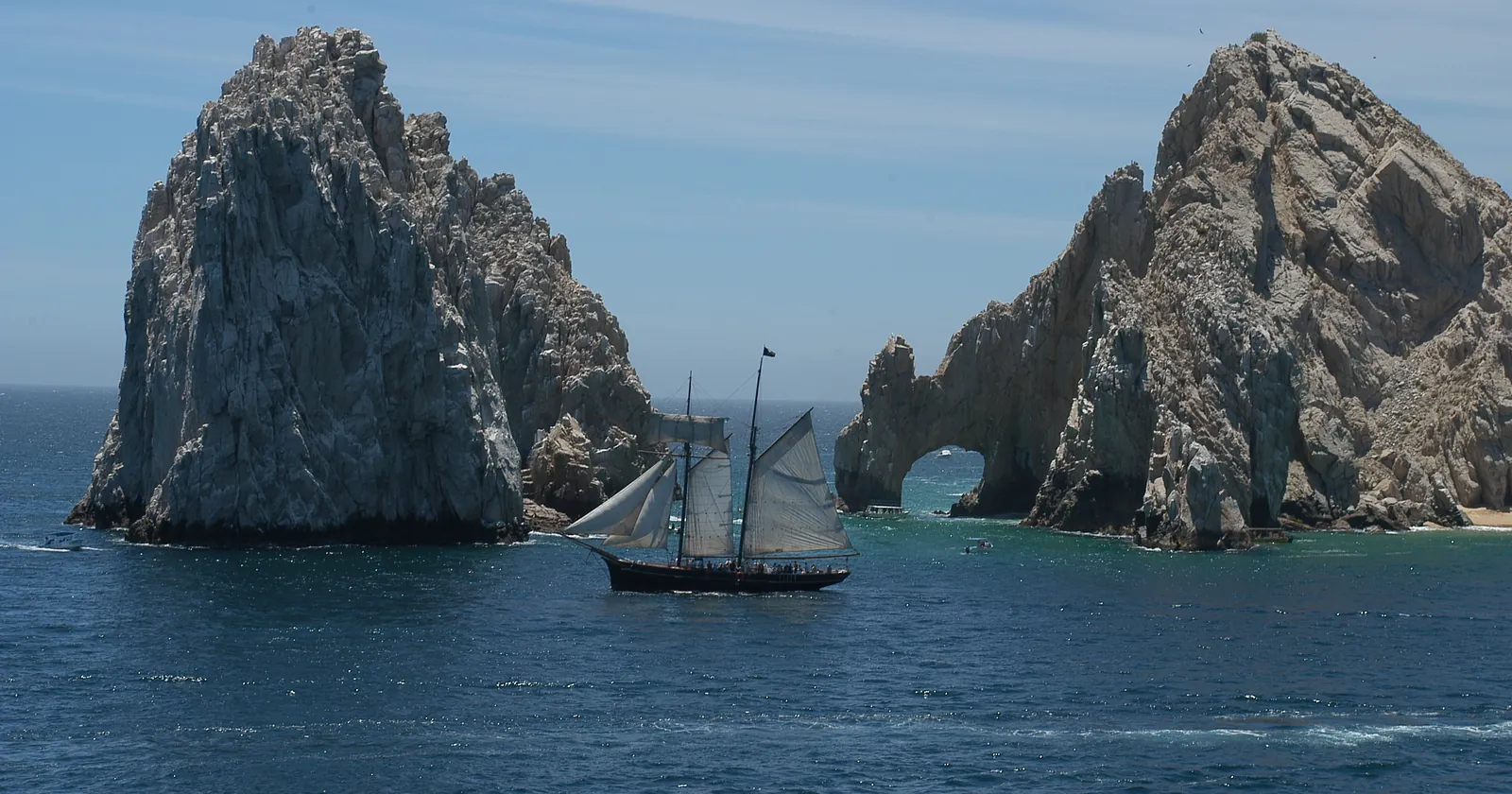
Photo: Lisa Andres, taken from a cruise ship in the bay, Wikimedia Commons, CC BY 2.0, cropped.

Key takeaways
- The Cabo San Lucas protected area still runs on its 1973 decree: article 3 bans fishing of every species and article 4 bans anchoring
- CONANP’s own record lists the area’s management program as not published, so there are no park rules on divers per guide, moorings or gloves at the Arch
- At Cabo Pulmo the 2009 program sets six scuba divers per instructor on the reef by day, three at night, no gloves and two small boats per mooring buoy per hour
- Both parks charge 125.32 pesos per person per day for 2026, rounded to 125; Revillagigedo, 540 km out, charges 3,759.29
- In the 2025-26 whale season, whale watching was barred within 2 kilometers of the Arch, and a whale-watching boat may not put divers in the water at all
Los Cabos diving splits between two protected areas with opposite rulebooks
Most first dives in Los Cabos happen off Land’s End, a short boat ride from the marina at Cabo San Lucas. That water is the Área de Protección de Flora y Fauna Cabo San Lucas, 3,996.04 hectares in CONANP’s record, of which 3,787.99 are sea. It began as a “submarine refuge” by a decree published on 29 November 1973 and was given its current category on 7 June 2000.
The second area is Cabo Pulmo National Park, declared a marine national park on 6 June 1995 off the coast of the municipality of Los Cabos, with 7,111 hectares, and recategorized as a national park by the same 2000 agreement. Measured between the coordinates in the two instruments, it sits roughly 75 kilometers north-east of the Arch in a straight line.
The two are regulated in completely different ways. Cabo Pulmo has a management program, published in the Diario Oficial de la Federación on 13 November 2009, whose administrative rules set how many divers go down per instructor, where boats tie up and when the reef closes for the night. The Arch area has its 1973 decree and not much else, which is why a rule you hear quoted in Cabo San Lucas may belong to a park 75 kilometers away.
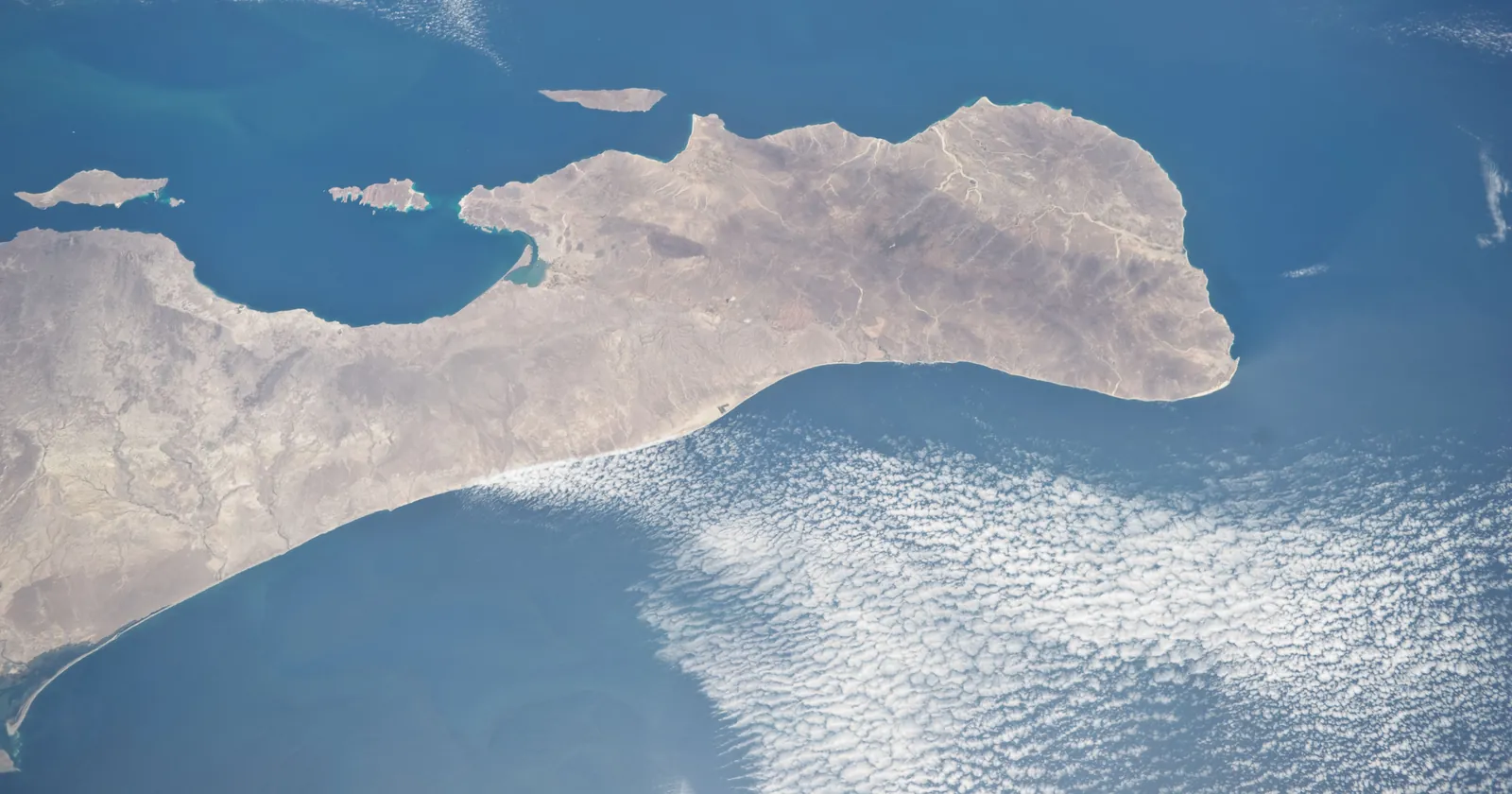

The Arch at Los Cabos sits under a 1973 decree that bans fishing and anchoring
The decree creating the refuge has six short articles. Article 2 draws a box: north to the parallel 22°54′, south to 22°50′50″, west to the meridian 109°54′ and east to 109°50′. Article 3 says that fishing of all species in that zone “queda estrictamente prohibida”, strictly prohibited.
Article 4 is the one a dive boat meets. It is “terminantemente prohibido anclar”, absolutely forbidden to anchor, or to throw toxic or harmful substances, use explosives, or leave fishing waste on the adjacent beaches. The recitals give the reason for all of it: to keep “con toda originalidad” the spectacle of the sand falls on the seabed, to let scientists study erosion in the submarine canyons, and to keep fish in the water so that the place would become “un gran atractivo turístico”.
The 2000 agreement that renamed the refuge did not wipe the decree out. Its article 3 subjects each area to the federal environmental law for its category “y lo estipulado en los decretos correspondientes”, and its first transitory article repeals only those provisions of the old decrees that oppose the agreement itself.
Practice has moved on regardless. CONANP’s 2023 study of the area records that cruise ships anchor at four positions set by the port administration within the harbor limits, and that those anchoring points lie inside the protected polygon. The same study describes a live-bait fishery of a little over 30 fishermen working the area between 2:00 and 6:00, and proposes that it continue.
No management program has been published for the Los Cabos Arch area
At Cabo Pulmo, every dive rule lives in the park’s management program. CONANP’s information system lists the program for Cabo San Lucas as “Resumen DOF no publicado / PM elaborado”: drafted, never published in the official gazette. The download link on that record opens a single page that reads “Programa de manejo no publicado”. The record was last updated on 17 July 2026.
A draft does exist. CONANP put one out for public consultation in August 2012, marked “borrador” on every page. A program takes effect on publication, as the 2009 notice for Cabo Pulmo spells out, so any figure for divers per guide, mooring time or glove use at the Arch that is presented as a park rule has no published rule behind it.
CONANP says as much itself. Its 2023 study, written to justify changing the 1973 decree, states that for diving the mooring sites, the hours and the carrying capacity of each site “serán determinados en el programa de manejo del área que en su momento sea expedido”: they will be set in the program once it is issued. Until then, the number that does apply on a guided dive comes from the federal tourism standard NOM-012-TUR-2016, whose table allows eight certified divers per guide in optimal conditions.
The study also proposes a bigger area. It would add 52.98 hectares of the bay and 437.94 hectares of coral and rocky reef to the north, cut out 173.02 hectares of land that the 1973 box drew over the town, and bring the total to 4,313.94 hectares, with a zoning the old decree never had. The notice opening it for comment appeared in the Diario Oficial on 23 March 2023. CONANP’s record still shows the 1973 decree and 3,996.04 hectares.
The Los Cabos sand falls pour into a canyon whose head starts 20 meters down
The reason the area exists is under the water. CONANP’s study credits Conrad Limbaugh with finding the sand falls in 1959, when a storm had stripped about 30 inches of sand off Playa del Amor and he saw sand pouring over rock like a submerged waterfall at a depth of 110 feet, about 30 meters. The falls run from Playa del Amor to Playa del Pelícano, and the one with the largest flow is the one nearest Playa del Amor.
They drain into the San Lucas submarine canyon. The study gives its main axis a length of 3,900 meters, reaching depths beyond 2,000 meters, with walls showing escarpments of up to 230 meters. Its head sits a few meters off the beach at a depth of about 20 meters, which leaves the shelf in the bay only 1.5 kilometers wide. A US Navy estimate the study cites puts the sand lost down the canyon at around 100,000 cubic meters a year.
The same study reports a coral survey of six dive sites. Coral cover was below 20 percent at every one, highest at Faro Cabeza de Ballena, Barco Varado and Piedra Pelícano. In the northern sites three species of Pocillopora made up more than 80 percent of the coral, and Piedra Pelícano, Pelican Rock to most visitors, was the only site with all five coral groups the survey counted.
The study frames that as acceptable rather than poor. It compares it with Cabo Pulmo, where average coral cover in 2016 was 18 percent, and adds that steeper bottoms around Los Cabos leave less room for corals to settle than the gentler slope at Pulmo. For buoyancy practice before a wall like this, the buoyancy control guide covers the basics.
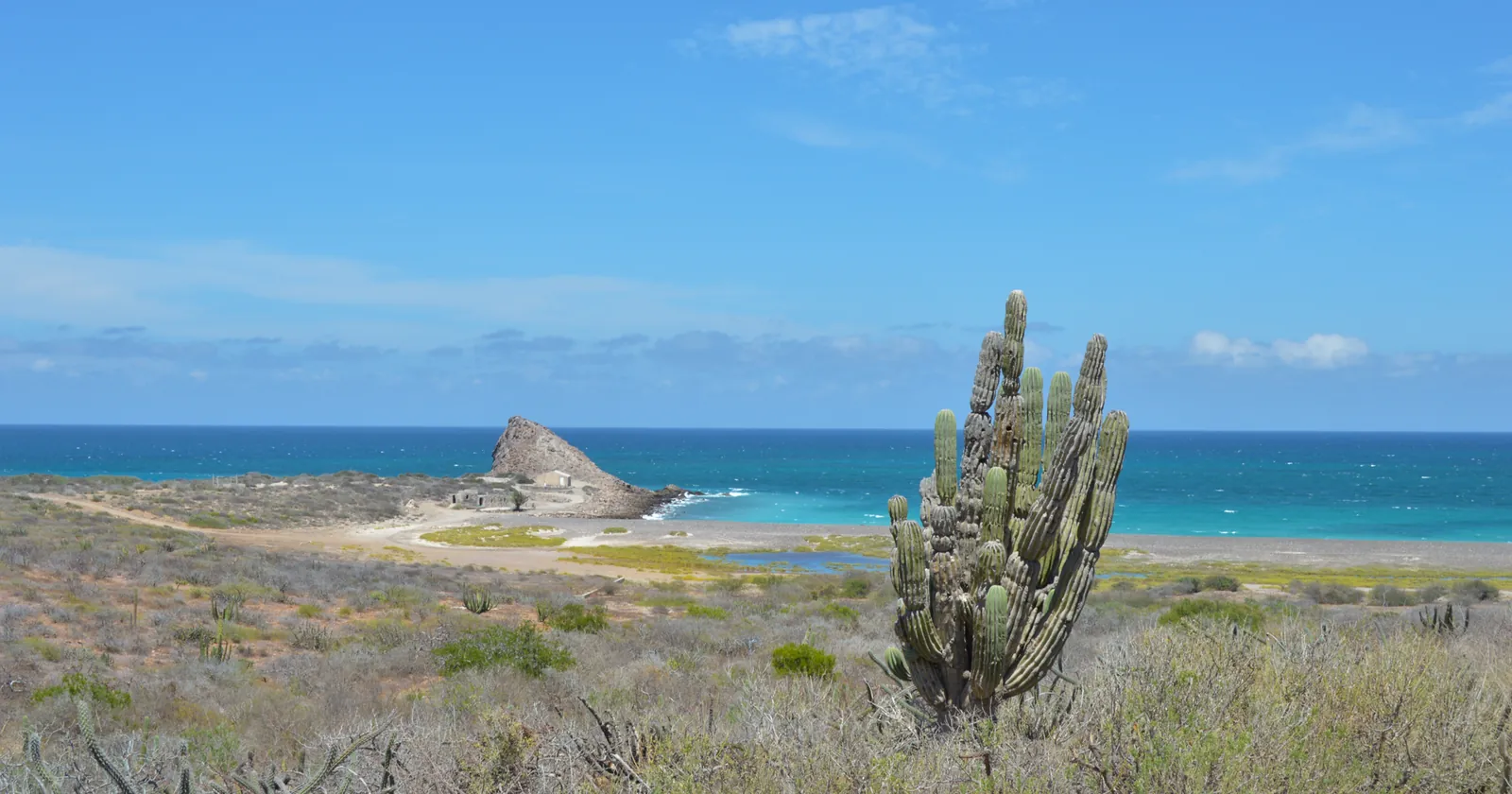

Cabo Pulmo, the Los Cabos coral reef, is a no-take zone only in part
The 1995 decree is unusually direct about why Cabo Pulmo matters. Its recitals call the reef one of the few reef areas in the eastern Pacific and the only one in the Gulf of California, and say it could be the oldest reef on the American Pacific coast, with a Late Pleistocene marine terrace in the bay dated from the corals in it.
Article 7 of the decree bans anchoring boats, platforms or infrastructure of any kind, “particularmente en las zonas arrecifales”, along with dredging, explosives and the extraction of coral. The decree gave the authorities 365 working days to write the management program. It was published fourteen years later, in November 2009.
Cabo Pulmo is often called a no-take reserve, including in the 2011 study that made its name. The 2009 program is narrower. Fishing of any kind is prohibited in preservation subzone 1, the 2,555.68 hectares over the reef itself, including Las Tachuelas, Los Mangles and the main reef off the village with Los Morros, El Bajo and La Esperanza. Anchoring is banned there too.
The remaining 4,557.37 hectares of sea are a sustainable-use subzone. There, the program permits anchoring of small boats, bait collection by residents with hook and line, domestic-consumption fishing, and sport fishing in catch-and-release mode. Divers share that outer water with rods.
What the closure did on the reef is documented. Aburto-Oropeza and co-authors, writing in PLOS ONE in 2011, measured total fish biomass rising from 0.75 tonnes per hectare in 1999 to 4.24 in 2009, an increase of 463 percent. Top predators grew elevenfold, and fish biomass in other protected and open-access areas of the Gulf did not change significantly over the same decade.
Six divers per instructor and no gloves: the Cabo Pulmo rules on a Los Cabos trip
Rule 32 sets the daytime ratio by subzone. On the reef, preservation subzone 1, one instructor may take six scuba divers or eight snorkelers. In the outer sustainable-use subzone the figure is eight for both. The rule adds that the instructor or leader must stay with the group for the whole dive.
Night is tighter. Rule 26 splits the diving day into daytime, 6:00 to 19:00, and night, 19:00 to 22:00, so no dive in the park runs later than that. Rule 33 caps a night dive at three scuba divers or five snorkelers per instructor in either subzone. The night diving guide covers the skills; the ratio here is the park’s.
Rule 30 is two sentences: keep at least 2.5 meters from rock or coral formations, and gloves are prohibited “a excepción de lo establecido en la regla 33”. Rule 33 is the night-ratio table and says nothing about gloves. As published, the exception points at nothing, so there is no written case in which gloves are allowed.
Rules 34 and 35 grade the reef units by experience. Las Tachuelas, Islote Piedra, Lobera and one Cabo Pulmo unit need divers certified with at least one star or equivalent. Los Morros and El Bajo, the Barco Hundido wreck, La Esperanza and Barra No. 5, Punto, Los Frailes and a second Cabo Pulmo unit need at least three stars or equivalent. The program does not say whose star system it means, so bring your logbook as well as your card.
The boat rules are just as specific. Only small boats, up to ten passengers and under 12 meters, may run dive trips (rule 47). Each mooring buoy takes two boats per hour, and a boat that finds it taken must wait more than 50 meters off, with nobody in the water until it is tied on (rule 48). From 200 meters before the buoys the limit is 4 knots (rule 50). Anchoring is allowed only on sand in marked sites (rule 56).
Snorkelers on the reef must wear a life jacket, guides included (rule 27), and every diver needs a certification from an internationally recognized agency and a certified guide or instructor (rule 28). Rule 29 still sends operators to NOM-05-TUR-2003 for equipment, a standard cancelled in 2016; the La Paz diving guide sets out what replaced it.
Los Cabos humpback season closes 2 kilometers around the Arch to whale watching
In winter, humpbacks are part of the Los Cabos dive calendar. The whale-watching standard NOM-131-SEMARNAT-2010 states in its recitals that humpbacks are especially concentrated in the Los Cabos region during their winter breeding migration, and SEMARNAT publishes a notice each year fixing the season and the restricted zones.
For 2025-26 the notice, published on 10 October 2025, opened the season in the Cabo San Lucas protected area and San José del Cabo from 15 December 2025 to 30 April 2026. It set two restricted zones there “debido a la excesiva navegación”, because of excessive boat traffic: the northern part of the polygon in the port area, including 2 kilometers around the Arch, and a 1-kilometer strip seaward from Punta Ballenas. At Cabo Pulmo it restricted a coastal strip 3.5 kilometers wide.
The standard itself is blunt about mixing the two activities. Section 4.19(d) says that during whale watching nobody may fish, dive, swim, water-ski or parasail. A boat running a whale trip cannot put you in the water with the animals, whatever is on offer at the dock. The notice for 2026-27 had not been published by 25 September 2026, so check the dates for the season you travel in.
Water off Los Cabos runs from about 19°C to 30.5°C, warmest from July to November
CONANP’s study used NOAA’s reconstructed monthly sea-surface temperature record from 1870 to 2015 for the square around Cabo San Lucas. The long-run mean was 24.38°C, give or take 2.68, with a sharp split between warm months, July to November, and cool ones, December to June. Monthly values reached a maximum of 30.5°C in some years and a minimum of 19°C.
El Niño years push the surface close to or above 30°C. A separate series the study cites puts its historical low at 20.07°C in February 1989. The study also finds more warm anomalies since 1990. In practice the cool half is also whale season, which is when a proper wetsuit earns its place.
The warm half also overlaps the eastern Pacific hurricane season. The La Paz guide sets out its dates from the US National Hurricane Center and what Hurricane Odile did to the peninsula in 2014.
Gordo Banks off Los Cabos is where pregnant whale sharks turn up
The seamount that Los Cabos boats run to for big animals is called Banco Gordo in the literature, sold in English as Gordo or Gorda Banks. The best peer-reviewed account of what visits it comes from a 2017 tagging study in PeerJ by Ramírez-Macías and co-authors, and it is about whale sharks rather than the hammerheads on the posters.
The paper describes adults, “specifically pregnant females”, as seasonally present at Banco Gordo and at Isla Espíritu Santo, while juveniles are found in coastal areas. One pregnant shark tagged at Banco Gordo on 8 May 2012 was photographed at Roca Partida in the Revillagigedo Islands on 22 November 2012, still pregnant.
That makes this a different encounter from the one in the Bahía de La Paz, where the same paper describes mostly juvenile males feeding in shallow water. It also named Banco Gordo in 2017 as one of two of its five whale shark sites that remained unprotected. For how this compares with other places, see the whale shark destinations page.
Los Cabos park fees in 2026: 125 pesos at the Arch and Cabo Pulmo, 3,760 at Revillagigedo
Article 198 of the Ley Federal de Derechos lists both Los Cabos parks by name in fracción I Ter, the tier for areas of medium carrying capacity. For 2026 that is 125.32 pesos per person per day for scuba, snorkeling, boat tours and other non-extractive use, which the article rounds to multiples of 5 pesos, so 125 pesos in practice. The payment falls on the permit-holding operator; the Cancún diving guide explains how that works.
Mexican nationals and foreign residents who can prove it pay half. Children under 12, people with disabilities, pensioners and holders of the INAPAM seniors card pay nothing. Rule 12 of the Cabo Pulmo program repeats the fee duty for tourism operators and makes them carry their CONANP authorization during the activity and show it on request.
Revillagigedo is priced on its own. The national park declared on 27 November 2017, which its program places 540 kilometers from the municipality of Los Cabos, is one of two areas in fracción I Bis: 3,759.29 pesos per person per day, rounded to 3,760. The annual pass that covers every other protected area for the same 3,759.29 pesos excludes it.
Its 2018 program is strict about diving too. Groups are capped at eight divers per guide, each diver may make at most four dives a day, and diving runs from 7:00 to 30 minutes before sunset, so night diving is not allowed. Two groups may not dive the same site at once, and rule 34 says to avoid jumping in to see whales, especially with calves. The liveaboard destinations page covers the trip itself.
The Los Cabos recompression chamber is in Cabo San Lucas
The Subaquatic Safety Services network runs a recompression chamber in Cabo San Lucas, which it describes as its west-coast chamber since 1996. Its own page gives the address as Adolfo López Mateos Street, between Leona Vicario and José María Morelos, Ejidal Chamizal, 23470 Cabo San Lucas, and the emergency line as +52 624 160 9393, with +52 624 143 3666 as a second number, both as read on 25 September 2026.
The network says it works with the Red Cross, the fire brigade and the coast guard on evacuations, and uses double-lock multiplace chambers. Hospital H+ Los Cabos, at kilometer 24.5 of the Transpeninsular highway in San José del Cabo, describes its own chamber as a monoplace medical unit and does not mention diving on its page, so ask before assuming it treats divers.
NOM-012-TUR-2016 requires every dive operator to carry a first-aid kit and oxygen equipment (8.3) and to hold a written contingency plan that identifies the nearest place of medical care (8.4). Ask to see that plan, ask how the boat gets you back from Cabo Pulmo, and check that your dive insurance covers the chamber and the evacuation.
Six dive businesses are listed for Los Cabos, filed under four different towns
The Los Cabos operator list, compiled on 21 September 2026, holds six businesses. Four are published by SSI in its register of affiliated centers, and SSI files them under four different towns: Cabo San Lucas, San José del Cabo, “Cabo Pulmas”, which reads as Cabo Pulmo, and La Paz. The town field is where the register files a business, not proof of where its boats go.
The other two are Green Fins digital members, which means they completed a self-evaluation and were not assessed in person. Five of the six publish a website, and SSI rates two of its four centers for Freediving, which describes the listing rather than a course running this season.
None of that says whether a business holds the CONANP authorization that rule 12 at Cabo Pulmo requires, and that authorization is not published as a list. Ask for it, and for the contingency plan. Which registers can be read explains what each source can and cannot tell you.
FAQ: scuba diving in Los Cabos
Do you pay a park fee to dive in Los Cabos?
Yes. Article 198 of the Ley Federal de Derechos puts both the Cabo San Lucas protected area and Cabo Pulmo National Park in fracción I Ter, at 125.32 pesos per person per day for 2026, rounded to 125 pesos for payment. The obligation to pay falls on the permit-holding operator. Mexican nationals and foreign residents pay half, and children under 12 are exempt.
What are the dive rules at Cabo Pulmo?
The 2009 management program allows six scuba divers per instructor on the reef by day and three at night, with night diving ending at 22:00. Gloves are prohibited and divers must stay 2.5 meters from rock and coral. Only small boats may run dive trips, two per mooring buoy per hour, at no more than 4 knots within 200 meters of the buoys.
Are there park rules for diving at the Arch in Cabo San Lucas?
Only the 1973 decree, which bans fishing of every species and bans anchoring in the zone. CONANP lists the area's management program as not published, and its 2023 study says dive moorings, hours and carrying capacity will be set once a program is issued. On a guided dive, the federal tourism standard NOM-012-TUR-2016 allows eight certified divers per guide in optimal conditions.
Where is the recompression chamber in Los Cabos?
The Subaquatic Safety Services network runs one in Cabo San Lucas, on Adolfo López Mateos Street between Leona Vicario and José María Morelos, Ejidal Chamizal. Its own page gives the emergency number as +52 624 160 9393, as read on 25 September 2026. Every Mexican dive operator must carry oxygen and hold a written contingency plan naming the nearest medical care.
When is the water warmest for diving in Los Cabos?
From July to November. CONANP's analysis of NOAA's sea-surface temperature record for the waters off Cabo San Lucas gives a long-run mean of 24.38 degrees Celsius, with warm months from July to November and cool ones from December to June. Monthly values have reached 30.5 degrees at the top and 19 degrees at the bottom.
Note: Conditions, safety guidance and regulations change. Verify current information with official sources, including the dive operator, the park authority and the relevant government department, before you travel or dive.
Founder of NOMADREEF and a former digital nomad. This guide is sourced from the references below; conditions, prices and rules change, so verify current details, and follow qualified local guidance and safety briefings. About the author · LinkedIn ↗
Sources
- The Arch area decree (primary). Decreto por el que se establece como zona de Refugio Submarino de Flora, Fauna y Condiciones Ecológicas del Fondo, la ubicada en Cabo San Lucas, DOF 29 November 1973, pages 5 and 6: article 2 on the box between 22°54′ and 22°50′50″ north and 109°54′ and 109°50′ west; article 3, “Queda estrictamente prohibida la pesca de todas las especies”; article 4 on anchoring, toxic substances, explosives and fishing waste; the recitals on the sand falls, the canyons and tourism. DOF, 29 November 1973 (scan held by CONANP, PDF). Read 25 September 2026.
- The 2000 recategorization (primary). Acuerdo que tiene por objeto dotar con una categoría acorde con la legislación vigente a las superficies que fueron objeto de diversas declaratorias de áreas naturales protegidas, DOF 7 June 2000: item 3, Cabo Pulmo with 7,111-01-00 hectares becoming a national park; item 10, the Cabo San Lucas refuge becoming an Área de Protección de Flora y Fauna; article 3 keeping each area subject to “lo estipulado en los decretos correspondientes”; first transitory article repealing only provisions opposed to the agreement. DOF, 7 June 2000 (PDF held by CONANP). Read 25 September 2026.
- The unpublished program (primary). CONANP, SIMEC record for the Área de Protección de Flora y Fauna Cabo San Lucas: total area 3,996.04 ha, marine 3,787.99 ha, decree 29/11/1973, recategorization 07/06/2000, “Programa de Manejo: Resumen DOF no publicado / PM elaborado”, last updated 17/07/2026; the linked program file reads “Programa de manejo no publicado”. SIMEC, Cabo San Lucas and program file (PDF). The August 2012 consultation draft, marked “borrador”: CONANP, draft program (PDF). Read 25 September 2026.
- CONANP’s 2023 study of the Arch area (primary). Estudio Previo Justificativo para la modificación de la declaratoria del Área de Protección de Flora y Fauna Cabo San Lucas, CONANP, February 2023, 154 pages: the program begun in 2012; the proposal to add 52-97-93.26 ha of bay and 437-93-75.44 ha of reef, exclude 173-02-20.97 ha of land and reach 4,313-94-39.09 ha; cruise ships anchoring at four positions inside the polygon; the live-bait fishery; diving moorings, hours and carrying capacity to be set in the program “que en su momento sea expedido”; Limbaugh’s 1959 discovery at 110 feet; the falls from Playa del Amor to Playa del Pelícano; the canyon at 3,900 m, beyond 2,000 m deep, escarpments to 230 m, head at 20 m, shelf 1.5 km wide; the US Navy estimate of about 100,000 m³ of sand a year as cited from Alcérreca-Huerta et al. (2016); the coral survey of six sites (Reyes-Bonilla, 2017) with cover below 20 percent, Pocillopora above 80 percent in the north, Piedra Pelícano with all five groups, and Cabo Pulmo at 18 percent in 2016; the NOAA ERSST analysis for 22.5°N 109.5°W with a mean of 24.38 ± 2.68°C, warm months July to November, extremes of 30.5 and 19°C, and the 1989 minimum of 20.07°C cited from Reyes-Bonilla and Torrejón-Arellano (2008). CONANP, EPJ Cabo San Lucas (PDF), with the notice opening it for comment, DOF 23 March 2023 (PDF). Read 25 September 2026. No decree modifying the area was found, and the SIMEC record of 17 July 2026 still shows the 1973 figures, so the page describes the proposal as a proposal.
- The Cabo Pulmo decree (primary). Decreto por el que se declara área natural protegida con el carácter de Parque Marino Nacional la zona conocida como Cabo Pulmo, DOF 6 June 1995: the recitals on the only reef area in the Gulf of California and possibly the oldest on the American Pacific; article 7 on anchoring “particularmente en las zonas arrecifales” and coral extraction; second transitory article giving 365 working days for the program. DOF, 6 June 1995 (scan held by CONANP, PDF). Read 25 September 2026.
- The Cabo Pulmo rules (primary). Aviso and Programa de Conservación y Manejo del Parque Nacional Cabo Pulmo, DOF 13 November 2009, administrative rules: 12 (operator authorization and fees), 26 (day and night hours), 27 (life jackets), 28 and 29 (certification and NOM-05-TUR-2003), 30 (2.5 meters and gloves, with its reference to rule 33), 32 and 33 (ratios), 34 and 35 (one-star and three-star units, two boats per buoy per hour), 47, 48 and 50 (small boats, buoys, 4 knots), 56 (anchoring on sand), 68 and the subzoning text for SP1 (2,555.68 ha) and SASRN 1 (4,557.37 ha). CONANP’s SIMEC record lists this 2009 text as the park’s program. DOF, 13 November 2009 and SIMEC, Cabo Pulmo. Read 25 September 2026. The straight-line distance of about 75 km between the two areas was calculated for this page from the 1973 box and the SP1 coordinates.
- What the reef closure did (peer-reviewed). Aburto-Oropeza O, Erisman B, Galland GR, Mascareñas-Osorio I, Sala E, Ezcurra E (2011), Large Recovery of Fish Biomass in a No-Take Marine Reserve, PLOS ONE 6(8): e23601: 0.75 t/ha in 1999 to 4.24 t/ha in 2009, 463 percent; top predators up 11 times; no significant change elsewhere. doi:10.1371/journal.pone.0023601. Read 25 September 2026.
- The fees (primary). Ley Federal de Derechos, consolidated text, last reform DOF 7 November 2025, amounts for 2026 updated by the Resolución Miscelánea Fiscal of 28 December 2025: article 198, fracción I Bis at 3,759.29 pesos (Revillagigedo, Isla Guadalupe), fracción I Ter at 125.32 pesos listing the Área de Protección de Flora y Fauna Cabo San Lucas and the Parque Nacional Cabo Pulmo, fracción III, the payer, the exemptions and discounts, and rounding to multiples of 5 pesos. Cámara de Diputados, LFD (PDF), read from the Internet Archive copy of 15 September 2026. Read 25 September 2026.
- The whale-watching standard (primary). NOM-131-SEMARNAT-2010, DOF 17 October 2011: the recital on humpbacks concentrated in the Los Cabos region; section 4.19(d) barring fishing, diving, swimming, water-skiing and parasailing during whale watching; section 4.20 on restricted zones set by annual notice. CONANP’s 2023 study describes it as in force and applicable to the Cabo San Lucas area. DOF, 17 October 2011. Read 25 September 2026.
- The 2025-26 season (primary). Aviso mediante el cual se da a conocer al público en general la temporada 2025-2026 para llevar a cabo actividades de observación de ballenas, DOF 10 October 2025, items II E and II F: 15 December 2025 to 30 April 2026; the port area and 2 km around the Arch; the 1 km strip from Punta Ballenas; the 3.5 km strip at Cabo Pulmo. DOF, 10 October 2025, read in the SIDOF copy. Read 25 September 2026.
- Whale sharks at Banco Gordo (peer-reviewed). Ramírez-Macías D, Queiroz N, Pierce SJ, Humphries NE, Sims DW, Brunnschweiler JM (2017), Oceanic adults, coastal juveniles: tracking the habitat use of whale sharks off the Pacific coast of Mexico, PeerJ 5: e3271: adults, “specifically pregnant females”, seasonally present at Banco Gordo; the shark tagged there on 8 May 2012 and seen pregnant at Roca Partida on 22 November 2012; Banco Gordo among the sites that “remain unprotected”. doi:10.7717/peerj.3271. Read 25 September 2026.
- Revillagigedo (primary). Acuerdo por el que se da a conocer el resumen del Programa de Manejo del Parque Nacional Revillagigedo, DOF 30 November 2018: the decree of 27 November 2017; rules 32 (7:00 to 30 minutes before sunset, no night diving), 34 (whales), 37 and 39 (eight divers per guide, four dives a day), 38 (one group per site). DOF, 30 November 2018; the distance of 540 km from the municipality of Los Cabos from the full program, CONANP, Programa de Manejo (PDF). Read 25 September 2026.
- The operator standard (primary). NOM-012-TUR-2016, DOF 2 September 2016: sections 8.3 (first-aid kit and oxygen) and 8.4 (written contingency plan naming the nearest medical care); the ratio table at 8:1 for certified divers; second transitory article cancelling NOM-05-TUR-2003. DOF, 2 September 2016. Read 25 September 2026.
- The chambers (primary, each facility’s own page). Subaquatic Safety Services, Cabo San Lucas chamber: address, emergency numbers +52 624 160 9393 and +52 624 143 3666; network page: west-coast chamber since 1996, evacuations with the Red Cross, fire brigade and coast guard, double-lock multiplace chambers. SSS, Cabo San Lucas and SSS, Mexico. Hospital H+ Los Cabos, monoplace Sechrist chamber, San José del Cabo: H+ Los Cabos, cámara hiperbárica. Read 25 September 2026. Phone numbers change; confirm them before your trip.
- Left out. The scalloped hammerheads that Gordo Banks trips are sold on: no primary or peer-reviewed account of hammerheads at this bank was read for this page, and a 2012 paper on whale sharks there (Ramírez-Macías et al., Endangered Species Research 18: 115–128) could not be retrieved in full, so neither the hammerheads nor their season are stated here. The depth and distance of Gordo Banks, and the site known as Neptune’s Finger, are given only by operators and are left out for the same reason. The 2026-27 whale season notice was not yet published.
- The six businesses. Six dive businesses on the Los Cabos operator list, compiled 21 September 2026: four published by SSI in its register of affiliated centers, filed under Cabo San Lucas, San José del Cabo, “Cabo Pulmas” and La Paz BCS, two of them rated for Freediving; two Green Fins digital members, self-evaluated and not assessed in person. Five of the six publish a website. The register’s town field records where a body files a business, not necessarily where it operates, and the limits of each source are set out on which registers can be read.