Cancun Diving: A National Park That Closes Its Best Reefs and Built a Museum to Spare the Rest
 by Yannick Schroth
Sep 24, 2026
13 min read
by Yannick Schroth
Sep 24, 2026
13 min read
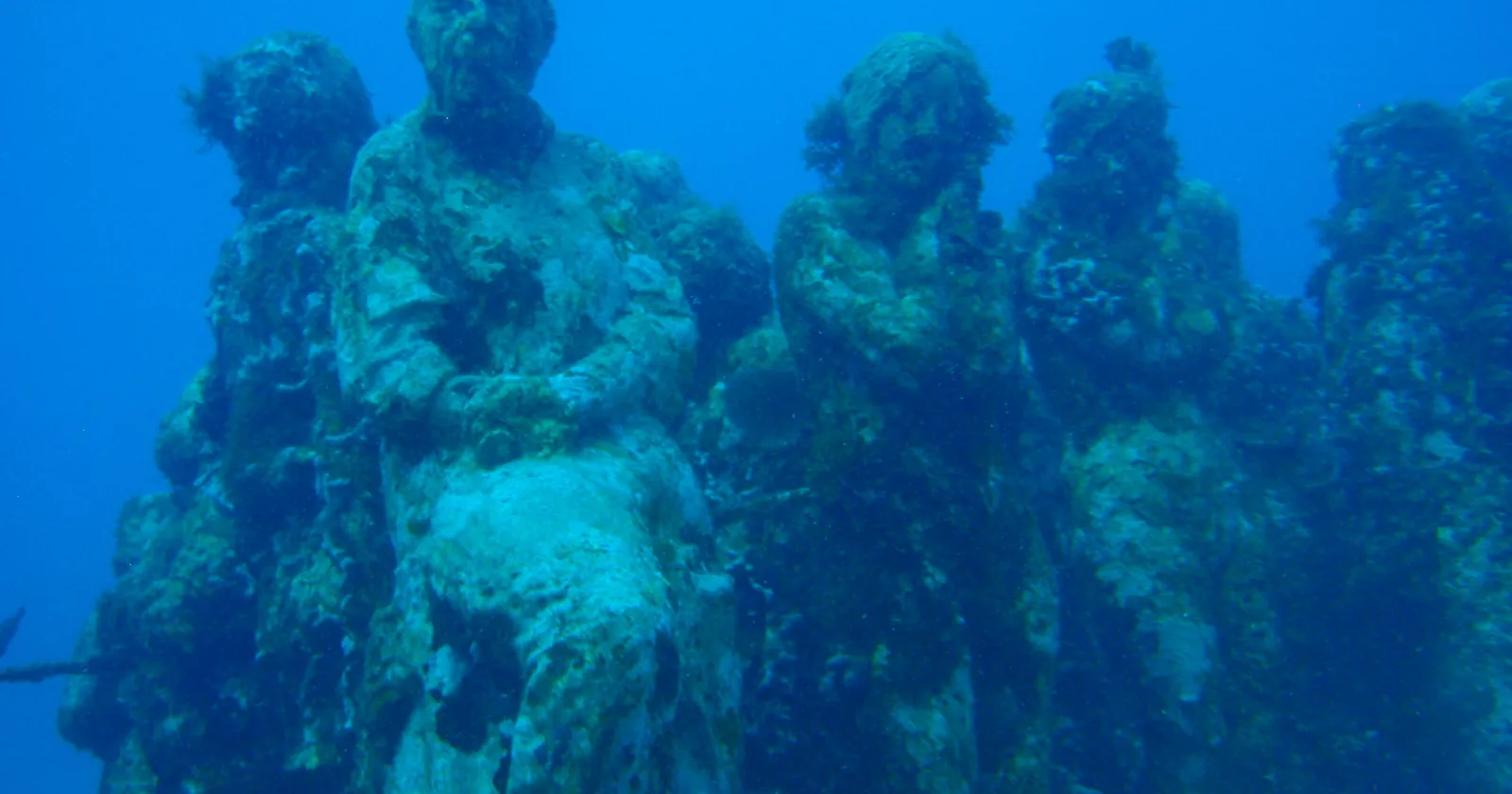
Photo: Andy Blackledge, Wikimedia Commons, CC BY 2.0. Sculptures by Jason deCaires Taylor.
.jpg)
Key takeaways
- Six reef units covering 436 hectares, including the Tercera Barrera at Punta Nizuc that the park calls its best-developed reef, are a preservation subzone where scuba, snorkeling and night diving are not permitted
- The park caps a dive group at six divers per guide by day and four at night, bans gloves except on the wrecks, and lets only the guide carry a knife
- The 2026 fee under article 198 of the Ley Federal de Derechos is 125.32 pesos a day, rounded to 125; foreign residents of Mexico pay half
- MUSA held 529 sculptures on 125 artificial habitats by 2015, placed under the park’s policy of steering visitors away from natural reef
- Whale shark trips run from 15 May to 17 September and are a surface swim, two people and a guide in the water at a time, with no breath-hold descents
Cancun diving happens inside a national park drawn in three pieces
The reefs you reach by boat from Cancun’s hotel zone lie in the Parque Nacional Costa Occidental de Isla Mujeres, Punta Cancún y Punta Nizuc. It was declared by presidential decree in the Diario Oficial de la Federación on 19 July 1996 as a marine national park of 8,673 hectares, and an agreement of 7 June 2000 gave it its present category of national park.
The name is the map. The park is three separate polygons: the west coast of Isla Mujeres, the point of Punta Cancún at the top of the hotel zone, and Punta Nizuc at its southern end. CONANP, the federal protected areas agency that runs it, places it in the Mesoamerican Reef System and lists elkhorn and staghorn coral, hawksbill turtles, spotted eagle rays and queen conch among its representative species.
What governs a dive is the management program, whose summary SEMARNAT republished in full on 2 August 2016 with new subzones and sixty administrative rules. Those rules decide which reefs you can visit, how many divers share a guide and who owes the daily fee. In Cancun they shape the dive as much as the water does, which is why most of this page is about them.
South of the hotel zone the coast changes character. Cozumel dives its own national park, compared on Cozumel vs Playa del Carmen, and Playa del Carmen diving leans on caves and a winter bull shark season. Cancun’s own offer is shallower and far more regulated at the reef.
Cancun’s best-kept reefs are closed to scuba and snorkeling
Rule 52 splits the park into five subzones, and the one with the finest coral is the one divers cannot use. The Preservation Subzone of Restricted Reef Units covers 436.39 hectares in six pieces: La Cadenita off Playa Norte on Isla Mujeres, a stretch of the island’s eastern shore, El Bajito off Punta Cancún, and at Punta Nizuc the Tercera Barrera Norte, a small Bajito inside the lagoon and the Tercera Barrera Sur.
The program’s table for this subzone lists scuba diving, snorkeling, night diving, surface-supplied diving and snuba as not permitted, alongside feeding or chasing marine life and anchoring on coral. What it allows is scientific research, monitoring, collection under permit, filming and low-impact productive activity.
The reason is written next to each piece. The program calls the third barrier at Punta Nizuc the best-developed reef in the whole park, with its highest diversity of stony corals and elkhorn colonies in very good condition, adapted to the surf. The small Bajito holds elkhorn it describes as well preserved and free of disease. La Cadenita, one of the few sites with significant Acropora cover, already saw no recreational use because of its current.
Another reef is closed for a different reason. Cuevones, a patch reef north of Punta Cancún, was struck by a cruise ship in 1997, which damaged more than 400 square meters, and it has been closed to the public since 1998. When the impacted area was surveyed again in 2011, live coral cover had risen from 1.3 to only 4.5 percent in thirteen years. Tourism is on its list of activities not permitted.
.jpg)
Where Cancun divers go instead: Manchones, Chitales and the deep reefs
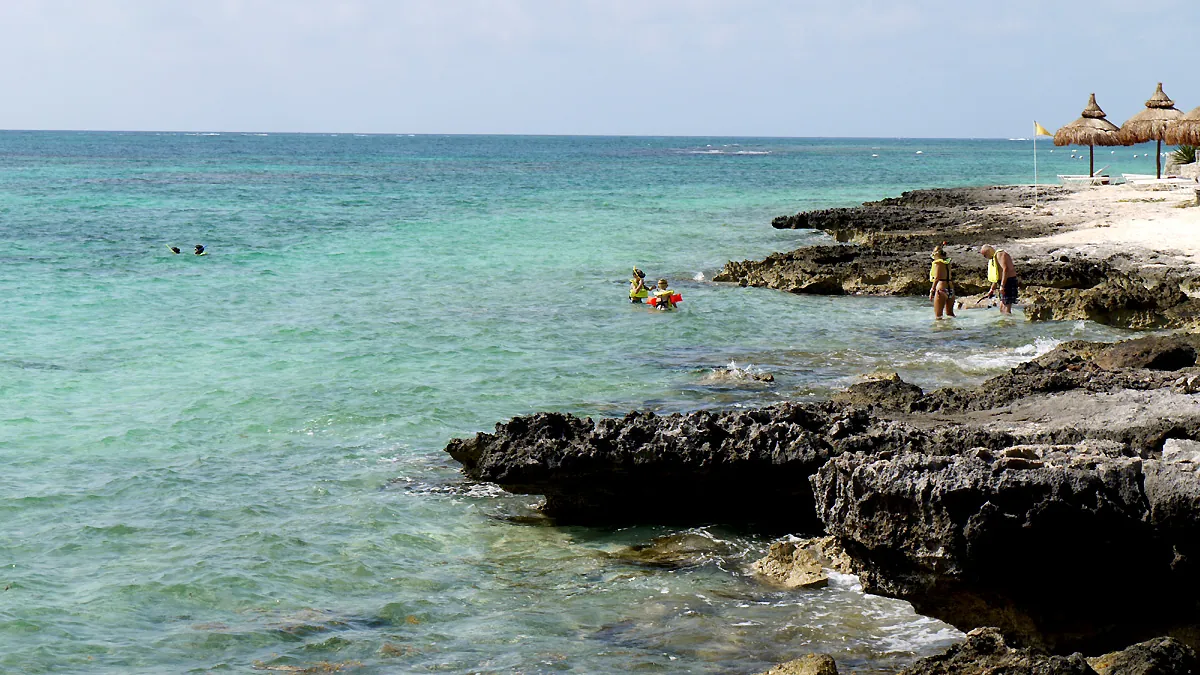
The reefs open to divers sit in Public Use Subzone 2, 1,219.38 hectares in nine pieces. On the Isla Mujeres side they are El Farito and Sac Bajo, El Garrafón and Manchones Grande and Chico. Off Punta Cancún they are La Bandera, Barbones, Chitales Grande and Chico, Santo Remedio and a large block the program calls the Arrecifes Profundos. At Nizuc it is the first and second barriers.
The descriptions are frank. Manchones averages 10 meters, with coral heads 3 to 5 meters tall, and is among the most used shallow dive sites, but the program rates its state of conservation as bad, with heavy sediment and brown algae. Chitales, 10 meters at most, has long been the reef chosen for scuba training. The deep reefs east of Punta Cancún lie between 12 and 18 meters and are used mainly for scuba.
The hurricane table is worth reading before you judge a reef by its brochure. Wilma in 2005 damaged 37 percent of coral colonies at Manchones Grande, 49 percent at Chitales Grande and 34 percent at Chitales Chico. Iván had already damaged a quarter of the colonies at Manchones Grande in 2004, and Dean in 2007 affected between 6 and 10.2 percent of colonies on the Nizuc barriers.
Two navy gunboats lie in the Punta Cancún polygon. The ex-C-58 Anaya was sunk on 28 May 2000 at 80 feet, 24 meters, and the ex-C-55 Juan de la Barrera followed on 25 October the same year, both donated by the Mexican Navy to create alternative dive sites. The program states that the site has strong to moderate currents and is not recommended for beginners. It prints the same coordinates for both hulls, so that position cannot tell them apart.
Rule 47 adds a condition for the natural reefs in this subzone: scuba there requires at least a basic national or international certification. Rule 4 confines night scuba to the artificial habitats, until 10 p.m. Anyone planning a first dive should read those two rules together before choosing a site.
MUSA, Cancun’s underwater museum, was placed to pull divers off the reef
The management program describes MUSA as policy rather than attraction. It says the Museo Subacuático de Arte began in 2008 as part of a strategy to move visitors away from the natural reef units to alternative sites, with 12 galleries planned across the three polygons. By 2015, it records, 529 sculptures stood on 125 artificial habitats, outside the Manchones reef unit off Isla Mujeres and at Punta Nizuc near the first barrier.
In the program’s own classification the sculptures are artificial habitat inside a national park, listed under the same heading as the sunken gunboats and the reef balls. The park had already placed about 98 reef balls and layer cakes at Sac Bajo in September 2005, at about 4 meters, to take visitors off El Farito, and 127 more in June 2007 south of Manchones, at 7.6 to 9.1 meters.
The British sculptor Jason deCaires Taylor, whose figures fill the galleries, states that the project was commissioned by the national marine park and the Cancún Nautical Association and installed in 2009. His studio gives the Manchones gallery a depth of 8 meters, for divers and snorkelers, and the Nizuc gallery 4 meters, for snorkeling only. The figures are cast in pH-neutral cement meant to encourage coral growth.
The program is candid that sculptures alone do not solve the problem. It notes that tourism stays under 30 percent of the park’s average annual carrying capacity, yet reef indicators at the most visited units still call for control of visitor loads. MUSA is one of the tools it names for that. The rules on the boat are the others.
Six divers per guide and no gloves: the rules on a Cancun dive boat
Rule 46 is the paragraph to know before you board. On scuba you keep at least 2 meters from coral formations. Gloves are banned except on the wrecks. An accredited dive guide must supervise under NOM-05-TUR-2003, the official standard on minimum safety requirements for dive operators, and only the guide may carry a knife. The ceiling is six divers per guide by day and four at night.
Rule 48 keeps any descent line at least 15 meters from coral. Rule 18 makes the operator assign a guide to each scuba group, preferably from the surrounding communities, and rule 16 requires the operator to tell you that you are entering a protected area and which rules apply. Snorkelers wear a life vest or waist float, keep 2 meters off the coral and go in groups of at most 12 per guide.
The boats have their own limits. Tourist activities run from 8:00 to 17:00 in winter time and 7:00 to 17:00 in summer time. Within 200 meters of the mooring buoys and in the access channels the speed limit is 4 knots, boats tie to the buoys rather than anchor, and rule 21 fixes the fleet at 629 motorized boats carrying up to 6,106 passengers across the park.
The table for the public reefs lists one more item among the permitted activities: sunscreen or tanning products that are exclusively biodegradable. The word on a bottle is not a guarantee, and our reef-safe sunscreen page covers what a label can and cannot tell you.
Cancun’s park fee is 125 pesos a day, and the law puts it on the operator
The fee is a federal derecho under article 198 of the Ley Federal de Derechos, charged per person per day for non-extractive use of a protected area, scuba and snorkeling included. The park sits in fracción I Ter, the tier for areas of medium carrying capacity. The consolidated text, with amounts updated for 2026 by the tax resolution published on 28 December 2025, sets that tier at 125.32 pesos.
Article 198 also says the amounts are rounded to multiples of 5 pesos for payment, which is why CONANP’s page for the park states 125 pesos per person per day. The tier was set at 120.74 pesos by the decree of 19 December 2024, in force from 1 January 2025, and the 2026 figure is that amount updated.
CONANP sells the bracelet, the Brazalete de la Conservación, to individuals online, so it looks like a ticket the diver buys. Article 198 reads the other way round: the obligation to pay falls on the holders of permits for tourist and nautical services, and only when an activity happens without such an operator does it fall on each individual. Rule 23 then makes the operator fit the bracelet, pass or badge visibly on each user, to be worn for the whole stay. Ask whether it is in the price.
Children under 12, people with disabilities, older adults with an INAPAM card, pensioners and retirees pay nothing. Students and teachers with a valid card get 75 percent off. Mexican nationals and foreigners resident in Mexico get 50 percent off if they prove nationality or residence, which matters to anyone living in Cancun on a residency card rather than visiting.
Day trips from Cancun cross other tiers. Isla Contoy and the Whale Shark Biosphere Reserve sit in fracción I, at 225.56 pesos a day for 2026, while the Caribe Mexicano Biosphere Reserve and the Arrecife de Puerto Morelos national park share the Cancun park’s tier. An annual option under fracción III covers every federal protected area except Revillagigedo and Isla Guadalupe for 3,759.29 pesos, which CONANP sells as the Pasaporte de la Conservación at 3,760 pesos.
Whale sharks off Cancun are a surface swim, not a dive
The whale shark trips sold from Cancun and Isla Mujeres run under a separate instrument: NOM-171-SEMARNAT-2018, the official standard for observing and swimming with whale sharks, published on 19 November 2019, and SEMARNAT’s management plan for the Mexican Caribbean covering the 2025, 2026 and 2027 seasons. The plan sets the season at 15 May to 17 September.
The zone lies between Isla Mujeres, Puerto Juárez, Chiquilá and Holbox, and takes in three protected areas: the Caribe Mexicano and Tiburón Ballena biosphere reserves and the Yum Balam flora and fauna protection area. In the two biosphere reserves the activity runs from 7:00 to 14:00, and boats may be no longer than 11 meters under section 4.2.1 of the standard.
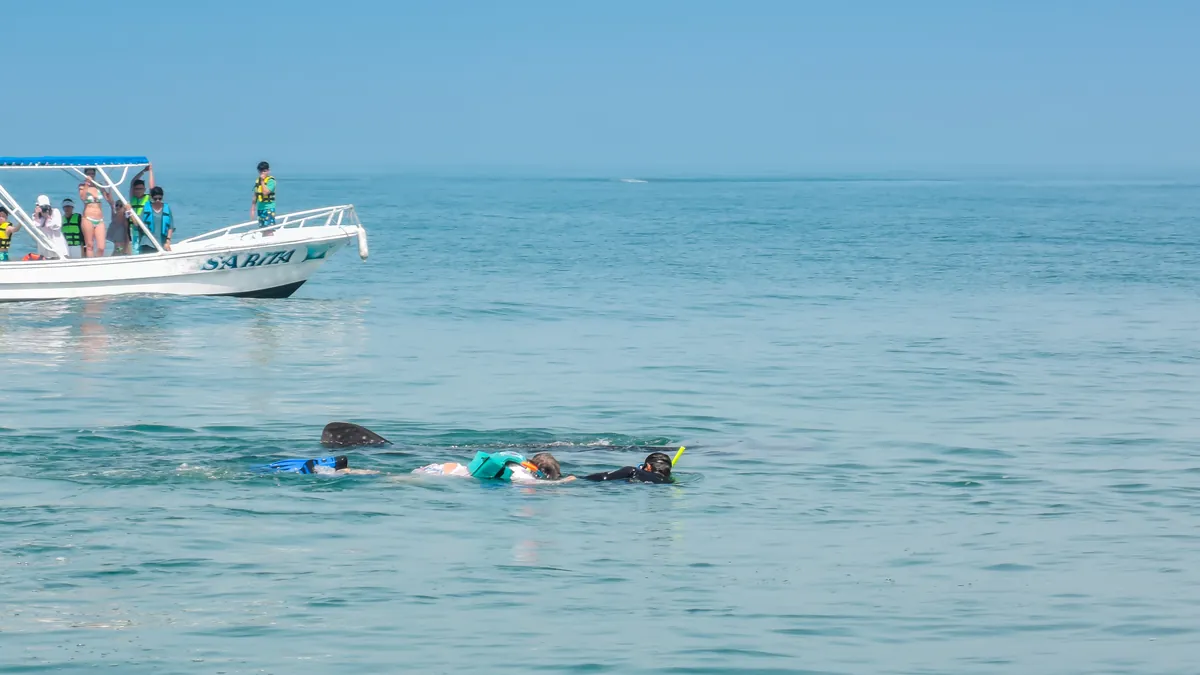
If you have read that you can scuba dive or freedive with the whale sharks here, the plan says otherwise. Its glossary defines the swim as moving across the surface only, with mask, fins and snorkel plus a life jacket or wetsuit, “sin la realización de inmersiones (apnea)”, without breath-hold descents. Rule 24 makes a full-torso life jacket compulsory for swimmers and guide, and rule 23 lets only two people plus one guide per boat into the water at a time.
Around the animal, only one boat may stay with a shark or a group of them, no closer than 5 meters, for at most 30 minutes, while the next boat waits at least 50 meters away. Boats approach diagonally from behind below 3 knots. The code of conduct asks swimmers to keep 5 meters from the head and 6 from the tail, and bans selfie sticks, flash and any light underwater.
On sunscreen the plan contradicts itself. Rule 19(a) prohibits using sunscreen or tanning products during the activity, with no qualifier, while the code of conduct in Annex II bars only products that are not biodegradable. Follow the stricter line and wear none on the day. How this encounter compares with others is on our whale shark destinations page.
.jpg)
Sargassum reached the Cancun coast in record volume in 2026
The brown seaweed that piles up on Caribbean beaches is tracked by satellite at the University of South Florida’s Optical Oceanography Lab, which publishes a monthly outlook. Its bulletin of 30 June 2026 reported record-high amounts in the Caribbean Sea for June and said 2026 was set to be at least the second-largest Sargassum year since the lab’s series began in 2011.
The July bulletin said the peak had passed: amounts had started to fall in every region, 2026 would rank second only to 2025, and beaching would continue but likely less severely than in June and July. On 31 August the lab reported amounts still declining, expected to keep falling until possibly November, though every region except the east Atlantic stayed above the 75th percentile of historical levels for the month.
On land the figures count what was removed. Mexico’s Navy said on 8 September 2026 that more than 123,400 tonnes had been collected in Quintana Roo so far that year, the highest on record, against 92,782 tonnes in all of 2025.
USF states that its bulletin should not be used to predict conditions at a specific beach, so none of these numbers tells you about the water at Manchones next Tuesday. For a shore snorkel or a beach entry, check a current local report shortly before you go.
Coral disease reached the Cancun coast in the summer of 2018
In July 2018, following reports from local divers, researchers from UNAM working with the Puerto Morelos reef national park found a reef near Puerto Morelos with a severe outbreak of the disease Florida had been calling stony coral tissue loss disease. Their paper in PeerJ in 2019 surveyed 82 sites across the Mexican Caribbean between July 2018 and April 2019.
They concluded that the disease had spread across the entire region within a few months, found no sign of such high disease prevalence anywhere in the region before 2018, and recorded symptoms in 24 of 46 coral species. Prevalence reached 71 percent in pillar coral, five of seven colonies, 40 percent in symmetrical brain coral, 38 percent in maze coral and 33 percent in smooth flower coral.
The authors write that the disease may have driven local extinctions of maze coral and pillar coral, which had vanished from several reef sites on the mainland coast. The park’s own cover figures, such as 7.12 percent at Manchones Grande in 2011, were taken before the outbreak, so a reef in Cancun today carries hurricane damage, the disease and heavy visitor use at once.
Fifteen dive businesses are listed for Cancun, and eight are filed in Puerto Morelos
The Cancun operator list holds 15 scuba businesses, read on 21 September 2026. Fourteen are published by SSI in its register of affiliated centers. One, Pocna Dive Center, is a Green Fins Digital Member, which means a self-evaluation with no in-person assessment behind it.
Where they are filed matters more than the count. SSI files eight of the fourteen under Puerto Morelos, four under Cancun and two under Isla Mujeres. The park program puts Puerto Morelos about 20 kilometers south of Punta Nizuc, and it has its own reef park, the Arrecife de Puerto Morelos national park, on the same fee tier. A register town is where a body files a business, not necessarily where it dives, so ask which park a trip goes to.
SSI lists eight of the fourteen for Freediving, two for Mermaid and one for Extended Range. A rating says what the body lists, not that a course runs this season. The park rules require operators to follow NOM-05-TUR-2003, but we found no public register of compliant businesses to check them against; which registers can be read logs what each source returned. Before a first trip, the dive insurance guide covers what a policy should include.
FAQ: scuba diving in Cancun
Do you have to pay a marine park fee to dive in Cancun?
Yes. Article 198 of the Ley Federal de Derechos sets 125.32 pesos per person per day for 2026 for the Costa Occidental de Isla Mujeres, Punta Cancún y Punta Nizuc national park, rounded to 125 pesos for payment. The legal obligation to pay falls on the permit-holding operator, which must fit a bracelet on each user. Mexican nationals and foreign residents get 50 percent off, and children under 12 are exempt.
Which Cancun reefs are closed to divers?
The six units of the preservation subzone: La Cadenita off Playa Norte and a stretch of the eastern shore of Isla Mujeres, El Bajito off Punta Cancún, and the Tercera Barrera Norte, a small Bajito and the Tercera Barrera Sur at Punta Nizuc. Scuba, snorkeling, night diving and snuba are not permitted there. Cuevones, north of Punta Cancún, has been closed to the public since 1998 after a cruise ship damaged it in 1997.
Can you scuba dive with whale sharks near Cancun?
No. SEMARNAT's management plan for the 2025 to 2027 seasons defines the activity as swimming at the surface with mask, fins, snorkel and a life jacket, without breath-hold descents. Only two people plus one guide per boat may be in the water at a time, the season runs from 15 May to 17 September, and a full-torso life jacket is compulsory.
How deep is the MUSA underwater museum in Cancun?
Jason deCaires Taylor's studio gives the Manchones gallery a depth of 8 meters, for divers and snorkelers, and the Nizuc gallery 4 meters, for snorkeling only. The park's management program records 529 sculptures on 125 artificial habitats by 2015, placed to steer visitors away from the natural reef units.
How many divers can one guide take in the Cancun marine park?
Six on a day dive and four on a night dive, under rule 46 of the park's administrative rules. The same rule requires an accredited guide under NOM-05-TUR-2003, a distance of at least 2 meters from coral, no gloves except on the wrecks, and no knife except the guide's. Night scuba is confined to the artificial habitats, until 10 p.m.
Note: Conditions, safety guidance and regulations change. Verify current information with official sources, including the dive operator, the park authority and the relevant government department, before you travel or dive.
Founder of NOMADREEF and a former digital nomad. This guide is sourced from the references below; conditions, prices and rules change, so verify current details, and follow qualified local guidance and safety briefings. About the author · LinkedIn ↗
Sources
- The park, its subzones and its rules (primary). SEMARNAT, Acuerdo por el que se da a conocer el Resumen del Programa de Manejo del Parque Nacional Costa Occidental de Isla Mujeres, Punta Cancún y Punta Nizuc, Diario Oficial de la Federación, 2 August 2016: the decree of 19 July 1996 and its 8,673-06-00 hectares; the agreement of 7 June 2000 on the category; the five subzones of rule 52 and their areas; the Preservation Subzone with La Cadenita, the eastern shore of Isla Mujeres, El Bajito, Tercera Barrera Norte, Bajito and Tercera Barrera Sur, and its table of activities not permitted; the descriptions of Manchones, Chitales and the Arrecifes Profundos; the hurricane damage table; the Cuevones recovery subzone, the 1997 cruise-ship impact and cover of 1.3 and 4.5 percent; the gunboats C-58 Anaya and C-55 Juan de la Barrera and the note on currents; the reef balls of 2005 and 2007; MUSA, 12 planned galleries and 529 sculptures on 125 artificial habitats by 2015; the 30 percent carrying-capacity statement; rules 4, 16, 18, 21, 23, 32, 40, 44, 46, 47 and 48; the Puerto Morelos distance of 20 km. DOF, 2 August 2016, read in full from the FAOLEX reproduction of the DOF text (PDF), because the DOF page stopped loading partway through. Read 24 September 2026.
- The fee (primary). Ley Federal de Derechos, consolidated text, last reform DOF 7 November 2025, amounts updated by the Resolución Miscelánea Fiscal of 28 December 2025: article 198, fracción I at 225.56 pesos with Isla Contoy and the Tiburón Ballena reserve; fracción I Ter at 125.32 pesos with the Costa Occidental de Isla Mujeres, Punta Cancún y Punta Nizuc park, the Caribe Mexicano reserve and the Arrecife de Puerto Morelos park; fracción III at 3,759.29 pesos; the payment obligation on permit holders; the exemptions and the 75 and 50 percent discounts; rounding to multiples of 5 pesos. Cámara de Diputados, LFD (PDF). The Chamber’s server did not respond from here, so the file was read from the Internet Archive copy of 15 September 2026. Read 24 September 2026.
- The 2025 amount (primary). Decreto por el que se reforman, adicionan y derogan diversas disposiciones de la Ley Federal de Derechos, DOF 19 December 2024: fracción I Ter at 120.74 pesos, in force from 1 January 2025. DOF, 19 December 2024. Read 24 September 2026.
- What CONANP charges (primary). CONANP, park page: entry fee of 125 pesos per person per day by way of derechos, the exemptions and discounts, the Mesoamerican Reef System and the representative species. Descubre ANP, Costa Occidental de Isla Mujeres, Punta Cancún y Punta Nizuc; the Pasaporte de la Conservación at 3,760 pesos: Descubre ANP, Pasaporte y Brazalete. Read 24 September 2026.
- MUSA in the artist’s words (primary for his own project). Jason deCaires Taylor studio: commissioned by the national marine park and the Cancún Nautical Association, installed in 2009, Manchones gallery at 8 meters for divers and snorkelers, Nizuc gallery at 4 meters for snorkeling only, pH-neutral cement. underwatersculpture.com, MUSA Mexico. Read 24 September 2026.
- Whale sharks (primary). SEMARNAT, Dirección General de Vida Silvestre, Plan de Manejo Tipo para la conservación y aprovechamiento no extractivo de Rhincodon typus a través de la observación y el nado en el Caribe mexicano, temporadas 2025, 2026 y 2027 (April 2025): season 15 May to 17 September; hours 7:00 to 14:00 in the Caribe Mexicano and Tiburón Ballena reserves; rules 19 to 25; Annex II code of conduct; glossary definition of nado. gob.mx (PDF). The standard’s title, its DOF date of 19 November 2019, the zone between Isla Mujeres, Puerto Juárez, Chiquilá and Holbox and the 11-meter limit of section 4.2.1 are from SEMARNAT’s notice under section 4.1.3 of NOM-171-SEMARNAT-2018 for the 2022 season: gob.mx (PDF). Read 24 September 2026.
- Sargassum at sea (primary). University of South Florida Optical Oceanography Lab, Outlook of 2026 Sargassum blooms, bulletins of 30 June, 31 July and 31 August 2026, including the disclaimer against use for a specific location or beach. June (PDF), July (PDF), August (PDF). Read 24 September 2026.
- Sargassum on land (triangulated). The Navy’s figure of more than 123,400 tonnes collected in Quintana Roo in 2026, against 92,782 in 2025, released on 8 September 2026. The Navy’s own release could not be located on gob.mx, so the figure rests on three independent outlets reporting it identically: Excélsior, Noticaribe and 24 Horas Quintana Roo. Read 24 September 2026. State-level totals published later in September use a different count and are not quoted here.
- Coral disease (primary). Alvarez-Filip L, Estrada-Saldívar N, Pérez-Cervantes E, Molina-Hernández A, González-Barrios FJ (2019), A rapid spread of the stony coral tissue loss disease outbreak in the Mexican Caribbean, PeerJ 7: e8069: the July 2018 find near Puerto Morelos; 82 sites surveyed July 2018 to April 2019; 24 of 46 species with symptoms; prevalence of 71, 40, 38 and 33 percent in the four species named; possible local extinction of Meandrina meandrites and Dendrogyra cylindrus on the mainland. doi:10.7717/peerj.8069. Read 24 September 2026.
- The fifteen businesses. The Cancun operator list, read 21 September 2026: fourteen centers published by SSI in its register of affiliated centers, filed under Puerto Morelos (8), Cancun (4) and Isla Mujeres (2), with the program ratings stated; one Green Fins Digital Member. The limits of each source are on which registers can be read.
- Left out. No recompression chamber is named on this page: no primary source for its location and operating status could be found, and a safety fact is not triangulated. Water temperature and visibility are left out for the same reason. The whale shark boat caps are published per season, and the only notice read was for 2022, so no 2026 cap is given. The number of MUSA sculptures today is not stated; the last figure in a primary source is the program’s count for 2015.