Jeju Diving: Seogwipo’s Soft Coral Islets and the Law That Keeps a Scuba Diver’s Catch Bag Empty
 by Yannick Schroth
Sep 25, 2026
14 min read
by Yannick Schroth
Sep 25, 2026
14 min read
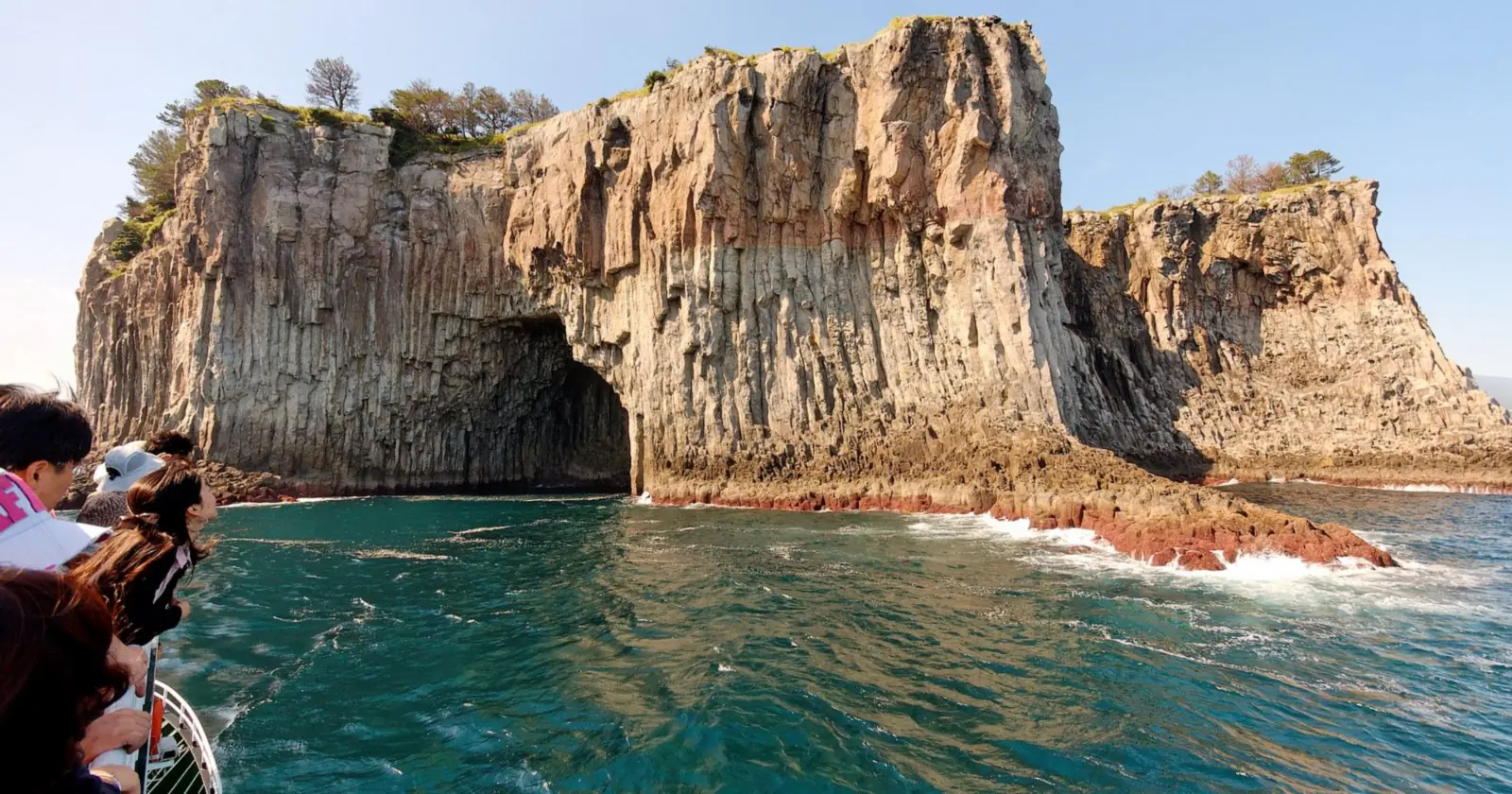
Beomseom from a boat out of Seogwipo. Photo: Alex Brown, Wikimedia Commons, CC BY 2.0.

Key takeaways
- Article 7-2 of the Fisheries Resources Management Act Enforcement Decree lets a non-fisher use a mask, snorkel, wetsuit and hood, fins, a dive knife and a whistle; no tank, regulator, BCD or weights, and a breach carries a fine of up to 10 million won
- Jeju Province Notice 2023-45 bans divers from touching black coral, soft coral and other legally protected species in the 9,006,410 m² sea area of the Munseom and Beomseom natural protection area
- A diving school must put at least one qualified instructor per five divers on site or on the boat, and night dives need lights and a safety escort
- At the Seogwipo station, March has averaged 16.5°C and August 22.4°C over 2000 to 2023, and August has run at 26.1°C in the decade to 2024
- Seogwipo Medical Center runs a hyperbaric center for haenyeo and divers, by appointment, three leisure divers per session
Jeju diving centers on three islets off Seogwipo, inside two natural monuments
The soft coral diving Jeju is known for sits in one stretch of water. Off the south-coast town of Seogwipo sit three uninhabited islets, Munseom, Beomseom and Seopseom, and the province’s biosphere reserve page describes the sea beneath them as a spectacle of soft coral colonies, “the flowers of the sea”, in a warm-current zone where subtropical fish can be seen in every season (our translation).
Two separate designations cover that water. The Munseom and Beomseom Natural Protection Area was designated on 18 July 2000 and measures 9,196,822 m², of which 190,412 m² is the islands themselves and 9,006,410 m² is sea. Over it lies a second, larger natural monument, the Jeju coastal soft coral community, which the national heritage portal records at 90,105,503 m² and dates to December 2004.
The corals themselves are specific. A 2026 paper in Scientific Reports by researchers at the Korea Institute of Ocean Science and Technology names the dominant species: Dendronephthya gigantea, typically at 10 to 20 meters, and Scleronephthya gracillima, which dominates deeper, from 15 to 40 meters. Both have also been seen as shallow as about 5 meters. Neither needs sunlight, so water temperature rather than light sets where they grow.
That same paper records something not previously reported in the wild. In August and September 2024, surveys at Beomseom, Munseom and Songaksan between 5 and 20 meters found soft corals collapsing, which the authors call slumping: drooping, dangling, deflating and disintegrating colonies. The event coincided with sustained low salinity and high temperature, and the authors describe only isolated cases in summer 2025.
What Jeju’s 2023 guideline asks of divers at Munseom and Beomseom
The rule a diver meets at these islets is not a national law but a provincial guideline. Jeju Special Self-Governing Province Notice 2023-45, dated 2 March 2023, sets out how the protection area is to be run, issued by the province as the managing body under the Cultural Heritage Protection Act. It applies to the sea part, 9,006,410 m², which the notice calls an exceptional open area.
For a diver, one line matters most. The guideline prohibits scuba divers from making contact with black coral (haesong), soft coral and other legally protected species during underwater activity. There is no fin-kick exemption and no photography exemption in the wording; contact is the offense.
The rest falls on the people who bring you. Boat owners must check identities and keep a passenger list, brief passengers before departure and carry at least two bins of 40 liters or more. Boat owners and scuba instructors must attend marine-environment training twice a year, and those who skip it face restricted access. The whole area is a no-smoking zone.
One date is worth putting in a calendar. The guideline designates the last Wednesday of every month as a marine-environment protection day, and on that day entry is allowed only for clean-up work. The province also commissions underwater monitoring twice a year.
The notice arrived after a closure. In December 2021 the Cultural Heritage Administration extended the public-access restriction at Munseom and Beomseom from the islands to the surrounding sea, which left fishing and scuba there needing a permit. Three Korean newspapers report that the March 2023 changes reopened the water without a permit, on the conditions above.
Korean fisheries law gives a scuba diver in Jeju no permitted gear for taking seafood
The version most visitors hear is that the haenyeo’s grounds are off limits. The rulebook is wider than that. Article 18(1) of the Fisheries Resources Management Act bars anyone who is not a fisher, as the Fisheries Act defines one, from catching or gathering marine resources in breach of the method, quantity and gear standards set by presidential decree.
That decree, Article 7-2 of the Enforcement Decree, in force since 21 December 2023, lists the equipment a non-fisher may use, and only that. It borrows the dive law’s own list of underwater leisure gear and keeps six items: mask, snorkel, wetsuit and hood, fins, dive knife and whistle. The air tank, the regulator, the buoyancy compensator and the weights, all on the dive law’s list, are left off.
Read that as a traveler and the consequence is plain. Under the national standard, no depth, place or species makes picking up a sea urchin or an octopus on scuba fit the rule. The permitted tools are a short list: a cast net, hand nets, a single fishing line, traps, tongs, hooks, a hoe, a shovel and your hands, and the tools may not be used with electric or compressed-air power.
The dive law ties itself to this rule. Article 8 of the underwater leisure act lists compliance with Article 18 of the Fisheries Resources Management Act among the duties of every diver. The penalty sits in Article 65 of the fisheries act: a fine of up to 10 million won for a non-fisher who catches in breach of Article 18(1), (2) or (5). Selling what was taken, or keeping it for sale, is a separate breach.
There is one moving part. Article 18(2) lets a province set its own catch standard by ordinance, within limits the decree sets, so the provincial version can differ from the national one. For a scuba diver, the practical answer does not change: bring nothing up.
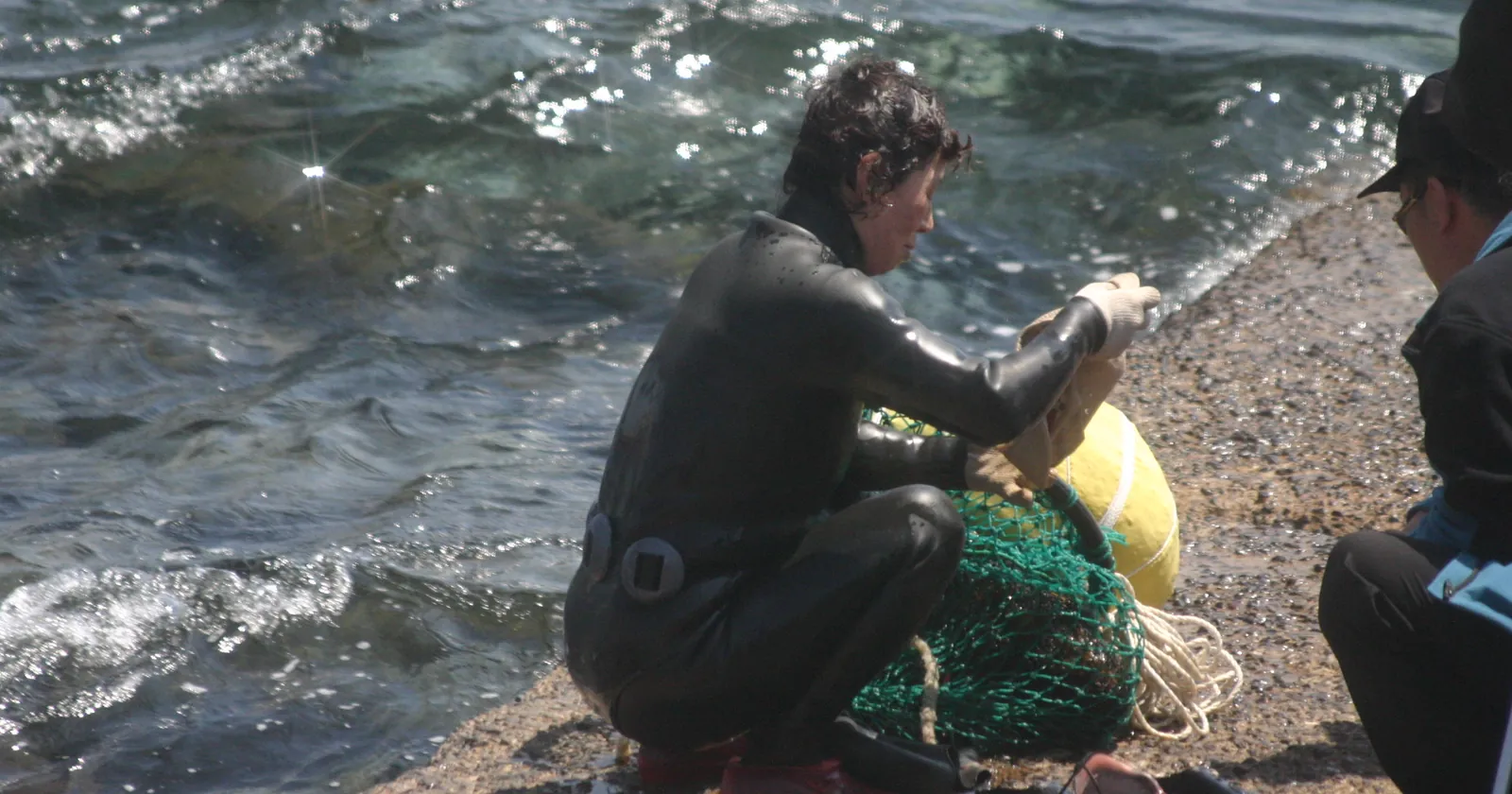

Jeju’s haenyeo work village fishing grounds capped at 7 meters of low-tide depth
The women divers are the reason these rules exist in this form. UNESCO inscribed the Culture of Jeju Haenyeo on its Representative List in 2016. Its description speaks of women, some in their 80s, diving to 10 meters without breathing equipment to gather abalone and sea urchins, for up to seven hours a day and 90 days a year, holding their breath for about a minute per dive.
The same text says the knowledge passes through “local fishery cooperatives which have the area’s fishing rights”. That right has a legal name. Under Article 8(1) of the Fisheries Act a village fishery (maeul eoeop) is licensed only to a fishing village cooperative (eochongye) or a district fisheries cooperative, for the shared benefit of the fishers who live there.
The water it covers is measured, not assumed. Article 7 of the Fisheries Act Enforcement Decree caps a village fishing ground at the average depth of the lowest sea level of the year: 5 meters in most of Korea, and 7 meters in Jeju, Gangwon and North Gyeongsang, a figure amended in June 2024. That is the band where most shore entries in Jeju start.
The dive law anticipated the overlap. Article 6 of the underwater leisure act lets a dive business and a fishing village cooperative sign a voluntary agreement for mutual benefit. Where a shop dives from a village’s shore, ask whether it has one; it is the document that records whose water you are entering.
Since 23 April 2026 a Jeju dive shop registers with the Korea Coast Guard
Scuba businesses in Korea are governed by the Act on the Safety and Promotion of Underwater Leisure Activities, Act No. 14243 of 29 May 2016, in force with its decree and rules on 30 May 2017. It covers skin diving and scuba diving, and it defines a dive business as renting gear, carrying divers by boat or teaching them.
Its latest amendment moved the paperwork. Act No. 20944 of 22 April 2025, in force on 23 April 2026, rewrote Article 15 so that a business registers with the Commissioner General of the Korea Coast Guard instead of the Minister of Oceans and Fisheries. The decree delegates registration to the local Coast Guard station chief, who issues a registration certificate by type: rental, transport or education.
The registration standard is short. A rental business must own the gear and hold, or contract, repair skills under the High-Pressure Gas Safety Control Act. A transport business needs its own boat and a licensed operator. A teaching business needs a qualified instructor, trained at a body the Minister recognizes by public notice. Running an unregistered dive business carries up to a year in prison or a 10 million won fine.
The ratio is written down. Article 6(2) of the rule, as amended in July 2025, requires a teaching business to place at least one instructor per five divers at the business or on the boat, and at each teaching site, which the rule defines as underwater or an indoor dive facility. Staff retrain every two years on safety, accident response and the law.
A few duties protect you directly. Prices must be reported to the Coast Guard and posted where you can see them, and nothing beyond the posted price may be demanded. The boat may not sell or serve alcohol, or let you bring it aboard. And a shop may not rent gear to, or carry, anyone under 14 without a guardian.
What the Jeju dive law asks of the diver: the flag, night dives and 10 nautical miles
The Act binds divers too. Article 8 requires you to wear the safety equipment the safety rules call for and to stay inside the activity zone, which the business marks with an international signal flag or a surface marker buoy at its edge. Leaving that zone, or diving without the required gear, carries a fine of up to 500,000 won.
Night diving is restricted by default. Article 13 bars underwater leisure activity from 30 minutes after sunset to 30 minutes before sunrise. The exception needs a searchlight or similar light, a luminous vest, band or marker on everyone, and an instructor or other safety escort unless the diver is a qualified instructor. Breaking it carries a fine of up to 1 million won. Our night diving guide covers the technique.
Two further duties are rarely mentioned. Anyone diving 10 nautical miles or more from the port of departure or the coastline must report to the police or the Coast Guard first. And a death, a disappearance or a serious injury, which the decree defines as unconsciousness or heavy bleeding, must be reported without delay.
Divers used to other countries often look for a depth limit or a buddy rule. The Act, its decree and its rule as in force on 23 April 2026 set neither. Those limits come from your certification agency’s standards and the shop’s own briefing, not from Korean statute.
Seogwipo water in Jeju runs from about 16.5°C in March to 26°C in recent Augusts
The coral grows here because of a current. Jeju sits in a transition zone where the Tsushima Warm Current, a surface branch of the Kuroshio, reaches the island’s south coast and is strongest in summer. A 2024 paper in Frontiers in Marine Science puts the average annual water temperature at about 20.0°C on the south coast against 18.8°C on the north, from 2004 to 2022 data.
For Seogwipo specifically, the 2026 Scientific Reports paper uses Korea Hydrographic and Oceanographic Agency records. Over 2000 to 2023, the coldest months averaged 16.7°C in February and 16.5°C in March, and August averaged 22.4°C. The decade to 2024 ran hotter: August averaged 26.1°C. The extremes in the station record over two decades were 12.2°C in February 2013 and 29.5°C in June 2008.
Two things shape a winter trip. Mount Halla shelters the south coast from the strong northerly winter winds that hit the north and east, so the soft coral coast is the sheltered side in winter. And water of 16 to 17°C in late winter calls for a thick wetsuit or a drysuit rather than a tropical shortie; our travel wetsuit guide covers the choice.
Summer brings a different problem. Changjiang River water from China reaches the island in summer, peaking in July and August, lowering surface salinity and layering the water column. That freshening, combined with heat, is what the 2026 paper links to the 2024 soft coral collapse. It can also put a warm, fresher layer over cooler water at depth.
Typhoons reach Korea mostly in August, the height of the Jeju diving season
The warm months are also the storm months. The Korea Meteorological Administration’s 1991 to 2020 normal counts 25.1 typhoons forming in the western North Pacific a year, of which 3.4 affect Korea. By month of formation, the normals for storms affecting Korea are 0.3 in June, 1.0 in July, 1.2 in August, 0.8 in September and 0.1 in October.
The agency’s own summary is blunt: about three typhoons affect Korea in a year, most often in August, then July, then September, and those three months account for 90 percent of them. June and October see one only very rarely.
What that means underwater was measured on Jeju. The 2024 Frontiers paper describes super typhoon Hinnamnor reaching the island in September 2022, destroying a permanent survey line at 10 meters at Sinheung on the northeast coast, and cites a 42 percent loss of kelp at 10 meters and 34 percent at 15 meters at Seongsan against the May count. Build spare days into any late-summer trip.
Jeju’s hyperbaric center for divers is at Seogwipo Medical Center, by appointment
Seogwipo Medical Center, the public hospital in Seogwipo, runs a hyperbaric oxygen therapy center and states that it was set up to treat diving-related illness among the haenyeo and divers of the south of the island. It lists decompression illness in haenyeo and divers, and gas embolism, among the conditions it treats.
Its published procedure is worth knowing before you need it. The center treats up to four haenyeo or three leisure divers per session, a session takes about one to two hours, and treatment is by appointment only, with reception hours of 8:30 to 9:30 and 13:30 to 14:30. A first visit includes an ECG, blood tests and X-rays. The page says treatment is free for haenyeo and states no such waiver for visitors.
The page does not describe round-the-clock emergency access, so do not assume it. Ask your dive shop which accident plan it follows; the Act already obliges the business to take rescue measures and notify the police, fire service or Coast Guard in an accident. Check that your dive insurance covers hyperbaric treatment in Korea before you fly.
Nine Jeju watersports businesses on the list: eight SSI dive centers and one IKO kite school
The Jeju operator list holds 9 watersports businesses, read on 20 September 2026. Eight are dive centers published by SSI in its register of affiliated centers, and one, Stagehouse, is a kite school published by IKO. Five of the nine publish a website in the register and four do not.
The register’s program ratings lean technical. SSI rates five of the eight dive centers for Extended Range and three for Freediving, which fits an island where breath-hold diving is the local tradition. A rating says the body lists the center for that program, not that a course runs this season. Our freediving safety guide applies to either path.
Where each business is filed says little about where it dives. Only one, Yaya Dive, is filed under Seogwipo-si; the others carry Jeju, Jeju-si, Jeju-do or the province’s Korean name. An SSI or IKO listing is also not the Korean registration described above, so ask any dive shop for its Coast Guard registration certificate. Which registers can be read explains what each source does and does not show.
The kite school sits under a different law. The Water Leisure Safety Act decree lists the kiteboard among non-powered water leisure devices, alongside windsurfing and the surfboard, so kiting falls outside the underwater leisure act. If you plan to learn, our kitesurfing guide covers the first lessons. For warm-water soft coral further south, compare diving in Okinawa.
FAQ: scuba diving in Jeju
Can you take seafood while scuba diving in Jeju?
Not with scuba gear. Article 7-2 of the Fisheries Resources Management Act Enforcement Decree, in force since 21 December 2023, lets a non-fisher use only a mask, snorkel, wetsuit and hood, fins, a dive knife and a whistle when taking marine resources. A tank, regulator, BCD and weights are not on the list. Article 65 of the Act sets a fine of up to 10 million won, and the dive law makes compliance a duty of every diver.
Do you need a permit to dive at Munseom and Beomseom?
Not as an individual diver in the sea area. Jeju Province Notice 2023-45 of 2 March 2023 treats the 9,006,410 square meter sea part of the protection area as an exceptional open area. It bans divers from touching black coral, soft coral and other protected species, requires boat owners and scuba instructors to train twice a year, and reserves the last Wednesday of each month for clean-up work.
What is the water temperature for diving in Jeju?
At the Seogwipo station, Korea Hydrographic and Oceanographic Agency data put the February mean at 16.7 degrees Celsius and March at 16.5 over 2000 to 2023, with August at 22.4. The decade to 2024 was hotter, with August averaging 26.1 degrees. The south coast averages about 20.0 degrees a year against 18.8 on the north.
When is typhoon season for diving in Jeju?
The Korea Meteorological Administration says about three typhoons affect Korea in a year, most often in August, then July, then September, and that those three months account for 90 percent of them. Its 1991 to 2020 normal counts 3.4 affecting Korea a year. Super typhoon Hinnamnor reached Jeju in September 2022 and stripped kelp at Seongsan.
Is there a recompression chamber for divers on Jeju?
Seogwipo Medical Center runs a hyperbaric oxygen therapy center set up to treat diving-related illness among haenyeo and divers. It treats up to three leisure divers per session, by appointment only, with reception from 8:30 to 9:30 and 13:30 to 14:30. Its page does not describe round-the-clock emergency access, so confirm your shop's accident plan before diving.
Note: Conditions, safety guidance and regulations change. Verify current information with official sources, including the dive operator, the park authority and the relevant government department, before you travel or dive.
Founder of NOMADREEF and a former digital nomad. This guide is sourced from the references below; conditions, prices and rules change, so verify current details, and follow qualified local guidance and safety briefings. About the author · LinkedIn ↗
Sources
Korean-language sources were read in Korean; quoted wording from them is our translation.
- The dive law (primary). Act on the Safety and Promotion of Underwater Leisure Activities (수중레저활동의 안전 및 활성화 등에 관한 법률), Act No. 14243 of 29 May 2016, as amended by Act No. 20944 of 22 April 2025, in force 23 April 2026: Article 2 on definitions and the three business types; Article 6 on voluntary agreements with fishing village cooperatives; Article 8 on diver duties including compliance with Article 18 of the Fisheries Resources Management Act; Article 11 on business duties including accident notification; Article 12 on the 10 nautical mile report and accident reports; Article 13 on the sunset and sunrise limit; Article 15 on registration with the Commissioner General of the Korea Coast Guard (previously the Minister of Oceans and Fisheries, per the version in force from 26 January 2024); Articles 19 and 21 on posted prices, alcohol and minors; Articles 29 to 32 on penalties and fines; addendum setting the 23 April 2026 commencement. National Law Information Center, current text and previous version. Read 25 September 2026.
- The dive law’s decree and rule (primary). Enforcement Decree, Presidential Decree No. 36274 of 21 April 2026: Article 2 limiting the activity to skin diving and scuba diving; Article 4 listing the gear, including air tank, regulator, BCD and weights; Article 9 defining serious injury; Article 12 delegating registration to Coast Guard station chiefs; addendum of Decree No. 28035 setting commencement on 30 May 2017. Enforcement Rule, Ministry Ordinance No. 795 of 23 April 2026: Article 4 on the signal flag or surface marker buoy; Article 6(2) on one instructor per five divers, as amended 10 July 2025; Article 7 on instructor qualification; Article 9 on night diving; Article 10 on the registration certificate; Article 13 on training every two years; Annex 1 on registration standards. Enforcement Decree and Enforcement Rule. Read 25 September 2026.
- The take ban (primary). Fisheries Resources Management Act (수산자원관리법), in force 18 September 2026: Article 18(1), (2), (4) and (5) on non-fishers; Article 65 item 2, a fine of up to 10 million won; Article 70(1) item 2-2 on selling. Enforcement Decree, Article 7-2, newly inserted 19 December 2023 and in force 21 December 2023: the permitted gear and methods, and the six permitted items of underwater gear. Act and Enforcement Decree. Read 25 September 2026.
- Village fishing grounds (primary). Fisheries Act (수산업법), Article 7(1)2 defining village fishery and Article 8(1) licensing it only to fishing village cooperatives or district fisheries cooperatives; Enforcement Decree Article 7(1), depth limit of 5 meters, 7 meters in Gangwon, North Gyeongsang and Jeju, as amended 4 June 2024. Act and Enforcement Decree. Read 25 September 2026.
- The kiteboard (primary). Water Leisure Safety Act Enforcement Decree, Presidential Decree No. 35916, Article 2(2) item 13 listing the kiteboard among non-powered water leisure devices. National Law Information Center. Read 25 September 2026.
- The Munseom and Beomseom guideline (primary). Jeju Special Self-Governing Province Notice 2023-45 of 2 March 2023, guideline for the operation and management of the Munseom and Beomseom Natural Protection Area: designation on 18 July 2000; area 9,196,822 m² (land 190,412, sea 9,006,410); the monthly protection day; twice-yearly training and access restriction for boat owners and scuba instructors; the ban on contact with black coral, soft coral and legally protected species; boat-owner duties; monitoring; scope limited to the sea area as an exceptional open area. Jeju Province notice board, notice 2023-45 with attachments. Read 25 September 2026.
- The two natural monuments (primary). National heritage portal records for the Munseom and Beomseom Natural Protection Area (9,196,822 m², designated 18 July 2000) and the Jeju coastal soft coral community (90,105,503 m², designated 13 December 2004). Munseom and Beomseom record and soft coral community record. Jeju Province’s own heritage page gives the soft coral designation as 14 December 2004, so the page states only December 2004. Read 25 September 2026.
- The islets and their corals (primary). Jeju Island Biosphere Reserve pages of Jeju Province on Munseom, Beomseom and Seopseom. Jeju Biosphere Reserve, Munseom, Beomseom and Seopseom and Jeju Province, Jeju coastal soft coral community. Read 25 September 2026. The two provincial pages give different species counts for the soft coral community, so no species count is stated here.
- The 2021 closure and 2023 reopening (triangulated). That the Cultural Heritage Administration extended the access restriction to the sea area in December 2021 and that the sea area reopened without a permit in 2023 is triangulated from three independent newspapers: Kyunghyang Shinmun, 3 March 2023, Seoul Shinmun, 2 March 2023 and Jnuri, 7 April 2023. The Administration’s own notice was not reached, so no notice number or exact reopening date is given. Read 25 September 2026.
- The haenyeo (primary). UNESCO, Culture of Jeju Haenyeo (women divers), inscribed 2016 on the Representative List, decision 11.COM 10.b.24: diving to 10 m without breathing equipment, up to seven hours a day and 90 days a year, about one minute per dive, and transmission through “local fishery cooperatives which have the area’s fishing rights”. UNESCO Intangible Cultural Heritage. Read 25 September 2026.
- Soft coral species, Seogwipo temperatures and the 2024 slumping (primary, peer-reviewed). Jöst AB, Kim T and co-authors (2026), From rigidity to collapse in soft coral slumping within the World Heritage coral gardens in Korean waters, Scientific Reports 16: 24861: dominant species and depth ranges; surveys at Beomseom, Munseom and Songaksan in August and September 2024; KHOA Seogwipo means of 16.7°C (February), 16.5°C (March) and 22.4°C (August) over 2000 to 2023 and 26.1°C in August over 2015 to 2024; station extremes of 12.2°C (February 2013) and 29.5°C (June 2008); Changjiang Diluted Water in summer. doi:10.1038/s41598-026-54847-9. Read 25 September 2026.
- The current, the north-south gap and typhoon Hinnamnor (primary, peer-reviewed). Perrois G, Jöst AB, Lee K-T and co-authors (2024), Environmental impact on marginal coastal benthic communities within the Jeju Island, South Korea temperate transition zone, Frontiers in Marine Science 11: 1345518: the Tsushima Warm Current as a branch of the Kuroshio strongest in summer; annual means of 18.8°C north and 20.0°C south from 2004 to 2022; Mount Halla sheltering the south from northerly winter winds; Hinnamnor in September 2022 and the Seongsan kelp losses of 42 and 34 percent reported from Lee K-T et al. (2023). doi:10.3389/fmars.2024.1345518. Read 25 September 2026.
- Typhoon statistics (primary). Korea Meteorological Administration, typhoon statistics, 1991 to 2020 normal: 25.1 formed a year, 3.4 affecting Korea; monthly normals; the summary on August, July and September and the 90 percent share. KMA typhoon statistics. Read 25 September 2026.
- The hyperbaric center (primary). Seogwipo Medical Center, hyperbaric oxygen therapy center page: purpose, conditions treated, four haenyeo or three leisure divers per session, one to two hours, appointment only, reception hours, first-visit tests, free treatment for haenyeo. Seogwipo Medical Center. Read 25 September 2026.
- The nine businesses. Nine watersports businesses on the Jeju operator list, read 20 September 2026: eight dive centers published by SSI in its register of affiliated centers and one kite school published by IKO in its register of affiliated schools. Five of the nine publish a website in the register; SSI rates five dive centers for Extended Range and three for Freediving. The limits of each source are set out on which registers can be read.
- Gaps. Whether Jeju has enacted its own non-fisher catch ordinance under Article 18(2) could not be confirmed at a primary source; local reporting from March 2025 describes a draft. The lead that Jeju National University Hospital runs a recompression chamber could not be confirmed at the hospital’s own site, so it is left out. Emergency telephone numbers are left out for the same reason. Whether the Korea Coast Guard publishes its register of dive businesses was not established: unverified, needs human check.