Dubai Diving: The Tanker Wreck, the Heat-Hardened Coral and the Rules That Stop at the Border
 by Yannick Schroth
Sep 24, 2026
14 min read
by Yannick Schroth
Sep 24, 2026
14 min read
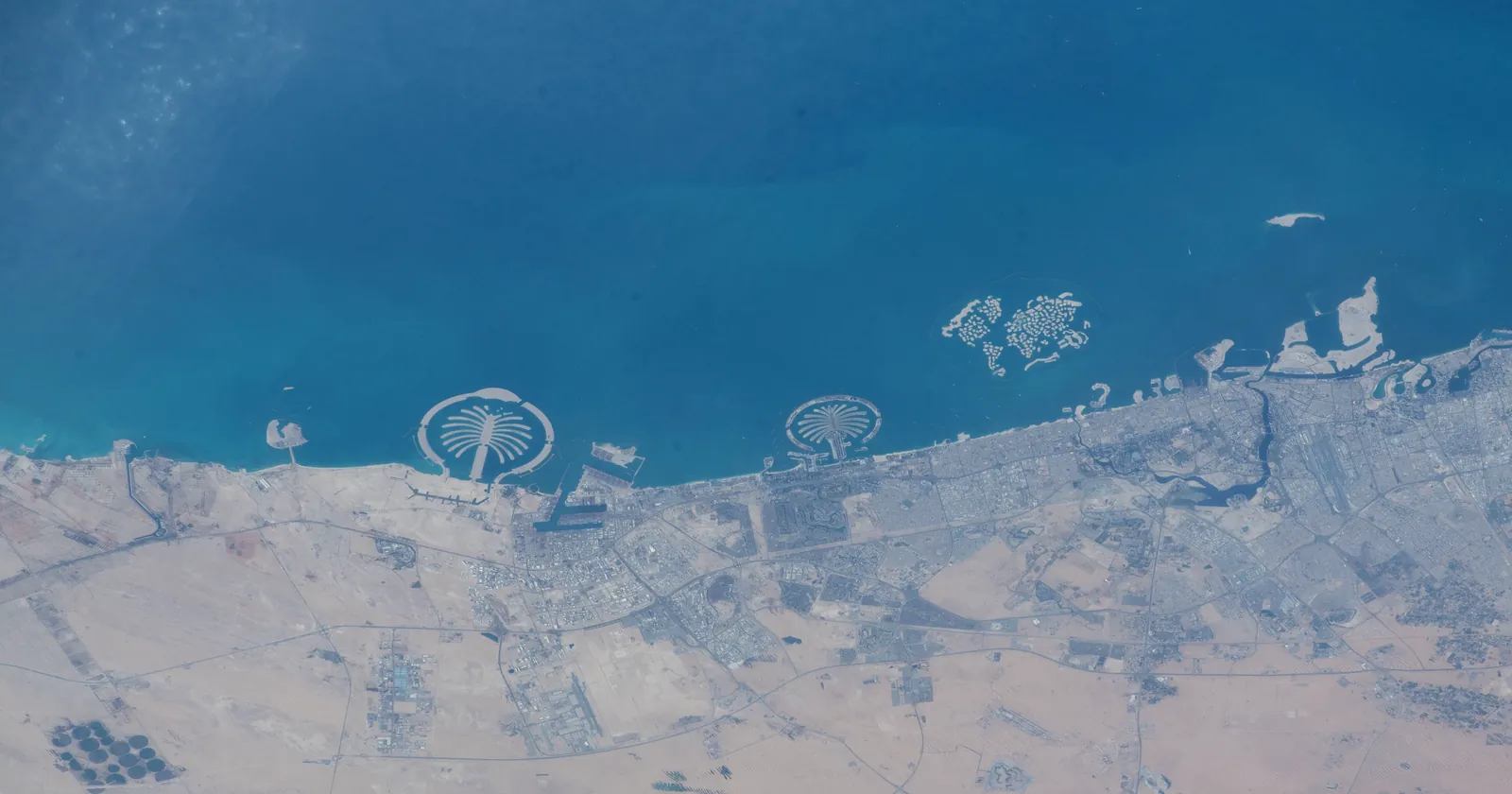
Photo: Raja Chari, NASA, Wikimedia Commons, public domain.
.jpg)
Key takeaways
- The Dubai Maritime Authority licenses diving training centers and, separately, every trainer and guide who works in one; the trainer must be at least 22 and hold its maritime trainer license
- A Dubai training center may not take a trainee under 10, and beginners train only in the daytime
- Dubai’s law defines its waters as lying between the Sharjah and Abu Dhabi borders, so an east coast dive day leaves that rulebook entirely
- The Jebel Ali Ramsar sheet records surface water from 16°C in winter to 37°C in summer, and the site’s corals grow as patches on rock rather than as true reef
- Deep Dive Dubai holds the Guinness record for the deepest swimming pool for diving, 60.02 meters, filled with fresh water kept at 30°C
Dubai licenses the diving instructor by name, not only the dive shop
Dubai’s licensing reaches past the dive shop to the person teaching in it. Law No. 3 of 2023, issued on 6 February 2023, renamed the Dubai Maritime City Authority as the Dubai Maritime Authority (DMA) and lists “diving” among the maritime activities the authority licenses. One of its stated objectives is to issue every approval and permit needed by the people working in the maritime sector, not only by the companies.
The DMA’s own service page for licensing a diving training center spells out what that means. A center may not hire any trainer or guide unless the authority has authorized that person and registered them in its records. The trainer must be at least 22, hold a maritime trainer license approved by the DMA, hold an instructor certificate from a local or international diving association plus a maritime rescue and first aid certificate, and pass whatever tests and interviews the authority sets.
So an instructor who is fully certified by PADI or SSI cannot, on that card alone, be hired by a Dubai center. The agency card is one of the entry conditions, and the DMA registration sits on top of it. The owner or manager of the center has an age floor too: not less than 25, with experience certificates filed at the first stage of the application.
The center itself is inspected against a list that is unusually concrete. It needs a pool dedicated to training beginners, diving safety instructions posted in Arabic and English, emergency oxygen able to deliver 15 liters a minute for twenty minutes, backup cylinders equal to at least half of those used in training, and a boat licensed by the DMA. It must hold professional liability insurance of not less than AED 500,000, and the annual permit for diving training costs AED 2,020.
Dubai’s training rules set 10 as the youngest age and keep beginners in daylight
The same service page carries the obligations a Dubai center owes its students, and several of them change how a course runs. No trainee is admitted to diving unless they can swim. No trainee is accepted under 10. A trainee under 15 may not dive alone unless accompanied by someone aged at least 18, and anyone under 18, or their guardian, signs a statement on their medical condition and capacity for diving.
The rule that changes a course most is shorter: beginners train only in the daytime. If you arrive expecting to finish an open water course with an evening dive, a Dubai center is working to a text that says no. Night diving is a skill for after certification, and our night diving guide covers how to start it.
Two more obligations reach the certified visitor. A center may only rent diving equipment to people authorized by local or international diving clubs and associations, which in practice means bring your card. And the center keeps records of participants and courses for at least three years, which the DMA may inspect, so the paperwork a Dubai shop asks for is not optional courtesy.
These are Dubai’s rules, on top of whatever the training agency requires, which is why it helps to read them before booking. If you plan to certify on the trip, the guide to certifying while traveling covers the agency side; in Dubai the DMA side sits on top of it.
Dubai’s rulebook stops at the Sharjah and Abu Dhabi borders
Both DMA texts cited here use the same definition of where they apply. The waters of the emirate are the waters “lying between the Dubai-Sharjah border and the Dubai-Abu Dhabi border, and extending to the exclusive economic zone”, including ports, marinas, canals and creeks. That is Dubai’s Arabian Gulf coast, and it does not reach the Gulf of Oman.
Inside that stretch, the boat needs its own paper. Administrative Resolution No. 1 of 2025, issued on 10 April 2025, lists “diving operations” among the commercial maritime activities that no vessel owner or operator may run without a DMA permit. The permit states the type and size of the vessel, the activity and the zone in which it may be carried out.
An east coast day trip therefore leaves all of this behind. The coral scientist John Burt places the UAE’s richest east coast coral at rocky headlands around Dibba, Al Aqah, Mirbah and Khor Fakkan, with no reefs south of Khor Fakkan because the coast there is sand. The federal environment ministry lists Dibba Rock as standing “within Al Aqah marine protected area”. Those lie in other emirates, under their own authorities, and the Dubai registration of your instructor does not travel with you.
A boat that continues north into Musandam enters a third jurisdiction. Oman regulates diving outside its nature reserves under Ministerial Decision 40/2009, and its Environment Authority issues an annual individual diving permit that its own service page describes as being for research or scientific purposes. Ask the operator which Omani paperwork your trip carries.
The Zainab wreck off Dubai went down as a loaded tanker in April 2001
The Zainab is on the federal environment ministry’s own list of ecotourism sites. The ministry describes it as “Sunk in 2001, the wreck of Zainab (originally known as The Seasroun Five)”, found off the coast of Dubai, a ship that was “once a transporter”.
News reports from April 2001 fill in the rest. Reuters, carried by the Tehran Times on 16 April 2001, reported that a tanker named Zainab sank off Jebel Ali on the afternoon of Saturday 14 April with a cargo of fuel oil, and that according to the Federal Environment Agency officials held an emergency meeting about the slick. Gulf News reported the next day that it was carrying smuggled Iraqi oil, flew the Georgian flag and had been intercepted by UN naval forces.
Two numbers in those reports do not agree, so neither appears here as fact. One report gave the cargo as 1,300 tons of fuel oil and another as more than 3,000 tonnes, and Gulf News put the wreck in about 40 meters of water at the time. Ask the boat for the depth it actually dives the site to and plan the dive on your computer.
What the history does tell you is that the Zainab was not scuttled as an attraction. It sank loaded, and it was the subject of an oil clean-up. That is different from the purpose-sunk wrecks on most coasts, and our wreck diving list covers places built around those.
Dubai’s coral grows as a carpet on rock, and the reefs off Jebel Ali were dredged away
A diver expecting a reef wall will not find one off Dubai, and the science explains why. Burt describes the corals of the southern Gulf near the UAE as “coral carpets”, where individual colonies grow as a single layer directly on rock. True reefs, coral growing on top of older coral, occur only near the Strait of Hormuz and around the offshore islands of Kuwait and Saudi Arabia.
Diversity falls the same way. About 70 coral species occur at the Strait of Hormuz, around 50 in the north-western Gulf, and the lowest diversity is along the UAE’s Gulf coast, where 34 species have been reported. The UAE’s east coast, facing the Gulf of Oman, carries an estimated 60, most of them within a few tens of meters of shore and shallower than 15 meters.
Then there is what was built over it. Burt writes that coastal dredging and reclamation since the 1980s “have decimated the once extensive reefs in Dubai and the Northern Emirates”, and that the large reefs once documented adjacent to Jebel Ali have been lost. The Palm islands in the photograph at the top of this page sit on that coast.
What remains near Jebel Ali is described in the Ramsar sheet for the area as patch corals: small, flat-topped colonies that grow straight onto exposed caprock and onto the large rocks used for breakwaters, without building a framework. For a diver that means breakwaters and rock outcrops are the coral dive in Dubai, and the scale is small.
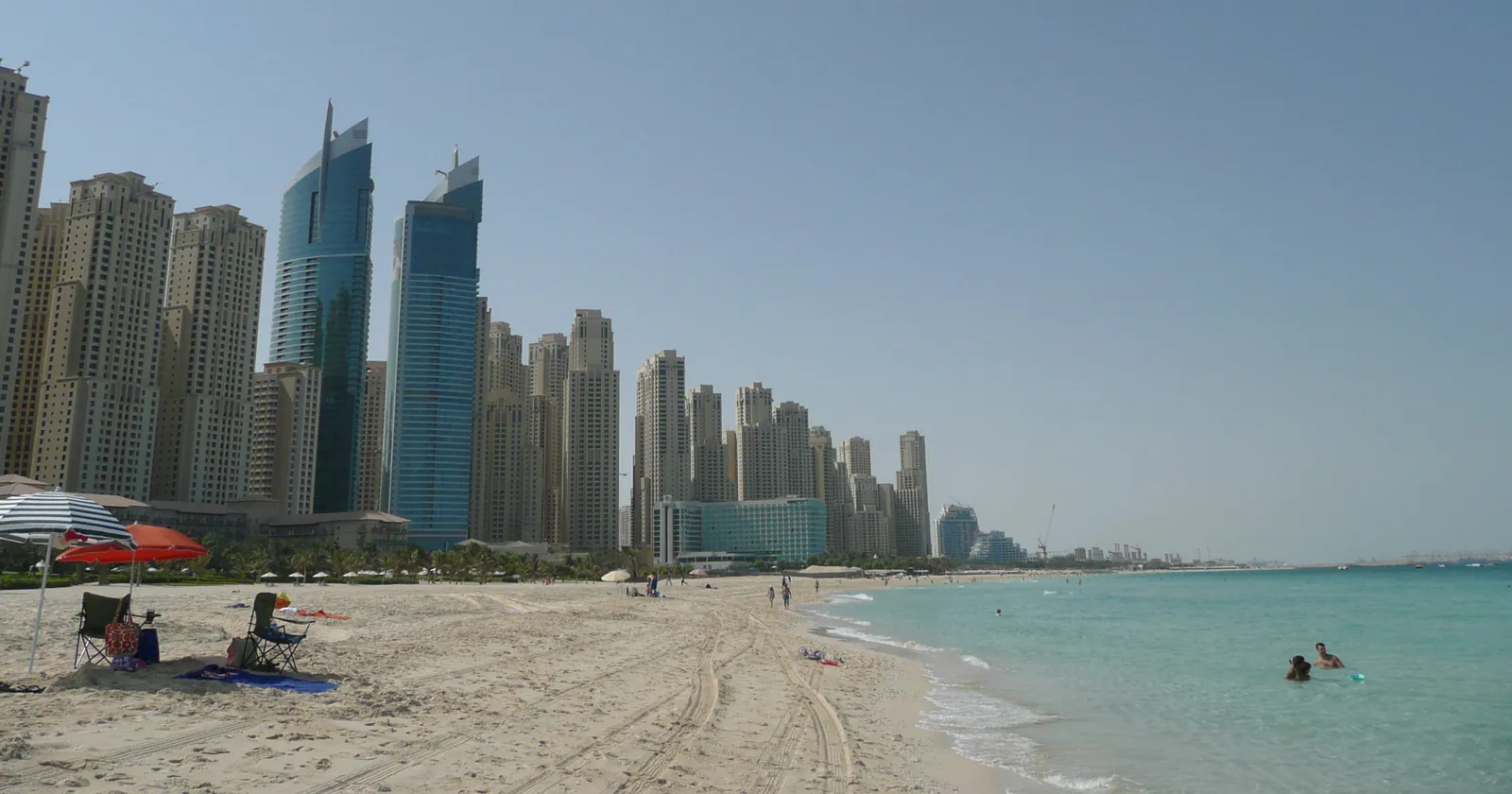

Dubai water runs from 16°C to 37°C, and the southern Gulf lost 73% of its coral in 2017
The Ramsar information sheet for the Jebel Ali site records surface water temperatures from a minimum of 16°C in winter to a maximum of 37°C in summer. Burt adds that the southern Gulf reefs also face winter cold below 18°C and salinity above 44, which is why only a hardy subset of species lives here at all.
Those that do are the most heat-tolerant corals known. They host a symbiotic alga, Cladocopium thermophilum, that dominates virtually all corals in the southern Gulf and is functionally absent east of Ras Al Khaimah. Tolerance is not immunity. The Gulf is warming at over twice the rate of the global oceans, and back-to-back bleaching in 1996 and 1998 killed over 90 percent of corals on reefs in Abu Dhabi and Dubai.
Dubai’s corals did come back once. A study at Saih Al-Shaib in Dubai a decade later found 25 coral species and coral cover of 35 percent, with Acropora dominating three of six sites and cover at those sites double the post-bleaching level. It also found five formerly common species missing, suggesting local extinction, and one shallow site reset by a further bleaching in 2002.
Then came 2017. Across eight reefs spanning more than 350 kilometers of the southern Gulf, reef-bottom temperatures reached 37.7°C in hourly readings, corals spent a mean 55 days above bleaching temperature and nearly 12 above lethal temperature, and 94.3 percent bleached. By April 2018 coral cover averaged 7.5 percent, a loss of 73 percent in one year, and the already rare Acropora was locally extirpated.
For planning, summer is the hottest water of the year and the season in which the 2017 bleaching struck. A thin rashguard or shorty covers summer; the winter floor near 16°C calls for more.
Dubai’s Jebel Ali sanctuary law never mentions diving, only disturbance and commerce
The Jebel Ali Wildlife Sanctuary is Dubai’s coastal marine protected area, declared on 1 March 1998 by Local Order No. 2 of 1998. Dubai Municipality gives its area as 75.2 km² and says its shallow waters support one of the most diverse coral reefs in the southern Arabian Gulf, alongside seagrass beds used by green turtles and dugongs. Its beaches are the last remaining breeding grounds in Dubai of the critically endangered hawksbill turtle.
A smaller part of it, 2,002 hectares between Palm Jebel Ali and the Abu Dhabi border, became the Jabal Ali Wetland Sanctuary Ramsar site on 25 October 2018. The two figures measure different things, the whole sanctuary and the Ramsar site inside it, and the sheet records 34 coral species there, 14 of them listed from Near Threatened to Threatened.
Read the prohibitions and notice what they do not say. The municipality quotes the protected areas law as banning any act that may destroy or damage wildlife or marine flora and fauna, naming hunting, killing or disturbing marine wildlife, introducing non-native species and pollution. It also names commercial activities in the protected areas, in a sentence that ends “unless by a permit from the competent authority”. Diving is not named.
A paid dive trip is a commercial activity, so ask the operator which permit covers a Jebel Ali dive before booking one. The competent authority may also have changed: Law No. 11 of 2024, issued on 25 April 2024, created the Dubai Environment and Climate Change Authority (DECCA) and gave it the job of establishing, managing and supervising nature reserves, with the related functions moving over from the municipality.
One naming trap is worth knowing. The municipality’s page calls the reserves instrument Local Order No. 11 of 2003, while Dubai’s legislation portal files it as Law No. 11 of 2003 establishing nature reserves and gives the number Local Order No. 11 of 2003 to a public health order. The 2026 public safety law annulled that public health order, not the reserves law.
Dubai Reef is a fisheries project first, with modules sunk at 15 to 25 meters
Announced on 1 December 2023, Dubai Reef is the emirate’s plan to sink 20,000 purpose-built reef modules across 600 km² of its waters. The government’s launch statement put the purpose first as increasing fish stocks, supporting sustainable fishing and food security, and a founding partner was Dubai’s regulatory committee on fishing, whose chairman said it would reduce the operating costs of commercial fishing.
The modules are between 1.6 and 6.5 meters high and go down in depths of 15 to 25 meters, in four clusters, according to the October 2024 update. By July 2025 the government reported 3,660 modules deployed and 39 percent of the total fabricated, and surveys at the proof-of-concept site recorded snappers, groupers and barracuda among 15 native species.
The official statements do not agree on the schedule. The launch spoke of four years, the October 2024 update of three, and the July 2025 release of completion by 2027. None of them says whether recreational diving on the modules will be allowed, or where the fishing zones will lie, so a Dubai Reef dive is not something to plan a trip around yet.
Deep Dive Dubai holds the pool depth record at 60.02 meters, in fresh water
Guinness World Records lists Deep Dive Dubai in Nad Al Sheba as the deepest swimming pool for diving: 60.02 meters, achieved on 27 June 2021. It holds 14 million liters of water kept at 30°C, filtered and circulated every six hours, around the set of a sunken city. For a certified diver it is the one Dubai dive whose conditions do not depend on wind or season.
It is fresh water, and that matters. A diver weighted for the sea is overweighted in a pool, so expect to drop lead and to recheck your trim; our buoyancy guide covers the adjustment. The facility’s own course pages set minimum ages of 10 for Junior Open Water, 12 for Open Water and 15 for Advanced Open Water, with try dives limited to 12 meters.
Two lines on its site are worth reading closely. It says that for courses with specific training requirements it uses partner centers in Fujairah or Dubai to finish the course, so an open water certification may end on the east coast after all. And it says it runs a hyperbaric chamber with a hyperbaric doctor on call. That is the facility describing its own equipment; it does not say whether the chamber takes divers injured elsewhere.
No other Dubai recompression chamber is named on this page, because none could be confirmed at a primary source. Before diving, ask your operator where they would send you, and check that your dive insurance covers evacuation and treatment in the UAE. Freedivers using the pool should read our freediving safety guide first.
Shore dives in Dubai fall under the 2026 public safety law’s beach rules
Anyone snorkeling or shore diving from a public beach in Dubai now walks in under a new law. Law No. 2 of 2026 on public safety, in force since 1 June 2026, requires the public to observe permitted swimming times at beaches and to avoid restricted areas reserved for staff and other unauthorized zones.
The law does not mention diving. It sets fines from AED 500 to AED 1,000,000, doubled for a repeat within a year, and leaves the list of violations and their fines to the Executive Council. It also puts Dubai Municipality’s Environment, Health and Safety Agency in charge of public safety across the emirate.
In practice, that means a shore entry belongs inside the hours and the zone the beach posts, and a site outside them is a boat dive. Our list of shore diving destinations covers coasts where walking in is the normal way to dive.
Five Dubai dive businesses to start from, one of them filed in Ajman
The Dubai operator list holds 5 dive businesses. Four are published by SSI in its register of affiliated centers, read on 20 September 2026. The fifth is a Green Fins Digital Member, read on 21 September 2026, which means it evaluated itself and was not assessed in person. Four of the five publish a website.
SSI rates some of them for more than recreational diving. One is listed for Extended Range and Rebreather training and for training instructors in both; another for Extended Range; a third for Freediving. That is what the register says about each listing, not evidence that a course runs this season. One SSI entry files its town as Ajman, a different emirate from Dubai, and the register’s town field records where a body files a business, not where it dives.
The DMA says it registers every trainer and guide working in a Dubai center, but no public list of those registrations could be found to set against these entries. Ask a center for its DMA permit and its instructors’ registration directly; which registers can be read logs what each source returned.
FAQ: scuba diving in Dubai
Who licenses scuba diving in Dubai?
The Dubai Maritime Authority, renamed from the Dubai Maritime City Authority by Law No. 3 of 2023, licenses diving training centers and authorizes each trainer and guide who works in one. A trainer must be at least 22, hold a maritime trainer license approved by the authority and hold an instructor certificate from a diving association. A center may not hire anyone the authority has not registered.
What is the minimum age to learn to dive in Dubai?
Ten. The Dubai Maritime Authority's rules for diving training centers say no trainee is accepted under 10, a trainee under 15 may not dive alone unless with someone at least 18, and anyone under 18 or their guardian signs a statement on their medical fitness. Beginners train only in the daytime.
How warm is the water for diving in Dubai?
The Ramsar information sheet for the Jebel Ali site records surface water from a minimum of 16 degrees Celsius in winter to a maximum of 37 degrees in summer. During the 2017 heatwave, hourly reef-bottom readings in the southern Gulf reached 37.7 degrees, and coral cover fell by 73 percent in one year.
What is the Zainab wreck in Dubai?
A tanker that sank off Jebel Ali on 14 April 2001. The UAE environment ministry lists it as an ecotourism site, originally named The Seasroun Five. Reports at the time said it was carrying smuggled Iraqi oil when it went down. The reported cargo and depth figures disagree between sources, so ask the dive boat for the depth it dives the site to.
Is the Fujairah dive trip covered by Dubai's rules?
No. Dubai's law defines its waters as those between the Dubai-Sharjah border and the Dubai-Abu Dhabi border on the Arabian Gulf, so the Gulf of Oman coast is outside them. The east coast reefs around Dibba, Al Aqah, Mirbah and Khor Fakkan are in other emirates, and Dibba Rock lies within the Al Aqah marine protected area.
Note: Conditions, safety guidance and regulations change. Verify current information with official sources, including the dive operator, the maritime authority and the relevant government department, before you travel or dive.
Founder of NOMADREEF and a former digital nomad. This guide is sourced from the references below; conditions, prices and rules change, so verify current details, and follow qualified local guidance and safety briefings. About the author · LinkedIn ↗
Sources
- The authority and its waters (primary). Law No. (3) of 2023 Concerning the Dubai Maritime Authority, issued 6 February 2023: Article 2 defining the Waters of the Emirate as lying between the Dubai-Sharjah border and the Dubai-Abu Dhabi border and extending to the exclusive economic zone, and listing diving among Maritime Activities; Article 3(b) replacing “Dubai Maritime City Authority” with “Dubai Maritime Authority” in all legislation; Article 5 on issuing approvals and permits for persons engaged in the maritime sector. Dubai Legislation Portal, Law No. 3 of 2023. Read 24 September 2026. The English text is a translation; the portal states the Arabic text prevails.
- The vessel permit (primary). Administrative Resolution No. (1) of 2025 Regulating the Conduct of Commercial Maritime Activities on Vessels in the Emirate of Dubai, issued 10 April 2025: the definition of Activity including “diving operations”; Article 3 requiring a Permit before a Vessel is used for the Activity; Article 4(c) on the Permit specifying the vessel, the activity and the zone. Dubai Legislation Portal, Administrative Resolution No. 1 of 2025. Read 24 September 2026.
- The training center, trainer and trainee rules (primary). Dubai Maritime Authority, service page “Maritime Training Center Licensing”, diving training section: owner or manager at least 25; professional liability insurance not less than AED 500,000; the pool for beginners, bilingual safety instructions, oxygen at 15 liters per minute for twenty minutes, backup cylinders of at least 50 percent and a DMA-licensed boat; trainees able to swim, not under 10, under 15 not alone unless with a person at least 18, medical statement under 18; beginners in the daytime only; no trainer or guide unless authorized by the DMA and registered in its records; equipment rented only to those authorized by diving clubs and associations; records kept at least three years; trainers at least 22 with a DMA-approved maritime trainer license; the AED 2,020 annual permit fee for diving training. DMA eServices, Maritime Training Center Licensing. Read 24 September 2026; the page shows a last update of 23 October 2025. The page still uses the old DMCA name in places. No public list of registered trainers and guides was found: gap.
- The Zainab (primary listing, history triangulated). The UAE Ministry of Climate Change and Environment ecotourism entry for Zainab: “Sunk in 2001, the wreck of Zainab (originally known as The Seasroun Five), can be found off the coast of Dubai. This ship was once a transporter of...”. MOCCAE, Zainab. The ministry site refused connections on 24 September 2026; the text was read from the Internet Archive copy of 11 March 2026, whose page body loads by script, so only the ministry’s own summary could be read. The sinking date, the fuel oil cargo, the smuggling and the interception are triangulated from three reports: Tehran Times, 16 April 2001, carrying Reuters; Gulf News, experts to survey sunken oil-smuggling vessel (Georgian flag, Iraqi owner, interception by naval forces, about 40 m of water, more than 3,000 tonnes of oil); Al Bawaba, US-intercepted Iraqi tanker spills oil (refused automated requests on 24 September 2026; read from the search index summary only). The cargo tonnage and the depth disagree between sources and are given no figure in the text.
- The Dibba Rock protected area (primary). MOCCAE ecotourism entry for Dibba Rock, “Standing in the Gulf of Oman, within Al Aqah marine protected area”. MOCCAE, Dibba Rock, read from the Internet Archive copy of 20 January 2026. Fujairah’s own permit rules for its marine reserves were reported in the press but no primary text was reached, so they are left out: gap.
- Oman’s diving permit (primary). Environment Authority of Oman, Annual Diving Permit for Individuals: a permit for diving outside nature reserves for research or scientific purposes, subject to the Regulations for Organizing Diving Activities in the Marine Environment outside the Boundaries of Nature Reserves, Ministerial Decision no. 40/2009. Environment Authority, Oman. Read 24 September 2026. What a recreational visitor on a Musandam trip needs was not established at a primary source: gap.
- Coral of the Emirates (peer-reviewed, open access). Burt JA (2024), Coral Reefs of the Emirates, in Burt JA (ed), A Natural History of the Emirates, Springer, 325–351: coral carpets in the southern Gulf; about 70 species at the Strait of Hormuz, around 50 in the north-western Gulf and 34 along the UAE Gulf coast; about 60 on the east coast, at Dibba, Al Aqah, Mirbah and Khor Fakkan, mostly shallower than 15 m, none south of Khor Fakkan; reefs in Dubai and next to Jebel Ali lost to dredging and reclamation since the 1980s; winter below 18°C and salinity above 44 PSU; Cladocopium thermophilum; Gulf warming at over twice the global rate; over 90 percent coral loss in Abu Dhabi and Dubai in 1996 and 1998. doi:10.1007/978-3-031-37397-8_11. Read 24 September 2026.
- The 2017 heatwave (peer-reviewed). Burt JA, Paparella F, Al-Mansoori N, Al-Mansoori A, Al-Jailani H (2019), Causes and consequences of the 2017 coral bleaching event in the southern Persian/Arabian Gulf, Coral Reefs 38: 567–589: eight reefs across more than 350 km; hourly temperatures up to 37.7°C; 55.1 days above bleaching and 11.8 days above lethal temperatures; 94.3 percent bleached; 7.5 percent cover by April 2018, a 73 percent loss; Acropora locally extirpated. doi:10.1007/s00338-019-01767-y. Read from the publisher abstract, 24 September 2026. Which of the eight reefs lie in Dubai is not stated in the abstract, so the text attributes the figures to the southern Gulf.
- Recovery at Saih Al-Shaib (peer-reviewed). Burt J, Bartholomew A, Usseglio P (2008), Recovery of corals a decade after a bleaching event in Dubai, United Arab Emirates, Marine Biology 154: 27–36: 25 species, 35 percent cover, Acropora dominance at three of six sites with cover double the post-bleaching level, a further bleaching in 2002, five formerly common species not observed. doi:10.1007/s00227-007-0892-9. Read from the publisher abstract, 24 September 2026.
- The Jebel Ali Ramsar site (primary). Ramsar Information Sheet, site 2364, Jabal Ali Wetland Sanctuary, designated 25 October 2018: 2,002 ha from Palm Jabal Ali towards the Abu Dhabi border within the Jabal Ali Marine Sanctuary designated by Local Order 2 of 1998; surface water 16°C to 37°C; 34 coral species, 14 Near Threatened to Threatened; patch corals growing on caprock and breakwater rock. Ramsar RIS 2364 (PDF). Read 24 September 2026.
- The sanctuary and the prohibitions (primary). Dubai Municipality, Dubai Protected Areas: Jabal Ali Wildlife Sanctuary, 75.2 km², declared 1 March 1998 by Local Order No. 2 of 1998, hawksbill breeding, seagrass, coral; and the page quoting the prohibited activities in protected areas. Dubai Municipality, wildlife sanctuaries and Dubai Municipality, about Dubai protected areas. Read 24 September 2026. The municipality labels the reserves instrument both “Law No.11 of 2003” and “Local Order No.11 of 2003” on the same page.
- Who now runs nature reserves (primary). Law No. (11) of 2024 Establishing the Dubai Environment and Climate Change Authority, issued 25 April 2024: Article 5 on establishing, managing and supervising Nature Reserves; Article 14 on the transfer of functions from Dubai Municipality; the preamble citing Law No. (11) of 2003 Establishing Nature Reserves in the Emirate of Dubai. Dubai Legislation Portal, Law No. 11 of 2024. Read 24 September 2026. The text of Law No. 11 of 2003 itself was not reached; its prohibitions are quoted from the municipality page.
- The public safety law (primary). Dubai Media Office, Mohammed bin Rashid issues law on public safety, 6 March 2026: Law No. (2) of 2026, effective 1 June 2026; permitted swimming times at beaches and restricted areas; fines from AED 500 to AED 1,000,000 and up to AED 2,000,000 for a repeat within a year; the Environment, Health and Safety Agency; the annulment of Local Order No. (11) of 2003 on public health and community safety. Dubai Media Office. Read 24 September 2026. The law text itself was not yet on the legislation portal.
- Dubai Reef (primary). Dubai Media Office releases of 1 December 2023 (600 km², fish stocks and fishing as purpose, four-year deployment), 30 October 2024 (20,000 modules over three years, 1.6 to 6.5 m high, 15 to 25 m deep, four clusters) and 28 July 2025 (3,660 deployed, 39 percent fabricated, completion by 2027, 15 native species). Read 24 September 2026. The launch release’s carbon capture figure is not repeated here. Whether divers may visit the modules is not stated in any release: gap.
- Deep Dive Dubai (primary). Guinness World Records, Deepest swimming pool for diving (60.02 m, 27 June 2021) and its July 2021 feature (14 million liters, Nad Al Sheba, filtration every six hours, 30°C); the operator’s own course page (minimum ages, partner centers in Fujairah or Dubai) and home page (fresh water, try dives to 12 m, its own hyperbaric chamber). Read 24 September 2026. The chamber statement is the operator describing its own facility. No public hyperbaric facility in Dubai was confirmed at a primary source, so none is named: gap.
- The five businesses. Five dive businesses on the Dubai operator list: four published by SSI in its register of affiliated centers, read 20 September 2026, one filed under the town Ajman, with programme ratings for Extended Range, Rebreather, instructor training in both, and Freediving; one Green Fins Digital Member, self-evaluated, read 21 September 2026. Four of the five publish a website. The limits of each source are set out on which registers can be read.
- Left out. The history and depth of the Cement Barge and other named Dubai dive sites, which rest on operator and travel pages only; the Dubai rules on spearfishing, whose federal text refused automated requests; any figure for visibility, which no primary source gives.