Cape Verde vs Mauritius for Kitesurfing: Which Winter Has Wind?
 by Yannick SchrothOct 13, 202610 min read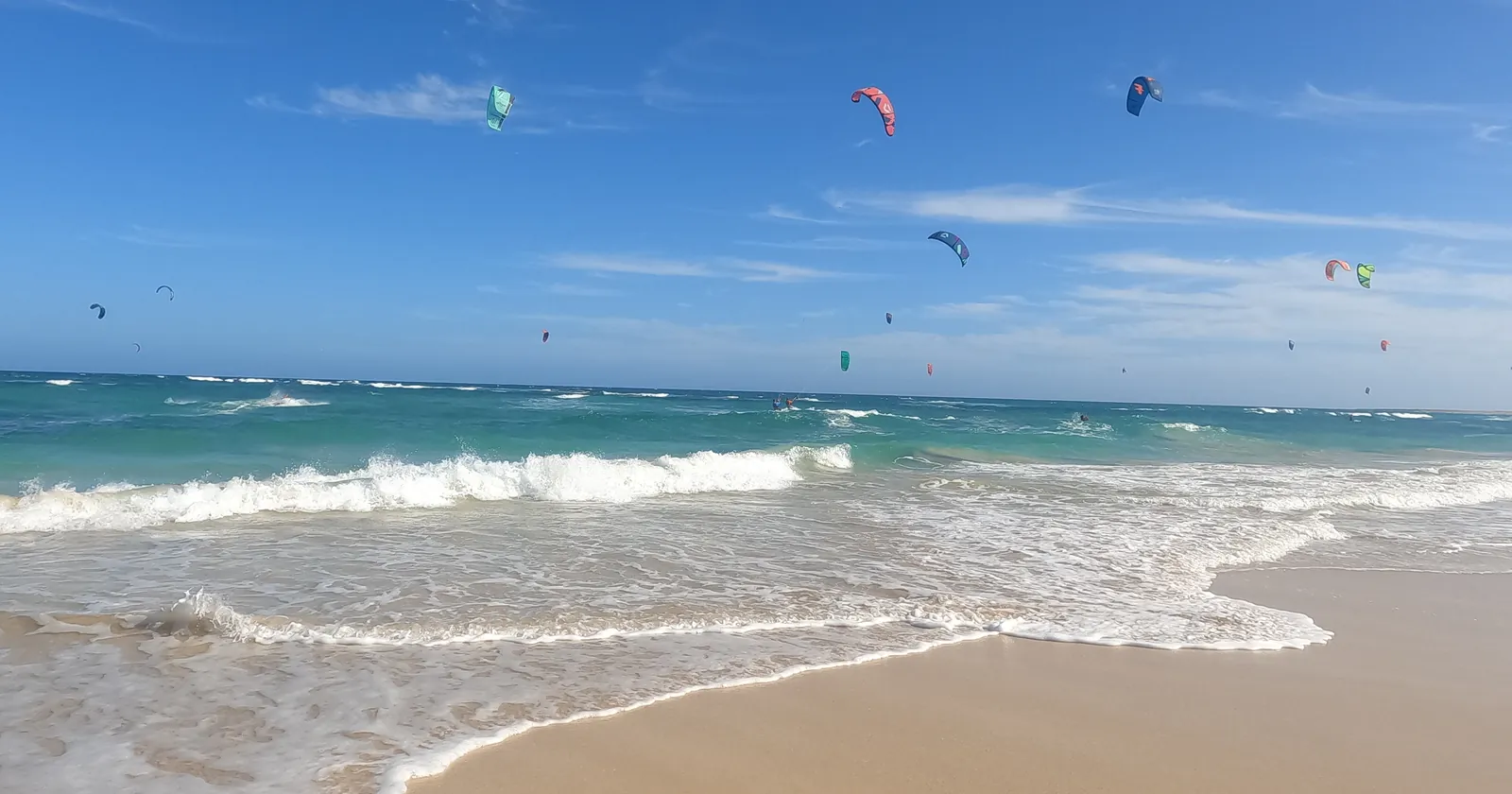
Kite Beach near Santa Maria on Sal, 3 January 2024: the Cape Verde side of this comparison, in its windy season. Photo: Tbo47, Wikimedia Commons, CC0, cropped.
| Sal (Santa Maria), Cape Verde | Le Morne, Mauritius | |
|---|---|---|
| Windiest months at the island's airport, 2015–2024 | February and March | June to September |
| Daytime hours at 12 knots or more, December to March | 83 to 92% | 25 to 39% |
| Daytime hours at 12 knots or more, June to September | 45 to 83% | 45 to 51% |
| Sea surface, February / August | 22.6 °C / 26.7 °C | 28.2 °C / 23.8 °C |
| Storm season | Atlantic hurricane season, 1 June to 30 November | Tropical cyclone season, 1 November to 15 May |
| Remote-work stay | Remote Working Program: 6 months, renewable for 6 more | Premium Visa: more than 6 months up to 1 year, renewable |
| Money test | Average bank balance of €1,500 over the last 6 months | Income of USD 1,500 a month per adult |
| Time zone | UTC−1 | UTC+4 |
Wind figures are calculated for this page from ten years of hourly airport reports in NOAA's Integrated Surface Database, counting 10:00 to 18:00 local time. Water is NOAA's daily satellite sea surface temperature for the ocean cell nearest each spot, averaged over 2021–2025. Visa terms are as read on each government's pages in October 2026.
Cape Verde vs Mauritius wind: Sal peaks in February, Le Morne in August
Cape Verde vs Mauritius is first a question of which months you have free. Both islands sit in a trade-wind belt, just on opposite sides of the equator. Sal, at 16° north, is reached by the north-east trades that strengthen in the northern winter. Mauritius, at 20° south, gets the south-east trades of the southern winter. The calendar flips.
The cleanest way to see it is the same instrument in both places: the anemometer at each island's international airport, read every hour for ten years. Amílcar Cabral airport sits about 17 km north of Santa Maria on a flat, open island. Sir Seewoosagur Ramgoolam airport sits on the south-east coast of Mauritius, about 38 km in a straight line from Le Morne.
| Month | Sal airport: mean, knots | Sal: hours at 12 kn+ | Mauritius airport: mean, knots | Mauritius: hours at 12 kn+ |
|---|---|---|---|---|
| December | 14.8 | 83% | 10.8 | 39% |
| January | 15.6 | 87% | 10.1 | 34% |
| February | 16.5 | 92% | 9.9 | 29% |
| March | 16.3 | 92% | 9.3 | 25% |
| April | 15.7 | 93% | 9.9 | 33% |
| May | 15.6 | 93% | 10.0 | 34% |
| June | 14.7 | 83% | 11.1 | 45% |
| July | 11.6 | 48% | 11.4 | 48% |
| August | 11.2 | 45% | 11.5 | 49% |
| September | 12.6 | 61% | 11.7 | 51% |
| October | 13.4 | 70% | 11.2 | 46% |
| November | 13.9 | 75% | 10.5 | 35% |
Raise the bar to 15 knots and the northern-winter gap gets wider. From December to March the Sal airport logs 15 knots or more in 42 to 60% of daytime hours, the Mauritian airport in 4 to 7%. In August the two are close: 9% on Sal, 13% in Mauritius.
An airport is not a kite beach, and Le Morne is on the opposite coast from its airport. ION Club, which runs a center on the lagoon, gives averages of 12 to 20 knots from November to March and about 15 to 26 knots from April to October. So the southern summer at Le Morne is lighter, not dead. The direction of the difference is the same as at the airport.
Mauritius's own met service shows the same swing on its west coast. At Medine, its station for the West region, the 1971–2000 mean wind is 7.6 km/h in November, December and January and 15.2 to 17.1 km/h from June to September, roughly double. The station is not a kite spot and the numbers are low; the shape of the year is the point.
Sea temperature at Sal and Le Morne: the windy months bring the cooler water
On water temperature, Cape Verde vs Mauritius is a mirror image. Each wind season comes with its island's coolest sea.
| Month | Off Sal | Off Le Morne |
|---|---|---|
| December | 24.7 °C | 27.2 °C |
| February | 22.6 °C | 28.2 °C |
| April | 22.8 °C | 28.0 °C |
| June | 23.6 °C | 25.4 °C |
| August | 26.7 °C | 23.8 °C |
| October | 27.3 °C | 24.4 °C |
Monthly means of NOAA's daily Optimum Interpolation sea surface temperature, 2021–2025, for the quarter-degree ocean cells about 25 km south of Santa Maria and about 27 km south-west of Le Morne.
The practical reading: Sal in its February peak sits around 22 to 23 °C, and Le Morne in its August peak around 24 °C. Pack the same wetsuit for either island's good season. If warm water matters more than wind, the off-seasons are where it is: Le Morne in February runs above 28 °C, Sal in September above 27 °C.
Cyclone and rain seasons for Mauritius and Cape Verde
A northern-winter stay in Mauritius lands in its storm season. Mauritius Meteorological Services treats 1 November to 15 May as the tropical cyclone season and notes that a storm can still form outside it. Its climate page describes a warm, humid summer from November to April and a relatively cool, dry winter from June to September.
The rain follows. At Medine on the west coast the 1971–2000 normal is 182 mm in February over 10 days with at least 1 mm, against 15 mm in August over 3 days. ION Club's own Le Morne page warns that "between December and April, there can be heavy precipitation."
Cape Verde's storm months fall outside its kite season. The US National Hurricane Center gives the Atlantic hurricane season as 1 June to 30 November, with most activity between mid-August and mid-October and the peak on 10 September. On Sal those are the lightest-wind months anyway. Neither island's best kite season overlaps its own storm season; a December trip to Le Morne does.
Kite Beach and Ponta Preta on Sal, the lagoon and One Eye at Le Morne
Both bases have a learning spot, a wave for experts and a main beach with tricky wind. The spot descriptions below are the operators' own, from ION Club, which runs centers at both.
Sal. The beach in front of Santa Maria is "dominated by a side-offshore wind, only suitable for experienced kitesurfers", so beginners are driven to Kite Beach, about five minutes away, which ION Club calls "the ideal place to learn and progress, or have fun in the waves".
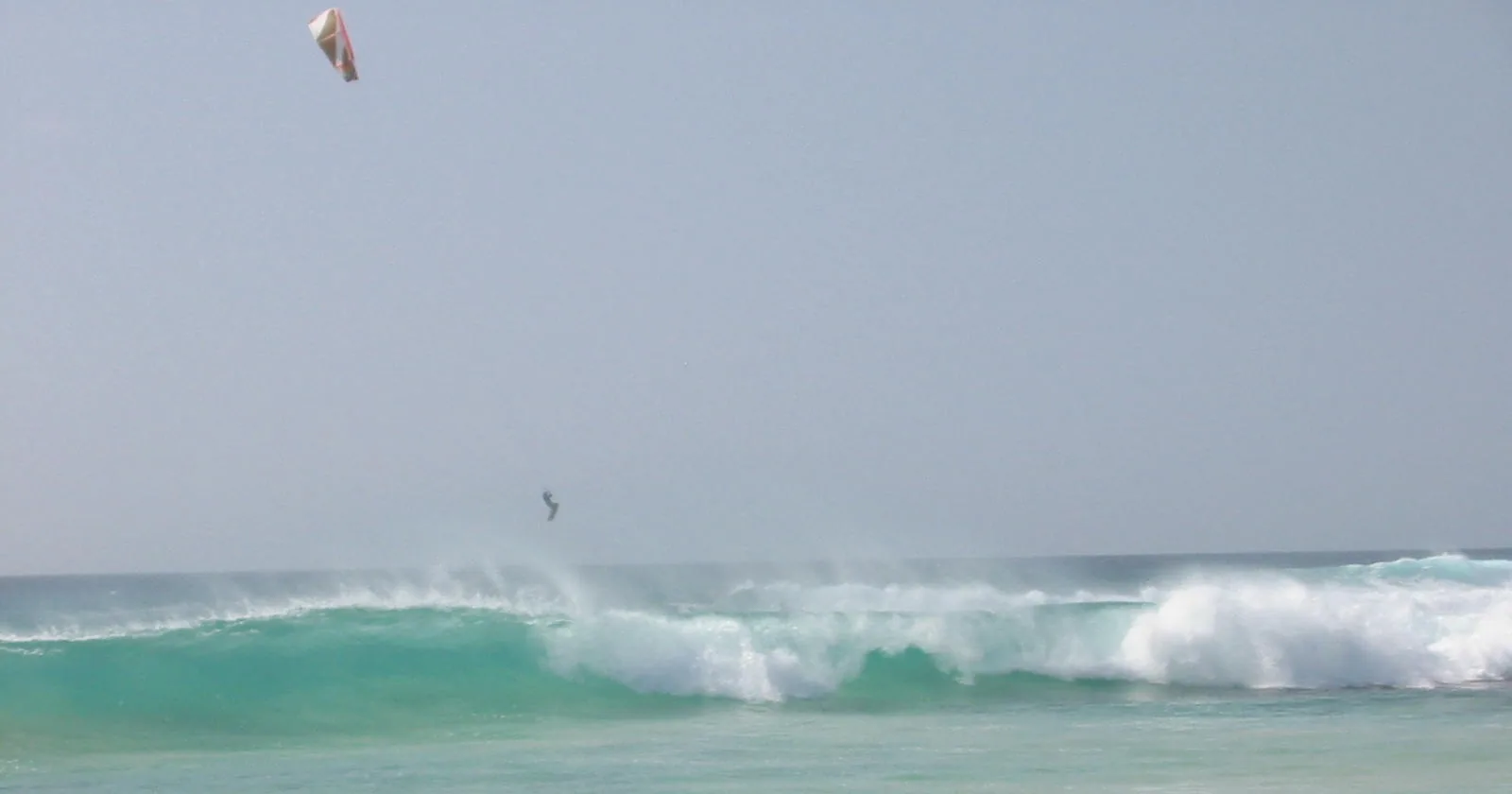
Ponta Preta, a 15-minute drive from the village, is the expert wave: "the slightest mistake and you're likely to end up on the rocks", and the center does not let its rental gear go there. ION Club opens on Sal from October to August and names October to May as the best period.
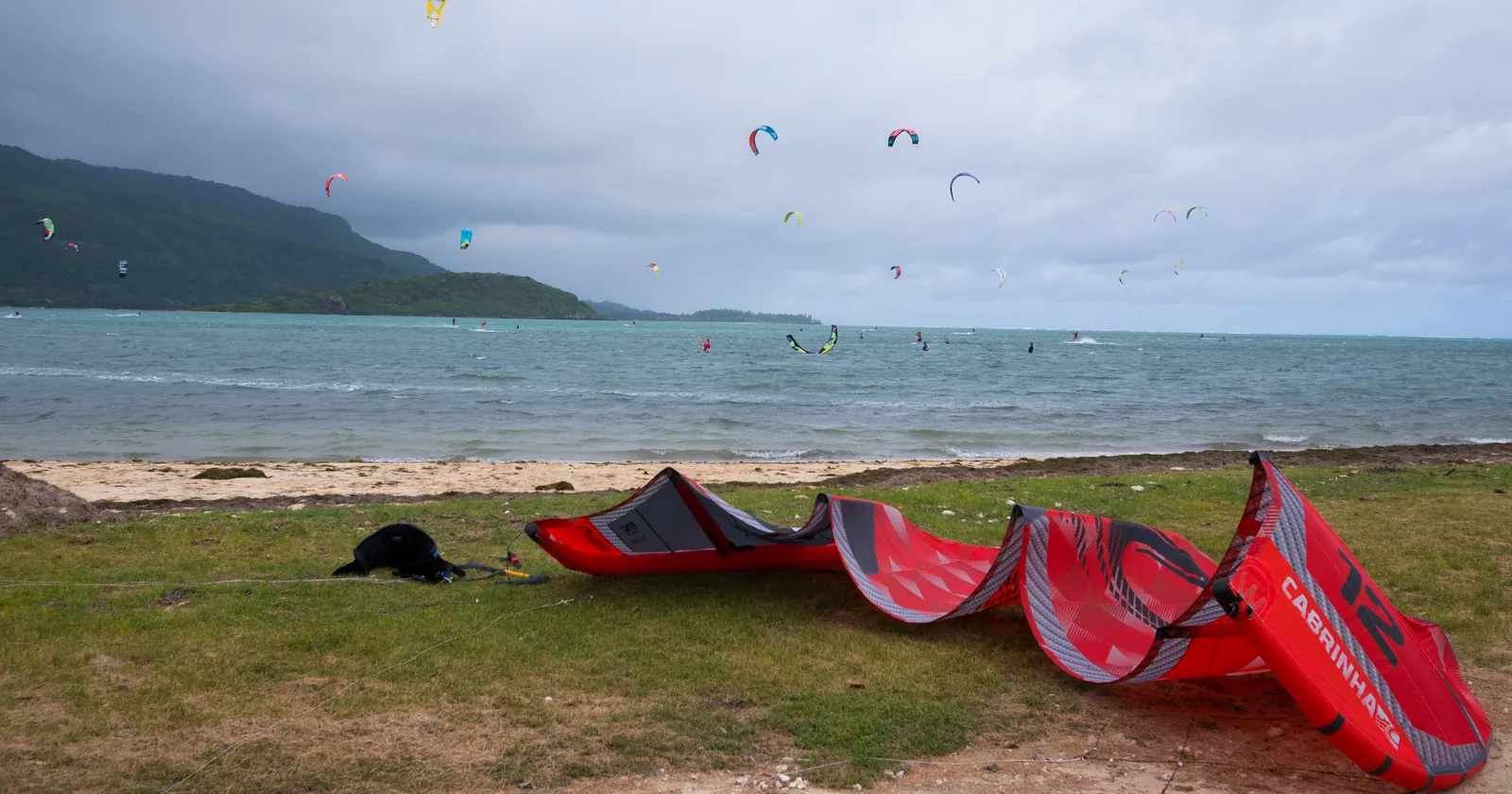
Le Morne. A shallow lagoon runs inside a reef about 600 m out. The wind there is "often side-off", which ION Club says is not dangerous because the water is shallow. Outside it, Little Reef is the beginner wave and Manawa and Chameau are for intermediates. One Eye is the other category: "shallow waters and considerable power", reserved for experienced wave riders on their own equipment, with a boat on standby.
So a beginner can learn at either. The difference is the month you can do it in.
Kite rental licenses in Cape Verde and Mauritius, and the 500-meter dolphin rule
In both countries the rules are written for the business that rents the kit.
In Cape Verde, Decree-Law 37/2015 sets the rules for recreational and nautical tourism. Article 20(4) lists boards "com ou sem vela", with or without a sail, among the small beach craft exempt from vessel registration. Article 64(1)(e) lists the rental of small craft that are exempt from registration as a maritime-tourism activity, and article 65(1) says such activities need a license from the tourism authority. The word kite does not appear in the 2015 text, so how a kite school is classed is a question for the school.
In Mauritius, the Tourism Authority Act 2006 names "Operating rental agency for kite surf" among the activities that count as a tourist enterprise, and section 26(1) bars running one without a tourist enterprise license. The list names kite rental, not kite teaching. The Authority's legislation page lists zone and speed rules by place name for Trou d'Eau Douce, Belle Mare, Bel Ombre, Flic en Flac and Wolmar, and Grande Rivière Noire. None is named for Le Morne.
One Mauritian rule binds every kiter on the water. Regulation 10 of the Tourism Authority (Dolphin and Whale Watching) Regulations 2012 says "No person shall knowingly do kite surfing, jet skiing, paragliding, diving or windsurfing in the zone within a radius of 500 metres from the closest dolphin or whale." If a pod surfaces near your session, ride away from it.
Cape Verde's Remote Working Program vs the Mauritius Premium Visa
Both countries run a long-stay scheme for people paid from abroad. On paperwork, Cape Verde vs Mauritius comes down to length and to how the money is proved.
Cabo Verde Remote Working Program, run by Turismo de Cabo Verde:
- Length: "a temporary work/tourism visa lasting 6 months, with the opportunity of renewal for another 6 months after".
- Who: "anyone from Europe, North America, Community of Portuguese Speaking Countries (CPLP) and Economic Community of West African States (CEDEAO)". The page says the program "is meant for people who are self-employed and who are able to work remotely".
- Money: "minimum average bank balance of 1.500€ on the last 6 months" for an individual, 2,700€ for a family.
- Insurance: travel and health cover "with coverage for evacuation and body transportation in the case of death".
- Costs and time: a visa fee of €20 and an airport fee of €34 per person; processing "approximately 2 weeks". The page adds: "Remote workers in Cabo Verde are exempt from income tax."
Mauritius Premium Visa, per the Economic Development Board:
- Length: "a period exceeding six (6) months up to one (1) year with an option to renew". It is multi-entry and "issued free of charge".
- Conditions: the "applicant should not enter the Mauritius labour market" and "the main place of business and /or source of income and profits should be outside Mauritius", with travel and health insurance for the stay.
- Money: "Minimum amount of USD 1500 per month for each adult applicant and minimum amount of USD 500 per month for each dependent child", shown with three months of bank statements.
- Tax: income from work done remotely in Mauritius "will be taxed on a remittance basis".
For a single season you may not need either. The EDB counts the Mauritian tourist allowance as "a cumulative period of stay not exceeding 180 days in a calendar year", and Le Morne's June-to-October season fits inside one calendar year.
In Cape Verde every non-resident visitor pre-registers on EASE and pays the airport security tax, and since 1 January 2026 nationals of the countries on the EASE list need a visa before arrival. How long a visa-free stay lasts depends on your passport, so confirm it with a Cabo Verde embassy before planning a whole season on a tourist entry.
Flights and time zones from Sal and Mauritius for remote work
For a working stay, the clock decides as much as the reef.
Cape Verde runs on UTC−1 and Mauritius on UTC+4. Against Central European winter time, Sal is two hours behind and Mauritius three ahead. Against New York in winter, Sal is four hours ahead and Mauritius nine. A London working day of 09:00 to 17:00 runs 08:00 to 16:00 on Sal and 13:00 to 21:00 in Mauritius. A New York day runs 13:00 to 21:00 on Sal and 18:00 to 02:00 in Mauritius. That last line decides it for anyone on American calls.
Distance follows the same line. In a straight line Sal is about 4,300 km from London and 2,800 km from Lisbon; Mauritius is about 9,800 km from London and 9,200 km from Frankfurt.
Sal is a budget-airline hop: the airport operator reported easyJet flying London to Sal three times a week from 31 March 2025, on top of Lisbon and Porto routes running since October 2024. ION Club puts the transfer from the airport to Santa Maria at about 20 minutes. Mauritius is a long-haul flight, and Le Morne is on the far side of the island from the airport.
Kite schools on the Sal and Mauritius lists
The operator lists show how big each market is. They settle none of the above.
| Santa Maria, Sal | Mauritius, whole island | |
|---|---|---|
| Businesses listed | 10 | 17 |
| Teaching kitesurfing | 4 | 8 (7 at Le Morne, 1 filed at Bel Ombre) |
| Dive centers | 6 | 9 |
| In the SSI, IKO or VDWS register | 10 of 10 | 12 of 17 (3 of the 8 kite schools) |
| Green Fins members | 0 | 0 |
Both lists mix kite schools and dive centers, and the Mauritius one covers the whole island, so the kite rows are the ones to read. Le Morne has more kite schools; Sal's four all carry a register entry you can open. Five of the eight Mauritian kite schools appear in none of the three registers, which on its own does not mean they are unlicensed. No register is a license.
Cape Verde vs Mauritius in five lines
- Sal for December to May: 12 knots or more in 83 to 93% of daytime hours at the airport.
- Le Morne for June to October: the trades double at Mauritius's west-coast station, and ION Club puts the spot at 15 to 26 knots.
- Each wind season comes with 22 to 24 °C water; the warm-water months are the light-wind ones.
- A northern winter in Mauritius is cyclone season, 1 November to 15 May.
- Visas: Cape Verde six months plus six, Mauritius up to a year, and 180 tourist days a calendar year in Mauritius.
Sal for a northern winter, Le Morne for a southern one
Pick Sal if "winter" means December to April and you want wind most days, a short flight from Europe and a time zone that works for London or New York. The Sal kite guide covers living in Santa Maria, and the Santa Maria operator list has its four kite schools. Do not pick it for August.
Pick Le Morne if you can travel from June to October, want a flat lagoon to learn in with a reef wave outside it, and can live with a three-hour lead on Central Europe. The Le Morne kite guide covers the spot, and Mauritius diving has the marine park and cyclone rules for days without wind. Do not pick it for February.
For a full year away, Cape Verde vs Mauritius does not have to be either/or. The two seasons fit end to end: Sal from December to May, Le Morne from June to October, each under its own entry rules.
If neither calendar fits, the comparison for a Mediterranean-side winter is Tarifa vs Dakhla. Whichever island you choose, read your travel insurance for kitesurfing before you book, and for Cape Verde's program check that it covers evacuation and repatriation.
FAQ: Cape Verde vs Mauritius
Is Cape Verde or Mauritius better for kitesurfing in winter?
For a northern winter, Cape Verde. From December to March the airport on Sal records 12 knots or more in 83 to 92% of daytime hours, against 25 to 39% at the Mauritian airport, and Mauritius is in cyclone season. For June to September, Mauritius: Le Morne's south-east trades are at their strongest.
When is the kitesurfing season in Cape Verde and Mauritius?
On Sal, roughly December to May, strongest in February and March; ION Club names October to May as its best period. At Le Morne in Mauritius, roughly June to October, with ION Club giving 15 to 26 knots from April to October and 12 to 20 knots from November to March.
Can beginners learn to kitesurf in Cape Verde or Mauritius?
Yes, at both. On Sal beginners use Kite Beach, because the beach at Santa Maria has side-offshore wind suited only to experienced riders. At Le Morne lessons run in the shallow lagoon inside the reef. Ponta Preta on Sal and One Eye at Le Morne are expert waves.
Is the water warmer in Cape Verde or Mauritius?
It depends on the month. Off Le Morne the sea averages about 28 °C in February and 24 °C in August; off Sal about 23 °C in February and 27 °C in August and September. Each island's windy season is its cooler-water season, at around 22 to 24 °C.
Does Cape Verde or Mauritius have the better visa for remote workers?
Mauritius's Premium Visa is longer, more than six months up to a year and renewable, free, with an income test of USD 1,500 a month. Cape Verde's Remote Working Program gives six months plus a six-month renewal, needs an average bank balance of €1,500 over six months, and costs €20 plus a €34 airport fee.
Sources
- Hourly wind at both airports, 2015–2024. NOAA National Centers for Environmental Information, Integrated Surface Database (global hourly), station 08594099999 Amilcar Cabral International, Sal, and 61990099999 Sir Seewoosagur Ramgoolam International, Mauritius, files read from the NOAA Open Data bucket on 13 October 2026. Monthly means, the shares of hours at 12 and 15 knots or more, 10:00 to 18:00 local time (UTC−1 and UTC+4), one report per hour, calculated for this page. ncei.noaa.gov, registry.opendata.aws
- West and South climate normals, Mauritius. Mauritius Meteorological Services, Medine (West) and Plaisance (South): mean wind speed in km/h, rainfall and rain days, 1971–2000. Read 13 October 2026. West (PDF), South (PDF)
- Seasons and cyclone season, Mauritius. Mauritius Meteorological Services, Climate of Mauritius, and technical report on the 2006–2007 cyclone season, section 2.2: "the period between 01 November and 15 May of the following year". Read 13 October 2026. climate, cyclone season (PDF)
- Atlantic hurricane season, 1 June to 30 November, peak 10 September. US National Hurricane Center, tropical cyclone climatology. Read 14 October 2026. nhc.noaa.gov
- Sea surface temperature. NOAA NCEI, OISST v2.1 AVHRR daily, quarter-degree cells at 16.375°N 22.875°W and 20.625°S 57.125°E, 1 January 2021 to 31 December 2025, averaged by month for this page. Read 13 October 2026. NCEI ERDDAP, product page
- Spot descriptions, wind ranges and seasons. ION Club, the operator's own pages for Le Morne (lagoon, Little Reef, Manawa, Chameau, One Eye; 12 to 20 knots November to March, 15 to 26 knots April to October; rain December to April) and for Sal (Santa Maria beach, Kite Beach, Ponta Preta; season October to August; airport transfer about 20 minutes). Read 13 October 2026. Le Morne, Sal
- Cape Verde, nautical tourism. Decree-Law 37/2015 of 29 July 2015, Boletim Oficial I Série No. 46: article 20(4) on boards with or without a sail, articles 64(1)(e) and 65(1) on maritime-tourism activities and their license, and the definition of the tourism authority. Read in the 2015 text, which was later amended, on 14 October 2026. FAOLEX (PDF)
- Mauritius, tourist enterprise license. Tourism Authority Act 2006, First Schedule Part B ("Operating rental agency for kite surf") and section 26(1); the Authority's list of regulations. Read 14 October 2026. Act (PDF), legislation page
- The 500-meter rule. Tourism Authority (Dolphin and Whale Watching) Regulations 2012, GN 154 of 2012, regulation 10. Read 14 October 2026. tourismauthority.mu (PDF)
- Cabo Verde Remote Working Program: length, eligible regions, bank balance, insurance, fees, processing time, income tax. Turismo de Cabo Verde, read 13 October 2026. visit-caboverde.com
- Cape Verde entry. EASE traveler pre-registration and the list of nationalities needing a visa from 1 January 2026. Read 13 October 2026. ease.gov.cv
- Mauritius Premium Visa and tourist stays. Economic Development Board, Premium Visa page and FAQ (November 2023), and the residency portal: length, renewal, multi-entry, conditions, USD 1,500 and USD 500 a month, free of charge, remittance-basis tax, 180 days in a calendar year. Read 13 October 2026. edbmauritius.org, FAQ (PDF), residency.mu
- easyJet to Sal. Cabo Verde Airports, news of 6 June 2025: London to Sal from 31 March, three a week; Porto and Lisbon to Sal since October of the year before. Read 14 October 2026. caboverde-airports.cv
- Distances are great-circle distances between airport coordinates, calculated for this page.
- SSI, IKO and VDWS registers, for the counts. divessi.com, ikointl.com, vdws.de
- Counted from the operator lists: Santa Maria, Sal compiled 21 August 2026 and Mauritius compiled 24 September 2026.