Tulum vs Playa del Carmen: Which Cenote Base?
 by Yannick SchrothSep 5, 20266 min read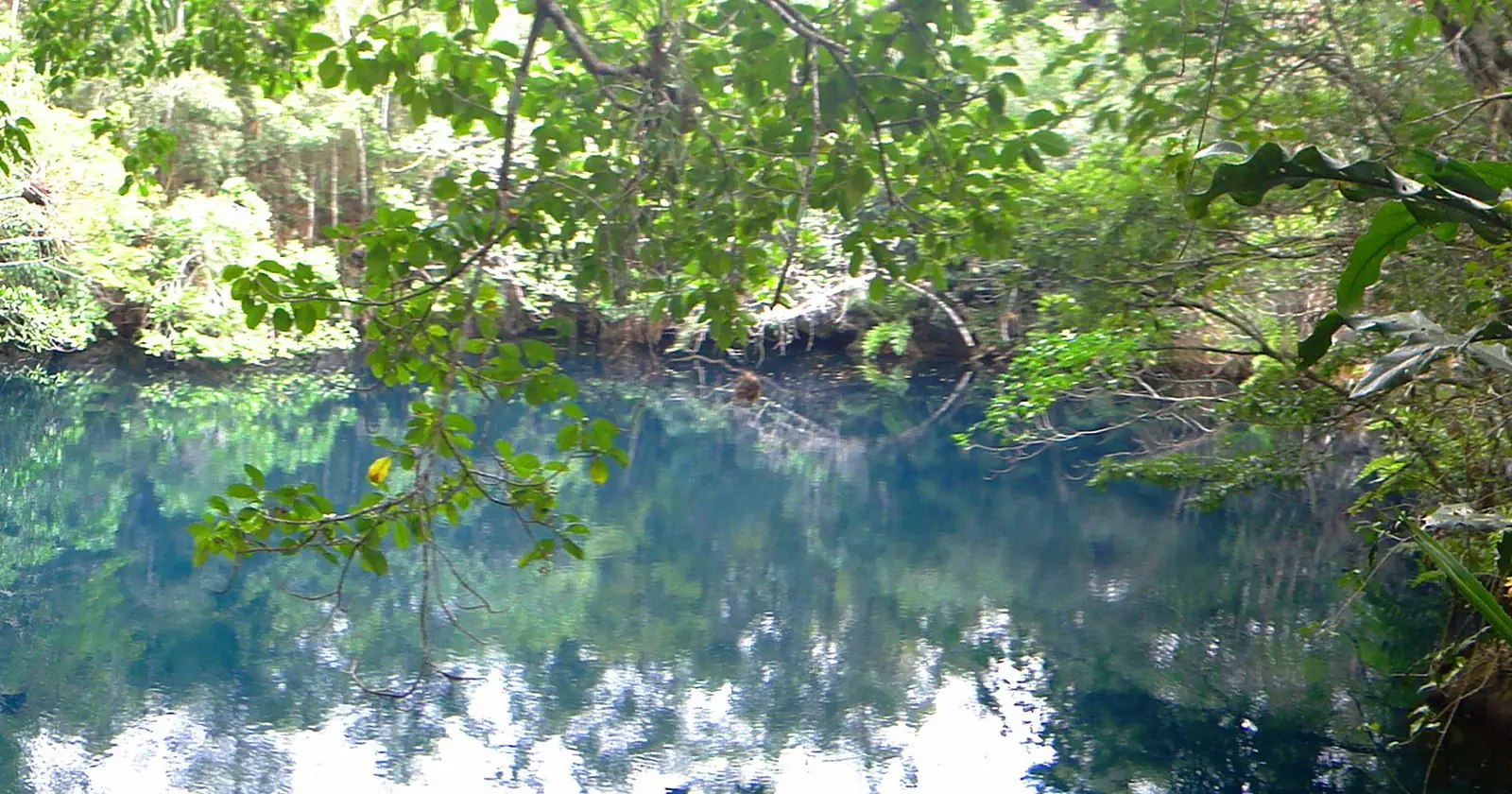
Cenote Angelita, near Tulum. Photo: Serge Melki, Wikimedia Commons, CC BY 2.0.
The lists, side by side
| Playa del Carmen | Tulum | |
|---|---|---|
| Dive centres on our list | 14 | 10 |
| With a register entry we can link | 14 | 10 |
| Green Fins members | 0 | 0 |
| Assessed by anybody | 0 | 0 |
Every entry on both lists carries an SSI record you can open, which settles the affiliation and nothing else. Mexico has no compulsory register for a dive centre, so a shop absent from this page may simply never have joined.
Cenotes are a different sport in the same gear
This is the thing worth knowing before either town. The open, daylight parts of a cenote are dived on an open-water certification with a guide who knows the site. Anything with rock overhead is cave diving, needs cave training, and has killed certified divers who thought the distinction was about attitude rather than qualification. Ask what you are actually being taken into, and ask what the guide is certified for.
What Tulum and Playa del Carmen are each good for
Playa del Carmen is the larger town, has the ferry to Cozumel and works as a base for people who are not diving every day. Tulum is nearer the cenotes and Sian Ka'an, and is the more expensive place to sleep. The drive between them is under an hour, so the choice is about where you want to be at seven in the evening rather than where the diving is.
What actually separates them
- Playa del Carmen: 14 centres, the Cozumel ferry, more town.
- Tulum: 10 centres, closer to the cenotes, pricier.
- Nobody has assessed anybody in either town.
- Cave is not cavern. Whichever town you pick, that question matters more than the town.
Tulum or Playa del Carmen: which to pick
Playa del Carmen if you want reef days on Cozumel as well as cenote days and a town that works when you are not diving. Tulum if the cenotes are the trip and you would rather not drive to them. Our Cozumel comparison covers the reef side of the same decision.
One of these has a World Heritage biosphere reserve on its doorstep
The difference people describe as “Tulum is quieter” has a formal version. Immediately south of Tulum lies Sian Ka'an, inscribed on UNESCO's World Heritage List in 1987. UNESCO's description: “Located on the east coast of the Yucatán peninsula, this biosphere reserve contains tropical forests, mangroves and marshes, as well as a large marine section intersected by a barrier reef.” The name is Mayan: “Sian Ka'an means ‘Origin of the Sky’”.
For a watersports traveller that is the substantive difference between the two towns. A World Heritage biosphere reserve is a zoned property with a management plan behind it, which is why the coastline immediately south of Tulum looks nothing like the coastline immediately north of it, and why trips into the reserve are run by permitted operators rather than by whoever has a boat. Playa del Carmen has no comparable designation on its doorstep; what it has is a ferry to Cozumel and more infrastructure. Which of those you want is the actual question.
The season is the same for both, and it is published. The National Hurricane Center's Atlantic basin “includes the Atlantic Ocean, Caribbean Sea” and the Gulf, with a season from 1 June to 30 November, a peak on 10 September, and most activity “between mid-August and mid-October”. An average season on the 1991–2020 record carries 14 named storms, 7 hurricanes and 3 major hurricanes. The Yucatán's dry, reliable window, December to April, sits entirely outside it, which is why the high season is the high season.
The line between a cenote tour and a cave dive is written down, and it is eight numbers
Every shop in Tulum sells “cenote diving” to divers with an open-water card, and that is legitimate: the product is a cavern dive, not a cave dive. The two are separated by a standard rather than by a feeling, and it is worth knowing the standard before you book, because it is the only way to tell whether the dive you are being sold is the one you are qualified for.
The NSS Cave Diving Section, the body whose accident analysis produced most of the rules the rest of the industry uses, defines the cavern limits in its standards as eight conditions, all of which must hold at once:
- “Daylight zone of cavern and within clear sight of the entrance.”
- “Penetration distance of no more than 60 m/200 ft from the surface.”
- “Depth of no more than 30 m/100 ft.”
- “Minimum starting visibility of at least 12 m/40 ft.”
- “Penetration is limited to a gas volume of 1,150 L/40 ft³ or one-third the available starting volume, whichever is less”, from a “minimum starting gas volume of 1,150 L/40 ft³”.
- “No planned decompression.”
- “No passing through restrictions (areas too small for two divers to pass through side-by-side).”
Read that list once and the marketing becomes legible. A guided dive at a cenote that stays in the light, turns round well inside 60 m and never squeezes is a cavern dive and is what the entry-level product should be. A dive that leaves the daylight, follows a line past a restriction or plans a stop is a cave dive, and the same standards set a different bar for it, depths “not to exceed 40 m/130 ft”, “6 m/20 ft minimum starting visibility”, and enough gas for “two divers to get out of the cave while swimming”.
This matters more for the Tulum-or-Playa decision than any of the counts above it. Tulum is where the cave system is, which means both products are on sale within twenty minutes of the town, often from the same shop and sometimes on the same morning. Playa del Carmen sells cenote trips too, but as a day out from a reef base, and the drive filters the offering towards the cavern end.
The question to ask a Tulum shop is therefore not “do you do cenotes” but which of the two this dive is, and what happens if the group wants to go further. A guide who answers in those terms is working to the standard. Cavern and cave are separate certifications, and the light behind you is the difference.
FAQ: Tulum vs Playa del Carmen
Is Tulum or Playa del Carmen better for cenote diving?
Both are beside the same cenotes and the drive between the towns is under an hour. Playa del Carmen carries 14 dive centres on our list and Tulum 10, and neither town has an operator assessed by anybody.
Do I need a certification to dive a cenote?
For the open, daylight parts of a cenote an open-water certification and a qualified guide is the usual requirement. Anything overhead is cave diving and needs cave training; the two are not the same activity in the same gear.
Which town is better as a base?
Playa del Carmen has the ferry to Cozumel, more centres and more of a town. Tulum is closer to the cenotes and to Sian Ka'an, and is the more expensive of the two.
Sources
- Where the cavern limits come from. NSS-CDS (National Speleological Society Cave Diving Section), Standards and Procedures, Version 8, revision 23-12-12, section 2.2.2 Limits of Training: “Daylight zone of cavern and within clear sight of the entrance”; “Penetration distance of no more than 60 m/200 ft from the surface”; “Depth of no more than 30 m/100 ft”; “Minimum starting visibility of at least 12 m/40 ft”; “Penetration is limited to a gas volume of 1,150 L/40 ft3 or one-third the available starting volume, whichever is less”; “No planned decompression”; “No passing through restrictions (areas too small for two divers to pass through side-by-side)”. For cave training the same document sets depths “not to exceed 40 m/130 ft” and “6 m/20 ft minimum starting visibility”. nsscds.org (PDF). Read 14 September 2026.
- The reserve south of Tulum. UNESCO World Heritage Centre, Sian Ka’an (inscribed property 410), Date of Inscription 1987: “Located on the east coast of the Yucatán peninsula, this biosphere reserve contains tropical forests, mangroves and marshes, as well as a large marine section intersected by a barrier reef”; “In the language of the Mayan peoples who once inhabited this region, Sian Ka’an means ‘Origin of the Sky’.” whc.unesco.org. Read 13 September 2026.
- The season both towns share. NOAA National Hurricane Center, tropical cyclone climatology: “The Atlantic hurricane season runs from June 1 to November 30. The Atlantic basin includes the Atlantic Ocean, Caribbean Sea” and the Gulf; an average season (1991–2020) has 14 named storms, 7 hurricanes and 3 major hurricanes; “The peak of the Atlantic hurricane season is September 10, with most activity occurring between mid-August and mid-October.” nhc.noaa.gov. Read 13 September 2026.
- SSI training centre register, read whole and filtered to each town. divessi.com
- Counted, both on 21 August 2026: Playa del Carmen and Tulum.